Fiber Optic Components Market Size, Share and Trends, 2026 To 2032

Fiber Optic Components Market Size, Share & Trends by Component (Transceivers, AOCs, Cables, Amplifiers), Data Rate (Less than 10Gbps, 10 Gbps to 40 Gbps, 41 Gbps to 100 Gbps, More than 100 Gbps), and Region - Global Forecast to 2032


OVERVIEW
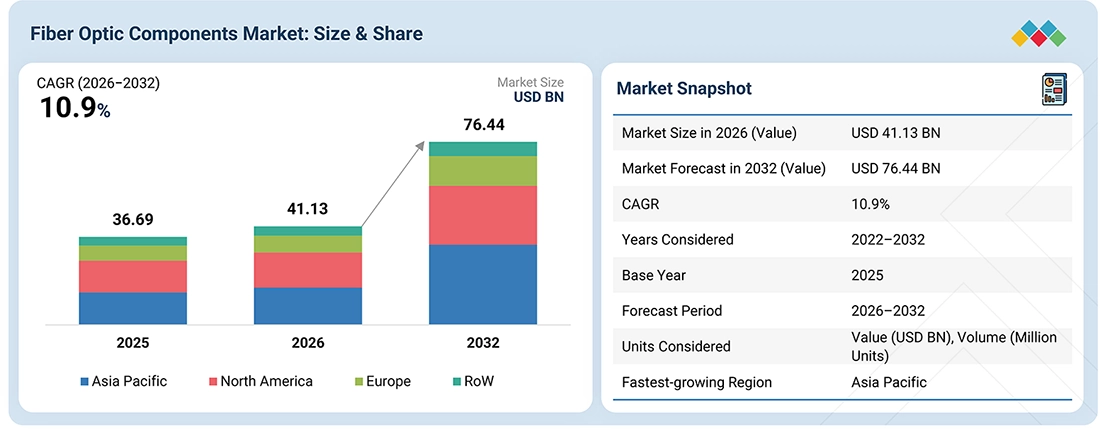
Source: Secondary Research, Interviews with Experts, MarketsandMarkets Analysis
The fiber optic components market is projected to reach USD 76.44 billion by 2032 from USD 41.13 billion in 2026, at a CAGR of 10.9%. The market is witnessing steady growth due to the increasing demand for high-bandwidth, low-latency, and reliable optical connectivity across telecommunications, data centers, enterprise networks, distributed sensing, analytical & medical equipment, and lighting applications. The expansion of fiber-optic networks to support rising data traffic, 5G deployments, cloud computing, data center infrastructure, and high-speed broadband connectivity is driving demand for fiber optic components, including transceivers, active optical cables, cables, amplifiers, splitters, connectors, and circulators. In addition, advancements in high-speed optical transceivers, optical amplification, fiber connectivity, and sensing technologies are improving transmission capacity, signal quality, network efficiency, and connectivity, thereby supporting the growth of the market.
KEY TAKEAWAYS
-
By RegionAsia Pacific is expected to lead the fiber optic components market, accounting for a share of ~37.9% in 2026.
-
By Product TypeBy product type, the transceivers segment is expected to account for the largest share.
-
By Data RateBy data rate, the 41 Gbps to 100 Gbps rate is expected to record the highest CAGR of ~12.8% during the forecast period.
-
By ApplicationBy application, the communications segment is expected to account for the largest share.
-
COMPETITIVE LANDSCAPE (KEY PLAYERS)Coherent Corporation, Lumentum Holdings Inc. (Oclaro), Broadcom Inc., Sumitomo Electric Industries, Ltd., and Accelink Technologies Co., Ltd. are identified as key players in the fiber optic components market based on their product offerings, optical technology capabilities, research and development activities, manufacturing capabilities, and presence across telecommunications, data centers, enterprise networks, distributed sensing, and other applications.
-
COMPETITIVE LANDSCAPE (STARTUPS/SMES)CommScope, Hexatronic, O-Net Technologies, Smiths Interconnect, Source Photonics, Fiber Mountain, Amphenol Corporation, TE Connectivity, Fiber Optic Communications, Inc., MW Technologies, LDA, Glenair, Souriau, and Japan Aviation Electronics Industry, Ltd., among others, offer fiber optic components, optical connectivity products, and related solutions for applications including telecommunications, data centers, enterprise networks, distributed sensing, analytical & medical equipment, and lighting. These companies focus on optical connectivity, high-speed transmission, fiber management, sensing, and specialized component solutions to address the evolving requirements of optical networks and end-use applications.
The fiber optic components market is expected to grow steadily as telecommunications providers, data center operators, enterprises, and other end users expand fiber-optic infrastructure to support increasing data traffic and demand for high-speed, reliable connectivity. Market growth is supported by the increasing deployment of broadband and 5G networks, expansion of data centers and cloud infrastructure, and growing adoption of optical technologies for distributed sensing and specialized applications. These factors are driving demand for fiber optic components, including cables, active optical cables (AOCs), amplifiers, splitters, connectors, circulators, and transceivers across communication and other applications. Product innovations and strategic developments by key players such as Coherent Corporation, Lumentum Holdings Inc., Broadcom Inc., Sumitomo Electric Industries, and Accelink Technologies are supporting market development. These developments focus on increasing transmission speeds, improving optical performance, enhancing network capacity and reliability, and supporting high-density and next-generation optical connectivity.
TRENDS & DISRUPTIONS IMPACTING CUSTOMERS' CUSTOMERS
Growing demand for high-speed connectivity, increasing data-center capacity, expanding fiber-optic networks, and the adoption of fiber-based sensing and lighting solutions are driving the development of advanced fiber-optic components. Higher-speed transceivers, 400G/800G and beyond, high-density interconnects, WDM components, active optical cables, and fiber optic sensing solutions are expanding applications across telecommunications, data centers, enterprises, analytical and medical equipment, distributed sensing, and lighting. These developments are helping customers achieve higher bandwidth, lower signal loss, faster data transmission, reliable sensing, and improved optical performance. As customers increasingly focus on network capacity, transmission reliability, power efficiency, compact designs, and ease of integration, manufacturers are developing more integrated, high-performance, and application-specific fiber optic components. This shift is creating new revenue opportunities and supporting broader adoption of fiber optic components across communication, sensing, medical, analytical, and lighting applications.
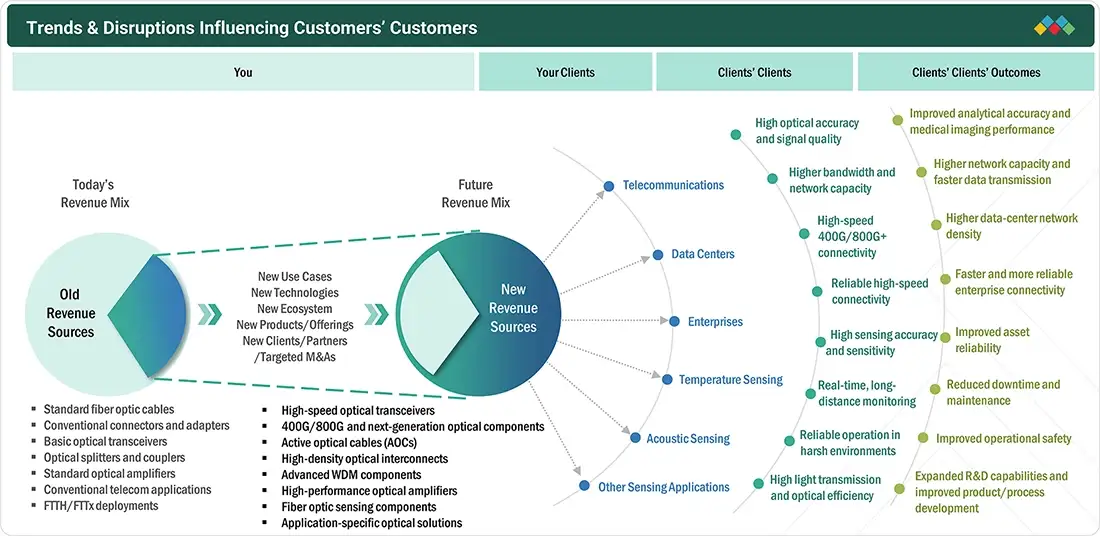
Source: Secondary Research, Interviews with Experts, MarketsandMarkets Analysis
MARKET DYNAMICS

Level
-
Increasing deployment of data centers

-
Growing internet penetration and data traffic


Level
-
Prone to physical damage and transmission loss


Level
-
Increasing adoption of fiber optic components in digital signage

-
Rising demand for fiber optics due to reliability


Level
-
Threat to optical network security

-
High cost of installation and difficulty in installing in different terrains

Source: Secondary Research, Interviews with Experts, MarketsandMarkets Analysis
Driver: Increasing deployment of data centers
The growing deployment of hyperscale, colocation, and enterprise data centers is driving demand for high-speed, high-bandwidth optical connectivity. The growth of cloud computing, artificial intelligence, high-performance computing, and data-intensive applications is increasing the need for high-speed transceivers, active optical cables, connectors, and other fiber optic components for data transmission between servers, switches, storage systems, and network equipment. The shift toward higher data rates further supports demand for advanced optical components.
Restraint: Prone to physical damage and transmission loss
Installing and maintaining fiber-optic networks can be costly, requiring specialized equipment, skilled personnel, fiber termination, splicing, testing, and network upgrades. In addition, components such as cables, connectors, splitters, and other optical infrastructure require proper installation and handling to maintain signal quality and minimize attenuation. These costs can limit the adoption of fiber-optic infrastructure in cost-sensitive applications and markets.
Opportunity: Increasing adoption of fiber optic components in digital signage
The increasing demand for higher data rates across data centers, telecommunications networks, enterprise networks, and broadband infrastructure is creating opportunities for advanced fiber optic components. The shift to 400G, 800G, and higher-speed optical connectivity is driving demand for high-performance transceivers, active optical cables, amplifiers, connectors, and related components. Continued network upgrades and the expansion of high-capacity optical infrastructure are expected to create opportunities for component manufacturers.
Challenge: Threat to optical network security
The increasing complexity of optical networks is creating challenges for component manufacturers and network operators. Modern networks require higher transmission speeds, greater port density, improved power efficiency, interoperability, and reliable performance across different network architectures. Integrating high-speed transceivers, cables, connectors, amplifiers, splitters, and other components while maintaining compatibility and signal integrity can increase design, testing, deployment, and maintenance requirements.
FIBER OPTIC COMPONENTS MARKET SIZE, SHARE AND TRENDS, 2026 TO 2032: COMMERCIAL USE CASES ACROSS INDUSTRIES
| COMPANY | USE CASE DESCRIPTION | BENEFITS |
|---|---|---|
 |
Coherent provides optical components and modules used in telecommunications and data center networks. Its products support high-speed optical transmission, optical amplification, and network connectivity. | Supports high-speed data transmission | Enables optical network connectivity | Supports increasing bandwidth requirements | Helps improve transmission performance |
 |
Lumentum provides optical components and modules used in telecommunications and data center applications. Its portfolio supports optical transmission, amplification, and high-speed network connectivity. | Supports high-capacity optical communication | Enables reliable signal transmission over fiber networks | Supports data center and telecom infrastructure | Helps meet increasing data-rate requirements |
 |
Broadcom provides optical connectivity products, including high-speed optical transceivers, used primarily in data center and networking applications. These products enable data transmission between switches, servers, and other network equipment. | Enables high-speed server-to-switch connectivity | Supports higher network bandwidth | Helps address data center connectivity requirements | Supports high-density network deployments |
 |
Sumitomo Electric provides fiber-optic cables, optical devices, transceivers, and related components used in telecommunications, data centers, and other optical communication networks. | Supports fiber-optic network deployment | Enables high-speed and reliable data transmission | Supports telecommunications and data center connectivity | Provides components for different network configurations |
 |
Accelink provides optical modules, transceivers, amplifiers, and other optical components used in telecommunications and data center networks. Its products support signal transmission and connectivity across optical communication infrastructure. | Supports high-speed optical transmission | Enables network connectivity and capacity expansion | Supports telecom and data center applications | Helps meet increasing optical network performance requirements |
Logos and trademarks shown above are the property of their respective owners. Their use here is for informational and illustrative purposes only.
MARKET ECOSYSTEM
The fiber optic components ecosystem comprises fiber optic component manufacturers, integrators, and end users. Fiber optic component manufacturers provide products such as cables, active optical cables, amplifiers, splitters, connectors, circulators, and transceivers, while integrators incorporate these components into optical communication and networking systems. Key participants include Coherent Corporation, Broadcom Inc., Lumentum Holdings Inc., Sumitomo Electric Industries, Ltd., Accelink Technologies Co., Ltd., Furukawa Electric Co., Ltd., TE Connectivity, and Fujitsu Optical Component Ltd., along with integrators such as Ciena Corporation, Huawei Technologies, ZTE Corporation, and Cisco Systems, and end users such as AT&T, Verizon, Vodafone, China Telecom, Amazon Web Services (AWS), and Orange. These companies deploy and use fiber optic components across telecommunications, data centers, enterprise networks, broadband infrastructure, and other high-bandwidth communication applications.
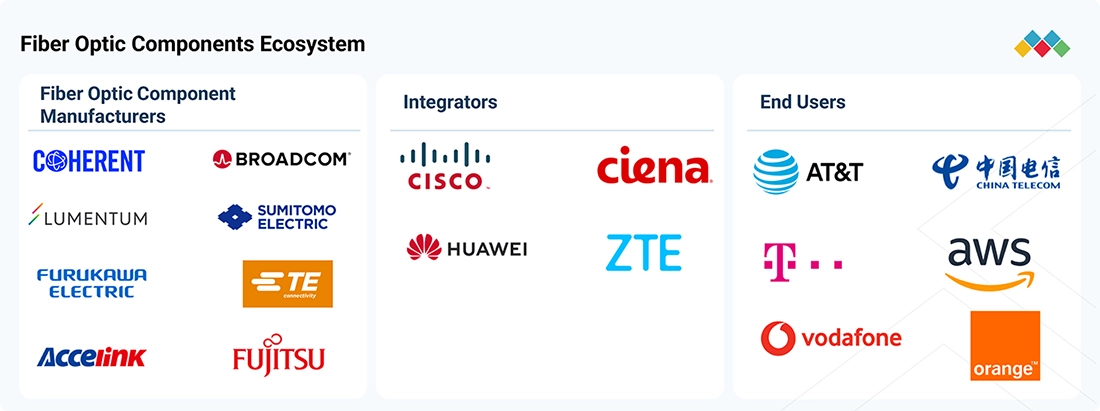
Logos and trademarks shown above are the property of their respective owners. Their use here is for informational and illustrative purposes only.
MARKET SEGMENTS
Source: Secondary Research, Interviews with Experts, MarketsandMarkets Analysis
Fiber Optic Components Market, By Region
Asia Pacific is expected to lead the fiber optic components market, driven by the large-scale expansion of telecom and broadband networks, growing data center capacity, and increasing demand for high-speed internet connectivity. The deployment of 5G networks, fiber-to-the-home (FTTH), cloud infrastructure, and enterprise networks is increasing the need for cables, connectors, splitters, transceivers, and other optical components. In addition, continued investments in digital infrastructure across China, India, Japan, South Korea, and Southeast Asia are supporting the expansion of fiber-optic networks.
Fiber Optic Components Market, By Product Type
By product type, the transceivers segment is expected to account for the largest share of the market during the forecast period, as transceivers are essential for converting electrical and optical signals and enabling data transmission between network equipment. Growing deployment of data centers, telecom networks, and high-speed switches is increasing demand for higher-capacity transceivers. The shift toward 100G, 400G, 800G, and higher-speed connections is also encouraging network operators and data center companies to upgrade existing optical modules.
Fiber Optic Components Market, By Data Rate
By data rate, the 41 Gbps to 100 Gbps segment is expected to record the highest growth during the forecast period, driven by increasing demand for higher-capacity connectivity across telecommunications networks, data centers, and enterprise networks. The segment is benefiting from continued upgrades from lower-speed connections to 40G, 100G, and related optical links to accommodate growing data traffic. Increasing cloud adoption, data center interconnect needs, 5G network deployment, and enterprise bandwidth demands further support the adoption of optical components operating in this data-rate range.
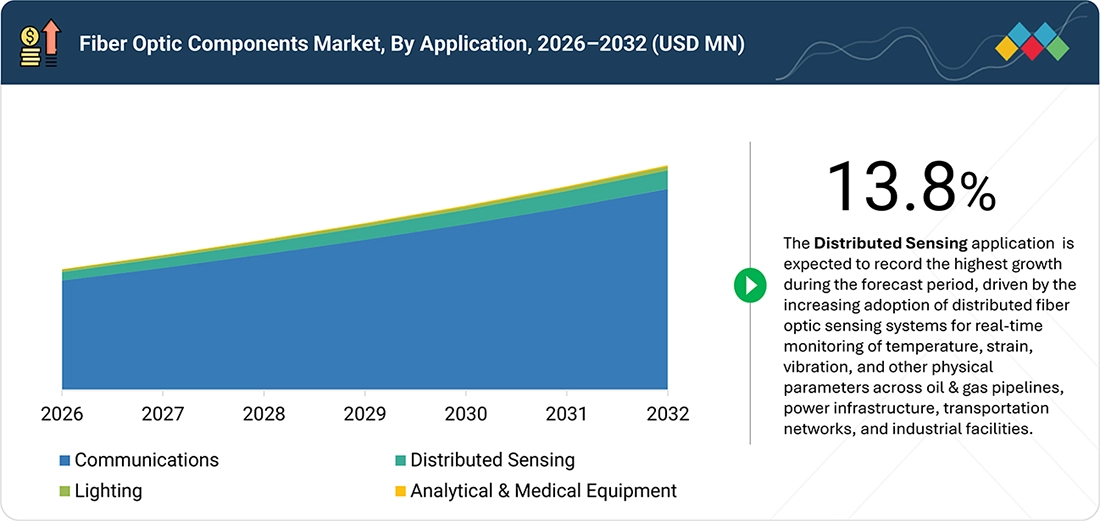
Fiber Optic Components Market, By Application
By application, the communications segment is expected to account for the largest share of the market during the forecast period, driven by the widespread deployment of fiber-optic infrastructure across telecommunications, data centers, and enterprise networks. Increasing internet usage, video traffic, cloud services, 5G deployment, and digitalization are driving network operators to expand and upgrade fiber infrastructure. In the communications segment, data centers are driving strong demand for high-speed transceivers, active optical cables, connectors, and other components to support high-density server and switch connectivity. Telecommunications operators are also expanding fiber networks to support broadband, 5G backhaul, and increasing network capacity requirements.
REGION
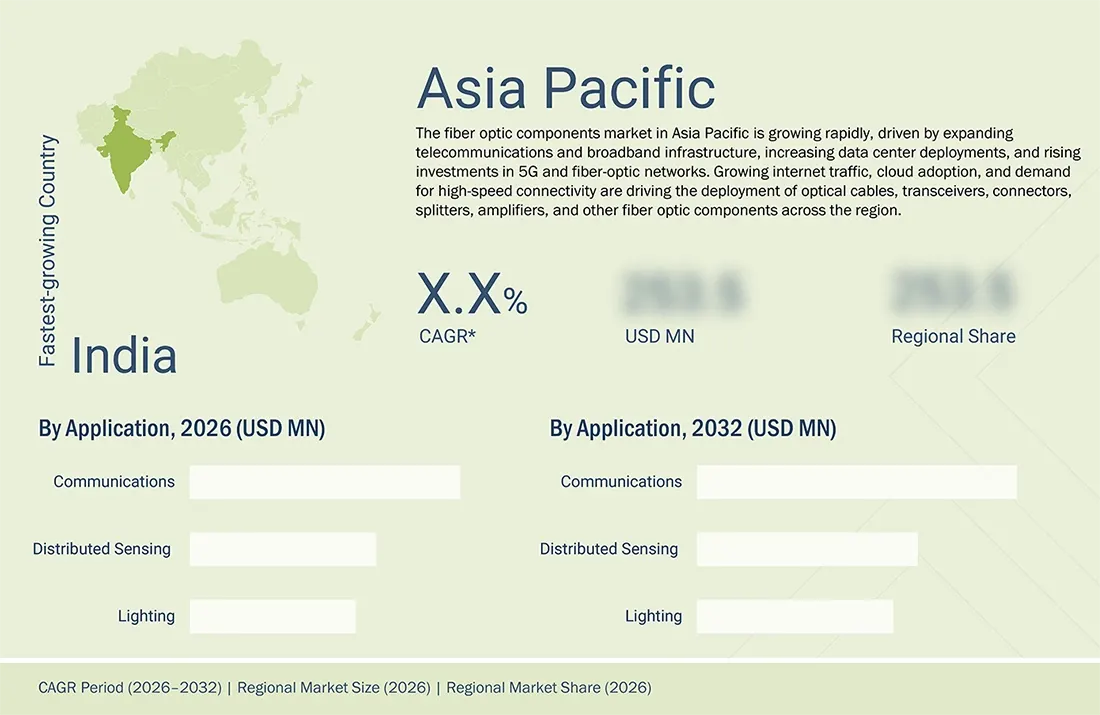
Asia Pacific to be the fastest-growing region in the fiber optic components market during the forecast period
Asia Pacific is expected to be the fastest-growing region in the fiber optic components market, driven by the expansion of telecommunications and broadband networks, increasing data center deployments, and growing demand for high-speed connectivity. Rising investments in 5G infrastructure, fiber-to-the-home (FTTH), cloud infrastructure, and enterprise networks are increasing demand for optical cables, transceivers, connectors, splitters, amplifiers, and other fiber optic components. China, Japan, South Korea, and India are contributing to regional growth through investments in 5G networks, data centers, broadband infrastructure, and digital connectivity. In addition, increasing internet usage, cloud adoption, and data traffic are encouraging telecom operators and data center companies to expand and upgrade fiber-optic infrastructure, further supporting the demand for fiber optic components across the region.
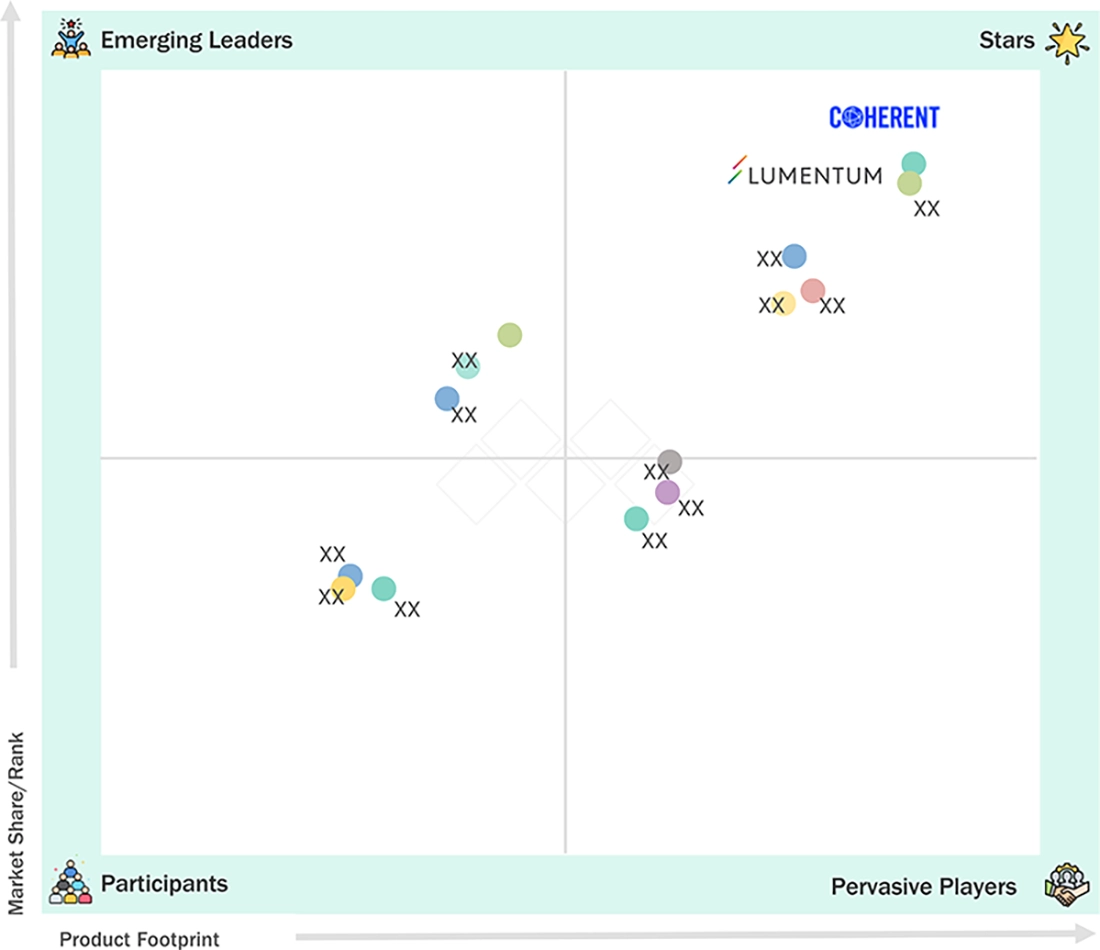
FIBER OPTIC COMPONENTS MARKET SIZE, SHARE AND TRENDS, 2026 TO 2032: COMPANY EVALUATION MATRIX
In the fiber optic components market matrix, Coherent (Star) holds a leading position in the fiber optic components market, supported by its broad portfolio of optical transceivers, photodetectors, receivers, passive components, pump lasers, optoelectronic devices, and integrated subassemblies for telecom and datacom applications. Its solutions support data centers, metro and long-haul networks, 5G, and high-speed optical communications, strengthening its presence across key fiber optic connectivity applications. Lumentum (Star) holds a leading position in the fiber optic components market, supported by its broad portfolio of optical transceivers, tunable lasers, modulators, photonic components, pump lasers, optical amplifiers, and wavelength-management solutions. Its products serve telecom, datacom, data center, access, metro, long-haul, and submarine networks, enabling high-capacity, scalable optical communications.
Source: Secondary Research, Interviews with Experts, MarketsandMarkets Analysis
KEY MARKET PLAYERS
- Coherent Corporation (US)
- Lumentum Holdings Inc. (US)
- Broadcom Inc. (US)
- Sumitomo Electric Industries, Ltd. (Japan)
- Accelink Technologies Co., Ltd. (China)
- Furukawa Electric Co., Ltd. (Japan)
- Fujitsu Optical Component Ltd. (Japan)
- CommScope (US)
- Source Photonics (US)
- O-Net Technologies (China)
MARKET SCOPE
| REPORT METRIC | DETAILS |
|---|---|
| Market Size in 2025 (Value) | USD 36.69 Billion |
| Market Size in 2026 (Value) | USD 41.13 Billion |
| Market Forecast in 2032 (Value) | USD 76.44 Billion |
| Growth Rate | 10.90% |
| Years Considered | 2022–2032 |
| Base Year | 2025 |
| Forecast Period | 2026–2032 |
| Units Considered | Value (USD Billion), Volume (Million Units) |
| Report Coverage | Revenue Forecast, Company Ranking, Competitive Landscape, Growth Factors, and Trends |
| Segments Covered |
|
| Regions Covered | North America, Europe, Asia Pacific, RoW |
WHAT IS IN IT FOR YOU: FIBER OPTIC COMPONENTS MARKET SIZE, SHARE AND TRENDS, 2026 TO 2032 REPORT CONTENT GUIDE
DELIVERED CUSTOMIZATIONS
We have successfully delivered the following deep-dive customizations:
| CLIENT REQUEST | CUSTOMIZATION DELIVERED | VALUE ADDS |
|---|---|---|
| Fiber Optic Component Manufacturer | Mapping and benchmarking fiber optic components based on product type, data rate, optical performance, compatibility, and application requirements. | Helps identify product gaps, technology opportunities, and areas for portfolio expansion and product development. |
| Optical Component and Module Supplier | Benchmarking cables, active optical cables, amplifiers, splitters, connectors, circulators, and transceivers based on specifications, data rates, applications, and network requirements. | Supports identification of technology gaps and helps align product development with evolving network requirements. |
| Telecom Operator/Data Center Operator | Assessing fiber-optic component requirements for telecommunications, data centers, enterprise networks, distributed sensing, and other applications. | Supports component selection, network upgrade planning, and identification of opportunities to improve network capacity and connectivity. |
| Enterprise/Network Infrastructure Provider | Evaluating suppliers based on product performance, data-rate capabilities, interoperability, customization, pricing, and technical support. | Supports informed supplier selection and procurement decisions for fiber-optic network infrastructure. |
| Enterprise/Original Equipment Manufacturer/System Developer | Benchmarking leading companies across regions, product types, data rates, applications, technologies, and manufacturing capabilities. | Helps validate market opportunities and identify potential investment, partnership, and product development areas. |
RECENT DEVELOPMENTS
- March 2026 : Coherent demonstrated next-generation pluggable optical technologies at OFC 2026, including 1.6T and 3.2T transceivers designed to support the growing bandwidth and connectivity requirements of AI-driven data center networks.
- March 2026 : Broadcom introduced a 400G/lane optical DSP for 1.6T transceivers at OFC 2026, supporting higher-speed optical connectivity and the growing bandwidth requirements of next-generation AI and hyperscale data center networks.
- March 2026 : Lumentum demonstrated a 1.6T DR4 OSFP pluggable transceiver prototype using four 400G differential EML lasers, targeting high-bandwidth optical interconnects for hyperscale AI data centers and next-generation network architectures.
- March 2026 : Sumitomo Electric announced a collaboration with AFL, Corning, and TeraHop to develop a four-core multicore fiber specification aimed at increasing optical transmission capacity and supporting short-reach connectivity requirements in AI data centers.
- September 2026 : Sumitomo Electric, together with AFL, Corning, and TeraHop, announced the completion of the SDM4 Multicore Fiber MSA and release of Version 1.0 of its technical specification, supporting the development of higher-capacity optical links for AI data centers and other short-reach applications.
Table of Contents
 Exclusive indicates content/data unique to MarketsandMarkets and not available with any competitors.
Methodology
The study involved four major activities in estimating the current size of the fiber optic components market. The team conducted extensive secondary research to gather information on the market, adjacent industries, and the broader optical communications, telecommunications, data center, cloud infrastructure, broadband, 5G, and fiber-optic networking ecosystem. This was followed by primary research with industry stakeholders across the value chain, including fiber optic component manufacturers, optical module and transceiver suppliers, fiber and cable manufacturers, optical network equipment providers, distributors, system integrators, telecom operators, data center operators, and end users across telecommunications, data centers, enterprises, distributed sensing, analytical & medical equipment, and lighting applications, to validate assumptions and market sizing. Both top-down and bottom-up approaches were used to estimate the overall market size. Market breakdowns and data triangulation techniques were then applied to derive the size of individual segments and subsegments. Secondary and primary sources were jointly used to support a comprehensive technical and commercial analysis of the fiber optic components market.
Secondary Research
Various secondary sources were referred to during the secondary research process to identify and collect information relevant to the fiber optic components market. These sources included annual reports, press releases, investor presentations of key companies, product catalogs, technical datasheets, white papers, industry journals, certified publications, patents, industry associations, company websites, trade directories, government databases, and optical communications, telecommunications, data center, and fiber-optic industry sources. Secondary research was conducted to obtain key insights into the market's supply chain, value chain, competitive landscape, and segmentation across product type, data rate, application, and region. It also helped analyze industry trends and the adoption of fiber optic cables, active optical cables, amplifiers, splitters, connectors, circulators, and transceivers across telecommunications, data centers, enterprises, distributed sensing, analytical & medical equipment, and lighting applications. The collected data was further analyzed to estimate the overall market size and validate findings, which were subsequently refined through primary research with industry experts and key stakeholders.
Primary Research
Extensive primary research was conducted after gaining knowledge about the current scenario of the fiber optic components market through secondary research. Several primary interviews were conducted with experts from the demand and supply sides across four major regions: North America, Europe, Asia Pacific, and RoW. This primary data was collected through questionnaires, emails, and telephonic interviews.
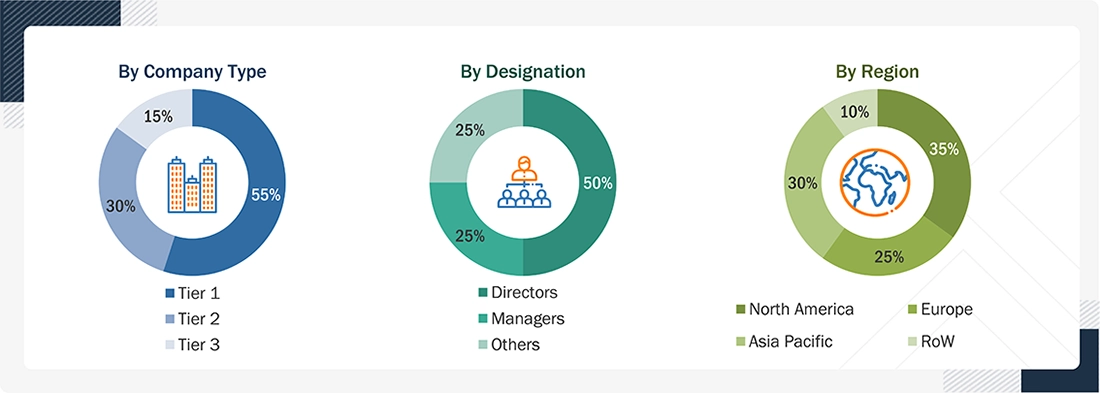
Note: The three tiers of companies are defined based on their total revenue in 2025: Tier 1 - revenue greater than or equal to USD 1 billion; Tier 2 - revenue between USD 100 million and USD 1 billion; and Tier 3 - revenue less than or equal to USD 100 million. Other designations include sales managers, marketing managers, and product managers.
To know about the assumptions considered for the study, download the pdf brochure
Market Size Estimation
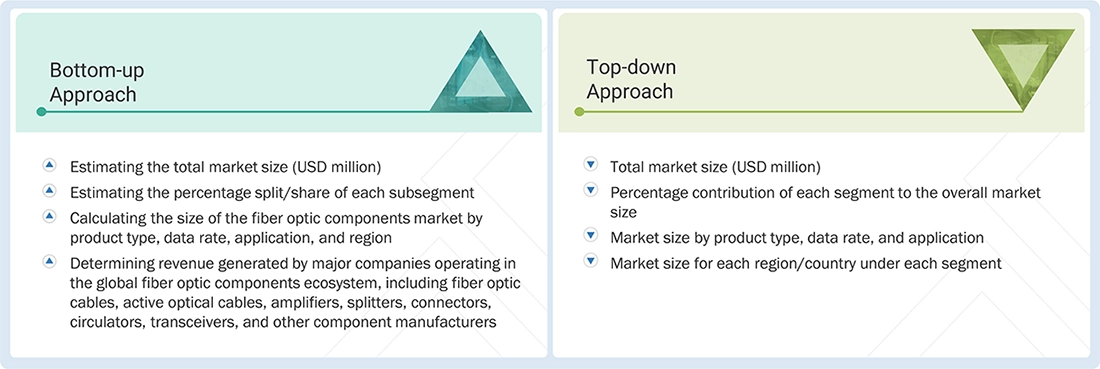
- Both top-down and bottom-up approaches were used to estimate and validate the total size of the fiber optic components market. These methods have also been used extensively to estimate the size of various subsegments in the market. The following research methodology was used to estimate the market size:
- Major players in the fiber optic components industry and related markets were identified through extensive secondary research.
- The industry's value chain and market size (in terms of value) were determined through primary and secondary research processes.
- All percentage shares, splits, and segment-level breakdowns across product type, data rate, application, and region were determined using secondary sources and verified through primary sources.
The market size estimation methodology is as follows:
Data Triangulation
After determining the overall size of the fiber optic components market using the market size estimation process explained above, the total market was split into several segments and subsegments. Data triangulation and market breakdown procedures were employed, where applicable, to complete the overall market engineering process and derive statistics for all market segments and subsegments. The data was triangulated by studying various factors and trends from both the demand and supply sides, including product type, data rate, application, and regional developments. The market size was also validated using both top-down and bottom-up approaches.
Market Definition
Fiber optic components are optical communication components used to transmit, receive, route, connect, split, amplify, and manage optical signals in fiber-optic networks. These components include fiber optic cables, active optical cables, amplifiers, splitters, connectors, circulators, transceivers, and other optical components that support high-speed, high-capacity data transmission. Fiber optic components are deployed across telecommunications, data centers, enterprise networks, distributed sensing, analytical & medical equipment, and lighting applications.
Fiber optic components are particularly important for applications that require high bandwidth, low latency, reliable connectivity, and long-distance data transmission. They support network deployment, capacity expansion, data center interconnects, FTTH, 5G backhaul, enterprise connectivity, and other optical communication requirements. A typical fiber-optic network may incorporate multiple components, including optical cables for signal transmission, transceivers for electrical-to-optical and optical-to-electrical signal conversion, connectors for physical fiber connections, splitters for distributing optical signals, and amplifiers for maintaining signal strength over longer distances. The configuration and combination of fiber optic components vary by application, data rate, network architecture, transmission distance, and performance requirements.
Key Stakeholders
- Raw material suppliers
- Component manufacturers
- System integrators
- Suppliers and distributors
- Market research and consulting firms
- Associations, organizations, forums, and alliances related to the fiber optic components industry
- Technology investors
- Governments and financial institutions
- Venture capitalists, private equity firms, and startups
- End users
Report Objectives
- To define, describe, and forecast the fiber optic components market in terms of value based on type, data rate, application, and region
- To define, describe, segment, and forecast the overall fiber optic components market in terms of volume based on type
- To forecast the market size, in terms of value, in four major regions: North America, Europe, Asia Pacific, and the Rest of the World
- To provide detailed information regarding the major factors influencing the growth of the fiber optic components market (drivers, restraints, opportunities, and challenges)
- To analyze the micromarkets for individual growth trends, prospects, and contributions to the total market
- To provide a detailed overview of the value chain of the fiber optic components market
- To analyze the opportunities for various stakeholders by identifying the high-growth segments of the market
- To profile the key players and comprehensively analyze their market positions in terms of ranking and core competencies, along with detailing the competitive landscape of the market
- To analyze competitive developments, such as product launches and developments, partnerships, acquisitions, contracts, expansions, and R&D in the fiber optic components market
Available customizations:
With the given market data, MarketsandMarkets offers customizations according to the company’s specific needs. The following customization options are available for the report:
Company Information:
- Detailed analysis and profiling of additional market players (up to 5)
Key Questions Addressed by the Report
What is the current size of the Fiber Optic Components Market?
The global Fiber Optic Components Market was valued at approximately USD 41.13 billion in 2026 and is projected to reach USD 76.44 billion by 2032.
What is the projected market value of the Fiber Optic Components Market by 2032?
The market is expected to grow to USD 76.44 billion by 2032, driven by increasing demand for high-speed connectivity, cloud computing, and 5G infrastructure.
What is the CAGR of the Fiber Optic Components Market during the forecast period?
The market is forecast to grow at a CAGR of 10.9% between 2026 and 2032.
What are the major growth drivers of the Fiber Optic Components Market?
Key growth drivers include rising internet traffic, expansion of 5G networks, increasing data center deployments, cloud computing adoption, AI workloads, and growing demand for high-bandwidth communication systems.
Which component segment holds the largest share of the market?
The transceivers segment accounted for nearly half of the market in 2024 due to growing demand for 100G, 200G, 400G, and 800G optical transmission technologies.
Which region dominates the Fiber Optic Components Market?
North America held the largest market share of 36.6% in 2024, supported by strong investments in cloud infrastructure, hyperscale data centers, and telecom networks.
Which region is expected to grow the fastest during the forecast period?
Asia Pacific is expected to register the highest growth rate due to expanding telecom infrastructure, rapid 5G deployment, and increasing investments in data centers across countries such as China, India, Japan, and South Korea.
Which application segment generates the highest demand for fiber optic components?
The communications application segment accounted for approximately 90.9% of the market share in 2024, driven by telecom network expansion and broadband connectivity requirements.
Who are the leading companies operating in the Fiber Optic Components Market?
Major market participants include Coherent Corp, Lumentum Operations LLC, Broadcom, Sumitomo Electric Industries, and Accelink Technology.
What opportunities are highlighted in the Fiber Optic Components Market report?
The report identifies opportunities arising from telecom infrastructure expansion in developing economies, increasing adoption of AI-enabled data centers, deployment of advanced optical transceivers, and growing demand for distributed sensing applications


Personalize This Research
- Triangulate with your Own Data
- Get Data as per your Format and Definition
- Gain a Deeper Dive on a Specific Application, Geography, Customer or Competitor
- Any level of Personalization
Let Us Help You
- What are the Known and Unknown Adjacencies Impacting the Fiber Optic Components Market
- What will your New Revenue Sources be?
- Who will be your Top Customer; what will make them switch?
- Defend your Market Share or Win Competitors
- Get a Scorecard for Target Partners

Custom Market Research Services
We Will Customise The Research For You, In Case The Report Listed Above Does Not Meet With Your Requirements
Get 10% Free CustomisationTESTIMONIALS

Tetsuya Ohhira
Business Development Manager-Technology Business
Nikon Corporation,
Leading Japanese MNC specializing in optics and imaging productswww.nikon.com
MarketsandMarkets™ response
is quick. Their attitude is flexible and positive. Analyst Insights are globally considered and
significant. Client Services quickly respond to our inquiry and demand. Their wide range of global
surveys help us make our strategic plan.
We hope Knowledge Store will be easier to search
for a report.
VP - Marketing & Business Development
Leading Provider of Process Control Solutions
We engaged with MarketsandMarkets on a study to perform an analysis and recommend a Go-To-Market strategy for metrology and process control in the semiconductor market. The study was tailored to our targets and needs with well-defined milestones. Our overall experience with the MarketsandMarkets team was very good throughout the project in all aspects including the analysis methodologies used, the quality and depth of primary and secondary data sets, the professionalism and flexibility of the team and the ability to meet the target schedule and milestones. We want to thank MarketsandMarkets team for a job well done.
Growth opportunities and latent adjacency in Fiber Optic Components Market



Glen
Apr, 2026
Does this report clearly define the fiber optic components market scope relevant to my business?.
Carl
Apr, 2026
How is AI influencing fiber optic network demand and optimization?.
Mary
Aug, 2019
We are a connector company and fiber optics is one of the fastest growing of connector types. This is in support of our market expansion and growth and innovation strategy development..
miguel
Feb, 2018
We need executive summary of Fiber Optic Components Market by Component (Transceivers, AOCs, Cables, Amplifiers, Splitters, Connectors, Circulators), Data Rate (10G, 40G, 100G, above 500G), Application (Communications, Distributed Sensing) - Global Forecast to 2023..
Jennifer
Apr, 2019
I am looking for information on the growth of the DWDM market. Your report was the closest I could find. I would like to receive the full report..
stephen
May, 2019
I am assisting a Japanese Fiber Optic company to enter the USA market and am looking for resources to assist..