
Mexico 3D Motion Capture System Market (2024-2029)

The Mexico 3D Motion Capture System Market was valued at $1.7 Million in 2024 and projected to reach to $2.3 Million by 2029, representing a compound annual growth rate of 6.2%. Mexico's 3D motion capture system market is positioned for gradual expansion as awareness of the technology grows within the entertainment, gaming, and sports sectors.


| Market Size in | USD 26.32 MN |
| Market Forecast in | |
| CAGR | |
| Forecast Period | |
| Units Considered | Value (USD MN) |
Mexico 3D Motion Capture System Market Trends and Insights
- Mexico's adoption of motion capture technology remains modest compared to global markets, driven primarily by emerging applications in entertainment, gaming, and sports analytics.
- The market in Mexico reflects growing interest from content creators and production studios seeking advanced digital solutions, though infrastructure and investment levels remain below North American peers. During the 2024-2029 forecast period, Mexico is expected to experience steady but measured expansion in 3D motion capture adoption.
- Mexico's growth trajectory is supported by increasing digitalization in media production and rising demand for virtual content creation.
- However, Mexico faces challenges including limited local manufacturing capacity, higher equipment costs relative to regional purchasing power, and competition from alternative technologies.
- Despite these constraints, Mexico represents an emerging opportunity within the North American region for vendors targeting Latin American expansion..
Key Market Statistics
- CAGR (2024-2029) 6.2% CAGR
- Market Size, 2024 ~USD 1.7 Million
- Forecast, 2029 ~USD 2.3 Million
- Country Mexico
Mexico 3D Motion Capture System Market Overview
Market Size & Growth :
Mexico's 3D motion capture system market is valued at USD 1.7 million in 2024, with projected growth to USD 2.3 million by 2029, reflecting a steady CAGR of 6.2% over the forecast period.
Emerging Application Sectors :
Entertainment, gaming, and sports analytics are driving adoption in Mexico. These sectors are increasingly leveraging motion capture technology for content creation, athlete performance analysis, and immersive gaming experiences.
Growth Lag vs. Global Markets :
Mexico's motion capture adoption remains modest compared to global benchmarks, with the country's CAGR of 6.2% significantly trailing the global CAGR of 15%, indicating substantial untapped market potential.
Regional Market Positioning :
As a developing market for motion capture technology, Mexico presents opportunities for market expansion through increased awareness, infrastructure development, and localized solutions tailored to regional entertainment and sports industries.
Mexico 3D Motion Capture System Market Dynamics
- The modest current adoption rate suggests significant room for market penetration, particularly as production companies and sports organizations increasingly invest in advanced analytics and content creation capabilities.
- Local gaming studios and entertainment producers are beginning to recognize the competitive advantages of motion capture technology. Over the next five years, Mexico's market growth will be supported by rising digital content consumption, growing esports interest, and increased investment in sports performance analysis.
- However, challenges such as high initial capital requirements, limited local expertise, and competition from international service providers may moderate growth rates.
- Strategic partnerships with global technology providers and government support for creative industries could accelerate market development and help Mexico capture a larger share of regional motion capture demand..
Market Ecosystem
Related Ecosystem
Industrial Automation
- Sensors
- Image Sensors
- Manufacturing Execution System (MES)
- Actuators
- Flow Sensors
- Siemens ag
- ABB India Limited
- Emerson Electric Co.
- HONEYWELL INTERNATIONAL INC.
- SCHNEIDER ELECTRIC SE
Augmented Virtual Reality
- Sensors
- Virtual Reality Devices
- Augmented Reality
- Virtual Reality
- Augmented Reality Devices
- MICROSOFT CORPORATION
- Lenovo
- VIVITEK CORPORATION
- Apple Inc.
Key Takeaways
- Mexico's 3D motion capture market valued at USD 1.7 million in 2024, growing to USD 2.3 million by 2029 at 6.2% CAGR.
- Mexico's market growth is driven by increasing adoption in entertainment, gaming, and sports analytics sectors.
- Mexico faces infrastructure and cost barriers that limit faster market penetration compared to developed North American markets.
- Mexico represents a strategic emerging market opportunity for vendors pursuing Latin American regional expansion strategies.
3D Motion Capture System Market Report Scope
| Report Metric | Details |
|---|---|
| Base Year | 2024 |
| Fastest Growing Segment | VIRTUAL REALITY (End-Use Industry) |
| Forecast Period | 2024-2029 |
| Growth Rate | CAGR of 15% from 2024 to 2029 |
| Largest Segment | HARDWARE (Offering) |
| Market Size Base Year (Billions) | ~USD 0.24 (2024) |
| Revenue Forecast (Billions) | ~USD 0.48 (2029) |
| Segments Covered | Offering, Type, Technology, Component, End-Use Industry |
Mexico 3D Motion Capture System Market Report Segmentation
5 segment dimensions are covered across the global market.
By Offering
- Hardware
- Services
- Software
By Type
- Accessories
- Cameras
- Communication Devices
- Sensors
By Technology
- Non-Optical Systems
- Optical Systems
By Component
- Hardware
- Services
- Software
By End-Use Industry
- Education
- Healthcare
- Industrial/Robotics
- Media & Entertainment
- Sports
- Virtual Reality
Target Audience
- Motion Capture Technology Vendors : Suppliers and manufacturers need Mexico-specific market data to assess expansion opportunities, identify customer segments, and develop localized pricing and support strategies for the underserved Mexican market.
- Entertainment & Gaming Studios : Mexican production companies and game developers require market insights to justify motion capture investments, benchmark against competitors, and understand technology adoption trends within their regional industry.
- Sports Analytics Organizations : Sports teams, leagues, and performance analysis firms need data on motion capture adoption in Mexico to evaluate technology implementation feasibility and competitive positioning within the growing sports tech sector.
- Investment & Private Equity Firms : Investors evaluating opportunities in Mexico's digital media and entertainment sectors need comprehensive market analysis to assess growth potential, competitive dynamics, and return prospects in motion capture technology.
- Government & Economic Development Agencies : Mexican economic development organizations and creative industry bodies need market intelligence to support policy decisions, incentive programs, and infrastructure investments in digital content and entertainment technology sectors.
Reasons to Buy this Report
- Identify Growth Opportunities : Understand Mexico's emerging motion capture market dynamics and pinpoint high-potential sectors including gaming, entertainment production, and sports analytics where early market entry can establish competitive advantages.
- Competitive Market Intelligence : Gain insights into Mexico's market positioning relative to global trends, with detailed analysis of why adoption lags behind international benchmarks and where localized strategies can drive faster penetration.
- Investment & Expansion Planning : Access comprehensive market sizing and five-year forecasts to support strategic investment decisions, partnership development, and market entry strategies specific to Mexico's entertainment and sports sectors.
- Sector-Specific Insights : Obtain detailed understanding of application trends across Mexico's gaming studios, entertainment producers, and sports organizations to tailor product offerings and marketing approaches to regional demand drivers.
- Risk & Opportunity Assessment : Evaluate market barriers including capital requirements, local expertise gaps, and competitive pressures alongside growth catalysts to develop informed go-to-market strategies for Mexico's developing motion capture ecosystem.
Frequently asked questions
What is the current market size of 3D motion capture systems in Mexico?
Mexico's 3D motion capture system market is estimated at USD 1.7 million in 2024.
What is the projected market size for 3D motion capture systems in Mexico by 2029?
Mexico's 3D motion capture market is forecast to reach USD 2.3 million by 2029.
What is the CAGR for Mexico's 3D motion capture system market?
Mexico's 3D motion capture system market is expected to grow at a CAGR of 6.2% from 2024 to 2029.
Which industries are driving 3D motion capture adoption in Mexico?
Entertainment, gaming, sports analytics, and digital content creation are the primary sectors driving adoption in Mexico.
What are the main challenges for 3D motion capture market growth in Mexico?
Mexico faces challenges including limited local manufacturing, higher equipment costs, infrastructure gaps, and competition from alternative technologies.
RESEARCH METHODOLOGY
The study involved four major activities in estimating the current size of the 3D motion capture system market. Exhaustive secondary research was done to collect information on the market, peer, and parent markets. The next step was to validate these findings, assumptions, and sizing with industry experts across the value chain through primary research. Both top-down and bottom-up approaches were employed to estimate the complete market size. After that, market breakdown and data triangulation were used to estimate the market size of segments and subsegments.
Secondary Research
Secondary sources for this research study included corporate filings (such as annual reports, investor presentations, and financial statements), trade, business, and professional associations, white papers, certified publications, articles by recognized authors, directories, and databases. The secondary data was collected and analyzed to determine the overall market size, further validated through primary research.
List of major secondary sources
|
SOURCE |
WEB LINK |
|
Federal Communications Commission (FCC) |
|
|
National Institute of Standards and Technology (NIST) |
|
|
Ministry of Electronics and Information Technology (MeitY) |
|
|
Ministry of Industry and Information Technology (MIIT) |
|
|
Ministry of Internal Affairs and Communications (MIC) |
Primary Research
Extensive primary research was conducted after gaining knowledge about the current scenario of the 3D motion capture system market through secondary research. Several primary interviews were conducted with experts from both demand and supply sides across four major regions—North America, Europe, Asia Pacific, and RoW. This primary data was collected through questionnaires, emails, and telephonic interviews.
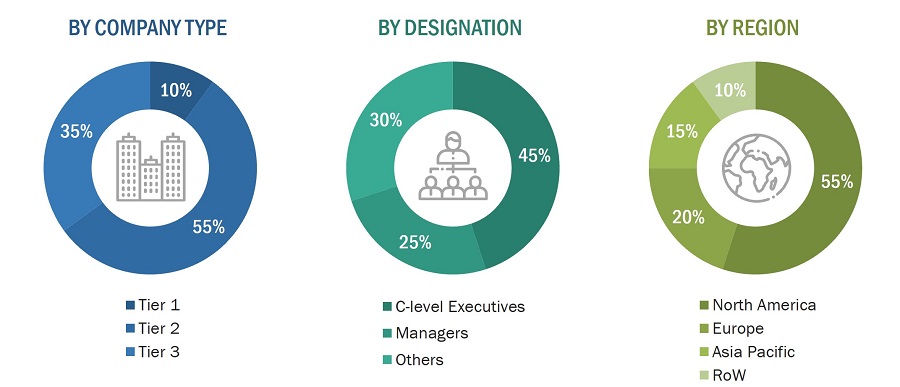
To know about the assumptions considered for the study, download the pdf brochure
Market Size Estimation
Both top-down and bottom-up approaches were used to estimate and validate the 3D motion capture system market size and its various dependent submarkets. The key players in the market were identified through secondary research, and their market share in the respective regions was determined through primary and secondary research. This entire procedure involved the study of annual and financial reports of top players and extensive interviews with industry leaders such as chief executive officers (CEOs), vice presidents (VPs), directors, and marketing executives. All percentage shares and breakdowns were determined using secondary sources and verified through primary sources. All the possible parameters that affect the markets covered in this research study were accounted for, viewed in extensive detail, verified through primary research, and analyzed to obtain the final quantitative and qualitative data. This data was consolidated and supplemented with detailed inputs and analysis from MarketsandMarkets and presented in this report.
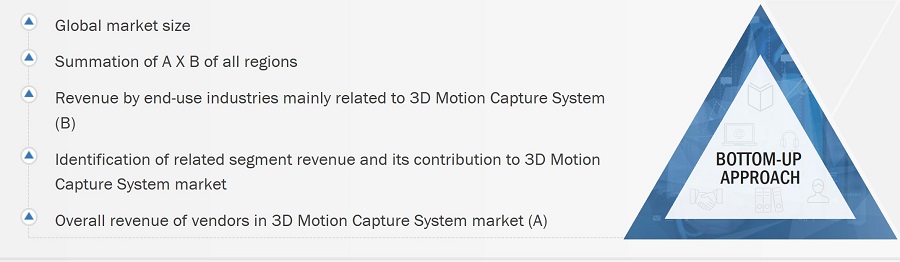
Bottom-Up Approach
The bottom-up approach was used to arrive at the overall size of the 3D motion capture system market from the revenues of the key players and their shares in the market. The overall market size was calculated based on the revenues of the key players identified in the market.
- Identifying various end-use industries using or expected to implement a 3D Motion Capture System
- Analyzing each end-use industry, along with the major related companies and 3D Motion Capture System providers
- Estimating the 3D Motion Capture System market for end-use industries
- Understanding the demand generated by companies operating across different end-use industries
- Tracking the ongoing and upcoming implementation of projects based on 3D Motion Capture System technology by end-use industries and forecasting the market based on these developments and other critical parameters
- Carrying out multiple discussions with key opinion leaders to understand the type of 3D Motion Capture System products designed and developed vertically, helping analyze the breakdown of the scope of work carried out by each major company in the 3D Motion Capture System market
- Arriving at the market estimates by analyzing 3D Motion Capture System companies as per their countries and subsequently combining this information to arrive at the market estimates by region
- Verifying and cross-checking the estimates at every level through discussions with the key opinion leaders, including CXOs, directors, and operations managers, and finally with domain experts at MarketsandMarkets
- Studying various paid and unpaid sources of information, such as annual reports, press releases, white papers, and databases
Top-Down Approach
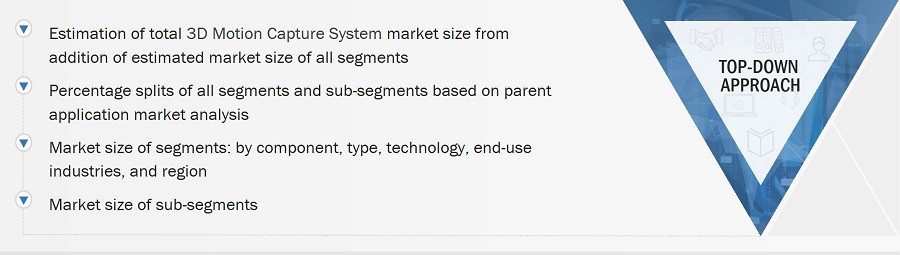
In the top-down approach, the overall market size has been used to estimate the size of the individual markets (mentioned in the market segmentation) through percentage splits from secondary and primary research.
The most appropriate immediate parent market size has been used to implement the top-down approach to calculate the market size of specific segments. The top-down approach was implemented for the data extracted from the secondary research to validate the market size obtained.
Each company's market share was estimated to verify the revenue shares used earlier in the top-down approach. The overall parent market size and individual market sizes were determined and confirmed in this study by the data triangulation method and the validation of data through primaries. The data triangulation method in this study is explained in the next section.
- Focusing on top-line investments and expenditures being made in the ecosystems of various end-use industries
- Building and developing the information related to the market revenue generated by key 3D Motion Capture System manufacturers
- Conducting multiple on-field discussions with the key opinion leaders involved in the development of 3D Motion Capture System products in various end-use industries
- Estimating geographic splits using secondary sources based on various factors, such as the number of players in a specific country and region, the offering of 3D Motion Capture System, and the level of solutions offered in end-use industries
- Considering the impact of the recession on the steps mentioned above
Data Triangulation
After arriving at the overall market size from the above estimation process, the market has been split into several segments and subsegments. The data triangulation procedure has been employed wherever applicable to complete the overall market engineering process and arrive at the exact statistics for all segments and subsegments. The data has been triangulated by studying various factors and trends from both the demand and supply sides. Additionally, the market size has been validated using top-down and bottom-up approaches.
Market Definition
A 3D Motion Capture System is a sophisticated technology used to digitally record and analyze the movements of objects or subjects in three-dimensional space. Typically employed in fields such as animation, biomechanics, sports science, and virtual reality, this system utilizes an array of cameras and sensors strategically positioned around a capture area to track the positions and orientations of markers or objects with high precision. By triangulating data from multiple viewpoints, the system reconstructs the three-dimensional motion of the captured subject, enabling detailed analysis of movements such as walking, running, jumping, or gestures. The resulting motion data can be used for various purposes, including creating lifelike character animations for films and video games, analyzing human movement patterns for sports performance enhancement or injury prevention, and developing immersive virtual environments.
Key Stakeholders
- 3D Motion Capture System providers
- Hardware manufacturers
- Cloud service providers
- End users
- System Integrators
- Resellers and distributors
- Regulatory bodies and compliance agencies
- Research institutions
- Industry associations and organizations
- Investors and financial institutions
Report Objectives
- To define, describe, and forecast the 3D Motion Capture System market by component, type, technology, end-use industry, and region
- To forecast the size of the market segments for four major regions—North America, Europe, Asia Pacific, and the Rest of the World (RoW)
- To provide detailed information regarding the major factors influencing the growth of the market (drivers, restraints, opportunities, and challenges)
- To strategically analyze micromarkets concerning individual growth trends, prospects, and contributions to the total market
- To provide a detailed overview of the 3D Motion Capture System market’s value chain, along with the ecosystem, technology trends, use cases, regulatory environment, and Porter’s five forces analysis for the market.
- To strategically profile the key players and comprehensively analyze their market shares and core competencies
- To analyze the opportunities in the market for stakeholders and describe the competitive landscape of the market
- To analyze competitive developments, such as collaborations, partnerships, product developments, and research & development (R&D), in the market
- To analyze the impact of the recession on the 3D Motion Capture System market
Available Customizations
With the given market data, MarketsandMarkets offers customizations according to the specific requirements of companies. The following customization options are available for the report:
- Detailed analysis and profiling of additional market players (up to 5)
- Additional country-level analysis of the 3D motion capture system market
Product Analysis
- Product matrix, which provides a detailed comparison of the product portfolio of each company in the 3D motion capture system market.
Get the Full 3D Motion Capture System Market Report
Full forecast, segment splits, and company analysis for all 3D Motion Capture System Market.
- US 3D Motion Capture System Market
- Canada 3D Motion Capture System Market
- Germany 3D Motion Capture System Market
- UK 3D Motion Capture System Market
- France 3D Motion Capture System Market
- Rest Of Europe 3D Motion Capture System Market
- China 3D Motion Capture System Market
- Japan 3D Motion Capture System Market
- South Korea 3D Motion Capture System Market
- India 3D Motion Capture System Market
- Rest Of Asia Pacific 3D Motion Capture System Market
Need a Tailored Report?
Customize this report to your needs
Get 10% FREE Customization
Customize This Report
