
MEXICO 3D Printing High-Performance Plastic Market (2025-2030)

The MEXICO 3D Printing High-Performance Plastic Market was valued at $4.53 Million in 2025 and projected to reach to $11.25 Million by 2030, representing a compound annual growth rate of 19.9%. Mexico's 3D printing high-performance plastic market is poised for accelerated growth driven by increasing adoption in aerospace, automotive, and medical sectors.


| Market Size in | USD 26.32 MN |
| Market Forecast in | |
| CAGR | |
| Forecast Period | |
| Units Considered | Value (USD MN) |
MEXICO 3D Printing High-Performance Plastic Market Trends and Insights
- This represents a compound annual growth rate (CAGR) of 19.9%, reflecting Mexico's increasing adoption of advanced manufacturing technologies across aerospace, automotive, and medical device sectors.
- Mexico's strategic position within North America and growing industrial base are driving demand for high-performance polymers in additive manufacturing applications. The market in Mexico is characterized by rising investments in manufacturing infrastructure and growing awareness of 3D printing's cost and efficiency benefits.
- Between 2025 and 2030, Mexico is expected to capture significant market share as local manufacturers and multinational companies establish production facilities leveraging the country's competitive advantages.
- Mexico's participation in regional supply chains and proximity to North American markets position the nation as an emerging hub for 3D printing innovation and high-performance plastic adoption..
Key Market Statistics
- CAGR (2025-2030) 19.9% CAGR
- Market Size, 2025 ~USD 4.53 Million
- Forecast, 2030 ~USD 11.25 Million
- Country MEXICO
MEXICO 3D Printing High-Performance Plastic Market Overview
Market Valuation & Growth :
Mexico's 3D printing high-performance plastic market is valued at USD 4.53 million in 2025, with a robust CAGR of 19.9% projected through 2030, reaching USD 11.25 million. This growth trajectory significantly outpaces traditional manufacturing sectors in the region.
Key Industry Drivers :
Aerospace, automotive, and medical device manufacturers in Mexico are increasingly adopting 3D printing technologies to reduce production costs, accelerate time-to-market, and enhance design flexibility. Nearshoring trends and proximity to North American markets further accelerate adoption.
Strategic Geographic Advantage :
Mexico's position as a manufacturing hub between North America and Latin America positions it as a critical hub for 3D printing adoption. Established industrial clusters in Monterrey, Guadalajara, and Mexico City drive technology integration and supply chain development.
Competitive Market Dynamics :
Growing competition from local and international 3D printing material suppliers is intensifying innovation in high-performance plastics. Investment in R&D and partnerships with global technology leaders are reshaping Mexico's manufacturing landscape.
MEXICO 3D Printing High-Performance Plastic Market Dynamics
- The country's strategic location, coupled with nearshoring initiatives and USMCA trade advantages, positions it as a critical manufacturing destination for advanced polymers and composite materials.
- Government support for industrial modernization and growing investments in manufacturing infrastructure further strengthen market fundamentals. The forecast period (2025-2030) will witness significant expansion as Mexican manufacturers transition from traditional production methods to additive manufacturing.
- Rising demand for lightweight, durable components in automotive and aerospace applications, combined with cost-competitive production capabilities, will drive market penetration.
- Strategic partnerships with global material suppliers and increasing local R&D capabilities will establish Mexico as a regional leader in high-performance 3D printing plastics..
Market Ecosystem
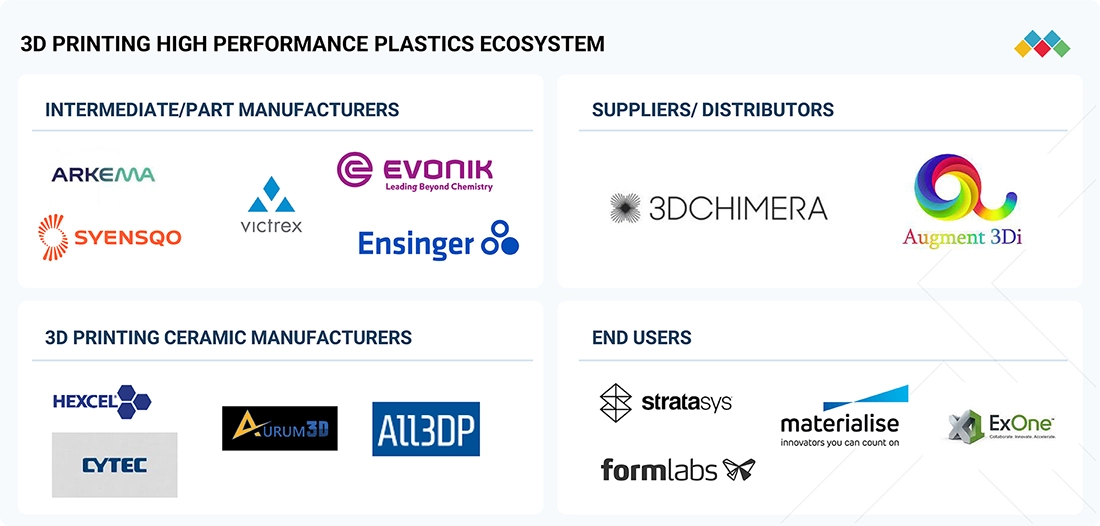
3D Printing High-Performance Plastic Market: COMMERCIAL USE CASES ACROSS INDUSTRIES
| COMPANY | USE CASE DESCRIPTION | BENEFITS |
|---|---|---|
 |
Integrating 3D-printed PEEK and titanium aluminide components in GE9X jet engines for Boeing 777X aircraft, including fuel nozzles, turbine blades, and heat exchangers. The GE9X engine incorporates over 300 3D-printed parts consolidating hundreds of traditional components into just seven additive manufactured parts. | 12% improvement in fuel efficiency, 10% reduction in operating costs, 25% lighter weight compared to traditionally manufactured parts, 5x longer lifetime for fuel nozzles, and USD 1.6 million annual fuel savings per engine. |
 |
Utilizing 3D-printed ULTEM 9085 resin components for A350 XWB aircraft interior and structural parts, including wall panels, cabinet doors, overhead compartments, and lightweight brackets. Over 1,000 3D-printed plastic parts are currently used in serial A350 production, with consolidation of 30+ fuel system components into single lightweight assemblies . | 55% weight reduction compared to traditionally manufactured parts, 75% weight savings in fuel system components, improved fuel efficiency through lightweighting, and 90% material waste reduction. |
 |
Developing patient-specific 3D-printed PEEK cranial implants using 3D Systems' EXT 220 MED printer and Evonik VESTAKEEP i4 3DF PEEK material for cranioplasty procedures. The VSP PEEK Cranial Implant system provides complete FDA-cleared workflow for neurosurgery applications with nearly 40 successful procedures completed across Europe . | Enhanced osteointegration with bone-like mechanics, 115 MPa yield strength exceeding cranial bone (100 MPa), precise "drop-in" fit reducing surgery time, 85% material waste reduction compared to traditional machining, radiolucency enabling clear post-operative imaging, and biocompatibility with no inflammatory response. |
Logos and trademarks shown above are the property of their respective owners. Their use here is for informational and illustrative purposes only.
Related Ecosystem
Automotive Electronics And Electrical Equipment
Fibers And Composites
Resins And Polymers
Key Takeaways
- Mexico's 3D printing high-performance plastic market is valued at USD 4.53 million in 2025 and will grow to USD 11.25 million by 2030, representing a 19.9% CAGR.
- Mexico's strategic location within North America and competitive manufacturing costs are accelerating adoption of 3D printing technologies across multiple industrial sectors.
- High-performance polymers in Mexico are increasingly used in aerospace, automotive, and medical applications, driving market expansion through 2030.
- Mexico's participation in regional supply chains and proximity to major North American markets position it as a key growth market for additive manufacturing innovation.
3D Printing High-Performance Plastic Market Report Scope
| Report Metric | Details |
|---|---|
| Base Year | 2025 |
| Fastest Growing Segment | PEEK & PEKK (Type) |
| Forecast Period | 2025–2030 |
| Growth Rate | CAGR of 20.4% from 2025 to 2030 |
| Largest Segment | PEEK & PEKK (Type) |
| Market Size Base Year (Billions) | ~USD 0.18 (2025) |
| Revenue Forecast (Billions) | ~USD 0.45 (2030) |
| Segments Covered | Type |
MEXICO 3D Printing High-Performance Plastic Market Report Segmentation
1 segment dimensions are covered across the global market.
By Type
- Other Types
- Pa
- Peek & Pekk
- Pei
- Reinforced Hpp
Target Audience
- Material Manufacturers & Suppliers : High-performance plastic producers need Mexico-specific demand forecasts, application trends, and customer requirements to develop localized product portfolios and establish distribution networks in this high-growth market.
- 3D Printing Equipment Providers : Equipment manufacturers require insights into Mexico's adoption rates by sector, technology preferences, and infrastructure readiness to tailor solutions and develop go-to-market strategies for aerospace, automotive, and medical applications.
- Aerospace & Automotive OEMs : Original equipment manufacturers operating in Mexico need market intelligence on local 3D printing capabilities, material availability, and cost competitiveness to optimize production strategies and supplier selection.
- Private Equity & Investment Firms : Investors evaluating opportunities in Mexico's advanced manufacturing sector require detailed market sizing, growth drivers, and competitive landscape analysis to assess investment returns and portfolio company growth potential.
- Government & Economic Development Agencies : Mexican economic development organizations need market data to support industrial policy, attract foreign investment, and develop infrastructure initiatives that strengthen the country's position in advanced manufacturing.
Key Companies in the MEXICO 3D Printing High-Performance Plastic Market
| Company | HQ | Ownership | Strongest segments |
|---|---|---|---|
| DUPONT | United States | Public Company | Healthcare & Water Technologies,Construction Materials (Tyvek house wrap, Styrofoam, Corian),Industrial Engineered Components (Vespel, Molykote, adhesives), |
| EVONIK INDUSTRIES | Germany | Public Company | Advanced Technologies,Custom Solutions,Infrastructure, |
| ARKEMA | France | Public Company | Adhesive Solutions,Advanced Materials,Coating Solutions, |
| EOS GMBH | Australia | Public Company | Remote weapon systems, fire control, and lethality solutions,Counter-drone, force protection, and UGV/marine lethality systems,High energy laser weapons, |
| SOLVAY | Belgium | Public Company | Soda ash and derivatives,Sodium bicarbonate and related applications,Hydrogen peroxide, |
| SABIC | Saudi Arabia | Public Company | Base petrochemicals & intermediates (olefins, aromatics, methanol, glycols, MTBE, CO2),Commodity polymers (PE, PP, PVC, PET, PS, ABS),Specialties & engineering plastics (NORYL, ULTEM, EXTEM, SILTEM, PC, compounds), |
| VICTREX PLC | United Kingdom | Public Company | Sustainable Solutions – Energy & Industrial,Sustainable Solutions – Aerospace,Sustainable Solutions – Automotive, |
| MITSUBISHI CHEMICAL CORPORATION | Japan | Public Company | Basic Materials & Polymers,Specialty Materials and Performance Products,MMA & Derivatives / PMMA, |
| TORAY INDUSTRIES, INC. | Japan | Public Company | Fibers and Textiles,Performance Chemicals (Resins, Films, Fine Chemicals, Electronic Materials),Carbon Fiber Composite Materials, |
DUPONT
DuPont is a publicly traded American chemical company founded in 2015 with 15,000 employees.
EVONIK INDUSTRIES
Evonik Industries is a publicly traded German chemical company founded in 1847 with 30,643 employees.
ARKEMA
Arkema is a publicly traded French chemical company founded in 2003 with 20,700 employees.
EOS GMBH
EOS GmbH is a publicly traded Australian company founded in 1983 with 436 employees.
SOLVAY
Solvay is a publicly traded Belgian chemical company founded in 1863 with 8,400 employees.
SABIC
SABIC is a publicly traded Saudi Arabian petrochemical company founded in 1976 with 35,000 employees.
VICTREX PLC
Victrex PLC is a publicly traded British company founded in 1993 with 1,169 employees.
MITSUBISHI CHEMICAL CORPORATION
Mitsubishi Chemical Corporation is a publicly traded Japanese chemical company founded in 1933 with 56,678 employees.
TORAY INDUSTRIES, INC.
Toray Industries, Inc. is a publicly traded Japanese company founded in 1926 with 46,294 employees.
Reasons to Buy this Report
- Market Entry Strategy : Gain comprehensive insights into Mexico's 3D printing landscape to identify optimal entry points, competitive positioning, and partnership opportunities with established manufacturers in key industrial clusters.
- Investment Decision Support : Access detailed market sizing, growth projections, and sector-specific demand analysis to support capital allocation decisions and facility expansion plans in Mexico's high-growth manufacturing segments.
- Competitive Intelligence : Understand Mexico's competitive dynamics, supplier ecosystem, and technology adoption rates to benchmark performance against regional competitors and identify market gaps for product differentiation.
- Supply Chain Optimization : Leverage Mexico-specific data on material demand, production capabilities, and logistics infrastructure to optimize supply chain networks and reduce costs through nearshoring strategies.
- Regulatory & Market Compliance : Navigate Mexico's regulatory environment, industry standards, and trade frameworks with actionable intelligence on compliance requirements and market-specific business practices for 3D printing materials.
Frequently asked questions
What is the current market size of 3D printing high-performance plastics in Mexico?
Mexico's 3D printing high-performance plastic market is valued at USD 4.53 million in 2025 and is projected to grow to USD 11.25 million by 2030.
What is the expected growth rate for Mexico's 3D printing high-performance plastic market?
Mexico's market is expected to grow at a compound annual growth rate (CAGR) of 19.9% between 2025 and 2030.
Which industries in Mexico are driving demand for 3D printing high-performance plastics?
Key industries in Mexico include aerospace, automotive, medical devices, and industrial manufacturing, all increasingly adopting 3D printing technologies for component production.
Why is Mexico becoming a significant market for 3D printing high-performance plastics?
Mexico's competitive manufacturing costs, strategic North American location, established supply chains, and growing industrial base make it an attractive hub for additive manufacturing adoption and innovation.
What factors are expected to support market growth in Mexico through 2030?
Rising investments in manufacturing infrastructure, increasing awareness of 3D printing benefits, multinational company expansion, and Mexico's role in regional supply chains are key growth drivers through 2030.
RESEARCH METHODOLOGY
The study involves two major activities in estimating the current market size for the 3D printing high-performance plastic market. Exhaustive secondary research was done to collect information on the market, peer market, and parent market. The next step was to validate these findings, assumptions, and sizing with industry experts across the value chain through primary research. Both top-down and bottom-up approaches were employed to estimate the complete market size. After that, market breakdown and data triangulation were used to estimate the market size of segments and subsegments.
Secondary Research
Secondary sources referred to for this research study include financial statements of companies offering 3D printing high-performance plastic and information from various trade, business, and professional associations. Secondary research has been used to obtain critical information about the industry’s value chain, the total pool of key players, market classification, and segmentation according to industry trends to the bottom-most level and regional markets. The secondary data was collected and analyzed to arrive at the overall size of the 3D printing high-performance plastic market, which was validated by primary respondents.
Primary Research
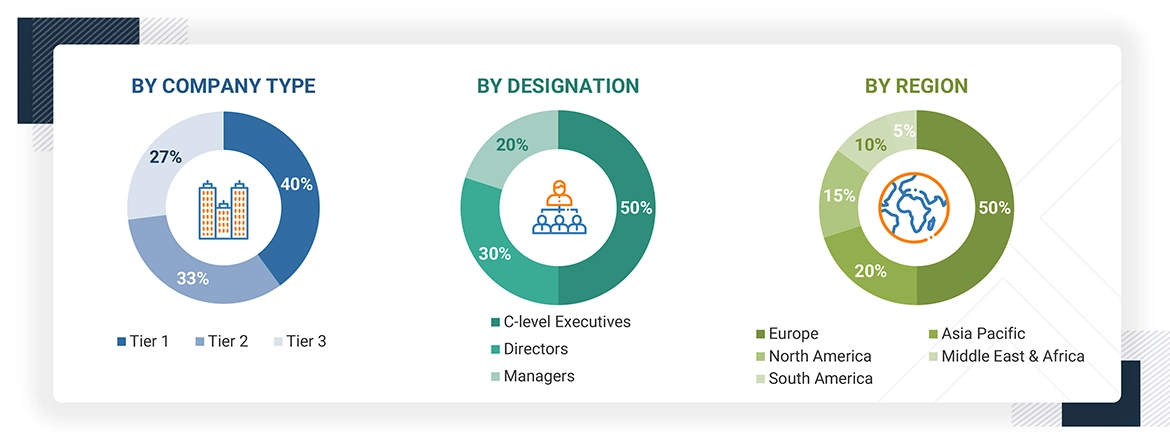
Extensive primary research was conducted after obtaining information regarding the 3D printing high-performance plastic market scenario through secondary research. Several primary interviews were conducted with market experts from both the demand and supply sides across major countries of North America, Europe, Asia Pacific, the Middle East & Africa, and South America. Primary data was collected through questionnaires, emails, and telephonic interviews. The primary sources from the supply side included various industry experts, such as chief experience officers (CXOs), vice presidents (VPs), business development/marketing directors, product development/innovation teams, related key executives from the 3D printing high-performance plastic industry, system integrators, component providers, distributors, and key opinion leaders. Primary interviews were conducted to gather insights such as market statistics, data on revenue collected from the products and services, market breakdowns, market size estimations, market forecasting, and data triangulation. Primary research also helped in understanding the various trends related to product type, end-use industry, and region. Stakeholders from the demand side, such as CIOs, CTOs, CSOs, and installation teams of the customers/end users who are 3D printing services, were interviewed to understand the buyer’s perspective on the suppliers, products, component providers, and their current usage of 3D printing high performance plastic and future outlook of their business which will affect the overall market.
Breakup of Primary Research:
To know about the assumptions considered for the study, download the pdf brochure
Market Size Estimation
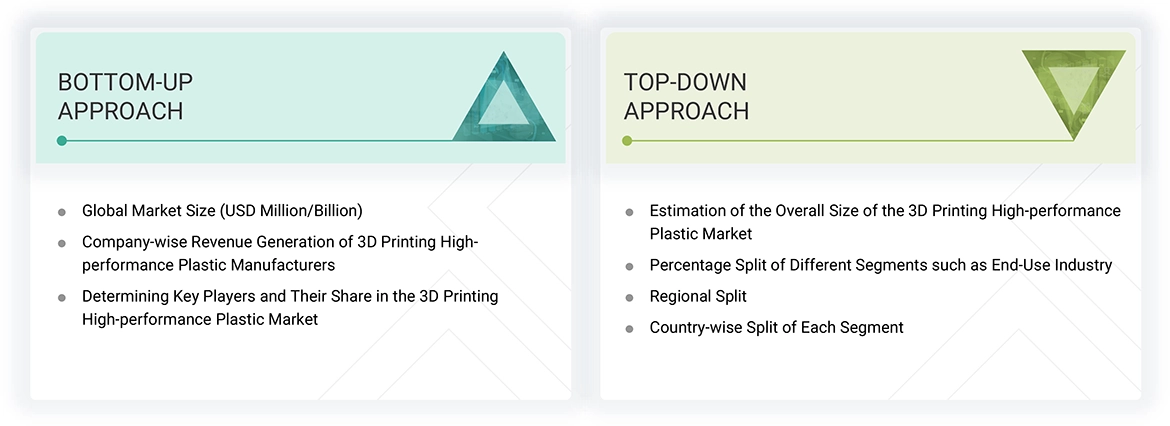
The research methodology used to estimate the size of the 3D printing high-performance plastic market includes the following details. The market sizing was undertaken from the demand side. The market was upsized based on the demand for 3D printing high-performance plastic in different end-use industries at the regional level. Such procurements provide information on the demand aspects of the 3D printing high-performance plastic industry for each end-use industry. For each end-use industry, all possible segments of the 3D printing high-performance plastic market were integrated and mapped.
Data Triangulation
After arriving at the overall size from the market size estimation process explained above, the total market was split into several segments and subsegments. The data triangulation and market breakdown procedures explained below were implemented, wherever applicable, to complete the overall market engineering process and arrive at the exact statistics for various market segments and subsegments. The data was triangulated by studying various factors and trends from the demand and supply sides. Along with this, the market size was validated using both the top-down and bottom-up approaches.
Market Definition
3D printing is the process of producing three-dimensional (3D) objects from digital models using materials such as plastics and other engineered substances. This advanced manufacturing approach enables the creation of stronger, lighter, and more complex components, revolutionizing traditional industrial production.
Within this market, high-performance plastics refer to polymer materials that exhibit superior mechanical strength, purity, stiffness, and resistance to wear and chemicals compared to standard 3D printing materials like PLA and ABS. In addition to a broad spectrum of polymer types, the market includes an extensive array of polymer blends, glass—and carbon-fiber-reinforced polymers, and proprietary composite materials.
High-performance plastics are specifically designed to retain their mechanical, thermal, and chemical properties under extreme conditions—such as elevated temperatures, high pressure, or exposure to corrosive substances—without bending, warping, cracking, or splintering.
In recent years, additive manufacturing has seen significant growth in the use of high-performance polymers, defined as polymers with a heat deflection temperature exceeding 150°C. These materials offer enhanced thermal stability, chemical resistance, mechanical strength, and low density, making them superior to conventional 3D printing polymers such as ABS, PP, and PET.
Examples of 3D printing high-performance plastics include engineered nylons, Polyether ether ketone (PEEK), Polyether ketone ketone (PEKK), Polyetherimide (PEI), Reinforced plastics, Polyphenylsulfone (PPSU), Polyphenylene sulfide (PPS), Polyamide-imide (PAI), and Polyethersulfone (PES).
Advancements in fused deposition modeling (FDM/FFF) and selective laser sintering (SLS) have significantly expanded the feasibility of using these materials in 3D printing. These technologies allow for the production of intricate, high-performance parts, reshaping the manufacturing landscape across multiple sectors.
Key application areas include tooling, prototyping, and functional part production across industries such as medical & healthcare, aerospace & defense, transportation, oil & gas, and others. High-performance plastics for 3D printing are commercially available in filament, pellet, and powder forms, enabling flexibility across different additive manufacturing platforms.
Stakeholders
- 3d printing high-performance plastic manufacturers
- 3d printing high-performance plastic distributors and suppliers
- Universities, governments, and research organizations
- Associations and industrial bodies
- R&D institutes
- Environmental support agencies
- Investment banks and private equity firms
- Research and consulting firms
Report Objectives
- To define, describe, and forecast the 3D printing high-performance plastic market size in terms of volume and value
- To provide detailed information regarding the key factors, such as drivers, restraints, opportunities, and challenges influencing the market growth
- To analyze and project the global 3D printing high-performance plastic market by product type, end-use industry, and region
- To forecast the market size concerning five main regions (along with country-level data): North America, Europe, Asia Pacific, the Middle East & Africa, and South America, and analyze the significant region-specific trends
- To strategically analyze micromarkets with respect to individual growth trends, prospects, and contributions of the submarkets to the overall market
- To analyze the market opportunities and the competitive landscape for stakeholders and market leaders
- To assess recent market developments and competitive strategies, such as agreements, contracts, acquisitions, and product developments/product launches, to draw the competitive landscape
- To strategically profile the key market players and comprehensively analyze their core competencies
Get the Full 3D Printing High-Performance Plastic Market Report
Full forecast, segment splits, and company analysis for all 3D Printing High-Performance Plastic Market.
- US 3D Printing High-Performance Plastic Market
- CANADA 3D Printing High-Performance Plastic Market
- GERMANY 3D Printing High-Performance Plastic Market
- FRANCE 3D Printing High-Performance Plastic Market
- UK 3D Printing High-Performance Plastic Market
- ITALY 3D Printing High-Performance Plastic Market
- SPAIN 3D Printing High-Performance Plastic Market
- CHINA 3D Printing High-Performance Plastic Market
- JAPAN 3D Printing High-Performance Plastic Market
- SOUTH KOREA 3D Printing High-Performance Plastic Market
- INDIA 3D Printing High-Performance Plastic Market
- BRAZIL 3D Printing High-Performance Plastic Market
- ARGENTINA 3D Printing High-Performance Plastic Market
- ISRAEL 3D Printing High-Performance Plastic Market
- SOUTH AFRICA 3D Printing High-Performance Plastic Market
- UAE 3D Printing High-Performance Plastic Market
Need a Tailored Report?
Customize this report to your needs
Get 10% FREE Customization
Customize This Report
