



3D Printing High Performance Plastic Market
Report Code
CH 7833
Published in
Jun, 2025, By MarketsandMarkets™
3D Printing High-Performance Plastic Market by Type (Polyamide (PA), Polyetherimide (PEI), Polyetheretherketone & Polyetherketoneketone (PEEK & PEKK), Reinforced HPP, Other Types), Form (Filament & Pellet and Powder), Technology (Fused Deposition Modeling (FDM)/Fused Filament Fabrication (FFF) and Selective Laser Sintering (SLS)), Application (Prototyping, Tooling, and Functional Part Manufacturing), and End-use Industry (Medical & Healthcare, Aerospace & Defense, Transportation, Oil & Gas, and Other End-use Industries), Region - Global Forecast to 2030

USD 0.45 BN
MARKET SIZE, 2030

CAGR 20.4%
(2025-2030)

300+
REPORT PAGES

400+
MARKET TABLES
OVERVIEW
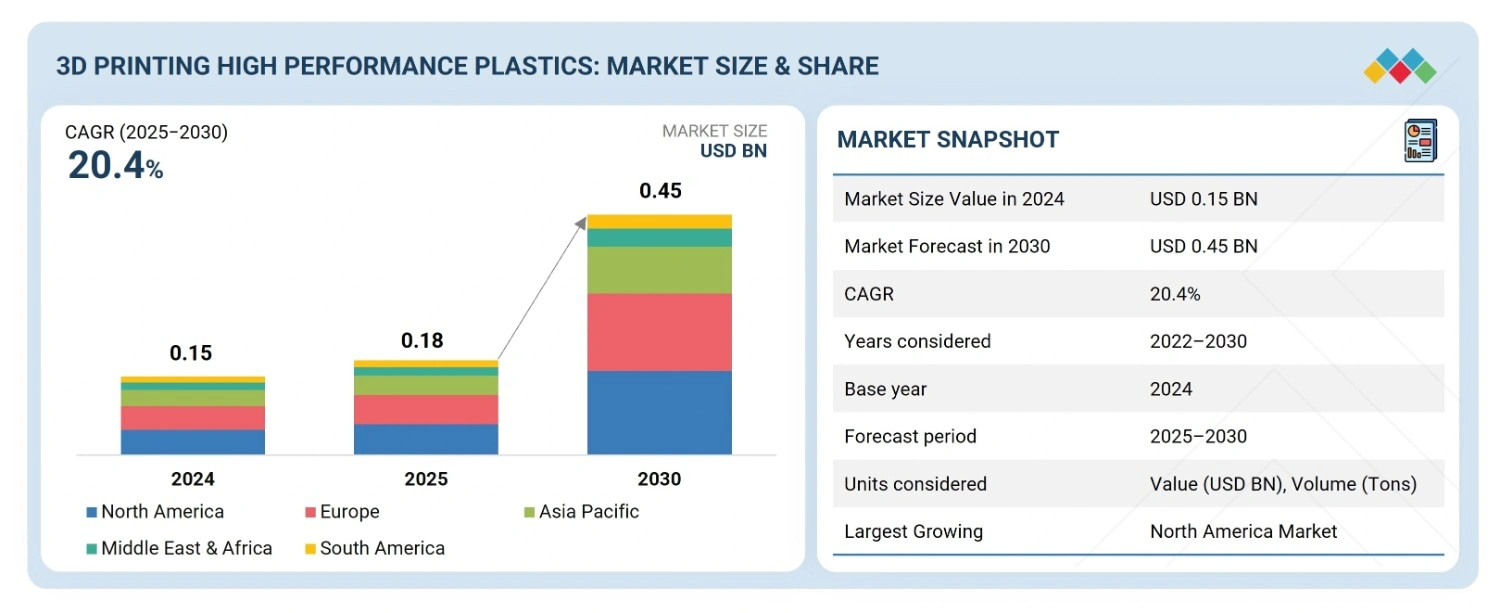
Source: Secondary Research, Interviews with Experts, MarketsandMarkets Analysis
The 3D printing high-performance plastics market is projected to grow from USD 0.18 billion in 2025 to USD 0.45 billion by 2030, registering a CAGR of 20.4% during the forecast period. This robust growth is primarily driven by increasing demand for lightweight, high-performance materials across critical applications, advancements in additive manufacturing technologies, and rising investments in infrastructure and industrial modernization.
KEY TAKEAWAYS
-
BY TYPEThe 3D printing high performance plastics market comprises of PA, PEI, PEEK & PEKK, Reinforced HPPs, and other types. The PEEK & PEKK segment dominated the 3D printing high-performance plastic market due to their widespread use in a variety of industries, driven primarily by their unique properties such as biocompatibility, tailorable properties, and superior resistance and durability.
-
BY FORM3D printing high performance plastics is available in powder and filament & pellets. The filament form is expected to have the highest growth in the forecasted period. Filament and pellet form accounted for the largest share in the 3D printing high-performance plastic market in 2024. Filaments are essential for Fused Deposition Modeling (FDM), the fastest-growing 3D printing technology for high-performance plastics, while pellets are increasingly used in large-scale and industrial 3D printing systems, offering flexibility and cost-effectiveness.
-
BY TECHNOLOGYThe technology segment consists of Fused Deposition Modelling (FDM)/ Fused Filament Fabrication (FFF) and Selective Laser Sintering (SLS). SLS leads the high-performance plastics 3D printing market by enabling the creation of strong, complex, and precise parts without needing support structures. It efficiently processes polymers like PEEK and PEKK for demanding industrial applications.
-
BY APPLICATIONPrototyping, Tooling, and Functional Part Manufacturing are the major application of 3D printing high performance plastics market. Prototyping leads the 3D printing high-performance plastics market in 2024 as it enables rapid design iteration and functional testing using materials that mimic end-use performance, helping manufacturers accelerate product development and improve design accuracy.
-
BY END-USE INDUSTRYKey applications of 3D printing high performance plastics span the aerospace & defense, medical & healthcare, transportation, oil & gas and other end-use industries. The medical and healthcare sector is projected to witness the highest CAGR in the 3D printing high-performance plastics market during the forecast period. This growth is primarily driven by the increasing demand for advanced materials capable of meeting stringent regulatory, mechanical, and biocompatibility requirements in medical applications.
-
BY REGIONThe 3D printing high performance plastics market covers Europe, North America, Asia Pacific, South America, the Middle East, and Africa. North America is projected to exhibit the highest growth rate in the 3D printing high-performance plastics market during the forecast period. This growth is driven by increasing adoption of additive manufacturing across high-value industries such as aerospace and defense, healthcare, electrical and electronics, and automotive.
-
COMPETITIVE LANDSCAPEMajor market players have adopted both organic and inorganic strategies, including partnerships and investments. For instance, Syensqo (Belgium) and Arkema (France)have entered into a number of agreements and partnerships to cater to the growing demand for 3D printing high performance plastics across innovative applications.
As industries prioritize efficiency, durability, and weight reduction, 3D-printed high-performance polymers are gaining traction in sectors such as aerospace & defense, medical & healthcare, transportation, and energy. In aerospace applications, for example, these materials are increasingly used to produce lightweight and durable components, including interior panels, overhead bin gap fillers, structural brackets, cabin supports, fuel nozzles, and turbine blade housings, contributing to improved fuel efficiency and performance. Technological advancements in additive manufacturing, such as fused deposition modeling (FDM), selective laser sintering (SLS), and powder bed fusion (PBF), are enhancing precision, scalability, and cost efficiency, making high-performance plastic 3D printing more accessible across a wider range of industries.
TRENDS & DISRUPTIONS IMPACTING CUSTOMERS' CUSTOMERS
Changes in customer trends or disruptions affect consumers' businesses. These shifts influence the revenues of end users. As a result, the revenue changes for end users are likely to impact the revenues of 3D printing high performance plastics suppliers, which, in turn, affect the revenues of 3D printing high performance plastics manufacturers
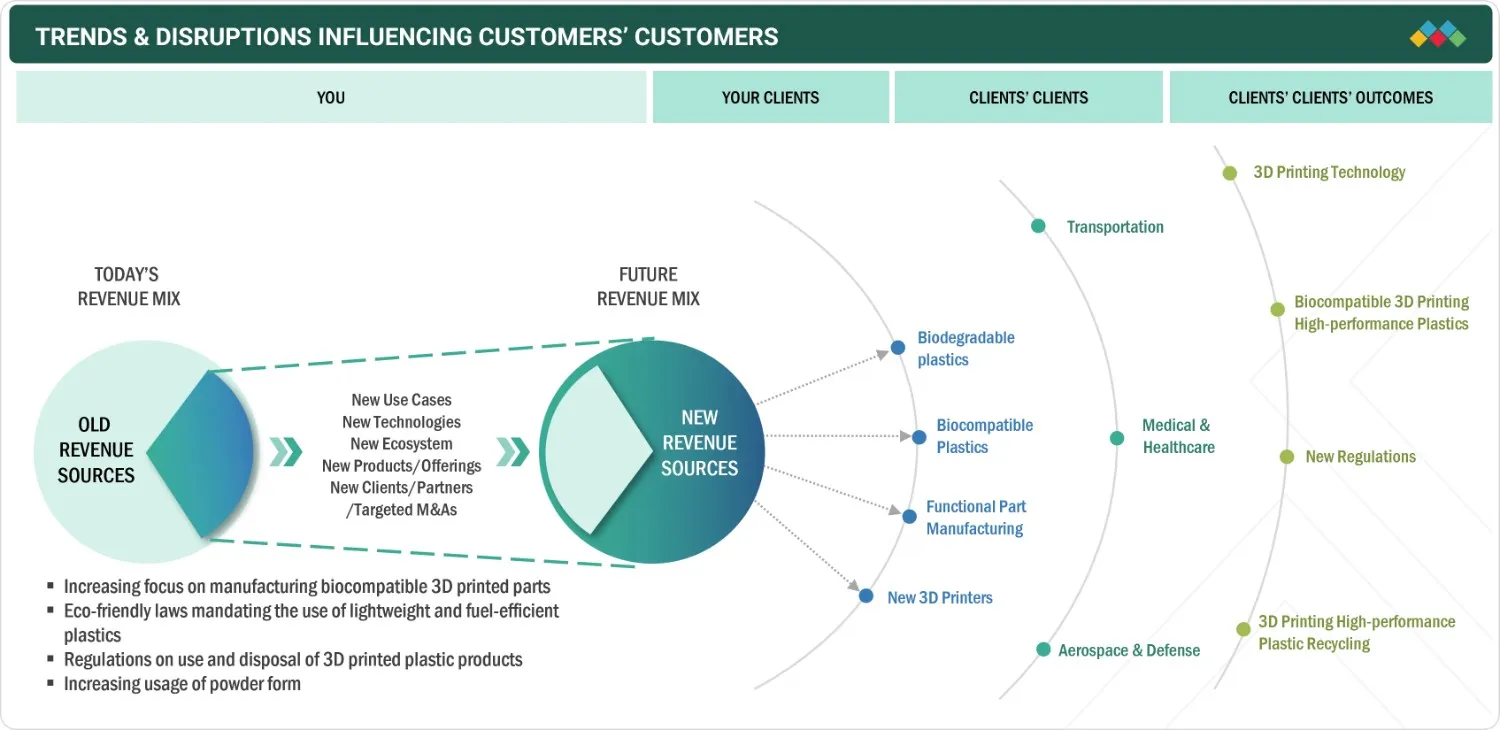
Source: Secondary Research, Interviews with Experts, MarketsandMarkets Analysis
MARKET DYNAMICS

Drivers
Impact
Level
Level
-
Increasing demand for 3D printing high performance plastic from medical & healthcare, aerospace & defense , and automotive industries

-
Government initiatives to support adoption of 3D printing high performance plastic technologies in different industries.


RESTRAINTS
Impact
Level
Level
-
Environmental concerns regarding disposal of 3D printed plastic products

-
Skepticism regarding acceptance of new technologies in emerging economies


OPPORTUNITIES
Impact
Level
Level
-
Increasing demand for bio-based grades of 3D printing high performance plastic materials

-
Growing penetration od reinforced 3D printing high performance plastics in manufacturing functional parts


CHALLENGES
Impact
Level
Level
-
High manufacturing cost of commercial grades of 3D printing high performance plastic

-
Reducing lead time

Source: Secondary Research, Interviews with Experts, MarketsandMarkets Analysis
Driver: Increasing demand for 3D printing high performance plastic from medical & healthcare, aerospace & defense , and automotive industries
The 3D printing technology is being significantly used in the aerospace & defense sector. The aircraft sector is among the first ones to use 3D printing high-performance plastic. These are extremely useful for generating complex and intricate components as they can be subjected to very high temperature conditions. The auto and aviation sectors are especially interested since these materials provide a very good balance of rigidity, strength, and thermal resistance. 3D printing high-performance plastic is revolutionizing the manufacturing process in the automotive sector. For example, BMW is working with leading 3D printing firms, such as EOS GmbH Electro Optical Systems (Germany) and Carbon (US), to produce 3D-printed components for commercial vehicles. ULTEM 9085 from Stratasys is perfect for aerospace and automotive markets, offering high-performance components and an exceptionally lightweight metal alternative. Latecoere, a French aircraft manufacturer and design team, employs ULTEM 9085 to create functional models, specialty tools, and air duct housing components.
Restraint: Environmental concerns regarding disposal of 3D printed plastic products
The purchase and upkeep of 3D printing high-performance plastic requires substantial capital outlays. The high cost creates an entry barrier for new firms and restricts the capabilities of small and medium-sized enterprises (SMEs) to purchase advanced machinery, limiting their competitiveness and market entry. SMEs often lack financial capabilities, making it difficult to afford the high upfront costs of purchasing or leasing advanced equipment. This limits their access to productive and efficient machinery, which affects their capacity to compete with larger companies. In some areas, lack of access to financing options worsens the situation, further limiting SMEs capacity to obtain the latest machinery. This can result in a dependence on aged or less effective equipment, which impacts the overall growth of the market. The major players in this market are gradually attempting to overcome this limitation to maintain the market. For example, Evonik Industries launched the first PA12 powder for 3D printing on the basis of bio-circular raw material. Moreover, Arkema initiated a new plant for bio-based polyamide 11 in Singapore that will enhance the 50% capacity of global polyamide 11.
Opportunity: Growing penetration of reinforced 3D printing high-performance plastics in manufacturing functional parts
There is a growing demand for reinforced 3D printing high-performance plastics for functional part production. The grades provide the best performance in the most severe conditions, including corrosive and high-pressure/high-temperature conditions. PEEK, PEKK, and polyamide are reinforced with carbon fibers and glass fibers to enhance their performance. They offer excellent flexural strength and an outstanding stiffness-to-weight ratio and are excellent substitutes for metal parts in functional prototypes and selective end-use parts. The blend of high strength and lightweight enables these materials to substitute heavier metals, enabling manufacturers to reduce part weight without compromising performance. This is especially useful in aerospace and automotive industries, where weight savings equal better fuel efficiency and fewer emissions. The blend of high strength, lightweight, and stiffness makes it a good substitute for heavier metal parts in such applications as functional prototypes and selective end-use parts.
Challenge: High manufacturing cost of commercial grades of 3D printing high-performance plastic
The production of commercial grades of 3D printing high-performance plastic is costly because of various value additions to the raw materials employed for the production of the same. The chain supply for distributing raw materials employed in the development of commercial grades of 3D printing plastics is still being formed in emerging economies. The high-cost value-adding materials, like carbon fiber and glass fiber, applied with base materials, are also costly. Therefore, the steep production expense of commercial grades of 3D printing high-performance plastic serves as a challenge in the 3D printing high-performance plastic industry worldwide.
3D Printing High-Performance Plastic Market: COMMERCIAL USE CASES ACROSS INDUSTRIES
| COMPANY | USE CASE DESCRIPTION | BENEFITS |
|---|---|---|
 |
Integrating 3D-printed PEEK and titanium aluminide components in GE9X jet engines for Boeing 777X aircraft, including fuel nozzles, turbine blades, and heat exchangers. The GE9X engine incorporates over 300 3D-printed parts consolidating hundreds of traditional components into just seven additive manufactured parts. | 12% improvement in fuel efficiency, 10% reduction in operating costs, 25% lighter weight compared to traditionally manufactured parts, 5x longer lifetime for fuel nozzles, and USD 1.6 million annual fuel savings per engine. |
 |
Utilizing 3D-printed ULTEM 9085 resin components for A350 XWB aircraft interior and structural parts, including wall panels, cabinet doors, overhead compartments, and lightweight brackets. Over 1,000 3D-printed plastic parts are currently used in serial A350 production, with consolidation of 30+ fuel system components into single lightweight assemblies . | 55% weight reduction compared to traditionally manufactured parts, 75% weight savings in fuel system components, improved fuel efficiency through lightweighting, and 90% material waste reduction. |
 |
Developing patient-specific 3D-printed PEEK cranial implants using 3D Systems' EXT 220 MED printer and Evonik VESTAKEEP i4 3DF PEEK material for cranioplasty procedures. The VSP PEEK Cranial Implant system provides complete FDA-cleared workflow for neurosurgery applications with nearly 40 successful procedures completed across Europe . | Enhanced osteointegration with bone-like mechanics, 115 MPa yield strength exceeding cranial bone (100 MPa), precise "drop-in" fit reducing surgery time, 85% material waste reduction compared to traditional machining, radiolucency enabling clear post-operative imaging, and biocompatibility with no inflammatory response. |
Logos and trademarks shown above are the property of their respective owners. Their use here is for informational and illustrative purposes only.
MARKET ECOSYSTEM
The 3D printing high performance plastics market ecosystem consists of raw material supplier (Hexcel Corporation, Cytec), 3D printing high performance plastics suppliers (Arkema, Syensqo), distributor (3D Chimera, Augment 3Di)), and end users (Stratasys, Materialse, ExOne). The raw material suppliers provide fibers, resins, and additives to 3D printing high performance plastics manufacturers. The distributors and suppliers establish contact between the manufacturing companies and end users to streamline the supply chain, increasing operational efficiency and profitability.
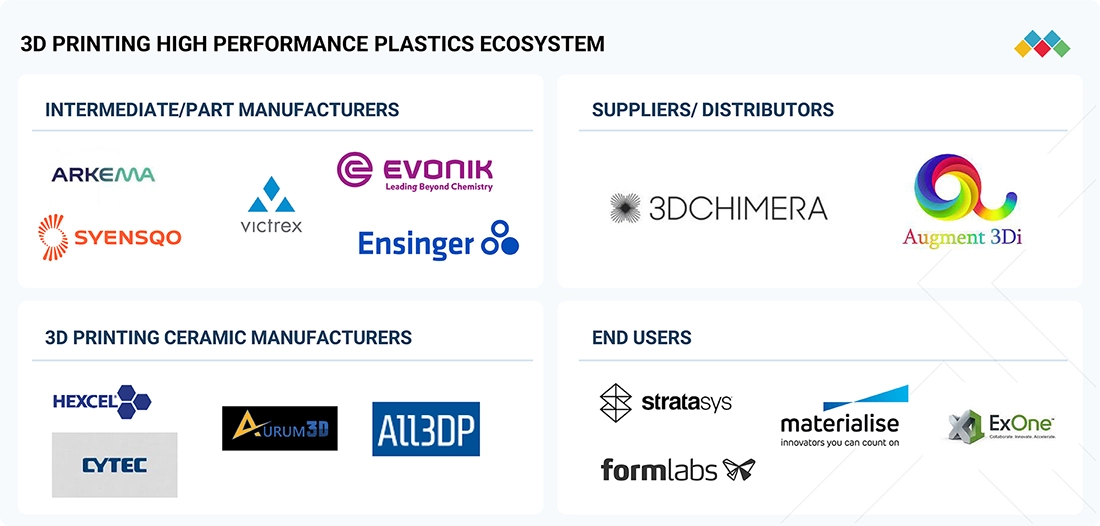
Logos and trademarks shown above are the property of their respective owners. Their use here is for informational and illustrative purposes only.
MARKET SEGMENTS
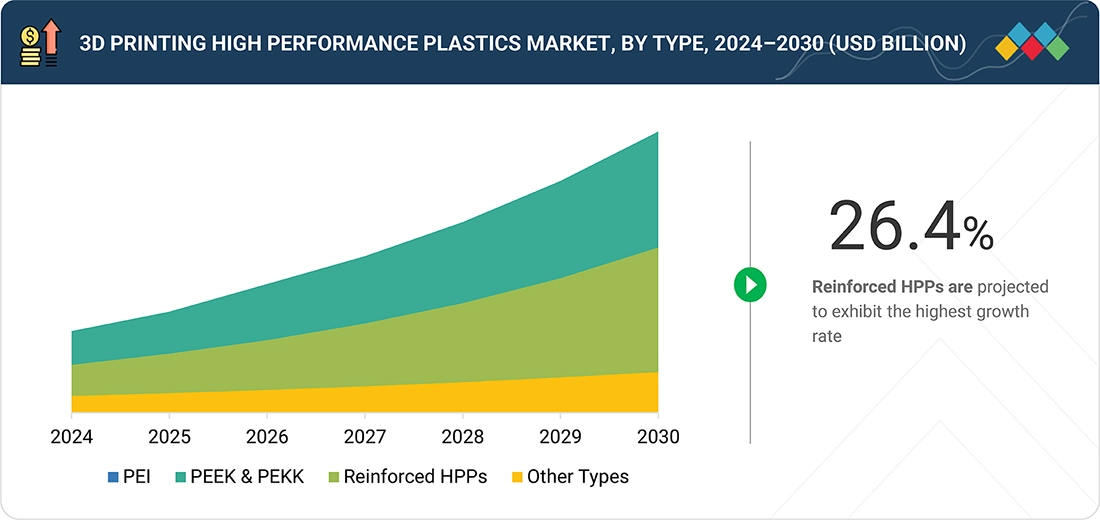
Source: Secondary Research, Interviews with Experts, MarketsandMarkets Analysis
3D Printing High Performance Plastics Market, By Type
Polyether ether ketone (PEEK) and Polyether ketone ketone (PEKK) will account for the largest market share in 2030, as the demand is rapidly increasing due to several factors. PEEK & PEKK exhibit exceptional chemical resistance, mechanical strength, high temperature tolerance, and durability, making them ideal for demanding applications in medical & healthcare, aerospace & defense, and transportation. Their capability to function under severe conditions (like high temperatures and harsh chemicals) distinguishes them from common polymers. Both of these materials are biocompatible and radiolucent, important for medical devices and implants. PEEK, for instance, is common in orthopedic and spinal implants as a non-metallic, lightweight option, and is well established in medicine as being compatible with the human body.
3D Printing High Performance Plastics Market, By Form
Filaments and pellets continue to hold substantial market share in the high-performance plastics for 3D printing market segment due to their versatility, reliability of the process and compatibility within FDM and extrusion-based processes. Filaments and pellets deliver reproducible mechanical and thermal performance, can accommodate complex and functional geometries, and drive down the amount of waste associated with other forms of materials. Advanced polymers such as PEEK, PEKK, PPSU, and ULTEM, have increased the availability of filaments and pellets, enabling manufacturers to produce prototypes and end-use components that meet the demanding requirements for many industries. In addition to these benefits, filaments and pellets are easy to store, transport, and to feed into printers. The ability to produce low-to-medium runs of parts at a low cost, makes filaments and pellets an easy choice among many industries such as aerospace, automotive, medical, and defence. Lastly, the ability of filaments and pellets to accommodate emerging developments in 3D printing including multi-material and high-temperature printing, continues to reinforce filaments and pellets as the most suitable and practical form of material in the market.
3D Printing High Performance Plastics Market, By Technology
FDM (Fused Deposition Modeling) and FFM (Fused Filament Fabrication) are the leading technology segment in the high-performance plastics 3D printing market. They represent a proven, low-cost, and scalable way to produce complex parts with high mechanical strength and thermal resistance. They can be compatible with advanced polymers such as PEEK, PEKK, PPSU, and ULTEM (as suggested by more recent applications of these polymers), which means manufacturers can produce functional prototypes, and end-use components in accordance with a strict level of industry standards. These technologies also provide design freedom, fast iteration, and low waste, allowing ease of use in the aerospace, automotive, defense, and medical markets, which often demand precision and performance. Their increasing popularity can be described as ease of operation of the machinery, filament and pellet (available feedstock), printers continually advancing the hardware and software of the machine, all which work to improve print quality, build time, and reliability of parts.
3D Printing High Performance Plastics Market, By Application
Prototyping will continue to dominate the high-performance plastics 3D printing market because it facilitates rapid production of complex, functional parts that closely resemble the final product, in a functional and durable manner. This practice speeds up product development cycles while greatly minimizing the costs associated with design errors, and allows for continual design improvements without the financial commitment of scaling and implementing full production. The value of proven prototypes is one that is heightened in sectors such as aerospace, automotive and healthcare especially when accuracy and reliability are absolutely necessary, and rapid innovation must be maintained as a place to compete. The ability to simulate real-world performance and make updates to the design early in the process is a systems role that makes prototyping the primary application of growth in the 3D printing market today.
3D Printing High Performance Plastics Market, By End-use Industry
The medical and healthcare industry is a key driver of growth in the 3D printing high-performance plastics market. As one of the most innovation-driven sectors, healthcare continuously adopts advanced materials and technologies to address complex clinical needs. High-performance polymers such as PEEK, PEKK, and PPSU are increasingly utilized due to their excellent biocompatibility, chemical resistance, dimensional stability, and creep resistance. These properties make them ideally suited for the fabrication of medical devices, surgical instruments, custom prosthetics and implants, as well as tissue engineering scaffolds. Following the healthcare sector, the aerospace and defense industry is also anticipated to exhibit significant growth, driven by the integration of 3D-printed high-performance components in aircraft systems. These materials offer weight reduction, design flexibility, and resistance to extreme operating environments key advantages for both commercial and defense aerospace applications.
REGION
North America to be fastest-growing region in global 3D printing high performance plastics market during forecast period
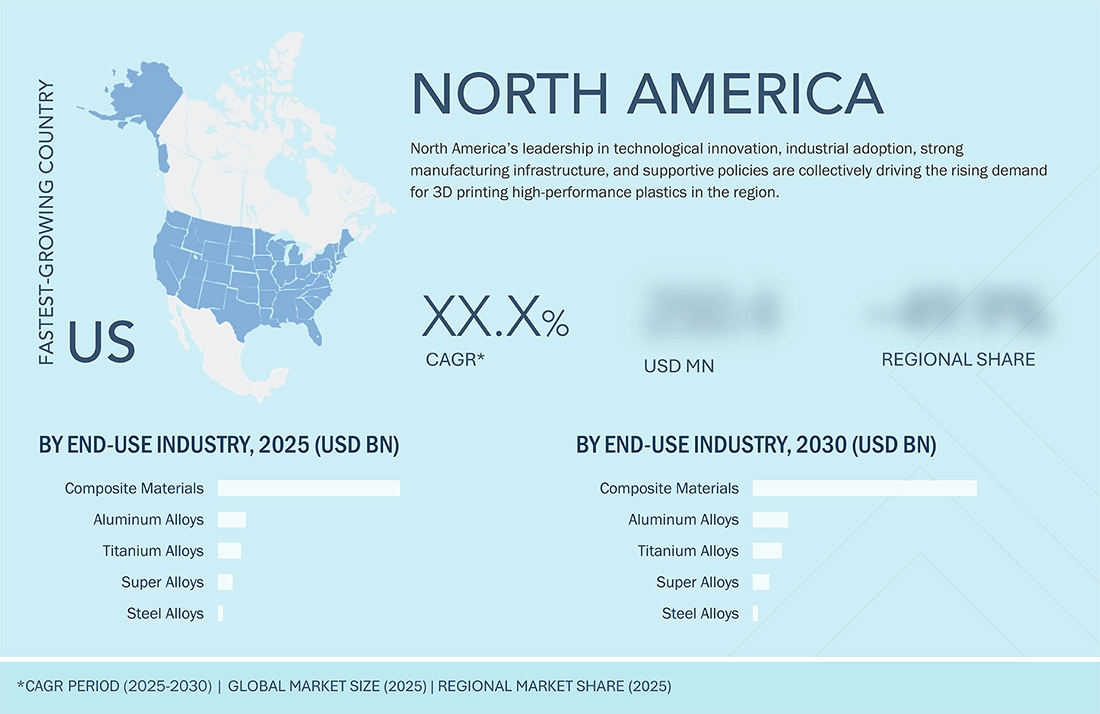
The North America region is projected to dominate the 3D printing high performance plastic market during the forecast period due to presence of significant 3D printing high performance plastic manufacturers like Nano Dimensions (Markforged), Oxford Performance Materials, Impossible Objects, and Evonik Industries which are driving the demand of 3D printing high performance plastic in various end-use industries such as medical & healthcare and aerospace & defense. These companies have tried to expand their operations and garner stronger market shares through organic and inorganic strategies like product launches, collaborations, partnerships, and acquisitions. Due to changing consumer preferences and a growing shift toward sustainability, manufacturers are engaged in the production of sustainable products. For instance, Evonik introduced the world’s first PA12 powder for 3D printing based on bio-circular raw material. North America leads in research & development, with significant investments in innovation and manufacturing proficiency. The integration of generative design tools and artificial intelligence further enhanced the infrastructure in North America, fostering the expansion of key industries using 3D-printed high-performance plastics.
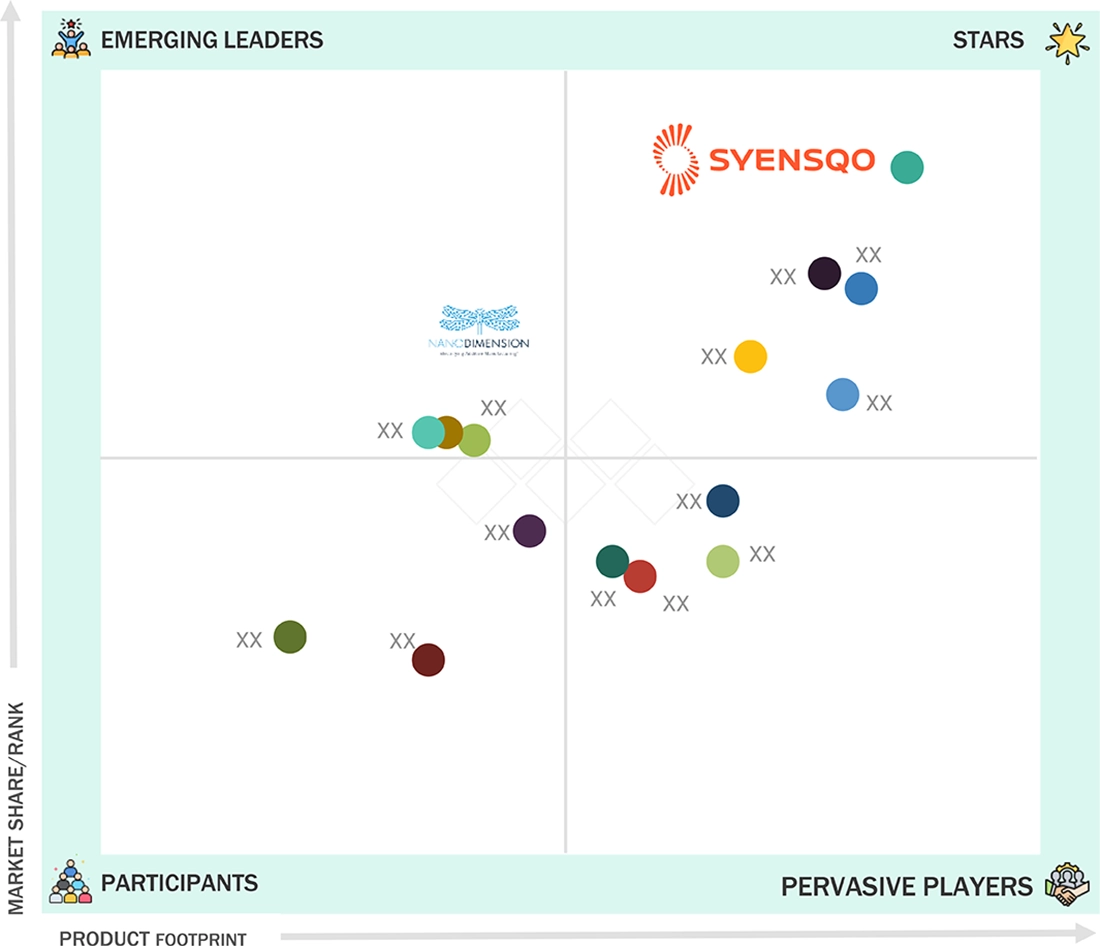
3D Printing High-Performance Plastic Market: COMPANY EVALUATION MATRIX
In the 3D Printing High Performance Plastics market matrix, Syensqo (Star) leads with a strong market share and extensive product footprint, driven by its collaborations and partnerships with end-users. Nano Dimensions (Emerging Leader) is gaining visibility with its specialized high performance plastics and tailored solutions for particular applications, strengthening its position through innovation and niche product offerings. While Syensqo dominates through scale and a diverse portfolio, Nano Dimension shows significant potential to move toward the leaders’ quadrant as demand for 3D Printing High Performance Plastics continues to rise.
Source: Secondary Research, Interviews with Experts, MarketsandMarkets Analysis
KEY MARKET PLAYERS
MARKET SCOPE
| REPORT METRIC | DETAILS |
|---|---|
| Market Size in 2024 (Value) | USD 0.15 Billion |
| Market Forecast in 2030 (value) | USD 0.45 Billion |
| Growth Rate | CAGR of 20.4% from 2025-2030 |
| Years Considered | 2022-2030 |
| Base Year | 2024 |
| Forecast Period | 2025-2030 |
| Units Considered | Value (USD Million/Billion), Volume (Tons) |
| Report Coverage | Revenue forecast, company ranking, competitive landscape, growth factors, and trends. |
| Segments Covered |
|
| Regions Covered | North America, Asia Pacific, Europe, South America, Middle East & Africa |
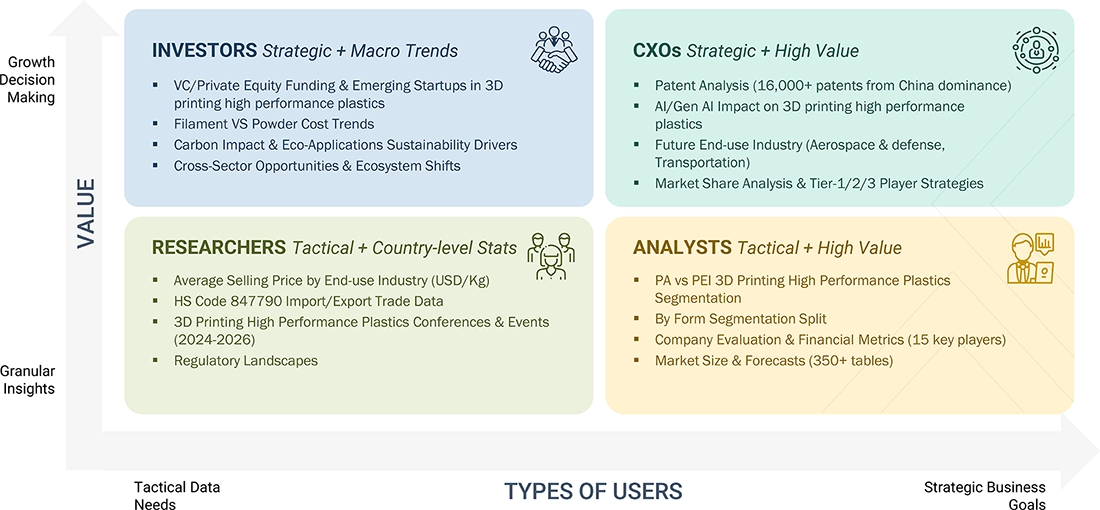
WHAT IS IN IT FOR YOU: 3D Printing High-Performance Plastic Market REPORT CONTENT GUIDE
DELIVERED CUSTOMIZATIONS
We have successfully delivered the following deep-dive customizations:
| CLIENT REQUEST | CUSTOMIZATION DELIVERED | VALUE ADDS |
|---|---|---|
| 3D printing high performance plastics manufacturer |
|
|
| High Performance Polymer Parts Manufacturers |
|
|
| Industrial 3D Printer OEMs |
|
|
| End -user |
|
|
RECENT DEVELOPMENTS
- September 2026: Syensqo announced a new compounding line at its Panoli, India site for high-performance aromatic polymers, with the capacity to include KetaSpire® PEEK alongside PPS, PPA and PARA materials. The investment will double current Panoli compounding capacity and is planned to become operational in Q1 2028, strengthening local availability of high-performance polymer materials relevant to demanding additive-manufacturing applications.
- December 2025: Victrex Plc updated its VICTREX AM™ 211 FIL material specification for additive manufacturing. The carbon-fibre-compounded LMPAEK™ filament is designed for FFF printing and provides improved printed-part strength and printability compared with PEEK, while retaining suitability for higher-temperature and chemically aggressive environments.
- November 2025: Arkema showcased its latest high-performance additive-manufacturing materials at Formnext 2025, including Orgasol® PA12 powders for powder-bed-fusion 3D printing and N3xtDimension® high-temperature resins. It also presented a collaboration with Manifest Technologies using N3xtDimension® high-temperature resin to produce thermally stable components through volumetric additive manufacturing.
- April 2025: Ensigner launched TECAFIL PC FRT GF10 black, a glass-fibre-reinforced, flame-retardant polycarbonate filament developed for railway 3D printing. The material is designed for prototypes, low-volume parts and spare parts, with printed specimens tested to EN 45545-2:2020, FAR 25.853 and UL94 V-0 requirements; it provides high mechanical strength while being easier to process than higher-temperature PEEK or PEI printing materials.
- March 2025: Evonik Industries (Germany) partnered with 3DChimera to expand U.S. distribution of its INFINAM® 3D-printing powders. The agreement covers industrial SLS PA12 materials offering high temperature resistance, stiffness, flexibility and carbon-black reinforcement, expanding access to ready-to-use high-performance polymer materials for industrial powder-bed-fusion applications.
Table of Contents
 Exclusive indicates content/data unique to MarketsandMarkets and not available with any competitors.
TITLE
PAGE NO
1
INTRODUCTION
35
2
RESEARCH METHODOLOGY
40
3
EXECUTIVE SUMMARY
50
4
PREMIUM INSIGHTS
55
5
MARKET OVERVIEW
Booming demand for sustainable 3D printing plastics reshapes industries amid cost and acceptance challenges.
59
5.1
INTRODUCTION
5.2
MARKET DYNAMICS
5.2.1
DRIVERS
5.2.1.1
INCREASING APPLICATIONS IN MEDICAL & HEALTHCARE, AEROSPACE & DEFENSE, AND AUTOMOTIVE INDUSTRIES
5.2.1.2
DEVELOPMENT OF APPLICATION-SPECIFIC GRADES FOR 3D PRINTING HIGH-PERFORMANCE PLASTICS
5.2.1.3
GOVERNMENT INITIATIVES TO SUPPORT ADOPTION IN DIFFERENT INDUSTRIES
5.2.1.4
RISING INVESTMENTS AND FAVORABLE POLICIES FOR SUSTAINABLE SOLUTIONS
5.2.2
RESTRAINTS
5.2.2.1
ENVIRONMENTAL CONCERNS REGARDING DISPOSAL OF 3D-PRINTED PLASTIC PRODUCTS
5.2.2.2
SKEPTICISM ABOUT ACCEPTANCE OF NEW TECHNOLOGIES IN EMERGING ECONOMIES
5.2.3
OPPORTUNITIES
5.2.3.1
INCREASING DEMAND FOR BIO-BASED GRADES OF 3D PRINTING HIGH-PERFORMANCE PLASTICS
5.2.3.2
GROWING PENETRATION OF REINFORCED 3D PRINTING HIGH-PERFORMANCE PLASTICS IN MANUFACTURING FUNCTIONAL PARTS
5.2.4
CHALLENGES
5.2.4.1
HIGH MANUFACTURING COST OF COMMERCIAL GRADES OF 3D PRINTING HIGH-PERFORMANCE PLASTICS
5.2.4.2
PROLONGED LEAD TIME
5.3
PORTER’S FIVE FORCES ANALYSIS
5.3.1
THREAT OF NEW ENTRANTS
5.3.2
THREAT OF SUBSTITUTES
5.3.3
BARGAINING POWER OF SUPPLIERS
5.3.4
BARGAINING POWER OF BUYERS
5.3.5
INTENSITY OF COMPETITIVE RIVALRY
5.4
KEY STAKEHOLDERS AND BUYING CRITERIA
5.4.1
KEY STAKEHOLDERS IN BUYING PROCESS
5.4.2
BUYING CRITERIA
5.5
MACROECONOMICS INDICATORS
5.5.1
INTRODUCTION
5.5.2
GDP TRENDS AND FORECAST
5.5.3
TRENDS IN MEDICAL & HEALTHCARE INDUSTRY
5.5.4
TRENDS IN AEROSPACE & DEFENSE INDUSTRY
5.6
SUPPLY CHAIN ANALYSIS
5.6.1
RAW MATERIAL
5.6.2
FINAL PRODUCT ANALYSIS
5.7
VALUE CHAIN ANALYSIS
5.8
ECOSYSTEM ANALYSIS
5.9
PRICING ANALYSIS
5.9.1
AVERAGE SELLING PRICE OF END-USE INDUSTRIES, BY KEY PLAYERS, 2024
5.9.2
AVERAGE SELLING PRICE TREND, BY TYPE
5.9.3
AVERAGE SELLING PRICE TREND, BY APPLICATION, 2022–2025
5.9.4
AVERAGE SELLING PRICE TREND, BY REGION
5.10
TRADE ANALYSIS
5.10.1
IMPORT SCENARIO (HS CODE 847790)
5.10.2
EXPORT SCENARIO (HS CODE 847790)
5.11
TECHNOLOGY ANALYSIS
5.11.1
KEY TECHNOLOGIES
5.11.1.1
FUSED DEPOSITION MODELING (FDM)/FUSED FILAMENT FABRICATION (FFF)
5.11.1.2
SELECTIVE LASER SINTERING (SLS)
5.11.2
COMPLEMENTARY TECHNOLOGIES
5.11.2.1
AUTOMATED FIBER PLACEMENT
5.12
IMPACT OF AI/GEN AI ON 3D PRINTING HIGH PERFORMANCE PLASTIC MARKET
5.12.1
TOP USE CASES AND MARKET POTENTIAL
5.12.2
BEST PRACTICES IN 3D PRINTING HIGH-PERFORMANCE PLASTIC MARKET
5.12.3
CASE STUDIES OF AI IMPLEMENTATION IN 3D PRINTING HIGH PERFORMANCE PLASTIC MARKET
5.12.4
INTERCONNECTED ADJACENT ECOSYSTEM AND IMPACT ON MARKET PLAYERS
5.12.5
CLIENTS’ READINESS TO ADOPT GENERATIVE AI IN 3D PRINTING HIGH-PERFORMANCE PLASTIC MARKET
5.13
PATENT ANALYSIS
5.13.1
INTRODUCTION
5.13.2
METHODOLOGY
5.13.3
PATENT TYPE
5.13.4
INSIGHTS
5.13.5
LEGAL STATUS OF PATENTS
5.13.6
JURISDICTION ANALYSIS
5.13.7
TOP APPLICANTS
5.13.8
LIST OF PATENTS BY FORD GLOBAL TECHNOLOGIES LLC
5.13.9
LIST OF PATENTS BY HEWLETT-PACKARD DEVELOPMENT COMPANY
5.13.10
LIST OF PATENTS BY BASF SE
5.14
REGULATORY LANDSCAPE
5.14.1
REGULATORY BODIES, GOVERNMENT AGENCIES, AND OTHER ORGANIZATIONS
5.15
KEY CONFERENCES AND EVENTS, 2024–2025
5.16
CASE STUDY ANALYSIS
5.16.1
TO DEVELOP MATERIALS FOR AEROSPACE AND AUTOMOTIVE INDUSTRIES TO PRODUCE GOOD-QUALITY COMPLEX PARTS AT RAPID PACE
5.16.2
LOCKHEED MARTIN AND HIGH-PERFORMANCE THERMOPLASTICS
5.16.3
EVONIK INTRODUCED WORLD’S FIRST PA12 POWDER FOR 3D PRINTING BASED ON BIO-CIRCULAR RAW MATERIAL
5.17
TRENDS AND DISRUPTIONS IMPACTING CUSTOMER BUSINESS
5.18
INVESTMENT AND FUNDING SCENARIO
5.19
IMPACT OF 2025 US TARIFF - 3D PRINTING HIGH-PERFORMANCE PLASTIC MARKET
5.19.1
INTRODUCTION
5.19.2
KEY TARIFF RATES
5.19.3
PRICE IMPACT ANALYSIS
5.19.4
KEY IMPACTS ON COUNTRY/REGION
5.19.4.1
US
5.19.4.2
EUROPE
5.19.4.3
ASIA PACIFIC
6
3D PRINTING HIGH-PERFORMANCE PLASTIC MARKET, BY TYPE
Market Size & Growth Rate Forecast Analysis to 2030 in USD Thousand and Tons | 32 Data Tables
104
6.1
INTRODUCTION
6.2
POLYAMIDE (PA)
6.2.1
DURABILITY, HEAT RESISTANCE, AND RESISTANCE AGAINST CORROSION BY CHEMICALS, WATER, FUELS, AND LUBRICANTS TO DRIVE MARKET
6.3
POLYETHERIMIDE (PEI)
6.3.1
HIGH DEMAND FROM AEROSPACE, AUTOMOTIVE, AND INDUSTRIAL SECTORS
6.4
POLYETHER ETHER KETONE & POLYETHER KETONE (PEEK & PEKK)
6.4.1
HIGH R&D INVESTMENTS TO BOOST MASS PRODUCTION
6.5
REINFORCED HPP
6.5.1
LARGE DEMAND FROM HIGH-END APPLICATIONS
6.5.2
REINFORCED 3D PRINTING HIGH-PERFORMANCE PLASTIC, BY RESIN TYPE
6.5.2.1
THERMOPLASTIC RESINS
6.5.2.2
THERMOSET RESINS
6.5.3
REINFORCED HPP, BY FIBER TYPE
6.5.3.1
CARBON FIBER
6.5.3.2
OTHER FIBER TYPES
6.6
OTHER TYPES
6.6.1
PPSU (POLYPHENYLSULFONE)
6.6.2
PAI (POLYAMIDE-IMIDE)
6.6.3
PSU (POLYSULFONE)
6.6.4
PES (POLYETHER SULFONE)
7
3D PRINTING HIGH-PERFORMANCE PLASTIC MARKET, BY FORM
Market Size & Growth Rate Forecast Analysis to 2030 in USD Thousand and Tons | 12 Data Tables
124
7.1
INTRODUCTION
7.2
FILAMENT & PELLET
7.2.1
MATERIALS SUCH AS PEEK & PEKK, PEI, PPSU, PES, PSU, PVDF, AND REINFORCED HPP TO DRIVE MARKET
7.3
POWDER
7.3.1
MARKET GROWTH SUPPORTED BY DEVELOPMENT OF FUSED FILAMENT FABRICATION (SLS) TECHNOLOGY
8
3D PRINTING HIGH-PERFORMANCE PLASTIC MARKET, BY TECHNOLOGY
Market Size & Growth Rate Forecast Analysis to 2030 in USD Thousand and Tons | 24 Data Tables
131
8.1
INTRODUCTION
8.2
FUSED DEPOSITION MODELING (FDM)/FUSED FILAMENT FABRICATION (FFF)
8.2.1
FDM/FFF TECHNOLOGY TO PRODUCE STRONG AND DURABLE PARTS WITH COMPLEX GEOMETRIES
8.2.2
FDM/FFF MARKET, BY TYPE
8.2.3
FDM/FFF TECHNOLOGY, BY APPLICATION
8.2.4
FDM/FFF TECHNOLOGY, BY END-USE INDUSTRY
8.3
SELECTIVE LASER SINTERING (SLS)
8.3.1
PRODUCTION OF PARTS WITH COMPLEX GEOMETRIES AND GOOD MECHANICAL PROPERTIES
9
3D PRINTING HIGH-PERFORMANCE PLASTIC MARKET, BY APPLICATION
Market Size & Growth Rate Forecast Analysis to 2030 in USD Thousand and Tons | 16 Data Tables
143
9.1
INTRODUCTION
9.2
PROTOTYPING
9.2.1
DEVELOPS 3D MODELS AT LOW COST AND IN REDUCED TIME
9.3
TOOLING
9.3.1
MANUFACTURE OF COMPONENTS AT LOW COST WITHOUT COMPROMISING QUALITY AND FUNCTIONALITIES
9.4
FUNCTIONAL PART MANUFACTURING
9.4.1
SHIFT TOWARD BULK MANUFACTURING TO DRIVE PENETRATION OF 3D PRINTING HIGH-PERFORMANCE PLASTICS
10
3D PRINTING HIGH-PERFORMANCE PLASTIC MARKET, BY END-USE INDUSTRY
Market Size & Growth Rate Forecast Analysis to 2030 in USD Thousand and Tons | 24 Data Tables
152
10.1
INTRODUCTION
10.2
MEDICAL & HEALTHCARE
10.2.1
MEDICAL DEVICES, IMPLANTS, AND BIO-PRINTING HUMAN ORGANS TO DRIVE MARKET
10.3
AEROSPACE & DEFENSE
10.3.1
REPLACEMENT OF METAL COMPONENTS TO INCREASE FUEL EFFICIENCY TO DRIVE MARKET
10.4
TRANSPORTATION
10.4.1
PROTOTYPING AUTOMOTIVE COMPONENTS TO DRIVE MARKET
10.5
OIL & GAS
10.5.1
MANUFACTURE OF STIFF, LIGHTWEIGHT, DURABLE, AND CORROSION-RESISTANT COMPONENTS TO DRIVE MARKET
10.6
OTHER END-USE INDUSTRIES
10.6.1
ELECTRICAL & ELECTRONICS
10.6.2
CONSUMER GOODS
10.6.3
INDUSTRIAL
11
3D PRINTING HIGH-PERFORMANCE PLASTIC MARKET, BY REGION
Comprehensive coverage of 8 Regions with country-level deep-dive of 16 Countries | 212 Data Tables.
164
11.1
INTRODUCTION
11.2
NORTH AMERICA
11.2.1
NORTH AMERICA: 3D PRINTING HIGH-PERFORMANCE PLASTIC MARKET, BY TYPE
11.2.2
NORTH AMERICA: 3D PRINTING HIGH-PERFORMANCE PLASTIC MARKET, BY FORM
11.2.3
NORTH AMERICA: 3D PRINTING HIGH-PERFORMANCE PLASTIC MARKET, BY APPLICATION
11.2.4
NORTH AMERICA: 3D PRINTING HIGH-PERFORMANCE PLASTIC MARKET, BY END-USE INDUSTRY
11.2.5
NORTH AMERICA: 3D PRINTING HIGH-PERFORMANCE PLASTIC MARKET, BY COUNTRY
11.2.5.1
US
11.2.5.2
CANADA
11.2.5.3
MEXICO
11.3
EUROPE
11.3.1
EUROPE: 3D PRINTING HIGH-PERFORMANCE PLASTIC MARKET, BY TYPE
11.3.2
EUROPE: 3D PRINTING HIGH-PERFORMANCE PLASTIC MARKET, BY FORM
11.3.3
EUROPE: 3D PRINTING HIGH-PERFORMANCE PLASTIC MARKET, BY APPLICATION
11.3.4
EUROPE: 3D PRINTING HIGH-PERFORMANCE PLASTIC MARKET, BY END-USE INDUSTRY
11.3.5
EUROPE: 3D PRINTING HIGH-PERFORMANCE PLASTIC MARKET, BY COUNTRY
11.3.5.1
GERMANY
11.3.5.2
FRANCE
11.3.5.3
UK
11.3.5.4
ITALY
11.3.5.5
SPAIN
11.3.5.6
REST OF EUROPE
11.4
ASIA PACIFIC
11.4.1
ASIA PACIFIC: 3D PRINTING HIGH-PERFORMANCE PLASTIC MARKET, BY TYPE
11.4.2
ASIA PACIFIC: 3D PRINTING HIGH-PERFORMANCE PLASTIC MARKET, BY FORM
11.4.3
ASIA PACIFIC: 3D PRINTING HIGH-PERFORMANCE PLASTIC MARKET, BY APPLICATION
11.4.4
ASIA PACIFIC: 3D PRINTING HIGH-PERFORMANCE PLASTIC MARKET, END-USE INDUSTRY
11.4.5
ASIA PACIFIC: 3D PRINTING HIGH-PERFORMANCE PLASTIC MARKET, BY COUNTRY
11.4.5.1
CHINA
11.4.5.2
JAPAN
11.4.5.3
SOUTH KOREA
11.4.5.4
INDIA
11.4.5.5
REST OF ASIA PACIFIC
11.5
SOUTH AMERICA
11.5.1
SOUTH AMERICA: 3D PRINTING HIGH-PERFORMANCE PLASTIC MARKET, BY TYPE
11.5.2
SOUTH AMERICA: 3D PRINTING HIGH-PERFORMANCE PLASTIC MARKET, BY FORM
11.5.3
SOUTH AMERICA: 3D PRINTING HIGH-PERFORMANCE PLASTIC MARKET, BY APPLICATION
11.5.4
SOUTH AMERICA: 3D PRINTING HIGH-PERFORMANCE PLASTIC MARKET, BY END-USE INDUSTRY
11.5.5
SOUTH AMERICA: 3D PRINTING HIGH-PERFORMANCE PLASTIC MARKET, BY COUNTRY
11.5.5.1
BRAZIL
11.5.5.2
ARGENTINA
11.5.6
REST OF SOUTH AMERICA
11.6
MIDDLE EAST & AFRICA
11.6.1
MIDDLE EAST & AFRICA: 3D PRINTING HIGH-PERFORMANCE PLASTIC MARKET, BY TYPE
11.6.2
MIDDLE EAST & AFRICA: 3D PRINTING HIGH-PERFORMANCE PLASTIC MARKET, BY FORM
11.6.3
MIDDLE EAST & AFRICA: 3D PRINTING HIGH-PERFORMANCE PLASTIC MARKET, BY APPLICATION
11.6.4
MIDDLE EAST & AFRICA: 3D PRINTING HIGH-PERFORMANCE PLASTIC MARKET, BY END-USE INDUSTRY
11.6.5
MIDDLE EAST & AFRICA: 3D PRINTING HIGH-PERFORMANCE PLASTIC MARKET, BY COUNTRY
11.6.5.1
ISRAEL
11.6.5.2
SOUTH AFRICA
11.6.5.3
GCC COUNTRIES
11.6.5.4
REST OF MIDDLE EAST & AFRICA
12
COMPETITIVE LANDSCAPE
Identify market leaders and emerging competitors shaping the industry's future competitive dynamics.
250
12.1
OVERVIEW
12.2
KEY PLAYER STRATEGIES/RIGHT TO WIN, 2019–2025
12.3
REVENUE ANALYSIS, 2020–2024
12.4
MARKET SHARE ANALYSIS, 2024
12.5
BRAND COMPARISON
12.5.1
INFINAM (EVONIK INDUSTRIES)
12.5.2
KEPSTAN (ARKEMA)
12.5.3
KETASPIRE (SOLVAY)
12.5.4
HT-23 (EOS GMBH)
12.6
COMPANY EVALUATION MATRIX: KEY PLAYERS, 2024
12.6.1
STARS
12.6.2
EMERGING LEADERS
12.6.3
PERVASIVE PLAYERS
12.6.4
PARTICIPANTS
12.6.5
COMPANY FOOTPRINT: KEY PLAYERS, 2024
12.6.5.1
COMPANY FOOTPRINT
12.6.5.2
REGION FOOTPRINT
12.6.5.3
TYPE FOOTPRINT
12.6.5.4
FORM FOOTPRINT
12.6.5.5
TECHNOLOGY FOOTPRINT
12.6.5.6
APPLICATION FOOTPRINT
12.6.5.7
END-USE INDUSTRY FOOTPRINT
12.7
COMPANY EVALUATION MATRIX: STARTUPS/SMES, 2024
12.7.1
PROGRESSIVE COMPANIES
12.7.2
RESPONSIVE COMPANIES
12.7.3
DYNAMIC COMPANIES
12.7.4
STARTING BLOCKS
12.7.5
COMPETITIVE BENCHMARKING: STARTUPS/SMES, 2024
12.7.5.1
DETAILED LIST OF KEY STARTUPS/SMES
12.7.5.2
COMPETITIVE BENCHMARKING OF KEY STARTUPS/SMES
12.7.5.3
COMPETITIVE BENCHMARKING OF KEY STARTUPS/SMES
12.8
COMPANY VALUATION AND FINANCIAL METRICS
12.9
COMPETITIVE SCENARIOS
12.9.1
PRODUCT LAUNCHES
12.9.2
DEALS
12.9.3
EXPANSIONS
13
COMPANY PROFILES
In-depth Company Profiles of Leading Market Players with detailed Business Overview, Product and Service Portfolio, Recent Developments, and Unique Analyst Perspective (MnM View)
276
13.1
KEY PLAYERS
13.1.1
EVONIK INDUSTRIES
13.1.1.1
BUSINESS OVERVIEW
13.1.1.2
PRODUCTS OFFERED
13.1.1.3
RECENT DEVELOPMENTS
13.1.1.4
MNM VIEW
13.1.2
ARKEMA
13.1.3
LEHMANN&VOSS&CO.
13.1.4
NANO DIMENSIONS (MARKFORGED)
13.1.5
OXFORD PERFORMANCE MATERIALS
13.1.6
EOS GMBH
13.1.7
SOLVAY
13.1.8
SABIC
13.1.9
FORWARD AM TECHNOLOGIES GMBH
13.1.10
IMPOSSIBLE OBJECTS
13.1.11
APIUM ADDITIVE TECHNOLOGIES GMBH
13.1.12
ENSINGER
13.1.13
VICTREX PLC
13.1.14
MITSUBISHI CHEMICAL CORPORATION
13.1.15
TORAY INDUSTRIES, INC.
13.2
OTHER PLAYERS
13.2.1
PROTO LABS
13.2.2
3DXTECH
13.2.3
3D4MAKERS.COM
13.2.4
ZORTRAX
13.2.5
TREED FILAMENTS
13.2.6
FORMLABS
13.2.7
EPLUS3D
13.2.8
JUNHUA PEEK
13.2.9
SCULPTEO
13.2.10
PEEKCHINA
14
APPENDIX
328
14.1
DISCUSSION GUIDE
14.2
KNOWLEDGESTORE: MARKETSANDMARKETS’ SUBSCRIPTION PORTAL
14.3
CUSTOMIZATION OPTIONS
14.4
RELATED REPORTS
14.5
AUTHOR DETAILS
LIST OF TABLES
TABLE 1
3D PRINTING HIGH-PERFORMANCE PLASTIC MARKET: PORTER’S FIVE FORCES ANALYSIS
TABLE 2
INFLUENCE OF STAKEHOLDERS ON BUYING PROCESS, BY END-USE INDUSTRY (%)
TABLE 3
KEY BUYING CRITERIA, BY APPLICATION
TABLE 4
GDP PERCENTAGE CHANGE, BY KEY COUNTRY, 2021–2029
TABLE 5
3D PRINTING HIGH-PERFORMANCE PLASTIC MARKET: ROLES OF COMPANIES IN ECOSYSTEM
TABLE 6
AVERAGE SELLING PRICE OF 3D PRINTING HIGH-PERFORMANCE PLASTIC, BY END-USE INDUSTRY, USD/KG, 2024
TABLE 7
AVERAGE SELLING PRICE OF 3D PRINTING HIGH-PERFORMANCE PLASTIC, BY TYPE, USD/KG, 2022–2025
TABLE 8
AVERAGE SELLING PRICE OF 3D PRINTING HIGH-PERFORMANCE PLASTIC, BY APPLICATION, USD/KG /UNIT, 2022–2025
TABLE 9
AVERAGE SELLING PRICE OF 3D PRINTING HIGH-PERFORMANCE PLASTIC, BY REGION, USD/KG /UNIT, 2022–2025
TABLE 10
LEADING IMPORTERS OF HS CODE 847790, 2021–2024 (USD MILLION)
TABLE 11
LEADING EXPORTERS OF HS CODE 847790, 2020–2024
TABLE 12
TOP USE CASES AND MARKET POTENTIAL
TABLE 13
BEST PRACTICES: COMPANIES IMPLEMENTING USE CASES
TABLE 14
3D PRINTING HIGH-PERFORMANCE PLASTIC MARKET: CASE STUDIES RELATED TO GEN AI IMPLEMENTATION
TABLE 15
INTERCONNECTED ADJACENT ECOSYSTEM AND IMPACT ON MARKET PLAYERS
TABLE 16
3D PRINTING HIGH-PERFORMANCE PLASTIC MARKET: TOTAL NUMBER OF PATENTS (JANUARY 2015–MARCH 2025)
TABLE 17
NORTH AMERICA: REGULATORY BODIES, GOVERNMENT AGENCIES, AND OTHER ORGANIZATIONS
TABLE 18
EUROPE: REGULATORY BODIES, GOVERNMENT AGENCIES, AND OTHER ORGANIZATIONS
TABLE 19
ASIA PACIFIC: REGULATORY BODIES, GOVERNMENT AGENCIES, AND OTHER ORGANIZATIONS
TABLE 20
REST OF WORLD: REGULATORY BODIES, GOVERNMENT AGENCIES, AND OTHER ORGANIZATIONS
TABLE 21
3D PRINTING HIGH-PERFORMANCE PLASTIC MARKET: LIST OF KEY CONFERENCES AND EVENTS, 2024–2025
TABLE 22
US-ADJUSTED RECIPROCAL TARIFF RATES
TABLE 23
3D PRINTING HIGH-PERFORMANCE PLASTIC MARKET, BY TYPE, 2022–2024 (USD THOUSAND)
TABLE 24
3D PRINTING HIGH-PERFORMANCE PLASTIC MARKET, BY TYPE, 2022–2024 (TON)
TABLE 25
3D PRINTING HIGH-PERFORMANCE PLASTIC MARKET, BY TYPE, 2025–2030 (USD THOUSAND)
TABLE 26
3D PRINTING HIGH-PERFORMANCE PLASTIC MARKET, BY TYPE, 2025–2030 (TON)
TABLE 27
PA: 3D PRINTING HIGH-PERFORMANCE PLASTIC MARKET, BY REGION, 2022–2024 (USD THOUSAND)
TABLE 28
PA: 3D PRINTING HIGH-PERFORMANCE PLASTIC MARKET, BY REGION, 2022–2024 (TON)
TABLE 29
PA: 3D PRINTING HIGH-PERFORMANCE PLASTIC MARKET, BY REGION, 2025–2030 (USD THOUSAND)
TABLE 30
PA: 3D PRINTING HIGH-PERFORMANCE PLASTIC MARKET, BY REGION, 2025–2030 (TON)
TABLE 31
POLYETHERIMIDE: 3D PRINTING HIGH-PERFORMANCE PLASTIC MARKET, BY REGION, 2022–2024 (USD THOUSAND)
TABLE 32
POLYETHERIMIDE: 3D PRINTING HIGH-PERFORMANCE PLASTIC MARKET, BY REGION, 2022–2024 (TON)
TABLE 33
POLYETHERIMIDE: 3D PRINTING HIGH-PERFORMANCE PLASTIC MARKET, BY REGION, 2025–2030 (USD THOUSAND)
TABLE 34
POLYETHERIMIDE: 3D PRINTING HIGH-PERFORMANCE PLASTIC MARKET, BY REGION, 2025–2030 (TON)
TABLE 35
PEEK & PEKK: 3D PRINTING HIGH-PERFORMANCE PLASTIC MARKET, BY REGION, 2022–2024 (USD THOUSAND)
TABLE 36
PEEK & PEKK: 3D PRINTING HIGH-PERFORMANCE PLASTIC MARKET, BY REGION, 2022–2024 (TON)
TABLE 37
PEEK & PEKK: 3D PRINTING HIGH-PERFORMANCE PLASTIC MARKET, BY REGION, 2025–2030 (USD THOUSAND)
TABLE 38
PEEK & PEKK: 3D PRINTING HIGH-PERFORMANCE PLASTIC MARKET, BY REGION, 2025–2030 (TON)
TABLE 39
REINFORCED 3D PRINTING HIGH-PERFORMANCE PLASTIC MARKET, BY REGION, 2022–2024 (USD THOUSAND)
TABLE 40
REINFORCED 3D PRINTING HIGH-PERFORMANCE PLASTIC MARKET, BY REGION, 2022–2024 (TON)
TABLE 41
REINFORCED 3D PRINTING HIGH-PERFORMANCE PLASTIC MARKET, BY REGION, 2025–2030 (USD THOUSAND)
TABLE 42
REINFORCED 3D PRINTING HIGH-PERFORMANCE PLASTIC MARKET, BY REGION, 2025–2030 (TON)
TABLE 43
REINFORCED 3D PRINTING HIGH-PERFORMANCE PLASTIC MARKET, BY RESIN TYPE, 2022–2024 (USD THOUSAND)
TABLE 44
REINFORCED 3D PRINTING HIGH-PERFORMANCE PLASTIC MARKET, BY RESIN TYPE, 2022–2024 (TON)
TABLE 45
REINFORCED 3D PRINTING HIGH-PERFORMANCE PLASTIC MARKET, BY RESIN TYPE, 2025–2030 (USD THOUSAND)
TABLE 46
REINFORCED 3D PRINTING HIGH-PERFORMANCE PLASTIC MARKET, BY RESIN TYPE, 2025–2030 (TON)
TABLE 47
REINFORCED 3D PRINTING HIGH-PERFORMANCE PLASTIC MARKET, BY FIBER TYPE, 2022–2024 (USD THOUSAND)
TABLE 48
REINFORCED 3D PRINTING HIGH-PERFORMANCE PLASTIC MARKET, BY FIBER TYPE, 2022–2024 (TON)
TABLE 49
REINFORCED 3D PRINTING HIGH-PERFORMANCE PLASTIC MARKET, BY FIBER TYPE, 2025–2030 (USD THOUSAND)
TABLE 50
REINFORCED 3D PRINTING HIGH-PERFORMANCE PLASTIC MARKET, BY FIBER TYPE, 2025–2030 (TON)
TABLE 51
OTHER TYPES 3D PRINTING HIGH-PERFORMANCE PLASTIC MARKET, BY REGION, 2022–2024 (USD THOUSAND)
TABLE 52
OTHER TYPES 3D PRINTING HIGH-PERFORMANCE PLASTIC MARKET, BY REGION, 2022–2024 (TON)
TABLE 53
OTHER TYPES 3D PRINTING HIGH-PERFORMANCE PLASTIC MARKET, BY REGION, 2025–2030 (USD THOUSAND)
TABLE 54
OTHER TYPES 3D PRINTING HIGH-PERFORMANCE PLASTIC MARKET, BY REGION, 2025–2030 (TON)
TABLE 55
3D PRINTING HIGH-PERFORMANCE PLASTIC MARKET, BY FORM, 2022–2024 (USD THOUSAND)
TABLE 56
3D PRINTING HIGH-PERFORMANCE PLASTIC MARKET, BY FORM, 2022–2024 (TON)
TABLE 57
3D PRINTING HIGH-PERFORMANCE PLASTIC MARKET, BY TYPE, 2025–2030 (USD THOUSAND)
TABLE 58
3D PRINTING HIGH-PERFORMANCE PLASTIC MARKET, BY TYPE, 2025–2030 (TON)
TABLE 59
FILAMENT AND PELLET: 3D PRINTING HIGH-PERFORMANCE PLASTIC MARKET, BY REGION, 2022–2024 (USD THOUSAND)
TABLE 60
FILAMENT AND PELLET: 3D PRINTING HIGH-PERFORMANCE PLASTIC MARKET, BY REGION, 2022–2024 (TON)
TABLE 61
FILAMENT AND PELLET: 3D PRINTING HIGH-PERFORMANCE PLASTIC MARKET, BY REGION, 2025–2030 (USD THOUSAND)
TABLE 62
FILAMENT AND PELLET: 3D PRINTING HIGH-PERFORMANCE PLASTIC MARKET, BY REGION, 2025–2030 (TON)
TABLE 63
POWDER: 3D PRINTING HIGH-PERFORMANCE PLASTIC MARKET, BY REGION, 2022–2024 (USD THOUSAND)
TABLE 64
POWDER: 3D PRINTING HIGH-PERFORMANCE PLASTIC MARKET, BY REGION, 2022–2024 (TON)
TABLE 65
POWDER: 3D PRINTING HIGH-PERFORMANCE PLASTIC MARKET, BY REGION, 2025–2030 (USD THOUSAND)
TABLE 66
POWDER: 3D PRINTING HIGH-PERFORMANCE PLASTIC MARKET, BY REGION, 2025–2030 (TON)
TABLE 67
3D PRINTING HIGH-PERFORMANCE PLASTIC MARKET, BY TECHNOLOGY, 2022–2024 (USD THOUSAND)
TABLE 68
3D PRINTING HIGH-PERFORMANCE PLASTIC MARKET, BY TECHNOLOGY, 2022–2024 (TON)
TABLE 69
3D PRINTING HIGH-PERFORMANCE PLASTIC MARKET, BY TECHNOLOGY, 2025–2030 (USD THOUSAND)
TABLE 70
3D PRINTING HIGH-PERFORMANCE PLASTIC MARKET, BY TECHNOLOGY, 2025–2030 (TON)
TABLE 71
FDM/FFF TECHNOLOGY: 3D PRINTING HIGH-PERFORMANCE PLASTIC MARKET, BY REGION, 2022–2024 (USD THOUSAND)
TABLE 72
FDM/FFF TECHNOLOGY: 3D PRINTING HIGH-PERFORMANCE PLASTIC MARKET, BY REGION, 2022–2024 (TON)
TABLE 73
FDM/FFF TECHNOLOGY: 3D PRINTING HIGH-PERFORMANCE PLASTIC MARKET, BY REGION, 2025–2030 (USD THOUSAND)
TABLE 74
FDM/FFF TECHNOLOGY: 3D PRINTING HIGH-PERFORMANCE PLASTIC MARKET, BY REGION, 2025–2030 (TON)
TABLE 75
FDM/FFF TECHNOLOGY: 3D PRINTING HIGH-PERFORMANCE PLASTIC MARKET, BY TYPE, 2022–2024 (USD THOUSAND)
TABLE 76
FDM/FFF TECHNOLOGY: 3D PRINTING HIGH-PERFORMANCE PLASTIC MARKET, BY PLASTIC TYPE, 2022–2024 (TON)
TABLE 77
FDM/FFF TECHNOLOGY: 3D PRINTING HIGH-PERFORMANCE PLASTIC MARKET, BY PLASTIC TYPE, 2025–2030 (USD THOUSAND)
TABLE 78
FDM/FFF TECHNOLOGY: 3D PRINTING HIGH-PERFORMANCE PLASTIC MARKET, BY PLASTIC TYPE, 2025–2030 (TON)
TABLE 79
FDM/FFF TECHNOLOGY: 3D PRINTING HIGH-PERFORMANCE PLASTIC MARKET, BY APPLICATION, 2022–2024 (USD THOUSAND)
TABLE 80
FDM/FFF TECHNOLOGY: 3D PRINTING HIGH-PERFORMANCE PLASTIC MARKET, BY APPLICATION, 2022–2024 (TON)
TABLE 81
FDM/FFF TECHNOLOGY: 3D PRINTING HIGH-PERFORMANCE PLASTIC MARKET, BY APPLICATION, 2025–2030 (USD THOUSAND)
TABLE 82
FDM/FFF TECHNOLOGY: 3D PRINTING HIGH-PERFORMANCE PLASTIC MARKET, BY APPLICATION, 2025–2030 (TON)
TABLE 83
FDM/FFF TECHNOLOGY: 3D PRINTING HIGH-PERFORMANCE PLASTIC MARKET, BY END-USE INDUSTRY, 2022–2024 (USD THOUSAND)
TABLE 84
FDM/FFF TECHNOLOGY: 3D PRINTING HIGH-PERFORMANCE PLASTIC MARKET, BY END-USE INDUSTRY, 2022–2024 (TON)
TABLE 85
FDM/FFF TECHNOLOGY: 3D PRINTING HIGH-PERFORMANCE PLASTIC MARKET, BY END-USE INDUSTRY, 2025–2030 (USD THOUSAND)
TABLE 86
FDM/FFF TECHNOLOGY: 3D PRINTING HIGH-PERFORMANCE PLASTIC MARKET, BY END-USE INDUSTRY, 2025–2030 (TON)
TABLE 87
SLS TECHNOLOGY: 3D PRINTING HIGH-PERFORMANCE PLASTIC MARKET, BY REGION, 2022–2024 (USD THOUSAND)
TABLE 88
SLS TECHNOLOGY: 3D PRINTING HIGH-PERFORMANCE PLASTIC MARKET, BY REGION, 2022–2024 (TON)
TABLE 89
SLS TECHNOLOGY: 3D PRINTING HIGH-PERFORMANCE PLASTIC MARKET, BY REGION, 2025–2030 (USD THOUSAND)
TABLE 90
SLS TECHNOLOGY: 3D PRINTING HIGH-PERFORMANCE PLASTIC MARKET, BY REGION, 2025–2030 (TON)
TABLE 91
3D PRINTING HIGH-PERFORMANCE PLASTIC MARKET, BY APPLICATION, 2022–2024 (USD THOUSAND)
TABLE 92
3D PRINTING HIGH-PERFORMANCE PLASTIC MARKET, BY APPLICATION, 2022–2024 (TON)
TABLE 93
3D PRINTING HIGH-PERFORMANCE PLASTIC MARKET, BY APPLICATION, 2025–2030 (USD THOUSAND)
TABLE 94
3D PRINTING HIGH-PERFORMANCE PLASTIC MARKET, BY APPLICATION, 2025–2030 (TON)
TABLE 95
PROTOTYPING: 3D PRINTING HIGH-PERFORMANCE PLASTIC MARKET, BY REGION, 2022–2024 (USD THOUSAND)
TABLE 96
PROTOTYPING: 3D PRINTING HIGH-PERFORMANCE PLASTIC MARKET, BY REGION, 2022–2024 (TON)
TABLE 97
PROTOTYPING: 3D PRINTING HIGH-PERFORMANCE PLASTIC MARKET, BY REGION, 2025–2030 (USD THOUSAND)
TABLE 98
PROTOTYPING: 3D PRINTING HIGH-PERFORMANCE PLASTIC MARKET, BY REGION, 2025–2030 (TON)
TABLE 99
TOOLING: 3D PRINTING HIGH-PERFORMANCE PLASTIC MARKET, BY REGION, 2022–2024 (USD THOUSAND)
TABLE 100
TOOLING: 3D PRINTING HIGH-PERFORMANCE PLASTIC MARKET, BY REGION, 2022–2024 (TON)
TABLE 101
TOOLING: 3D PRINTING HIGH-PERFORMANCE PLASTIC MARKET, BY REGION, 2025–2030 (USD THOUSAND)
TABLE 102
TOOLING: 3D PRINTING HIGH-PERFORMANCE PLASTIC MARKET, BY REGION, 2025–2030 (TON)
TABLE 103
FUNCTIONAL PART MANUFACTURING: 3D PRINTING HIGH-PERFORMANCE PLASTIC MARKET, BY REGION, 2022–2024 (USD THOUSAND)
TABLE 104
FUNCTIONAL PART MANUFACTURING: 3D PRINTING HIGH-PERFORMANCE PLASTIC MARKET, BY REGION, 2022–2024 (TON)
TABLE 105
FUNCTIONAL PART MANUFACTURING EQUIPMENT: 3D PRINTING HIGH-PERFORMANCE PLASTIC MARKET, BY REGION, 2025–2030 (USD THOUSAND)
TABLE 106
FUNCTIONAL PART MANUFACTURING EQUIPMENT: 3D PRINTING HIGH-PERFORMANCE PLASTIC MARKET, BY REGION, 2025–2030 (TON)
TABLE 107
3D PRINTING HIGH-PERFORMANCE PLASTIC MARKET, BY END-USE INDUSTRY, 2022–2024 (USD THOUSAND)
TABLE 108
3D PRINTING HIGH-PERFORMANCE PLASTIC MARKET, BY END-USE INDUSTRY, 2022–2024 (TON)
TABLE 109
3D PRINTING HIGH-PERFORMANCE PLASTIC MARKET, BY END-USE INDUSTRY, 2025–2030 (USD THOUSAND)
TABLE 110
3D PRINTING HIGH-PERFORMANCE PLASTIC MARKET, BY END-USE INDUSTRY, 2025–2030 (TON)
TABLE 111
MEDICAL & HEALTHCARE: 3D PRINTING HIGH-PERFORMANCE PLASTIC MARKET, BY REGION, 2022–2024 (USD THOUSAND)
TABLE 112
MEDICAL & HEALTHCARE: 3D PRINTING HIGH-PERFORMANCE PLASTIC MARKET, BY REGION, 2022–2024 (TON)
TABLE 113
MEDICAL & HEALTHCARE: 3D PRINTING HIGH-PERFORMANCE PLASTIC MARKET, BY REGION, 2025–2030 (USD THOUSAND)
TABLE 114
MEDICAL & HEALTHCARE: 3D PRINTING HIGH-PERFORMANCE PLASTIC MARKET, BY REGION, 2025–2030 (TON)
TABLE 115
AEROSPACE & DEFENSE: 3D PRINTING HIGH-PERFORMANCE PLASTIC MARKET, BY REGION, 2022–2024 (USD THOUSAND)
TABLE 116
AEROSPACE & DEFENSE: 3D PRINTING HIGH-PERFORMANCE PLASTIC MARKET, BY REGION, 2022–2024 (TON)
TABLE 117
AEROSPACE & DEFENSE: 3D PRINTING HIGH-PERFORMANCE PLASTIC MARKET, BY REGION, 2025–2030 (USD THOUSAND)
TABLE 118
AEROSPACE & DEFENSE: 3D PRINTING HIGH-PERFORMANCE PLASTIC MARKET, BY REGION, 2025–2030 (TON)
TABLE 119
TRANSPORTATION: 3D PRINTING HIGH-PERFORMANCE PLASTIC MARKET, BY REGION, 2022–2024 (USD THOUSAND)
TABLE 120
TRANSPORTATION: 3D PRINTING HIGH-PERFORMANCE PLASTIC MARKET, BY REGION, 2022–2024 (TON)
TABLE 121
TRANSPORTATION: 3D PRINTING HIGH-PERFORMANCE PLASTIC MARKET, BY REGION, 2025–2030 (USD THOUSAND)
TABLE 122
TRANSPORTATION: 3D PRINTING HIGH-PERFORMANCE PLASTIC MARKET, BY REGION, 2025–2030 (TON)
TABLE 123
OIL & GAS: 3D PRINTING HIGH-PERFORMANCE PLASTIC MARKET, BY REGION, 2022–2024 (USD THOUSAND)
TABLE 124
OIL & GAS: 3D PRINTING HIGH-PERFORMANCE PLASTIC MARKET, BY REGION, 2022–2024 (TON)
TABLE 125
OIL & GAS: 3D PRINTING HIGH-PERFORMANCE PLASTIC MARKET, BY REGION, 2025–2030 (USD THOUSAND)
TABLE 126
OIL & GAS: 3D PRINTING HIGH-PERFORMANCE PLASTIC MARKET, BY REGION, 2025–2030 (TON)
TABLE 127
OTHER END-USE INDUSTRIES: 3D PRINTING HIGH-PERFORMANCE PLASTIC MARKET, BY REGION, 2022–2024 (USD THOUSAND)
TABLE 128
OTHER END-USE INDUSTRIES: 3D PRINTING HIGH-PERFORMANCE PLASTIC MARKET, BY REGION, 2022–2024 (TON)
TABLE 129
OTHER END-USE INDUSTRIES: 3D PRINTING HIGH-PERFORMANCE PLASTIC MARKET, BY REGION, 2025–2030 (USD THOUSAND)
TABLE 130
OTHER END-USE INDUSTRIES: 3D PRINTING HIGH-PERFORMANCE PLASTIC MARKET, BY REGION, 2025–2030 (TON)
TABLE 131
3D PRINTING HIGH-PERFORMANCE PLASTIC MARKET, BY REGION, 2022–2024 (USD THOUSAND)
TABLE 132
3D PRINTING HIGH-PERFORMANCE PLASTIC MARKET, BY REGION, 2022–2024 (TON)
TABLE 133
3D PRINTING HIGH-PERFORMANCE PLASTIC MARKET, BY REGION, 2025–2030 (USD THOUSAND)
TABLE 134
3D PRINTING HIGH-PERFORMANCE PLASTIC MARKET, BY REGION, 2025–2030 (TON)
TABLE 135
NORTH AMERICA: 3D PRINTING HIGH-PERFORMANCE PLASTIC MARKET, BY TYPE, 2022–2024 (USD THOUSAND)
TABLE 136
NORTH AMERICA: 3D PRINTING HIGH-PERFORMANCE PLASTIC MARKET, BY TYPE, 2022–2024 (TON)
TABLE 137
NORTH AMERICA: 3D PRINTING HIGH-PERFORMANCE PLASTIC MARKET, BY TYPE, 2025–2030 (USD THOUSAND)
TABLE 138
NORTH AMERICA: 3D PRINTING HIGH-PERFORMANCE PLASTIC MARKET, BY TYPE, 2025–2030 (TON)
TABLE 139
NORTH AMERICA: 3D PRINTING HIGH-PERFORMANCE PLASTIC MARKET, BY FORM, 2022–2024 (USD THOUSAND)
TABLE 140
NORTH AMERICA: 3D PRINTING HIGH-PERFORMANCE PLASTIC MARKET, BY FORM, 2022–2024 (TON)
TABLE 141
NORTH AMERICA: 3D PRINTING HIGH-PERFORMANCE PLASTIC MARKET, BY FORM, 2025–2030 (USD THOUSAND)
TABLE 142
NORTH AMERICA: 3D PRINTING HIGH-PERFORMANCE PLASTIC MARKET, BY FORM, 2025–2030 (TON)
TABLE 143
NORTH AMERICA: 3D PRINTING HIGH-PERFORMANCE PLASTIC MARKET, BY TECHNOLOGY, 2022–2024 (USD THOUSAND)
TABLE 144
NORTH AMERICA: 3D PRINTING HIGH-PERFORMANCE PLASTIC MARKET, BY TECHNOLOGY, 2022–2024 (TON)
TABLE 145
NORTH AMERICA: 3D PRINTING HIGH-PERFORMANCE PLASTIC MARKET, BY TECHNOLOGY, 2025–2030 (USD THOUSAND)
TABLE 146
NORTH AMERICA: 3D PRINTING HIGH-PERFORMANCE PLASTIC MARKET, BY TECHNOLOGY, 2025–2030 (TON)
TABLE 147
NORTH AMERICA: 3D PRINTING HIGH-PERFORMANCE PLASTIC MARKET, BY APPLICATION, 2022–2024 (USD THOUSAND)
TABLE 148
NORTH AMERICA: 3D PRINTING HIGH-PERFORMANCE PLASTIC MARKET, BY APPLICATION, 2022–2024 (TON)
TABLE 149
NORTH AMERICA: 3D PRINTING HIGH-PERFORMANCE PLASTIC MARKET, BY APPLICATION, 2025–2030 (USD THOUSAND)
TABLE 150
NORTH AMERICA: 3D PRINTING HIGH-PERFORMANCE PLASTIC MARKET, BY APPLICATION, 2025–2030 (TON)
TABLE 151
NORTH AMERICA: 3D PRINTING HIGH-PERFORMANCE PLASTIC MARKET, BY END-USE INDUSTRY, 2022–2024 (USD THOUSAND)
TABLE 152
NORTH AMERICA: 3D PRINTING HIGH-PERFORMANCE PLASTIC MARKET, BY END-USE INDUSTRY, 2022–2024 (TON)
TABLE 153
NORTH AMERICA: 3D PRINTING HIGH-PERFORMANCE PLASTIC MARKET, BY END-USE INDUSTRY, 2025–2030 (USD THOUSAND)
TABLE 154
NORTH AMERICA: 3D PRINTING HIGH-PERFORMANCE PLASTIC MARKET, BY END-USE INDUSTRY, 2025–2030 (TON)
TABLE 155
NORTH AMERICA: 3D PRINTING HIGH-PERFORMANCE PLASTIC MARKET, BY COUNTRY, 2022–2024 (USD THOUSAND)
TABLE 156
NORTH AMERICA: 3D PRINTING HIGH-PERFORMANCE PLASTIC MARKET, BY COUNTRY, 2022–2024 (TON)
TABLE 157
NORTH AMERICA: 3D PRINTING HIGH-PERFORMANCE PLASTIC MARKET, BY COUNTRY, 2025–2030 (USD THOUSAND)
TABLE 158
NORTH AMERICA: 3D PRINTING HIGH-PERFORMANCE PLASTIC MARKET, BY COUNTRY, 2025–2030 (TON)
TABLE 159
US: 3D PRINTING HIGH-PERFORMANCE PLASTIC MARKET, BY END-USE INDUSTRY, 2022–2024 (USD THOUSAND)
TABLE 160
US: 3D PRINTING HIGH-PERFORMANCE PLASTIC MARKET, BY MATERIAL, 2022–2024 (TON)
TABLE 161
US: 3D PRINTING HIGH-PERFORMANCE PLASTIC MARKET, BY MATERIAL, 2025–2030 (USD THOUSAND)
TABLE 162
US: 3D PRINTING HIGH-PERFORMANCE PLASTIC MARKET, BY MATERIAL, 2025–2030 (TON)
TABLE 163
CANADA: 3D PRINTING HIGH-PERFORMANCE PLASTIC MARKET, BY END-USE INDUSTRY, 2022–2024 (USD THOUSAND)
TABLE 164
CANADA: 3D PRINTING HIGH-PERFORMANCE PLASTIC MARKET, BY END-USE INDUSTRY, 2022–2024 (TON)
TABLE 165
CANADA: 3D PRINTING HIGH-PERFORMANCE PLASTIC MARKET, BY END-USE INDUSTRY, 2025–2030 (USD THOUSAND)
TABLE 166
CANADA: 3D PRINTING HIGH-PERFORMANCE PLASTIC MARKET, BY END-USE INDUSTRY, 2025–2030 (TON)
TABLE 167
MEXICO: 3D PRINTING HIGH-PERFORMANCE PLASTIC MARKET, BY END-USE INDUSTRY, 2022–2024 (USD THOUSAND)
TABLE 168
MEXICO: 3D PRINTING HIGH-PERFORMANCE PLASTIC MARKET, BY END-USE INDUSTRY, 2022–2024 (TON)
TABLE 169
MEXICO: 3D PRINTING HIGH-PERFORMANCE PLASTIC MARKET, BY END-USE INDUSTRY, 2025–2030 (USD THOUSAND)
TABLE 170
MEXICO: 3D PRINTING HIGH-PERFORMANCE PLASTIC MARKET, BY END-USE INDUSTRY, 2025–2030 (TON)
TABLE 171
EUROPE: 3D PRINTING HIGH-PERFORMANCE PLASTIC MARKET, BY TYPE, 2022–2024 (USD THOUSAND)
TABLE 172
EUROPE: 3D PRINTING HIGH-PERFORMANCE PLASTIC MARKET, BY TYPE, 2022–2024 (TON)
TABLE 173
EUROPE: 3D PRINTING HIGH-PERFORMANCE PLASTIC MARKET, BY TYPE, 2025–2030 (USD THOUSAND)
TABLE 174
EUROPE: 3D PRINTING HIGH-PERFORMANCE PLASTIC MARKET, BY TYPE, 2025–2030 (TON)
TABLE 175
EUROPE: 3D PRINTING HIGH-PERFORMANCE PLASTIC MARKET, BY FORM, 2022–2024 (USD THOUSAND)
TABLE 176
EUROPE: 3D PRINTING HIGH-PERFORMANCE PLASTIC MARKET, BY FORM, 2022–2024 (TON)
TABLE 177
EUROPE: 3D PRINTING HIGH-PERFORMANCE PLASTIC MARKET, BY FORM, 2025–2030 (USD THOUSAND)
TABLE 178
EUROPE: 3D PRINTING HIGH-PERFORMANCE PLASTIC MARKET, BY FORM, 2025–2030 (TON)
TABLE 179
EUROPE: 3D PRINTING HIGH-PERFORMANCE PLASTIC MARKET, BY TECHNOLOGY, 2022–2024 (USD THOUSAND)
TABLE 180
EUROPE: 3D PRINTING HIGH-PERFORMANCE PLASTIC MARKET, BY TECHNOLOGY, 2022–2024 (TON)
TABLE 181
EUROPE: 3D PRINTING HIGH-PERFORMANCE PLASTIC MARKET, BY TECHNOLOGY, 2025–2030 (USD THOUSAND)
TABLE 182
EUROPE: 3D PRINTING HIGH-PERFORMANCE PLASTIC MARKET, BY TECHNOLOGY, 2025–2030 (TON)
TABLE 183
EUROPE: 3D PRINTING HIGH-PERFORMANCE PLASTIC MARKET, BY APPLICATION, 2022–2024 (USD THOUSAND)
TABLE 184
EUROPE: 3D PRINTING HIGH-PERFORMANCE PLASTIC MARKET, BY APPLICATION, 2022–2024 (TON)
TABLE 185
EUROPE: 3D PRINTING HIGH-PERFORMANCE PLASTIC MARKET, BY APPLICATION, 2025–2030 (USD THOUSAND)
TABLE 186
EUROPE: 3D PRINTING HIGH-PERFORMANCE PLASTIC MARKET, BY APPLICATION, 2025–2030 (TON)
TABLE 187
EUROPE: 3D PRINTING HIGH-PERFORMANCE PLASTIC MARKET, BY END-USE INDUSTRY, 2022–2024 (USD THOUSAND)
TABLE 188
EUROPE: 3D PRINTING HIGH-PERFORMANCE PLASTIC MARKET, BY END-USE INDUSTRY, 2022–2024 (TON)
TABLE 189
EUROPE: 3D PRINTING HIGH-PERFORMANCE PLASTIC MARKET, BY END-USE INDUSTRY, 2025–2030 (USD THOUSAND)
TABLE 190
EUROPE: 3D PRINTING HIGH-PERFORMANCE PLASTIC MARKET, BY END-USE INDUSTRY, 2025–2030 (TON)
TABLE 191
EUROPE: 3D PRINTING HIGH-PERFORMANCE PLASTIC MARKET, BY COUNTRY, 2022–2024 (USD THOUSAND)
TABLE 192
EUROPE: 3D PRINTING HIGH-PERFORMANCE PLASTIC MARKET, BY COUNTRY, 2022–2024 (TON)
TABLE 193
EUROPE: 3D PRINTING HIGH-PERFORMANCE PLASTIC MARKET, BY COUNTRY, 2025–2030 (USD THOUSAND)
TABLE 194
EUROPE: 3D PRINTING HIGH-PERFORMANCE PLASTIC MARKET, BY COUNTRY, 2025–2030 (TON)
TABLE 195
GERMANY: 3D PRINTING HIGH-PERFORMANCE PLASTIC MARKET, BY END-USE INDUSTRY, 2022–2024 (USD THOUSAND)
TABLE 196
GERMANY: 3D PRINTING HIGH-PERFORMANCE PLASTIC MARKET, BY MATERIAL, 2022–2024 (TON)
TABLE 197
GERMANY: 3D PRINTING HIGH-PERFORMANCE PLASTIC MARKET, BY MATERIAL, 2025–2030 (USD THOUSAND)
TABLE 198
GERMANY: 3D PRINTING HIGH-PERFORMANCE PLASTIC MARKET, BY MATERIAL, 2025–2030 (TON)
TABLE 199
FRANCE: 3D PRINTING HIGH-PERFORMANCE PLASTIC MARKET, BY END-USE INDUSTRY, 2022–2024 (USD THOUSAND)
TABLE 200
FRANCE: 3D PRINTING HIGH-PERFORMANCE PLASTIC MARKET, BY END-USE INDUSTRY, 2022–2024 (TON)
TABLE 201
FRANCE: 3D PRINTING HIGH-PERFORMANCE PLASTIC MARKET, BY END-USE INDUSTRY, 2025–2030 (USD THOUSAND)
TABLE 202
FRANCE: 3D PRINTING HIGH-PERFORMANCE PLASTIC MARKET, BY END-USE INDUSTRY, 2025–2030 (TON)
TABLE 203
UK: 3D PRINTING HIGH-PERFORMANCE PLASTIC MARKET, BY END-USE INDUSTRY, 2022–2024 (USD THOUSAND)
TABLE 204
UK: 3D PRINTING HIGH-PERFORMANCE PLASTIC MARKET, BY END-USE INDUSTRY, 2022–2024 (TON)
TABLE 205
UK: 3D PRINTING HIGH-PERFORMANCE PLASTIC MARKET, BY END-USE INDUSTRY, 2025–2030 (USD THOUSAND)
TABLE 206
UK: 3D PRINTING HIGH-PERFORMANCE PLASTIC MARKET, BY END-USE INDUSTRY, 2025–2030 (TON)
TABLE 207
ITALY: 3D PRINTING HIGH-PERFORMANCE PLASTIC MARKET, BY END-USE INDUSTRY, 2022–2024 (USD THOUSAND)
TABLE 208
ITALY: 3D PRINTING HIGH-PERFORMANCE PLASTIC MARKET, BY END-USE INDUSTRY, 2022–2024 (TON)
TABLE 209
ITALY: 3D PRINTING HIGH-PERFORMANCE PLASTIC MARKET, BY END-USE INDUSTRY, 2025–2030 (USD THOUSAND)
TABLE 210
ITALY: 3D PRINTING HIGH-PERFORMANCE PLASTIC MARKET, BY END-USE INDUSTRY, 2025–2030 (TON)
TABLE 211
SPAIN: 3D PRINTING HIGH-PERFORMANCE PLASTIC MARKET, BY END-USE INDUSTRY, 2022–2024 (USD THOUSAND)
TABLE 212
SPAIN: 3D PRINTING HIGH-PERFORMANCE PLASTIC MARKET, BY END-USE INDUSTRY, 2022–2024 (TON)
TABLE 213
SPAIN: 3D PRINTING HIGH-PERFORMANCE PLASTIC MARKET, BY END-USE INDUSTRY, 2025–2030 (USD THOUSAND)
TABLE 214
SPAIN: 3D PRINTING HIGH-PERFORMANCE PLASTIC MARKET, BY END-USE INDUSTRY, 2025–2030 (TON)
TABLE 215
REST OF EUROPE: 3D PRINTING HIGH-PERFORMANCE PLASTIC MARKET, BY END-USE INDUSTRY, 2022–2024 (USD THOUSAND)
TABLE 216
REST OF EUROPE: 3D PRINTING HIGH-PERFORMANCE PLASTIC MARKET, BY END-USE INDUSTRY, 2022–2024 (TON)
TABLE 217
REST OF EUROPE: 3D PRINTING HIGH-PERFORMANCE PLASTIC MARKET, BY END-USE INDUSTRY, 2025–2030 (USD THOUSAND)
TABLE 218
REST OF EUROPE: 3D PRINTING HIGH-PERFORMANCE PLASTIC MARKET, BY END-USE INDUSTRY, 2025–2030 (TON)
TABLE 219
ASIA PACIFIC: 3D PRINTING HIGH-PERFORMANCE PLASTIC MARKET, BY TYPE, 2022–2024 (USD THOUSAND)
TABLE 220
ASIA PACIFIC: 3D PRINTING HIGH-PERFORMANCE PLASTIC MARKET, BY TYPE, 2022–2024 (TON)
TABLE 221
ASIA PACIFIC: 3D PRINTING HIGH-PERFORMANCE PLASTIC MARKET, BY TYPE, 2025–2030 (USD THOUSAND)
TABLE 222
ASIA PACIFIC: 3D PRINTING HIGH-PERFORMANCE PLASTIC MARKET, BY TYPE, 2025–2030 (TON)
TABLE 223
ASIA PACIFIC: 3D PRINTING HIGH-PERFORMANCE PLASTIC MARKET, BY FORM, 2022–2024 (USD THOUSAND)
TABLE 224
ASIA PACIFIC: 3D PRINTING HIGH-PERFORMANCE PLASTIC MARKET, BY FORM, 2022–2024 (TON)
TABLE 225
ASIA PACIFIC: 3D PRINTING HIGH-PERFORMANCE PLASTIC MARKET, BY FORM, 2025–2030 (USD THOUSAND)
TABLE 226
ASIA PACIFIC: 3D PRINTING HIGH-PERFORMANCE PLASTIC MARKET, BY FORM, 2025–2030 (TON)
TABLE 227
ASIA PACIFIC: 3D PRINTING HIGH-PERFORMANCE PLASTIC MARKET, BY TECHNOLOGY, 2022–2024 (USD THOUSAND)
TABLE 228
ASIA PACIFIC: 3D PRINTING HIGH-PERFORMANCE PLASTIC MARKET, BY TECHNOLOGY, 2022–2024 (TON)
TABLE 229
ASIA PACIFIC: 3D PRINTING HIGH-PERFORMANCE PLASTIC MARKET, BY TECHNOLOGY, 2025–2030 (USD THOUSAND)
TABLE 230
ASIA PACIFIC: 3D PRINTING HIGH-PERFORMANCE PLASTIC MARKET, BY TECHNOLOGY, 2025–2030 (TON)
TABLE 231
ASIA PACIFIC: 3D PRINTING HIGH-PERFORMANCE PLASTIC MARKET, BY APPLICATION, 2022–2024 (USD THOUSAND)
TABLE 232
ASIA PACIFIC: 3D PRINTING HIGH-PERFORMANCE PLASTIC MARKET, BY APPLICATION, 2022–2024 (TON)
TABLE 233
ASIA PACIFIC: 3D PRINTING HIGH-PERFORMANCE PLASTIC MARKET, BY APPLICATION, 2025–2030 (USD THOUSAND)
TABLE 234
ASIA PACIFIC: 3D PRINTING HIGH-PERFORMANCE PLASTIC MARKET, BY APPLICATION, 2025–2030 (TON)
TABLE 235
ASIA PACIFIC: 3D PRINTING HIGH-PERFORMANCE PLASTIC MARKET, BY END-USE INDUSTRY, 2022–2024 (USD THOUSAND)
TABLE 236
ASIA PACIFIC: 3D PRINTING HIGH-PERFORMANCE PLASTIC MARKET, BY END-USE INDUSTRY, 2022–2024 (TON)
TABLE 237
ASIA PACIFIC: 3D PRINTING HIGH-PERFORMANCE PLASTIC MARKET, BY END-USE INDUSTRY, 2025–2030 (USD THOUSAND)
TABLE 238
ASIA PACIFIC: 3D PRINTING HIGH-PERFORMANCE PLASTIC MARKET, BY END-USE INDUSTRY, 2025–2030 (TON)
TABLE 239
ASIA PACIFIC: 3D PRINTING HIGH-PERFORMANCE PLASTIC MARKET, BY COUNTRY, 2022–2024 (USD THOUSAND)
TABLE 240
ASIA PACIFIC: 3D PRINTING HIGH-PERFORMANCE PLASTIC MARKET, BY COUNTRY, 2022–2024 (TON)
TABLE 241
ASIA PACIFIC: 3D PRINTING HIGH-PERFORMANCE PLASTIC MARKET, BY COUNTRY, 2025–2030 (USD THOUSAND)
TABLE 242
ASIA PACIFIC: 3D PRINTING HIGH-PERFORMANCE PLASTIC MARKET, BY COUNTRY, 2025–2030 (TON)
TABLE 243
CHINA: 3D PRINTING HIGH-PERFORMANCE PLASTIC MARKET, BY END-USE INDUSTRY, 2022–2024 (USD THOUSAND)
TABLE 244
CHINA: 3D PRINTING HIGH-PERFORMANCE PLASTIC MARKET, BY MATERIAL, 2022–2024 (TON)
TABLE 245
CHINA: 3D PRINTING HIGH-PERFORMANCE PLASTIC MARKET, BY MATERIAL, 2025–2030 (USD THOUSAND)
TABLE 246
CHINA: 3D PRINTING HIGH-PERFORMANCE PLASTIC MARKET, BY MATERIAL, 2025–2030 (TON)
TABLE 247
JAPAN: 3D PRINTING HIGH-PERFORMANCE PLASTIC MARKET, BY END-USE INDUSTRY, 2022–2024 (USD THOUSAND)
TABLE 248
JAPAN: 3D PRINTING HIGH-PERFORMANCE PLASTIC MARKET, BY END-USE INDUSTRY, 2022–2024 (TON)
TABLE 249
JAPAN: 3D PRINTING HIGH-PERFORMANCE PLASTIC MARKET, BY END-USE INDUSTRY, 2025–2030 (USD THOUSAND)
TABLE 250
JAPAN: 3D PRINTING HIGH-PERFORMANCE PLASTIC MARKET, BY END-USE INDUSTRY, 2025–2030 (TON)
TABLE 251
SOUTH KOREA: 3D PRINTING HIGH-PERFORMANCE PLASTIC MARKET, BY END-USE INDUSTRY, 2022–2024 (USD THOUSAND)
TABLE 252
SOUTH KOREA: 3D PRINTING HIGH-PERFORMANCE PLASTIC MARKET, BY END-USE INDUSTRY, 2022–2024 (TON)
TABLE 253
SOUTH KOREA: 3D PRINTING HIGH-PERFORMANCE PLASTIC MARKET, BY END-USE INDUSTRY, 2025–2030 (USD THOUSAND)
TABLE 254
SOUTH KOREA: 3D PRINTING HIGH-PERFORMANCE PLASTIC MARKET, BY END-USE INDUSTRY, 2025–2030 (TON)
TABLE 255
INDIA: 3D PRINTING HIGH-PERFORMANCE PLASTIC MARKET, BY END-USE INDUSTRY, 2022–2024 (USD THOUSAND)
TABLE 256
INDIA: 3D PRINTING HIGH-PERFORMANCE PLASTIC MARKET, BY END-USE INDUSTRY, 2022–2024 (TON)
TABLE 257
INDIA: 3D PRINTING HIGH-PERFORMANCE PLASTIC MARKET, BY END-USE INDUSTRY, 2025–2030 (USD THOUSAND)
TABLE 258
INDIA: 3D PRINTING HIGH-PERFORMANCE PLASTIC MARKET, BY END-USE INDUSTRY, 2025–2030 (TON)
TABLE 259
REST OF ASIA PACIFIC: 3D PRINTING HIGH-PERFORMANCE PLASTIC MARKET, BY END-USE INDUSTRY, 2022–2024 (USD THOUSAND)
TABLE 260
REST OF ASIA PACIFIC: 3D PRINTING HIGH-PERFORMANCE PLASTIC MARKET, BY END-USE INDUSTRY, 2022–2024 (TON)
TABLE 261
REST OF ASIA PACIFIC: 3D PRINTING HIGH-PERFORMANCE PLASTIC MARKET, BY END-USE INDUSTRY, 2025–2030 (USD THOUSAND)
TABLE 262
REST OF ASIA PACIFIC: 3D PRINTING HIGH-PERFORMANCE PLASTIC MARKET, BY END-USE INDUSTRY, 2025–2030 (TON)
TABLE 263
SOUTH AMERICA: 3D PRINTING HIGH-PERFORMANCE PLASTIC MARKET, BY TYPE, 2022–2024 (USD THOUSAND)
TABLE 264
SOUTH AMERICA: 3D PRINTING HIGH-PERFORMANCE PLASTIC MARKET, BY TYPE, 2022–2024 (TON)
TABLE 265
SOUTH AMERICA: 3D PRINTING HIGH-PERFORMANCE PLASTIC MARKET, BY TYPE, 2025–2030 (USD THOUSAND)
TABLE 266
SOUTH AMERICA: 3D PRINTING HIGH-PERFORMANCE PLASTIC MARKET, BY TYPE, 2025–2030 (TON)
TABLE 267
SOUTH AMERICA: 3D PRINTING HIGH-PERFORMANCE PLASTIC MARKET, BY FORM, 2022–2024 (USD THOUSAND)
TABLE 268
SOUTH AMERICA: 3D PRINTING HIGH-PERFORMANCE PLASTIC MARKET, BY FORM, 2022–2024 (TON)
TABLE 269
SOUTH AMERICA: 3D PRINTING HIGH-PERFORMANCE PLASTIC MARKET, BY FORM, 2025–2030 (USD THOUSAND)
TABLE 270
SOUTH AMERICA: 3D PRINTING HIGH-PERFORMANCE PLASTIC MARKET, BY FORM, 2025–2030 (TON)
TABLE 271
SOUTH AMERICA: 3D PRINTING HIGH-PERFORMANCE PLASTIC MARKET, BY TECHNOLOGY, 2022–2024 (USD THOUSAND)
TABLE 272
SOUTH AMERICA: 3D PRINTING HIGH-PERFORMANCE PLASTIC MARKET, BY TECHNOLOGY, 2022–2024 (TON)
TABLE 273
SOUTH AMERICA: 3D PRINTING HIGH-PERFORMANCE PLASTIC MARKET, BY TECHNOLOGY, 2025–2030 (USD THOUSAND)
TABLE 274
SOUTH AMERICA: 3D PRINTING HIGH-PERFORMANCE PLASTIC MARKET, BY TECHNOLOGY, 2025–2030 (TON)
TABLE 275
SOUTH AMERICA: 3D PRINTING HIGH-PERFORMANCE PLASTIC MARKET, BY APPLICATION, 2022–2024 (USD THOUSAND)
TABLE 276
SOUTH AMERICA: 3D PRINTING HIGH-PERFORMANCE PLASTIC MARKET, BY APPLICATION, 2022–2024 (TON)
TABLE 277
SOUTH AMERICA: 3D PRINTING HIGH-PERFORMANCE PLASTIC MARKET, BY APPLICATION, 2025–2030 (USD THOUSAND)
TABLE 278
SOUTH AMERICA: 3D PRINTING HIGH-PERFORMANCE PLASTIC MARKET, BY APPLICATION, 2025–2030 (TON)
TABLE 279
SOUTH AMERICA: 3D PRINTING HIGH-PERFORMANCE PLASTIC MARKET, BY END-USE INDUSTRY, 2022–2024 (USD THOUSAND)
TABLE 280
SOUTH AMERICA: 3D PRINTING HIGH-PERFORMANCE PLASTIC MARKET, BY END-USE INDUSTRY, 2022–2024 (TON)
TABLE 281
SOUTH AMERICA: 3D PRINTING HIGH-PERFORMANCE PLASTIC MARKET, BY END-USE INDUSTRY, 2025–2030 (USD THOUSAND)
TABLE 282
SOUTH AMERICA: 3D PRINTING HIGH-PERFORMANCE PLASTIC MARKET, BY END-USE INDUSTRY, 2025–2030 (TON)
TABLE 283
SOUTH AMERICA: 3D PRINTING HIGH-PERFORMANCE PLASTIC MARKET, BY COUNTRY, 2022–2024 (USD THOUSAND)
TABLE 284
SOUTH AMERICA: 3D PRINTING HIGH-PERFORMANCE PLASTIC MARKET, BY COUNTRY, 2022–2024 (TON)
TABLE 285
SOUTH AMERICA: 3D PRINTING HIGH-PERFORMANCE PLASTIC MARKET, BY COUNTRY, 2025–2030 (USD THOUSAND)
TABLE 286
SOUTH AMERICA: 3D PRINTING HIGH-PERFORMANCE PLASTIC MARKET, BY COUNTRY, 2025–2030 (TON)
TABLE 287
BRAZIL: 3D PRINTING HIGH-PERFORMANCE PLASTIC MARKET, BY END-USE INDUSTRY, 2022–2024 (USD THOUSAND)
TABLE 288
BRAZIL: 3D PRINTING HIGH-PERFORMANCE PLASTIC MARKET, BY MATERIAL, 2022–2024 (TON)
TABLE 289
BRAZIL: 3D PRINTING HIGH-PERFORMANCE PLASTIC MARKET, BY MATERIAL, 2025–2030 (USD THOUSAND)
TABLE 290
BRAZIL: 3D PRINTING HIGH-PERFORMANCE PLASTIC MARKET, BY MATERIAL, 2025–2030 (TON)
TABLE 291
ARGENTINA: 3D PRINTING HIGH-PERFORMANCE PLASTIC MARKET, BY END-USE INDUSTRY, 2022–2024 (USD THOUSAND)
TABLE 292
ARGENTINA: 3D PRINTING HIGH-PERFORMANCE PLASTIC MARKET, BY END-USE INDUSTRY, 2022–2024 (TON)
TABLE 293
ARGENTINA: 3D PRINTING HIGH-PERFORMANCE PLASTIC MARKET, BY END-USE INDUSTRY, 2025–2030 (USD THOUSAND)
TABLE 294
ARGENTINA: 3D PRINTING HIGH-PERFORMANCE PLASTIC MARKET, BY END-USE INDUSTRY, 2025–2030 (TON)
TABLE 295
REST OF SOUTH AMERICA: 3D PRINTING HIGH-PERFORMANCE PLASTIC MARKET, BY END-USE INDUSTRY, 2022–2024 (USD THOUSAND)
TABLE 296
REST OF SOUTH AMERICA: 3D PRINTING HIGH-PERFORMANCE PLASTIC MARKET, BY END-USE INDUSTRY, 2022–2024 (TON)
TABLE 297
REST OF SOUTH AMERICA: 3D PRINTING HIGH-PERFORMANCE PLASTIC MARKET, BY END-USE INDUSTRY, 2025–2030 (USD THOUSAND)
TABLE 298
REST OF SOUTH AMERICA: 3D PRINTING HIGH-PERFORMANCE PLASTIC MARKET, BY END-USE INDUSTRY, 2025–2030 (TON)
TABLE 299
MIDDLE EAST & AFRICA: 3D PRINTING HIGH-PERFORMANCE PLASTIC MARKET, BY TYPE, 2022–2024 (USD THOUSAND)
TABLE 300
MIDDLE EAST & AFRICA: 3D PRINTING HIGH-PERFORMANCE PLASTIC MARKET, BY TYPE, 2022–2024 (TON)
TABLE 301
MIDDLE EAST & AFRICA: 3D PRINTING HIGH-PERFORMANCE PLASTIC MARKET, BY TYPE, 2025–2030 (USD THOUSAND)
TABLE 302
MIDDLE EAST & AFRICA: 3D PRINTING HIGH-PERFORMANCE PLASTIC MARKET, BY TYPE, 2025–2030 (TON)
TABLE 303
MIDDLE EAST & AFRICA: 3D PRINTING HIGH-PERFORMANCE PLASTIC MARKET, BY FORM, 2022–2024 (USD THOUSAND)
TABLE 304
MIDDLE EAST & AFRICA: 3D PRINTING HIGH-PERFORMANCE PLASTIC MARKET, BY FORM, 2022–2024 (TON)
TABLE 305
MIDDLE EAST & AFRICA: 3D PRINTING HIGH-PERFORMANCE PLASTIC MARKET, BY FORM, 2025–2030 (USD THOUSAND)
TABLE 306
MIDDLE EAST & AFRICA: 3D PRINTING HIGH-PERFORMANCE PLASTIC MARKET, BY FORM, 2025–2030 (TON)
TABLE 307
MIDDLE EAST & AFRICA: 3D PRINTING HIGH-PERFORMANCE PLASTIC MARKET, BY TECHNOLOGY, 2022–2024 (USD THOUSAND)
TABLE 308
MIDDLE EAST & AFRICA: 3D PRINTING HIGH-PERFORMANCE PLASTIC MARKET, BY TECHNOLOGY, 2022–2024 (TON)
TABLE 309
MIDDLE EAST & AFRICA: 3D PRINTING HIGH-PERFORMANCE PLASTIC MARKET, BY TECHNOLOGY, 2025–2030 (USD THOUSAND)
TABLE 310
MIDDLE EAST & AFRICA: 3D PRINTING HIGH-PERFORMANCE PLASTIC MARKET, BY TECHNOLOGY, 2025–2030 (TON)
TABLE 311
MIDDLE EAST & AFRICA: 3D PRINTING HIGH-PERFORMANCE PLASTIC MARKET, BY APPLICATION, 2022–2024 (USD THOUSAND)
TABLE 312
MIDDLE EAST & AFRICA: 3D PRINTING HIGH-PERFORMANCE PLASTIC MARKET, BY APPLICATION, 2022–2024 (TON)
TABLE 313
MIDDLE EAST & AFRICA: 3D PRINTING HIGH-PERFORMANCE PLASTIC MARKET, BY APPLICATION, 2025–2030 (USD THOUSAND)
TABLE 314
MIDDLE EAST & AFRICA: 3D PRINTING HIGH-PERFORMANCE PLASTIC MARKET, BY APPLICATION, 2025–2030 (TON)
TABLE 315
MIDDLE EAST & AFRICA: 3D PRINTING HIGH-PERFORMANCE PLASTIC MARKET, BY END-USE INDUSTRY, 2022–2024 (USD THOUSAND)
TABLE 316
MIDDLE EAST & AFRICA: 3D PRINTING HIGH-PERFORMANCE PLASTIC MARKET, BY END-USE INDUSTRY, 2022–2024 (TON)
TABLE 317
MIDDLE EAST & AFRICA: 3D PRINTING HIGH-PERFORMANCE PLASTIC MARKET, BY END-USE INDUSTRY, 2025–2030 (USD THOUSAND)
TABLE 318
MIDDLE EAST & AFRICA: 3D PRINTING HIGH-PERFORMANCE PLASTIC MARKET, BY END-USE INDUSTRY, 2025–2030 (TON)
TABLE 319
MIDDLE EAST & AFRICA: 3D PRINTING HIGH-PERFORMANCE PLASTIC MARKET, BY COUNTRY, 2022–2024 (USD THOUSAND)
TABLE 320
MIDDLE EAST & AFRICA: 3D PRINTING HIGH-PERFORMANCE PLASTIC MARKET, BY COUNTRY, 2022–2024 (TON)
TABLE 321
MIDDLE EAST & AFRICA: 3D PRINTING HIGH-PERFORMANCE PLASTIC MARKET, BY COUNTRY, 2025–2030 (USD THOUSAND)
TABLE 322
MIDDLE EAST & AFRICA: 3D PRINTING HIGH-PERFORMANCE PLASTIC MARKET, BY COUNTRY, 2025–2030 (TON)
TABLE 323
ISRAEL: 3D PRINTING HIGH-PERFORMANCE PLASTIC MARKET, BY END-USE INDUSTRY, 2022–2024 (USD THOUSAND)
TABLE 324
ISRAEL: 3D PRINTING HIGH-PERFORMANCE PLASTIC MARKET, BY MATERIAL, 2022–2024 (TON)
TABLE 325
ISRAEL: 3D PRINTING HIGH-PERFORMANCE PLASTIC MARKET, BY MATERIAL, 2025–2030 (USD THOUSAND)
TABLE 326
ISRAEL: 3D PRINTING HIGH-PERFORMANCE PLASTIC MARKET, BY MATERIAL, 2025–2030 (TON)
TABLE 327
SOUTH AFRICA: 3D PRINTING HIGH-PERFORMANCE PLASTIC MARKET, BY END-USE INDUSTRY, 2022–2024 (USD THOUSAND)
TABLE 328
SOUTH AFRICA: 3D PRINTING HIGH-PERFORMANCE PLASTIC MARKET, BY END-USE INDUSTRY, 2022–2024 (TON)
TABLE 329
SOUTH AFRICA: 3D PRINTING HIGH-PERFORMANCE PLASTIC MARKET, BY END-USE INDUSTRY, 2025–2030 (USD THOUSAND)
TABLE 330
SOUTH AFRICA: 3D PRINTING HIGH-PERFORMANCE PLASTIC MARKET, BY END-USE INDUSTRY, 2025–2030 (TON)
TABLE 331
UAE: 3D PRINTING HIGH-PERFORMANCE PLASTIC MARKET, BY END-USE INDUSTRY, 2022–2024 (USD THOUSAND)
TABLE 332
UAE: 3D PRINTING HIGH-PERFORMANCE PLASTIC MARKET, BY END-USE INDUSTRY, 2022–2024 (TON)
TABLE 333
UAE: 3D PRINTING HIGH-PERFORMANCE PLASTIC MARKET, BY END-USE INDUSTRY, 2025–2030 (USD THOUSAND)
TABLE 334
UAE: 3D PRINTING HIGH-PERFORMANCE PLASTIC MARKET, BY END-USE INDUSTRY, 2025–2030 (TON)
TABLE 335
REST OF GCC COUNTRIES: 3D PRINTING HIGH-PERFORMANCE PLASTIC MARKET, BY END-USE INDUSTRY, 2022–2024 (USD THOUSAND)
TABLE 336
REST OF GCC COUNTRIES: 3D PRINTING HIGH-PERFORMANCE PLASTIC MARKET, BY END-USE INDUSTRY, 2022–2024 (TON)
TABLE 337
REST OF GCC COUNTRIES: 3D PRINTING HIGH-PERFORMANCE PLASTIC MARKET, BY END-USE INDUSTRY, 2025–2030 (USD THOUSAND)
TABLE 338
REST OF GCC COUNTRIES: 3D PRINTING HIGH-PERFORMANCE PLASTIC MARKET, BY END-USE INDUSTRY, 2025–2030 (TON)
TABLE 339
REST OF MIDDLE EAST & AFRICA: 3D PRINTING HIGH-PERFORMANCE PLASTIC MARKET, BY END-USE INDUSTRY, 2022–2024 (USD THOUSAND)
TABLE 340
REST OF MIDDLE EAST & AFRICA: 3D PRINTING HIGH-PERFORMANCE PLASTIC MARKET, BY END-USE INDUSTRY, 2022–2024 (TON)
TABLE 341
REST OF MIDDLE EAST & AFRICA: 3D PRINTING HIGH-PERFORMANCE PLASTIC MARKET, BY END-USE INDUSTRY, 2025–2030 (USD THOUSAND)
TABLE 342
REST OF MIDDLE EAST & AFRICA: 3D PRINTING HIGH-PERFORMANCE PLASTIC MARKET, BY END-USE INDUSTRY, 2025–2030 (TON)
TABLE 343
3D PRINTING HIGH-PERFORMANCE PLASTIC MARKET: OVERVIEW OF KEY STRATEGIES ADOPTED BY MAJOR PLAYERS, JANUARY 2019–JANUARY 2025
TABLE 344
3D PRINTING HIGH-PERFORMANCE PLASTIC MARKET: DEGREE OF COMPETITION, 2024
TABLE 345
3D PRINTING HIGH-PERFORMANCE PLASTIC MARKET: REGION FOOTPRINT
TABLE 346
3D PRINTING HIGH-PERFORMANCE PLASTIC MARKET: TYPE FOOTPRINT
TABLE 347
3D PRINTING HIGH-PERFORMANCE PLASTIC MARKET: FORM FOOTPRINT
TABLE 348
3D PRINTING HIGH-PERFORMANCE PLASTIC MARKET: TECHNOLOGY FOOTPRINT
TABLE 349
3D PRINTING HIGH-PERFORMANCE PLASTIC MARKET: APPLICATION FOOTPRINT
TABLE 350
3D PRINTING HIGH-PERFORMANCE PLASTIC MARKET: END-USE INDUSTRY FOOTPRINT
TABLE 351
3D PRINTING HIGH-PERFORMANCE PLASTIC MARKET: DETAILED LIST OF KEY STARTUPS/SMES
TABLE 352
3D PRINTING HIGH-PERFORMANCE PLASTIC MARKET: COMPETITIVE BENCHMARKING OF KEY STARTUPS/SMES: (BY PRODUCT OFFERINGS)
TABLE 353
3D PRINTING HIGH-PERFORMANCE PLASTIC MARKET: COMPETITIVE BENCHMARKING OF KEY STARTUPS/SMES (BY REGIONAL PRESENCE)
TABLE 354
3D PRINTING HIGH-PERFORMANCE PLASTIC MARKET: PRODUCT LAUNCHES, JANUARY 2019–JANUARY 2025
TABLE 355
3D PRINTING HIGH-PERFORMANCE PLASTIC MARKET: DEALS, JANUARY 2019–JANUARY 2025
TABLE 356
3D PRINTING HIGH-PERFORMANCE PLASTIC MARKET: EXPANSIONS, JANUARY 2019–JANUARY 2025
TABLE 357
EVONIK INDUSTRIES: COMPANY OVERVIEW
TABLE 358
EVONIK INDUSTRIES: PRODUCTS OFFERED
TABLE 359
EVONIK INDUSTRIES: PRODUCT LAUNCHES, JANUARY 2019–JANUARY 2025
TABLE 360
EVONIK INDUSTRIES: DEALS, JANUARY 2019–JANUARY 2025
TABLE 361
ARKEMA: COMPANY OVERVIEW
TABLE 362
ARKEMA: PRODUCTS OFFERED
TABLE 363
ARKEMA: DEALS, JANUARY 2019–JANUARY 2025
TABLE 364
ARKEMA: EXPANSIONS, JANUARY 2019–JANUARY 2025
TABLE 365
LEHMANN&VOSS&CO.: COMPANY OVERVIEW
TABLE 366
LEHMANN&VOSS&CO.: PRODUCTS OFFERED
TABLE 367
LEHMANN&VOSS&CO.: DEALS, JANUARY 2019–JANUARY 2025
TABLE 368
NANO DIMENSIONS (MARKFORGED): COMPANY OVERVIEW
TABLE 369
NANO DIMENSIONS (MARKFORGED): PRODUCTS OFFERED
TABLE 370
NANO DIMENSIONS (MARKFORGED): PRODUCT LAUNCHES, JANUARY 2019–JANUARY 2025
TABLE 371
NANO DIMENSIONS (MARKFORGED): DEALS, JANUARY 2019–JANUARY 2025
TABLE 372
NANO DIMENSIONS (MARKFORGED): EXPANSIONS, JANUARY 2019– JANUARY 2025
TABLE 373
OXFORD PERFORMANCE MATERIALS: COMPANY OVERVIEW
TABLE 374
OXFORD PERFORMANCE MATERIALS: PRODUCTS OFFERED
TABLE 375
OXFORD PERFORMANCE MATERIALS: DEALS, JANUARY 2019–JANUARY 2025
TABLE 376
EOS GMBH: COMPANY OVERVIEW
TABLE 377
EOS GMBH: PRODUCTS OFFERED
TABLE 378
EOS GMBH: DEALS, JANUARY 2019–JANUARY 2025
TABLE 379
EOS GMBH: EXPANSIONS, JANUARY 2019–JANUARY 2025
TABLE 380
SOLVAY: COMPANY OVERVIEW
TABLE 381
SOLVAY: PRODUCTS OFFERED
TABLE 382
SOLVAY: PRODUCT LAUNCHES, JANUARY 2019–JANUARY 2025
TABLE 383
SOLVAY: DEALS, JANUARY 2019–JANUARY 2025
TABLE 384
SABIC: COMPANY OVERVIEW
TABLE 385
SABIC: PRODUCTS OFFERED
TABLE 386
SABIC: PRODUCT LAUNCHES, JANUARY 2019–JANUARY 2025
TABLE 387
SABIC: DEALS, JANUARY 2019–JANUARY 2025
TABLE 388
FORWARD AM TECHNOLOGIES GMBH: COMPANY OVERVIEW
TABLE 389
FORWARD AM TECHNOLOGIES GMBH: PRODUCTS OFFERED
TABLE 390
FORWARD AM TECHNOLOGIES GMBH: DEALS, JANUARY 2019–JANUARY 2025
TABLE 391
FORWARD AM TECHNOLOGIES GMBH: EXPANSIONS, JANUARY 2019–JANUARY 2025
TABLE 392
IMPOSSIBLE OBJECTS: COMPANY OVERVIEW
TABLE 393
IMPOSSIBLE OBJECTS: PRODUCTS OFFERED
TABLE 394
IMPOSSIBLE OBJECTS: PRODUCT LAUNCHES, JANUARY 2019–JANUARY 2025
TABLE 395
IMPOSSIBLE OBJECTS: DEALS, JANUARY 2019–JANUARY 2025
TABLE 396
APIUM ADDITIVE TECHNOLOGIES GMBH: COMPANY OVERVIEW
TABLE 397
APIUM ADDITIVE TECHNOLOGIES GMBH: PRODUCTS OFFERED
TABLE 398
ENSINGER: COMPANY OVERVIEW
TABLE 399
ENSINGER: PRODUCTS OFFERED
TABLE 400
ENSINGER: PRODUCT LAUNCHES, JANUARY 2019–JANUARY 2025
TABLE 401
ENSINGER: DEALS, JANUARY 2019–JANUARY 2025
TABLE 402
ENSINGER: EXPANSIONS, JANUARY 2019–JANUARY 2025
TABLE 403
VICTREX PLC: COMPANY OVERVIEW
TABLE 404
VICTREX PLC: PRODUCTS OFFERED
TABLE 405
VICTREX PLC: PRODUCT LAUNCHES, JANUARY 2019–JANUARY 2025
TABLE 406
VICTREX PLC: DEALS, JANUARY 2019–JANUARY 2025
TABLE 407
VICTREX PLC: EXPANSIONS, JANUARY 2019–JANUARY 2025
TABLE 408
MITSUBISHI CHEMICAL CORPORATION: COMPANY OVERVIEW
TABLE 409
MITSUBISHI CHEMICAL CORPORATION: PRODUCTS OFFERED
TABLE 410
TORAY INDUSTRIES, INC.: COMPANY OVERVIEW
TABLE 411
TORAY INDUSTRIES, INC.: PRODUCTS OFFERED
TABLE 412
PROTO LABS: COMPANY OVERVIEW
TABLE 413
3DXTECH: COMPANY OVERVIEW
TABLE 414
3D4MAKERS.COM: COMPANY OVERVIEW
TABLE 415
ZORTRAX: COMPANY OVERVIEW
TABLE 416
TREED FILAMENTS: COMPANY OVERVIEW
TABLE 417
FORMLABS: COMPANY OVERVIEW
TABLE 418
EPLUS3D: COMPANY OVERVIEW
TABLE 419
JUNHUA PEEK: COMPANY OVERVIEW
TABLE 420
SCULPTEO: COMPANY OVERVIEW
TABLE 421
PEEKCHINA: COMPANY OVERVIEW
LIST OF FIGURES
FIGURE 1
3D PRINTING HIGH-PERFORMANCE PLASTIC: MARKET SEGMENTATION AND REGIONAL SNAPSHOT
FIGURE 2
3D PRINTING HIGH-PERFORMANCE PLASTIC MARKET: RESEARCH DESIGN
FIGURE 3
3D PRINTING HIGH-PERFORMANCE PLASTIC MARKET: BOTTOM-UP APPROACH
FIGURE 4
3D PRINTING HIGH-PERFORMANCE PLASTIC MARKET: TOP-DOWN APPROACH
FIGURE 5
3D PRINTING HIGH-PERFORMANCE PLASTIC MARKET: DATA TRIANGULATION
FIGURE 6
PEEK & PEKK SEGMENT TO REGISTER HIGHEST MARKET SHARE DURING FORECAST PERIOD
FIGURE 7
FILAMENT & PELLET SEGMENT ACCOUNTED FOR LARGER MARKET SHARE IN 2024
FIGURE 8
FDM/FFF SEGMENT TO DOMINATE MARKET IN 2030
FIGURE 9
PROTOTYPING APPLICATION SEGMENT TO LEAD MARKET IN 2025
FIGURE 10
MEDICAL & HEALTHCARE SEGMENT LED MARKET IN 2024
FIGURE 11
NORTH AMERICA LED 3D PRINTING HIGH-PERFORMANCE PLASTIC MARKET IN 2024
FIGURE 12
HIGH DEMAND FROM MEDICAL & HEALTHCARE INDUSTRY TO CREATE LUCRATIVE OPPORTUNITIES FOR MARKET PLAYERS
FIGURE 13
PEEK & PEKK SEGMENT AND NORTH AMERICA ACCOUNTED FOR LARGEST SHARES OF 3D PRINTING HIGH-PERFORMANCE PLASTIC MARKET IN 2024
FIGURE 14
FILAMENT & PELLET TO DOMINATE 3D PRINTING HIGH-PERFORMANCE PLASTIC MARKET IN 2030
FIGURE 15
FDM/FFF ACCOUNTED FOR LARGER SHARE OF 3D PRINTING HIGH-PERFORMANCE PLASTIC MARKET IN 2024
FIGURE 16
PROTOTYPING SEGMENT ACCOUNTED FOR LARGEST SHARE OF 3D PRINTING HIGH-PERFORMANCE PLASTIC MARKET IN 2024
FIGURE 17
MEDICAL & HEALTHCARE SEGMENT TO ACCOUNT FOR LARGEST SHARE OF 3D PRINTING HIGH-PERFORMANCE PLASTIC MARKET IN 2030
FIGURE 18
GERMANY TO REGISTER HIGHEST CAGR DURING FORECAST PERIOD
FIGURE 19
3D PRINTING HIGH-PERFORMANCE PLASTIC MARKET: DRIVERS, RESTRAINTS, OPPORTUNITIES, AND CHALLENGES
FIGURE 20
3D PRINTING HIGH-PERFORMANCE PLASTIC MARKET: PORTER’S FIVE FORCES ANALYSIS
FIGURE 21
INFLUENCE OF STAKEHOLDERS ON BUYING PROCESS, BY END-USE INDUSTRY
FIGURE 22
KEY BUYING CRITERIA, BY END-USE INDUSTRY
FIGURE 23
3D PRINTING HIGH-PERFORMANCE PLASTIC MARKET: SUPPLY CHAIN ANALYSIS
FIGURE 24
3D PRINTING HIGH-PERFORMANCE PLASTIC MARKET: VALUE CHAIN ANALYSIS
FIGURE 25
3D PRINTING HIGH-PERFORMANCE PLASTIC MARKET: KEY PLAYERS IN ECOSYSTEM
FIGURE 26
3D PRINTING HIGH-PERFORMANCE PLASTIC MARKET: ECOSYSTEM ANALYSIS
FIGURE 27
AVERAGE SELLING PRICE OF 3D PRINTING HIGH-PERFORMANCE PLASTIC BY KEY PLAYERS, 2024
FIGURE 28
AVERAGE SELLING PRICE TREND OF 3D PRINTING HIGH-PERFORMANCE PLASTIC, BY TYPE, 2022–2025
FIGURE 29
AVERAGE SELLING PRICE TREND, BY APPLICATION, 2022–2025
FIGURE 30
AVERAGE SELLING PRICE OF 3D PRINTING HIGH-PERFORMANCE PLASTIC, BY REGION, USD/ KG, 2022–2025
FIGURE 31
IMPORT DATA RELATED TO HS CODE 847790, BY KEY COUNTRY, 2020–2024
FIGURE 32
EXPORT DATA RELATED TO HS CODE 847790, BY KEY COUNTRY, 2020–2024 (USD MILLION)
FIGURE 33
PATENT ANALYSIS, BY DOCUMENT TYPE (JANUARY 2015–MARCH 2025)
FIGURE 34
PATENT PUBLICATION TRENDS, 2015−2024
FIGURE 35
3D PRINTING HIGH-PERFORMANCE PLASTIC MARKET: LEGAL STATUS OF PATENTS (JANUARY 2015–JANUARY 2025)
FIGURE 36
JURISDICTION OF CHINA REGISTERED HIGHEST NUMBER OF PATENTS (JANUARY 2014–JULY 2024)
FIGURE 37
TOP PATENT APPLICANTS (JANUARY 2015–MARCH 2025)
FIGURE 38
TRENDS AND DISRUPTIONS IMPACTING CUSTOMER BUSINESS
FIGURE 39
3D PRINTING HIGH-PERFORMANCE PLASTIC MARKET: INVESTMENT AND FUNDING SCENARIO, 2025 (USD BILLION)
FIGURE 40
PEEK & PEKK 3D PRINTING HIGH-PERFORMANCE PLASTIC TO LEAD MARKET THROUGH 2030
FIGURE 41
FILAMENT & PELLET FORM TO REGISTER HIGHER CAGR DURING FORECAST PERIOD
FIGURE 42
FDM/FFF TECHNOLOGY TO DOMINATE THE 3D PRINTING HIGH-PERFORMANCE PLASTIC MARKET
FIGURE 43
FUNCTIONAL PART MANUFACTURING TO REGISTER HIGHEST CAGR DURING FORECAST PERIOD
FIGURE 44
MEDICAL & HEALTHCARE SEGMENT TO LEAD MARKET DURING FORECAST PERIOD
FIGURE 45
CHINA TO REGISTER HIGHEST CAGR DURING FORECAST PERIOD
FIGURE 46
NORTH AMERICA: 3D PRINTING HIGH-PERFORMANCE PLASTIC MARKET SNAPSHOT
FIGURE 47
EUROPE: 3D PRINTING HIGH-PERFORMANCE PLASTIC MARKET SNAPSHOT
FIGURE 48
ASIA PACIFIC: 3D PRINTING HIGH-PERFORMANCE PLASTIC MARKET SNAPSHOT
FIGURE 49
3D PRINTING HIGH-PERFORMANCE PLASTIC MARKET: REVENUE ANALYSIS OF KEY PLAYERS, 2020–2024 (USD MILLION)
FIGURE 50
3D PRINTING HIGH-PERFORMANCE PLASTIC MARKET SHARE ANALYSIS, 2024
FIGURE 51
3D PRINTING HIGH-PERFORMANCE PLASTIC MARKET: BRAND COMPARISON
FIGURE 52
3D PRINTING HIGH-PERFORMANCE PLASTIC MARKET: COMPANY EVALUATION MATRIX (KEY PLAYERS), 2023
FIGURE 53
3D PRINTING HIGH-PERFORMANCE PLASTIC MARKET: COMPANY FOOTPRINT
FIGURE 54
3D PRINTING HIGH-PERFORMANCE PLASTIC MARKET: COMPANY EVALUATION MATRIX (STARTUPS/SMES), 2024
FIGURE 55
COMPANY VALUATION AND FINANCIAL METRICS OF KEY VENDORS
FIGURE 56
YEAR-TO-DATE (YTD) PRICE TOTAL RETURN AND 5-YEAR STOCK BETA OF KEY VENDORS
FIGURE 57
EVONIK INDUSTRIES: COMPANY SNAPSHOT
FIGURE 58
ARKEMA: COMPANY SNAPSHOT
FIGURE 59
NANO DIMENSIONS (MARKFORGED): COMPANY SNAPSHOT
FIGURE 60
SOLVAY: COMPANY SNAPSHOT
FIGURE 61
SABIC: COMPANY SNAPSHOT
FIGURE 62
VICTREX PLC: COMPANY SNAPSHOT
FIGURE 63
MITSUBISHI CHEMICAL CORPORATION: COMPANY SNAPSHOT
FIGURE 64
TORAY INDUSTRIES, INC.: COMPANY SNAPSHOT
Methodology
The study involves two major activities in estimating the current market size for the 3D printing high-performance plastic market. Exhaustive secondary research was done to collect information on the market, peer market, and parent market. The next step was to validate these findings, assumptions, and sizing with industry experts across the value chain through primary research. Both top-down and bottom-up approaches were employed to estimate the complete market size. After that, market breakdown and data triangulation were used to estimate the market size of segments and subsegments.
Secondary Research
Secondary sources referred to for this research study include financial statements of companies offering 3D printing high-performance plastic and information from various trade, business, and professional associations. Secondary research has been used to obtain critical information about the industry’s value chain, the total pool of key players, market classification, and segmentation according to industry trends to the bottom-most level and regional markets. The secondary data was collected and analyzed to arrive at the overall size of the 3D printing high-performance plastic market, which was validated by primary respondents.
Primary Research
Extensive primary research was conducted after obtaining information regarding the 3D printing high-performance plastic market scenario through secondary research. Several primary interviews were conducted with market experts from both the demand and supply sides across major countries of North America, Europe, Asia Pacific, the Middle East & Africa, and South America. Primary data was collected through questionnaires, emails, and telephonic interviews. The primary sources from the supply side included various industry experts, such as chief experience officers (CXOs), vice presidents (VPs), business development/marketing directors, product development/innovation teams, related key executives from the 3D printing high-performance plastic industry, system integrators, component providers, distributors, and key opinion leaders. Primary interviews were conducted to gather insights such as market statistics, data on revenue collected from the products and services, market breakdowns, market size estimations, market forecasting, and data triangulation. Primary research also helped in understanding the various trends related to product type, end-use industry, and region. Stakeholders from the demand side, such as CIOs, CTOs, CSOs, and installation teams of the customers/end users who are 3D printing services, were interviewed to understand the buyer’s perspective on the suppliers, products, component providers, and their current usage of 3D printing high performance plastic and future outlook of their business which will affect the overall market.
Breakup of Primary Research:
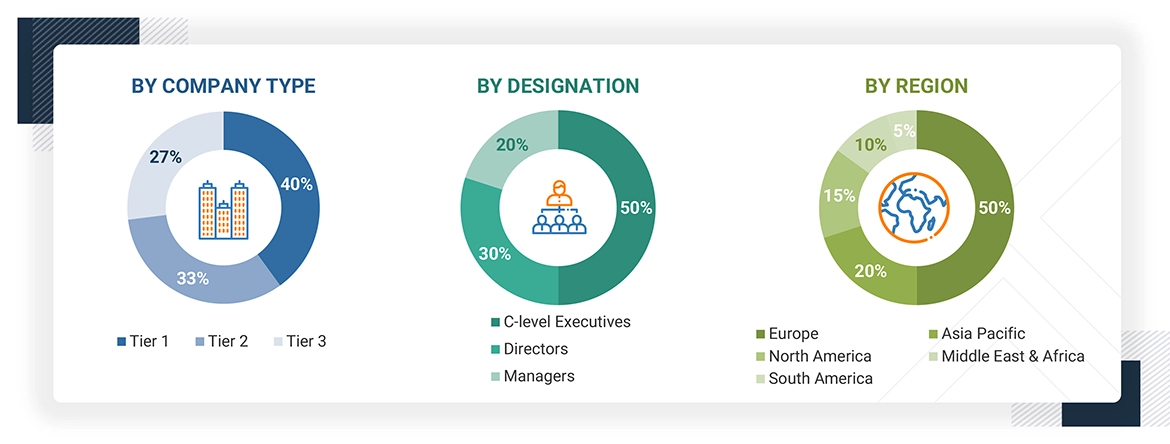
To know about the assumptions considered for the study, download the pdf brochure
Market Size Estimation
The research methodology used to estimate the size of the 3D printing high-performance plastic market includes the following details. The market sizing was undertaken from the demand side. The market was upsized based on the demand for 3D printing high-performance plastic in different end-use industries at the regional level. Such procurements provide information on the demand aspects of the 3D printing high-performance plastic industry for each end-use industry. For each end-use industry, all possible segments of the 3D printing high-performance plastic market were integrated and mapped.
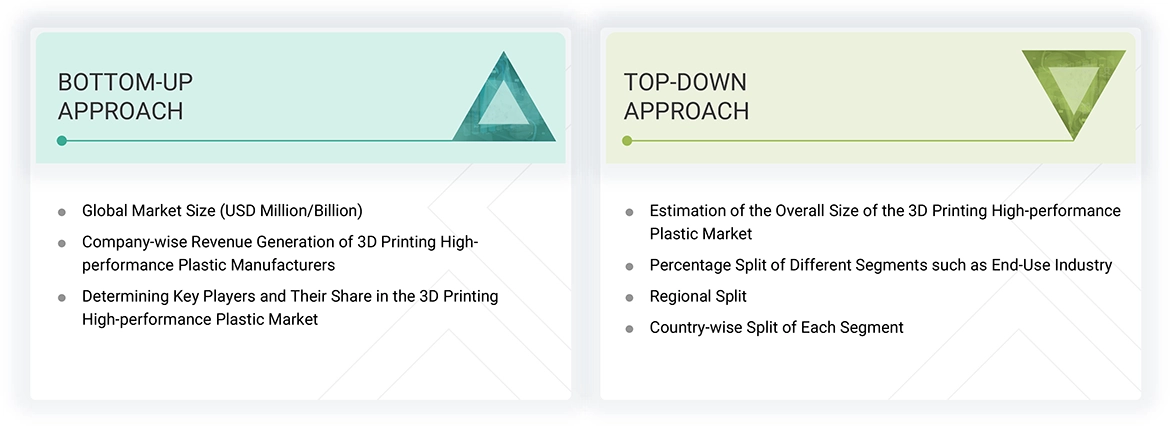
Data Triangulation
After arriving at the overall size from the market size estimation process explained above, the total market was split into several segments and subsegments. The data triangulation and market breakdown procedures explained below were implemented, wherever applicable, to complete the overall market engineering process and arrive at the exact statistics for various market segments and subsegments. The data was triangulated by studying various factors and trends from the demand and supply sides. Along with this, the market size was validated using both the top-down and bottom-up approaches.
Market Definition
3D printing is the process of producing three-dimensional (3D) objects from digital models using materials such as plastics and other engineered substances. This advanced manufacturing approach enables the creation of stronger, lighter, and more complex components, revolutionizing traditional industrial production.
Within this market, high-performance plastics refer to polymer materials that exhibit superior mechanical strength, purity, stiffness, and resistance to wear and chemicals compared to standard 3D printing materials like PLA and ABS. In addition to a broad spectrum of polymer types, the market includes an extensive array of polymer blends, glass—and carbon-fiber-reinforced polymers, and proprietary composite materials.
High-performance plastics are specifically designed to retain their mechanical, thermal, and chemical properties under extreme conditions—such as elevated temperatures, high pressure, or exposure to corrosive substances—without bending, warping, cracking, or splintering.
In recent years, additive manufacturing has seen significant growth in the use of high-performance polymers, defined as polymers with a heat deflection temperature exceeding 150°C. These materials offer enhanced thermal stability, chemical resistance, mechanical strength, and low density, making them superior to conventional 3D printing polymers such as ABS, PP, and PET.
Examples of 3D printing high-performance plastics include engineered nylons, Polyether ether ketone (PEEK), Polyether ketone ketone (PEKK), Polyetherimide (PEI), Reinforced plastics, Polyphenylsulfone (PPSU), Polyphenylene sulfide (PPS), Polyamide-imide (PAI), and Polyethersulfone (PES).
Advancements in fused deposition modeling (FDM/FFF) and selective laser sintering (SLS) have significantly expanded the feasibility of using these materials in 3D printing. These technologies allow for the production of intricate, high-performance parts, reshaping the manufacturing landscape across multiple sectors.
Key application areas include tooling, prototyping, and functional part production across industries such as medical & healthcare, aerospace & defense, transportation, oil & gas, and others. High-performance plastics for 3D printing are commercially available in filament, pellet, and powder forms, enabling flexibility across different additive manufacturing platforms.
Stakeholders
- 3d printing high-performance plastic manufacturers
- 3d printing high-performance plastic distributors and suppliers
- Universities, governments, and research organizations
- Associations and industrial bodies
- R&D institutes
- Environmental support agencies
- Investment banks and private equity firms
- Research and consulting firms
Report Objectives
- To define, describe, and forecast the 3D printing high-performance plastic market size in terms of volume and value
- To provide detailed information regarding the key factors, such as drivers, restraints, opportunities, and challenges influencing the market growth
- To analyze and project the global 3D printing high-performance plastic market by product type, end-use industry, and region
- To forecast the market size concerning five main regions (along with country-level data): North America, Europe, Asia Pacific, the Middle East & Africa, and South America, and analyze the significant region-specific trends
- To strategically analyze micromarkets with respect to individual growth trends, prospects, and contributions of the submarkets to the overall market
- To analyze the market opportunities and the competitive landscape for stakeholders and market leaders
- To assess recent market developments and competitive strategies, such as agreements, contracts, acquisitions, and product developments/product launches, to draw the competitive landscape
- To strategically profile the key market players and comprehensively analyze their core competencies
Key Questions Addressed by the Report
Who are the major companies in the 3D printing high-performance plastic market? What key strategies have market players adopted to strengthen their market presence?
Major companies include Evonik Industries, Arkema, Lehmann&Voss&Co., Nano Dimensions, Oxford Performance Materials, EOS GmbH, Solvay, SABIC, Forward AM Technologies GmbH, Impossible Objects, Apium Additive Technologies GmbH, Ensigner, Victrex Plc, Mitsubishi Chemical Corporation, and Toray Industries. Key strategies adopted include product launches, acquisitions, and expansions.
What are the drivers and opportunities for the 3D printing high-performance plastic market?
Key drivers include increasing demand from medical & healthcare and aerospace & defense sectors for lightweight and durable materials. Opportunities lie in the development of sustainable and biocompatible materials.
Which region is expected to hold the largest market share?
North America is projected to hold the largest market share, driven by demand from aerospace & defense, transportation, and oil & gas sectors.
What is the projected growth rate of the 3D printing high-performance plastic market over the next five years?
The market is projected to grow at a CAGR of 20.4% over the next five years (in terms of value).
How is the 3D printing high-performance plastic market aligned for future growth?
The market is aligned for strong future growth due to rising demand for high-performance, lightweight, and durable plastics across diverse industries.
Fact checked
Personalize This Research
- Triangulate with your Own Data
- Get Data as per your Format and Definition
- Gain a Deeper Dive on a Specific Application, Geography, Customer or Competitor
- Any level of Personalization
Let Us Help You
- What are the Known and Unknown Adjacencies Impacting the 3D Printing High-Performance Plastic Market
- What will your New Revenue Sources be?
- Who will be your Top Customer; what will make them switch?
- Defend your Market Share or Win Competitors
- Get a Scorecard for Target Partners

Custom Market Research Services
We Will Customise The Research For You, In Case The Report Listed Above Does Not Meet With Your Requirements
Get 10% Free CustomisationTESTIMONIALS

We at Nissan Chemicals Corporation have been clients of MarketsandMarkets for more than a year now. We recently consulted MarketsandMarkets for a study, the team at MarketsandMarkets was extremely professional and organized. The business insights were very detailed and aligned well with our expectations that really helped us formulate the Business Plans and device new strategies for development themes. MarketsandMarkets offers a unique combination of expertise and dedicated engagement model. Their research findings have helped us in designing our Pricing Strategy which will make it easier for us to predict the future sales and profits for the next ten years. We look forward to working with MarketsandMarkets in the future.
VP of Strategy & New Business Development
Leading Specialty Chemical Company
The MarketsandMarkets Engagement Model, composed of both the Knowledge Store and advisory custom research, has greatly helped us in understanding our markets and making strategic decisions. The Knowledge Store is a fast way to allow everyone in our organization to understand more about most any market they are interested in. The ability to then get custom research done and get answers to specific strategic questions and market insight has been spectacular. The Markets and Markets team feel more like colleagues than vendors and their services have helped us change our culture where statements of things like growth opportunities and competitive position are always backed by industry research.

Rich Gibson,
Director, Corporate Strategy
Milliken & Company,
Leading Industrial Manufacturer of specialty chemical, floor covering, performance and protective textile materials, and healthcaremilliken.com
MarketsandMarkets is a trusted resource that helps us to better understand markets that are near-adjacencies-whether its technology, value chain or geography. Their Knowledge Store platform provides a dashboard of markets and their characteristics which is easy to use and saves us time.
Adam Shaw,
Market Development and Strategy Manager
AdvanSix Inc. USA,
An American Leader in Chemicalswww.advansix.com
The Knowledge Store from MarketsandMarkets is a valuable tool which has helped my team acquire greater insight in to the end markets that our business serves. This has enabled us to help our company build stronger strategies throughout our planning process.
TOSHIO KINOSHITA
Senior Chif Consultion Research & Consulting Division
Mitsubishi Chemical Research Corporation,
Leading Manufacturer of Chemical Productswww.mitsubishichem-res.co.jp/en/

We recently engaged with MarketsandMarkets for a study, the team not only clearly understood our business objectives but was also extremely professional in the way they handled the entire project. The study was efficiently conducted in a phase-wise manner, and the engagement model furnished us with high-quality business insights that far exceeded our expectations at each phase. We were especially happy that MarketsandMarkets could provide us with both, an English as well as a Japanese version of the study. A special thanks to the Analyst Team and Client Services Team, whose fluency in Japanese enhanced our comfort level, as we could converse with them in our preferred language.
Independent entrepreneurs
Arrow Precision
We approached MarketsandMarkets for study on Proppants Market, and their work exceeded our expectations. The study conducted was comprehensive and enabled us to view the market through the various dimensions. In addition, the team was extraordinarily responsive throughout the process and resolved our queries on time. I strongly recommend MarketsandMarkets and will certainly consider them for additional market assessments we will need in the future.
Global engineering company, Japan
Deputy Manager,
Strategic Planning OfficeThe high-quality insights shared by the MarketsandMarkets team helped us understand the pharmaceutical plant designers in a specific geography. It also captured the risks that we may likely face in communicating with our potential partners. The study would enable us identify partners, which would impact our future growth.
- US 3D Printing High-Performance Plastic Market
- CANADA 3D Printing High-Performance Plastic Market
- MEXICO 3D Printing High-Performance Plastic Market
- GERMANY 3D Printing High-Performance Plastic Market
- FRANCE 3D Printing High-Performance Plastic Market
- UK 3D Printing High-Performance Plastic Market
- ITALY 3D Printing High-Performance Plastic Market
- SPAIN 3D Printing High-Performance Plastic Market
- CHINA 3D Printing High-Performance Plastic Market
- JAPAN 3D Printing High-Performance Plastic Market
- SOUTH KOREA 3D Printing High-Performance Plastic Market
- INDIA 3D Printing High-Performance Plastic Market
- BRAZIL 3D Printing High-Performance Plastic Market
- ARGENTINA 3D Printing High-Performance Plastic Market
- ISRAEL 3D Printing High-Performance Plastic Market
- SOUTH AFRICA 3D Printing High-Performance Plastic Market
- UAE 3D Printing High-Performance Plastic Market






Growth opportunities and latent adjacency in 3D Printing High-Performance Plastic Market