
Japan 5G NTN Market (2026-2031)

The Japan 5G NTN Market was valued at $545.3 Million in 2026 and projected to reach to $2475 Million by 2031, representing a compound annual growth rate of CAGR 35.3%. Japan's 5G NTN market is experiencing exceptional growth momentum, driven by the nation's commitment to comprehensive digital connectivity and technological advancement.


| Market Size in | USD 26.32 MN |
| Market Forecast in | |
| CAGR | |
| Forecast Period | |
| Units Considered | Value (USD MN) |
Japan 5G NTN Market Trends and Insights
- Japan's advanced telecommunications infrastructure and early 5G adoption create a strong foundation for NTN deployment across satellite and aerial platforms.
- The country's geographic characteristics and demand for seamless connectivity in remote regions drive investment in Japan's 5G NTN ecosystem. Japan's market growth is accelerated by government initiatives supporting next-generation connectivity and private sector innovation in space-based communications.
- Japan's strategic focus on integrated terrestrial-non-terrestrial networks positions the nation as a key player in Asia Pacific's 5G NTN expansion.
- By 2031, Japan is expected to capture significant market share through enterprise solutions, IoT applications, and critical infrastructure connectivity..
Key Market Statistics
- CAGR (2026-2031) CAGR 35.3%
- Market Size, 2026 ~USD 545.3 Million
- Forecast, 2031 ~USD 2475 Million
- Country Japan
Japan 5G NTN Market Overview
Rapid Market Expansion :
Japan's 5G NTN market is projected to grow from $545.3 million in 2026 to $2,475 million by 2031, representing a robust 35.3% CAGR, outpacing the global average of 30.8%.
Advanced Infrastructure Foundation :
Japan's mature telecommunications ecosystem and early 5G adoption provide an ideal platform for NTN integration, enabling faster deployment of satellite and aerial network solutions across the nation.
Geographic Advantage :
Japan's island geography and mountainous terrain create significant demand for non-terrestrial networks to ensure seamless connectivity in remote and underserved regions, driving market adoption.
Strategic Technology Leadership :
Japanese telecommunications operators and equipment manufacturers are investing heavily in 5G NTN capabilities, positioning the country as a regional innovation hub for satellite and aerial connectivity solutions.
Japan 5G NTN Market Dynamics
- The country's early adoption of 5G infrastructure, combined with geographic imperatives for coverage in remote areas, creates substantial opportunities for satellite and aerial platform deployment.
- Major telecommunications providers are actively integrating NTN solutions to enhance service reliability and expand coverage footprints. Looking ahead to 2031, Japan's market is expected to nearly quintuple in value, reflecting increasing enterprise demand for mission-critical connectivity, IoT applications, and government initiatives supporting digital infrastructure.
- The convergence of 5G standardization, declining satellite launch costs, and growing investment from both public and private sectors will accelerate NTN adoption across telecommunications, maritime, aviation, and emergency response sectors throughout Japan..
Market Ecosystem
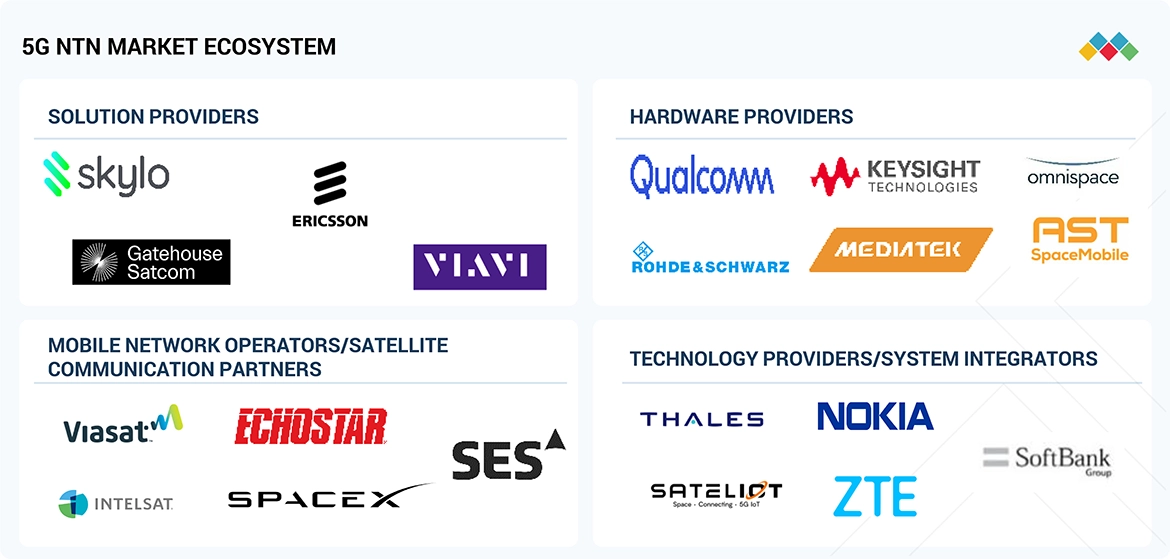
5G NTN MARKET: COMMERCIAL USE CASES ACROSS INDUSTRIES
| COMPANY | USE CASE DESCRIPTION | BENEFITS |
|---|---|---|
 |
5G direct-to-device demonstrations enabling voice and data directly from satellite. | Remote-area coverage, ground-station-free links, secure government and enterprise communications. |
 |
Direct-to-Cell satellite messaging and broadband for standard mobile devices. | Coverage in dead zones, emergency connectivity, and resilient mobility. |
 |
Direct-to-device NTN services and LEO broadband for standard 5G handhelds. | Global talk, text and broadband, with wider device reach and coverage. |
Logos and trademarks shown above are the property of their respective owners. Their use here is for informational and illustrative purposes only.
Related Ecosystem
Aviation
- Narrow Body Aircraft
- Wide Body Aircraft
- Military Helicopters
- Special Mission Aircraft
- Fighter Aircraft
- HONEYWELL INTERNATIONAL INC.
- COLLINS AEROSPACE
- Thales group
- Safran group
- HEICO Corporation
Data Centre And Networking
- Software-Defined Networking (SDN)
- Mid-Sized Data Centers
- Small Data Centers
- Remote Monitoring
- Smart Healthcare
- Cisco Systems, Inc.
- HUAWEI TECHNOLOGIES CO LTD
- Hewlett Packard Enterprise Company
- MITSUBISHI ELECTRIC INFORMATION SYSTEMS CORPORATION
- MITSUBISHI ELECTRIC INFORMATION NETWORK CORPORATION
Mobility And Telecom
- Smart Utilities
- Smart Healthcare
- Sensors
- Parking Management System
- Passenger Information System (PIS)
- AT&T Inc.
- Cisco Systems, Inc.
- HUAWEI TECHNOLOGIES CO LTD
- Telefonaktiebolaget LM Ericsson (publ)
- International Business Machines Corporation
Key Takeaways
- Japan's 5G NTN market will grow from $545.3M (2026) to $2,475M (2031) at a 35.3% CAGR.
- Japan's advanced telecom infrastructure and early 5G adoption enable rapid NTN deployment.
- Japan's geographic and demographic factors create strong demand for satellite and aerial connectivity solutions.
- Japan's government support and private innovation position the nation as a regional 5G NTN leader.
5G NTN Market Report Scope
| Report Metric | Details |
|---|---|
| Base Year | 2026 |
| Fastest Growing Segment | CONNECTIVITY SERVICES (Service) |
| Forecast Period | 2026–2031 |
| Growth Rate | CAGR of 30.8% from 2026 to 2031 |
| Largest Segment | EMBB (Application) |
| Market Size Base Year (Billions) | ~USD 11.9 (2026) |
| Revenue Forecast (Billions) | ~USD 45.55 (2031) |
| Segments Covered | Offering, Service, Platform, Application, End-Use Industry |
Japan 5G NTN Market Report Segmentation
5 segment dimensions are covered across the global market.
By Offering
- Hardware
- Services
- Software
By Service
- Connectivity Services
- Deployment Services
By Platform
- Geo Satellite
- Leo Satellite
- Meo Satellite
- Uas Platform
By Application
- Embb
- Mmtc
- Urllc
By End-Use Industry
- Aerospace & Defense
- Government
- Maritime
- Mining
- Other End-Use Industries
Target Audience
- Telecommunications Operators : Japanese telecom providers need detailed market analysis to plan 5G NTN integration strategies, assess competitive positioning, and identify investment priorities for satellite and aerial network expansion.
- Equipment Manufacturers : Satellite and aerial platform manufacturers require Japan-specific demand forecasts, regulatory insights, and customer requirements to develop products and solutions tailored to the Japanese market.
- Investment & Private Equity Firms : Investors evaluating opportunities in Japan's telecommunications sector need comprehensive market sizing, growth projections, and competitive dynamics to make informed funding and acquisition decisions.
- Government & Regulatory Bodies : Japanese policymakers and regulatory agencies require market intelligence to develop spectrum policies, infrastructure standards, and digital connectivity initiatives supporting NTN deployment nationwide.
- Enterprise & IoT Solution Providers : Companies developing IoT, maritime, aviation, and emergency response solutions need Japan market insights to identify NTN-enabled service opportunities and plan localized go-to-market strategies.
Key Companies in the Japan 5G NTN Market
| Company | HQ | Ownership | Strongest segments |
|---|---|---|---|
| GILAT SATELLITE NETWORKS | Israel | Public Company | EMBB – 5G NTN backhaul and broadband (all locations),URLLC – mission-critical defense, aero, and mobility,MMTC – IoT and wide-area sensor connectivity, |
| ANRITSU CORPORATION | Japan | Public Company | EMBB NTN test (LEO/GEO/UAS),URLLC NTN test (mission-critical, remote),MMTC NTN / IoT and asset tracking, |
| THALES | France | Public Company | EMBB (5G NTN backhaul and mobility connectivity),URLLC (defence, aviation, critical infrastructure),MMTC (IoT and Geonav/secure IoT NTN), |
| ECHOSTAR CORPORATION | United States | Public Company | EMBB,URLLC,MMTC, |
| MEDIATEK | Taiwan | Public Company | EMBB,URLLC,MMTC, |
| SPACEX | United States | Public Company | eMBB – LEO-based broadband and 5G backhaul,URLLC – mission-critical and government/defense links,mMTC – IoT and sensor connectivity over NTN, |
| KEYSIGHT TECHNOLOGIES | United States | Public Company | EMBB NTN test and validation solutions,URLLC NTN and mission-critical validation,MMTC NTN and IoT-focused solutions, |
| SOFTBANK GROUP | Japan | Public Company | EMBB,URLLC,MMTC, |
| SES | Luxembourg | Public Company | EMBB-oriented services (data-heavy remote monitoring),URLLC-oriented services (safety-critical and real-time operations),MMTC-oriented services (sensor-dense waste and asset networks), |
| SUNWAVE COMMUNICATIONS | China | Public Company | EMBB – Urban & Transport (DAS, repeaters, 5G/LTE CPE, base stations),EMBB – Remote/Isolated (satellite backhauled CPE and small cells),URLLC – Industry and public safety coverage (public safety DAS, rugged terminals), |
| ZTE | China | Public Company | EMBB over NTN (RAN, core, terminals),URLLC over NTN (mission-critical, government, enterprise),mMTC over NTN (IoT, sensors, asset tracking), |
| VIAVI SOLUTIONS INC. | United States | Public Company | EMBB-focused NTN test and assurance,URLLC and mission-critical NTN validation,MMTC and IoT-oriented NTN solutions, |
| VIASAT | United States | Public Company | EMBB (fixed and mobility broadband over GEO/LEO/MEO),URLLC (defense, ISR, safety, and mission-critical links),mMTC / IoT and narrowband services, |
| ERICSSON | Sweden | Public Company | EMBB over NTN (LEO/MEO/GEO backhaul, UAS-assisted),URLLC over NTN (mission-critical, low-latency links),MMTC over NTN (massive IoT, sensor networks), |
GILAT SATELLITE NETWORKS
Gilat Satellite Networks is an Israeli public company founded in 1987 that employs 1,159 people and operates in the satellite communications sector.
ANRITSU CORPORATION
Anritsu Corporation is a Japanese public company established in 1900 with 4,114 employees, operating in telecommunications and measurement technology.
THALES
Thales is a French public company founded in 1893 with 82,111 employees, operating as a major defense, aerospace, and technology conglomerate.
ECHOSTAR CORPORATION
EchoStar Corporation is a United States public company founded in 1980 with 12,100 employees, operating in satellite broadcasting and digital television services.
MEDIATEK
MediaTek is a Taiwanese public company founded in 1997 with 17,449 employees, operating as a semiconductor and fabless chip designer.
SPACEX
SpaceX is a United States public company founded in 2002 with 22,000 employees, specializing in space launch services and rocket development.
KEYSIGHT TECHNOLOGIES
Keysight Technologies is a United States public company founded in 1939 with 16,500 employees, providing electronic measurement and testing solutions.
SOFTBANK GROUP
SoftBank Group is a Japanese public company founded in 1981 with 73,677 employees, operating as a major telecommunications and investment conglomerate.
SES
SES is a Luxembourg-based public company founded in 2007 with 1,937 employees, operating as a satellite operator providing broadcasting and communications services.
SUNWAVE COMMUNICATIONS
Sunwave Communications is a Chinese public company founded in 1993 with 979 employees, operating in the telecommunications and satellite communications sector.
ZTE
ZTE is a Chinese public company founded in 1985 with 65,095 employees, operating as a major telecommunications equipment and network solutions provider.
VIAVI SOLUTIONS INC.
Viavi Solutions Inc. is a United States public company founded in 1923 with 3,600 employees, providing network testing and software solutions.
VIASAT
Viasat is a United States public company founded in 1986 with 7,000 employees, operating in satellite communications and broadband services.
ERICSSON
Ericsson is a Swedish public company founded in 1876 with 87,521 employees, operating as a global leader in telecommunications infrastructure and services.
Reasons to Buy this Report
- Market-Specific Growth Projections : Access detailed forecasts showing Japan's 5G NTN market expanding to $2,475 million by 2031, enabling precise investment planning and resource allocation for Japan-focused operations.
- Competitive Landscape Intelligence : Understand Japan's telecommunications operators, equipment manufacturers, and emerging NTN providers to identify partnership opportunities and competitive positioning within the Japanese market.
- Regional Deployment Insights : Gain actionable intelligence on Japan's geographic priorities, regulatory environment, and infrastructure requirements specific to satellite and aerial 5G network implementation across the country.
- Sector-Specific Opportunity Analysis : Identify high-growth segments within Japan including maritime connectivity, aviation services, IoT applications, and emergency response systems driving NTN adoption and revenue generation.
- Strategic Decision Support : Leverage Japan-specific market data to support executive decisions on market entry, technology investments, partnership strategies, and go-to-market approaches in this high-growth Asian market.
Frequently asked questions
What is the projected market size of Japan's 5G NTN market in 2031?
Japan's 5G NTN market is projected to reach $2,475 million by 2031, growing from $545.3 million in 2026.
What is the CAGR for Japan's 5G NTN market?
Japan's 5G NTN market is expected to grow at a compound annual growth rate (CAGR) of 35.3% between 2026 and 2031.
What factors are driving growth in Japan's 5G NTN market?
Japan's growth is driven by advanced telecommunications infrastructure, government support for next-generation connectivity, geographic demand for remote coverage, and private sector innovation in space-based communications.
How does Japan's 5G NTN market compare to the global market?
Japan's 35.3% CAGR exceeds the global 5G NTN CAGR of 30.8%, reflecting Japan's accelerated adoption and market maturity in non-terrestrial network technologies.
What applications are expected to drive Japan's 5G NTN adoption?
Key applications in Japan include enterprise IoT solutions, critical infrastructure connectivity, remote area coverage, and integrated terrestrial-non-terrestrial network services.
RESEARCH METHODOLOGY
The research study involved four major activities in estimating the 5G NTN market size. Exhaustive secondary research has been conducted to gather key information on the market and peer markets. The next step has been to validate these findings and assumptions and size them with the help of primary research with industry experts across the value chain. Both top-down and bottom-up approaches have been used to estimate the market size. Post which, the market breakdown and data triangulation have been adopted to estimate the market sizes of segments and sub-segments.
Secondary Research
The market size of companies offering 5G NTN hardware, solutions, and services was estimated using secondary data from paid and unpaid sources. It was also arrived at by analyzing the product portfolios of major companies and rating the companies based on their performance and quality.
In the secondary research process, various sources were consulted to identify and collect information for this study. Secondary sources included annual reports, press releases, and investor presentations of companies; white papers, journals, and certified publications; and articles from recognized authors, directories, and databases. The data was also collected from other secondary sources, such as 5G Americas, GSMA, TRAI, and others. The investment spending of various countries was extracted from respective sources. Secondary research was used to obtain key information related to the industry’s value chain and supply chain to identify key players based on hardware, solutions, services, market classification, and segmentation according to offerings of major players, industry trends related to offering, end-use industry, application, platform, location, and regions, and key developments from both market- and technology-oriented perspectives.
Primary Research
In the primary research process, various sources from the supply and demand sides were interviewed to obtain qualitative and quantitative information for the report. The primary sources from the supply side included Chief Executive Officers (CEOs), Chief Technology Officers (CTOs), Chief Operating Officers (COOs), Vice Presidents (VPs), Managing Directors (MDs), technology and innovation directors, and related key executives from various key companies and organizations operating in the 5G NTN Market.
Primary interviews were conducted to gather insights, including market statistics, software and services revenue data, market breakups, market size estimates, market forecasts, and data triangulation. Stakeholders from the demand side, such as Chief Information Officers (CIOs), Chief Finance Officers (CFOs), Chief Strategy Officers (CSOs), and the installation team of end users who use 5G NTN, were interviewed to understand buyers’ perspectives on suppliers, products, service providers, and their current usage of 5G NTN solutions and services, which is expected to affect the overall 5G NTN Market growth.
BREAKDOWN OF PRIMARIES
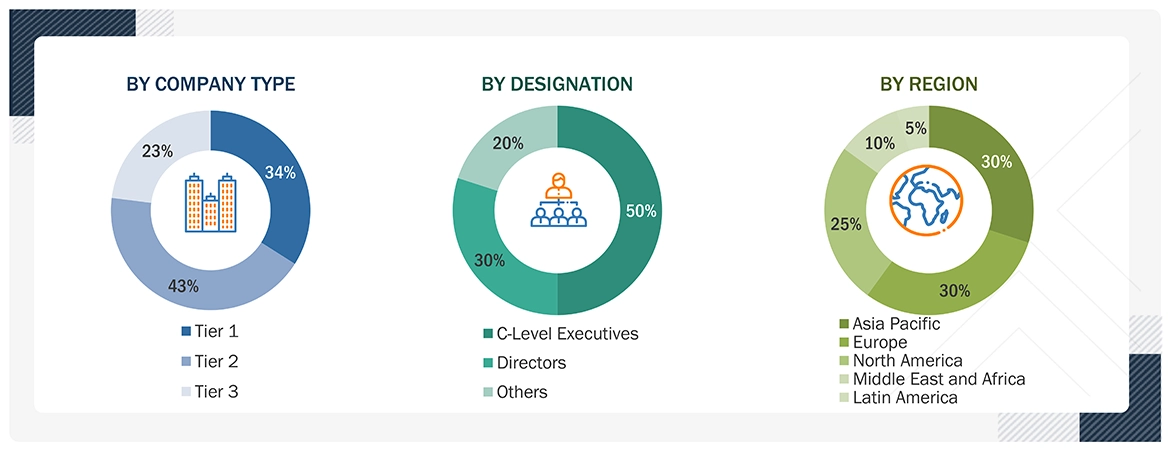
Note 1: Tier 1 companies have revenues of more than USD 10 billion; tier 2 companies’ revenue ranges from USD 1 billion to USD 10 billion; and tier 3 companies’ revenue ranges from USD 500 million to USD 1 billion
Source: Secondary Literature, Expert Interviews, and MarketsandMarkets Analysis
To know about the assumptions considered for the study, download the pdf brochure
Market Size Estimation
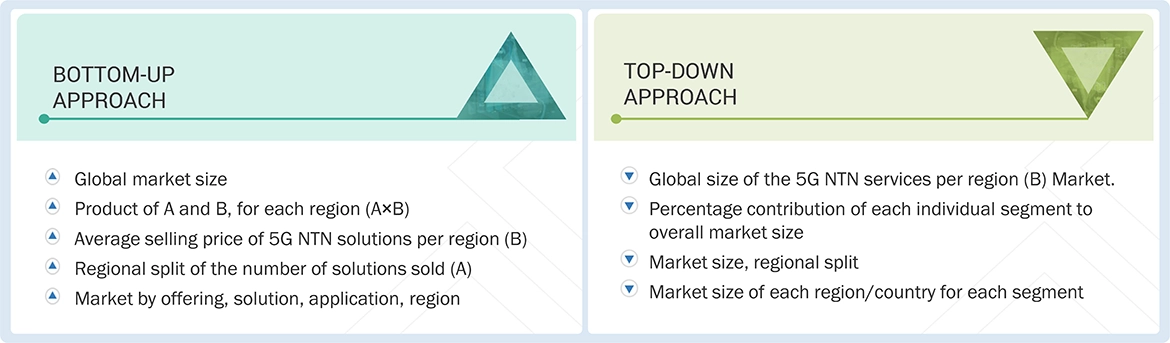
In the market engineering process, the top-down and bottom-up approaches were used, along with multiple data triangulation methods, to estimate and validate the size of the 5G NTN Market and other dependent submarkets. The research methodology used to estimate the market sizes includes the following:
- Initially, MarketsandMarkets focuses on top-line investments and spending in the ecosystems. Further, significant developments in the critical market area have been considered.
- Tracking the recent and upcoming developments in the 5G NTN Market that include investments, R&D activities, product launches, collaborations, mergers and acquisitions, and partnerships, as well as forecasting the market size based on these developments and other critical parameters.
- Conduct multiple discussions with key opinion leaders to learn about the diverse types of authentications and brand protection offerings used and the applications for which they are used to analyze the breakdown of the scope of work carried out by major companies.
- Segmenting the market based on applications, wherein the applications are to be used, and deriving the size of the global application market.
- Segmenting the overall market into various market segments
- Validating the estimates at every level through discussions with key opinion leaders, such as chief executives (CXOs), directors, and operations managers, and finally with the domain experts at MarketsandMarkets
5G NTN Market : Top-Down and Bottom-Up Approach
Data Triangulation
After arriving at the overall market size from the above estimation process, the 5G NTN market has been split into several segments and sub-segments. To complete the overall market engineering process and arrive at the exact statistics for all segments and sub-segments, data triangulation and market breakdown procedures have been used, wherever applicable. The data has been triangulated by studying various factors and trends from both the demand and supply sides.
The 5G NTN market size has been validated using top-down and bottom-up approaches.
Market Definition
Non-Terrestrial Networks (NTN) can satisfy requests for anywhere, anytime connectivity by offering wide-area coverage and ensuring service availability, continuity, and scalability. 5G NTN, a 5G non-terrestrial network, expands 5G technology by incorporating satellite communication into its infrastructure. This enables global connectivity, bridging gaps in remote and underserved areas. 5G NTN leverages a unique combination of satellite constellations, ground-based infrastructure, and advanced protocols, enabling seamless and reliable global communication.
Key Stakeholders
- Satellite operators
- Suppliers, distributors, and contractors
- Mobile operators
- Business organizations
- Government organizations
- System integrators
- Value-added resellers
- Vendors of software applications
- Investors and venture capitalists
- Government and financial institutions
- Research institutes and organizations
Report Objectives
- To define, describe, and forecast the 5G NTN market by offering, platform, application, location, end-use industry, and region
- To provide detailed information related to major factors (drivers, restraints, opportunities, and industry-specific challenges) influencing the market growth
- To analyze opportunities in the market and provide details of the competitive landscape for stakeholders and market leaders
- To forecast the market size of segments for five main regions: North America, Europe, Asia Pacific (APAC), Middle East and Africa (MEA), and Latin America
- To profile the key market players and provide a comparative analysis based on their business overviews, regional presence, product offerings, business strategies, and key financials, and illustrate the competitive landscape of the market
- To track and analyze competitive developments, such as acquisitions, expansions, new product launches, and product enhancements; agreements, collaborations, and partnerships; and R&D activities in the market
Available customizations:
With the given market data, MarketsandMarkets offers customizations per the company’s specific needs. The following customization options are available for the report:
Regional Analysis
- Further break-up of the Asia Pacific market into countries contributing 75% to the regional market size
- Further break-up of the North American market into countries contributing 75% to the regional market size
- Further break-up of the Latin American market into countries contributing 75% to the regional market size
- Further break-up of the Middle East African market into countries contributing 75% to the regional market size
- Further break-up of the European market into countries contributing 75% to the regional market size
Company Information
- Detailed analysis and profiling of additional market players (up to 5)
Get the Full 5G NTN Market Report
Full forecast, segment splits, and company analysis for all 5G NTN Market.
- Canada 5G NTN Market
- US 5G NTN Market
- France 5G NTN Market
- Germany 5G NTN Market
- Italy 5G NTN Market
- UK 5G NTN Market
- Rest Of Europe 5G NTN Market
- China 5G NTN Market
- India 5G NTN Market
- South Korea 5G NTN Market
- Rest Of Asia Pacific 5G NTN Market
- Brazil 5G NTN Market
- Mexico 5G NTN Market
- Rest Of Latin America 5G NTN Market
Need a Tailored Report?
Customize this report to your needs
Get 10% FREE Customization
Customize This Report
