
Asia Pacific 6G Market (2030-2035)

The Asia Pacific 6G Market was valued at $4446 Million in 2030 and projected to reach to $51469.9 Million by 2035, representing a compound annual growth rate of CAGR 50.4%. Asia Pacific is emerging as the dominant growth region for 6G technology, driven by aggressive government initiatives, substantial private sector investment, and the region's established leadership in 5G infrastructure.


| Market Size in | USD 26.32 MN |
| Market Forecast in | |
| CAGR | |
| Forecast Period | |
| Units Considered | Value (USD MN) |
Asia Pacific 6G Market Trends and Insights
- This exceptional 50.4% compound annual growth rate significantly outpaces global trends, reflecting Asia Pacific's accelerating investment in next-generation telecommunications infrastructure and advanced connectivity solutions.
- Asia Pacific's dominance is driven by rapid digital transformation across major economies, substantial government backing for 5G-to-6G transitions, and the region's concentration of leading semiconductor and telecom equipment manufacturers. The forecast period from 2030 to 2035 represents a transformative phase for Asia Pacific, as countries including China, Japan, South Korea, and India intensify their 6G research and development initiatives.
- Asia Pacific's market expansion is underpinned by increasing demand for ultra-low latency applications, enhanced mobile broadband capabilities, and emerging use cases in autonomous systems and industrial IoT.
- The region's competitive advantage in manufacturing, coupled with substantial capital investments and favorable regulatory environments, positions Asia Pacific to capture a disproportionate share of global 6G opportunities during this critical development window..
Key Market Statistics
- CAGR (2030-2035) CAGR 50.4%
- Market Size, 2030 ~USD 4446 Million
- Forecast, 2035 ~USD 51469.9 Million
- Geography Asia Pacific
Asia Pacific 6G Market Overview
Explosive Growth Trajectory :
Asia Pacific's 6G market is projected to grow from $4,446.0 million in 2030 to $51,469.9 million by 2035, representing a 50.4% CAGR that significantly exceeds the global average of 46%.
Regional Leadership in 5G Infrastructure :
Countries like China, South Korea, and Japan are leveraging existing 5G dominance to accelerate 6G research and development, positioning Asia Pacific as the innovation epicenter for next-generation telecommunications.
Government Investment & Policy Support :
Major Asia Pacific governments are allocating substantial R&D budgets and establishing 6G consortiums, with initiatives in China, Japan, and South Korea driving standardization and commercialization timelines.
Manufacturing & Supply Chain Advantage :
Asia Pacific's semiconductor and telecommunications equipment manufacturing ecosystem provides competitive advantages in 6G component production, reducing time-to-market and supporting regional deployment.
Asia Pacific 6G Market Dynamics
- Countries including China, South Korea, Japan, and Singapore are spearheading 6G research programs with ambitious commercialization targets, creating a competitive ecosystem that accelerates innovation cycles. The region's 11.6x market expansion between 2030 and 2035 reflects growing demand for ultra-high-speed connectivity, IoT applications, and advanced telecommunications services.
- Strategic partnerships between technology leaders, telecommunications operators, and government bodies are expected to facilitate rapid standardization and deployment, positioning Asia Pacific as the primary market for early 6G adoption and revenue generation..
Market Ecosystem
6G market: COMMERCIAL USE CASES ACROSS INDUSTRIES
| COMPANY | USE CASE DESCRIPTION | BENEFITS |
|---|---|---|
 |
Case studies are bypassed in 6G |
Logos and trademarks shown above are the property of their respective owners. Their use here is for informational and illustrative purposes only.
Related Ecosystem
Mobility And Telecom
- Smart Utilities
- Smart Healthcare
- Sensors
- Parking Management System
- Passenger Information System (PIS)
- AT&T Inc.
- Cisco Systems, Inc.
- HUAWEI TECHNOLOGIES CO LTD
- Telefonaktiebolaget LM Ericsson (publ)
- International Business Machines Corporation
Key Takeaways
- Asia Pacific's 6G market will grow from $4.4B (2030) to $51.5B (2035) at a 50.4% CAGR, substantially exceeding global growth rates.
- Asia Pacific leads global 6G development through concentrated R&D investments and government-backed standardization initiatives across China, Japan, South Korea, and India.
- Ultra-low latency applications, industrial IoT, and autonomous systems are primary demand drivers accelerating Asia Pacific's 6G market expansion through 2035.
- Asia Pacific's manufacturing ecosystem and semiconductor leadership position the region to dominate 6G infrastructure deployment and equipment supply globally.
6G Market Report Scope
| Report Metric | Details |
|---|---|
| Base Year | 2030 |
| Fastest Growing Segment | ULTRA-MASSIVE MACHINE TYPE COMMUNICATIONS (Usage Scenario) |
| Forecast Period | 2030–2035 |
| Growth Rate | CAGR of 46% from 2030 to 2035 |
| Largest Segment | CELLULAR (Communication Infrastructure) |
| Market Size Base Year (Billions) | ~USD 11.4 (2030) |
| Revenue Forecast (Billions) | ~USD 75.66 (2035) |
| Segments Covered | Usage Scenario, Communication Infrastructure |
Asia Pacific 6G Market Report Segmentation
2 segment dimensions are covered across the global market.
By Usage Scenario
- Extremely Low-Power Communications
- Extremely Reliable And Low-Latency Communications
- Further-Enhanced Mobile Broadband
- Long-Distance And High-Mobility Communications
- Ultra-Massive Machine Type Communications
By Communication Infrastructure
- Broadband
- Cellular
- Fixed
Target Audience
- Telecommunications Operators : Regional telecom providers need Asia Pacific-specific market data to plan network infrastructure investments, evaluate 6G technology partnerships, and anticipate competitive dynamics in their markets.
- Technology & Equipment Manufacturers : Hardware and semiconductor companies require detailed Asia Pacific forecasts to prioritize R&D investments, identify manufacturing opportunities, and establish regional supply chain strategies.
- Government & Policy Makers : Asia Pacific government agencies and regulatory bodies use market intelligence to inform 6G policy frameworks, allocate research funding, and coordinate regional standardization efforts.
- Investment & Private Equity Firms : Investors targeting Asia Pacific's 6G ecosystem need comprehensive market analysis to identify high-growth opportunities, evaluate portfolio companies, and assess regional market timing.
- Strategic Consultants & Analysts : Business consultants and research firms require Asia Pacific-specific 6G data to advise clients on market entry strategies, competitive positioning, and long-term technology roadmaps.
Key Companies in the Asia Pacific 6G Market
| Company | HQ | Ownership | Strongest segments |
|---|---|---|---|
| AT&T | United States | Public Company | Wireless services (postpaid, prepaid, Mexico),Wireline & broadband (fiber, copper, VPN, IP),Equipment & CPE (devices, smartphones, CPE), |
| NTT DOCOMO | Japan | Private Company | Telecommunications Business (mobile, LTE/FOMA, VoLTE, docomo Hikari, Wi-Fi),Smart Life Business (content, d POINT CLUB, finance/payment, e-commerce, life services),Other Businesses (device protection, commissioned development, system maintenance, technical services), |
| RELIANCE JIO | India | Private Company | Prepaid mobile (voice, SMS, data bundles),Postpaid mobile and roaming,Home broadband (optical-fiber based), |
| BHARTI AIRTEL | India | Public Company | Mobile Data (4G/5G and related VAS),Mobile Voice & Messaging,Enterprise Services (MPLS, CPaaS, IoT, Cloud, Security), |
| VERIZON | United States | Public Company | Consumer wireless services and equipment,Consumer broadband (Fios and FWA),Business wireless and wireline services, |
| DEUTSCHE TELEKOM | Germany | Public Company | Mobile services (voice, data, wholesale/MVNO),Fixed network and broadband (incl. IPTV/Internet-based TV),ICT, cloud, and digital solutions, |
| CHINA UNICOM | Hong Kong | Public Company | Mobile services (voice, SMS/MMS, mobile data),Fixed broadband and internet access,Cloud computing, ICT, and system integration, |
| ORANGE S.A. | France | Public Company | Consumer Mobile,Fixed Broadband & TV (Consumer),Enterprise Connectivity & ICT, |
| RAKUTEN GROUP | Japan | Public Company | Internet Services (e-commerce, travel, digital content, advertising),FinTech (credit card, banking, securities, insurance, payments, crypto),Mobile (communications, electricity, related services), |
| KT CORPORATION | United States | Public Company | Kratos Government Solutions (C4ISR, space ground, microwave electronics, training),Unmanned Systems (jet-powered drones, hypersonic and rocket systems),Propulsion and related subsystems for drones, missiles, spacecraft, launch, |
| SINGTEL | Singapore | Public Company | Mobile services (consumer and SMB),Fixed voice and data, pay TV, and content,ICT and managed services (NCS, enterprise ICT), |
AT&T
AT&T is a major United States-based public telecommunications company founded in 1983, employing 133,030 people. The company provides wireless, broadband, and entertainment services to millions of customers across North America.
NTT DOCOMO
NTT DOCOMO is a Japanese private telecommunications company established in 1991 with 27,558 employees. It is one of Japan's leading mobile network operators providing wireless and broadband services.
RELIANCE JIO
Reliance Jio is an Indian private telecommunications company founded in 2007. It operates as a major mobile and broadband service provider in India's competitive telecom market.
BHARTI AIRTEL
Bharti Airtel is an Indian public telecommunications company founded in 1995 with 13,336 employees. The company provides mobile, broadband, and digital services across India and select international markets.
VERIZON
Verizon is a major United States-based public telecommunications company founded in 1983, employing 97,600 people. The company provides wireless, broadband, and enterprise communication services to millions of customers.
DEUTSCHE TELEKOM
Deutsche Telekom is a German public telecommunications company founded in 1995 with 196,586 employees. It is one of Europe's largest telecom operators providing mobile, broadband, and digital services across multiple countries.
CHINA UNICOM
China Unicom is a Hong Kong-listed public telecommunications company founded in 2000 with 237,251 employees. It operates as one of China's major mobile and broadband service providers.
ORANGE S.A.
Orange S.A. is a French public telecommunications company founded in 1990. It is a leading European telecom operator providing mobile, broadband, and digital services across Europe and Africa.
RAKUTEN GROUP
Rakuten Group is a Japanese public company founded in 1997 with 29,419 employees. The company operates diverse businesses including e-commerce, telecommunications, and digital services.
KT CORPORATION
KT Corporation is a United States-based public telecommunications company founded in 1994 with 4,300 employees. The company provides telecommunications and related services to its customer base.
SINGTEL
Singtel is a Singapore-based public telecommunications company founded in 1992 with 24,233 employees. It is a leading regional telecom operator providing mobile, broadband, and digital services across Asia-Pacific.
Countries within Asia Pacific - compare and drill down
| Country | 2025 size (native) |
|---|
Country market size visualization
Reasons to Buy this Report
- Regional Market Sizing & Forecasts : Obtain precise market valuations for Asia Pacific's 6G sector with detailed projections through 2035, enabling accurate budget allocation and investment planning specific to regional growth dynamics.
- Competitive Landscape Intelligence : Identify leading technology providers, telecommunications operators, and government initiatives across Asia Pacific, understanding competitive positioning and partnership opportunities in the region.
- Country-Level Insights & Strategies : Access granular analysis of individual Asia Pacific markets including China, Japan, South Korea, and emerging economies, revealing distinct regulatory environments and commercialization timelines.
- Investment & Funding Trends : Understand capital allocation patterns, government R&D spending, and venture investment flows specific to Asia Pacific 6G development, informing strategic investment decisions.
- Technology Adoption Roadmap : Gain clarity on Asia Pacific's 6G deployment timeline, infrastructure requirements, and use case prioritization, enabling vendors to align product development with regional market demands.
Frequently asked questions
What is the projected market size for 6G in Asia Pacific by 2035?
Asia Pacific's 6G market is forecast to reach $51,469.9 million by 2035, up from $4,446.0 million in 2030, representing a 50.4% compound annual growth rate.
Which countries are driving 6G development in Asia Pacific?
China, Japan, South Korea, and India are leading 6G research, development, and standardization efforts in Asia Pacific, supported by substantial government funding and private sector investment.
What are the primary use cases for 6G in Asia Pacific?
Key 6G applications in Asia Pacific include ultra-low latency communications, enhanced mobile broadband, autonomous systems, industrial IoT, and advanced manufacturing automation.
How does Asia Pacific's 6G growth compare to global trends?
Asia Pacific's 50.4% CAGR significantly outpaces the global 6G market CAGR of 46%, reflecting the region's accelerated digital transformation and infrastructure investment priorities.
What competitive advantages does Asia Pacific hold in the 6G market?
Asia Pacific benefits from a robust semiconductor manufacturing base, established telecom equipment suppliers, concentrated R&D capabilities, and government-backed standardization initiatives that collectively strengthen its 6G market position.
RESEARCH METHODOLOGY
This research study involved four major activities in estimating the 6G market size. Exhaustive secondary research was conducted to collect important information about the market and peer markets. The next step involved validating these findings and assumptions and sizing them with the help of primary research with industry experts across the value chain. The top-down and bottom-up approaches were used to estimate the market size. After the market breakdown, data triangulation was utilized to estimate the sizes of segments and sub-segments.
Secondary Research
The market size of the telecom companies researching 6G was arrived at based on the secondary data available through paid and unpaid sources, and by analyzing their 6G development. In the secondary research process, various sources were referred to to identify and collect information. The secondary sources included announcements by various organizations, press releases of companies, such as AT&T, Verizon, and China Mobile, white papers, journals, certified publications & articles from recognized authors, directories, and databases, such as Next G Alliance, GSM Association, and International Telecommunication Union.
Secondary research was used to obtain key information about the industry’s supply chain, the total pool of key players, market classification and segmentation according to the industry trends to the bottom-most level, regional markets, and key developments from market and technology-oriented perspectives.
Primary Research
In the primary research process, various supply and demand sources were interviewed to obtain qualitative & quantitative information. The primary sources from the supply side included Chief Executive Officers (CEOs), Chief Technology Officers (CTOs), Chief Operating Officers (COOs), Vice Presidents (VPs), Managing Directors (MDs), technology and innovation directors, and related key executives from various key companies and organizations.
Primary interviews were conducted to gather insights, including market statistics, revenue data from solutions & services, market breakups, market size estimations, market forecasts, and data triangulation. Stakeholders from the demand side, such as Chief Information Officers (CIOs), Chief Finance Officers (CFOs), Chief Strategy Officers (CSOs), and the installation team of end-users using 6G, were interviewed to understand buyers’ perspectives on suppliers and products, which are expected to affect the overall market growth.
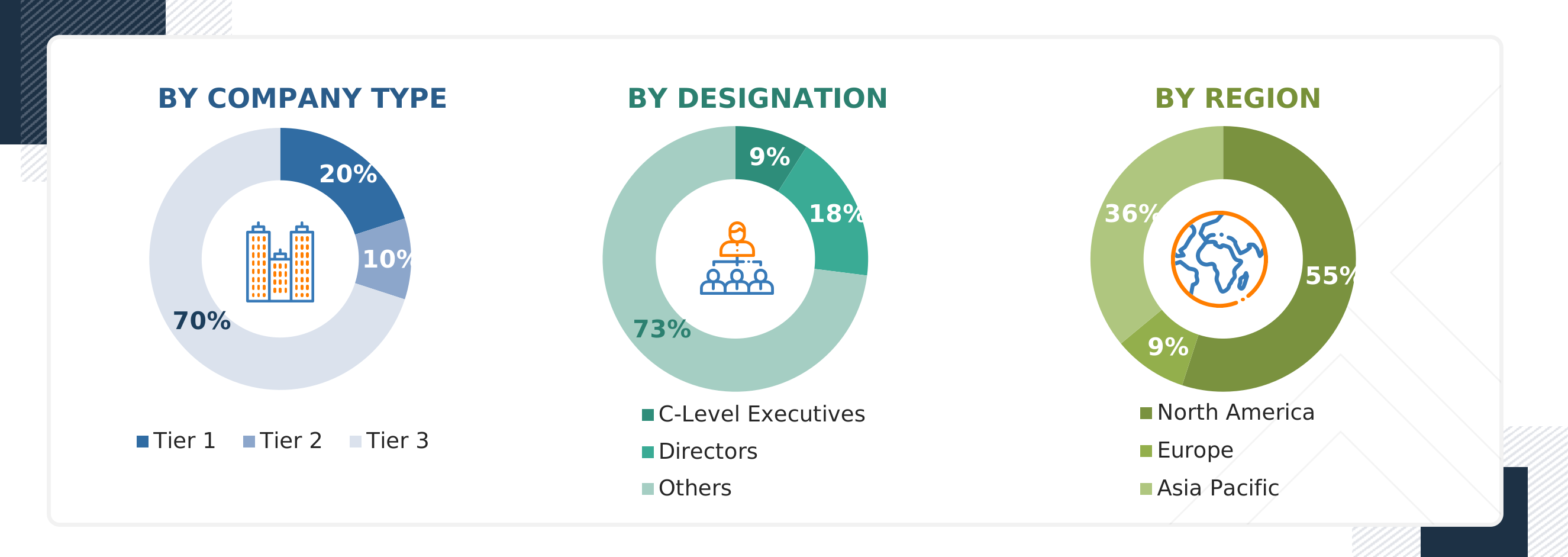
Note: Tier 1 companies have revenues over USD 1 billion, Tier 2 companies have revenues between USD 500 million and USD 1 billion, and Tier 3 companies have revenues less than USD 500 million. Other designations include sales managers, marketing managers, and product managers. Source: Industry Experts
To know about the assumptions considered for the study, download the pdf brochure
Market Size Estimation
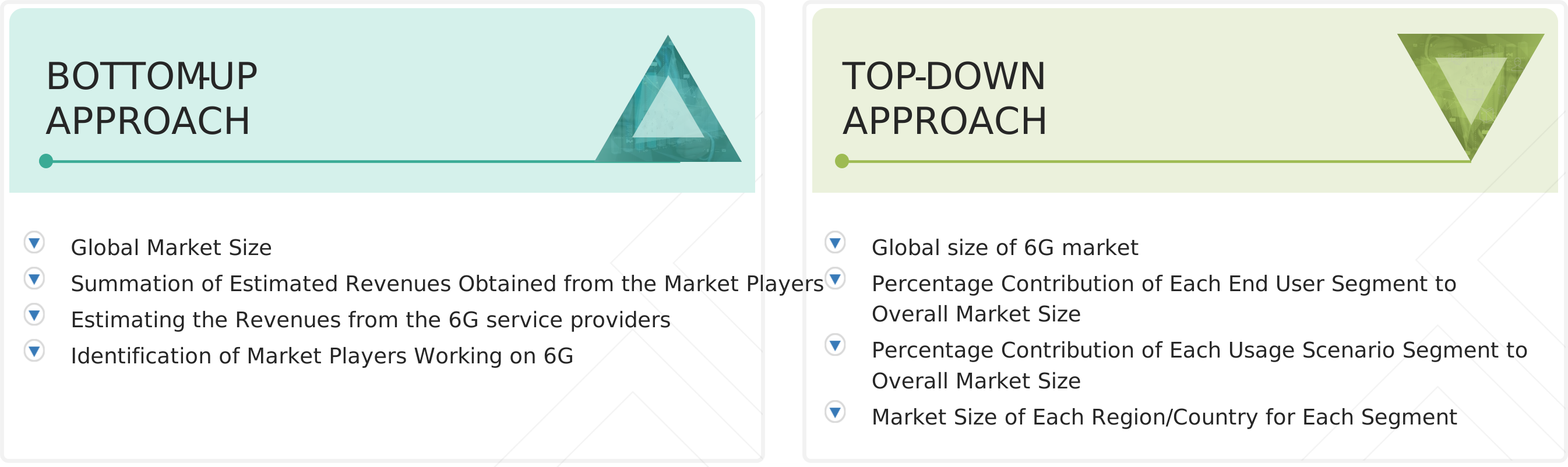
Both top-down and bottom-up approaches were used to estimate and validate the total size of the 6G market. These methods were also used extensively to estimate the size of various subsegments in the market.
6G Market : Top-Down and Bottom-Up Approach
Data Triangulation
The 6G market was split into several segments and sub-segments after determining the overall market size from the above estimation process. To complete the overall market engineering process and arrive at the exact statistics for all segments and sub-segments, data triangulation and market breakdown procedures were used, wherever applicable. The data was triangulated by studying various factors and trends from the demand and supply sides. The 6G market size was validated using top-down and bottom-up approaches.
Market Definition
6G is the next-generation advanced mobile communications system beyond communications. It will serve as a distributed neural network, providing communication links between everything that can be sensed, connected, and intelligent. It will cover ultra-high speed and ultra-reliable wireless connections, native AI, and advanced sensing technologies from 2030 and beyond. 6G will define five major categories of usage scenarios: Further-enhanced Mobile Broadband (FeMBB), Extremely Reliable Low-latency Communications (ERLLC), Long-distance and High-mobility Communications (LDHMC), Ultra-massive Machine Type Communications (umMTC), and Extremely Low-power Communications (ELPC) that will flourish in the era of 6G.
Stakeholders
- Satellite Operators
- Suppliers, Distributors, and Contractors
- Mobile Operators
- Business Organizations
- Government Organizations
- System Integrators
- Value-added Resellers
- Vendors of Software Applications
- Investors & Venture Capitalists
- Government & Financial Institutions
- Research Institutes & Organizations
Report Objectives
- To determine, segment, and forecast the 6G market based on end user, enterprise application, communication infrastructure, usage scenario, and region in terms of value
- To forecast the segment’s size with respect to five main regions: North America, Europe, Asia Pacific, Latin America, and the Middle East & Africa
- To provide detailed information about the major factors (drivers, restraints, opportunities, and challenges) influencing the market
- To study the complete value chain and related industry segments, and perform a value chain analysis
- To strategically analyze macro and micro-markets with respect to individual growth trends, prospects, and contributions to the market
- To analyze industry trends, regulatory landscape, and patents & innovations
- To analyze opportunities for stakeholders by identifying the high-growth segments
- To track and analyze competitive developments, such as agreements, partnerships, collaborations, and R&D activities
Available Customizations
With the given market data, MarketsandMarkets offers customizations based on the company’s specific needs. The following customization options are available for the report:
Product Analysis
- Product Matrix, which gives a detailed comparison of the product portfolios of the top five companies
Geographic Analysis as per Feasibility
- Further breakdown of the Rest of Asia Pacific market into countries
- Further breakdown of the Rest of Latin America market into countries
- Further breakdown of the Rest of Middle East & Africa market into countries
- Further breakdown of the Rest of Europe market into countries
Company Information
- Detailed analysis and profiling of additional market players (up to five)
Get the Full 6G Market Report
Full forecast, segment splits, and company analysis for all 6G Market.
Need a Tailored Report?
Customize this report to your needs
Get 10% FREE Customization
Customize This Report
