
Europe Industrial Robotics Market (2026-2031)

The Europe Industrial Robotics Market was valued at $2518.98 Million in 2026 and projected to reach to $2913.17 Million by 2031, representing a compound annual growth rate of 2.5%. Europe's industrial robotics market is positioned as a mature, stable segment within the global semiconductor and electronics landscape.


| Market Size in | USD 26.32 MN |
| Market Forecast in | |
| CAGR | |
| Forecast Period | |
| Units Considered | Value (USD MN) |
Europe Industrial Robotics Market Trends and Insights
- Europe maintains a mature and established robotics sector, driven by strong manufacturing traditions in Germany, Italy, and Scandinavia, where automation adoption remains steady across automotive, electronics, and precision engineering sectors.
- The region's growth trajectory reflects Europe's focus on Industry 4.0 initiatives and digital transformation, though expansion rates remain moderate compared to global markets. Europe's industrial robotics landscape is characterized by high-value applications and technological sophistication rather than rapid volume expansion.
- Between 2026 and 2031, Europe will continue to leverage advanced robotics for quality improvement, labor optimization, and complex manufacturing processes in the semiconductor and electronics industries.
- The region's regulatory environment, skilled workforce, and emphasis on sustainable manufacturing practices position Europe as a leader in specialized robotic solutions, even as its overall market growth remains conservative relative to emerging markets..
Key Market Statistics
- CAGR (2026-2031) 2.5% CAGR
- Market Size, 2026 ~USD 2518.98 Million
- Forecast, 2031 ~USD 2913.17 Million
- Geography Europe
Europe Industrial Robotics Market Overview
Germany's Market Leadership :
Germany dominates Europe's industrial robotics sector with $47.02 million in market value, leveraging its strong automotive and precision manufacturing heritage. The country's advanced engineering capabilities and Industry 4.0 initiatives drive sustained robotics adoption across production facilities.
Mature Market Stability :
Europe's industrial robotics market demonstrates steady growth at 2.5% CAGR through 2031, reflecting a mature and established sector. This measured expansion contrasts with faster-growing regions, indicating consolidation and optimization rather than rapid market disruption.
Multi-Country Manufacturing Base :
Italy ($14.59M), France ($13.09M), and Spain ($8.72M) form a robust secondary tier of robotics adoption, supported by established electronics and precision engineering sectors. These markets benefit from EU-wide manufacturing standards and cross-border supply chain integration.
Automotive & Electronics Focus :
European robotics deployment concentrates in automotive assembly, electronics manufacturing, and precision engineering. Scandinavian and Central European facilities increasingly integrate collaborative robots and AI-enabled automation to enhance productivity while maintaining workforce stability.
Europe Industrial Robotics Market Dynamics
- With a projected value of $2,913.17 million by 2031, the region's 2.5% CAGR reflects steady adoption driven by established manufacturing traditions and regulatory support for automation.
- Germany, Italy, and France lead investment, while broader European integration facilitates technology transfer and standardization across member states. The outlook for Europe emphasizes quality, precision, and sustainability over rapid expansion.
- Investment priorities focus on upgrading existing production lines, integrating collaborative robotics, and enhancing workforce transition programs.
- EU regulations promoting green manufacturing and digital transformation create favorable conditions for selective, high-value robotics deployments.
- While growth lags global averages, Europe's mature market offers stability and proven ROI for industrial automation solutions..
Market Ecosystem
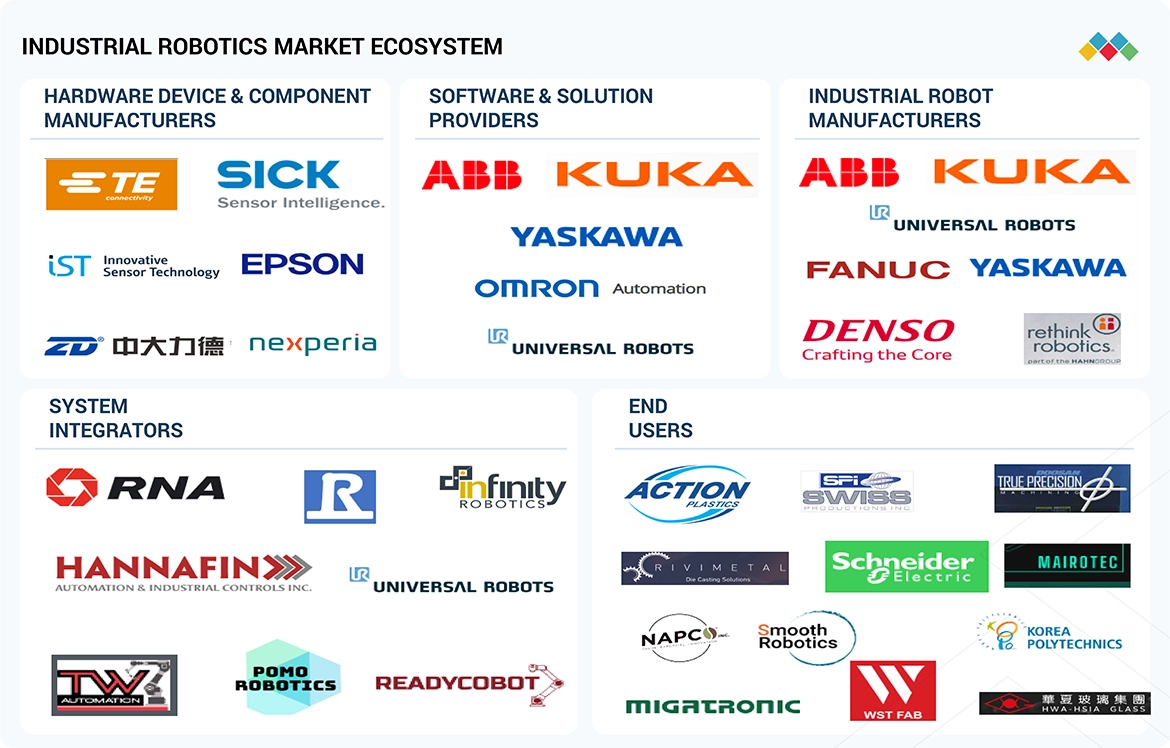
INDUSTRIAL ROBOTICS MARKET SIZE, SHARE & ANALYSIS: COMMERCIAL USE CASES ACROSS INDUSTRIES
| COMPANY | USE CASE DESCRIPTION | BENEFITS |
|---|---|---|
 |
Deployment of high-speed handling robots in automotive body-shop lines for welding, material transfer, and precision assembly | Delivers ultra-high cycle time reliability | >99.99% uptime | Reduced takt time | Lower total cost of ownership |
 |
Use of articulated robots integrated into flexible manufacturing cells for EV battery module assembly and pack handling | Enables high-precision battery assembly | Reduces defect rates | Supports multi-product flexibility | Accelerates EV line ramp-up |
 |
Integration of ABB’s IRB series robots in electronics manufacturing for PCB assembly, micro-soldering, and component placement | Enhances throughput by 20–30% | Improves micro-assembly accuracy | Reduces human-error-driven quality deviations |
 |
Adoption of Motoman robots in metal fabrication for welding, cutting, and grinding operations in industrial machinery plants | Improves weld consistency | Reduces scrap | Increases operator safety | Enables continuous 24/7 production |
 |
Use of Mitsubishi’s SCARA & 6-axis robots in food & beverage packaging lines for pick-and-place and high-speed sorting | Boosts packaging line efficiency | Ensures hygiene compliance | Minimizes labor dependency | Improves output scalability |
Logos and trademarks shown above are the property of their respective owners. Their use here is for informational and illustrative purposes only.
Related Ecosystem
Automotive Electronics And Electrical Equipment
- Battery Electric Vehicle (BEV)
- Light Commercial Vehicles (LCVs)
- Fuel Cell Electric Vehicle (FCEV)
- Sensors
- Hybrid Electric Vehicle (HEV)
- BOSCH LIMITED
- Continental ag
- DENSO Corporation
- Texas Instruments Incorporated
- Panasonic Holdings Corporation
Fandb Processing And Technology
- Dairy Products
- Bakery Products
- Filtration Equipment
- Heat Exchanger
- Acetic Acid
- Gea group
- John Bean Technologies Corporation
- Alfa Laval Corporate AB
- AZELIS HOLDINGS SA
- SPX FLOW INC
Drones And Robotics
- Sensors
- Articulated Robots
- Cartesian Robots
- Scara Robots
- Actuators
- ABB India Limited
- KUKA AG
- MOMENTIVE PERFORMANCE MATERIALS INC.
- STAUBLI INTERNATIONAL AG
- Fanuc Corporation
Key Takeaways
- Europe's industrial robotics market will grow from $2,518.98M (2026) to $2,913.17M (2031) at a 2.5% CAGR, reflecting steady but moderate expansion.
- Europe prioritizes high-value, precision robotics applications in semiconductor and electronics manufacturing over high-volume deployment.
- Industry 4.0 and digital transformation initiatives drive Europe's robotics adoption, supported by strong regulatory frameworks and skilled labor.
- Europe's mature market dynamics contrast with faster-growing regions, positioning the continent as a leader in specialized and advanced robotic solutions.
Industrial Robotics Market Report Scope
| Report Metric | Details |
|---|---|
| Base Year | 2026 |
| Fastest Growing Segment | COLLABORATIVE ROBOTS (Robot Type) |
| Forecast Period | 2026–2031 |
| Growth Rate | CAGR of 5% from 2026 to 2031 |
| Largest Segment | ADDITIONAL ROBOTIC HARDWARE (SAFETY FENCING, FIXTURES, CONVEYORS) (Offering) |
| Market Size Base Year (Billions) | ~USD 15.52 (2026) |
| Revenue Forecast (Billions) | ~USD 19.81 (2031) |
| Segments Covered | Robot Type, Type, Application, End-Use Industry, Payload, Offering |
Europe Industrial Robotics Market Report Segmentation
6 segment dimensions are covered across the global market.
By Robot Type
- Collaborative Robots
- Traditional Robots
By Type
- Articulated Robots
- Cartesian Robots
- Cylindrical Robots
- Other Traditional Robots
- Parallel Robots
- Scara Robots
By Application
- Assembling & Disassembling
- Cleanroom
- Cleanrooms
- Dispensing
- Handling
- Other Applications
- Processing
- Welding & Soldering
By End-Use Industry
- Automotive
- Electrical & Electronics
- Food & Beverages
- Metals & Machinery
- Oil & Gas
- Other End-Use Industries
- Pharmaceuticals & Cosmetics
- Plastics, Rubbers & Chemicals
- Precision Engineering & Optics
By Payload
- 16.01–60.00 Kg
- 60.01–225.00 Kg
- More Than 225.00 Kg
- Up To 16.00 Kg
By Offering
- Additional Robotic Hardware (Safety Fencing, Fixtures, Conveyors)
- Industrial Robots
- Robot Accessories (End Effectors, Controllers, Etc.)
- Software & Programming
- System Engineering
EUROPE: INDUSTRIAL ROBOTS MARKET, BY END-USE INDUSTRY, 2026–2032
| Segment | 2026 | 2027 | 2028 | 2029 | 2030 | 2031 | 2032 | CAGR (%) |
|---|---|---|---|---|---|---|---|---|
| AUTOMOTIVE | 30.86 | 32.16 | 33.5 | 34.91 | 36.41 | 37.98 | 39.61 | 4.2 |
| ELECTRICAL & ELECTRONICS | 19.82 | 20.59 | 21.35 | 22.14 | 22.94 | 23.75 | 24.1 | 3.3 |
| FOOD & BEVERAGES | 2.81 | 2.91 | 3.02 | 3.12 | 3.21 | 3.31 | 3.38 | 3.1 |
| METALS & MACHINERY | 18.58 | 19.48 | 20.41 | 21.37 | 22.39 | 23.46 | 24.6 | 4.8 |
| OIL & GAS | 1.42 | 1.46 | 1.5 | 1.54 | 1.58 | 1.62 | 1.66 | 2.7 |
| OTHER END-USE INDUSTRIES | 14.25 | 14.73 | 15.23 | 15.75 | 16.29 | 16.87 | 17.52 | 3.5 |
| PHARMACEUTICALS & COSMETICS | 2.52 | 2.65 | 2.77 | 2.9 | 3.02 | 3.14 | 3.26 | 4.3 |
| PLASTICS, RUBBERS & CHEMICALS | 7.89 | 8.18 | 8.46 | 8.72 | 8.96 | 9.23 | 9.55 | 3.2 |
| PRECISION ENGINEERING & OPTICS | 2.39 | 2.53 | 2.67 | 2.82 | 2.99 | 3.16 | 3.36 | 5.9 |
| TOTAL | 100.54 | 104.68 | 108.91 | 113.26 | 117.78 | 122.52 | 127.03 | 4 |
REST OF EUROPE: INDUSTRIAL ROBOTS MARKET, BY END-USE INDUSTRY, 2026–2032
| Segment | 2026 | 2027 | 2028 | 2029 | 2030 | 2031 | 2032 | CAGR (%) |
|---|---|---|---|---|---|---|---|---|
| AUTOMOTIVE | 9.4 | 9.73 | 10.07 | 10.43 | 10.8 | 11.19 | 11.6 | 3.6 |
| ELECTRICAL & ELECTRONICS | 5.97 | 6.12 | 6.27 | 6.44 | 6.58 | 6.72 | 6.74 | 2 |
| FOOD & BEVERAGES | 0.86 | 0.9 | 0.93 | 0.96 | 1 | 1.03 | 1.05 | 3.3 |
| METALS & MACHINERY | 5.77 | 6.03 | 6.31 | 6.58 | 6.88 | 7.19 | 7.52 | 4.5 |
| OIL & GAS | 0.4 | 0.41 | 0.42 | 0.43 | 0.45 | 0.46 | 0.47 | 2.9 |
| OTHER END-USE INDUSTRIES | 4.39 | 4.53 | 4.67 | 4.81 | 4.97 | 5.13 | 5.32 | 3.2 |
| PHARMACEUTICALS & COSMETICS | 0.76 | 0.79 | 0.82 | 0.86 | 0.89 | 0.93 | 0.96 | 4.2 |
| PLASTICS, RUBBERS & CHEMICALS | 2.22 | 2.27 | 2.32 | 2.35 | 2.38 | 2.42 | 2.49 | 1.9 |
| PRECISION ENGINEERING & OPTICS | 0.73 | 0.77 | 0.81 | 0.86 | 0.91 | 0.96 | 1.02 | 5.8 |
| TOTAL | 30.5 | 31.56 | 32.62 | 33.72 | 34.85 | 36.02 | 37.18 | 3.4 |
Target Audience
- Industrial Robotics Manufacturers : Manufacturers need Europe-specific market data to calibrate product portfolios, pricing strategies, and sales resources for a mature, quality-focused market with distinct regulatory requirements and customer preferences.
- Automation Systems Integrators : Integrators require country-level insights to identify high-potential markets, assess competitive intensity, and develop localized service offerings aligned with European manufacturing standards and sustainability goals.
- Electronics & Semiconductor OEMs : OEMs need market forecasts to plan automation investments, evaluate supplier capabilities, and optimize production efficiency across European facilities in response to regional demand and regulatory pressures.
- Private Equity & Investment Firms : Investors require detailed market analysis to evaluate acquisition targets, assess growth potential in European robotics companies, and identify consolidation opportunities in a stable, mature sector.
- Government & Policy Organizations : Policy makers and economic development agencies need market intelligence to design incentive programs, support workforce transition initiatives, and align industrial automation strategies with EU digital and green agendas.
Key Companies in the Europe Industrial Robotics Market
| Company | HQ | Ownership | Strongest segments |
|---|---|---|---|
| QINETIQ GROUP PLC | United Kingdom | Public Company | Test and Training,Mission Support and Operations,Research and Development, |
| GODREJ GROUP | India | Private Company | Consumer home appliances,Commercial appliances & cooling solutions,Locks, architectural hardware & home security, |
| LG CHEM LTD. | South Korea | Public Company | Ethylene-based synthetic resins (PE, EVA, UNIQABLE),Styrene- and benzene-based resins (ABS, PS, EPS, SAN, polycarbonate),Propylene-based resins and elastomers (PP, POE, rubbers, latex), |
| FOXCONN INDUSTRIAL INTERNET CO LTD | China | Public Company | Servers and Storage Hardware,Networking Equipment,Industrial Automation Systems, |
| SIMPLO TECHNOLOGY CO., LTD. | Taiwan | Public Company | Mobile device and notebook battery modules,Household appliance and fit accessory battery packs,LEV and EV battery modules, |
| LENOVO | China | Public Company | Commercial PCs and Small Form Factor Signage Controllers,Dedicated Media Players and Embedded Systems,Tablets, Smart Devices, and Interactive Kiosk Endpoints, |
| ZENSAR TECHNOLOGIES LTD | India | Public Company | Digital and Application Services,Cloud Infrastructure and Security,Consulting, Brand, and Marketing/Insights, |
| LEONI AG | Germany | Private Company | Complete wiring systems and cable harnesses,High-voltage wiring systems for hybrid and electric vehicles,Standard and special automotive cables, |
| ABB | Switzerland | Public Company | Electrification,Motion,Automation, |
| YASKAWA ELECTRIC CORPORATION | Japan | Public Company | Motion control (servo motors, drives, controllers, encoders),Industrial robots (arc/spot welding, handling, palletizing, collaborative, biomedical),AC drives and industrial systems (low- and medium-voltage, system controllers), |
| FANUC CORPORATION | Japan | Public Company | Industrial robots,CNC systems and factory automation components (servo motors, lasers),Robomachine equipment (compact machining centers, electric injection molding, wire EDM), |
| KUKA SE & CO. KGAA | Germany | Private Company | Industrial robots and controllers,Collaborative and mobile robots,Turnkey production systems and cells, |
| MITSUBISHI ELECTRIC CORPORATION | Japan | Public Company | Factory Automation and Industrial Systems,Building Systems (Elevators, Escalators, BMS),Air Conditioning, Refrigeration, and Home Equipment, |
| KAWASAKI HEAVY INDUSTRIES, LTD. | Japan | Public Company | Energy solutions, turbines, and industrial plants,Aerospace systems and defense-related industrial equipment,Powersports, motorcycles, and general-purpose engines, |
| DENSO CORPORATION | Japan | Public Company | Powertrain systems (gasoline, diesel, hybrid, EV, fuel cell),Thermal and HVAC systems (air-conditioning, heat pumps, cooling),Safety and cockpit systems, |
| NACHI-FUJIKOSHI CORP. | Japan | Public Company | Bearings and bearing units,Hydraulic equipment and automotive hydraulics,Cutting tools, |
| SEIKO EPSON CORPORATION | Japan | Public Company | Home and office inkjet printers and consumables,Commercial and industrial inkjet printers and printheads,POS systems, label printers, and related solutions, |
| DüRR GROUP | Germany | Public Company | Automotive paint shops and final assembly systems,Process technology, sealing, gluing, and application systems,DXQ software, control, and digital services, |
| YAMAHA MOTOR CO., LTD. | Japan | Public Company | Motorcycles and land mobility,Marine (outboards, boats, WaveRunners),Outdoor land vehicles (ATVs, ROHVs, golf cars), |
| ESTUN AUTOMATION CO., LTD | China | Public Company | Motion control systems (servo drivers, motors, inverters, HMI, CNC),Industrial robots (ER, UNO, specialized, collaborative, workstations, accessories),Digital products and industrial software (design tools, E-PMT, E-noesis), |
| SHIBAURA MACHINE | Japan | Public Company | Injection molding machines,Die-casting and extrusion machinery,Machine tools (machining centers, boring machines, vertical lathes), |
| DOVER CORPORATION | United States | Public Company | Pumps & Process Solutions,Clean Energy & Fueling,Imaging & Identification, |
| AUROTEK CORPORATION | Taiwan | Public Company | Automation Components,Automation Equipment,Robotics and Others, |
QINETIQ GROUP PLC
QinetiQ Group PLC is a United Kingdom-based public company founded in 2001 with 7,378 employees.
GODREJ GROUP
Godrej Group is an Indian private company founded in 1897 with 13,316 employees.
LG CHEM LTD.
LG Chem Ltd. is a South Korean public company founded in 1947 with 14,019 employees.
FOXCONN INDUSTRIAL INTERNET CO LTD
Foxconn Industrial Internet Co Ltd is a Chinese public company founded in 2015 with 217,084 employees.
SIMPLO TECHNOLOGY CO., LTD.
Simplo Technology Co., Ltd. is a Taiwanese public company founded in 1981 with 449 employees.
LENOVO
Lenovo is a Chinese public company founded in 1984.
ZENSAR TECHNOLOGIES LTD
Zensar Technologies Ltd is an Indian public company founded in 1963 with 10,066 employees.
LEONI AG
LEONI AG is a German private company founded in 1569 with 95,090 employees.
ABB
ABB is a Swiss public company founded in 1883 with 111,900 employees.
YASKAWA ELECTRIC CORPORATION
Yaskawa Electric Corporation is a Japanese public company founded in 1915 with 12,483 employees.
FANUC CORPORATION
FANUC Corporation is a Japanese public company founded in 1950 with 10,040 employees.
KUKA SE & CO. KGAA
KUKA SE & Co. KGaA is a German private company founded in 1898 with 14,985 employees.
MITSUBISHI ELECTRIC CORPORATION
Mitsubishi Electric Corporation is a Japanese public company founded in 1921 with 150,386 employees.
KAWASAKI HEAVY INDUSTRIES, LTD.
Kawasaki Heavy Industries, Ltd. is a Japanese public company founded in 1878 with 40,640 employees.
DENSO CORPORATION
Denso Corporation is a Japanese public company founded in 1949 with 154,716 employees.
NACHI-FUJIKOSHI CORP.
Nachi-Fujikoshi Corp. is a Japanese public company founded in 1928 with 6,532 employees.
SEIKO EPSON CORPORATION
Seiko Epson Corporation is a Japanese public company founded in 1942 with 74,619 employees.
DüRR GROUP
Dürr Group is a German public company founded in 1895 with 17,731 employees.
YAMAHA MOTOR CO., LTD.
Yamaha Motor Co., Ltd. is a Japanese public company founded in 1918 with 55,176 employees.
ESTUN AUTOMATION CO., LTD
Estun Automation Co., Ltd is a Chinese public company founded in 1993 with 3,261 employees.
SHIBAURA MACHINE
Shibaura Machine is a Japanese public company founded in 1938 with 3,175 employees.
DOVER CORPORATION
Dover Corporation is a United States-based public company founded in 1947 with 24,000 employees.
AUROTEK CORPORATION
Aurotek Corporation is a Taiwanese public company founded in 1980.
Countries within Europe - compare and drill down
| Country | 2025 size (native) |
|---|---|
| Germany | USD 47.02 Million |
| Italy | USD 14.59 Million |
| France | USD 13.09 Million |
| Spain | USD 8.72 Million |
| UK | USD 6.44 Million |
| Rest Of Europe | USD 37.18 Million |
Country market size visualization
Reasons to Buy this Report
- Country-Level Market Segmentation : Access detailed market sizing for Germany, Italy, France, Spain, and UK, enabling targeted go-to-market strategies for specific European manufacturing hubs and regulatory environments.
- Competitive Landscape Intelligence : Understand market dynamics across Europe's mature robotics sector, identifying consolidation trends, technology leaders, and emerging opportunities in collaborative and AI-enabled automation.
- Investment & Expansion Planning : Leverage 5-year forecast data (2026–2031) to plan facility investments, supply chain positioning, and partnership development across Europe's stable, predictable robotics market.
- Regulatory & Compliance Insights : Navigate EU-wide automation standards, green manufacturing directives, and digital transformation mandates that shape robotics adoption and create differentiation opportunities for compliant solutions.
- Sector-Specific Application Data : Identify high-value deployment opportunities in automotive, electronics, and precision engineering verticals where European manufacturers prioritize quality, sustainability, and workforce integration.
Frequently asked questions
What is the projected size of Europe's industrial robotics market in 2031?
Europe's industrial robotics market is projected to reach $2,913.17 million by 2031, up from $2,518.98 million in 2026.
What is the CAGR for Europe's industrial robotics market?
Europe's industrial robotics market is expected to grow at a compound annual growth rate of 2.5% between 2026 and 2031.
Which industries drive industrial robotics demand in Europe?
Europe's industrial robotics demand is primarily driven by the semiconductor, electronics, automotive, and precision engineering sectors, which prioritize automation for quality and efficiency.
How does Europe's robotics market growth compare to global trends?
Europe's 2.5% CAGR is more conservative than the global 5% CAGR, reflecting Europe's mature market status and focus on high-value applications rather than rapid volume expansion.
What factors support industrial robotics adoption in Europe?
Europe's robotics adoption is supported by Industry 4.0 initiatives, strong regulatory frameworks, skilled labor availability, and emphasis on sustainable and precision manufacturing practices.
RESEARCH METHODOLOGY
The research process for this technical, market-oriented, and commercial study of the industrial robotics market included the systematic collection, recording, and analysis of data on companies operating in the market. It involved the extensive use of secondary sources, directories, and databases (Factiva, Oanda) to identify and collect relevant information. In-depth interviews were conducted with primary respondents, including experts from core and related industries and preferred manufacturers, to obtain and verify critical qualitative and quantitative information and to assess the market's growth prospects. Key players in the industrial robotics market were identified through secondary research, and their market rankings were determined through primary and secondary research. This included studying the annual reports of top players and interviewing key industry experts, including CEOs, directors, and marketing executives.
Secondary Research
In the secondary research process, various secondary sources have been referred to for identifying and collecting information relevant to this study. Secondary sources include annual reports, press releases, and investor presentations of companies; white papers, certified publications, and articles from recognized authors; directories; and databases. Secondary research has been mainly conducted to obtain key information about the supply of the industry; a total pool of key players; segmentation of the market according to industry trends, geographic markets, and key developments from market- and technology-oriented perspectives.
Primary Research
In the primary research process, primary sources from the supply and demand sides have been interviewed to obtain qualitative and quantitative information for this report. Primary sources from the supply side include experts, such as CEOs, vice presidents, marketing directors, technology and innovation directors, subject-matter experts, consultants, and related key executives from major companies and organizations operating in the industrial robotics market.
After the complete market engineering process (market statistics calculations, market breakdown, market size estimations, market forecasting, and data triangulation), extensive primary research has been conducted to gather information and verify and validate the critical market numbers.
Several primary interviews have been conducted with experts from the demand and supply sides across four major regions—North America, Europe, Asia Pacific, and RoW. Approximately 25% of the primary interviews were conducted with the demand side and 75% with the supply side. This primary data has been collected through questionnaires, emails, and telephonic interviews.
BREAKDOWN OF PRIMARY INTERVIEW PARTICIPANTS
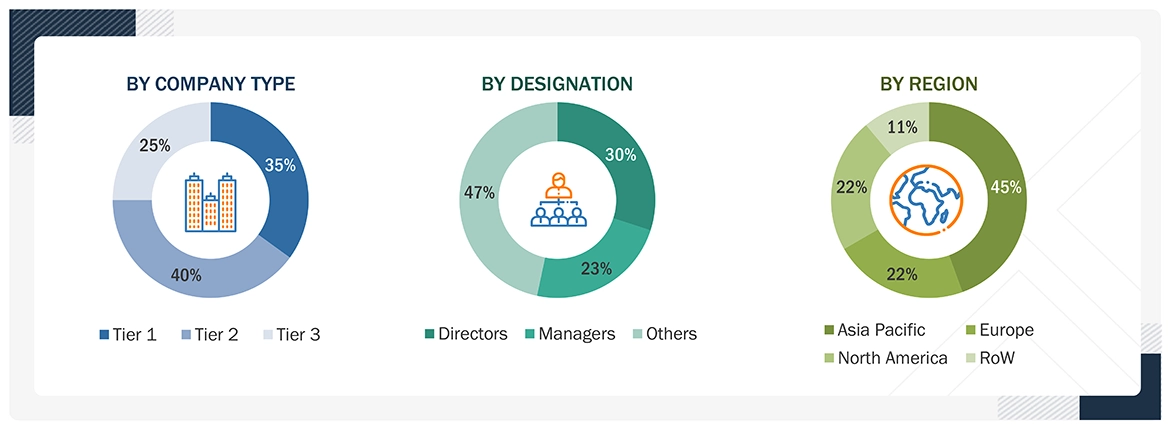
Notes: Tier 1 companies include market players with revenues above USD 500 million; tier 2 companies earn revenues between USD 100 million and USD 500 million; and tier 3 companies earn revenues up to USD 100 million.
Other designations include sales, marketing, and product managers.
To know about the assumptions considered for the study, download the pdf brochure
Market Size Estimation
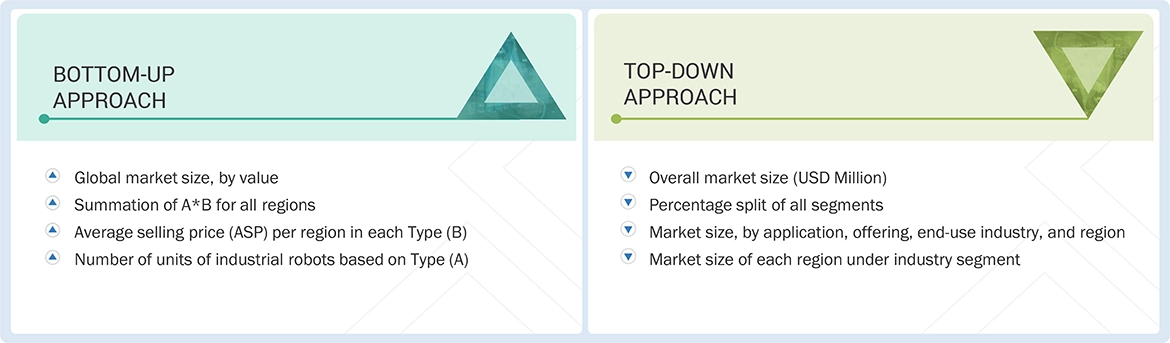
In the complete market estimation process, the top-down and bottom-up approaches have been used, along with several data triangulation methods, to estimate and forecast the size of the market and its segments and subsegments listed in the report. Extensive qualitative and quantitative analyses have been carried out on the complete market engineering process to list the key information/insights pertaining to the industrial robotics market.
Key players in the industrial robotics market have been identified through secondary research, and their rankings in the respective regions have been determined through primary and secondary research. This entire procedure involved the study of the annual and financial reports of top players and interviews with industry experts, such as chief executive officers, vice presidents, directors, and marketing executives, for quantitative and qualitative insights. All percentage shares, splits, and breakdowns have been determined using secondary sources and verified through primary sources. All parameters that affect the markets covered in this research study have been accounted for, viewed in extensive detail, verified through primary research, and analyzed to obtain the final quantitative and qualitative data. This data has been consolidated and enhanced with detailed inputs and analysis from MarketsandMarkets and presented in this report.
BOTTOM-UP APPROACH
- Identifying shipments of industrial robots at the country levels
- Analyzing the penetration of each country-level shipment through secondary and primary research
- Conducting multiple discussion sessions with key opinion leaders to understand the detailed adoption of industrial robots and their implementation by multiple end users; this helped analyze the breakdown of the scope of work carried out by each major company
- Verifying and cross-checking the estimates at every level with key opinion leaders, including CEOs, directors, and operations managers, and finally with MarketsandMarkets’ domain experts
- Studying various paid and unpaid sources of information, such as annual reports, press releases, white papers, and databases
TOP-DOWN APPROACH
- Focusing initially on the top-line investments and expenditures made in the industrial robots ecosystem, further splitting the key market areas based on robot type, payload, offering, application, end-use industry, and region, and listing the key developments
- Identifying all leading players in the industrial robots market based on type and end-use industry through secondary research and fully verifying them through brief discussions with industry experts
- Analyzing revenues, product mix, geographic presence, and key verticals served by all identified players to estimate and arrive at percentage splits for all key segments
- Discussing splits with industry experts to validate the information and identify key growth pockets across all key segments
- Breaking down the total market based on verified splits and key growth pockets across all segments
Industrial Robotics Market : Top-Down and Bottom-Up Approach
Data Triangulation
After arriving at the overall market size from the market size estimation process explained above, the total market has been split into several segments and subsegments. To complete the overall market engineering process and arrive at the exact statistics for all segments and subsegments, the market breakdown and data triangulation procedures have been employed, wherever applicable. The data has been triangulated by studying various factors and trends from both the demand and supply sides. Additionally, the market size has been validated using both top-down and bottom-up approaches.
Market Definition
According to the International Organization for Standardization (ISO 8373), an industrial robot is an automatically controlled, reprogrammable, multipurpose manipulator with three or more axes of motion that can be either fixed in place or mounted on a mobile platform for use in automation applications in an industrial environment.
According to the International Federation of Robotics (IFR), collaborative industrial robots perform tasks alongside workers in industrial settings. These robots comply with ISO 10218-1 and 10218-2, which specify requirements and guidelines for the inherently safe design, protective measures, and use of industrial robots. The industrial robotics market study primarily includes an analysis of industrial robots and brief market information on peripherals, software, and systems engineering required to develop a robotic cell.
Key Stakeholders
- Original equipment manufacturers (OEMs)
- Providers of technology solutions
- Research institutes
- Market research and consulting firms
- Forums, alliances, and associations
- Technology investors
- Governments and financial institutions
- Analysts and strategic business planners
- Existing and prospective end users
Report Objectives
- To describe and forecast the industrial robotics market, by robot type and offering, in terms of value
- To describe and forecast the industrial robotics market, by robot type, payload, application, and end-use industry, in terms of value and volume
- To describe and forecast the industrial robotics market size with respect to four main regions, namely, North America, Europe, Asia Pacific, and the Rest of the World (RoW), in terms of value and volume
- To provide detailed information regarding the drivers, restraints, opportunities, and challenges influencing the growth of the industrial robotics market
- To provide a detailed overview of the supply chain, ecosystem analysis, case study analysis, patent analysis, trade analysis, technology analysis, average selling price (ASP) analysis, AI/gen AI impact analysis, Porter’s Five Forces analysis, macroeconomic outlook, and regulations of the market of industrial robotics
- To strategically analyze micromarkets1 with respect to individual growth trends, prospects, and contributions to the overall market
- To analyze opportunities in the market for various stakeholders by identifying the high-growth segments of the market
- To benchmark the market players using the proprietary company evaluation matrix framework, which analyzes the market players on various parameters within the broad categories of business strategy excellence and strength of product portfolios
- To strategically profile the key players and comprehensively analyze their market positions in terms of ranking and core competencies, along with a detailed competitive landscape of the market
- To analyze competitive developments, such as acquisitions, product launches, partnerships, expansions, and collaborations, in the industrial robotics market
Available customizations:
With the given market data, MarketsandMarkets offers customizations according to the company’s specific needs. The following customization options are available for the report:
Company Information
-
Detailed analysis and profiling of additional market players (up to 7)
Get the Full Industrial Robotics Market Report
Full forecast, segment splits, and company analysis for all Industrial Robotics Market.
- US Industrial Robotics Market
- Canada Industrial Robotics Market
- Mexico Industrial Robotics Market
- France Industrial Robotics Market
- Germany Industrial Robotics Market
- Italy Industrial Robotics Market
- Spain Industrial Robotics Market
- UK Industrial Robotics Market
- China Industrial Robotics Market
- India Industrial Robotics Market
- Japan Industrial Robotics Market
- South Korea Industrial Robotics Market
- Taiwan Industrial Robotics Market
- Thailand Industrial Robotics Market
- Rest Of Europe Industrial Robotics Market
- Rest Of Asia Pacific Industrial Robotics Market
Need a Tailored Report?
Customize this report to your needs
Get 10% FREE Customization
Customize This Report
