
India AC Circuit Breaker Market (2026-2031)

The India AC Circuit Breaker Market was valued at $235.7 Million in 2026 and projected to reach to $338.3 Million by 2031, representing a compound annual growth rate of CAGR 7.5%. India's AC circuit breaker market is poised for sustained expansion driven by the government's ambitious infrastructure modernization agenda, including smart grid deployment and renewable energy targets.


| Market Size in | USD 26.32 MN |
| Market Forecast in | |
| CAGR | |
| Forecast Period | |
| Units Considered | Value (USD MN) |
India AC Circuit Breaker Market Trends and Insights
- This 7.5% compound annual growth rate reflects India's accelerating infrastructure modernization, renewable energy integration, and rising electricity demand across industrial and residential sectors.
- India's expanding power distribution networks and grid upgrades are driving adoption of advanced circuit protection technologies. The Indian market benefits from government initiatives promoting electrification, smart grid deployment, and industrial automation.
- India's growing manufacturing base and urbanization trends are increasing the need for reliable electrical protection systems.
- By 2031, India is expected to solidify its position as a key regional market, supported by investments in transmission and distribution infrastructure and the transition toward sustainable energy solutions..
Key Market Statistics
- CAGR (2026-2031) CAGR 7.5%
- Market Size, 2026 ~USD 235.7 Million
- Forecast, 2031 ~USD 338.3 Million
- Country India
India AC Circuit Breaker Market Overview
Market Valuation Growth :
India's AC circuit breaker market is valued at USD 235.7 million in 2026 and is projected to reach USD 338.3 million by 2031, representing a robust 7.5% CAGR, outpacing the global growth rate of 6.3%.
Infrastructure Modernization :
India's rapid infrastructure development and smart grid initiatives are driving demand for advanced AC circuit breakers across urban and rural electrification projects, supporting the nation's power distribution expansion.
Renewable Energy Integration :
The surge in solar and wind energy installations across India necessitates reliable circuit protection systems, creating significant opportunities for AC circuit breaker manufacturers and distributors in the renewable sector.
Industrial & Residential Demand :
Rising electricity consumption from India's growing industrial base, manufacturing sector, and residential expansion in tier-2 and tier-3 cities is fueling sustained demand for circuit protection solutions.
India AC Circuit Breaker Market Dynamics
- The 7.5% CAGR reflects strong fundamentals from increasing electrification rates, industrial growth, and the transition toward cleaner energy sources.
- Rising electricity demand across manufacturing, commercial, and residential segments will continue to support market growth through 2031. Key growth catalysts include India's commitment to renewable energy capacity additions, ongoing power distribution network upgrades, and regulatory mandates for electrical safety standards.
- The market will benefit from technological advancements in circuit breaker efficiency and digital monitoring capabilities.
- Strategic investments by both domestic and international players in manufacturing facilities and distribution networks will further accelerate market penetration across India's diverse regional markets..
Market Ecosystem

AC CIRCUIT BREAKER MARKET: COMMERCIAL USE CASES ACROSS INDUSTRIES
| COMPANY | USE CASE DESCRIPTION | BENEFITS |
|---|---|---|
 |
DigiTek needed to modernize power distribution and energy monitoring at its Kokomo, Indiana facility, replacing costly external CTs and hazardous door-mounted monitoring. Siemens deployed SENTRON 3VA6 digital breakers with integrated protection, metering, and communication feeding directly into the plant's PLC/HMI. | Lower installation/wiring costs | Improved worker safety | Real-time energy and breaker monitoring | Better predictive maintenance and operational transparency |
 |
EcoDataCenter (Falun, Sweden) needed high efficiency and low carbon footprint while maintaining Tier-level redundancy. Schneider Electric deployed EcoStruxure architecture with Prisma MV switchgear and MasterPact MTZ air circuit breakers, feeding operational data into EcoStruxure Power and IT platforms. | Very high efficiency with low PUE | Preserved 2N redundancy | Granular power quality/asset health visibility | Simplified maintenance | Stronger sustainability positioning |
 |
Merdeka 118 (Kuala Lumpur) required a reliable, intelligent LV distribution system for a large mixed-use tower. ABB deployed SACE Emax 3 intelligent air circuit breakers with digital communication, real-time monitoring, predictive maintenance, and cybersecurity features integrated with building energy management. | Improved reliability and safety | Enabled predictive maintenance | Strengthened cybersecurity | Increased asset visibility for long-term operational efficiency |
Logos and trademarks shown above are the property of their respective owners. Their use here is for informational and illustrative purposes only.
Related Ecosystem
Power Infrastructure
- Geographical Information System (GIS)
- Cogeneration
- Battery Electric Vehicle (BEV)
- Cellular Network
- Fuel Cell
- Siemens ag
- ABB India Limited
- SCHNEIDER ELECTRIC SE
- General Electric Company
- Eaton Corporation plc
Key Takeaways
- India's AC circuit breaker market is valued at USD 235.7 million in 2026 and will reach USD 338.3 million by 2031, representing a 7.5% CAGR.
- India's rapid industrialization and urbanization are driving demand for advanced electrical protection and distribution infrastructure.
- Government-backed electrification and smart grid initiatives in India are accelerating circuit breaker adoption across utilities and industrial sectors.
- India's renewable energy expansion and grid modernization efforts position the country as a high-growth market within Asia Pacific through 2031.
AC Circuit Breaker Market Report Scope
| Report Metric | Details |
|---|---|
| Base Year | 2026 |
| Fastest Growing Segment | DATA CENTERS (End Use) |
| Forecast Period | 2026-2031 |
| Growth Rate | CAGR of 6.3% from 2026 to 2031 |
| Largest Segment | OUTDOOR (Installation) |
| Market Size Base Year (Billions) | ~USD 4.85 (2026) |
| Revenue Forecast (Billions) | ~USD 6.58 (2031) |
| Segments Covered | Insulation Type, Installation, Voltage, Voltage Type, End Use, End Use Type |
India AC Circuit Breaker Market Report Segmentation
6 segment dimensions are covered across the global market.
By Insulation Type
- Gas
- Oil
- Vacuum
By Installation
- Indoor
- Outdoor
By Voltage
- Extra High (Above 230 Kv)
- High (53-230 Kv)
- Medium (1-52 Kv)
By Voltage Type
- 145 Kv
- 72.5 Kv
By End Use
- Commercial
- Data Centers
- EV Infrastructure
- Industrial
- Other End Use
- Other End Uses
- Power Utilities
- Railways
- Renewables
By End Use Type
- Offshore
- Onshore
Target Audience
- Circuit Breaker Manufacturers : Manufacturers need India-specific market data to assess production capacity requirements, identify distribution partnerships, and develop localized product strategies for India's growing industrial and residential segments.
- Power Distribution Companies : Utility operators and distribution companies require market insights to plan infrastructure upgrades, procurement strategies, and technology investments aligned with India's expanding power grid and renewable energy integration.
- Electrical Equipment Distributors : Distributors and wholesalers need market forecasts to optimize inventory management, identify high-growth regional markets within India, and align product portfolios with evolving customer demand patterns.
- Infrastructure & Construction Firms : Project developers and construction companies need market data to estimate material costs, plan electrical system specifications, and identify supplier partnerships for large-scale infrastructure projects across India.
- Investment & Consulting Firms : Investors, private equity firms, and management consultants require comprehensive India market analysis to evaluate investment opportunities, assess portfolio companies, and develop growth strategies in the energy sector.
Reasons to Buy this Report
- Market Size & Growth Validation : Obtain precise market valuation data for India (USD 235.7M in 2026, USD 338.3M in 2031) with a 7.5% CAGR to support investment decisions, business planning, and competitive positioning in this high-growth market.
- Regional Demand Drivers : Understand India-specific growth catalysts including infrastructure modernization, renewable energy integration, and rising electricity demand across industrial and residential sectors to identify market entry and expansion opportunities.
- Competitive Benchmarking : Compare India's market performance against global trends (6.3% global CAGR) to assess relative growth potential, market attractiveness, and strategic resource allocation for India-focused operations.
- Sector-Specific Insights : Access detailed analysis of India's power distribution network expansion, smart grid initiatives, and renewable energy sector requirements to tailor product offerings and marketing strategies for maximum market relevance.
- Strategic Planning & Forecasting : Leverage 5-year forecast data (2026-2031) to develop long-term business strategies, supply chain planning, and investment roadmaps aligned with India's accelerating electrification and modernization trajectory.
Frequently asked questions
What is the current size of India's AC circuit breaker market?
India's AC circuit breaker market is valued at USD 235.7 million in 2026 and is expected to grow to USD 338.3 million by 2031.
What is the projected growth rate for India's AC circuit breaker market?
India's AC circuit breaker market is projected to grow at a compound annual growth rate (CAGR) of 7.5% from 2026 to 2031.
What factors are driving growth in India's AC circuit breaker market?
Key drivers include India's infrastructure modernization, renewable energy integration, government electrification initiatives, smart grid deployment, and rising industrial and residential electricity demand.
Which sectors are the primary consumers of AC circuit breakers in India?
Primary sectors include utilities and power distribution companies, manufacturing and industrial facilities, commercial buildings, and residential developments across India.
How does India's market compare to the global AC circuit breaker market?
India's market is growing faster than the global average, with a 7.5% CAGR compared to the global CAGR of 6.3%, reflecting India's accelerated infrastructure and energy transition investments.
RESEARCH METHODOLOGY
The research process for this technical, market-oriented, and commercial study of the AC circuit breaker market included systematic gathering, recording, and analysis of data about companies operating in the market. It involved the extensive use of secondary sources, directories, and databases (Factiva, Oanda) to identify and collect relevant information. In-depth interviews were conducted with various primary respondents, including experts from core and related industries and preferred manufacturers, to obtain and verify critical qualitative and quantitative information, as well as to assess the growth prospects of the market. Key players in the AC circuit breaker market were identified through secondary research, and their market rankings were determined through primary and secondary research. This included studying annual reports of top players and interviewing key industry experts, such as CEOs, directors, and marketing executives.
Secondary Research
In the secondary research process, various secondary sources were referred to for identifying and collecting information relevant to this study. Secondary sources include annual reports, press releases, and investor presentations of companies; white papers, certified publications, and articles from recognized authors; directories; and databases. Secondary research was mainly conducted to obtain key information about the supply of the industry; a total pool of key players; segmentation of the market according to industry trends, geographic markets, and key developments from market- and technology-oriented perspectives.
Primary Research
During the primary research phase, various key sources from the demand side and supply side have been interviewed to gather qualitative and quantitative data for this report. Throughout the comprehensive market engineering process, a combination of top-down and bottom-up approaches, along with multiple data triangulation methods, has been extensively employed to estimate market sizes and forecast all segments and subsegments outlined in this report. Extensive qualitative and quantitative analyses have been undertaken to ensure the integrity of the market engineering process, providing key insights throughout the report. Following completion of the market engineering process, which involved calculations of market statistics, breakdowns, size estimates, forecasts, and data triangulation, thorough primary research has been conducted to gather, verify, and validate critical data points. Primary research has also been conducted to identify market segments, industry trends, and the competitive landscape in the AC circuit breaker market.
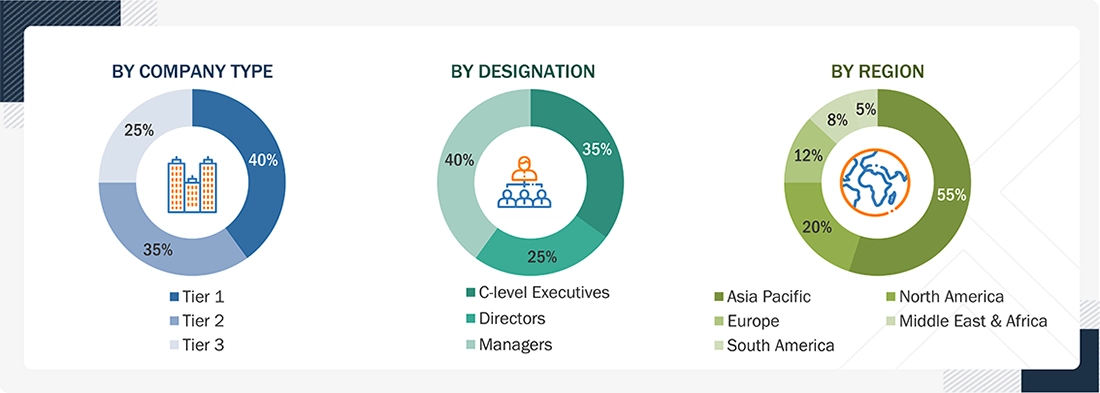
Note: Managers include sales managers, production managers, and regional managers.
Tier 1 company: revenue >USD 5 billion; tier 2 company: revenue between USD 1 and USD 5 billion; and tier 3 company: revenue <USD 1 billion in 2025
To know about the assumptions considered for the study, download the pdf brochure
Market Size Estimation
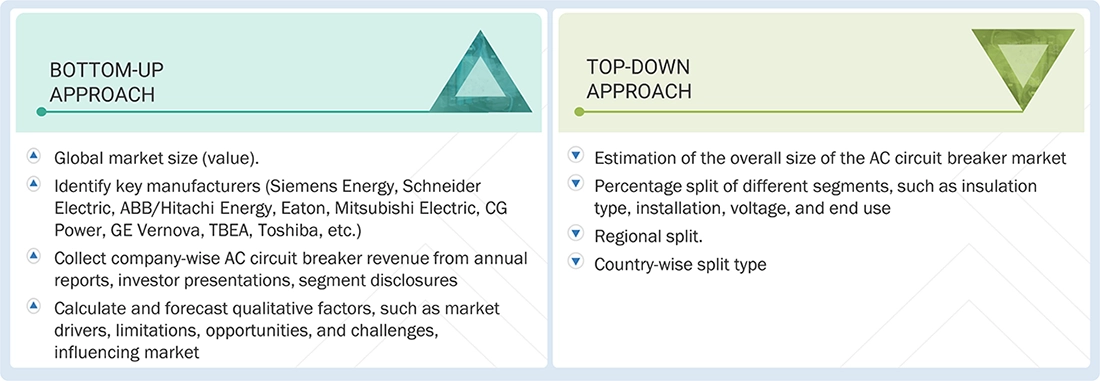
The estimation and validation of the AC circuit breaker market size have been conducted using a bottom-up approach and top-down approach. These approaches were rigorously employed to ascertain the dimensions of multiple subsegments within the market. The research process comprises the following key stages.
Bottom-up Approach
- Determining the overall value of the global AC circuit breaker market
- Mapping leading players in the industry, such as Siemens Energy, Schneider Electric, ABB, Hitachi Energy, Eaton, Mitsubishi Electric, GE Vernova, and TOSHIBA CORPORATION.
- Gathering segment-specific revenue data for these companies from annual reports, investor presentations, and public disclosures
- Considering key qualitative inputs, including market drivers, restraints, opportunities, and challenges, into the forecasting process
Top-down Approach
- Assessing the total size of the AC circuit breaker market as a whole
- Breaking this down by segment, covering insulation type, installation, voltage, and end use categories
- Allocating market share across regions worldwide
- Further refining figures down to individual country-level estimates
AC Circuit Breaker Market : Top-Down and Bottom-Up Approach
Data Triangulation
The process of determining the overall market size involved the methodologies described earlier, followed by segmenting the market into multiple segments and subsegments. To finalize the comprehensive market analysis and obtain precise statistics for each market segment and subsegment, data triangulation and market segmentation techniques were applied, as appropriate. Data triangulation was accomplished by examining various factors and trends from both the demand and supply perspectives within the ecosystem of the AC circuit breaker market.
Market Definition
An AC circuit breaker is a switching device designed to make, carry, and interrupt current under normal operating conditions as well as fault conditions such as short circuits, overloads, and earth faults in alternating current networks. Unlike fuses, which require replacement after operation, AC circuit breakers are reusable devices that automatically detect faults and interrupt current within milliseconds, protecting generators, transformers, transmission and distribution infrastructure, motors, and other electrical equipment from damage.
Key Stakeholders
- AC Circuit Breaker Manufacturers
- Power Equipment and Garden Tool Manufacturers
- Energy & Power Sector’s Consulting Companies
- Distribution Utilities
- Government and Research Organizations
- Organizations, Forums, and Associations
- Raw Material Suppliers
- State and National Regulatory Authorities
- AC Circuit Breaker Manufacturers, Distributors, and Suppliers
- Original Equipment Manufacturers (OEMs)
Report Objectives
- To describe, segment, and forecast the AC circuit breaker market size, by insulation type, installation, voltage, end use, and region, in terms of value
- To forecast the market size across five key regions: North America, Europe, Asia Pacific, South America, and the Middle East & Africa, along with country-level analysis, in terms of value
- To forecast the AC circuit breaker market size, by region, in terms of volume
- To forecast the AC circuit breaker market size, by voltage, in terms of volume
- To provide detailed information about the key drivers, restraints, opportunities, and industry-specific challenges influencing the growth of the AC circuit breaker market
- To strategically analyze the AC circuit breaker market with respect to individual growth trends, prospects, and contributions of each segment to the market
- To provide value chain analysis, trends/disruptions impacting customer business, market maps, ecosystem analysis, sustainability and regulatory landscape, pricing analysis, patent analysis, case study analysis, technology analysis, key conferences and events, Porter’s five forces analysis, macroeconomic outlook, customer landscape & buyer behavior, regulatory analysis, and AI/Gen AI impact on the market
- To strategically analyze micromarkets1 with respect to individual growth trends, upcoming expansions, and their contribution to the overall market
- To analyze opportunities for stakeholders in the AC circuit breaker market and draw a competitive landscape for market players.
- To benchmark players within the market using the company evaluation matrix, which analyzes market players based on several parameters within the broad categories of business and product strategies.
- To compare the key market players with respect to the market share, product specifications, and applications
- To strategically profile the key players and comprehensively analyze their market ranking and core competencies2
- To analyze competitive developments in the AC circuit breaker market, such as contracts, agreements, investments, expansions, product launches, partnerships, and collaborations
Available customizations:
With the given market data, MarketsandMarkets offers customizations based on the company’s specific needs. The following customization options are available for the report:
Product Analysis
- Product Matrix, which provides a detailed comparison of the product portfolio of each company
Company Information
-
Detailed analyses and profiling of additional market players (up to 5)
Get the Full AC Circuit Breaker Market Report
Full forecast, segment splits, and company analysis for all AC Circuit Breaker Market.
- China AC Circuit Breaker Market
- Japan AC Circuit Breaker Market
- Germany AC Circuit Breaker Market
- France AC Circuit Breaker Market
- UK AC Circuit Breaker Market
- Spain AC Circuit Breaker Market
- Italy AC Circuit Breaker Market
- Canada AC Circuit Breaker Market
- Mexico AC Circuit Breaker Market
- US AC Circuit Breaker Market
- Brazil AC Circuit Breaker Market
- Argentina AC Circuit Breaker Market
- Saudi Arabia AC Circuit Breaker Market
- UAE AC Circuit Breaker Market
- South Africa AC Circuit Breaker Market
- Rest Of Europe AC Circuit Breaker Market
- Rest Of Asia Pacific AC Circuit Breaker Market
- GCC AC Circuit Breaker Market
- Rest Of South America AC Circuit Breaker Market
- Rest Of GCC AC Circuit Breaker Market
Need a Tailored Report?
Customize this report to your needs
Get 10% FREE Customization
Customize This Report
