
China Acrylic Emulsion Market (2026-2031)

The China Acrylic Emulsion Market was valued at $1529.8 Million in 2026 and projected to reach to $2368.1 Million by 2031, representing a compound annual growth rate of CAGR 9.1%. China's acrylic emulsion market is poised for exceptional growth through 2031, driven by sustained urbanization, infrastructure investments, and the expansion of the construction and coatings sectors.


| Market Size in | USD 26.32 MN |
| Market Forecast in | |
| CAGR | |
| Forecast Period | |
| Units Considered | Value (USD MN) |
China Acrylic Emulsion Market Trends and Insights
- China's market growth significantly outpaces the global average of 7.2%, driven by rapid industrialization, urbanization, and increased demand from construction and coatings sectors.
- The country's dominance in manufacturing and infrastructure development positions China as a critical growth engine for the acrylic emulsion industry throughout the forecast period. China's acrylic emulsion market benefits from strong domestic consumption patterns and export-oriented production capabilities.
- China's expanding middle class and rising disposable incomes fuel demand for high-quality paints, adhesives, and specialty coatings.
- The 9.1% compound annual growth rate reflects China's strategic investments in sustainable manufacturing practices and technological innovation within the chemical sector. China's market trajectory underscores the country's pivotal role in Asia Pacific's acrylic emulsion landscape.
- By 2031, China is expected to consolidate its position as a leading regional market, supported by favorable government policies, competitive labor costs, and established supply chain networks that attract both domestic and international manufacturers..
Key Market Statistics
- CAGR (2026-2031) CAGR 9.1%
- Market Size, 2026 ~USD 1529.8 Million
- Forecast, 2031 ~USD 2368.1 Million
- Country China
China Acrylic Emulsion Market Overview
Rapid Market Expansion :
China's acrylic emulsion market is projected to grow from USD 1,529.8 million in 2026 to USD 2,368.1 million by 2031, representing a robust 9.1% CAGR that significantly outpaces the global average of 7.2%.
Industrialization & Urbanization Drivers :
Accelerated urbanization and rapid industrialization across China are fueling unprecedented demand for acrylic emulsions in construction, coatings, and infrastructure development projects nationwide.
Construction & Coatings Sector Growth :
China's booming construction and coatings industries are primary growth catalysts, with acrylic emulsions essential for architectural paints, protective coatings, and adhesive applications in residential and commercial projects.
Manufacturing Dominance :
China's position as a global manufacturing powerhouse creates substantial domestic demand for acrylic emulsions, supported by the country's extensive supply chain infrastructure and production capabilities.
China Acrylic Emulsion Market Dynamics
- The market's 9.1% CAGR reflects China's strategic focus on modernizing cities and developing industrial capacity, creating consistent demand for high-performance coating solutions.
- Government initiatives supporting green building standards and sustainable construction practices are expected to further accelerate market penetration. The competitive landscape in China presents significant opportunities for both established players and new entrants targeting the rapidly expanding domestic market.
- Rising disposable incomes, increased consumer awareness of product quality, and regulatory emphasis on low-VOC formulations are reshaping market dynamics.
- Strategic partnerships with local distributors and investments in manufacturing facilities will be critical for capturing market share in this high-growth region..
Market Ecosystem
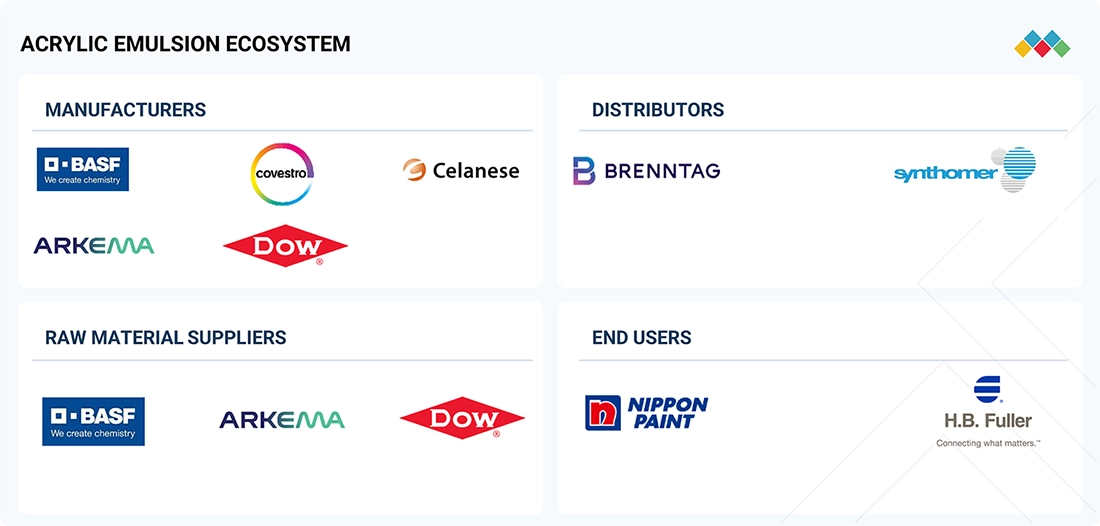
ACRYLIC EMULSION MARKET: COMMERCIAL USE CASES ACROSS INDUSTRIES
| COMPANY | USE CASE DESCRIPTION | BENEFITS |
|---|---|---|
 |
Utilizes acrylic emulsions in architectural coatings, industrial coatings, adhesives, and construction applications | Enhances coating durability | Improves weather resistance | Supports low-VOC and sustainable formulations |
 |
Incorporates acrylic emulsions in paints, coatings, adhesives, and specialty polymer solutions | Improves adhesion performance | Provides flexibility and chemical resistance | Enables high-performance water-based solutions |
 |
Applies acrylic emulsions in decorative coatings, industrial finishes, and adhesive applications | Enhances film formation | Improves surface protection | Supports eco-friendly coating technologies |
 |
Uses acrylic emulsion technologies for coatings, automotive finishes, and protective surface applications | Improves durability and appearance | Enhances scratch and weather resistance | Enables sustainable coating systems |
 |
Integrates acrylic emulsions in adhesives, paints, coatings, and industrial bonding applications | Reduces maintenance requirements | Improves bonding strength | Extends product performance life |
Logos and trademarks shown above are the property of their respective owners. Their use here is for informational and illustrative purposes only.
Related Ecosystem
Automotive Materials
- Light Commercial Vehicles (LCVs)
- Battery Electric Vehicle (BEV)
- Hybrid Electric Vehicle (HEV)
- Fuel Cell Electric Vehicle (FCEV)
- Agricultural Tractors
- AISIN CORPORATION
- GORKOVSKY AVTOMOBILNY ZAVOD
- Basf se
- BOSCH LIMITED
- Continental ag
Paints And Coatings
- Polyurethane Resin
- Alkyd Resins
- Epoxy Resin
- Polyester Resin
- Acrylics
- Basf se
- JOTUN
- PPG Industries, Inc.
- DOW CHEMICAL COMPANY
- Akzonobel n.v.
Speciality Chemicals
- Corrosion Inhibitors
- Polyetheretherketone (PEEK)
- Acrylonitrile Butadiene Styrene (ABS)
- Epoxy Resin
- Polycarbonate
- Basf se
- DOW CHEMICAL COMPANY
- Evonik industries ag
- Clariant ag.
- Solvay sa
Key Takeaways
- China's acrylic emulsion market will grow from USD 1,529.8M (2026) to USD 2,368.1M (2031) at a 9.1% CAGR, outpacing global growth.
- China's construction and coatings industries are primary demand drivers, supported by ongoing urbanization and infrastructure investment.
- China's manufacturing capabilities and export orientation position the country as a regional supply hub for acrylic emulsion products.
- China's commitment to sustainable practices and technological advancement will shape competitive dynamics through 2031.
Acrylic Emulsion Market Report Scope
| Report Metric | Details |
|---|---|
| Base Year | 2026 |
| Fastest Growing Segment | -SILICONE-MODIFIED ACRYLIC EMULSION (Type) |
| Forecast Period | 2026-2031 |
| Growth Rate | CAGR of 7.2% from 2026 to 2031 |
| Largest Segment | POLYMER & COPOLYMER (Type) |
| Market Size Base Year (Billions) | ~USD 14.49 (2026) |
| Revenue Forecast (Billions) | ~USD 20.52 (2031) |
| Segments Covered | Type, Application, Type 2026-2031 |
China Acrylic Emulsion Market Report Segmentation
3 segment dimensions are covered across the global market.
By Type
- Polymer & Copolymer
- Pure Acrylic
- -Others
- -Silicone-Modified Acrylic Emulsion
- -Styrene Acrylic Emulsion
- -Vinyl Acrylic Emulsion
By Application
- Adhesives & Sealants
- Construction Additives
- Other Applications
- Paints & Coatings
- Paper Coatings
By Type 2026-2031
- Polymer & Copolymer
- Pure Acrylic
- -Others
- -Silicone-Modified Acrylic Emulsion
- -Styrene Acrylic Emulsion
- -Vinyl Acrylic Emulsion
Target Audience
- Chemical Manufacturers & Suppliers : Acrylic emulsion producers and raw material suppliers need China market data to identify growth opportunities, optimize production capacity, and develop distribution strategies in this rapidly expanding market.
- Paint & Coatings Companies : Coating manufacturers require detailed China market insights to forecast demand, plan product launches, and establish competitive positioning in the construction and industrial coatings segments.
- Construction & Real Estate Developers : Large-scale construction firms and real estate companies need market intelligence to understand coating material trends, supplier capabilities, and cost dynamics for major infrastructure and building projects.
- Investment & Private Equity Firms : Investors evaluating opportunities in China's chemicals sector require validated market data, growth projections, and competitive analysis to assess portfolio companies and identify acquisition targets.
- Government & Policy Makers : Chinese regulatory bodies and industrial planners need market research to inform policy decisions, sustainability initiatives, and industrial development strategies in the coatings and chemicals sector.
Reasons to Buy this Report
- Market Size & Growth Validation : Obtain precise market valuation data for China (USD 1,529.8M in 2026, USD 2,368.1M in 2031) with verified 9.1% CAGR to support investment decisions and business planning in this high-growth market.
- Competitive Intelligence for China : Gain insights into China-specific market dynamics, competitive positioning, and regional trends to develop targeted strategies for market entry or expansion within the world's largest acrylic emulsion consumer base.
- Sector-Specific Demand Analysis : Understand construction and coatings sector demand drivers unique to China, including urbanization patterns, infrastructure projects, and regulatory requirements shaping acrylic emulsion consumption.
- Strategic Partnership Opportunities : Identify growth opportunities and potential partnerships with Chinese manufacturers, distributors, and end-users to capitalize on the market's 9.1% CAGR and expanding industrial base.
- Risk Mitigation & Forecasting : Access reliable China-focused forecasts through 2031 to mitigate market entry risks, optimize supply chain planning, and align product development with anticipated demand growth in key application segments.
Frequently asked questions
What is the projected market size of acrylic emulsion in China by 2031?
China's acrylic emulsion market is projected to reach USD 2,368.1 million by 2031, up from USD 1,529.8 million in 2026.
What is the CAGR for China's acrylic emulsion market?
China's acrylic emulsion market is expected to grow at a compound annual growth rate of 9.1% between 2026 and 2031.
Which industries drive demand for acrylic emulsion in China?
China's construction, coatings, adhesives, and specialty chemical sectors are primary drivers of acrylic emulsion demand.
How does China's market growth compare to global trends?
China's 9.1% CAGR significantly exceeds the global average of 7.2%, reflecting the country's accelerated industrialization and urbanization.
What factors support China's acrylic emulsion market expansion?
China's market growth is supported by rising disposable incomes, infrastructure development, manufacturing capabilities, and investments in sustainable production technologies.
RESEARCH METHODOLOGY
The study involved four major activities to estimate the current size of the global acrylic emulsion market. Exhaustive secondary research was carried out to collect information on the market, the peer product market, and the parent product group market. The next step was to validate these findings, assumptions, and sizes with industry experts across the value chain of acrylic emulsion through primary research. The top-down and bottom-up approaches were employed to estimate the overall size of the acrylic emulsion market. After that, market breakdown and data triangulation procedures were used to determine the size of different segments and sub-segments of the market.
Secondary Research
The market for companies offering acrylic emulsion is arrived at by secondary data available through paid and unpaid sources, analyzing the product portfolios of the major companies in the ecosystem, and rating the companies by their performance and quality. Various secondary sources, such as Business Standard, Bloomberg, World Bank, and Factiva, were referred to identify and collect information for this study on the acrylic emulsion market. In the secondary research process, various secondary sources were referred to identify and collect information related to the study. Secondary sources included annual reports, press releases, and investor presentations of door vendors, forums, certified publications, and whitepapers. The secondary research was used to obtain critical information on the industry’s value chain, the total pool of key players, market classification, and segmentation from the market and technology-oriented perspectives.
Primary Research
In the primary research process, various primary sources from both the supply and demand sides were interviewed to obtain qualitative and quantitative information for this report. The primary sources from the supply side included industry experts, such as Chief Executive Officers (CEOs), Vice Presidents (VPs), marketing directors, technology and innovation directors, and related key executives from several key companies and organizations operating in the acrylic emulsion market. After the complete market engineering (calculations for market statistics, market breakdown, market size estimations, market forecasting, and data triangulation), extensive primary research was conducted to gather information and verify and validate the critical numbers arrived at. Primary research was also conducted to identify the segmentation, industry trends, competitive landscape of acrylic emulsion offered by various market players, and key market dynamics, such as drivers, restraints, opportunities, challenges, industry trends, and key player strategies. In the complete market engineering process, the top-down and bottom-up approaches and several data triangulation methods were extensively used to perform the market estimation and market forecasting for the overall market segments and subsegments listed in this report. Extensive qualitative and quantitative analysis was performed on the complete market engineering process to list the key information/insights throughout the report.
Following is the breakdown of primary respondents:
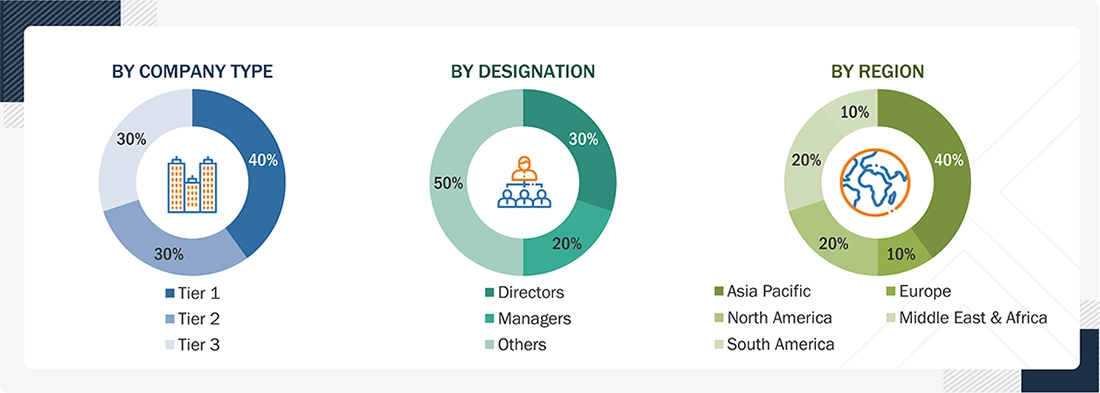
Notes: Other designations include sales, marketing, and product managers.
Tier 1: >USD 1 Billion; Tier 2: USD 500 million–1 Billion; and Tier 3: <USD 500 million.
To know about the assumptions considered for the study, download the pdf brochure
Market Size Estimation
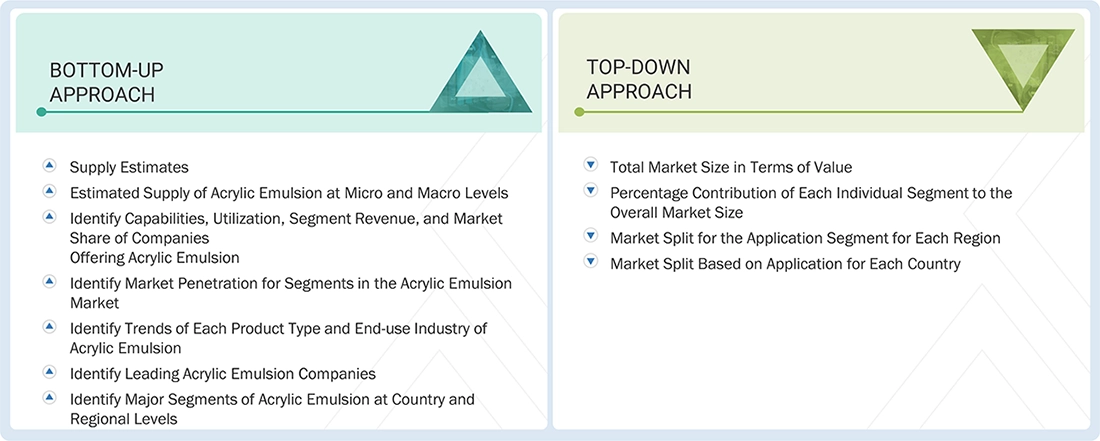
The top-down and bottom-up approaches were used to estimate and validate the size of the global acrylic emulsion market. These approaches were also used extensively to estimate the size of various dependent market segments. The research methodology used to estimate the market size included the following:
Acrylic Emulsion Market : Top-Down and Bottom-Up Approach
Data Triangulation
After arriving at the overall market size using the market size estimation processes, the market was split into several segments and subsegments. The data triangulation and market breakup procedures were employed, wherever applicable, to complete the overall market engineering process and arrive at the exact statistics of each market segment and subsegment. The data was triangulated by studying various factors and trends from both the demand and supply sides.
Market Definition
The acrylic emulsion industry relies on the development of water-based polymer dispersions which provide better adhesive strength, longer service life, higher flexibility, and enhanced resistance to chemical and weather damage than traditional materials. Acrylic emulsions are obtained with acrylic monomers via a controlled emulsion polymerization method that allows the manufacturer to produce products that are of uniform quality with performance characteristics that are specific to the customer. These water-dispersible binders were originally designed to satisfy the requirements of high-performance applications, such as decorating the building interior and providing coating solutions for industrial sectors. Besides architectural coatings, acrylic emulsions have found application in the automotive, construction, packaging, textiles, adhesives, and industrial sectors. In these markets, acrylic emulsions are present in materials such as coatings, surface treatment for sealing, pressure-sensitive bonding, and waterproofing systems. Owing to their relatively high degree of compatibility with substrates, as well as film-forming behavior and low VOC emissions, they are considered ideal for the making of clean, eco-friendly, and durable materials. The increasing need for paint and polymer solutions continues to expand the adoption of acrylic emulsions across diverse end-use industries.
Key Stakeholders
- Acrylic emulsion manufacturers
- Acrylic emulsion distributors and suppliers
- Government and private research organizations
- Associations and industrial bodies
- R&D institutions
Report Objectives
- To define, describe, and forecast the size of the global acrylic emulsion market, based on type, application, and region in terms of value
- To provide detailed information on the significant drivers, restraints, opportunities, and challenges influencing the market
- To strategically analyze micro markets concerning individual growth trends, prospects, and their contribution to the market
- To assess the growth opportunities in the market for stakeholders and provide details on the competitive landscape for market leaders
- To forecast the market size of segments and subsegments for North America, Europe, Asia Pacific, South America, and the Middle East & Africa
- To strategically profile key players and comprehensively analyze their market shares and core competencies
- To analyze competitive developments such as product launches, acquisitions, expansions, partnerships, and agreements in the acrylic emulsion market
- To provide the impact of AI/Generative AI on the market
Available customizations:
With the given market data, MarketsandMarkets offers customizations according to client-specific needs.
The following customization options are available for the acrylic emulsion market report:
Product Analysis
-
A product matrix that gives a detailed comparison of the product portfolio of each company
Company Information
-
Detailed analysis and profiling of additional market players (up to five)
Geographical Analysis
-
A further breakdown of the acrylic emulsion market for additional countries
Get the Full Acrylic Emulsion Market Report
Full forecast, segment splits, and company analysis for all Acrylic Emulsion Market.
- US Acrylic Emulsion Market
- Canada Acrylic Emulsion Market
- Mexico Acrylic Emulsion Market
- Germany Acrylic Emulsion Market
- France Acrylic Emulsion Market
- Spain Acrylic Emulsion Market
- UK Acrylic Emulsion Market
- Italy Acrylic Emulsion Market
- India Acrylic Emulsion Market
- Japan Acrylic Emulsion Market
- South Korea Acrylic Emulsion Market
- Malaysia Acrylic Emulsion Market
- Thailand Acrylic Emulsion Market
- Indonesia Acrylic Emulsion Market
- Vietnam Acrylic Emulsion Market
- Singapore Acrylic Emulsion Market
- South Africa Acrylic Emulsion Market
- Brazil Acrylic Emulsion Market
- Argentina Acrylic Emulsion Market
- Rest Of Europe Acrylic Emulsion Market
- Rest Of Asia Pacific Acrylic Emulsion Market
- GCC Countries Acrylic Emulsion Market
- -Rest Of GCC Acrylic Emulsion Market
- Rest Of South America Acrylic Emulsion Market
Need a Tailored Report?
Customize this report to your needs
Get 10% FREE Customization
Customize This Report
