
Australia Phase Change Materials Market (2025-2030)

The Australia Phase Change Materials Market was valued at $2388.8 Million in 2025 and projected to reach to $4935.4 Million by 2030, representing a compound annual growth rate of 15.62%. Australia's Phase Change Materials market is poised for significant expansion through 2030, driven by the nation's strategic emphasis on sustainability and energy efficiency.


| Market Size in | USD 26.32 MN |
| Market Forecast in | |
| CAGR | |
| Forecast Period | |
| Units Considered | Value (USD MN) |
Australia Phase Change Materials Market Trends and Insights
- This expansion reflects Australia's increasing adoption of thermal energy storage solutions across building, industrial, and renewable energy sectors.
- Australia's strategic focus on sustainability and energy efficiency is driving demand for phase change materials in temperature regulation applications, particularly in construction and HVAC systems. The Australian market benefits from the country's commitment to renewable energy integration and climate resilience initiatives.
- Between 2025 and 2030, Australia is expected to see accelerated deployment of PCM-based solutions in both commercial and residential segments.
- Australia's growing manufacturing capabilities and investment in advanced materials research further support market penetration, positioning the nation as a key growth hub within the Asia Pacific region for phase change material applications..
Key Market Statistics
- CAGR (2025-2030) 15.62% CAGR
- Market Size, 2025 ~USD 2388.8 Million
- Forecast, 2030 ~USD 4935.4 Million
- Country Australia
Australia Phase Change Materials Market Overview
Market Valuation Growth :
Australia's Phase Change Materials market is valued at USD 2,388.8 million in 2025, with a projected CAGR of 15.62% through 2030, reaching USD 4,935.4 million by forecast end.
Sustainability-Driven Expansion :
Australia's commitment to energy efficiency and sustainability is accelerating PCM adoption across building, industrial, and renewable energy sectors, positioning the nation as a key regional market.
Thermal Energy Storage Focus :
Increasing demand for thermal energy storage solutions in Australia reflects growing investment in climate control technologies and renewable energy integration across commercial and residential applications.
Regional Market Opportunity :
Australia's PCM market growth outpaces many developed economies, driven by favorable government policies, rising construction activity, and heightened awareness of energy conservation benefits.
Australia Phase Change Materials Market Dynamics
- The market's 15.62% CAGR reflects strong adoption across building thermal management, industrial cooling systems, and renewable energy storage applications.
- Government incentives for green building certifications and increasing commercial sector investments in climate control technologies are key growth catalysts.
- The forecast period will see PCM integration become standard in new construction projects and retrofitting initiatives, particularly in Australia's growing renewable energy infrastructure..
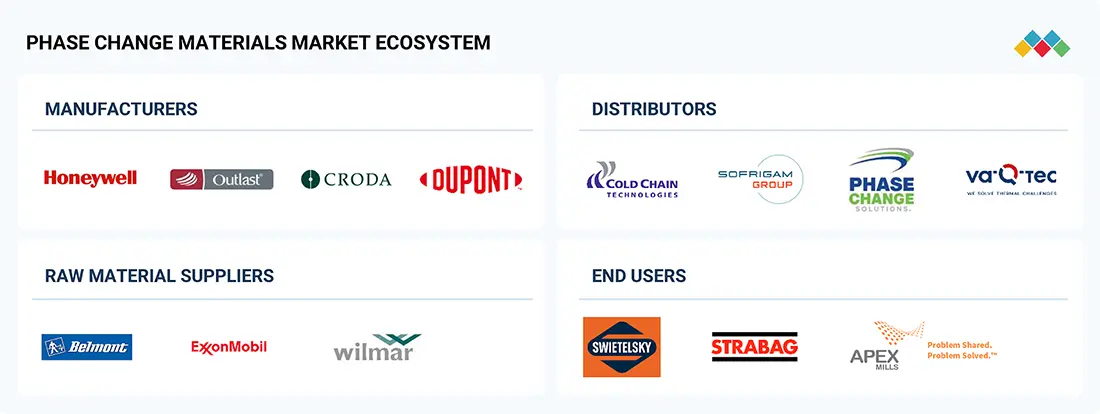
Market Ecosystem
Phase Change Materials Market: COMMERCIAL USE CASES ACROSS INDUSTRIES
| COMPANY | USE CASE DESCRIPTION | BENEFITS |
|---|---|---|
 |
Battery thermal management systems in electric vehicles using PCMs to regulate lithium-ion battery temperatures during operation | Prevents overheating, extends battery life, improves performance, enhances safety, maintains optimal operating temperatures without additional energy consumption |
 |
Pharmaceutical cold chain logistics for vaccine storage and transportation requiring precise temperature control throughout distribution networks | Maintains vaccine efficacy, ensures product integrity, reduces spoilage, enables temperature-stable shipping, protects sensitive biologics reliably worldwide |
 |
Performance athletic apparel and footwear incorporating PCM technology for thermal regulation in extreme weather conditions and sports | Regulates body temperature, enhances athlete comfort, improves performance, provides passive cooling/heating, eliminates power requirements for temperature control |
 |
Automotive cabin climate control and battery thermal management in electric and hybrid vehicles for enhanced passenger comfort | Reduces energy consumption, improves cabin comfort, extends vehicle range, provides efficient temperature regulation, enhances overall driving experience |
 |
Outdoor clothing and gear with PCM-integrated fabrics for temperature regulation in extreme outdoor and adventure activities | Maintains wearer comfort, adapts to temperature changes, reduces layering needs, provides lightweight thermal protection, enhances outdoor performance |
Logos and trademarks shown above are the property of their respective owners. Their use here is for informational and illustrative purposes only.
Related Ecosystem
Foam And Insulation
Renewable Energy Material
Resins And Polymers
Key Takeaways
- Australia's Phase Change Materials market will grow from USD 2,388.8M (2025) to USD 4,935.4M (2030), representing a 15.62% CAGR.
- Australia's renewable energy and sustainability initiatives are primary drivers of PCM adoption in thermal storage and building applications.
- Australia's construction and HVAC sectors are leading demand segments for phase change materials through 2030.
- Australia's investment in advanced materials research and manufacturing infrastructure positions it as a regional growth leader in the Asia Pacific PCM market.
Phase Change Materials Market Report Scope
| Report Metric | Details |
|---|---|
| Base Year | 2025 |
| Forecast Period | 2025–2030 |
| Growth Rate | CAGR of 17.58% from 2025 to 2030 |
| Market Size Base Year (Billions) | ~USD 0.73 (2025) |
| Revenue Forecast (Billions) | ~USD 1.64 (2030) |
| Segments Covered | Type, Application |
Australia Phase Change Materials Market Report Segmentation
2 segment dimensions are covered across the global market.
By Type
- Eutectic Pcm
- Inorganic Pcm
- Organic Pcm
By Application
- Building & Construction
- Cold Chain & Packaging
- Electronics
- Hvac
- Other Applications
- Refrigeration & Equipment
- Textiles
- Thermal Energy Storage
Target Audience
- Materials Manufacturers & Suppliers : PCM producers and distributors need Australia-specific market data to assess demand potential, identify growth segments, and develop localized supply chain strategies for the expanding thermal materials market.
- Construction & Building Companies : Builders and construction firms require insights into PCM adoption trends in Australian commercial and residential projects to integrate thermal management solutions and meet sustainability requirements.
- Energy & Renewable Sector Players : Renewable energy companies and thermal storage solution providers need Australia market intelligence to capitalize on growing demand for energy storage systems and grid stabilization technologies.
- Investment & Private Equity Firms : Investors evaluating opportunities in Australia's green technology and materials sectors need detailed market forecasts and growth drivers to assess investment viability and portfolio positioning.
- Government & Policy Organizations : Australian government agencies and policy makers require market data to inform sustainability initiatives, building codes, and incentive programs supporting thermal energy efficiency adoption.
Key Companies in the Australia Phase Change Materials Market
| Company | HQ | Ownership | Strongest segments |
|---|---|---|---|
| BASF SE | Germany | Public Company | Chemicals (petrochemicals and intermediates),Materials (isocyanates, polyamides, plastics specialties),Industrial Solutions (dispersions, resins, additives, catalysts), |
| ROYAL DUTCH SHELL PLC | United Kingdom | Public Company | Integrated Gas (including LNG and GTL),Upstream (oil, gas, NGLs),Marketing (mobility, lubricants, commercial fuels, EV charging), |
| SHELL PLC | United Kingdom | Public Company | Integrated Gas (incl. LNG and GTL),Upstream (oil, gas, NGLs),Marketing (mobility, lubricants, commercial fuels), |
| HONEYWELL INTERNATIONAL INC. | United States | Public Company | Industrial Automation,Building Automation,Energy and Sustainability Solutions (UOP and related), |
| DUPONT DE NEMOURS, INC. | United States | Public Company | Healthcare & Water Technologies,Construction Materials (TYVEK, STYROFOAM, CORIAN),Engineered Components & Specialty Materials, |
| CRODA INTERNATIONAL PLC. | United Kingdom | Public Company | Consumer Care (beauty care, actives, home care, fragrances & flavours),Life Sciences (biologics delivery, crop protection, seed coating & enhancement),Industrial Specialties (phase change materials, surfactants, textile & spin finishes), |
| BOYD CORPORATION | Canada | Public Company | Collision repair centers,Retail auto glass services,Claims administration and roadside/ancillary services, |
| SASOL LIMITED | South Africa | Public Company | Transport fuels (petrol, diesel, jet, burner fuels, illuminating paraffin),Natural gas, methane-rich gas, LPG, and industrial heating fuels,Base and performance chemicals for industrial, mining, paper, water, textile, and leather, |
BASF SE
BASF SE is a German public company founded in 1865 with 106,428 employees. It is one of the world's largest chemical manufacturers.
ROYAL DUTCH SHELL PLC
Royal Dutch Shell PLC is a United Kingdom-based public company founded in 1897 with 84,000 employees. It operates as a major international oil and gas company.
SHELL PLC
Shell PLC is a United Kingdom-based public company founded in 1897 with 84,000 employees. It operates as a major international oil and gas company.
HONEYWELL INTERNATIONAL INC.
Honeywell International Inc. is a United States-based public company founded in 1885 with 101,000 employees. It is a diversified technology and manufacturing conglomerate.
DUPONT DE NEMOURS, INC.
DuPont de Nemours, Inc. is a United States-based public company founded in 2015 with 15,000 employees. It operates as a specialty chemicals and materials manufacturer.
CRODA INTERNATIONAL PLC.
Croda International PLC is a United Kingdom-based public company founded in 1925 with 5,954 employees. It specializes in specialty chemicals and ingredients.
BOYD CORPORATION
Boyd Corporation is a Canada-based public company founded in 1990 with 13,424 employees.
SASOL LIMITED
Sasol Limited is a South Africa-based public company founded in 1950 with 27,107 employees. It operates in energy and chemicals production.
Reasons to Buy this Report
- Localized Market Intelligence : Gain comprehensive insights specific to Australia's PCM market dynamics, including regional adoption patterns, regulatory environment, and sector-specific growth drivers unavailable in global reports.
- Investment Decision Support : Access detailed market sizing and forecasts (2025-2030) to inform capital allocation decisions, market entry strategies, and expansion planning within Australia's high-growth thermal materials sector.
- Competitive Landscape Analysis : Understand Australia-specific competitive positioning, key market players, and differentiation opportunities in the PCM sector to develop targeted go-to-market strategies.
- Sector-Specific Opportunity Mapping : Identify growth opportunities across Australia's building, industrial, and renewable energy sectors with tailored insights on application demand and adoption timelines.
- Strategic Planning Resource : Leverage Australia-focused market data to support business development, product positioning, and partnership strategies aligned with regional sustainability and energy efficiency trends.
Frequently asked questions
What is the current market size of Phase Change Materials in Australia?
Australia's Phase Change Materials market was valued at USD 2,388.8 million in 2025 and is expected to reach USD 4,935.4 million by 2030.
What is the projected growth rate for Australia's PCM market?
Australia's Phase Change Materials market is projected to grow at a compound annual growth rate (CAGR) of 15.62% from 2025 to 2030.
Which sectors are driving Phase Change Materials demand in Australia?
Australia's building and construction sector, HVAC systems, and renewable energy storage applications are the primary drivers of PCM market growth.
Why is Australia's PCM market growing faster than global averages?
Australia's strong commitment to renewable energy integration, climate resilience, and energy efficiency regulations are accelerating PCM adoption compared to global trends.
What applications are most prevalent for PCM in Australia?
Australia's most prevalent PCM applications include thermal energy storage in buildings, temperature regulation in HVAC systems, and renewable energy integration solutions.
RESEARCH METHODOLOGY
The study involved four major activities in estimating the size of the phase change materials market. Exhaustive secondary research was done to collect information on the market, the peer market, and the parent market. The next step was to validate these findings, assumptions, and sizing with industry experts across the value chain through primary research. Both top-down and bottom-up approaches were employed to complete the overall market size estimation process. After that, the market breakdown and data triangulation procedures were used to estimate the market size of the segments and subsegments.
Secondary Research
Secondary sources used in this study included annual reports, press releases, and investor presentations of companies; white papers; certified publications; articles from recognized authors; and gold-standard and silver-standard websites, such as Factiva, ICIS, Bloomberg, and others. The findings of this study were verified through primary research, which involved conducting extensive interviews with key officials, including CEOs, VPs, directors, and other executives. The breakdown of profiles of the primary interviewees is illustrated in the figure below:
Primary Research
The phase change materials market comprises several stakeholders, such as raw material suppliers, end-product manufacturers, and regulatory organizations in the supply chain. Primary research from the demand side includes key opinion leaders in various end-use industries of phase change materials. Various primary sources from both the supply and demand sides of the market were interviewed to obtain qualitative and quantitative information.
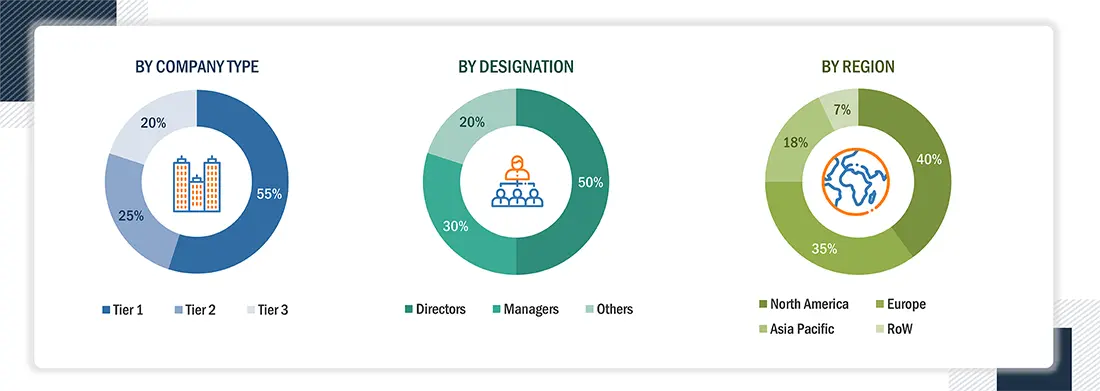
Notes: Tier 1, Tier 2, and Tier 3 companies are classified based on their market revenue in 2023/2024 available
in the public domain, product portfolios, and geographical presence.
Other designations include consultants and sales, marketing, and procurement managers.
To know about the assumptions considered for the study, download the pdf brochure
|
COMPANY NAME |
DESIGNATION |
|
Honeywell International Inc. |
Senior Manager |
|
Croda International Plc |
Innovation Manager |
|
Microtek Laboratories Inc. |
Vice President |
|
Sasol Limited |
Production Supervisor |
|
PureTemp LLC |
Sales Manager |
Market Size Estimation
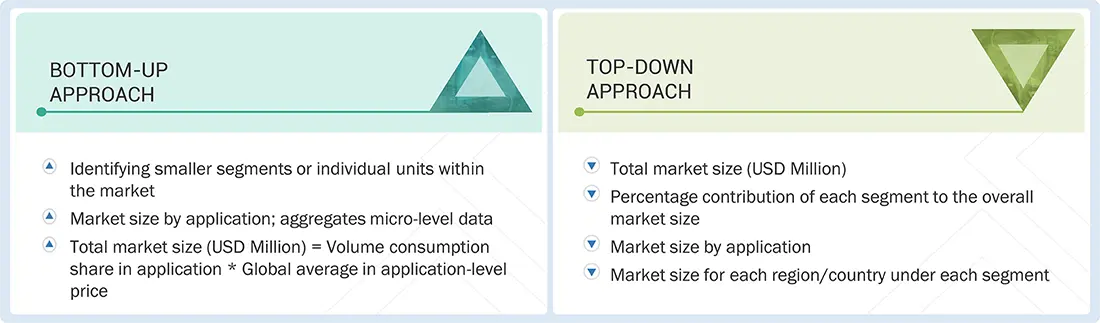
Both the top-down and bottom-up approaches were used to estimate and validate the total size of the phase change materials market. These methods were also used extensively to estimate the size of various subsegments in the market. The research methodology used to estimate the market size includes the following:
- The key players in the industry have been identified through extensive secondary research.
- The supply chain of the industry has been determined through primary and secondary research.
- All percentage shares, splits, and breakdowns have been determined using secondary sources and verified through primary sources.
- All possible parameters that affect the markets covered in this research study have been accounted for, viewed in extensive detail, verified through primary research, and analyzed to obtain the final quantitative and qualitative data.
Phase Change Materials Market : Top-Down and Bottom-Up Approach
Data Triangulation
After determining the overall market size using the market size estimation processes explained above, the market was divided into several segments and subsegments. To complete the overall market engineering process and determine the exact statistics for each market segment and subsegment, data triangulation and market breakdown procedures were employed, as applicable. The data was triangulated by studying various factors and trends from both the demand and supply sides in the phase change materials industry.
Market Definition
According to the Phase Change Material Industry Association (PCMIA), “Phase change materials are compounds that absorb, store, and release a large amount of heat at a relatively constant temperature by changing their physical state. When a phase change material freezes, it releases a large amount of energy as latent heat, whereas when such material melts, it absorbs a large amount of heat from the environment.” Heat stored in the materials is called latent heat, due to which, phase change materials are also known as latent heat storage materials. Phase change materials absorb and release heat by liquefying and solidifying at set temperatures. The natural latent heat property of phase change materials helps maintain a structure’s temperature and prevent sudden external changes. Fluctuations in ambient temperature recharge advanced phase change materials, making them suitable for everyday applications.
Stakeholders
- Phase change material manufacturers
- Phase change material distributors
- Raw material suppliers
- Government and research organizations
- Investment banks and private equity firms
Report Objectives
- To analyze and forecast the size of the global phase change materials market in terms of value and volume
- To provide detailed information about the important drivers, restraints, challenges, and opportunities influencing the market growth
- To define, describe, and segment the market based on type, application, and region
- To forecast the size of the market segments based on regions such as Asia Pacific, North America, Europe, and the Rest of the World
- To strategically analyze the segmented markets with respect to individual growth trends, prospects, and contributions to the overall market
- To identify and analyze opportunities for stakeholders in the market
- To analyze competitive developments such as expansions, partnerships & collaborations, mergers & acquisitions, agreements, and product launches in the market
- To strategically profile the key companies and comprehensively analyze their core competencies
Available Customizations
Along with the given market data, MarketsandMarkets offers customizations according to the company’s specific needs. The following customization options are available for the report:
Regional Analysis
- Further breakdown of a region with respect to a particular country or additional application
Company Information
- Detailed analysis and profiles of additional market players (up to five)
Get the Full Phase Change Materials Market Report
Full forecast, segment splits, and company analysis for all Phase Change Materials Market.
- Singapore Phase Change Materials Market
- Germany Phase Change Materials Market
- France Phase Change Materials Market
- UK Phase Change Materials Market
- Netherlands Phase Change Materials Market
- US Phase Change Materials Market
- Rest Of North America Phase Change Materials Market
- Rest Of Europe Phase Change Materials Market
- Italy Phase Change Materials Market
- Spain Phase Change Materials Market
- Rest Of Asia Pacific Phase Change Materials Market
- Canada Phase Change Materials Market
- China Phase Change Materials Market
- India Phase Change Materials Market
Need a Tailored Report?
Customize this report to your needs
Get 10% FREE Customization
Customize This Report
