
North America Aerosol Cans Market (2026-2031)

The North America Aerosol Cans Market was valued at $2308 Million in 2026 and projected to reach to $2752.5 Million by 2031, representing a compound annual growth rate of 3.6%. North America's aerosol cans market demonstrates steady growth momentum through 2031, supported by diverse end-use applications spanning packaging, construction, mining, and industrial gases.


| Market Size in | USD 26.32 MN |
| Market Forecast in | |
| CAGR | |
| Forecast Period | |
| Units Considered | Value (USD MN) |
North America Aerosol Cans Market Trends and Insights
- In North America, demand for aerosol cans is driven by robust activity in packaging, construction, mining, and industrial gas applications.
- The region benefits from established manufacturing infrastructure, stringent regulatory frameworks promoting sustainable packaging, and strong end-user demand across consumer and industrial sectors. Throughout the 2026-2031 forecast period, North America will experience steady market expansion supported by innovation in propellant technology and growing adoption of eco-friendly aerosol formulations.
- In North America, key drivers include rising construction activity, increased adoption of aerosol-based personal care and household products, and compliance with environmental regulations that favor low-VOC and non-flammable aerosol solutions.
- The competitive landscape in North America remains dynamic, with both established manufacturers and emerging players investing in capacity expansion and product differentiation to capture market share..
Key Market Statistics
- CAGR (2026-2031) 3.6% CAGR
- Market Size, 2026 ~USD 2308 Million
- Forecast, 2031 ~USD 2752.5 Million
- Geography North America
North America Aerosol Cans Market Overview
Market Size & Growth :
North America's aerosol cans market is valued at $2,308.0 million in 2026 and is projected to reach $2,752.5 million by 2031, growing at a CAGR of 3.6%, outpacing global average growth in select segments.
US Market Dominance :
The United States represents the largest market share in North America at $2,172.6 million, driven by strong demand from packaging, construction, and industrial gas sectors with established supply chains.
Industrial & Construction Demand :
Robust activity in construction, mining, and industrial gas applications fuels aerosol can demand across North America, supported by infrastructure development and manufacturing expansion in the region.
Regulatory & Manufacturing Advantages :
North America benefits from stringent environmental regulations promoting sustainable aerosol solutions and established manufacturing infrastructure that supports innovation and quality standards.
North America Aerosol Cans Market Dynamics
- The region's mature manufacturing base and stringent regulatory environment drive adoption of advanced, eco-friendly aerosol technologies.
- Strong demand from construction and industrial sectors, coupled with established distribution networks, positions North America as a stable growth market. The 3.6% CAGR reflects consistent demand across multiple verticals, with particular strength in specialty aerosol applications.
- Investment in sustainable packaging solutions and compliance with environmental standards will continue to shape market dynamics.
- North America's competitive advantage lies in technological innovation, quality assurance, and the ability to meet evolving customer requirements in packaging and industrial applications..
Market Ecosystem
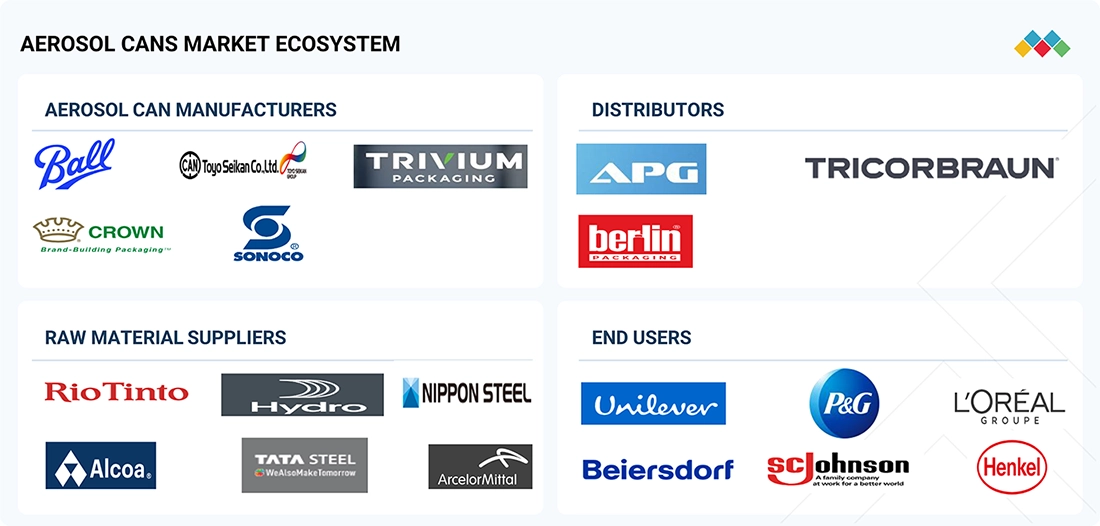
AEROSOL CANS MARKET: COMMERCIAL USE CASES ACROSS INDUSTRIES
| COMPANY | USE CASE DESCRIPTION | BENEFITS |
|---|---|---|
 |
Ball Corporation collaborated with recycling partners to demonstrate that empty aerosol cans can be safely sorted and recovered through modern Material Recovery Facilities (MRFs) | The initiative focused on validating sorting efficiency, improving recycling acceptance, and supporting greater collection of aluminum aerosol cans within existing recycling systems. | Demonstrated that aerosol cans are compatible with existing recycling infrastructure, increased confidence among recyclers and municipalities, improved recovery of valuable aluminum, and supported higher recycling rates while advancing circular economy objectives. |
 |
Trivium Packaging worked with recycling stakeholders to evaluate the recyclability of steel aerosol cans and promote best practices for collection, sorting, and consumer education | The company emphasized collaboration across the value chain to enhance aerosol can recycling and improve packaging sustainability. | Strengthened the case for steel aerosol cans as a recyclable packaging format, increased awareness among consumers and recycling facilities, encouraged wider acceptance of aerosol cans in curbside recycling programs, and supported resource conservation through greater material recovery. |
Logos and trademarks shown above are the property of their respective owners. Their use here is for informational and illustrative purposes only.
Related Ecosystem
Consumer Fandb
- Bakery Products
- Animal-Based Sealants
- Dairy Products
- Actuators
- Azo Pigments
- AZELIS HOLDINGS SA
- VENTURA FOODS, LLC
- Amway
- UNILEVER PLC
- Nestle s.a
Mining Minerals And Metals
- Wastewater Treatment
- Fiberglass
- Light Commercial Vehicles (LCVs)
- Nitrogen
- Acetic Acid
- LHOIST S.A
- SEVERSTAL JSC
- ArcelorMittal S.A.
- TW METALS, INC.
- Linde plc
Packaging
- Ampoules
- Gravure Process
- Rigid Packaging
- Aerosols
- Aseptic Filling and Sealing Equipment
- Amcor plc
- Essentra plc
- Berry Global Group, Inc.
- Mondi plc
- SEALED AIR CORPORATION
Key Takeaways
- North America's aerosol cans market will grow from $2,308.0M (2026) to $2,752.5M (2031) at a 3.6% CAGR.
- In North America, regulatory compliance and sustainability initiatives are reshaping product formulations and manufacturing practices.
- North America's construction and industrial sectors are primary growth drivers for aerosol can demand through 2031.
- North America's market is characterized by established players and emerging competitors focusing on innovation and capacity expansion.
Aerosol Cans Market Report Scope
| Report Metric | Details |
|---|---|
| Base Year | 2026 |
| Fastest Growing Segment | COMPRESSED GAS PROPELLANT (Type) |
| Forecast Period | 2026-2031 |
| Growth Rate | CAGR of 4.3% from 2026 to 2031 |
| Largest Segment | LIQUEFIED GAS PROPELLANT (Type) |
| Market Size Base Year (Billions) | ~USD 7.28 (2026) |
| Revenue Forecast (Billions) | ~USD 8.99 (2031) |
| Segments Covered | Type, Product Type, Material, End-Use Sector |
North America Aerosol Cans Market Report Segmentation
4 segment dimensions are covered across the global market.
By Type
- Compressed Gas Propellant
- Liquefied Gas Propellant
By Product Type
- 1-Piece Cans
- 3-Piece Cans
By Material
- Aluminum
- Glass
- Plastic
- Steel
By End-Use Sector
- Automotive
- Healthcare
- Household Care
- Other End-Use Sectors
- Personal Care
Target Audience
- Packaging Manufacturers : Identify market trends, customer demand patterns, and growth opportunities in North American aerosol packaging to optimize production capacity and product portfolios.
- Construction & Industrial Companies : Understand aerosol can demand in construction and mining applications, supplier capabilities, and regional sourcing strategies to improve procurement efficiency.
- Investment & Private Equity Firms : Evaluate market growth potential, regional valuations, and M&A opportunities in North America's aerosol cans sector for portfolio expansion and strategic investments.
- Market Entry & Expansion Teams : Assess North American market size, competitive dynamics, and country-specific opportunities to develop go-to-market strategies and localization plans.
- Supply Chain & Procurement Professionals : Benchmark supplier capabilities, regional pricing trends, and market availability of aerosol cans across North America to optimize sourcing and vendor management.
Countries within North America - compare and drill down
| Country | 2025 size (native) |
|---|---|
| US | USD 2172.6 Million |
| Canada | USD 162.79 Million |
| Mexico | USD 417.1 Million |
Country market size visualization
Reasons to Buy this Report
- Country-Level Market Breakdown : Access detailed market sizing for US ($2,172.6M), Canada ($162.79M), and Mexico ($417.1M) to identify regional opportunities and tailor market entry strategies by country.
- Segment & Application Insights : Understand demand drivers across packaging, construction, mining, and industrial gas sectors specific to North America, enabling targeted product development and marketing strategies.
- Competitive Landscape Analysis : Gain intelligence on North American manufacturers, market consolidation trends, and competitive positioning to inform partnership and acquisition decisions in the region.
- Regulatory & Sustainability Trends : Stay informed on North American environmental regulations, sustainability requirements, and compliance standards shaping aerosol can innovation and market opportunities.
- Growth Forecasting & Planning : Leverage 2026-2031 CAGR projections (3.6%) and market forecasts to develop accurate business plans, investment strategies, and revenue projections for North America.
Frequently asked questions
What is the projected market size for aerosol cans in North America by 2031?
North America's aerosol cans market is forecast to reach $2,752.5 million by 2031, up from $2,308.0 million in 2026.
What is the CAGR for North America's aerosol cans market?
North America's aerosol cans market is expected to grow at a compound annual growth rate of 3.6% between 2026 and 2031.
Which industries drive demand for aerosol cans in North America?
In North America, primary demand drivers include packaging, construction, mining, industrial gases, personal care, and household products sectors.
How are environmental regulations affecting North America's aerosol cans market?
North America's stringent environmental regulations are driving adoption of low-VOC, non-flammable, and sustainable aerosol formulations and propellant technologies.
What competitive trends are shaping North America's aerosol cans market?
In North America, both established manufacturers and emerging players are investing in capacity expansion, product innovation, and differentiation strategies to gain market share.
RESEARCH METHODOLOGY
The study involved four major activities to estimate the current size of the global aerosol cans market. Exhaustive secondary research was carried out to collect information on the market, the peer product market, and the parent product group market. The next step was to validate these findings, assumptions, and sizes with industry experts across the aerosol cans value chain through primary research. The top-down and bottom-up approaches were employed to estimate the overall size of the aerosol cans market. After that, market breakdown and data triangulation procedures were used to determine the size of different segments of the market.
Secondary Research
The market for companies offering aerosol cans is arrived at by secondary data available through paid and unpaid sources, analyzing the product portfolios of the major companies in the ecosystem, and rating the companies by their performance and quality. For this study, various secondary sources, such as Business Standard, Bloomberg, the World Bank, and Factiva, were referred to in order to identify and collect information on the aerosol cans market. In the secondary research process, various secondary sources were referred to identify and collect information related to the study. Secondary sources included annual reports, press releases, and investor presentations of aerosol cans vendors, forums, certified publications, and whitepapers. Secondary research was used to obtain critical information on the industry’s value chain, the total pool of key players, market classification, and segmentation from market- and technology-oriented perspectives.
Primary Research
In the primary research process, various primary sources from the supply and demand sides were interviewed to obtain qualitative and quantitative information for this report. The primary sources from the supply side included industry experts, such as chief executive officers (CEOs), vice presidents (VPs), marketing directors, technology and innovation directors, and related key executives from several key companies and organizations operating in the aerosol cans market. After the complete market engineering (calculations for market statistics, market breakdown, market size estimations, market forecasting, and data triangulation), extensive primary research was conducted to gather information and verify and validate the critical numbers arrived at.
Primary research was also conducted to identify the segmentation types, industry trends, competitive landscape of aerosol cans offered by various market players, and key market dynamics, such as drivers, restraints, opportunities, challenges, trends, and key player strategies. In the complete market engineering process, the top-down and bottom-up approaches and several data triangulation methods were extensively used to perform the market estimation and market forecasting for the overall market segments and subsegments listed in this report. Extensive qualitative and quantitative analysis was performed throughout the market engineering process to list key information/insights throughout the report.
Following is the breakdown of primary respondents:
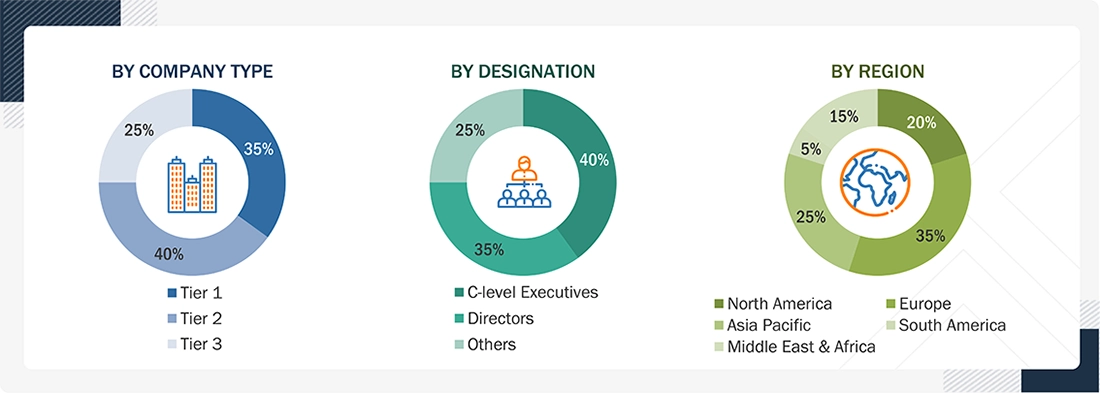
To know about the assumptions considered for the study, download the pdf brochure
Market Size Estimation
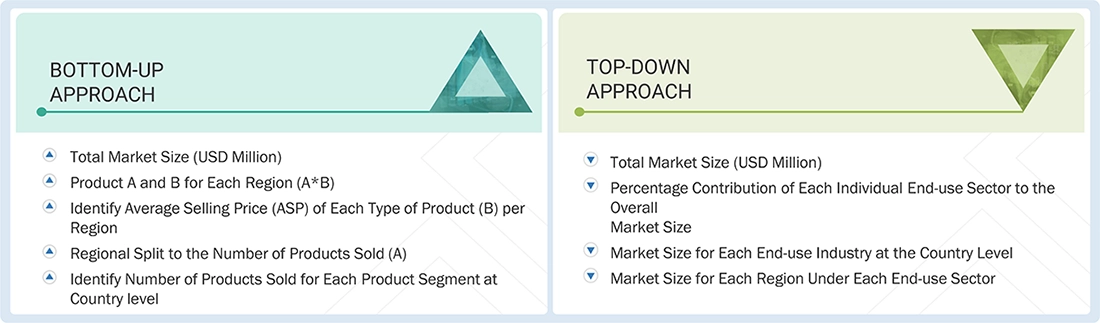
The top-down and bottom-up approaches were used to estimate and validate the size of the global aerosol cans market. These approaches were also used extensively to estimate the size of various dependent market segments. The research methodology used to estimate the market size included the following:
Aerosol Cans Market : Top-Down and Bottom-Up Approach
Data Triangulation
After arriving at the overall market size using the market size estimation processes, the market was split into several segments and subsegments. The data triangulation and market breakup procedures were employed, wherever applicable, to complete the overall market engineering process and arrive at the exact statistics of each market segment and subsegment. The data was triangulated by studying various factors and trends from the demand and supply sides.
Market Definition
An aerosol can is a self-dispensing pressurized packaging form with a permanently attached continuous or metering valve that dispenses the required product formulation in the form of aerosol sprays, streams, gels, foams, lotions, or gases. The contents are introduced and contained in the cans under high pressure and are released with the help of a valve that forces them out through a small orifice. These cans are primarily made up of aluminum, steel, plastic, and glass. Aerosol cans are used in various end-use sectors such as personal care, household care, healthcare, and automotive.
Key Stakeholders
- Raw material suppliers and producers
- Traders, suppliers, and distributors
- Recycling & waste management companies
- Regulatory bodies
- Industry associations
- Research & development organizations
- Environmental protection agencies
- End users
Report Objectives
- To define, describe, and forecast the size of the global aerosol cans market, by type, product type, material, and end-use sector, in terms of value and volume
- To forecast the market size of segments for North America, Europe, Asia Pacific, South America, and the Middle East & Africa, along with their respective countries, in terms of value and volume
- To provide detailed information on the significant drivers, restraints, opportunities, and challenges influencing the market
- To strategically analyze micromarkets concerning individual growth trends, prospects, and their contribution to the market
- To assess the growth opportunities in the market for stakeholders and provide details on the competitive landscape for market leaders
- To strategically profile key players and comprehensively analyze their market shares and core competencies
- To analyze competitive developments, such as partnerships, acquisitions, and expansions in the aerosol cans market
- To provide the impact of AI/Gen AI on the market
- To provide the macroeconomic outlook for each region covered under the study, and the impact of the 2025 US tariff on the market
Available customizations:
With the given market data, MarketsandMarkets offers customizations according to client-specific needs.
The following customization options are available for the aerosol cans report:
Product Analysis
-
A product matrix that gives a detailed comparison of the product portfolio of each company
Company Information
-
Detailed analysis and profiling of additional market players (up to five)
Geographical Analysis
-
A further breakdown of the aerosol cans market for additional countries
Get the Full Aerosol Cans Market Report
Full forecast, segment splits, and company analysis for all Aerosol Cans Market.
- Canada Aerosol Cans Market
- Mexico Aerosol Cans Market
- Germany Aerosol Cans Market
- France Aerosol Cans Market
- UK Aerosol Cans Market
- Italy Aerosol Cans Market
- Spain Aerosol Cans Market
- China Aerosol Cans Market
- Japan Aerosol Cans Market
- India Aerosol Cans Market
- South Korea Aerosol Cans Market
- Brazil Aerosol Cans Market
- Argentina Aerosol Cans Market
- South Africa Aerosol Cans Market
- Rest Of Europe Aerosol Cans Market
- Rest Of Asia Pacific Aerosol Cans Market
- GCC Countries Aerosol Cans Market
- -Rest Of GCC Countries Aerosol Cans Market
- Rest Of South America Aerosol Cans Market
- US Aerosol Cans Market
Need a Tailored Report?
Customize this report to your needs
Get 10% FREE Customization
Customize This Report
