
Canada Aerospace Materials Market (2025-2030)

The Canada Aerospace Materials Market was valued at $2004.7 Million in 2025 and projected to reach to $3056.6 Million by 2030, representing a compound annual growth rate of 8.8%. Canada's aerospace materials market is poised for sustained expansion driven by increased aircraft production, rising demand for lightweight composite materials, and strengthening defense spending across North America.


| Market Size in | USD 26.32 MN |
| Market Forecast in | |
| CAGR | |
| Forecast Period | |
| Units Considered | Value (USD MN) |
Canada Aerospace Materials Market Trends and Insights
- This 8.8% compound annual growth rate reflects Canada's strategic position in North American aerospace manufacturing and supply chains.
- Canada benefits from established aerospace clusters, advanced manufacturing capabilities, and proximity to major U.S.
- aerospace hubs, driving sustained demand for high-performance materials including composites, titanium alloys, and aluminum variants. The Canadian aerospace materials sector is supported by government initiatives, R&D investments, and partnerships with leading global aerospace manufacturers.
- Canada's role as a Tier-1 and Tier-2 supplier to major OEMs and defense programs underpins market expansion through 2030.
- Increasing aircraft production rates, modernization of aging fleets, and growing defense spending across North America create favorable conditions for aerospace material suppliers operating in Canada..
Key Market Statistics
- CAGR (2025-2030) 8.8% CAGR
- Market Size, 2025 ~USD 2004.7 Million
- Forecast, 2030 ~USD 3056.6 Million
- Country Canada
Canada Aerospace Materials Market Overview
Market Valuation Growth :
Canada's aerospace materials market is valued at USD 2,004.7 million in 2025, with projections reaching USD 3,056.6 million by 2030, representing a robust 8.8% CAGR.
Strategic North American Position :
Canada's proximity to the US aerospace hub and established manufacturing clusters position it as a critical supplier in North American aerospace supply chains and OEM partnerships.
Advanced Manufacturing Capabilities :
Canadian aerospace material manufacturers leverage cutting-edge technologies and specialized expertise in composite materials, aluminum alloys, and titanium processing for commercial and defense applications.
Outpacing Global Growth :
Canada's 8.8% CAGR exceeds the global aerospace materials market growth rate of 8.4%, indicating accelerating demand and competitive advantages in the sector.
Canada Aerospace Materials Market Dynamics
- The country's established aerospace ecosystem, including major OEM facilities and Tier-1 suppliers, supports continued market penetration and innovation in advanced materials.
- Government support for aerospace R&D and manufacturing infrastructure further enhances growth prospects.
- By 2030, the market is expected to benefit from the transition toward fuel-efficient aircraft and next-generation defense platforms, solidifying Canada's role as a key materials supplier in the region..
Market Ecosystem
Related Ecosystem
Fibers And Composites
- Polyetheretherketone (PEEK)
- Polyphenylene Sulfide (PPS)
- Epoxy Resin
- Polycarbonate
- Polyester Resin
- Toray Industries, Inc.
- Teijin Limited
- Sgl carbon se
- Hexcel Corporation
- Solvay sa
Key Takeaways
- Canada's aerospace materials market grows at 8.8% CAGR from 2025 to 2030, outpacing global growth of 8.4%.
- Market size in Canada expands from USD 2,004.7 million (2025) to USD 3,056.6 million (2030), representing USD 1,051.9 million incremental value.
- Canada's established aerospace supply chain and manufacturing infrastructure position it as a critical North American materials hub.
- Defense modernization and commercial aircraft production recovery drive sustained demand for advanced aerospace materials in Canada.
Aerospace Materials Market Report Scope
| Report Metric | Details |
|---|---|
| Base Year | 2025 |
| Fastest Growing Segment | COMPOSITE MATERIALS (Type) |
| Forecast Period | 2025-2030 |
| Growth Rate | CAGR of 8.4% from 2025 to 2030 |
| Largest Segment | EXTERIOR (Application) |
| Market Size Base Year (Billions) | ~USD 41.62 (2025) |
| Revenue Forecast (Billions) | ~USD 62.3 (2030) |
| Segments Covered | Type, Aircraft Type, Application |
Canada Aerospace Materials Market Report Segmentation
3 segment dimensions are covered across the global market.
By Type
- Aluminum Alloys
- Composite Materials
- Other Types
- Steel Alloys
- Super Alloys
- Titanium Alloys
By Aircraft Type
- Business & General Aviation
- Civil Helicopter
- Commercial Aircraft
- Military Aircraft
- Other Aircraft Types
By Application
- Exterior
- Interior
Target Audience
- Aerospace Material Manufacturers : Manufacturers need Canada-specific market data to identify growth opportunities, assess competitive positioning, and develop localized product strategies within the North American aerospace supply chain.
- OEM & Tier-1 Suppliers : Original equipment manufacturers and major suppliers require detailed Canadian market insights to optimize sourcing strategies, evaluate supplier capabilities, and plan capacity investments.
- Investment & Private Equity Firms : Investors seeking aerospace sector exposure need Canada-focused market analysis to identify acquisition targets, assess growth potential, and evaluate risk-adjusted returns in the region.
- Government & Policy Makers : Canadian government agencies and economic development organizations use market data to inform aerospace industry policy, R&D funding decisions, and strategic manufacturing initiatives.
- Strategic Consultants & Analysts : Business consultants and market analysts require granular Canadian market data to support client advisory work, competitive intelligence, and long-term strategic planning in aerospace materials.
Reasons to Buy this Report
- Market-Specific Growth Intelligence : Gain detailed insights into Canada's 8.8% CAGR trajectory and USD 1,051.9 million market expansion opportunity, enabling precise investment and expansion planning tailored to Canadian market dynamics.
- Supply Chain Positioning Strategy : Understand Canada's critical role in North American aerospace supply chains and identify partnership opportunities with established clusters and Tier-1 suppliers to strengthen competitive positioning.
- Regulatory & Policy Landscape : Access comprehensive analysis of Canadian aerospace material standards, government incentives, R&D support programs, and defense procurement trends influencing market opportunities.
- Competitive Benchmarking : Compare Canada's 8.8% growth rate against the global 8.4% benchmark to identify market outperformance drivers and competitive advantages in advanced materials manufacturing.
- Localized Market Forecasting : Leverage Canada-specific demand projections through 2030 to optimize production capacity, resource allocation, and go-to-market strategies for aerospace material products and services.
Frequently asked questions
What is the current size of Canada's aerospace materials market?
Canada's aerospace materials market is valued at USD 2,004.7 million in 2025 and is expected to grow to USD 3,056.6 million by 2030.
What is the growth rate for aerospace materials in Canada?
Canada's aerospace materials market is projected to grow at a compound annual growth rate (CAGR) of 8.8% between 2025 and 2030.
Which materials dominate Canada's aerospace sector?
High-performance materials including advanced composites, titanium alloys, aluminum variants, and specialty fasteners are primary segments in Canada's aerospace materials market.
What drives growth in Canada's aerospace materials market?
Key drivers include increased commercial aircraft production, defense spending growth, Canada's role as a Tier-1 supplier, government R&D support, and modernization of aging aircraft fleets.
How does Canada's aerospace materials market compare to North America?
Canada represents a significant portion of North American aerospace materials demand, with its 8.8% CAGR exceeding the global average of 8.4%, reflecting strong regional aerospace activity.
RESEARCH METHODOLOGY
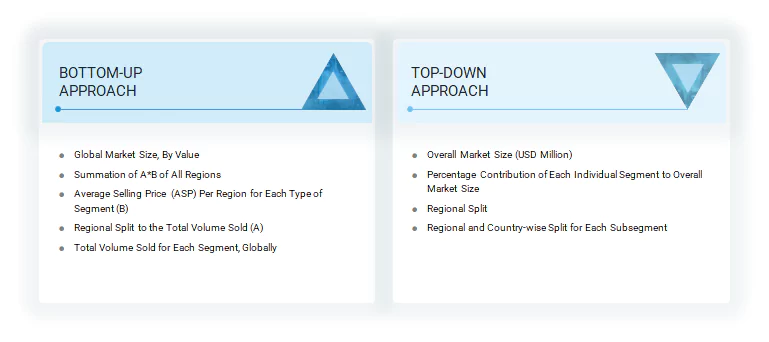
The study to estimate the current size of the aerospace materials market involved two key steps. First, comprehensive secondary research was conducted to gather data on the market itself, as well as related and parent markets. This was followed by primary research, where insights, assumptions, and market estimates were validated through interviews with industry experts across the value chain. Both top-down and bottom-up methodologies were applied to determine the overall market size. Finally, the market was segmented, and data triangulation techniques were used to refine and validate the estimates for each segment and subsegment.
Secondary Research
Secondary sources consulted for this research included financial reports of aerospace materials manufacturers, along with data from trade organizations, business publications, and professional associations. This secondary research provided essential insights into the industry's value chain, identified key players, and helped classify and segment the market based on prevailing industry trends down to the regional and sub-regional levels. The information gathered was thoroughly analyzed to estimate the overall size of the aerospace materials market, which was then validated through primary research with industry experts.
Primary Research
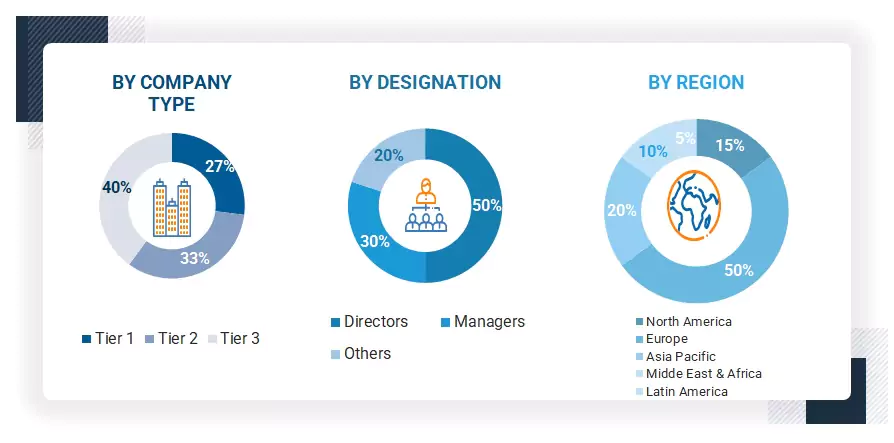
Extensive primary research was carried out following the collection of market insights through secondary research to validate the aerospace materials market scenario. Numerous interviews were conducted with industry experts from both the demand and supply sides across key regions, including North America, Europe, Asia Pacific, the Middle East & Africa, and South America. Primary data was gathered through structured questionnaires, emails, and telephonic interviews. On the supply side, respondents included industry professionals such as CXOs, Vice Presidents, Directors of business development, marketing, product innovation teams, system integrators, component suppliers, distributors, and key opinion leaders in the aerospace materials space. These interviews provided valuable insights into market statistics, revenue data, segmentation, size estimations, forecasts, and enabled data triangulation. On the demand side, stakeholders such as CIOs, CTOs, CSOs, and installation teams from end-user organizations were consulted to gain a better understanding of customer perspectives, current usage patterns, supplier evaluations, and the future outlook for aerospace materials, all of which influence the overall market dynamics.
To know about the assumptions considered for the study, download the pdf brochure
Market Size Estimation
The research methodology used to estimate the size of the aerospace materials market primarily focused on a demand-side approach. Market sizing was conducted by analyzing procurement activities and modernization efforts involving aerospace composite products across various applications at the regional level. These procurement trends offered valuable insights into the demand patterns within the aerospace materials industry for each application segment. All relevant segments were thoroughly mapped and integrated to provide a comprehensive view of the market structure and size across different end-use applications.
Data Triangulation
After estimating the overall market size through the process described above, the total market was further segmented into various segments and subsegments. To ensure accuracy, data triangulation and market breakdown techniques were applied wherever relevant, forming a key part of the overall market engineering process. This involved analyzing multiple factors and trends from both the demand and supply sides. Additionally, the final market size and segment-level figures were validated using a combination of top-down and bottom-up approaches to ensure precision and reliability of the statistical estimates.
Market Definition
Aerospace materials are specialized materials engineered to deliver high performance under the extreme operating conditions of aircraft and spacecraft, characterized by their lightweight properties, high strength-to-weight ratio, and resistance to fatigue, creep, and corrosion. These include composites, which combine carbon, glass, or aramid fibers in a resin matrix to provide lightweight strength for fuselage, wings, and interiors; titanium alloys, valued for their high strength, corrosion resistance, and temperature endurance; aluminum alloys, widely used for their light weight, corrosion resistance, and machinability in fuselage and wing structures; steel alloys, offering exceptional strength and durability for landing gear, fasteners, and load-bearing components; and super alloys (nickel-, cobalt-, and iron-based), critical in jet engines and turbines for their ability to withstand extreme heat. Other advanced materials include GLARE (Glass Laminate Aluminum Reinforced Epoxy), which combines aluminum and glass fibers to offer fatigue resistance and damage tolerance, ceramics for thermal protection systems, and magnesium alloys for lightweight structural and interior applications. Collectively, these materials enable the aerospace industry to achieve greater efficiency, durability, safety, and innovation in modern aircraft and space vehicles.
Stakeholders
- Aerospace materials manufacturers
- Aircraft manufacturers
- Universities, governments, and research organizations
- Aerospace composites and composite associations and industrial bodies
- Research and consulting firms
- R&D institutions
- Environmental support agencies
- Investment banks and private equity firms
Report Objectives
- To define, describe, and forecast the aerospace materials market size in terms of volume and value
- To provide detailed information regarding the key factors, such as drivers, restraints, opportunities, and challenges influencing market growth
- To analyze and project the global aerospace materials market by type, aircraft type, application, and region
- To forecast the market size concerning five main regions (along with country-level data), namely, North America, Europe, Asia Pacific, South America, and the Middle East & Africa, and analyze the significant region-specific trends
- To strategically analyze micromarkets with respect to individual growth trends, prospects, and contributions of the submarkets to the overall market
- To analyze the market opportunities and the competitive landscape for stakeholders and market leaders
- To assess recent market developments and competitive strategies, such as agreements, contracts, acquisitions, and new product developments/new product launches, to draw the competitive landscape
- To strategically profile the key market players and comprehensively analyze their core competencies
Get the Full Aerospace Materials Market Report
Full forecast, segment splits, and company analysis for all Aerospace Materials Market.
- US Aerospace Materials Market
- Mexico Aerospace Materials Market
- Germany Aerospace Materials Market
- France Aerospace Materials Market
- UK Aerospace Materials Market
- Turkey Aerospace Materials Market
- Russia Aerospace Materials Market
- China Aerospace Materials Market
- Japan Aerospace Materials Market
- India Aerospace Materials Market
- South Korea Aerospace Materials Market
- Indonesia Aerospace Materials Market
- Brazil Aerospace Materials Market
- Argentina Aerospace Materials Market
- Israel Aerospace Materials Market
- South Africa Aerospace Materials Market
- Rest Of Europe Aerospace Materials Market
- Rest Of Asia Pacific Aerospace Materials Market
- GCC Countries Aerospace Materials Market
- -Rest Of GCC Countries Aerospace Materials Market
- Rest Of South America Aerospace Materials Market
Need a Tailored Report?
Customize this report to your needs
Get 10% FREE Customization
Customize This Report
