
Asia Pacific Agricultural Global Warming Solutions Market (2025-2030)

The Asia Pacific Agricultural Global Warming Solutions Market was valued at $4257.1 Million in 2025 and projected to reach to $8123.3 Million by 2030, representing a compound annual growth rate of 13.8%. Asia Pacific's agricultural global warming solutions market is positioned for exceptional growth, expanding from $4,257.1 million in 2025 to $8,123.3 million by 2030.


| Market Size in | USD 26.32 MN |
| Market Forecast in | |
| CAGR | |
| Forecast Period | |
| Units Considered | Value (USD MN) |
Asia Pacific Agricultural Global Warming Solutions Market Trends and Insights
- This represents a compound annual growth rate of 13.8%, driven by increasing climate pressures, regulatory mandates, and farmer adoption of sustainable practices across the region.
- Asia Pacific is emerging as a critical hub for climate-smart agriculture innovation, with countries investing heavily in carbon-neutral farming technologies and soil health solutions. The Asia Pacific market's accelerated growth trajectory reflects heightened awareness of climate risks among agricultural stakeholders and government support for green farming initiatives.
- Between 2025 and 2030, Asia Pacific is expected to nearly double its market value, outpacing global averages as regional economies prioritize climate resilience in food production.
- Asia Pacific's diverse agricultural landscape-spanning smallholder farms to large-scale operations-creates varied demand for customized global warming solutions tailored to local environmental and economic conditions. Key drivers propelling Asia Pacific's market include rising temperatures affecting crop yields, water scarcity concerns, and increasing consumer demand for sustainably produced food.
- Asia Pacific's strategic position in global agriculture, combined with supportive policy frameworks and technological advancement, positions the region as a leader in adopting and scaling agricultural climate solutions through 2030..
Key Market Statistics
- CAGR (2025-2030) 13.8% CAGR
- Market Size, 2025 ~USD 4257.1 Million
- Forecast, 2030 ~USD 8123.3 Million
- Geography Asia Pacific
Asia Pacific Agricultural Global Warming Solutions Market Overview
Rapid Market Expansion :
Asia Pacific's agricultural global warming solutions market is growing at 13.8% CAGR, significantly outpacing the global average of 12.5%, driven by intensifying climate impacts and monsoon variability across the region.
China & India Leadership :
China ($3,158.2M) and India ($1,197.1M) dominate the Asia Pacific market, collectively accounting for over 97% of the region's 2025 valuation, reflecting their vast agricultural sectors and climate adaptation priorities.
Regulatory & Policy Drivers :
Stringent environmental regulations, carbon neutrality commitments, and government subsidies for sustainable farming practices are accelerating adoption of climate-smart agriculture solutions across Asia Pacific nations.
Farmer Adoption Surge :
Increasing awareness of climate risks, coupled with improved access to financing and technology, is driving widespread farmer adoption of precision agriculture, water management, and renewable energy solutions in Asia Pacific.
Asia Pacific Agricultural Global Warming Solutions Market Dynamics
- This trajectory reflects the region's vulnerability to climate change, with rising temperatures, erratic rainfall patterns, and extreme weather events compelling governments and farmers to invest in sustainable agricultural technologies.
- China and India's substantial market contributions underscore the region's critical role in global food security and climate mitigation efforts. The market's expansion is underpinned by increasing regulatory mandates for emissions reduction, growing farmer awareness of climate risks, and improving access to climate-smart agriculture solutions.
- Public-private partnerships, technology transfer initiatives, and international climate finance are facilitating market penetration across rural and semi-urban areas.
- As Asia Pacific continues to balance agricultural productivity with environmental sustainability, the demand for innovative global warming solutions will remain robust through 2030 and beyond..
Market Ecosystem
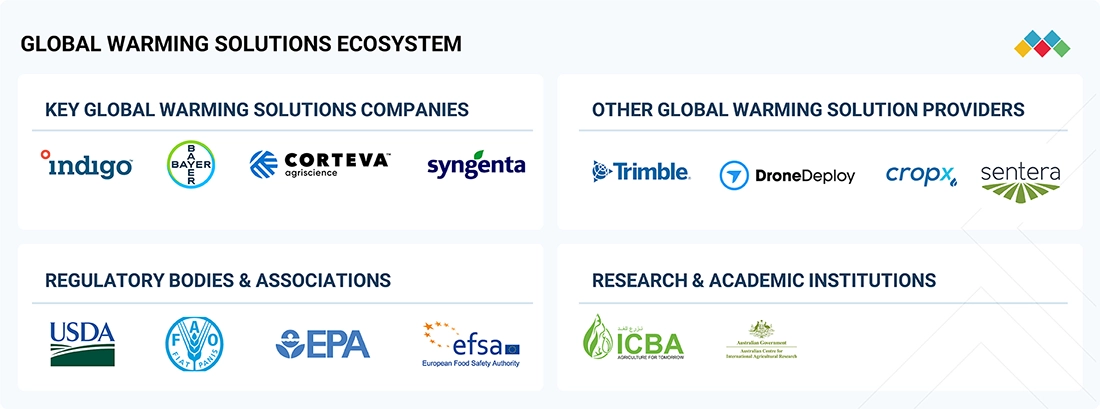
agricultural-global-warming-solutions-market: COMMERCIAL USE CASES ACROSS INDUSTRIES
| COMPANY | USE CASE DESCRIPTION | BENEFITS |
|---|---|---|
 |
Development of sustainable fertilizers and nutrient management solutions to reduce emissions and improve soil health. | Lower greenhouse gas emissions, enhanced soil fertility, improved crop yields with reduced environmental impact. |
 |
Climate-smart sourcing programs integrating regenerative farming practices across supply chains. | Stronger supply chain resilience, improved farmer income, enhanced sustainability positioning with buyers. |
 |
Deployment of precision agriculture machinery and smart farming technologies to optimize input use. | Reduced resource wastage, higher efficiency in farm operations, support for low-carbon agriculture. |
 |
Introduction of biologicals, digital platforms, and climate-resilient seeds for crop protection. | Increased resilience to climate change, reduced chemical dependency, better productivity outcomes. |
Logos and trademarks shown above are the property of their respective owners. Their use here is for informational and illustrative purposes only.
Related Ecosystem
Key Takeaways
- Asia Pacific's agricultural global warming solutions market will nearly double from $4,257.1M (2025) to $8,123.3M (2030), growing at 13.8% CAGR.
- Asia Pacific is accelerating adoption of climate-smart agriculture technologies driven by regulatory support and heightened climate risk awareness among farmers.
- Asia Pacific's diverse farm structures create differentiated demand for tailored global warming solutions across smallholder and commercial operations.
- Asia Pacific is positioned as a regional leader in agricultural climate innovation, with government investments and policy frameworks supporting market expansion through 2030.
Agricultural Global Warming Solutions Market Report Scope
| Report Metric | Details |
|---|---|
| Base Year | 2025 |
| Fastest Growing Segment | BIOCONTROL (Type) |
| Forecast Period | 2025-2030 |
| Growth Rate | CAGR of 12.5% from 2025 to 2030 |
| Largest Segment | CROP-BASED PRODUCTION SYSTEMS (Production System) |
| Market Size Base Year (Billions) | ~USD 14.13 (2025) |
| Revenue Forecast (Billions) | ~USD 25.47 (2030) |
| Segments Covered | Production System, Solution Type, Type |
Asia Pacific Agricultural Global Warming Solutions Market Report Segmentation
3 segment dimensions are covered across the global market.
By Production System
- Aquatic & Agroforestry Systems
- Crop-Based Production Systems
- Livestock & Animal Production Systems
By Solution Type
- Carbon Markets & Mrv Platforms
- Carbon Sequestration Solutions
- Climate-Smart Farming Technologies
- Emissions Reduction Technologies
- Sustainable Inputs & Practices
By Type
- Biocontrol
- Biofertilizers
- Biostimulants
Target Audience
- Agricultural Technology Providers : Agritech companies need Asia Pacific market data to identify high-growth segments, prioritize regional expansion, and develop localized climate-smart solutions aligned with farmer needs and regulatory requirements.
- Investment & Private Equity Firms : Investors require detailed Asia Pacific market forecasts, country-level valuations, and growth drivers to evaluate acquisition targets, fund climate-focused agricultural ventures, and optimize portfolio allocation in the region.
- Government & Policy Makers : Agricultural ministries and environmental agencies need market intelligence to design effective climate adaptation policies, allocate subsidies, and measure the impact of regulatory mandates on sustainable farming adoption.
- Agricultural Input Manufacturers : Seed, fertilizer, and equipment suppliers require Asia Pacific market segmentation data to forecast demand, optimize supply chains, and develop climate-resilient product portfolios for regional farmer segments.
- Sustainability & ESG Consultants : Corporate sustainability advisors need Asia Pacific agricultural climate data to benchmark client performance, identify best practices, and develop credible net-zero agriculture strategies aligned with regional market trends.
Countries within Asia Pacific - compare and drill down
| Country | 2025 size (native) |
|---|---|
| China | USD 3158.2 Million |
| India | USD 1197.1 Million |
| Japan | USD 2243.8 Million |
| Australia & New Zealand | USD 822.1 Million |
| Rest Of Asia Pacific | USD 702.2 Million |
Country market size visualization
Reasons to Buy this Report
- Regional Market Dominance Data : Gain detailed insights into China ($3.2B) and India ($1.2B) market dynamics, including country-specific growth drivers, regulatory landscapes, and competitive positioning essential for Asia Pacific expansion strategies.
- High-Growth Opportunity Identification : Identify emerging opportunities in Australia & New Zealand ($822.1M) and Rest of Asia Pacific ($702.2M) segments, where climate adaptation investments are accelerating and market penetration remains untapped.
- Competitive Landscape Intelligence : Understand regional competitive dynamics, key player strategies, and market consolidation trends specific to Asia Pacific's agricultural climate solutions sector to inform investment and partnership decisions.
- Regulatory & Policy Roadmap : Access comprehensive analysis of Asia Pacific government mandates, carbon pricing mechanisms, agricultural subsidies, and climate commitments driving market growth and shaping future demand patterns.
- Technology Adoption Trends : Benchmark farmer adoption rates for precision agriculture, water management systems, renewable energy integration, and digital farming solutions across Asia Pacific's diverse agricultural landscapes and economies.
Frequently asked questions
What is the projected market size for agricultural global warming solutions in Asia Pacific by 2030?
Asia Pacific's agricultural global warming solutions market is projected to reach $8,123.3 million by 2030, up from $4,257.1 million in 2025.
What is the CAGR for Asia Pacific's agricultural global warming solutions market?
Asia Pacific's market is expected to grow at a compound annual growth rate of 13.8% between 2025 and 2030.
What are the primary drivers of growth in Asia Pacific's agricultural global warming solutions market?
Key drivers include rising temperatures affecting crop yields, water scarcity concerns, regulatory mandates, government support for green farming, and increasing consumer demand for sustainably produced food.
How does Asia Pacific's agricultural global warming solutions market compare to global growth rates?
Asia Pacific's 13.8% CAGR exceeds the global average of 12.5%, indicating the region is outpacing worldwide market expansion in agricultural climate solutions.
What types of solutions are driving demand in Asia Pacific's agricultural global warming market?
Asia Pacific demand is driven by carbon-neutral farming technologies, soil health solutions, climate-smart agriculture practices, and water management systems tailored to regional agricultural conditions.
RESEARCH METHODOLOGY
The study involved two major approaches in estimating the current size of the agricultural global warming solutions market. Exhaustive secondary research was conducted to gather information on the market, peer markets, and parent markets. The next step involved validating these findings, assumptions, and sizing with industry experts across the value chain through primary research. Both top-down and bottom-up approaches were employed to estimate the complete market size. After that, market breakdown and data triangulation were used to estimate the market size of segments and subsegments.
Secondary Research
This research study involved the extensive use of secondary sources—directories and databases such as Bloomberg Businessweek and Factiva—to identify and collect information useful for a technical, market-oriented, and commercial study of the market.
In the secondary research process, various sources, such as company annual reports, press releases, investor presentations, white papers, food journals, certified publications, articles from recognized authors, directories, and databases, were used to identify and collect information.
Secondary research was mainly used to obtain key information about the industry’s supply chain, the total pool of key players, and market classification and segmentation as per the industry trends to the bottom-most level, regional markets, and key developments from both market- and technology-oriented perspectives.
Primary Research
Extensive primary research was conducted after obtaining information regarding the agricultural global warming solutions market scenario through secondary research. Several primary interviews were conducted with market experts from both the demand and supply sides across major countries of North America, Europe, Asia Pacific, South America, and the Rest of the World. Primary data was collected through questionnaires, emails, and telephonic interviews. The primary sources from the supply side included various industry experts, such as chief executive officers (CEOs), vice presidents (VPs), directors from business development, marketing, research, and development teams, and key opinion leaders. Primary interviews were conducted to gather insights, including market statistics, revenue data from products and services, market breakdowns, market size estimations, market forecasting, and data triangulation. Primary research also helped in understanding the various trends related to solution type, production system, and region. Stakeholders from the demand side, including research institutions, universities, and third-party vendors, were interviewed to understand the buyer’s perspective on the services, the current usage of agricultural global warming solutions, and their outlook for the business, which will impact the overall market.
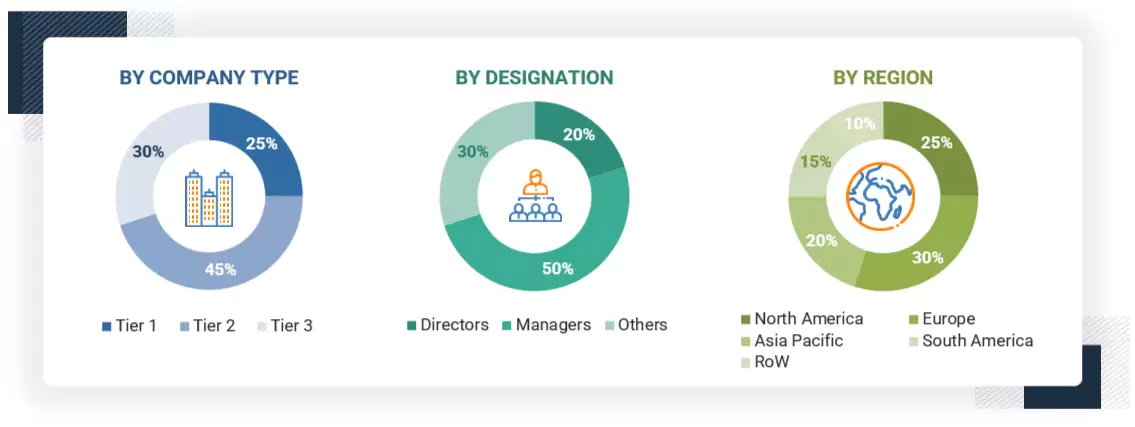
Note: The three tiers of the companies are defined based on their total revenues in 2023 or 2024, as per the availability of financial data: Tier 1: Revenue >USD 1 billion; Tier 2: USD 100 million ≤ Revenue ≤ USD 1 billion; Tier 3: Revenue USD 100 million.
To know about the assumptions considered for the study, download the pdf brochure
|
COMPANY NAME |
DESIGNATION |
|
Corteva Agriscience (US) |
R&D Expert |
|
Indigo Ag, Inc. (US) |
Sales Manager |
|
DSM-Firmenich (Switzerland) |
Manager |
|
Syngenta (Switzerland) |
Sales Manager |
|
Bayer Crop Science (Germany) |
Marketing Manager |
Market Size Estimation
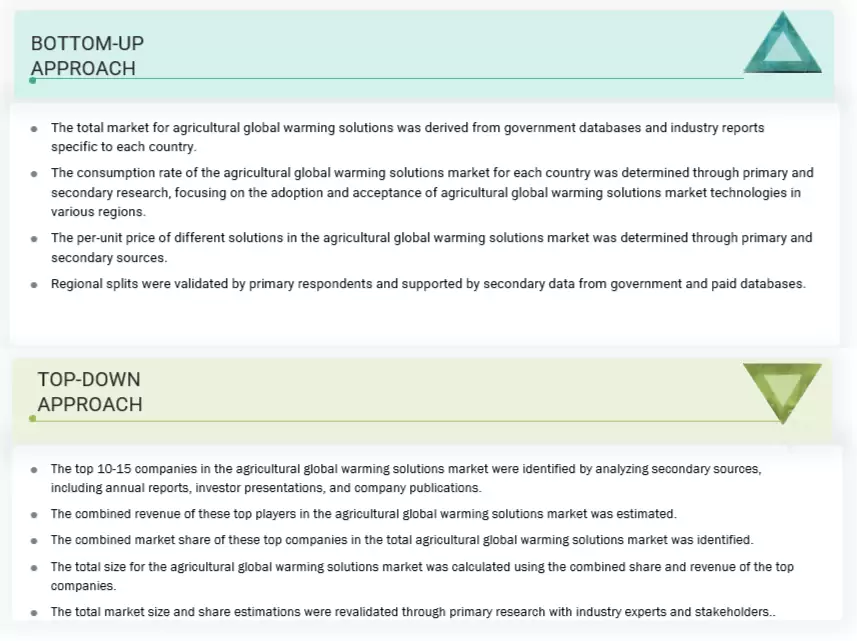
Both the top-down and bottom-up approaches were used to estimate and validate the total size of the agricultural global warming solutions market. These approaches were also used extensively to determine the size of various subsegments in the market. The research methodology used to estimate the market size included the following details:
- The key players in the industry and the overall markets were identified through extensive secondary research.
- All shares, splits, and breakdowns were determined using secondary sources and verified through primary sources.
- All possible parameters that affect the market covered in this research study were accounted for, viewed in extensive detail, verified through primary research, and analyzed to obtain final quantitative and qualitative data.
- The research included the study of reports, reviews, and newsletters of top market players, along with extensive interviews for opinions from leaders, such as CEOs, directors, and marketing executives.
Agricultural Global Warming Solutions Market : Top-Down and Bottom-Up Approach
Data Triangulation
After arriving at the overall market size from the estimation process explained above, the total market was split into several segments and subsegments. The data triangulation and market breakdown procedures were employed, wherever applicable, to estimate the overall agricultural global warming solutions market and arrive at the exact statistics for all segments and subsegments. The data was triangulated by studying various factors and trends from the demand and supply sides. The market size was also validated using both the top-down and bottom-up approaches.
Market Definition
The agricultural global warming solutions refers to the ecosystem of technologies, products, and practices aimed at mitigating the effects of climate change within agriculture, while improving productivity and sustainability. It encompasses innovations such as precision farming, carbon-smart fertilizers, bio-stimulants, regenerative agricultural practices, renewable energy integration, water conservation technologies, livestock emission reduction methods, and carbon capture approaches. This market addresses rising concerns over greenhouse gas emissions, soil degradation, biodiversity loss, and extreme weather events, providing solutions that enhance crop yield resilience, reduce environmental footprint, and align with global sustainability targets.
Stakeholders
- Agricultural technology companies
- Climate-focused startups and innovators
- Sustainable farming organizations
- Carbon offset and trading firms
- Farmers and agricultural cooperatives
- Environmental non-governmental organizations (NGOs)
- University and research institutions
- Water management and irrigation technology providers
- Government agencies focused on agriculture and climate change
- Financial institutions and green investment funds
- Associations and industry bodies (national/international agricultural associations)
- Concerned government authorities, commercial R&D institutions, and other regulatory bodies
-
Regulatory bodies such as -
- United States Environmental Protection Agency (EPA)
- Food and Agriculture Organization (FAO)
- European Environment Agency (EEA)
- Global Alliance for Climate-Smart Agriculture (GACSA)
Report Objectives
- To determine and project the size of the agricultural global warming solutions market with respect to the solution type, production system, and region in terms of value over five years, ranging from 2025 to 2030
- To identify the attractive opportunities in the market by determining the largest and fastest-growing segments across regions
- To provide detailed information about the key factors influencing market growth (drivers, restraints, opportunities, and challenges)
- To analyze the opportunities in the market for stakeholders and provide details of the competitive landscape for market leaders
- To analyze the micro-markets with respect to individual growth trends, prospects, and their contribution to the total market
- To identify and profile the key players in the agricultural global warming solutions market
- To understand the competitive landscape and identify the major growth strategies adopted by players across the key regions
Customization Options:
With the given market data, MarketsandMarkets offers customizations according to company-specific scientific needs. The following customization options are available for the report:
Product Analysis
- Product/Service Matrix, which gives a detailed comparison of the service portfolio of each company.
Geographic Analysis as per Feasibility
With the given market data, MarketsandMarkets offers customizations according to company-specific scientific needs.
- Further breakdown of the Rest of European agricultural global warming solutions market into key countries
- Further breakdown of the Rest of Asia Pacific agricultural global warming solutions market into key countries
- Further breakdown of the Rest of South American agricultural global warming solutions market into key countries
Company Information
- Detailed analyses and profiling of additional market players (up to five)
Get the Full Agricultural Global Warming Solutions Market Report
Full forecast, segment splits, and company analysis for all Agricultural Global Warming Solutions Market.
- Middle East Agricultural Global Warming Solutions Market
- US Agricultural Global Warming Solutions Market
- Canada Agricultural Global Warming Solutions Market
- Mexico Agricultural Global Warming Solutions Market
- Germany Agricultural Global Warming Solutions Market
- UK Agricultural Global Warming Solutions Market
- France Agricultural Global Warming Solutions Market
- Spain Agricultural Global Warming Solutions Market
- Italy Agricultural Global Warming Solutions Market
- China Agricultural Global Warming Solutions Market
- India Agricultural Global Warming Solutions Market
- Japan Agricultural Global Warming Solutions Market
- Brazil Agricultural Global Warming Solutions Market
- Argentina Agricultural Global Warming Solutions Market
- Rest Of Europe Agricultural Global Warming Solutions Market
- Rest Of Asia Pacific Agricultural Global Warming Solutions Market
- Rest Of South America Agricultural Global Warming Solutions Market
- Africa Agricultural Global Warming Solutions Market
Need a Tailored Report?
Customize this report to your needs
Get 10% FREE Customization
Customize This Report
