
Japan AI Data Center Liquid Cooling Market (2026-2032)

The Japan AI Data Center Liquid Cooling Market was valued at $59.6 Million in 2026 and projected to reach to $338.6 Million by 2032, representing a compound annual growth rate of 33.6%. Japan's AI data center liquid cooling market is poised for exceptional growth as the nation strengthens its position as a regional technology hub.


| Market Size in | USD 26.32 MN |
| Market Forecast in | |
| CAGR | |
| Forecast Period | |
| Units Considered | Value (USD MN) |
Japan AI Data Center Liquid Cooling Market Trends and Insights
- This represents a compound annual growth rate of 33.6%, reflecting Japan's strategic investments in AI infrastructure and data center modernization.
- Japan's position as a technology leader in Asia Pacific is driving demand for advanced cooling solutions to support high-density computing environments required for artificial intelligence applications. The growth trajectory in Japan is underpinned by increasing power consumption in AI-driven data centers and the nation's commitment to energy efficiency standards.
- Japan's regulatory environment and focus on sustainable cooling technologies are accelerating adoption of liquid cooling systems across the country's expanding data center footprint.
- Between 2026 and 2032, Japan is expected to emerge as a key market for liquid cooling innovation, with enterprises and hyperscalers investing heavily in thermal management solutions to optimize operational efficiency..
Key Market Statistics
- CAGR (2026-2032) 33.6% CAGR
- Market Size, 2026 ~USD 59.6 Million
- Forecast, 2032 ~USD 338.6 Million
- Country Japan
Japan AI Data Center Liquid Cooling Market Overview
Rapid Market Expansion :
Japan's AI data center liquid cooling market is projected to grow from $59.6 million in 2026 to $338.6 million by 2032, representing a robust 33.6% CAGR driven by accelerated AI infrastructure investments.
Technology Leadership Position :
Japan's established reputation as a technology innovator in Asia Pacific is catalyzing demand for cutting-edge liquid cooling solutions to support next-generation AI data centers and computational workloads.
Strategic Infrastructure Modernization :
Japanese enterprises and government initiatives are prioritizing data center modernization with advanced thermal management systems to enhance energy efficiency and support AI-driven digital transformation.
Competitive CAGR Performance :
Japan's 33.6% CAGR closely aligns with the global market growth rate of 34%, positioning the country as a key contributor to the worldwide AI data center liquid cooling expansion.
Japan AI Data Center Liquid Cooling Market Dynamics
- Government support for AI development, combined with major tech companies' infrastructure investments, is driving widespread adoption of liquid cooling technologies to manage heat dissipation in high-performance computing environments.
- The market's expansion reflects Japan's commitment to maintaining competitive advantage in AI capabilities and data center efficiency standards. Looking ahead, Japan's market will benefit from increasing energy costs, stricter environmental regulations, and the proliferation of AI applications across industries.
- Domestic manufacturers and international suppliers are capitalizing on this momentum by developing innovative cooling solutions tailored to Japanese data center specifications.
- The convergence of technological advancement and sustainability imperatives positions Japan as a critical growth market within the Asia Pacific region..
Market Ecosystem
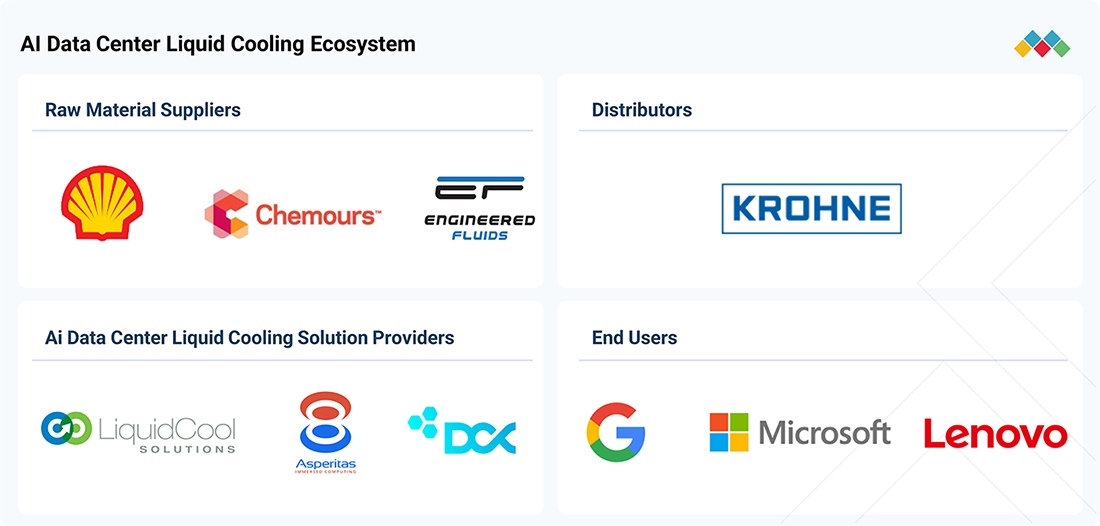
AI DATA CENTER LIQUID COOLING MARKET: COMMERCIAL USE CASES ACROSS INDUSTRIES
| COMPANY | USE CASE DESCRIPTION | BENEFITS |
|---|---|---|
 |
Vertiv provides liquid cooling infrastructure for AI and high-density data centers through CoolChip CDUs, CoolPhase CDUs, fluid networks, and rear-door heat exchangers. Its solutions support direct-to-chip cooling of high-power CPUs/GPUs and hybrid cooling configurations across hyperscale, colocation, and enterprise facilities. | Its solutions support high-density AI racks. |
 |
Schneider Electric provides end-to-end liquid cooling solutions for AI data centers, including direct-to-chip cooling, CDUs, rear-door heat exchangers, and heat-rejection systems. Its solutions are used in both new and existing facilities to accommodate high-density GPU infrastructure and retrofit air-cooled data centers for AI workloads. | Its solutions enable higher rack densities. |
 |
Super Micro Computer integrates direct liquid cooling (DLC) into GPU-optimized AI server and rack-scale platforms, including NVIDIA HGX and GB200 NVL72 systems. Its liquid-cooled architectures incorporate cold plates, CDUs, and coolant distribution manifolds to provide rack-level thermal management for dense AI/LLM deployments. | Its solutions support high-density GPU deployment. |
 |
DCX Liquid Cooling Systems develops facility, in-rack, and equipment-level liquid cooling systems for AI, HPC, hyperscale, colocation, and enterprise data centers. Its portfolio includes ECDU, FDU, and InRack CDU platforms, with facility-level systems designed to provide multi-megawatt cooling capacity for high-density AI data halls. | Its solutions support large-scale AI and HPC deployments. |
 |
CoolIT Systems provides scalable direct liquid cooling systems for AI and high-performance computing, including cold plates, CDUs, manifolds, and rack-level cooling architectures. Its solutions are designed to remove heat directly from high-power processors and support increasingly dense AI compute clusters. | Its solutions enable high-density AI computing. |
Logos and trademarks shown above are the property of their respective owners. Their use here is for informational and illustrative purposes only.
Related Ecosystem
Key Takeaways
- Japan's AI data center liquid cooling market will grow from $59.6M (2026) to $338.6M (2032) at a 33.6% CAGR.
- Japan's technology leadership and energy efficiency mandates are driving rapid adoption of advanced liquid cooling systems.
- Japan's data center operators are prioritizing sustainable and high-performance thermal management solutions for AI workloads.
- Japan represents a critical growth hub in Asia Pacific for liquid cooling innovation and market expansion through 2032.
AI Data Center Liquid Cooling Market Report Scope
| Report Metric | Details |
|---|---|
| Base Year | 2026 |
| Fastest Growing Segment | 120 KW & ABOVE (Rack Density) |
| Forecast Period | 2026-2030 |
| Growth Rate | CAGR of 34% from 2026 to 2030 |
| Largest Segment | DIRECT-TO-CHIP (Cooling Type) |
| Market Size Base Year (Billions) | ~USD 3.52 (2026) |
| Revenue Forecast (Billions) | ~USD 11.36 (2030) |
| Segments Covered | Component, Cooling Type, Data Center Type, Rack Density |
Japan AI Data Center Liquid Cooling Market Report Segmentation
4 segment dimensions are covered across the global market.
By Component
- Services
- Solutions
By Cooling Type
- Direct-To-Chip
- Immersion
By Data Center Type
- Colocation
- Enterprise
- Hyperscale
By Rack Density
- 120 Kw & Above
- 30 Kw - 40 Kw
- 40 Kw - 60 Kw
- 60 Kw - 120 Kw
Target Audience
- Data Center Operators & Facility Managers : Japanese data center operators need market intelligence to evaluate liquid cooling investments, benchmark against regional standards, and plan infrastructure upgrades to support growing AI workloads efficiently.
- Technology & Equipment Manufacturers : Cooling system manufacturers and suppliers require Japan-specific market data to identify growth opportunities, develop localized products, and establish partnerships with Japanese enterprises and data center providers.
- Enterprise IT & Infrastructure Leaders : Japanese corporations investing in AI capabilities need insights into cooling solutions and market trends to optimize data center performance, reduce operational costs, and support digital transformation initiatives.
- Investment & Strategy Consultants : Consultants advising Japanese tech companies, venture capital firms, and infrastructure investors require detailed market analysis to guide investment decisions and identify emerging opportunities in the cooling technology sector.
- Government & Policy Makers : Japanese government agencies and policy makers need market intelligence to inform AI infrastructure strategies, sustainability initiatives, and technology development programs aligned with national competitiveness goals.
Reasons to Buy this Report
- Japan-Specific Market Sizing : Access precise valuation data for Japan's market segment with verified 2026 baseline ($59.6M) and 2032 forecast ($338.6M), enabling accurate budget allocation and ROI projections for Japan-focused strategies.
- Competitive Intelligence for Japan : Understand Japan's unique market dynamics, local competitor positioning, and technology adoption patterns specific to Japanese data center operators and enterprises planning cooling infrastructure investments.
- Regulatory & Infrastructure Insights : Gain detailed knowledge of Japan's energy efficiency standards, environmental regulations, and government AI initiatives that directly influence liquid cooling technology adoption and market opportunities.
- Growth Trajectory Analysis : Leverage Japan's 33.6% CAGR data to identify high-growth periods, market inflection points, and optimal entry windows for product launches, partnerships, and expansion initiatives within the Japanese market.
- Strategic Decision Support : Make informed decisions on market entry, product development, and resource allocation with comprehensive Japan-specific insights that align with regional technology trends and customer requirements.
Frequently asked questions
What is the market size of AI data center liquid cooling in Japan?
Japan's AI data center liquid cooling market is estimated at $59.6 million in 2026 and is projected to reach $338.6 million by 2032.
What is the growth rate for liquid cooling in Japan's data centers?
Japan's market is growing at a compound annual growth rate (CAGR) of 33.6% from 2026 to 2032.
Why is Japan's liquid cooling market expanding rapidly?
Japan's expansion is driven by increased AI infrastructure investments, energy efficiency regulations, and the need for advanced thermal management in high-density data centers.
How much will Japan's liquid cooling market grow by 2032?
Japan's market is expected to grow by approximately $279 million, representing a 468% increase from 2026 to 2032.
What factors are influencing Japan's adoption of liquid cooling technologies?
Key factors include Japan's commitment to sustainable data center operations, rising AI workload demands, energy cost pressures, and regulatory compliance requirements.
RESEARCH METHODOLOGY
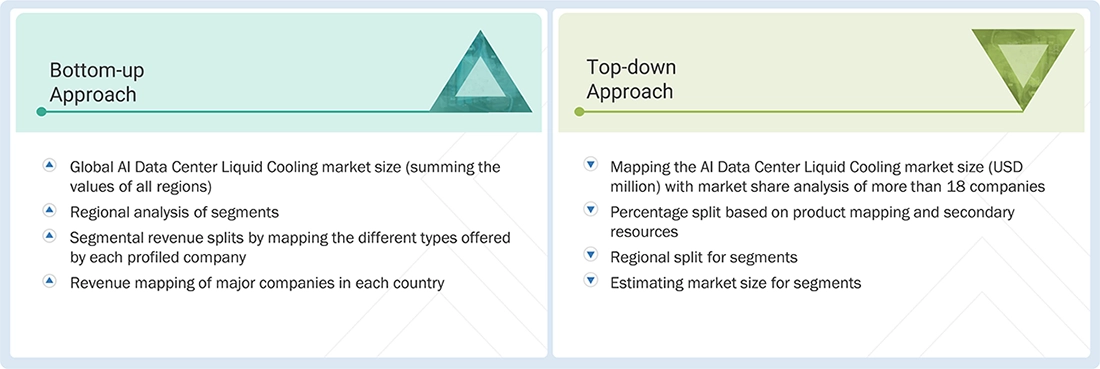
The study involved four major activities in estimating the current size of the AI data center liquid cooling market. Exhaustive secondary research was done to collect information on the market, peer markets, and parent market. The next step was to validate these findings, assumptions, and sizing with industry experts across the AI data center liquid cooling value chain through primary research. Both top-down and bottom-up approaches were employed to estimate the complete market size. Thereafter, market breakdown and data triangulation were used to estimate the market size of segments and subsegments.
Secondary Research
Secondary sources for this research study include annual reports, press releases, and investor presentations of companies; white papers; certified publications; and articles by recognized authors; gold- and silver-standard websites; AI data center liquid cooling manufacturing companies, regulatory bodies, trade directories, and databases. The secondary research was mainly used to obtain key information about the industry’s supply chain, the total pool of key players, market classification, and segmentation according to industry trends to the bottom-most level and regional markets. It has also been used to obtain information about key developments from a market-oriented perspective.
Primary Research
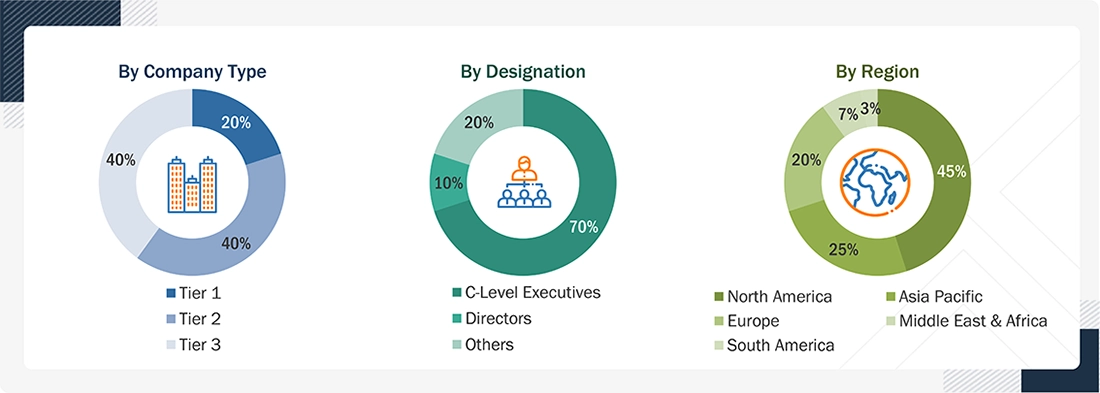
The AI data center liquid cooling market comprises several stakeholders, such as raw material suppliers, technology support providers, data center cooling equipment manufacturers, and regulatory organizations in the supply chain. Various primary sources from both the supply and demand sides of the market were interviewed to obtain qualitative and quantitative information. Primary sources from the supply side included industry experts such as chief executive officers (CEOs), vice presidents, marketing directors, technology and innovation directors, and related key executives from various key companies and organizations operating in the AI data center liquid cooling market. Primary sources from the demand side included directors, marketing heads, and purchase managers from various sourcing industries. The following is the breakdown of the primary respondents:
Breakdown of Primary Profiles
To know about the assumptions considered for the study, download the pdf brochure
Market Size Estimation
The top-down and bottom-up approaches have been employed to estimate and validate the total size of the AI data center liquid cooling market. These approaches have also been used extensively to estimate the size of various dependent market subsegments. The research methodology used to estimate the market size included the following:
The following segments provide details about the overall market size estimation process employed in this study:
- Extensive primary and secondary research was done to identify the key players.
- The value chain and market size of the AI data center liquid cooling market, in terms of value, were determined through primary and secondary research.
- All percentage shares, splits, and breakdowns were collected through secondary sources and verified through primary sources.
- All possible parameters that affect the market were covered in this research study and are viewed in extensive detail, verified through primary research, and analyzed to obtain the final quantitative and qualitative data.
- The study of reports, reviews, and newsletters of top market players, along with extensive interviews for opinions from key leaders, such as CEOs, directors, and marketing executives, is included in this research.
Global AI data center liquid cooling Market Size: Bottom-up & Top-down Approach
Data Triangulation
After arriving at the overall market size using the market size estimation processes as explained above, the market was split into several segments and subsegments. To complete the overall market engineering process and arrive at the exact statistics of each market segment and subsegment, the data triangulation and market breakdown procedures were employed, wherever applicable. The data was triangulated by studying various factors and trends from both the demand and supply sides.
Market Definition
AI data center liquid cooling refers to a range of cooling solutions designed to manage the heat generated by increasingly powerful AI processors and computing systems. These solutions provide targeted thermal management for high-density infrastructure and can be integrated into new or existing data center environments. Market growth is being supported by the rapid deployment of AI and accelerated computing, increasing computational workloads, higher equipment density, and the need for dependable cooling infrastructure. The expansion of hyperscale, colocation, and enterprise data centers is expected to create further opportunities for liquid cooling technologies.
Key Stakeholders
- AI data center liquid cooling manufacturers, processors, and recycling technology providers
- Research institutions, standards organizations, and regulatory agencies such as ASTM, ISO, and others
- NGOs, governments, investment banks, venture capitalists, and private equity firms
Report Objectives
- To define, describe, and forecast the market size of AI data center liquid cooling in terms of value
- To provide detailed information regarding the key factors, such as drivers, restraints, opportunities, and industry-specific challenges, influencing the growth of the AI data center liquid cooling market
- To analyze and forecast the global AI data center liquid cooling market on the basis of cooling type, rack density, component, data center type, and region
- To analyze the opportunities in the market for stakeholders and provide details of a competitive landscape for market leaders
- To forecast the size of various market segments based on four major regions: North America, Asia Pacific, Europe, and Rest of the World, along with their respective key countries
- To track and analyze the competitive developments, such as product launches, expansions, and others, in the market
- To strategically profile the key players and comprehensively analyze their market shares and core competencies
Available customizations:
With the given market data, MarketsandMarkets offers customizations according to the client-specific needs.
The following customization options are available for the report:
- Additional country-level analysis of the AI data center liquid cooling market
- Profiling of additional market players (up to five)
Product Analysis
- Product matrix, which provides a detailed comparison of each company's product portfolio
Get the Full AI Data Center Liquid Cooling Market Report
Full forecast, segment splits, and company analysis for all AI Data Center Liquid Cooling Market.
- US AI Data Center Liquid Cooling Market
- Canada AI Data Center Liquid Cooling Market
- Mexico AI Data Center Liquid Cooling Market
- UK AI Data Center Liquid Cooling Market
- Germany AI Data Center Liquid Cooling Market
- France AI Data Center Liquid Cooling Market
- China AI Data Center Liquid Cooling Market
- South Korea AI Data Center Liquid Cooling Market
- India AI Data Center Liquid Cooling Market
- Singapore AI Data Center Liquid Cooling Market
- Malaysia AI Data Center Liquid Cooling Market
- Australia AI Data Center Liquid Cooling Market
- Brazil AI Data Center Liquid Cooling Market
- South Africa AI Data Center Liquid Cooling Market
- Rest Of Europe AI Data Center Liquid Cooling Market
- Rest Of Asia Pacific AI Data Center Liquid Cooling Market
- GCC Countries AI Data Center Liquid Cooling Market
- -Rest Of GCC Countries AI Data Center Liquid Cooling Market
- Rest Of South America AI Data Center Liquid Cooling Market
Need a Tailored Report?
Customize this report to your needs
Get 10% FREE Customization
Customize This Report
