
Japan Artificial Intelligence in Energy Market (2024-2030)

The Japan Artificial Intelligence in Energy Market was valued at $344.1 Million in 2024 and projected to reach to $2585.6 Million by 2030, representing a compound annual growth rate of 40.0%. Japan's AI in Energy market is positioned for exceptional growth through 2030, driven by the nation's commitment to achieving carbon neutrality and modernizing its energy infrastructure.


| Market Size in | USD 26.32 MN |
| Market Forecast in | |
| CAGR | |
| Forecast Period | |
| Units Considered | Value (USD MN) |
Japan Artificial Intelligence in Energy Market Trends and Insights
- This represents a compound annual growth rate (CAGR) of 40.0%, significantly outpacing global trends.
- Japan's advanced technological infrastructure, coupled with the nation's commitment to energy efficiency and renewable energy adoption, positions the country as a critical hub for AI-driven energy solutions in the Asia Pacific region. The growth trajectory in Japan reflects increasing investments in smart grid technologies, predictive maintenance systems, and AI-powered energy optimization platforms.
- Japan's energy sector is leveraging artificial intelligence to enhance operational efficiency, reduce carbon emissions, and modernize aging infrastructure.
- Between 2024 and 2030, Japan is expected to see substantial deployment of machine learning algorithms across utility companies, industrial facilities, and renewable energy installations, driving market expansion and technological innovation..
Key Market Statistics
- CAGR (2024-2030) 40.0% CAGR
- Market Size, 2024 ~USD 344.1 Million
- Forecast, 2030 ~USD 2585.6 Million
- Country Japan
Japan Artificial Intelligence in Energy Market Overview
Exceptional Growth Trajectory :
Japan's AI in Energy market is expanding at 40% CAGR, substantially exceeding the global rate of 36.9%, driven by aggressive digital transformation initiatives and government support for smart grid technologies.
Rapid Market Expansion :
Market valuation is projected to grow from $344.1 million in 2024 to $2,585.6 million by 2030, representing a 651% increase over six years, reflecting Japan's strategic focus on AI-powered energy solutions.
Advanced Technological Infrastructure :
Japan's mature ICT ecosystem and high digital adoption rates provide a strong foundation for deploying AI applications across energy generation, distribution, and consumption optimization.
Renewable Energy Integration :
Government mandates for renewable energy adoption and carbon neutrality targets are accelerating AI implementation in grid management, predictive maintenance, and energy forecasting systems across Japan.
Japan Artificial Intelligence in Energy Market Dynamics
- The convergence of aging power grids requiring smart management solutions, increasing renewable energy penetration, and substantial government investments in digital transformation creates a compelling market opportunity.
- Japanese enterprises are increasingly adopting AI for demand forecasting, grid optimization, and predictive maintenance to enhance operational efficiency and reduce costs. The market will be further catalyzed by Japan's technological leadership in robotics and automation, enabling sophisticated AI applications in energy systems.
- Strategic partnerships between energy utilities, technology providers, and government agencies are accelerating innovation cycles.
- As Japan transitions toward a decarbonized energy landscape, AI-driven solutions will become essential for managing complex, distributed energy networks and maximizing renewable resource utilization..
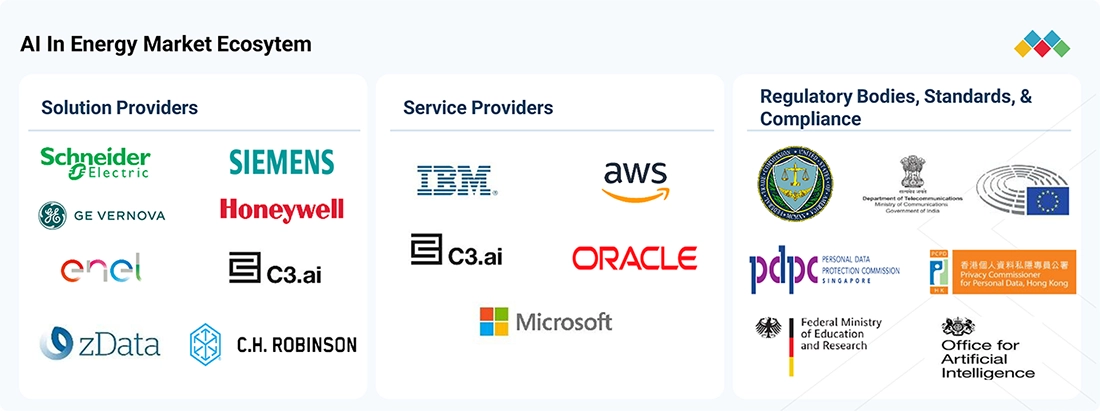
Market Ecosystem
ARTIFICIAL INTELLIGENCE IN ENERGY MARKET: COMMERCIAL USE CASES ACROSS INDUSTRIES
| COMPANY | USE CASE DESCRIPTION | BENEFITS |
|---|---|---|
 |
Citycon’s Lippulaiva shopping centre, Finland: Citycon implemented Schneider Electric’s EcoStruxure Microgrid Advisor to coordinate energy resources and optimize energy use across the site. The project integrates local energy production and consumption to support a more sustainable, energy-efficient building. | Reduced annual CO2 emissions by 335 tonnes and achieved a reported €3 million investment payback within five years. |
 |
Schwarzenbruck wastewater treatment plant, Germany: The plant uses ABB Ability OPTIMAX energy management technology to monitor and optimize energy flows across hydroelectric, photovoltaic, combined heat and power, and energy-storage systems. Load forecasts help determine how energy storage should be used. | ABB reports a 100% reduction in the plant’s previous grid electricity demand and annual savings of approximately 300 tonnes of CO2. |
 |
KP Group, India: KP Group uses IBM Maximo Renewables to support renewable-energy operations and maintenance. The platform helps identify underperforming solar strings, improve portfolio performance, and manage maintenance and contractual compliance across renewable-energy projects. | The company reported that its first 100 projects were onboarded and delivering value within weeks. The solution is expected to reduce energy loss associated with corrective maintenance by up to 5%. |
Logos and trademarks shown above are the property of their respective owners. Their use here is for informational and illustrative purposes only.
Related Ecosystem
Analytics
- Natural Language Processing (NLP)
- Machine Learning
- Supply Chain Management
- Predictive Analytics
- Image Sensors
- International Business Machines Corporation
- MICROSOFT CORPORATION
- Oracle Corporation
- SAP SE
Software And Services
- Natural Language Processing (NLP)
- Machine Learning
- Supply Chain Management
- Predictive Analytics
- Image Sensors
- International Business Machines Corporation
- MICROSOFT CORPORATION
- Oracle Corporation
- SAP SE
- Amazon.com, Inc.
Key Takeaways
- Japan's AI in Energy market will grow from $344.1M (2024) to $2,585.6M (2030) at a 40.0% CAGR, demonstrating exceptional market momentum.
- Japan's advanced technological capabilities and energy transition goals are primary drivers of AI adoption across the energy sector.
- Smart grid optimization and predictive maintenance represent the fastest-growing application segments in Japan's AI energy market.
- Japan's market growth rate significantly exceeds global averages, positioning the nation as a regional leader in AI-powered energy solutions.
Artificial Intelligence in Energy Market Report Scope
| Report Metric | Details |
|---|---|
| Base Year | 2024 |
| Fastest Growing Segment | BIOMASS (Renewable Energy Type) |
| Forecast Period | 2024-2030 |
| Growth Rate | CAGR of 36.9% from 2024 to 2030 |
| Largest Segment | EXTERNAL COMMUNICATION CHANNELS (Integration Mode) |
| Market Size Base Year (Billions) | ~USD 8.91 (2024) |
| Revenue Forecast (Billions) | ~USD 58.66 (2030) |
| Segments Covered | Offering, Service, Professional Service, Energy Type, Conventional Energy Type, Renewable Energy Type, Type, Application, End Use, Consumption, Business Function, Integration Mode, Vertical, Deployment Type, Organization Size |
Japan Artificial Intelligence in Energy Market Report Segmentation
15 segment dimensions are covered across the global market.
By Offering
- Services
- Software
- Solutions
By Service
- Managed Services
- Professional Services
By Professional Service
- Support & Maintenance
- System Integration & Implementation
- Training & Consulting
By Energy Type
- Conventional Energy
- Renewable Energy
By Conventional Energy Type
- Fossil Fuels
- Nuclear Energy
- Other Conventional Energy Types
By Renewable Energy Type
- Biomass
- Hydropower
- Other Renewable Energy Types
- Solar
- Wind
By Type
- Generative AI
- Other AI
By Application
- Disaster Resilience & Recovery
- Energy Demand Forecasting
- Energy Storage Optimization
- Energy Sustainability Management
- Energy Trading & Market Forecasting
- Grid Optimization & Management
- Other Applications
- Renewables Integration
By End Use
- Commercial
- Consumption
- Distribution
- Generation
- Industrial
- Transmission
By Consumption
- Commercial
- Consumption
- Distribution
- Generation
- Industrial
- Transmission
By Business Function
- Finance & Accounting
- Hr
- Itsm
- Operations & Supply Chain
- Sales & Marketing
By Integration Mode
- External Communication Channels
- Internal Enterprise Systems
By Vertical
- Automotive
- Bfsi
- Education
- Government & Defense
- Healthcare
- Healthcare & Life Sciences
- It & Telecom
- It/Ites
- Media & Entertainment
- Other Verticals
- Other Verticals*
- Public Sector
- Retail
- Retail & Ecommerce
- Travel & Hospitality
By Deployment Type
- Cloud
- On-Premises
By Organization Size
- Large Enterprises
- Smes
Target Audience
- Energy Utility Companies : Japanese utilities need market intelligence to understand AI adoption trends, competitive threats, and investment priorities for modernizing grid infrastructure and optimizing operations in a rapidly evolving landscape.
- Technology & Software Providers : AI and software vendors require detailed market data to identify customer segments, assess demand for specific solutions (grid management, forecasting, maintenance), and develop localized offerings for Japan.
- Investment & Private Equity Firms : Investors evaluating opportunities in Japan's energy tech sector need comprehensive market sizing, growth projections, and competitive analysis to make informed funding and acquisition decisions.
- Government & Policy Makers : Japanese government agencies and energy regulators use market research to evaluate policy effectiveness, identify technology gaps, and design incentive programs supporting AI adoption in energy systems.
- Consulting & Strategy Firms : Management consultants advising energy clients in Japan require detailed market insights, trend analysis, and forecasts to develop credible strategic recommendations and competitive positioning strategies.
Reasons to Buy this Report
- Market Size & Growth Validation : Obtain precise market valuation data for Japan ($344.1M in 2024) and verified forecasts through 2030, enabling accurate financial planning and investment decisions for market entry or expansion strategies.
- Competitive Intelligence : Identify key players, market dynamics, and competitive positioning specific to Japan's AI energy sector, allowing you to benchmark against local and international competitors and identify differentiation opportunities.
- Regulatory & Policy Insights : Understand Japan's government initiatives, carbon neutrality targets, and renewable energy mandates driving AI adoption, ensuring compliance and alignment with national energy transition priorities.
- Technology Adoption Trends : Analyze which AI applications (predictive maintenance, grid optimization, demand forecasting) are gaining traction in Japan, guiding product development and go-to-market strategies for maximum relevance.
- Investment & Partnership Opportunities : Discover high-potential segments, emerging players, and strategic partnership possibilities within Japan's rapidly expanding AI energy ecosystem to maximize ROI and accelerate market penetration.
Frequently asked questions
What is the current market size of AI in Energy in Japan?
Japan's AI in Energy market was valued at $344.1 million in 2024 and is projected to reach $2,585.6 million by 2030.
What is the expected growth rate for Japan's AI in Energy market?
Japan's AI in Energy market is expected to grow at a compound annual growth rate (CAGR) of 40.0% from 2024 to 2030.
What are the primary drivers of AI adoption in Japan's energy sector?
Japan's energy transition goals, aging infrastructure modernization needs, renewable energy integration, and commitment to carbon reduction are key drivers of AI adoption in the energy sector.
Which applications are leading growth in Japan's AI Energy market?
Smart grid optimization, predictive maintenance, demand forecasting, and AI-powered energy management systems are the leading application segments driving growth in Japan.
How does Japan's AI Energy market growth compare to global trends?
Japan's 40.0% CAGR significantly exceeds the global average of 36.9%, positioning Japan as a high-growth market within the Asia Pacific region.
RESEARCH METHODOLOGY
The research study involved four major activities to estimate the artificial intelligence (AI) in energy market size. Extensive secondary research was conducted to collect relevant information about the market and related energy technologies. The findings and assumptions were subsequently validated through primary research with industry experts across the energy value chain. Top-down and bottom-up approaches were used to estimate the market size, followed by data triangulation to validate the estimates and determine the sizes of individual segments and sub-segments.
Secondary Research
The market size of companies offering AI in energy solutions and services to various end users was determined using secondary data from paid and publicly available sources. The research involved analyzing product portfolios, service offerings, geographic presence, and competitive positioning of major market participants. Various sources were consulted to identify and collect relevant information, including company annual reports, official websites, press releases, investor presentations, product announcements, white papers, industry publications, certified reports, and publications from recognized energy associations, regulatory bodies, and government agencies. Particular attention was given to AI-powered energy forecasting, grid optimization, predictive maintenance, renewable energy integration, energy storage optimization, and energy sustainability management.
Secondary research was primarily used to obtain critical information about industry trends, market drivers and restraints, the market value chain, the competitive landscape, and the overall pool of key players. It also supported market classification and segmentation by offering, type, energy type, application, end use, and region, along with the identification of key developments from market-oriented and technology-oriented perspectives.
Primary Research
In the primary research process, various stakeholders from the supply and demand sides of the AI in energy market were considered to obtain qualitative and quantitative information for the report. These included Chief Executive Officers (CEOs), Chief Technology Officers (CTOs), Chief Information Officers (CIOs), Vice Presidents (VPs), and directors from business development, marketing, product development, and innovation teams, along with key executives from AI solution providers, energy utilities, power generation companies, renewable energy developers, grid operators, system integrators, cloud service providers, consulting firms, industry associations, independent consultants, and key opinion leaders.
Primary interviews were conducted to gather insights, such as market statistics, data on revenue collected from platforms and services, market breakdowns, market size estimations, market forecasts, and data triangulation. Stakeholders from the demand side, such as Chief Information Officers (CIOs), Chief Finance Officers (CFOs), Chief Strategy Officers (CSOs), and the installation team of end users who use AI in energy solutions, were interviewed to understand buyers’ perspectives on suppliers, products, service providers, and their use of AI in energy solutions, which is expected to affect the overall AI in energy market growth.
Breakdown Of Primary Interviews
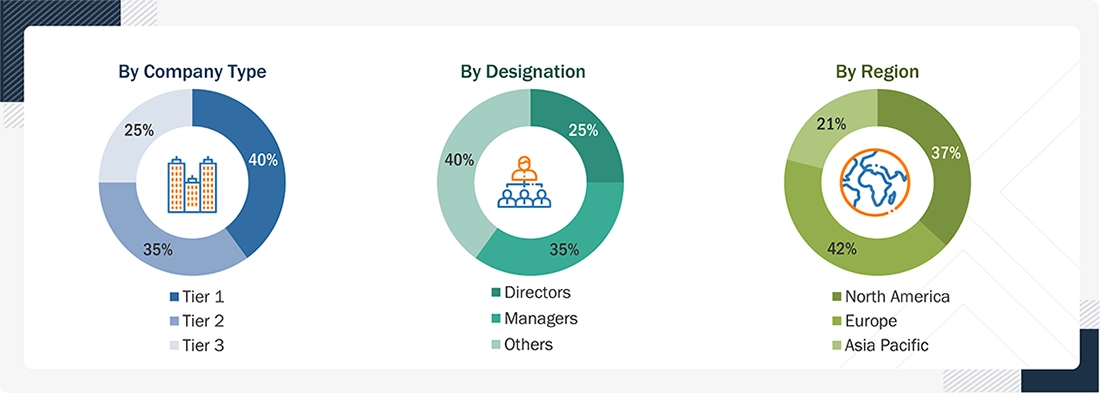
Note: Tier 1 companies have revenues over USD 1 billion, Tier 2 companies have revenues between USD 500 million and 1 billion, and Tier 3 companies have revenues less than USD 500 million. Other designations include sales managers, marketing managers, and product managers.
Source: Industry Experts
To know about the assumptions considered for the study, download the pdf brochure
Market Size Estimation
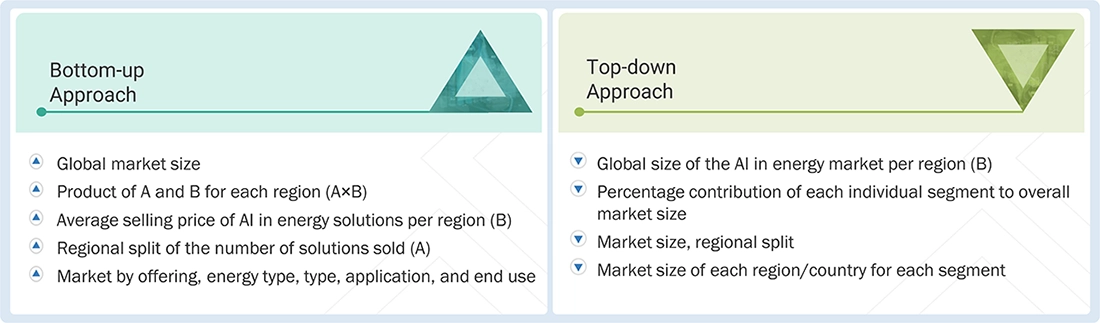
Both top-down and bottom-up approaches were used to estimate and validate the total size of the AI in energy market. These methods were also used extensively to estimate the size of various subsegments in the market.
Artificial Intelligence in Energy Market: Top-Down and Bottom-Up Approach
Data Triangulation
The AI in energy market was split into several segments and sub-segments after determining the overall market size from the above estimation process. To complete the overall market engineering process and arrive at the exact statistics for all segments and sub-segments, data triangulation and market breakdown procedures were used, wherever applicable. The data was triangulated by studying various factors and trends from the demand and supply sides. The market size was validated using top-down and bottom-up approaches.
Market Definition
The AI in energy market encompasses the application of artificial intelligence technologies to optimize various aspects of the energy sector, including generation, transmission, distribution, and consumption. It leverages advanced tools like machine learning, predictive analytics, computer vision, and natural language processing to enhance efficiency, reduce costs, and support sustainability goals. By integrating AI, the energy industry can address challenges like energy demand forecasting, grid stability, renewable energy management, and risk mitigation. This market drives innovation in smart energy solutions, enabling the transition to cleaner and more decentralized energy systems while improving operational reliability and environmental impact.
Key Stakeholders
- Energy Companies
- Technology Providers
- Governments and Regulatory Bodies
- Energy Consumers (Industrial, Commercial, Residential)
- Research and Academic Institutions
- AI and Data Analytics Firms
- Utilities and Grid Operators
- Energy Storage Solution Providers
- Renewable Energy Developers
Report Objectives
- To determine, segment, and forecast the AI in energy market based on offering, type, energy type, application, end use, and region in terms of value
- To forecast the segment’s size with respect to five main regions: North America, Europe, Asia Pacific, Latin America, and the Middle East & Africa
- To provide detailed information about the major factors (drivers, restraints, opportunities, and challenges) influencing the market growth
- To study the complete value chain and related industry segments, and perform a value chain analysis
- To strategically analyze macro and micro-markets with respect to individual growth trends, prospects, and contributions to the market
- To analyze industry trends, regulatory landscape, and patents & innovations
- To analyze opportunities for stakeholders by identifying the high-growth segments
- To track and analyze competitive developments, such as agreements, partnerships, collaborations, and R&D activities
Available customizations:
With the given market data, MarketsandMarkets offers customizations based on the company’s specific needs. The following customization options are available for the report:
Geographical Analysis
- Further break-up of the Asia Pacific market into countries contributing 75% to the regional market size
- Further break-up of the North American market into countries contributing 75% to the regional market size
- Further break-up of the Latin American market into countries contributing 75% to the regional market size
- Further break-up of the Middle East & African market into countries contributing 75% to the regional market size
- Further break-up of the European market into countries contributing 75% to the regional market size
Company Information
- Detailed analysis and profiling of additional market players (up to five)
Get the Full Artificial Intelligence in Energy Market Report
Full forecast, segment splits, and company analysis for all Artificial Intelligence in Energy Market.
- Canada Artificial Intelligence in Energy Market
- US Artificial Intelligence in Energy Market
- Germany Artificial Intelligence in Energy Market
- China Artificial Intelligence in Energy Market
- Brazil Artificial Intelligence in Energy Market
- France Artificial Intelligence in Energy Market
- Italy Artificial Intelligence in Energy Market
- Nordic Countries Artificial Intelligence in Energy Market
- Rest Of Europe Artificial Intelligence in Energy Market
- Spain Artificial Intelligence in Energy Market
- UK Artificial Intelligence in Energy Market
- Asean Artificial Intelligence in Energy Market
- India Artificial Intelligence in Energy Market
- Rest Of Asia Pacific Artificial Intelligence in Energy Market
- South Korea Artificial Intelligence in Energy Market
- Argentina Artificial Intelligence in Energy Market
- Mexico Artificial Intelligence in Energy Market
- Rest Of Latin America Artificial Intelligence in Energy Market
- Ksa Artificial Intelligence in Energy Market
- Kuwait Artificial Intelligence in Energy Market
- Qatar Artificial Intelligence in Energy Market
- South Africa Artificial Intelligence in Energy Market
- UAE Artificial Intelligence in Energy Market
Need a Tailored Report?
Customize this report to your needs
Get 10% FREE Customization
Customize This Report
