
North America Artificial Intelligence (AI) in Networks Market (2024-2029)

The North America Artificial Intelligence (AI) in Networks Market was valued at $4309.8 Million in 2024 and projected to reach to $18078.1 Million by 2029, representing a compound annual growth rate of 33.2%. North America's AI in Networks market is poised for exceptional growth through 2029, driven by substantial capital investments in 5G infrastructure, edge computing, and intelligent network automation.


| Market Size in | USD 26.32 MN |
| Market Forecast in | |
| CAGR | |
| Forecast Period | |
| Units Considered | Value (USD MN) |
North America Artificial Intelligence (AI) in Networks Market Trends and Insights
- The region is experiencing rapid expansion driven by substantial investments in network infrastructure modernization and AI-powered automation across telecommunications, cloud computing, and enterprise sectors.
- North America's advanced technological ecosystem and early adoption of AI-driven network solutions position it as a critical growth engine for the industry. By 2029, North America's AI in Networks market is forecast to reach $18,078.1 million, representing a compound annual growth rate (CAGR) of 33.2% over the five-year period.
- This accelerated growth reflects increasing demand for intelligent network management, predictive analytics, and autonomous network operations across North American enterprises.
- North America's leadership in semiconductor innovation and cloud infrastructure further strengthens its market position and competitive advantage in AI-enabled networking technologies..
Key Market Statistics
- CAGR (2024-2029) 33.2% CAGR
- Market Size, 2024 ~USD 4309.8 Million
- Forecast, 2029 ~USD 18078.1 Million
- Geography North America
North America Artificial Intelligence (AI) in Networks Market Overview
Market Leadership Position :
North America commands the largest share of the global AI in Networks market with $4,309.8 million in 2024, driven by early adoption of AI technologies and robust digital infrastructure investments across the region.
Accelerated Growth Trajectory :
The region is projected to reach $18,078.1 million by 2029, representing a 33.2% CAGR. This growth outpaces many global regions, fueled by telecommunications modernization and enterprise AI integration initiatives.
US Market Dominance :
The United States represents the largest market within North America at $14,487.3 million, accounting for approximately 84% of the regional market and serving as the innovation hub for AI-powered network solutions.
Diverse Regional Contribution :
Canada ($2,415.7 million) and Mexico ($1,175.2 million) contribute significantly to North America's growth, with increasing cloud infrastructure investments and digital transformation initiatives across all three countries.
North America Artificial Intelligence (AI) in Networks Market Dynamics
- Major telecommunications providers and cloud giants are deploying AI-powered solutions to optimize network performance, reduce operational costs, and enhance security across enterprise and consumer segments.
- The region's technological maturity, favorable regulatory environment, and concentration of leading technology companies create a competitive advantage for innovation and market expansion. The forecast period will witness accelerated adoption of AI-driven network management platforms, predictive analytics, and autonomous network operations across North America.
- Investment in AI talent, research institutions, and startup ecosystems will further strengthen the region's market position.
- Strategic partnerships between telecom operators, software vendors, and AI specialists will unlock new use cases in network optimization, cybersecurity, and service personalization, solidifying North America's leadership in the global AI in Networks landscape..
Market Ecosystem
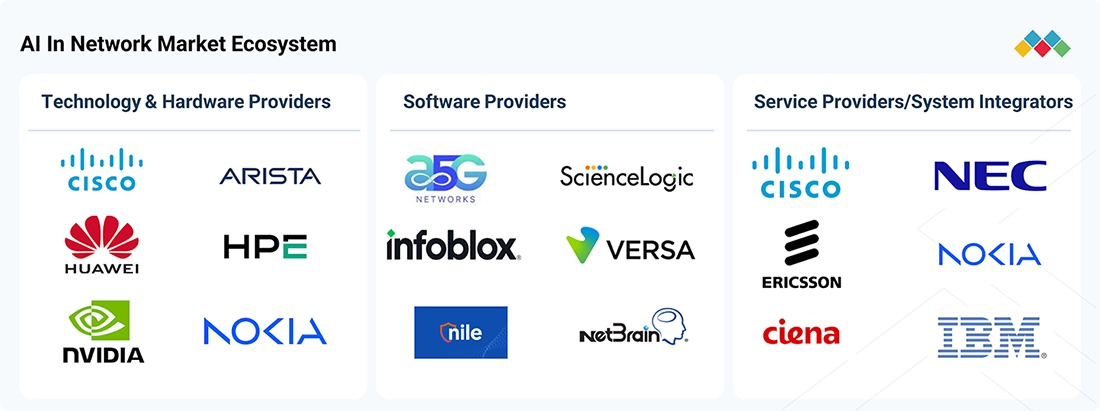
AI IN NETWORK MARKET : COMMERCIAL USE CASES ACROSS INDUSTRIES
| COMPANY | USE CASE DESCRIPTION | BENEFITS |
|---|---|---|
 |
Cisco integrates AI, network telemetry, predictive analytics, and agentic operations across data center, campus, and WAN environments | Enterprises use these capabilities to monitor network performance, detect anomalies, optimize traffic paths, automate troubleshooting, and enable autonomous network assurance. | Real-time network visibility and assurance | Predictive issue detection and remediation | Optimized traffic routing and application performance | Reduced downtime and troubleshooting effort | Improved operational efficiency. |
 |
Ericsson integrates AI across RAN, core, and OSS/BSS to enable intent-driven and autonomous network operations | Telecom operators use AI to monitor network conditions, optimize resources, automate provisioning and fault resolution, and implement closed-loop service assurance across multi-domain networks. | Improved network reliability and service quality | Automated fault resolution and assurance | Reduced operating costs and mean time to resolution | Optimized resource and energy utilization | Scalable autonomous operations. |
 |
Huawei integrates AI, generative AI, digital twins, and intelligent network management through its Autonomous Driving Network solutions | Telecom operators use these capabilities for predictive fault management, traffic optimization, energy saving, network planning, and closed-loop service provisioning and assurance. | Proactive fault detection and faster troubleshooting | Optimized network resource utilization | Improved service quality and SLA assurance | Reduced manual O&M effort and costs | Enhanced energy efficiency and network reliability. |
Logos and trademarks shown above are the property of their respective owners. Their use here is for informational and illustrative purposes only.
Related Ecosystem
Electrical System And Components
- Natural Language Processing (NLP)
- Sensors
- Machine Learning
- Temperature Sensors
- Actuators
- ABB India Limited
- Siemens ag
- SCHNEIDER ELECTRIC SE
- Eaton Corporation plc
- Lenovo
Analytics
- Natural Language Processing (NLP)
- Machine Learning
- Supply Chain Management
- Predictive Analytics
- Image Sensors
- International Business Machines Corporation
- MICROSOFT CORPORATION
- Oracle Corporation
- SAP SE
Cloud Computing
- Software as A Service (SaaS)
- Natural Language Processing (NLP)
- Platform as A Service (PaaS)
- Machine Learning
- Supply Chain Management
- International Business Machines Corporation
- MICROSOFT CORPORATION
- Oracle Corporation
- Amazon.com, Inc.
Key Takeaways
- North America's AI in Networks market is valued at $4,309.8 million in 2024 and is projected to grow to $18,078.1 million by 2029, representing a 33.2% CAGR.
- North America leads global adoption of AI-driven network solutions, driven by early technology adoption and substantial enterprise investment in intelligent network management.
- Telecommunications, cloud computing, and enterprise sectors in North America are primary growth drivers for AI-enabled networking technologies.
- North America's advanced semiconductor and cloud infrastructure capabilities position the region as a competitive leader in AI network innovation through 2029.
Artificial Intelligence (AI) in Networks Market Report Scope
| Report Metric | Details |
|---|---|
| Base Year | 2024 |
| Fastest Growing Segment | GENERATIVE AI (Technology) |
| Forecast Period | 2024-2029 |
| Growth Rate | CAGR of 33.8% from 2024 to 2029 |
| Largest Segment | CLOUD (Deployment Mode) |
| Market Size Base Year (Billions) | ~USD 10.91 (2024) |
| Revenue Forecast (Billions) | ~USD 46.8 (2029) |
| Segments Covered | Offering, Deployment Mode, Network Function, Technology, End User |
North America Artificial Intelligence (AI) in Networks Market Report Segmentation
5 segment dimensions are covered across the global market.
By Offering
- AI Networking Platforms
- Routers And Ethernet Switches
- Services
- Software
By Deployment Mode
- Cloud
- On-Premises
By Network Function
- Cybersecurity
- Optimization
- Predictive Maintenance
- Troubleshooting
By Technology
- Deep Learning
- Generative AI
- Machine Learning
- Natural Language Processing
- Other Technologies
By End User
- Data Centers
- Enterprises
- Government
- Telecom Service Providers
Target Audience
- Telecom & Network Operators : Telecommunications companies and network service providers in North America need this data to benchmark competitive positioning, identify AI investment priorities, and plan infrastructure modernization strategies.
- Technology & Software Vendors : AI software, networking, and cloud solution providers require regional market intelligence to prioritize North American expansion, allocate R&D resources, and develop localized product strategies.
- Enterprise IT Decision-Makers : CIOs and IT leaders across North American enterprises need market insights to evaluate AI-powered network solutions, assess vendor capabilities, and justify technology investments to stakeholders.
- Investment & Private Equity Firms : Investors and PE firms targeting the North American AI and networking sectors require detailed market data to identify acquisition targets, assess portfolio company growth potential, and evaluate exit opportunities.
- Government & Policy Organizations : Regulatory bodies and government agencies in North America need market intelligence to inform technology policy, infrastructure funding decisions, and competitive analysis of the regional AI networking sector.
Countries within North America - compare and drill down
| Country | 2025 size (native) |
|---|---|
| US | USD 14487.3 Million |
| Canada | USD 2415.7 Million |
| Mexico | USD 1175.2 Million |
Country market size visualization
Reasons to Buy this Report
- Regional Market Sizing & Forecasts : Access precise market valuations for North America ($4.3B in 2024) and country-level breakdowns for US, Canada, and Mexico with detailed 5-year projections to 2029.
- Competitive Landscape Analysis : Understand the strategic positioning of leading AI network solution providers operating in North America, including market share, product portfolios, and regional expansion strategies.
- Growth Driver Identification : Identify key catalysts fueling the 33.2% CAGR in North America, including 5G deployment, cloud migration, enterprise automation, and regulatory tailwinds specific to the region.
- Investment & Opportunity Assessment : Evaluate market entry opportunities, partnership potential, and M&A targets across North America's fragmented AI networking ecosystem with country-specific insights.
- Trend & Technology Insights : Discover emerging technologies, use cases, and adoption patterns in North American networks, from autonomous network operations to AI-powered cybersecurity solutions.
Frequently asked questions
What is the current market size of AI in Networks in North America?
North America's AI in Networks market is estimated at $4,309.8 million in 2024, making it a significant segment of the global market.
What is the projected market size for North America's AI in Networks market by 2029?
North America's AI in Networks market is forecast to reach $18,078.1 million by 2029, growing at a CAGR of 33.2% from 2024 to 2029.
What are the primary drivers of AI in Networks growth in North America?
North America's growth is driven by increased investment in network infrastructure modernization, demand for intelligent network management, predictive analytics capabilities, and autonomous network operations across telecommunications and enterprise sectors.
Which industries in North America are adopting AI in Networks solutions most rapidly?
Telecommunications, cloud computing providers, and large enterprises in North America are leading the adoption of AI-driven network solutions for operational efficiency and network optimization.
Why is North America a leader in the global AI in Networks market?
North America's leadership stems from its advanced semiconductor ecosystem, robust cloud infrastructure, early technology adoption culture, and significant enterprise investment in AI-powered network modernization initiatives.
RESEARCH METHODOLOGY
The research study involved four major activities to estimate the AI in network market size. We conducted exhaustive secondary research to collect key information on the market and peer markets. Next, we validated these findings and assumptions and sized the market with the help of primary research with industry experts across the value chain. We used both top-down and bottom-up approaches to estimate market size. Afterward, we used market breakdowns and data triangulation to estimate segment and sub-segment market sizes.
Secondary Research
We determined the market size of companies offering AI in network solutions and services for various subscribers based on secondary data from paid and unpaid sources, and by analyzing the offerings (solutions and services) of major companies in the ecosystem and rating them based on performance and quality. In the secondary research process, various sources were used to identify and collect information for this study. The secondary sources included annual reports, press releases and investor presentations of companies, white papers, journals, and certified publications and articles from recognized authors, directories, and databases.
Secondary research was mainly used to obtain key information about the industry’s supply chain, the total pool of key players, market classification, and segmentation according to industry trends to the bottom-most level, regional markets, and key developments from both market- and technology-oriented perspectives, all of which were further validated by primary sources.
Primary Research
In the primary research process, we interviewed primary sources from both the supply and demand sides to obtain qualitative and quantitative information for the report. Primary sources on the supply side include industry experts such as Chief Executive Officers (CEOs), Vice Presidents (VPs), marketing directors, technology and innovation directors, and other key executives from companies and organizations providing AI in network solutions. Primary demand-side sources include end users such as Chief Information Officers (CIOs), consultants, service professionals, technicians and technologists, and managers at public and investor-owned utilities.
In the market engineering process, we used top-down and bottom-up approaches, along with several data triangulation methods, to estimate and forecast the overall market segments and subsegments listed in the report. We performed extensive qualitative and quantitative analyses across the entire market engineering process to identify key information/insights throughout the report.
After completing the market engineering (including calculations for market statistics, market breakup, market size estimations, market forecasting, and data triangulation), we conducted extensive primary research to gather information. Primary research identified segmentation, industry trends, key players, the competitive landscape, and key market dynamics such as drivers, restraints, opportunities, challenges, and key strategies.
breakdown of primaries
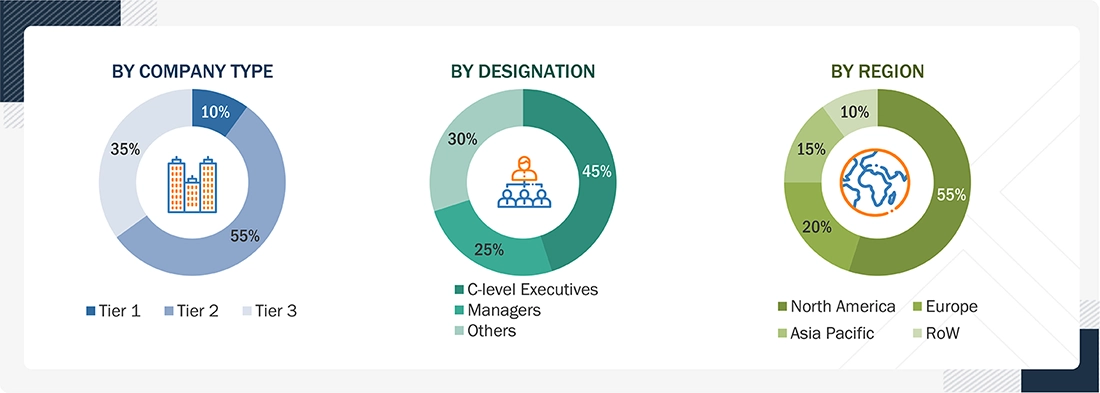
Note 1: Tier 1 companies have revenues of more than USD 10 billion; tier 2 companies’ revenue ranges from USD 1 billion to USD 10 billion; and tier 3 companies’ revenue ranges from USD 500 million to USD 1 billion
Source: Secondary Literature, Expert Interviews, and MarketsandMarkets Analysis
To know about the assumptions considered for the study, download the pdf brochure
Market Size Estimation
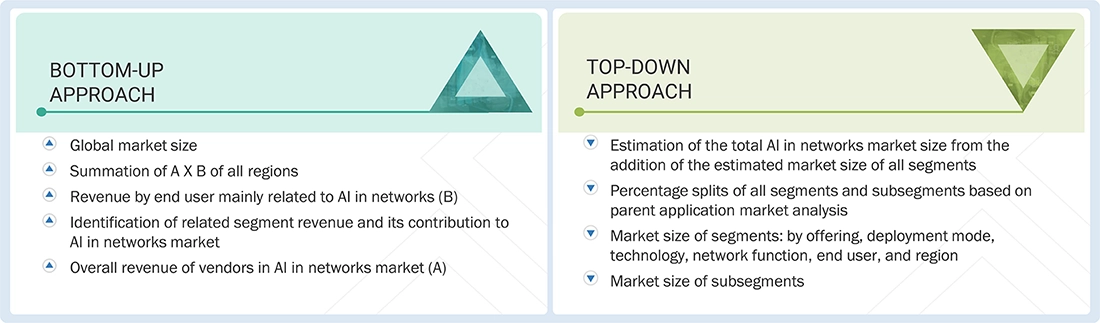
In the market engineering process, the top-down and bottom-up approaches were used, along with multiple data triangulation methods, to estimate and validate the size of the AI in network market and other dependent submarkets. The research methodology used to estimate the market sizes includes the following:
- Initially, MarketsandMarkets focuses on top-line investments and spending in the ecosystems. It also considers significant developments in the critical market area.
- Tracking the recent and upcoming developments in the AI in network market that include investments, R&D activities, product launches, collaborations, mergers and acquisitions, and partnerships, as well as forecasting the market size based on these developments and other critical parameters.
- Conduct multiple discussions with key opinion leaders to learn about the diverse types of authentications and brand protection offerings used and the applications for which they are used to analyze the breakdown of the scope of work carried out by major companies.
- Segmenting the market based on technology types concerning applications wherein the types are to be used and deriving the size of the global AI in network market.
- Segmenting the overall market into various market segments
- Validating the estimates at every level through discussions with key opinion leaders, such as chief executives (CXOs), directors, and operations managers, and finally with the domain experts at MarketsandMarkets
AI in Network Market : Top-Down and Bottom-Up Approach
Data Triangulation
After arriving at the overall market size from the above estimation process, the AI in network market has been split into several segments and sub-segments. To complete the overall market engineering process and arrive at exact statistics for all segments and sub-segments, we used data triangulation and market breakdown procedures, where applicable. The data has been triangulated by studying various factors and trends from both the demand and supply sides.
We validated the AI in network market size using top-down and bottom-up approaches.
Market Definition
AI in network refers to applying artificial intelligence technologies across network infrastructure and operations to enhance visibility, decision-making, performance, security, and automation. It includes machine learning, generative AI, predictive analytics, and intelligent automation for network monitoring, observability, DDI, optimization, threat detection, configuration, orchestration, and planning. AI in Network solutions analyze telemetry, traffic, topology, configuration, and operational data to identify anomalies, predict network conditions, optimize resources, automate remediation, and support increasingly autonomous network operations across data center, cloud, wireless, SD-WAN, campus, and other network environments.
Key Stakeholders
- AI in Network Solution Vendors
- Network Equipment and Infrastructure Providers
- Network Monitoring & Observability Solution Providers
- Network Automation & Orchestration Solution Providers
- DDI and DNS Management Solution Providers
- Network Security Solution Providers
- AI/ML Technology and Platform Providers
- Cloud Service Providers and Hyperscalers
- System Integrators (SIs) and Technology Consulting Firms
- Managed Network Service Providers (MNSPs) and Managed Service Providers (MSPs)
- Value-added Resellers (VARs), Distributors, and Channel Partners
- Telecommunication Operators and Communication Service Providers (CSPs)
- Data Center and Colocation Service Providers
- Enterprise Network Operators/Large Enterprises
Report Objectives
- To determine, segment, and forecast the AI in network market based on offerings (solutions and services), end users, and regions in terms of value
- To forecast the size of the market segments across five main regions: North America, Europe, Asia Pacific, Middle East & Africa, and Latin America
- To provide detailed information about the major factors (drivers, restraints, opportunities, and challenges) influencing the growth of the market
- To study the complete value chain and related industry segments and perform a value chain analysis of the market landscape
- To strategically analyze the macro and micromarkets with respect to individual growth trends, prospects, and contributions to the total market
- To analyze the industry trends, pricing data, patents, and innovations related to the market
- To analyze opportunities for stakeholders by identifying high-growth market segments
- To profile the key players in the market and comprehensively analyze their market share/ranking and core competencies
- To track and analyze competitive developments, such as mergers & acquisitions, product launches & developments, partnerships, agreements, collaborations, business expansions, and R&D activities
Available customizations:
With the given market data, MarketsandMarkets offers customizations per the company’s specific needs. The following customization options are available for the report:
Geographic Analysis
- Further break-up of the Asia Pacific market into countries contributing 75% to the regional market size
- Further break-up of the North American market into countries contributing 75% to the regional market size
- Further break-up of the Latin American market into countries contributing 75% to the regional market size
- Further break-up of the Middle East & African market into countries contributing 75% to the regional market size
- Further break-up of the European market into countries contributing 75% to the regional market size
Company Information
- Detailed analysis and profiling of additional market players (up to 5)
Get the Full Artificial Intelligence (AI) in Networks Market Report
Full forecast, segment splits, and company analysis for all Artificial Intelligence (AI) in Networks Market.
- US Artificial Intelligence (AI) in Networks Market
- Canada Artificial Intelligence (AI) in Networks Market
- Mexico Artificial Intelligence (AI) in Networks Market
- Germany Artificial Intelligence (AI) in Networks Market
- UK Artificial Intelligence (AI) in Networks Market
- France Artificial Intelligence (AI) in Networks Market
- Italy Artificial Intelligence (AI) in Networks Market
- Rest Of Europe Artificial Intelligence (AI) in Networks Market
- China Artificial Intelligence (AI) in Networks Market
- Japan Artificial Intelligence (AI) in Networks Market
- South Korea Artificial Intelligence (AI) in Networks Market
- Rest Of Asia Pacific Artificial Intelligence (AI) in Networks Market
Need a Tailored Report?
Customize this report to your needs
Get 10% FREE Customization
Customize This Report
