
US Artificial Intelligence in Tourism Market (2024-2029)

The US Artificial Intelligence in Tourism Market was valued at $830 Million in 2024 and projected to reach to $2869 Million by 2029, representing a compound annual growth rate of 23.0%. The US artificial intelligence in tourism market is poised for sustained growth as travel operators recognize AI's transformative potential in enhancing guest experiences and streamlining operations.


| Market Size in | USD 26.32 MN |
| Market Forecast in | |
| CAGR | |
| Forecast Period | |
| Units Considered | Value (USD MN) |
US Artificial Intelligence in Tourism Market Trends and Insights
- This 23.0% compound annual growth rate reflects the US tourism industry's accelerating adoption of AI-powered solutions for personalization, operational efficiency, and customer experience enhancement.
- US travel operators, hospitality providers, and destination management organizations are increasingly deploying machine learning algorithms, chatbots, and predictive analytics to optimize booking processes and traveler engagement. Driving this growth, the US market benefits from high digital infrastructure maturity, substantial investment in AI startups, and strong consumer demand for seamless travel experiences.
- Between 2024 and 2029, US tourism stakeholders are expected to integrate AI across revenue management, dynamic pricing, and intelligent recommendation engines.
- The competitive landscape in the US remains fragmented, with both established technology giants and specialized AI tourism vendors competing to capture market share in this high-growth segment..
Key Market Statistics
- CAGR (2024-2029) 23.0% CAGR
- Market Size, 2024 ~USD 830 Million
- Forecast, 2029 ~USD 2869 Million
- Country US
US Artificial Intelligence in Tourism Market Overview
Market Valuation Growth :
The US AI in tourism market is valued at $830.0 million in 2024, with projections reaching $2,869.0 million by 2029, representing a robust 23.0% CAGR driven by widespread adoption across hospitality and travel sectors.
Personalization & Customer Experience :
US travel operators are increasingly leveraging AI-powered recommendation engines and chatbots to deliver hyper-personalized travel experiences, significantly improving customer satisfaction and repeat bookings across major tourism destinations.
Operational Efficiency Gains :
Hotels, airlines, and tour operators in the US are deploying AI solutions for revenue management, dynamic pricing, and predictive maintenance, reducing operational costs while maximizing profitability in a competitive market.
Technology Integration Acceleration :
Major US hospitality chains and online travel agencies are rapidly integrating AI technologies for demand forecasting, inventory optimization, and automated customer service, positioning themselves as industry leaders in digital transformation.
US Artificial Intelligence in Tourism Market Dynamics
- Investment in AI-driven solutions is accelerating across major metropolitan areas and resort destinations, with particular emphasis on natural language processing for customer service and machine learning for predictive analytics.
- The competitive landscape is intensifying as both established hospitality giants and innovative startups vie for market share through advanced AI implementations. Looking ahead, the US market will be shaped by increasing consumer expectations for seamless digital interactions, regulatory developments around data privacy, and the integration of emerging technologies like generative AI for content creation and virtual concierge services.
- Strategic partnerships between tourism operators and AI technology providers will drive innovation, while investment in talent and infrastructure will remain critical for maintaining competitive advantage in this rapidly evolving sector..
Market Ecosystem
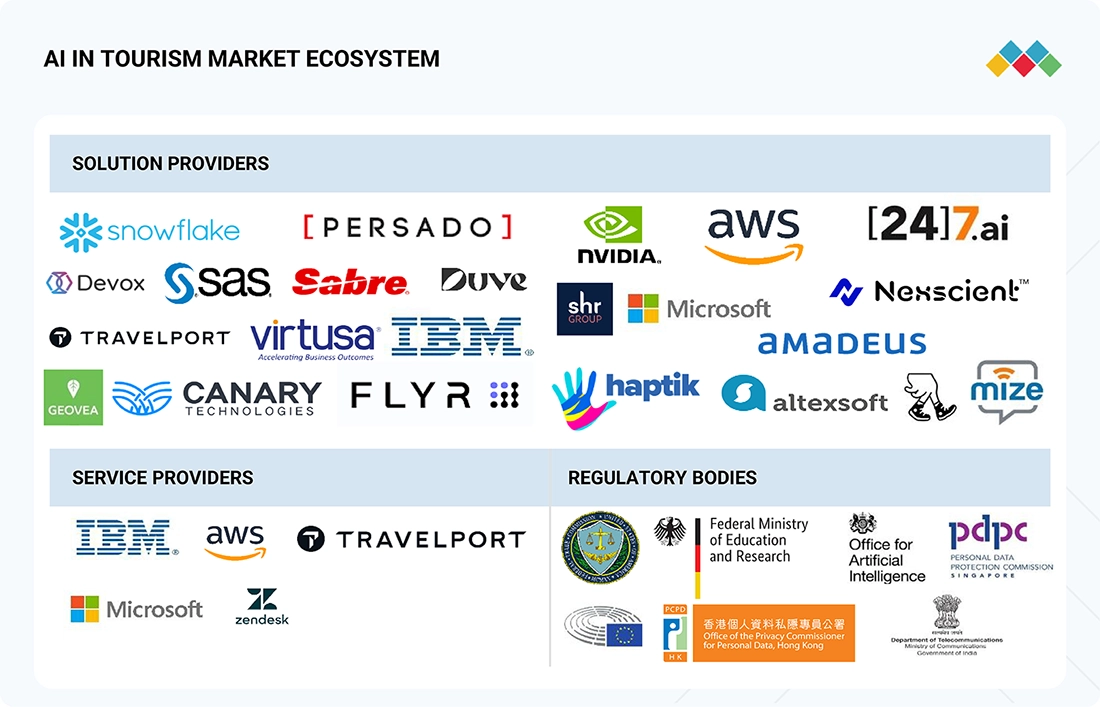
AI in Tourism Market: COMMERCIAL USE CASES ACROSS INDUSTRIES
| COMPANY | USE CASE DESCRIPTION | BENEFITS |
|---|---|---|
 |
Booking.com, a Netherlands-based startup, has grown into one of the world’s top digital travel agencies by revolutionizing how people book travel | Focused on using technology to enhance the customer experience, the company is now leveraging generative AI to create tailored travel recommendations, reduce booking friction, and inspire travelers | By utilizing Amazon Bedrock’s advanced language models, Booking.com is connecting users with unique destinations, making it a premier platform for personalized travel planning. | By incorporating generative AI and AWS capabilities, Booking.com significantly improved its ability to offer personalized and unexpected travel recommendations, boosting customer satisfaction and brand loyalty | The use of AI-driven, data-powered suggestions has enhanced the user experience by providing unique, custom travel ideas that customers may not have considered on their own | The seamless integration of AI also ensured the company stayed at the forefront of technological innovation in the travel industry, furthering its mission to make travel planning easy and enjoyable. |
 |
Travelpass is a travel-experience platform dedicated to connecting travelers with tailored hotel stays, unique activities, and personalized recommendations | By leveraging data to enhance traveler experiences, Travelpass aims to facilitate deeper connections among users while satisfying their wanderlust | As the demand for customized travel experiences grows, the company sought a robust data management solution that would enable effective AI integration to deliver more relevant and curated travel options. | Switching to Snowflake brought Travelpass a 65% reduction in operational costs, freeing up resources for investment in AI-driven initiatives | The platform's improved data accessibility increased data delivery efficiency by over 350%, enabling quicker implementation of AI solutions across the organization | Snowflake's user-friendly design also empowered more team members to participate in data analysis without needing extensive training | With AI tools seamlessly integrated into their data architecture, Travelpass is now able to deliver highly personalized travel recommendations, enhancing customer satisfaction and engagement. |
 |
A1 Inteligência em Viagens, a Brazil-based corporate travel agency with over 30 years of experience, transformed its travel coordination process by implementing Power Automate and Microsoft Copilot Studio | The agency specializes in coordinating international and luxury travel for executives, working with a global network of partners to deliver personalized experiences | During the COVID-19 pandemic, founder and CEO Daniel Schaurich de Oliveira used the downtime to improve business processes with automation, creating a copilot named "Fifi" to assist both clients and staff. | Automating the travel booking process saved significant time and minimized errors, boosting the team’s productivity by 55% | Fifi's real-time responses and personalized assistance improved the client experience by providing timely, relevant information and simplifying the creation of custom travel policies | By embedding Fifi into Microsoft Teams, A1’s travel agents gained instant access to a knowledge base, allowing them to focus on higher-value tasks while still ensuring accurate information was provided to customers. |
Logos and trademarks shown above are the property of their respective owners. Their use here is for informational and illustrative purposes only.
Related Ecosystem
Software And Services
- Natural Language Processing (NLP)
- Machine Learning
- Supply Chain Management
- Predictive Analytics
- Image Sensors
- International Business Machines Corporation
- MICROSOFT CORPORATION
- Oracle Corporation
- SAP SE
- Amazon.com, Inc.
Key Takeaways
- The US AI in tourism market will grow from $830.0M (2024) to $2,869.0M (2029), representing a 23.0% CAGR.
- US hospitality and travel operators are prioritizing AI adoption for personalization, chatbots, and revenue optimization.
- The US market is driven by advanced digital infrastructure, venture capital investment, and consumer expectations for frictionless travel.
- By 2029, US tourism enterprises will leverage AI across dynamic pricing, predictive analytics, and intelligent customer engagement platforms.
Artificial Intelligence in Tourism Market Report Scope
| Report Metric | Details |
|---|---|
| Base Year | 2024 |
| Fastest Growing Segment | MANAGED SERVICES (Service) |
| Forecast Period | 2024-2029 |
| Growth Rate | CAGR of 28.7% from 2024 to 2029 |
| Largest Segment | EXTERNAL COMMUNICATION CHANNELS (Integration Mode) |
| Market Size Base Year (Billions) | ~USD 2.94 (2024) |
| Revenue Forecast (Billions) | ~USD 13.38 (2029) |
| Segments Covered | Offering, Travel Solution, Hospitality Solution, Service, Professional Service, Type, End User, Travel Industry, Hospitality Industry, Business Function, Integration Mode, Vertical, Deployment Type, Organization Size |
US Artificial Intelligence in Tourism Market Report Segmentation
14 segment dimensions are covered across the global market.
By Offering
- Services
- Software
- Solutions
By Travel Solution
- Booking Management System
- Customer Experience Management
- Other Travel Solutions
- Pricing & Revenue Management
- Security & Surveillance System
- Virtual Assistant & Chatbots
By Hospitality Solution
- Booking Management System
- Customer Experience Management
- Operational Efficiency & Resource Management
- Other Hospitality Solutions
- Pricing & Revenue Management
- Security & Surveillance System
- Virtual Assistant & Chatbots
By Service
- Managed Services
- Professional Services
By Professional Service
- Consulting
- Support & Maintenance
- System Integration & Implementation
By Type
- Generative AI
- Other AI
By End User
- Hospitality Industry
- Travel Industry
By Travel Industry
- Aviation
- Car Rental & Mobility Providers
- Maritime Travel
- Other End Users
By Hospitality Industry
- Cruise Line Operators
- Hotels
- Other End Users
- Resorts & Theme Parks
By Business Function
- Finance & Accounting
- Hr
- Itsm
- Operations & Supply Chain
- Sales & Marketing
By Integration Mode
- External Communication Channels
- Internal Enterprise Systems
By Vertical
- Automotive
- Bfsi
- Education
- Government & Defense
- Healthcare
- Healthcare & Life Sciences
- It & Telecom
- It/Ites
- Media & Entertainment
- Other Verticals
- Other Verticals*
- Public Sector
- Retail
- Retail & Ecommerce
- Tourism
By Deployment Type
- Cloud
- On-Premises
By Organization Size
- Large Enterprises
- Smes
US: AI IN TOURISM MARKET, BY END USER, 2024–2030
| Segment | 2024 | 2025 | 2026 | 2027 | 2028 | 2029 | 2030 | CAGR (%) |
|---|---|---|---|---|---|---|---|---|
| HOSPITALITY INDUSTRY | 344.4 | 457.2 | 569.9 | 716.9 | 878.7 | 1071.9 | 1276.7 | 24.4 |
| TRAVEL INDUSTRY | 485.5 | 631.4 | 771.1 | 950.2 | 1141.3 | 1364.2 | 1592.3 | 21.9 |
| TOTAL | 830 | 1088.6 | 1341 | 1667.1 | 2019.9 | 2436.1 | 2869 | 23 |
Target Audience
- Hospitality Executives : Hotel chains, resort operators, and hospitality management companies need this data to benchmark AI adoption rates, justify technology investments to stakeholders, and develop competitive digital transformation strategies.
- Travel & Tourism Operators : Online travel agencies, tour operators, and travel management companies require market insights to identify AI solution providers, understand customer expectations, and optimize booking and customer service platforms.
- AI Technology Vendors : Software companies, AI solution providers, and tech startups targeting the tourism sector need detailed US market data to assess opportunity size, identify customer segments, and refine go-to-market strategies.
- Investment & Private Equity Firms : Investors evaluating opportunities in tourism technology and AI need comprehensive market analysis to assess growth potential, competitive dynamics, and valuation benchmarks for portfolio companies and acquisition targets.
- Tourism Destination Marketers : Convention bureaus, destination marketing organizations, and regional tourism boards need insights into AI adoption trends to understand how technology is reshaping visitor experiences and competitive positioning.
Reasons to Buy this Report
- Strategic Market Sizing : Obtain precise valuation data for the US AI in tourism market with detailed forecasts through 2029, enabling accurate budget allocation and investment planning for market entry or expansion strategies.
- Competitive Intelligence : Understand how US travel operators and hospitality chains are deploying AI technologies for personalization and efficiency, identifying competitive gaps and opportunities to differentiate your offerings in the market.
- Growth Opportunity Identification : Leverage detailed insights into the 23% CAGR growth trajectory to identify high-potential segments within US tourism, from luxury travel to budget accommodations, and align product development accordingly.
- Investment Decision Support : Access comprehensive market analysis to support investment decisions, partnership evaluations, and M&A strategies within the US AI tourism ecosystem with data-driven confidence.
- Technology Adoption Roadmap : Understand current and emerging AI applications in US tourism operations, from chatbots to revenue management systems, to prioritize technology investments and implementation timelines for maximum ROI.
Frequently asked questions
What is the current size of the US AI in tourism market?
The US artificial intelligence in tourism market was valued at $830.0 million in 2024.
What is the projected size of the US AI in tourism market by 2029?
The US market is forecast to reach $2,869.0 million by 2029, growing at a 23.0% CAGR.
What are the main applications of AI in US tourism?
US tourism operators deploy AI for personalized recommendations, chatbot customer service, dynamic pricing, revenue management, and predictive analytics.
What factors are driving AI adoption in the US tourism sector?
Key drivers include advanced digital infrastructure, strong venture capital funding, consumer demand for seamless experiences, and competitive pressure on margins.
Who are the main competitors in the US AI tourism market?
The US market includes both large technology platforms and specialized AI tourism vendors competing across booking, personalization, and operational intelligence solutions.
RESEARCH METHODOLOGY
This research study involved the extensive use of secondary sources, directories, and databases, such as Dun & Bradstreet (D&B) Hoovers and Bloomberg BusinessWeek, to identify and collect information useful for a technical, market-oriented, and commercial study of the AI in tourism market. The primary sources have been mainly industry experts from the core and related industries and preferred suppliers, manufacturers, distributors, service providers, technology developers, alliances, and organizations related to all segments of the value chain of this market. In-depth interviews have been conducted with various primary respondents, including key industry participants, subject matter experts, C-level executives of key market players, and industry consultants, to obtain and verify critical qualitative and quantitative information.
Secondary Research
The market for companies offering AI in tourism solutions and services to different end users has been estimated and projected based on the secondary data made available through paid and unpaid sources and by analyzing their product portfolios in the ecosystem of the AI in tourism market. In the secondary research process, various sources such as Journal of Tourism Studies and Hospitality Research and International Journal of Contemporary Hospitality Management (IJCHM) have been referred to for identifying and collecting information for this study on the AI in tourism market. The secondary sources included annual reports, press releases, investor presentations of companies, white papers, journals, certified publications, and articles by recognized authors, directories, and databases. Secondary research has been mainly used to obtain essential information about the supply chain of the market, the total pool of key players, market classification, segmentation according to industry trends to the bottommost level, regional markets, and key developments from both market- and technology-oriented perspectives that primary sources have further validated.
Primary Research
In the primary research process, various primary sources from both the supply and demand sides were interviewed to obtain qualitative and quantitative information on the market. The primary sources from the supply side included various industry experts, including Chief Experience Officers (CXOs); Vice Presidents (VPs); directors from business development, marketing, and product development/innovation teams; related critical executives from AI in tourism service vendors, System Integrators, professional service providers, and industry associations; and key opinion leaders. Primary interviews were conducted to gather insights, such as market statistics, revenue data collected from services, market breakups, market size estimations, market forecasts, and data triangulation. Primary research also helped in understanding various trends related to technologies, applications, deployments, and regions. Stakeholders from the demand side, such as Chief Information Officers (CIOs), Chief Technology Officers (CTOs), Chief Strategy Officers (CSOs), and end users using AI in tourism services, were interviewed to understand the buyer’s perspective on suppliers, products, service providers, and their current usage of AI in tourism services which would impact the overall AI in tourism market.
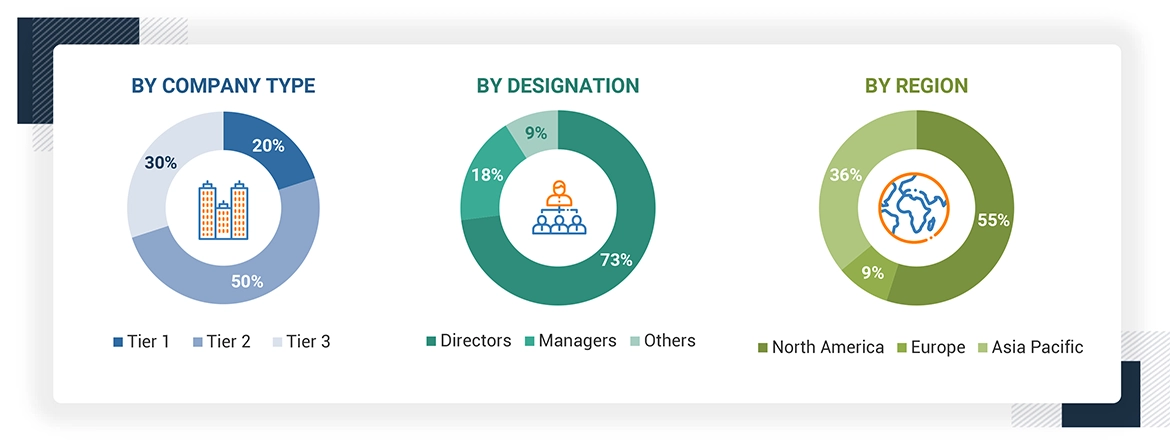
Note: Others include sales managers, marketing managers, and product managers.
To know about the assumptions considered for the study, download the pdf brochure
Market Size Estimation
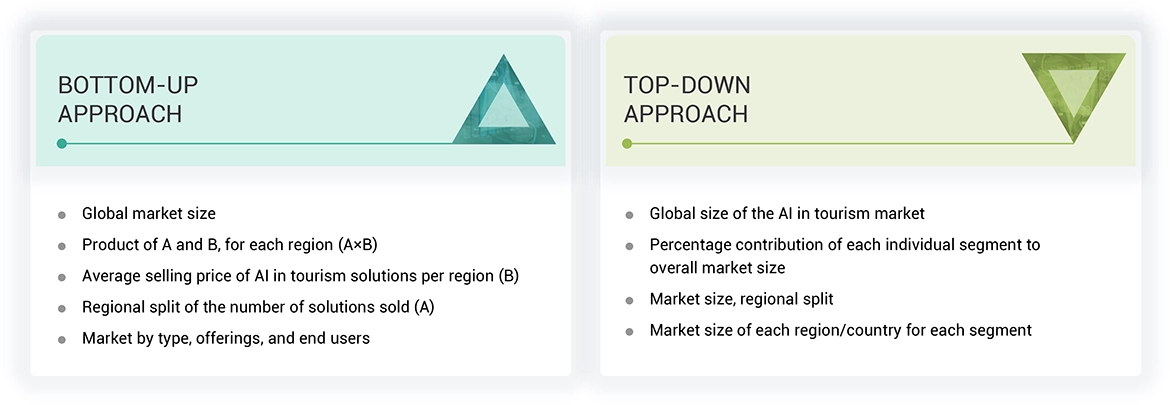
Multiple approaches were adopted to estimate and forecast the size of the AI in tourism market. The first approach involves estimating market size by summing up the revenue generated by companies through the sale of AI in tourism solutions and services.
Both top-down and bottom-up approaches were used to estimate and validate the total size of the AI in tourism market. These methods were extensively used to estimate the size of various segments in the market. The research methodology used to estimate the market size includes the following:
- Key players in the market have been identified through extensive secondary research.
- In terms of value, the industry’s supply chain and market size have been determined through primary and secondary research processes.
- All percentage shares, splits, and breakups have been determined using secondary sources and verified through primary sources.
- After arriving at the overall market size, the AI in tourism market was divided into several segments and subsegments.
Artificial Intelligence in Tourism Market : Top-Down and Bottom-Up Approach
Data Triangulation
After arriving at the overall market size, the AI in tourism market was divided into several segments and subsegments. The data was triangulated by studying various factors and trends from the demand and supply sides. Along with data triangulation and market breakdown, the market size was validated by the top-down and bottom-up approaches.
Market Definition
AI in the tourism refers to the use of artificial intelligence technologies in a variety of activities through which practices in travel, tourism, and hospitality are improved and optimized. It speaks about using solutions like machine learning, chatbots, predictive analytics, and automation to improve customer service, personalize travel experiences, streamline processes, and enhance efficiency in the whole industry. From personalized recommendations and dynamic pricing to real-time customer support and smart management of resources, AI is transforming all aspects of tourism businesses in their interactions with customers, management of services, and response to market needs.
Stakeholders
- Solution Providers
- Service Providers
- Regulatory Bodies
- Technology Partners
- Travel Agencies
- Hospitality Chains
- End Users
- Transportation Companies
- Industry Associations
- Cloud Service Providers
Report Objectives
- To determine, segment, and forecast the AI in tourism market based on end users, offerings, type, and region in terms of value
- To forecast the segment’s size with respect to five main regions: North America, Europe, Asia Pacific (Asia Pacific), Latin America, and the Middle East & Africa (Middle East & Africa)
- To provide detailed information about the major factors (drivers, restraints, opportunities, and challenges) influencing the market
- To study the complete value chain and related industry segments and perform a value chain analysis
- To strategically analyze macro and micro-markets with respect to individual growth trends, prospects, and contributions to the market
- To analyze industry trends, regulatory landscape, and patents & innovations
- To analyze opportunities for stakeholders by identifying the high-growth segments
- To track and analyze competitive developments, such as agreements, partnerships, collaborations, and R&D activities
Available Customizations
With the given market data, MarketsandMarkets offers customizations as per the company’s specific needs. The following customization options are available for the report:
Country-wise information
- Analysis for additional countries (up to five)
Company Information
- Detailed analysis and profiling of additional market players (up to 5)
Get the Full Artificial Intelligence in Tourism Market Report
Full forecast, segment splits, and company analysis for all Artificial Intelligence in Tourism Market.
- Canada Artificial Intelligence in Tourism Market
- UK Artificial Intelligence in Tourism Market
- China Artificial Intelligence in Tourism Market
- Brazil Artificial Intelligence in Tourism Market
- France Artificial Intelligence in Tourism Market
- Germany Artificial Intelligence in Tourism Market
- Italy Artificial Intelligence in Tourism Market
- Nordic Countries Artificial Intelligence in Tourism Market
- Rest Of Europe Artificial Intelligence in Tourism Market
- Spain Artificial Intelligence in Tourism Market
- Asean Artificial Intelligence in Tourism Market
- India Artificial Intelligence in Tourism Market
- Japan Artificial Intelligence in Tourism Market
- Rest Of Asia Pacific Artificial Intelligence in Tourism Market
- South Korea Artificial Intelligence in Tourism Market
- Argentina Artificial Intelligence in Tourism Market
- Mexico Artificial Intelligence in Tourism Market
- Rest Of Latin America Artificial Intelligence in Tourism Market
- Ksa Artificial Intelligence in Tourism Market
- Kuwait Artificial Intelligence in Tourism Market
- Qatar Artificial Intelligence in Tourism Market
- South Africa Artificial Intelligence in Tourism Market
- UAE Artificial Intelligence in Tourism Market
Need a Tailored Report?
Customize this report to your needs
Get 10% FREE Customization
Customize This Report
