
Germany Air Quality Control System Market (2024-2029)

The Germany Air Quality Control System Market was valued at $7565.6 Million in 2024 and projected to reach to $10648.5 Million by 2029, representing a compound annual growth rate of 7.1%. Germany's air quality control system market is poised for sustained growth through 2029, driven by increasingly stringent EU environmental regulations and the country's commitment to achieving net-zero emissions.


| Market Size in | USD 26.32 MN |
| Market Forecast in | |
| CAGR | |
| Forecast Period | |
| Units Considered | Value (USD MN) |
Germany Air Quality Control System Market Trends and Insights
- Germany's stringent environmental regulations and commitment to EU air quality directives are driving significant investment in advanced air quality monitoring and control technologies across industrial, commercial, and residential sectors.
- The country's focus on reducing particulate matter and emissions from manufacturing facilities positions Germany as a key market for air quality solutions in Europe. Germany's industrial base, particularly in automotive and chemical manufacturing, creates substantial demand for air quality control systems to meet regulatory compliance standards.
- Between 2024 and 2029, Germany is expected to see accelerated adoption of real-time air quality monitoring systems and integrated pollution control technologies.
- Germany's transition toward sustainable industrial practices and smart city initiatives further supports market expansion, with investments in IoT-enabled air quality sensors and data analytics platforms driving innovation and competitive differentiation in the region..
Key Market Statistics
- CAGR (2024-2029) 7.1% CAGR
- Market Size, 2024 ~USD 7565.6 Million
- Forecast, 2029 ~USD 10648.5 Million
- Country Germany
Germany Air Quality Control System Market Overview
Market Valuation :
Germany's air quality control system market is valued at USD 7,565.6 million in 2024, reflecting strong demand driven by industrial compliance and environmental standards.
Robust Growth Trajectory :
The market is projected to reach USD 10,648.5 million by 2029, representing a CAGR of 7.1%, outpacing the global average of 7% and indicating accelerating adoption.
Regulatory Drivers :
Germany's stringent environmental regulations and commitment to EU air quality directives mandate advanced monitoring and control technologies across industrial, commercial, and municipal sectors.
Technology Investment :
Significant capital allocation toward smart air quality monitoring systems, IoT-enabled sensors, and real-time data analytics reflects Germany's leadership in environmental technology innovation.
Germany Air Quality Control System Market Dynamics
- Industrial facilities, municipalities, and commercial enterprises are investing heavily in advanced monitoring and control technologies to comply with air quality standards and reduce particulate matter and harmful emissions.
- The integration of IoT sensors, artificial intelligence, and cloud-based analytics platforms is transforming how organizations manage air quality, creating new opportunities for technology providers and system integrators across Germany's industrial heartland..
Market Ecosystem
Related Ecosystem
Decarbonization
- Battery Electric Vehicle (BEV)
- Energy Management Systems
- Fuel Cell
- Fuel Cell Electric Vehicle (FCEV)
- Geographical Information System (GIS)
- TotalEnergies SE
- Siemens ag
- Mitsui & Co., Ltd.
- General Electric Company
- Thyssenkrupp ag
Industrial Equipment
- HVAC System
- Fiberglass
- Actuators
- Cartridge Filters
- Electrostatic Precipitators
- Siemens ag
- GRUNDFOS GROUP
- ABB India Limited
- SCHNEIDER ELECTRIC SE
- Emerson Electric Co.
Key Takeaways
- Germany's air quality control system market is valued at USD 7,565.6 million in 2024 and will reach USD 10,648.5 million by 2029, growing at 7.1% CAGR.
- Germany's strict EU environmental regulations and industrial emissions standards are primary drivers of air quality control system adoption across manufacturing and urban sectors.
- Germany's automotive and chemical industries are major end-users, requiring advanced air quality monitoring and pollution control technologies to maintain compliance.
- Smart city initiatives and IoT-enabled air quality sensors are accelerating market growth in Germany, with increasing focus on real-time monitoring and data analytics solutions.
Air Quality Control System Market Report Scope
| Report Metric | Details |
|---|---|
| Base Year | 2024 |
| Fastest Growing Segment | FLUE-GAS DESULFURIZATION SYSTEM (Technology) |
| Forecast Period | 2024–2029 |
| Growth Rate | CAGR of 7% from 2024 to 2029 |
| Largest Segment | INDUSTRIAL (End User) |
| Market Size Base Year (Billions) | ~USD 107.45 (2024) |
| Revenue Forecast (Billions) | ~USD 150.7 (2029) |
| Segments Covered | End User, Pollutant Type, Product Type, Technology, Industrial End User, Industrial By End User |
Germany Air Quality Control System Market Report Segmentation
6 segment dimensions are covered across the global market.
By End User
- Industrial
- Residential & Commercial
By Pollutant Type
- Dust
- Dust Particles
- Gas
- Gases
- Multi-Pollutants
By Product Type
- Ambient
- Ambient Air Control
- Indoor
- Indoor Air Control
By Technology
- Electrostatic Precipitators
- Fabric Filters
- Flue-Gas Desulfurization
- Flue-Gas Desulfurization System
- Flue-Gas Desulfurization Systems
- Mercury Control Systems
- Nox Control Systems
- Scrubbers
By Industrial End User
- Cement
- Chemicals
- Food & Beverage
- Food & Beverages
- Metal Processing
- Oil & Gas
- Pharmaceuticals
- Power Generation
- Textile
- Textiles
By Industrial By End User
- Cement
- Chemicals
- Food & Beverage
- Metal Processing
- Oil & Gas
- Pharmaceuticals
- Power Generation
- Textile
GERMANY: AIR QUALITY CONTROL SYSTEM MARKET, BY END USER, 2024–2029
| Segment | 2024 | 2025 | 2026 | 2027 | 2028 | 2029 | CAGR (%) |
|---|---|---|---|---|---|---|---|
| INDUSTRIAL | 7249.3 | 7742.7 | 8279.5 | 8873 | 9530.5 | 10260.4 | 7.2 |
| RESIDENTIAL & COMMERCIAL | 316.3 | 328.4 | 341.3 | 355.5 | 371 | 388.1 | 4.2 |
| TOTAL | 7565.6 | 8071.1 | 8620.9 | 9228.5 | 9901.5 | 10648.5 | 7.1 |
Target Audience
- Industrial Manufacturers : German industrial facilities require detailed market insights to understand compliance obligations, technology trends, and investment benchmarks for air quality control system upgrades.
- Environmental Technology Providers : Air quality solution vendors need Germany-specific market data to identify growth opportunities, competitive positioning, and customer segments within Europe's most regulated industrial market.
- Municipal & Government Agencies : City planners and environmental authorities in Germany require market intelligence to develop air quality improvement strategies and evaluate technology solutions for urban air monitoring.
- Investment & Private Equity Firms : Investors evaluating opportunities in German environmental technology need precise market sizing, growth forecasts, and regulatory drivers to assess portfolio companies and acquisition targets.
- Consulting & Engineering Firms : Environmental consultants advising German clients on compliance and sustainability initiatives need market data to benchmark solutions, justify investments, and recommend technology strategies.
Key Companies in the Germany Air Quality Control System Market
| Company | HQ | Ownership | Strongest segments |
|---|---|---|---|
| FLUOR CORPORATION | United States | Public Company | Energy Solutions (traditional oil, gas, chemicals, LNG, power),Energy Transition (nuclear, low-carbon, CCUS, hydrogen, green chemicals),Urban Solutions (advanced manufacturing, life sciences, mining, infrastructure, staffing, maintenance), |
| TOTAL SA | France | Public Company | Upstream oil and gas (incl. LNG trading),Refining, petrochemicals, and fuels marketing,Power generation, renewables, and electricity marketing, |
| MITSUBISHI HEAVY INDUSTRIES, LTD. | Japan | Public Company | Thermal Power Generation (gas turbine combined cycle, steam),Nuclear Power & Post-Operational Services,Renewables & Environmental Systems (wind, CO2 capture, exhaust/water treatment), |
| THERMAX LIMITED | India | Public Company | Industrial Products (boilers, heating, chillers, APC, water & waste),Industrial Infra (EPC power, infra, FGD, large boiler-heater plants),Green Solutions (BOO, energy management, renewables, green hydrogen), |
| BABCOCK & WILCOX ENTERPRISES, INC. | United States | Public Company | Steam generation equipment (new build),Aftermarket parts, maintenance, and field services,BrightLoop and low-carbon solutions (steam, hydrogen, syngas), |
| DONALDSON COMPANY, INC. | United States | Public Company | Mobile Solutions (OEM and aftermarket),Industrial Solutions (dust, fume, gas, and process filtration),Life Sciences (bioprocessing and micro-environment filtration), |
| GE VERNOVA | United States | Public Company | Power (gas, nuclear, hydro, steam),Wind (onshore and offshore),Electrification (grid, power conversion, software, solar and storage), |
| YOKOGAWA ELECTRIC CORPORATION | Japan | Public Company | Control Business (DCS, PLCs, control software, lifecycle services),Field Instruments (flow, pressure, analyzers, recorders),Measuring Instruments (waveform, optical, power, temperature, pressure), |
| GEA GROUP AKTIENGESELLSCHAFT | Germany | Public Company | Separation & Flow Technologies,Liquid & Power Technologies,Food & Health Technologies, |
| DAIKIN INDUSTRIES, LTD. | Japan | Public Company | Residential split/multi-split air conditioners and air purifiers,Commercial VRV/VRF, packaged AC, rooftops, and air side equipment,Chillers, air-to-water heat pumps, and heating systems, |
| CALGON CARBON CORPORATION | United States | Private Company | Granular activated carbon (GAC) for water and environmental air,Powdered and pelletized activated carbon for industrial and F&B,Ion exchange resins and purification equipment/systems, |
FLUOR CORPORATION
Fluor Corporation is a United States-based public company founded in 1912 that employs 22,995 people. The company operates as a major engineering and construction firm serving diverse industrial sectors.
TOTAL SA
Total SA is a French public company established in 1924 with 94,847 employees. The company is a global energy corporation operating across oil, gas, and renewable energy sectors.
MITSUBISHI HEAVY INDUSTRIES, LTD.
Mitsubishi Heavy Industries, Ltd. is a Japanese public company founded in 1884 with 78,793 employees. The company manufactures heavy machinery, industrial equipment, and defense systems across multiple sectors.
THERMAX LIMITED
Thermax Limited is an Indian public company founded in 1966 with 5,601 employees. The company specializes in energy and environmental solutions for industrial applications.
BABCOCK & WILCOX ENTERPRISES, INC.
Babcock & Wilcox Enterprises, Inc. is a United States-based public company founded in 1867 with 1,625 employees. The company provides engineering and manufacturing services primarily for energy and industrial markets.
DONALDSON COMPANY, INC.
Donaldson Company, Inc. is a United States-based public company founded in 1915 with 15,000 employees. The company manufactures filtration systems and related products for industrial and commercial applications.
GE VERNOVA
GE Vernova is a United States-based public company founded in 2023 with 78,000 employees. The company focuses on energy infrastructure and renewable energy solutions.
YOKOGAWA ELECTRIC CORPORATION
Yokogawa Electric Corporation is a Japanese public company founded in 1915 with 18,313 employees. The company provides industrial automation, control systems, and measurement solutions globally.
GEA GROUP AKTIENGESELLSCHAFT
GEA Group Aktiengesellschaft is a German public company founded in 1881 with 19,670 employees. The company manufactures process technology and equipment for the food, beverage, and industrial sectors.
DAIKIN INDUSTRIES, LTD.
Daikin Industries, Ltd. is a Japanese public company founded in 1924 with 104,095 employees. The company is a global leader in air conditioning, refrigeration, and chemical products.
CALGON CARBON CORPORATION
Calgon Carbon Corporation is a United States-based private company founded in 1942 with 1,268 employees. The company manufactures activated carbon and related purification products.
Reasons to Buy this Report
- Market Size & Growth Data : Access precise valuation metrics for Germany's market (USD 7,565.6M in 2024) with 5-year forecasts, enabling accurate investment planning and competitive positioning in this high-growth segment.
- Regulatory Landscape Intelligence : Understand Germany's specific environmental compliance requirements and EU directive implementations that are driving market demand, helping you align product development with regulatory expectations.
- Competitive Benchmarking : Identify market dynamics specific to Germany, including growth rates exceeding global averages, to assess competitive opportunities and market entry strategies in this premium European market.
- Sector-Specific Insights : Gain detailed understanding of which German industrial sectors are investing most heavily in air quality control systems, enabling targeted sales and marketing strategies.
- Strategic Decision Support : Leverage Germany-focused market intelligence to support M&A decisions, partnership development, and resource allocation for expansion into Central Europe's largest industrial economy.
Frequently asked questions
What is the current market size of air quality control systems in Germany?
Germany's air quality control system market is valued at USD 7,565.6 million in 2024 and is expected to grow to USD 10,648.5 million by 2029.
What is the projected growth rate for Germany's air quality control system market?
Germany's air quality control system market is projected to grow at a CAGR of 7.1% from 2024 to 2029.
Which industries are driving demand for air quality control systems in Germany?
Germany's automotive, chemical manufacturing, and industrial sectors are primary drivers of air quality control system demand due to strict regulatory compliance requirements.
What regulatory factors influence Germany's air quality control system market?
Germany's adherence to EU air quality directives, national emissions standards, and industrial pollution control regulations significantly influence market growth and technology adoption.
What emerging technologies are shaping Germany's air quality control system market?
IoT-enabled sensors, real-time monitoring systems, data analytics platforms, and smart city integration are key emerging technologies driving innovation in Germany's air quality control market.
RESEARCH METHODOLOGY
The study involved major activities in estimating the current size of the Air Quality Control Systems market. Exhaustive secondary research was done to collect information on the peer and parent markets. The next step was to validate these findings, assumptions, and sizing with industry experts across the value chain through primary research. Both top-down and bottom-up approaches were employed to estimate the complete market size. Thereafter, market breakdown and data triangulation were used to estimate the market size of the segments and subsegments.
Secondary Research
This research study on the Air Quality Contro AIR QUALITY CONTROL SYSTEM MARKET l System market involved the use of extensive secondary sources, directories, and databases, such as US Department of Energy, US Environmental Protection Agency (EPA), Environment and Climate Change Canada (ECCC), Secretariat of Environment and Natural Resources (SEMARNAT), Federal Environment Agency (Umweltbundesamt - UBA), Ministry of Ecological Transition (MTE) & French Associations for Air Monitoring (AASQA), National Air Quality Cooperation Programme (NSL), Ministry of Ecology & Environment Ministry of Environment, Forest and Climate Change, Central Pollution Control Board (CPCB), National Environment Protection Council (NEPC), Ministério do Meio Ambiente (MMA) - Ministry of Environment, Brazilian Institute of Environment and Renewable Natural Resources, South African National Accreditation System (SANAS), to identify and collect information useful for a technical, market-oriented, and commercial study of the global Air Quality Control Systems market. The other secondary sources included annual reports, press releases & investor presentations of companies, white papers, certified publications, articles by recognized authors, manufacturer associations, trade directories, and databases.
Primary Research
The Air Quality Control Systems market comprises several stakeholders such as AQCS manufacturers, manufacturers of subcomponents of AQCS, manufacturing technology providers, and technology support providers in the supply chain. An air quality control system (AQCS) is a set of technologies used to minimize the release of pollutants into the atmosphere. These systems are typically used in industrial facilities, such as power plants, factories, and refineries, to reduce emissions that can harm human health and the environment. It addresses the escalating global concerns regarding air pollution, the associated health risks of poor air quality, and the need to comply with stringent environmental regulations.
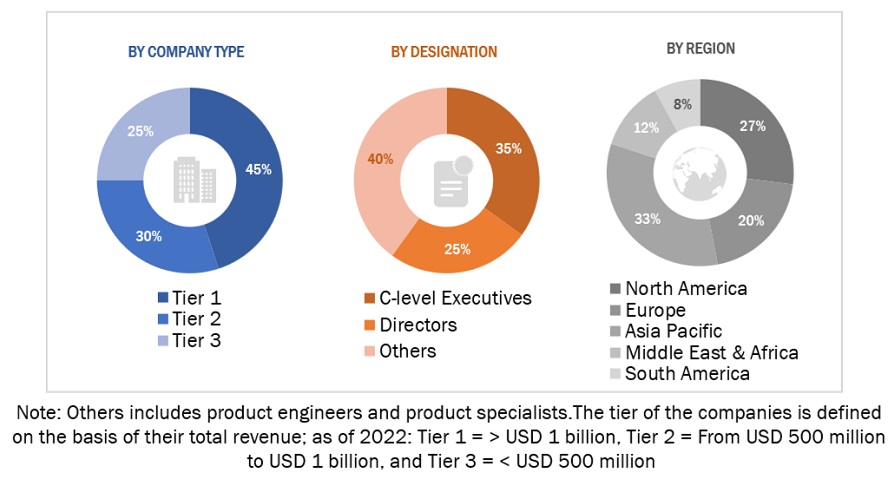
To know about the assumptions considered for the study, download the pdf brochure
Market Size Estimation
Both top-down and bottom-up approaches were used to estimate and validate the total size of the Air Quality Control System market. These methods were also used extensively to estimate the size of various subsegments in the market. The research methodology used to estimate the market size includes the following:
- The key players in the industry and market have been identified through extensive secondary research, and their market share in the respective regions have been determined through both primary and secondary research.
- The industry’s value chain and market size, in terms of value, have been determined through primary and secondary research processes.
- All percentage shares, splits, and breakdowns have been determined using secondary sources and verified through primary sources.
Global Air Quality Control Systems Market Size: Top-down Approach
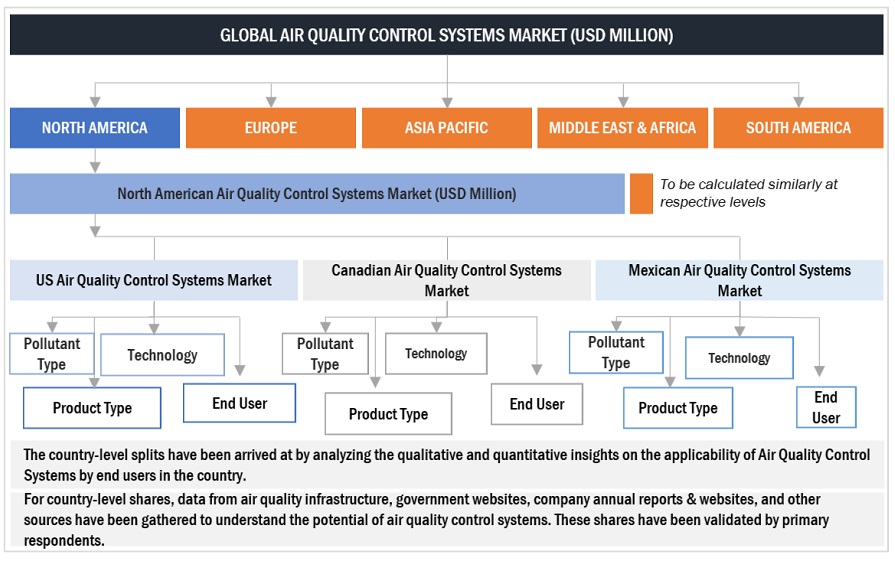
To know about the assumptions considered for the study, Request for Free Sample Report
Global Air Quality Control Systems Market Size: Bottom-Up Approach
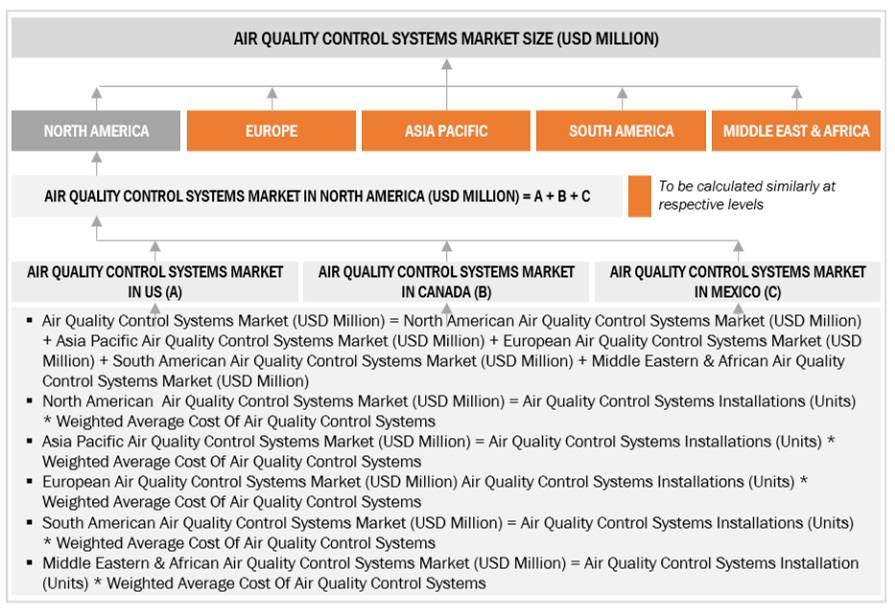
Data Triangulation
After arriving at the overall market size from the estimation process explained above, the total market has been split into several segments and subsegments. To complete the overall market engineering process and arrive at the exact statistics for all the segments and subsegments, the data triangulation and market breakdown processes have been employed, wherever applicable. The data has been triangulated by studying various factors and trends from both the demand- and supply sides. Along with this, the market has been validated using both the top-down and bottom-up approaches.
Market Definition
The air quality control systems market refers to the sector encompassing the production, distribution, and utilization of technologies and solutions aimed at controlling, improving and maintaining the quality of air in various environments. This market includes a wide range of products and services such as air pollution control devices, emission control systems, air purifiers, ventilation systems, and pollution control equipment utilized in industrial, commercial, and residential industry. It caters to the increasing global concern regarding air pollution, health hazards associated with poor air quality, and regulatory standards aimed at mitigating air pollutants. The market is driven by factors such as urbanization, industrialization, stringent environmental regulations, growing awareness about health impacts of air pollution, and technological advancements in air quality control solutions.
Key Stakeholders
- Air quality control system equipment manufacturers
- Air quality control system unit manufacturers
- Air quality control system unit distributors and suppliers
- Research institutes and companies.
- Hotels, hospitals, care homes, office buildings, retail stores, and other utilities
- Industry, energy, and environmental associations
- Government and research organizations
Objectives of the Study
- To define, describe, segment, and forecast the Air Quality Control System market, by pollutant type, technology, product type, and end user, in terms of value.
- To forecast the market size for five key regions: North America, South America, Europe, Asia Pacific, and Middle East & Africa, along with their key countries
- To provide detailed information about the key drivers, restraints, opportunities, and challenges influencing the growth of the market
- To strategically analyze the subsegments with respect to individual growth trends, prospects, and contributions of each segment to the overall market size
- To analyze market opportunities for stakeholders and the competitive landscape of the market
- To strategically profile the key players and comprehensively analyze their market shares and core competencies
- To analyze competitive developments, such as deals and agreements in the market
Available Customizations:
With the given market data, MarketsandMarkets offers customizations as per the client’s specific needs. The following customization options are available for this report:
Geographic Analysis
- Further breakdown of region or country-specific analysis
Company Information
- Detailed analyses and profiling of additional market players (up to 5)
Get the Full Air Quality Control System Market Report
Full forecast, segment splits, and company analysis for all Air Quality Control System Market.
- US Air Quality Control System Market
- Canada Air Quality Control System Market
- Mexico Air Quality Control System Market
- UK Air Quality Control System Market
- France Air Quality Control System Market
- Italy Air Quality Control System Market
- Russia Air Quality Control System Market
- Spain Air Quality Control System Market
- China Air Quality Control System Market
- Japan Air Quality Control System Market
- South Korea Air Quality Control System Market
- India Air Quality Control System Market
- Malaysia Air Quality Control System Market
- Saudi Arabia Air Quality Control System Market
- UAE Air Quality Control System Market
- South Africa Air Quality Control System Market
- Iran Air Quality Control System Market
- Brazil Air Quality Control System Market
- Argentina Air Quality Control System Market
Need a Tailored Report?
Customize this report to your needs
Get 10% FREE Customization
Customize This Report
