
South Korea Air Suspension Market (2024-2029)

The South Korea Air Suspension Market was valued at $21.2 Million in 2024 and projected to reach to $28 Million by 2029, representing a compound annual growth rate of 4.8%. South Korea's air suspension market is poised for steady expansion through 2029, supported by the country's robust automotive manufacturing base and continuous technological advancement.


| Market Size in | USD 26.32 MN |
| Market Forecast in | |
| CAGR | |
| Forecast Period | |
| Units Considered | Value (USD MN) |
South Korea Air Suspension Market Trends and Insights
- South Korea's automotive sector, driven by major manufacturers and technological innovation, continues to adopt advanced suspension systems to enhance vehicle comfort and performance.
- The market in South Korea reflects strong demand from both premium and commercial vehicle segments seeking improved ride quality and load management capabilities. The growth trajectory for South Korea's air suspension market is supported by increasing vehicle production and rising consumer preference for luxury features in the automotive sector.
- South Korea's position as a global automotive hub accelerates the adoption of air suspension technologies across passenger cars, SUVs, and commercial vehicles.
- Between 2024 and 2029, South Korea is expected to see sustained expansion driven by regulatory compliance, vehicle electrification trends, and the integration of air suspension systems in next-generation vehicle platforms..
Key Market Statistics
- CAGR (2024-2029) 4.8% CAGR
- Market Size, 2024 ~USD 21.2 Million
- Forecast, 2029 ~USD 28 Million
- Country South Korea
South Korea Air Suspension Market Overview
Market Valuation :
South Korea's air suspension market is valued at USD 21.2 million in 2024, with steady growth driven by the country's advanced automotive manufacturing ecosystem and consumer demand for premium vehicle features.
Growth Trajectory :
The market is projected to reach USD 28.0 million by 2029, representing a CAGR of 4.8%, outpacing broader regional trends as local OEMs integrate air suspension into mid-range and premium vehicle segments.
Technological Innovation :
South Korea's leading automotive manufacturers are investing heavily in air suspension R&D, leveraging the country's advanced engineering capabilities to develop cost-effective and efficient suspension solutions for domestic and export markets.
Market Drivers :
Rising consumer preference for vehicle comfort, increasing adoption of luxury features in mid-segment vehicles, and stringent emission regulations are propelling air suspension adoption across South Korea's automotive sector.
South Korea Air Suspension Market Dynamics
- Major domestic OEMs are increasingly incorporating air suspension systems into their vehicle portfolios to enhance ride quality and meet evolving consumer expectations for comfort and performance.
- The market benefits from South Korea's strong supply chain infrastructure and competitive manufacturing capabilities. Looking ahead, the market will be shaped by growing electrification trends, integration of air suspension with autonomous vehicle technologies, and rising export demand from South Korean manufacturers.
- Investment in lightweight materials and smart suspension systems will further accelerate market growth.
- Additionally, government initiatives promoting advanced automotive technologies and sustainability will create new opportunities for air suspension adoption in both domestic and international markets..
Market Ecosystem
Related Ecosystem
Automotive Systems
- Light Commercial Vehicles (LCVs)
- Battery Electric Vehicle (BEV)
- Hybrid Electric Vehicle (HEV)
- Agricultural Tractors
- Fuel Cell Electric Vehicle (FCEV)
- BOSCH LIMITED
- DENSO Corporation
- Continental ag
- ZF FRIEDRICHSHAFEN AG
- TENNECO
Key Takeaways
- South Korea's air suspension market is valued at USD 21.2 million in 2024 with a projected value of USD 28.0 million by 2029.
- South Korea is experiencing a 4.8% CAGR, reflecting steady growth in premium vehicle segments and commercial applications.
- South Korea's automotive manufacturers are increasingly integrating air suspension systems to meet consumer demand for enhanced comfort and performance.
- South Korea's market growth is driven by vehicle electrification, regulatory standards, and the country's position as a global automotive manufacturing hub.
Air Suspension Market Report Scope
| Report Metric | Details |
|---|---|
| Base Year | 2024 |
| Fastest Growing Segment | PASSENGER CARS (Vehicle Type) |
| Forecast Period | 2024-2029 |
| Growth Rate | CAGR of 5.6% from 2024 to 2029 |
| Largest Segment | ELECTRONICALLY CONTROLLED (Technology) |
| Market Size Base Year (Billions) | ~USD 10.02 (2024) |
| Revenue Forecast (Billions) | ~USD 13.16 (2029) |
| Segments Covered | Vehicle Type, Technology, Component |
South Korea Air Suspension Market Report Segmentation
3 segment dimensions are covered across the global market.
By Vehicle Type
- Buses
- Light Commercial Vehicles
- Light-Duty Vehicles
- Passenger Cars
- Rigid Trucks
- Semi-Trailer
- Semi-Trailers
- Trucks
By Technology
- Electronically Controlled
- Non-Electronically Controlled
By Component
- Air Bellows
- Air Compressors
- Air Reservoirs
- Air Springs
- Electronic Control Units
- Height Sensors
- Pressure Sensors
- Shock Absorber Bushes
- Shock Absorbers
- Solenoid Valves
Target Audience
- Automotive OEMs : South Korean and international vehicle manufacturers need detailed market insights to optimize air suspension integration strategies, benchmark against local competitors, and capitalize on growing domestic demand for advanced suspension systems.
- Suspension Component Suppliers : Tier-1 and Tier-2 suppliers operating in South Korea require market data to identify growth opportunities, understand OEM procurement trends, and develop products aligned with local manufacturing standards and export requirements.
- Investment & Private Equity Firms : Investors evaluating opportunities in South Korea's automotive supply chain need comprehensive market analysis to assess growth potential, competitive dynamics, and strategic acquisition targets in the air suspension sector.
- Technology & Innovation Companies : Companies developing advanced suspension technologies, IoT solutions, and autonomous vehicle systems need South Korea-specific market intelligence to identify partnerships with OEMs and position solutions for the growing premium vehicle segment.
- Market Consultants & Analysts : Business consultants and research professionals require detailed South Korea market data to support client advisory services, competitive benchmarking, and strategic planning for automotive and transportation industry stakeholders.
Reasons to Buy this Report
- Market-Specific Sizing & Forecasts : Access precise valuation data for South Korea's air suspension market (USD 21.2M in 2024, USD 28.0M by 2029) with country-specific CAGR of 4.8%, enabling accurate business planning and investment decisions tailored to the Korean market.
- Competitive Landscape Intelligence : Understand the positioning of South Korean OEMs and suppliers in the air suspension space, including their technological capabilities, market share dynamics, and strategic initiatives specific to the domestic and export markets.
- Growth Driver Analysis : Identify key factors driving air suspension adoption in South Korea, including consumer preferences for comfort, regulatory requirements, electrification trends, and the role of major manufacturers in market expansion.
- Strategic Market Entry Insights : Gain actionable intelligence on market entry strategies, partnership opportunities with Korean OEMs and suppliers, and localization requirements for companies seeking to establish or expand presence in South Korea's air suspension sector.
- Technology & Innovation Trends : Discover emerging technologies and innovation trends specific to South Korea, including smart suspension systems, lightweight materials integration, and autonomous vehicle compatibility driving the next phase of market growth.
Frequently asked questions
What is the current size of South Korea's air suspension market?
South Korea's air suspension market is valued at USD 21.2 million in 2024.
What is the projected market size for South Korea's air suspension market by 2029?
South Korea's air suspension market is projected to reach USD 28.0 million by 2029.
What is the CAGR for South Korea's air suspension market?
South Korea's air suspension market is growing at a compound annual growth rate (CAGR) of 4.8% from 2024 to 2029.
Which vehicle segments drive demand for air suspension in South Korea?
South Korea's air suspension demand is driven by premium passenger vehicles, SUVs, and commercial vehicles seeking improved comfort and load management.
What factors are contributing to growth in South Korea's air suspension market?
South Korea's market growth is supported by vehicle electrification, regulatory compliance, consumer preference for luxury features, and the country's strong automotive manufacturing base.
RESEARCH METHODOLOGY
The study encompassed four primary tasks to determine the present scope of the Air Suspension market. Initially, extensive secondary research was conducted to gather data on the market, its related sectors, and overarching industries. Subsequently, primary research involving industry experts across the value chain corroborated and validated these findings and assumptions. Employing both bottom-up and top-down methodologies, the complete market size was estimated. Following this, a market breakdown and data triangulation approach were utilized to determine the size of specific segments and subsegments within the market.
Secondary Research
The Secondary sources referred to in this research study include the Organization Internationale des Constructeurs d'Automobiles (OICA); European Automobile Manufacturers Association (ACEA); National Association of Automobile Manufacturers of South Africa (NAAMSA); corporate filings (such as annual reports, investor presentations, and financial statements); and trade, business, and automotive associations, databases such as Factiva, MarkLines, and Bloomberg. The secondary data was collected and analyzed to determine the overall market size, further validated by primary research. Historical production data has been collected and analyzed, and the industry trend is considered to arrive at the forecast, further validated by primary research.
Primary Research
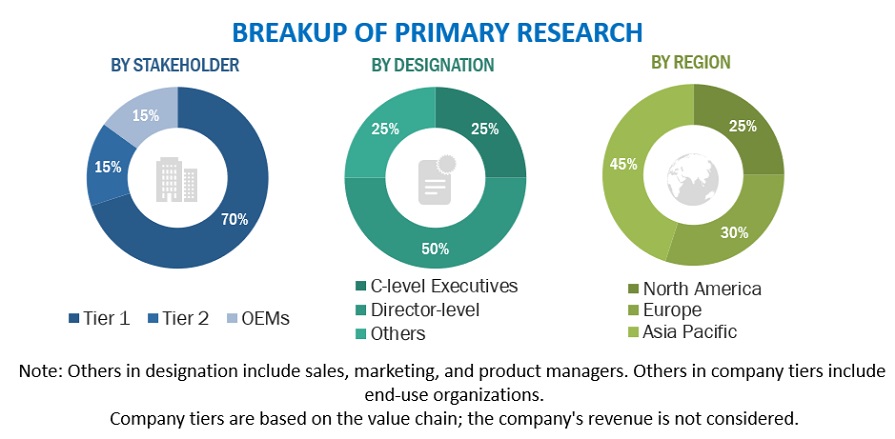
Extensive primary research has been conducted after understanding the air suspension market scenario through secondary research. Several primary interviews have been conducted with market experts from the demand- (OEMs) and the supply side (air suspension and component manufacturers) across major regions, namely, North America, Europe, Asia Pacific, and the Rest of the World. Approximately 85% and 15% of primary interviews have been conducted from the supply side and industry associations & dealers/distributors, respectively. Primary data has been collected through questionnaires, emails, and telephonic interviews. In the canvassing of primaries, we have strived to cover various departments within organizations, such as sales, operations, and administration, to provide a holistic viewpoint in our report.
After interacting with industry experts, we also conducted brief sessions with highly experienced independent consultants to reinforce the findings from our primaries. This and the in-house subject matter experts’ opinions have led us to the conclusions described in the remainder of this report.
Market Size Estimation
A detailed market estimation approach was followed to estimate and validate the value and volume of the air suspension market and other dependent submarkets, as mentioned below:
- Key players in the air suspension market were identified through secondary research, and their global market shares were determined through primary and secondary research.
- The research methodology included studying annual and quarterly financial reports, regulatory filings of significant market players (public), and interviews with industry experts for detailed market insights.
- All industry-level penetration rates, percentage shares, splits, and breakdowns for the air suspension market were determined using secondary sources and verified through primary sources.
- All key macro indicators affecting the revenue growth of the market segments and subsegments were accounted for, viewed in extensive detail, verified through primary research, and analyzed to get the validated and verified quantitative and qualitative data.
- The gathered market data was consolidated and added with detailed inputs, analyzed, and presented in this report.
Bottom-up approach: Air suspension Market, by vehicle type
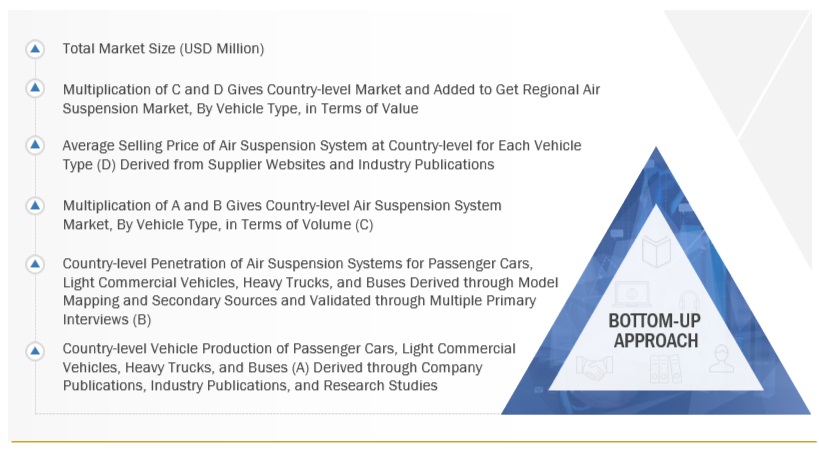
To know about the assumptions considered for the study, Request for Free Sample Report
Market Breakdown and Data Triangulation
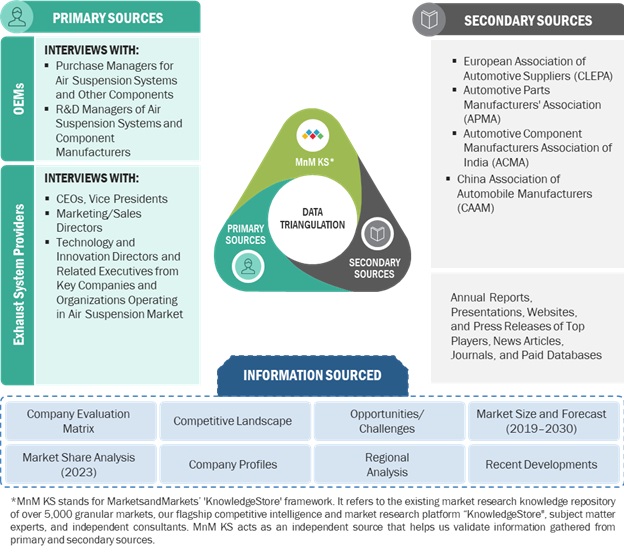
After arriving at the overall market size of the global market through the above-mentioned methodology, this market was split into several segments and subsegments. The data triangulation and market breakdown procedures were employed, wherever applicable, to complete the overall market engineering process and arrive at the exact data for the market by value for the key segments and subsegments. The extrapolated market data was triangulated by studying various macro indicators and regional trends from both the demand- and supply-side participants.
Data Triangulation
Market Definition
Air Suspension Systems:
An air suspension system replaces traditional metal springs, such as coils or leaf springs, with air springs or airbags to support the vehicle on its axles. This system relies on a network of airbags to provide the necessary suspension. Bellow type air suspension, piston-type air suspension, and elongated bellows type air suspension are the three prominent types of air suspension used in currently.
The key components of an air suspension system are air bellows, air compressors, and shock absorbers. Air suspension is crucial to a vehicle as it provides comfort, ride quality, stability, and safety.
Key Stakeholders
- Senior Management
- End User Finance/Procurement Department
- R&D Department
Report Objectives
- To define, describe, and forecast the air suspension market in terms of volume (units) and value (USD million)
-
OE Market By Component (air springs, shock absorbers, compressors, electronic control units, air reservoirs, height sensors, solenoid valves, and pressure sensors)
- By Technology (electronically controlled and non-electronically controlled)
- By Vehicle Type (passenger cars, LCVs, trucks, and buses)
- Cabin Air Suspension Market By Vehicle Type (rigid trucks and semi-trailers)
- Aftermarket, By Component (air bellows and shock absorber bushes)
- Electric & Hybrid HDVs Air Suspension Market, By Vehicle Type (Light-duty Vehicles, Trucks and buses)
- Electric & Hybrid HDVs Air Suspension Market, By Technology (Electronically controlled and Non-electronically controlled)
- By Region (Asia Pacific, Europe, North America, and Rest of the World)
- To understand the market dynamics (drivers, restraints, opportunities, and challenges) of the air suspension market
- To analyze the market share analysis of key players operating in the air suspension market
- To analyze the competitive landscape and company profiles of global players operating in the air suspension market
- To understand the dynamics of competitors and distinguish them into stars, emerging leaders, pervasive players, and emerging companies according to the strength of their product portfolio and business strategies
- Strategically analyze the market with patent, trade, and supply chain analyses.
- To analyze and understand the customer buying behavior in the air suspension market
- To analyze recent developments, alliances, joint ventures, mergers & acquisitions, new product launches, and other activities carried out by key industry participants in the air suspension market
AVAILABLE CUSTOMIZATIONS
With the given market data, MarketsandMarkets offers customizations in accordance with the company’s specific needs.
Air Suspension Market, by Vehicle Type & Technology
- Light Duty Vehicles
- Trucks
- Buses
Note: The market of Electronically Controlled vs. Non-electronically Controlled Air Suspension can be provided for each mentioned vehicle type in terms of volume and value
Air Suspension Componen Market by Vehicle Type
- Light Duty Vehicles
- Trucks
- Buses
Note: The market of each considered component in the study can be provided for each mentioned vehicle type in terms of volume and value detailed analysis and profiling of additional market players (UP TO 5)
Get the Full Air Suspension Market Report
Full forecast, segment splits, and company analysis for all Air Suspension Market.
- China Air Suspension Market
- India Air Suspension Market
- Japan Air Suspension Market
- Germany Air Suspension Market
- France Air Suspension Market
- Spain Air Suspension Market
- Italy Air Suspension Market
- UK Air Suspension Market
- Russia Air Suspension Market
- Canada Air Suspension Market
- Mexico Air Suspension Market
- US Air Suspension Market
- Brazil Air Suspension Market
- South Africa Air Suspension Market
- Rest Of Europe Air Suspension Market
- Rest Of Asia Pacific Air Suspension Market
Need a Tailored Report?
Customize this report to your needs
Get 10% FREE Customization
Customize This Report
