



Automotive Suspension Market Size, Share & Analysis
Report Code
AT 2511
Published in
Nov, 2025, By MarketsandMarkets™
Automotive Suspension Market by Architecture (MacPherson Strut, Double Wishbone, Multilink, Twist Beam, Leaf Spring, Air Suspension), System, Actuation, Component, Vehicle (ICE, Electric, Off-Highway, ATV), Aftermarket, & Region – Global Forecast to 2032

USD 42.43 BN
MARKET SIZE, 2032

CAGR 0.9%
(2025-2032)

250
REPORT PAGES

120
MARKET TABLES
OVERVIEW
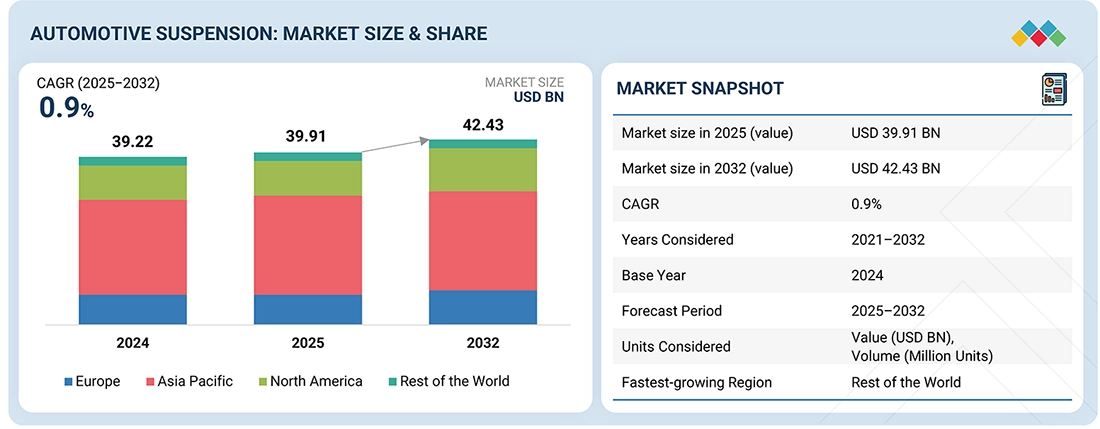
Source: Secondary Research, Interviews with Experts, MarketsandMarkets Analysis
The automotive suspension market is projected to reach USD 42.43 billion by 2032 from USD 39.91 billion in 2025, at a CAGR of 0.9%. Market growth is driven by the shift toward electrification, ride comfort, and energy efficiency, prompting OEMs to adopt lightweight, electronically controlled, and adaptive suspension systems. EV platforms, in particular, demand weight-optimized and software-tunable suspensions to offset battery mass and improve range designs in North America. SUVs predominantly use MacPherson strut suspensions (over 80%) due to their compact and cost-efficient design, while premium SUVs adopt double wishbone fronts and multi-link rears (with 8–10% adoption) for improved handling, camber control, and ride articulation. Air suspension, though limited to high-end models, is gaining traction as OEMs prioritize comfort and adaptive damping, especially in premium ICE and EV SUVs. In pickup trucks, double wishbone (75–80%) and MacPherson (15–20%) dominate the front, while rear setups rely on leaf springs (>70%) and multilink (20–25%), a mix driven by growing demand for durability and ride comfort in light-duty applications.
Automotive Suspension Market Size and Forecast:
- Market Size Value in 2024: USD 39.22 Billion
- Market Size Value in 2025: USD 39.91 Billion
- Revenue Forecast in 2032: USD 42.43 Billion
- Growth Rate: CAGR of 0.9% from 2025 to 2032
- Data available from 2021 to 2032
- Base year: 2024
- Forecast period: 2025–2032
Key Market Trends and Insights
- Market Growth: Growth is driven by vehicle electrification, demand for ride comfort, and increasing adoption of adaptive and lightweight suspension systems.
-
IoT Impact: IoT enables real-time suspension monitoring and adaptive control, enhancing vehicle comfort, safety, and performance.
- Growing Trends: The market is witnessing increased adoption of lightweight, adaptive, and electronically controlled suspension systems.
- Growth Opportunities: Opportunities are driven by smart suspension integration with ADAS, software-defined vehicles, and OTA-enabled vehicle upgrades.
KEY TAKEAWAYS
- By region, the Asia Pacific is expected to lead the automotive suspension market, accounting for a 57% share in 2025.
- By system type, the active suspension systems segment is expected to register the highest CAGR of 5.8%.
- By architecture, the air suspension segment is expected to grow at the fastest rate from 2025 to 2032.
- By electric vehicle type, the BEV segment is expected to dominate the market.
- By vehicle type, the buses segment is expected to register the fastest growth during the forecast period.
- By region, the Asia Pacific is expected to lead the automotive suspension market, accounting for a 57% share in 2025.
- Key players such as Continental AG (Germany), ZF Friedrichshafen AG (Germany), ThyssenKrupp AG (Germany), KYB Corporation (Japan), and Tenneco Inc. (US) are focusing on innovations in lightweight materials, active and adaptive damping technologies, NVH optimization, and manufacturing process improvements.
The automotive suspension market is rapidly evolving, driven by the shift toward electrified, connected, and premium vehicles. Advanced suspension systems, including active, air, and adaptive damping technologies, are becoming essential for improving ride comfort, handling precision, and energy efficiency. As electric vehicle (EV) architectures increase battery weight and alter chassis dynamics, original equipment manufacturers (OEMs) are investing in lightweight materials, electronically controlled systems, and modular suspension platforms to strike a balance between performance and range optimization. These innovations are transforming suspension design into a key differentiator in the development of next-generation vehicles.
TRENDS & DISRUPTIONS IMPACTING CUSTOMERS' CUSTOMERS
Changes in demand and emerging trends in the automotive suspension market directly impact OEMs and Tier-I suppliers. There is an increasing focus on lightweight, durable, and high-performance suspension systems, which enhance vehicle comfort, handling, safety, and energy efficiency. These shifts ripple throughout the value chain, affecting raw material suppliers, component manufacturers, and OEMs. As a result, they shape revenue streams and create growth opportunities for innovative solutions such as active damping, air suspensions, multilink architectures, and software-controlled adaptive systems.
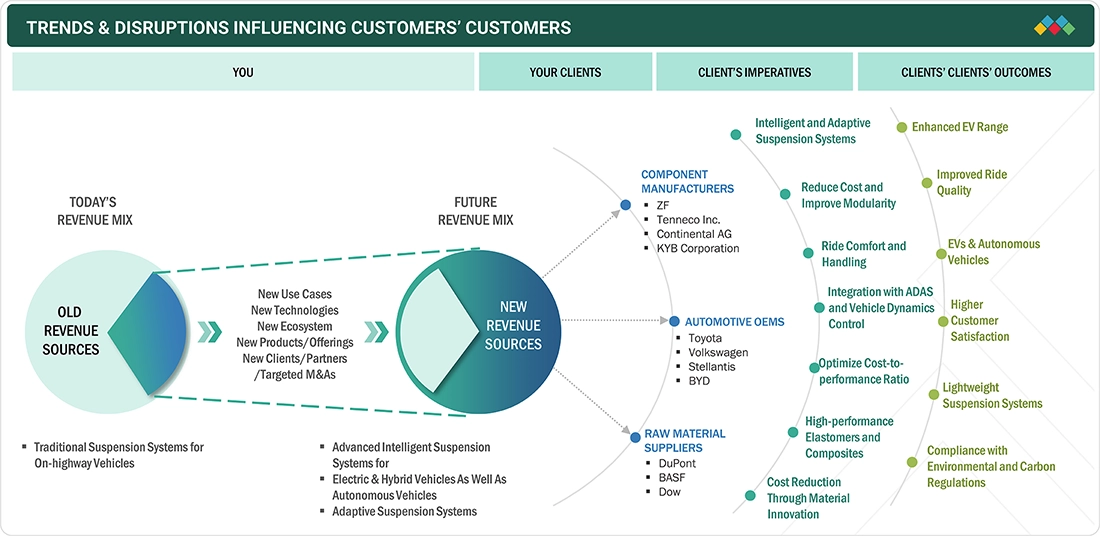
Source: Secondary Research, Interviews with Experts, MarketsandMarkets Analysis
MARKET DYNAMICS

Drivers
Impact
Level
Level
-
Strong Premium SUV & Pickup Demand

-
Regulatory Pressure on Vehicle & Passenger Safety & Curb Emissions


RESTRAINTS
Impact
Level
Level
-
High System Cost vs. ROI in Non-Premium Segments


OPPORTUNITIES
Impact
Level
Level
-
Integration of Smart/Connected Suspensions with ADAS & SDVs

-
Local Manufacturing & Supply Chain Opportunities


CHALLENGES
Impact
Level
Level
-
Balancing Suspension Weight and Range Efficiency in Electric Vehicles

Source: Secondary Research, Interviews with Experts, MarketsandMarkets Analysis
Driver: Strong Premium SUV & Pickup Demand
The global increase in SUVs and pickups, which now account for more than half of light vehicle sales, has heightened the demand for advanced suspension technologies. MacPherson struts are the most common worldwide due to their packaging efficiency and cost-effectiveness. In contrast, premium SUVs are increasingly adopting double wishbone and multi-link suspension systems to enhance handling and ride quality. Pickup trucks typically utilize double wishbone front suspensions, combined with either leaf or multi-link rear suspensions, to provide the necessary load durability. Additionally, air suspensions are gaining popularity in premium internal combustion engine (ICE) and electric SUVs, driven by rising expectations for adaptive comfort and dynamic performance.
Restraint: High System Cost vs. ROI in Non-premium Segments
The high cost of advanced suspension systems continues to limit their global adoption, primarily to premium vehicle segments. Conventional setups such as MacPherson struts, multi-link, and double wishbone suspensions dominate passenger cars, SUVs, and light commercial vehicles (LCVs) due to their proven reliability, lower weight, and ease of integration. The typical cost of these conventional systems ranges from USD 200 to USD 1,500, making them suitable for high-volume production. In contrast, air and active suspension systems cost between USD 1,500 and USD 4,000 for light vehicles, and can reach up to USD 9,000 for heavy trucks. Although advanced suspension systems offer superior ride comfort and load management, the return on investment is largely justified only for premium models or fleets with high utilization.
Opportunity: Integration of Smart/Connected Suspensions with ADAS & SDVs
Software-defined vehicles are revolutionizing suspensions by turning them into intelligent systems. These systems integrate active damping and air suspension with advanced driver assistance systems (ADAS) to provide predictive ride quality and adaptive load management. OEMs such as GM, BMW, and Toyota are utilizing these advanced suspensions in their premium SUVs, electric vehicles (EVs), and pickups. Additionally, over-the-air (OTA) updates allow for post-purchase tuning, creating new revenue streams for manufacturers.
Challenge: Balancing Suspension Weight and Range Efficiency in Electric Vehicles
The increasing popularity of EVs around the world is prompting automakers to find a balance between suspension performance and efficiency. Adaptive air and multilink suspension systems can add 50 to 100 kg to a vehicle's weight, potentially reducing its driving range. Premium models often utilize reinforced suspension setups for enhanced comfort, whereas mass-market EVs tend to opt for simpler systems to maintain efficiency. Although lightweight materials and optimized dampers present opportunities for improvement, widespread adoption of these solutions remains limited.
automobile-suspension-systems-market: COMMERCIAL USE CASES ACROSS INDUSTRIES
| COMPANY | USE CASE DESCRIPTION | BENEFITS |
|---|---|---|
 |
Design and supply of suspension systems, including MacPherson strut, multilink, double wishbone, air, and active/semi-active suspensions | Enhance ride comfort, handling, safety, and NVH performance; enable integration with EV and ICE platforms |
 |
Provide high-strength steel, aluminum, composites, and elastomers for suspension components | Reduce weight, improve durability, and support lightweight, energy-efficient suspension designs |
 |
Integrate suspension systems into production vehicles, including EVs, PCs, SUVs, LCVs, and HCVs | Optimize ride quality, handling, and energy efficiency; differentiate vehicles in premium and mass-market segments |
|
|
Supply replacement suspension components and retrofit kits | Maintain vehicle performance, extend system lifespan, and offer cost-effective solutions for repairs and upgrades |
Logos and trademarks shown above are the property of their respective owners. Their use here is for informational and illustrative purposes only.
MARKET ECOSYSTEM
The ecosystem mapping highlights various players in the automotive suspension market, mainly including raw material suppliers, component manufacturers, automotive OEMs, and aftermarket suppliers. The leading players in the automotive suspension market are Continental AG (Germany), ZF Friedrichshafen AG (Germany), ThyssenKrupp AG (Germany), KYB Corporation (Japan), and Tenneco Inc. (US), among others.
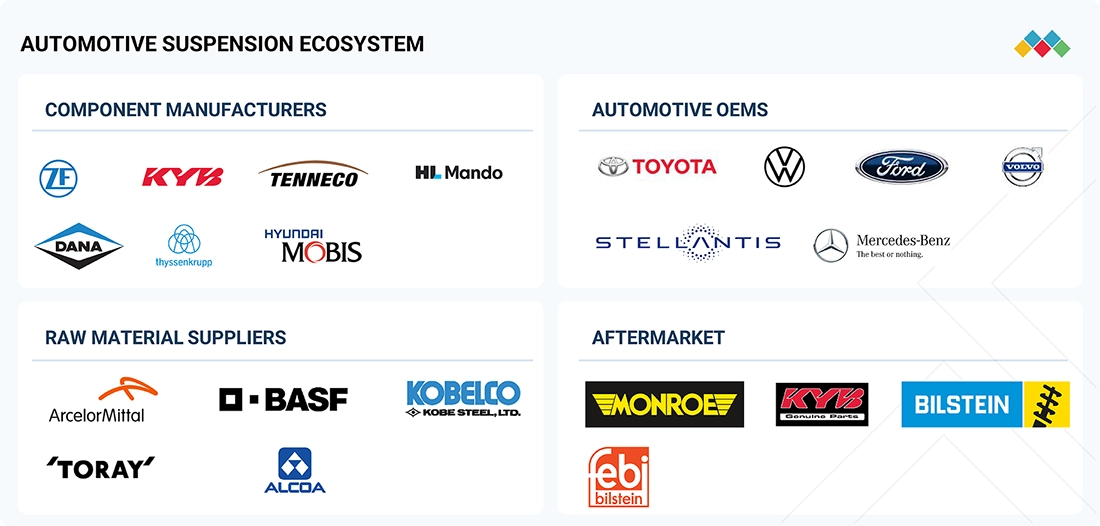
Logos and trademarks shown above are the property of their respective owners. Their use here is for informational and illustrative purposes only.
MARKET SEGMENTS
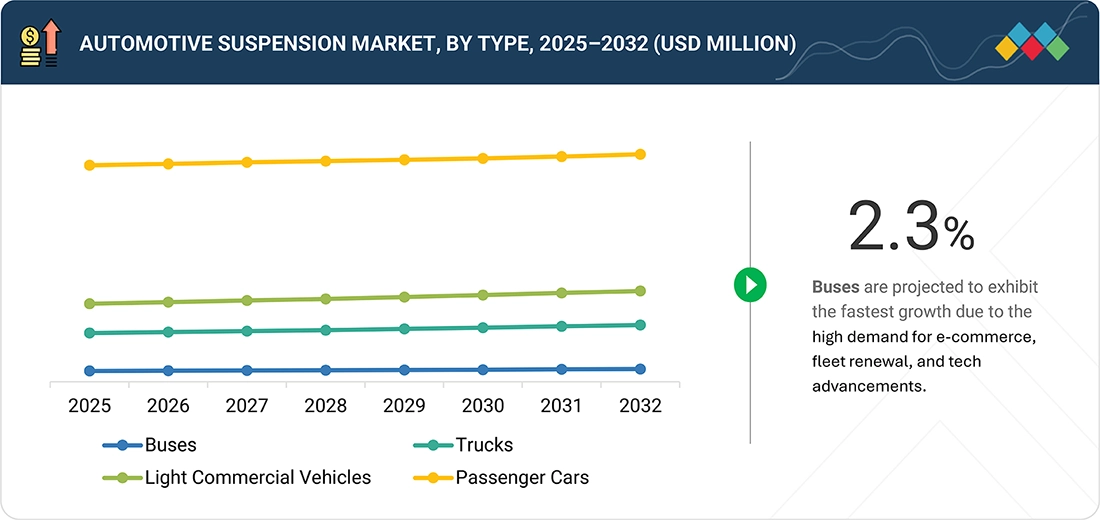
Source: Secondary Research, Interviews with Experts, MarketsandMarkets Analysis
Automotive Suspension Market, by System Type
The rising demand for improved ride quality and occupant comfort is driving the market for active suspension systems, especially in luxury cars, sports cars, and premium SUVs. Modern active suspension technologies, such as Mercedes-Benz’s Magic Body Control, Porsche’s PASM, and GM’s Magnetic Ride Control, tend to be high-cost but offer superior comfort and handling. The global growth of SUVs, particularly in the Asia Pacific region, where it accounted for over 55% of SUV sales in 2024, is further accelerating the adoption of active suspension systems, positioning this region as a leading market.
Automotive Suspension Market, by Architecture
The MacPherson strut remains a widely adopted front suspension architecture due to its low cost, reduced weight, and compact design, eliminating the need for a separate upper control arm. Its simplicity makes it the preferred choice for compact and mid-size passenger cars globally. Asia Pacific continues to lead adoption, with front MacPherson struts used in over 70% of vehicles, driven by high demand for cost-effective, space-efficient designs in markets like China, India, and Southeast Asian nations.
Automotive Suspension Market, by Electric Vehicle
Global EV adoption is accelerating, with sales surpassing 10?million units in 2024, driven by stricter emissions regulations and shifting consumer preferences. Most EVs retain front MacPherson struts, while rear multilink or air suspension systems are increasingly used in premium models, such as the BMW i5, Porsche Taycan Cross Turismo, and Lucid Air, to enhance ride comfort and handle heavier battery loads. The absence of an ICE allows flexible packaging, enabling optimized rear suspension layouts. Growing EV penetration, particularly in premium and high-performance segments, is expected to drive sustained demand for advanced multilink suspension systems globally.
Automotive Suspension Market, by Vehicle Type
Passenger cars continue to be the largest and fastest-growing segment in the automotive suspension market. This growth is primarily driven by rising production volumes, especially in China and India, as well as an increasing consumer demand for comfort and safety. Modern cars are increasingly adopting independent suspension systems, such as MacPherson strut, multilink, and air suspensions, to improve ride quality and handling. This shift reflects a broader trend of incorporating premium features into even mass-market vehicles.
REGION
Asia Pacific is expected to be the largest region in the global automotive suspension market during the forecast period
The Asia Pacific region is the largest automotive suspension market globally, driven by high vehicle production capacity, a strong presence of original equipment manufacturers (OEMs), and rapidly increasing vehicle sales in China, India, and Southeast Asia. Rising incomes among the middle class, urbanization, and shifting consumer expectations for comfort are driving demand for advanced suspension systems, including multilink and air suspensions. However, the high costs associated with these systems limit their widespread adoption. China remains the leader in this market due to its large passenger vehicle sector and strong production recovery following the pandemic. Meanwhile, India is the fastest-growing market, fueled by economic recovery and increasing demand for passenger vehicles. The dominance of the Asia Pacific region is further supported by cost advantages for OEMs, substantial local manufacturing capabilities, and a vast, diverse consumer base.
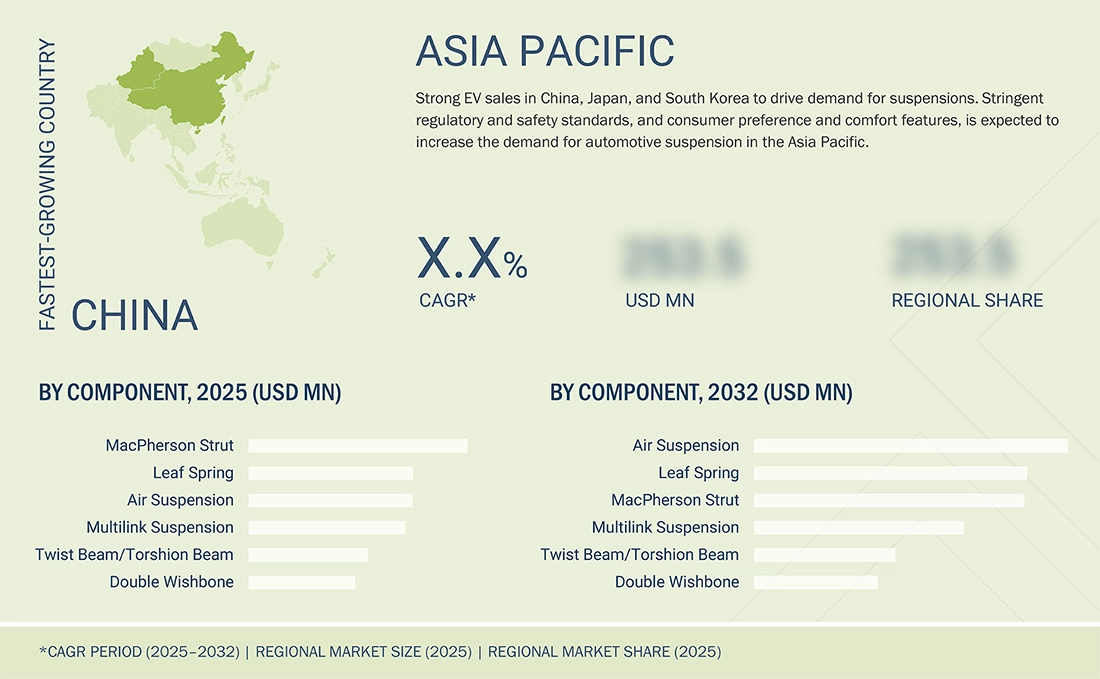
Asia Pacific
Asia Pacific dominates the global Automotive Suspension market, accounting for more than 53% of the market share in 2026 followed by Europe and North America.
automobile-suspension-systems-market: COMPANY EVALUATION MATRIX
In the automotive suspension market matrix, ZF (Germany) (Star) leads with a strong global presence and a comprehensive portfolio spanning passive, semi-active, and active suspension systems across all vehicle types. Benteler (Austria) (Emerging Leader) is gaining traction with advanced electronically controlled dampers and lightweight suspension modules tailored for EVs and SUVs.
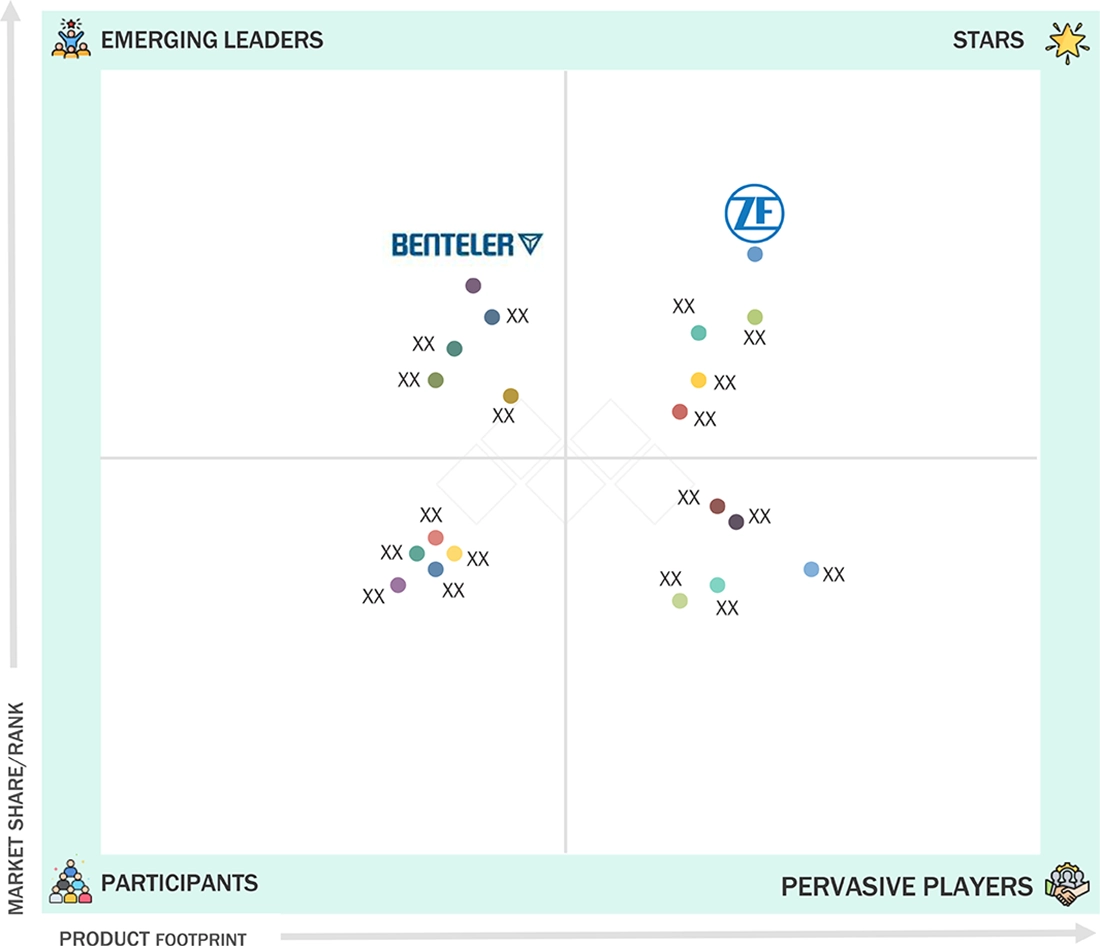
Source: Secondary Research, Interviews with Experts, MarketsandMarkets Analysis
KEY MARKET PLAYERS
- ZF Friedrichshafen AG
- Tenneco Inc.
- Magna International Inc.
- HYUNDAI MOBIS
- Dana Incorporated
- Continental AG
- BWI Group
- KYB Corporation
- HL Mando Corporation
MARKET SCOPE
| REPORT METRIC | DETAILS |
|---|---|
| Market Size in 2025 (Value) | USD 39.91 billion |
| Market Forecast in 2032 (Value) | USD 42.43 billion |
| Growth Rate | CAGR of 0.9% from 2025 to 2032 |
| Years Considered | 2021–2032 |
| Base Year | 2024 |
| Forecast Period | 2025–2032 |
| Units considered | Value (USD Million), Volume (Thousand Units) |
| Report Coverage | Revenue Forecast, Company Ranking, Competitive Landscape, Growth Factors, and Trends |
| Top Companies |
|
| Growth Drivers |
|
| Segments Covered | • By Vehicle Type: Passenger Cars, Light Commercial Vehicles, Trucks, and Buses • By System: Passive, Semi-active, and Active • Architecture: MacPherson Strut, Double Wishbone, Multilink, Twist Beam/Torsion Beam, Leaf Spring, and Air Suspension • Active Suspension Market, by Actuation: Hydraulically Actuated and Electronically Actuated • Components (OE Market): Coil Springs, Air Springs, Shock Absorbers, Struts, Control Arms, Rubber Bushings, Leaf Springs, Link Stabilizers/Sway Bars, and Ball Joint • Components (Aftermarket): Shock Absorbers, Struts, Ball Joints, Leaf Springs, Control Arms, and Coil Springs • Electric & Hybrid Passenger Cars Suspension Market, by Architecture: MacPherson Strut, Double Wishbone, Multilink, Twist Beam/Torsion Beam, and Air Suspension • Electric & Hybrid HCVs Suspension Market, by Vehicle Type: Trucks and Buses • Off-highway Vehicles Suspension Market, by Application: Construction Equipment and Agricultural Tractors • ATV Suspension Market, by Region: Asia Pacific, Europe, and North America |
| Regional Scope | Asia Pacific, Europe, North America, and the Rest of the World |
| Driver | Strong Premium SUV & Pickup Demand |
| Restraint | High System Cost vs. ROI in Non-premium Segments |
WHAT IS IN IT FOR YOU: automobile-suspension-systems-market REPORT CONTENT GUIDE
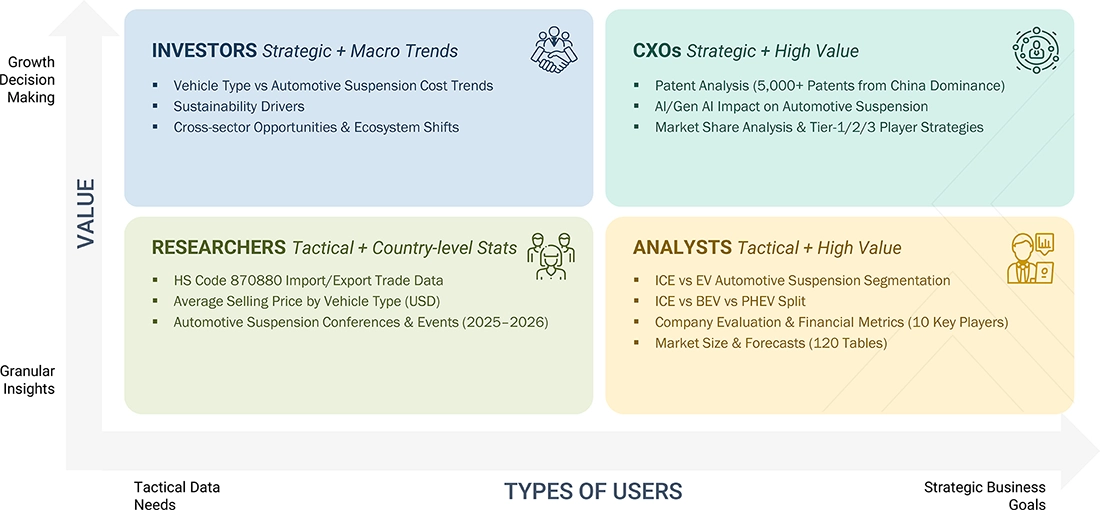
DELIVERED CUSTOMIZATIONS
We have successfully delivered the following deep-dive customizations:
| CLIENT REQUEST | CUSTOMIZATION DELIVERED | VALUE ADDS |
|---|---|---|
| US-based EV OEMs & Tier-I Suppliers | Benchmarking of EV-specific suspension systems, including adaptive air suspensions, multilink architectures, and weight-optimized components | Identification of high-value differentiation opportunities in EV suspension design, such as lightweight materials, active damping strategies, and OTA-enabled tuning for ride comfort and energy efficiency |
| Global OEMs Exploring Premium SUVs | ||
| OEMs Expanding EV Lineups |
RECENT DEVELOPMENTS
- June 2026: Monroe Ride Solutions expanded its Monroe Intelligent Suspension portfolio with the launch of the CVSA2 variant. The new system features a compact valve design, improved packaging flexibility, enhanced damping control, and compatibility with software defined vehicle architectures through support for advanced electronic suspension control.
- September 2025: At IAA Mobility 2025, ZF presented its “Chassis 2.0” concept, a next-generation intelligent chassis approach integrating by-wire steering and braking with active and semi-active damping systems, electronic roll stabilization, and AKC rear axle steering. These suspension and chassis technologies are designed to be software-defined, enabling optimized driving dynamics, advanced ADAS functions, and automated driving capabilities.
- July 2025: ZF introduced its new Smart Chassis Sensor, which is integrated directly into the ball joint of independent suspension systems. The sensor enables precise measurement of wheel-to-body motion, improving suspension control while reducing the need for separate sensors.
- July 2025: DRiV, a Tenneco business group, introduced Monroe Air Suspension alongside Wagner HVAC Components, FP Diesel Starters & Alternators, and Wagner Sensors for the US and Canadian markets. The Monroe Air Suspension line includes air springs, air shocks, and air struts under Monroe, OESpectrum, and Monroe Restore brands, engineered for OE-style fit, reduced noise and vibration, and smooth ride performance, backed by a limited lifetime warranty.
- April 2025: Monroe Ride Solutions recently launched the Monroe Intelligent Suspension CVSA2, a semi-active suspension system for SUVs, off-road vehicles, and luxury cars. Featuring steel-tube dampers with dual electro-hydraulic valves, it provides independent rebound and compression damping control for all four wheels, enabling high-resolution tunability, multiple driving modes, and enhanced ride comfort, handling, and vehicle stability across diverse road conditions.
- April 2025: Thyssenkrupp Bilstein and Baolong Automotive have entered a strategic cooperation to deliver integrated suspension solutions for global OEMs. The partnership combines Bilstein’s expertise in shock absorbers with Baolong’s strength in air springs and ECAS components to offer bundled suspension systems, particularly targeting China and Europe. The joint offering focuses on semi-active and air suspension technologies, addressing growing demand for premium ride comfort, safety, and EV-ready suspension systems.
- December 2025: Dana Incorporated has launched the new AdvanTEK 40 Pro axle system, the next generation of its 40,000-pound 6x4 tandem axle, designed for enhanced efficiency and improved fleet productivity. Featuring the fastest axle ratio of 2.05 for advanced engine downspeeding, it offers 18 total ratios, a high-capacity bearing system, increased weight capacity, and advanced coatings for longer drivetrain life.
Table of Contents
 Exclusive indicates content/data unique to MarketsandMarkets and not available with any competitors.
TITLE
PAGE NO
1
INTRODUCTION
37
2
RESEARCH METHODOLOGY
43
3
EXECUTIVE SUMMARY
58
4
PREMIUM INSIGHTS
63
5
MARKET OVERVIEW
Premium SUV demand and smart suspension integration drive transformative growth in automotive market dynamics.
69
5.1
INTRODUCTION
5.2
MARKET DYNAMICS
5.2.1
DRIVERS
5.2.1.1
RISING DEMAND FOR PREMIUM SUVS AND PICKUP TRUCKS
5.2.1.2
REGULATORY PRESSURE ON VEHICLE AND PASSENGER SAFETY AND EMISSIONS
5.2.2
RESTRAINTS
5.2.2.1
HIGH COST OF SUSPENSION SYSTEMS
5.2.3
OPPORTUNITIES
5.2.3.1
INTEGRATION OF SMART/CONNECTED SUSPENSION SYSTEMS WITH ADAS AND SDVS
5.2.3.2
LOCAL MANUFACTURING AND SUPPLY CHAIN OPPORTUNITIES
5.2.4
CHALLENGES
5.2.4.1
BALANCING SUSPENSION WEIGHT AND RANGE EFFICIENCY IN ELECTRIC VEHICLES
5.3
UNMET NEEDS AND WHITE SPACES
5.4
INTERCONNECTED MARKETS AND CROSS-SECTOR OPPORTUNITIES
5.5
STRATEGIC MOVES BY TIER 1/2/3 PLAYERS
6
CUSTOMER LANDSCAPE & BUYER BEHAVIOR
Uncover stakeholder influence and profitability drivers shaping buying decisions in automotive markets.
78
6.1
DECISION-MAKING PROCESS
6.2
KEY STAKEHOLDERS AND BUYING EVALUATION CRITERIA
6.2.1
KEY STAKEHOLDERS IN BUYING PROCESS
6.2.2
BUYING CRITERIA
6.3
ADOPTION BARRIERS & INTERNAL CHALLENGES
6.4
MARKET PROFITABILITY
6.4.1
REVENUE POTENTIAL
6.4.2
COST DYNAMICS
7
REGULATORY LANDSCAPE
Navigate complex global regulations with insights into key agencies and safety standards per region.
83
7.1
REGULATORY LANDSCAPE
7.1.1
REGULATORY BODIES, GOVERNMENT AGENCIES, AND OTHER ORGANIZATIONS
7.1.2
GLOBAL SAFETY REGULATIONS
8
STRATEGIC DISRUPTION THROUGH TECHNOLOGY, PATENTS, DIGITAL, AND AI ADOPTION
Leverage AI and patents to revolutionize automotive suspension with cutting-edge adaptive technologies.
90
8.1
PATENT ANALYSIS
8.1.1
INTRODUCTION
8.1.1.1
METHODOLOGY
8.1.1.2
DOCUMENT TYPE
8.1.1.3
INSIGHTS
8.1.1.4
LEGAL STATUS OF PATENTS
8.1.1.5
JURISDICTION ANALYSIS
8.1.1.6
TOP APPLICANTS
8.1.1.7
LIST OF PATENTS
8.2
TECHNOLOGY ANALYSIS
8.2.1
KEY TECHNOLOGIES
8.2.1.1
ACTIVE AND SEMI-ACTIVE SUSPENSION SYSTEMS
8.2.1.2
IN-WHEEL SUSPENSION TECHNOLOGY
8.2.2
COMPLEMENTARY TECHNOLOGIES
8.2.2.1
ADAS & SENSOR FUSION INTEGRATION
8.2.3
ADJACENT TECHNOLOGIES
8.2.3.1
LIGHTWEIGHT MATERIALS AND ADDITIVE MANUFACTURING
8.2.3.2
REGENERATIVE SUSPENSION SYSTEMS
8.3
TECHNOLOGY/PRODUCT ROADMAP
8.4
FUTURE APPLICATIONS
8.5
IMPACT OF AI/GEN AI ON AUTOMOTIVE SUSPENSION MARKET
8.5.1
TOP USE CASES OF AI IMPLEMENTATION AND MARKET POTENTIAL
8.5.2
BEST PRACTICES IN AUTOMOTIVE SUSPENSION DEVELOPMENT
8.5.3
AUTOMOTIVE SUSPENSION MARKET: CASE STUDIES RELATED TO IMPLEMENTATION OF GEN AI
8.5.4
INTERCONNECTED ADJACENT MARKET ECOSYSTEM AND IMPACT ON MARKET PLAYERS
8.5.5
CLIENTS’ READINESS TO ADOPT GENERATIVE AI IN AUTOMOTIVE SUSPENSION MARKET
8.6
SUCCESS STORIES AND REAL-WORLD APPLICATIONS
8.6.1
ZF FRIEDRICHSHAFEN: AI-DRIVEN ADAPTIVE DAMPER CALIBRATION
8.6.2
KYB CORPORATION: PREDICTIVE MAINTENANCE FOR ELECTRONIC DAMPERS
8.6.3
HITACHI ASTEMO: ELECTROHYDRAULIC ACTUATOR OPTIMIZATION
8.6.4
CONTINENTAL: SMART AIR SPRING WITH SENSOR INTEGRATION
8.7
REGIONAL AUTOMOTIVE SUSPENSION HOTSPOTS AND LOCALIZATION DYNAMICS
8.8
SUPPLY CHAIN RISKS IN AUTOMOTIVE SUSPENSION COMPONENTS
8.9
POLICY DRIVES SHAPING SUSPENSION SOURCING
8.10
COST TRAJECTORY FOR NEXT-GEN SUSPENSION SYSTEMS
8.11
SHARE OF AUTOMOTIVE SUSPENSION SYSTEMS IN BILL OF MATERIALS FOR EVS, 2025 VS. 2032
8.12
SUSPENSION SOURCING MODELS: MULTI-SUPPLIER VS. CAPTIVE DESIGN
8.13
UPCOMING VEHICLE LAUNCHES AND FUTURE DEMAND FOR SUSPENSION SYSTEMS
9
INDUSTRY TRENDS
Electric vehicle growth reshapes global automotive supply chains amid geopolitical trade shifts.
113
9.1
MACROECONOMIC INDICATORS
9.1.1
INTRODUCTION
9.1.2
GDP TRENDS AND FORECAST
9.1.3
TRENDS IN GLOBAL ELECTRIC VEHICLE INDUSTRY
9.1.4
TRENDS IN GLOBAL AUTOMOTIVE & TRANSPORTATION INDUSTRY
9.2
ECOSYSTEM ANALYSIS
9.2.1
RAW MATERIAL SUPPLIERS
9.2.2
COMPONENT MANUFACTURERS
9.2.3
SYSTEM INTEGRATORS/SUSPENSION MANUFACTURERS
9.2.4
OEM ASSEMBLY
9.2.5
AFTERMARKET AND REPLACEMENT PART PROVIDERS
9.3
SUPPLY CHAIN ANALYSIS
9.4
PRICING ANALYSIS
9.4.1
AVERAGE SELLING PRICE OF LIGHT-DUTY VEHICLE SUSPENSION SYSTEMS, BY REGION
9.4.2
AVERAGE SELLING PRICE OF TRUCK SUSPENSION ARCHITECTURE TYPES, BY REGION
9.4.3
AVERAGE SELLING PRICE OF AUTOMOTIVE SUSPENSION OE COMPONENTS, BY REGION
9.5
TRENDS AND DISRUPTIONS IMPACTING CUSTOMER BUSINESS
9.6
INVESTMENT AND FUNDING SCENARIO
9.7
KEY CONFERENCES & EVENTS, 2025–2026
9.8
TRADE ANALYSIS
9.8.1
EXPORT SCENARIO
9.8.2
IMPORT SCENARIO
9.8.3
TRADE RESTRICTIONS
9.8.4
US-CHINA EXPORT BANS
9.8.5
EU SUBSIDY RACE
9.8.6
IMPACT OF LOCALIZATION POLICIES ON SOURCING
9.8.7
CXO PRIORITIES
9.9
CASE STUDY ANALYSIS
9.9.1
LINK AND VOLVO ENGINEERING TEAMS COLLABORATED TO DEVELOP PROPRIETARY APPLICATION AND VALIDATE FUEL SAVINGS
9.9.2
EMPLOYEES OF HENDRICKSON USA, L.L.C. IMPORTED CREO CAD GEOMETRY OF SUSPENSION SYSTEM
9.9.3
CONTINENTAL AG DEVELOPED HITEMP AIR SPRINGS, CAPABLE OF WITHSTANDING TEMPERATURES
9.10
IMPACT OF US TARIFF
9.10.1
INTRODUCTION
9.10.2
KEY TARIFF RATES
9.10.3
PRICE IMPACT ANALYSIS
9.10.4
IMPACT ON REGION/COUNTRY
9.10.5
IMPACT ON END-USE INDUSTRIES
10
ACTIVE SUSPENSION MARKET, BY ACTUATION
Market Size & Growth Rate Forecast Analysis to 2032 in USD Million and Units | 13 Data Tables
138
10.1
INTRODUCTION
10.2
HYDRAULICALLY ACTUATED ACTIVE SUSPENSION
10.2.1
HYDRAULIC SUSPENSION SYSTEMS REPLACE CONVENTIONAL COIL SPRINGS WITH AIR SPRINGS
10.3
ELECTRONICALLY ACTUATED ACTIVE SUSPENSION
10.3.1
TECHNOLOGICAL ADVANCEMENTS DRIVING NEED FOR ELECTRONICALLY ACTUATED ACTIVE SUSPENSION SYSTEM
10.4
KEY INDUSTRY INSIGHTS
11
AUTOMOTIVE SUSPENSION AFTERMARKET, BY COMPONENT
Market Size & Growth Rate Forecast Analysis to 2032 in USD Million and Units | 28 Data Tables
145
11.1
INTRODUCTION
11.2
SHOCK ABSORBERS
11.2.1
SHOCK ABSORBERS ARE AMONG MOST FREQUENTLY REPLACED SUSPENSION COMPONENTS DUE TO NATURAL WEAR FROM CONTINUOUS DAMPING CYCLES
11.3
STRUTS
11.3.1
GROWING VEHICLE SALES TO BOOST DEMAND FOR STRUTS
11.4
BALL JOINTS
11.4.1
BALL JOINTS ARE UNIVERSALLY USED IN FRONT SUSPENSION
11.5
LEAF SPRINGS
11.5.1
ABILITY OF LEAF SPRINGS TO HANDLE HEAVY LOAD TO DRIVE THEIR DEMAND
11.6
CONTROL ARMS
11.6.1
ALUMINUM AND HYBRID COMPOSITE CONTROL ARMS TO GAIN POPULARITY AS LIGHTWEIGHT REPLACEMENTS COMPATIBLE WITH OE SPECIFICATIONS
11.7
COIL SPRINGS
11.7.1
COIL SPRINGS ALLOW MAXIMUM RANGE OF MOVEMENT IN SUSPENSION SYSTEM
11.8
KEY INDUSTRY INSIGHTS
12
AUTOMOTIVE SUSPENSION MARKET, BY ARCHITECTURE
Market Size & Growth Rate Forecast Analysis to 2032 in USD Million and Units | 33 Data Tables
158
12.1
INTRODUCTION
12.2
MACPHERSON STRUT
12.2.1
COST-EFFECTIVENESS AND SIMPLE DESIGN MAKE MACPHERSON STRUT SUITABLE FOR PASSENGER CARS
12.3
DOUBLE WISHBONE
12.3.1
COMPLEX DESIGN AND HIGH COST MAKE DOUBLE WISHBONE SUITABLE FOR PREMIUM VEHICLES
12.4
MULTILINK
12.4.1
MULTILINK SUSPENSION PROVIDES BETTER RIDE QUALITY AND HANDLING
12.5
TWIST BEAM/TORSION BEAM
12.5.1
DEMAND FOR TWIST BEAM/TORSION BEAM SUSPENSION IS LIMITED TO ECONOMIC CARS
12.6
LEAF SPRING
12.6.1
LEAF SPRINGS ARE PREFERRED IN HEAVY TRUCKS DUE TO THEIR HIGH LOAD-CARRYING CAPACITY
12.7
AIR SUSPENSION
12.7.1
INCREASED DEMAND FOR CABIN COMFORT, BETTER CONTROL, AND STABILITY TO DRIVE MARKET
12.8
KEY INDUSTRY INSIGHTS
13
AUTOMOTIVE SUSPENSION MARKET, BY SYSTEM
Market Size & Growth Rate Forecast Analysis to 2032 in USD Million and Units | 16 Data Tables
175
13.1
INTRODUCTION
13.2
PASSIVE
13.2.1
MACPHERSON STRUT AND DOUBLE WISHBONE ARE MOST COMMONLY USED PASSIVE SYSTEMS IN PASSENGER CARS
13.3
SEMI-ACTIVE
13.3.1
INCREASING DEMAND FOR HIGH-PERFORMANCE CARS TO DRIVE MARKET FOR SEMI-ACTIVE SYSTEMS
13.4
ACTIVE
13.4.1
INCREASING DEMAND FOR ACTIVE AIR SUSPENSION SYSTEM IN BUSES TO DRIVE MARKET
13.5
KEY INDUSTRY INSIGHTS
14
AUTOMOTIVE SUSPENSION MARKET, BY VEHICLE TYPE
Market Size & Growth Rate Forecast Analysis to 2032 in USD Million and Units | 20 Data Tables
184
14.1
INTRODUCTION
14.2
PASSENGER CARS
14.2.1
USE OF MACPHERSON STRUT IN PASSENGER CARS TO DRIVE MARKET
14.3
LCVS
14.3.1
DEMAND FOR MULTILINK ARCHITECTURE TO DRIVE MARKET FOR LCV SUSPENSION
14.4
TRUCKS
14.4.1
INCREASED USE OF TRUCKS IN MAJOR REGIONS TO DRIVE NEED FOR LEAF SPRING SUSPENSION
14.5
BUSES
14.5.1
AIR SUSPENSION OFFERS MAXIMUM COMFORT TO PASSENGERS
14.6
KEY INDUSTRY INSIGHTS
15
AUTOMOTIVE SUSPENSION OE MARKET, BY COMPONENT
Market Size & Growth Rate Forecast Analysis to 2032 in USD Million and Units | 40 Data Tables
194
15.1
INTRODUCTION
15.2
COIL SPRINGS
15.3
AIR SPRINGS
15.4
SHOCK ABSORBERS
15.5
STRUTS
15.6
CONTROL ARMS
15.7
RUBBER BUSHINGS
15.8
LEAF SPRINGS
15.9
LINK STABILIZERS/SWAY BARS
15.10
BALL JOINTS
15.11
KEY INDUSTRY INSIGHTS
16
ELECTRIC & HYBRID PASSENGER CAR SUSPENSION MARKET, BY ARCHITECTURE & REGION
Market Size & Growth Rate Forecast Analysis to 2032 in USD Million and Units | 28 Data Tables
213
16.1
INTRODUCTION
16.2
ELECTRIC & HYBRID SUSPENSION MARKET FOR BEVS, PHEVS, AND FCEVS, BY ARCHITECTURE
16.2.1
BATTERY ELECTRIC VEHICLES (BEVS), BY ARCHITECTURE
16.2.1.1
ACTIVE SUSPENSION SYSTEMS TO ENHANCE DRIVING PERFORMANCE OF BEVS
16.2.2
PLUG-IN HYBRID ELECTRIC VEHICLES (PHEVS), BY ARCHITECTURE
16.2.2.1
DEMAND FOR MAXIMUM COMFORT AND SAFETY IN PHEVS TO DRIVE MARKET FOR ADVANCED SUSPENSION SYSTEMS
16.2.3
FUEL CELL ELECTRIC VEHICLES (FCEVS), BY ARCHITECTURE
16.2.3.1
LIMITED DEMAND FOR FCEVS DUE TO INFRASTRUCTURE CHALLENGES
16.3
REGIONAL ELECTRIC & HYBRID SUSPENSION MARKET, BY PROPULSION
16.3.1
ASIA PACIFIC, BY PROPULSION
16.3.1.1
ADVANCEMENTS IN BATTERY TECHNOLOGY AND GOVERNMENT SUPPORT TO DRIVE BEV SALES
16.3.2
EUROPE, BY PROPULSION
16.3.2.1
DEMAND FOR EMISSION-FREE VEHICLES TO DRIVE ELECTRIC & HYBRID VEHICLE SUSPENSION MARKET
16.3.3
NORTH AMERICA, BY PROPULSION
16.3.3.1
TECHNOLOGICAL ADVANCEMENTS TO FUEL DEMAND FOR ADVANCED SUSPENSION SYSTEMS
16.3.4
INDUSTRY INSIGHTS
17
ELECTRIC & HYBRID HCV SUSPENSION MARKET, BY VEHICLE TYPE
Market Size & Growth Rate Forecast Analysis to 2032 in USD Million and Units | 24 Data Tables
227
17.1
INTRODUCTION
17.2
REGIONAL ELECTRIC & HYBRID HCV SUSPENSION MARKET, BY VEHICLE TYPE
17.2.1
ASIA PACIFIC, BY VEHICLE TYPE
17.2.1.1
NEED TO SCALE ZERO-EMISSION BUS DEPLOYMENT IN URBAN MEGA-CITIES THROUGH POLICY AND CHARGING INTEGRATION TO DRIVE MARKET
17.2.2
EUROPE, BY VEHICLE TYPE
17.2.2.1
NEED TO EXPAND ZERO-EMISSION URBAN FREIGHT AND PUBLIC TRANSIT ZONES TO DRIVE FLEET CONVERSION
17.2.3
NORTH AMERICA, BY VEHICLE TYPE
17.2.3.1
NEED FOR LEVERAGING FEDERAL INCENTIVES TO SCALE ZERO-EMISSION FREIGHT CORRIDORS AND TRANSIT FLEETS TO DRIVE MARKET
17.3
ELECTRIC & HYBRID HCV SUSPENSION MARKET, BY ARCHITECTURE
17.3.1
ELECTRIC & HYBRID TRUCKS
17.3.2
ELECTRIC & HYBRID BUSES
17.4
KEY INDUSTRY INSIGHTS
18
OFF-HIGHWAY VEHICLE SUSPENSION MARKET, BY APPLICATION
Market Size & Growth Rate Forecast Analysis to 2032 in Units | 6 Data Tables
238
18.1
INTRODUCTION
18.2
CONSTRUCTION EQUIPMENT
18.2.1
INCREASED DEMAND FOR OPERATOR COMFORT AND EQUIPMENT STABILITY TO DRIVE MARKET
18.3
AGRICULTURAL TRACTORS
18.3.1
RISING FARM MECHANIZATION ACTIVITIES TO DRIVE DEMAND FOR SUSPENSION IN TRACTORS
18.4
KEY INDUSTRY INSIGHTS
19
ALL-TERRAIN VEHICLE SUSPENSION MARKET, BY REGION
Comprehensive Coverage of Major Geographical Regions with Detailed Country-specific Data
243
19.1
INTRODUCTION
19.2
ALL-TERRAIN VEHICLE SUSPENSION MARKET ARCHITECTURE TYPES, BY REGION
19.2.1
MACPHERSON STRUT
19.2.1.1
GROWING PENETRATION OF ATVS IN AGRICULTURAL PRACTICES AND SPORTS ACTIVITIES TO DRIVE MARKET
19.2.2
DOUBLE WISHBONE
19.2.2.1
DOUBLE WISHBONE SUSPENSION SYSTEMS OFFER MAXIMUM COMFORT WHILE TRAVELING
19.2.3
KEY INDUSTRY INSIGHTS
20
AUTOMOTIVE SUSPENSION MARKET, BY REGION
Comprehensive coverage of 7 Regions with country-level deep-dive of 15 Countries | 92 Data Tables.
250
20.1
INTRODUCTION
20.2
ASIA PACIFIC
20.2.1
CHINA
20.2.1.1
DEMAND FOR MACPHERSON STRUT ARCHITECTURE TO DRIVE GROWTH
20.2.2
INDIA
20.2.2.1
GROWING VEHICLE PRODUCTION AND EXPANDING DOMESTIC DEMAND FOR COMFORT AND SAFETY TO DRIVE MARKET
20.2.3
JAPAN
20.2.3.1
NEED FOR ELECTRIFICATION AND PREMIUM VEHICLE DEVELOPMENT TO DRIVE MARKET
20.2.4
SOUTH KOREA
20.2.4.1
STRONG PUSH TOWARD INDEPENDENT SUSPENSION ARCHITECTURE TO DRIVE MARKET
20.2.5
REST OF ASIA PACIFIC
20.3
NORTH AMERICA
20.3.1
US
20.3.1.1
PREFERENCE FOR SUVS AND LIGHT TRUCKS TO BOOST GROWTH
20.3.2
MEXICO
20.3.2.1
STRONG VEHICLE PRODUCTION AND EXPORT BASE TO LEAD MARKET
20.3.3
CANADA
20.3.3.1
INCREASING ADOPTION OF ADVANCED SUSPENSION TECHNOLOGIES TO BOOST GROWTH
20.4
EUROPE
20.4.1
GERMANY
20.4.1.1
RAPID TECHNOLOGICAL ADVANCEMENTS TO DRIVE MARKET
20.4.2
UK
20.4.2.1
STRONG BASE OF PREMIUM AND PERFORMANCE VEHICLE MANUFACTURERS TO BOOST MARKET
20.4.3
FRANCE
20.4.3.1
NOTABLE TRANSITION TOWARD ELECTRIFIED AND COMFORT-ORIENTED VEHICLE PLATFORMS TO BOOST GROWTH
20.4.4
SPAIN
20.4.4.1
INCREASING PRODUCTION OF COMPACT CARS, SUVS, AND LIGHT COMMERCIAL VEHICLES TO DRIVE MARKET
20.4.5
ITALY
20.4.5.1
INCREASED DEMAND FOR AIR SUSPENSION ARCHITECTURE IN SPECIAL APPLICATION TRUCKS TO DRIVE MARKET
20.4.6
RUSSIA
20.4.6.1
RISE IN PRODUCTION OF SUVS, LCVS, AND OFF-ROAD VEHICLES TO BOOST MARKET
20.4.7
REST OF EUROPE
20.5
REST OF THE WORLD (ROW)
20.5.1
BRAZIL
20.5.1.1
WELL-ESTABLISHED AUTOMOTIVE MANUFACTURING BASE AND STRONG DOMESTIC DEMAND TO DRIVE MARKET
20.5.2
SOUTH AFRICA
20.5.2.1
COUNTRY’S EXPANDING AND AGING VEHICLE FLEET TO DRIVE MARKET
20.5.3
IRAN
21
COMPETITIVE LANDSCAPE
Discover market leaders' strategies and emerging competitors shaping the industry's future landscape.
297
21.1
INTRODUCTION
21.2
KEY PLAYER STRATEGIES/RIGHT TO WIN
21.3
MARKET SHARE ANALYSIS, 2024
21.4
REVENUE ANALYSIS, 2020–2024
21.5
COMPANY VALUATION AND FINANCIAL METRICS
21.6
BRAND/PRODUCT COMPARISON
21.7
COMPANY EVALUATION MATRIX: KEY PLAYERS, 2024
21.7.1
STARS
21.7.2
EMERGING LEADERS
21.7.3
PERVASIVE PLAYERS
21.7.4
PARTICIPANTS
21.7.5
COMPANY FOOTPRINT
21.7.5.1
COMPANY FOOTPRINT
21.7.5.2
REGION FOOTPRINT
21.7.5.3
SYSTEM FOOTPRINT
21.7.5.4
ACTUATION FOOTPRINT
21.7.5.5
VEHICLE TYPE FOOTPRINT
21.8
COMPANY EVALUATION MATRIX: STARTUPS/SMES, 2024
21.8.1
PROGRESSIVE COMPANIES
21.8.2
RESPONSIVE COMPANIES
21.8.3
DYNAMIC COMPANIES
21.8.4
STARTING BLOCKS
21.8.5
COMPETITIVE BENCHMARKING
21.8.5.1
LIST OF STARTUPS/SMES
21.8.5.2
COMPETITIVE BENCHMARKING OF SMES
21.9
COMPETITIVE SCENARIO
21.9.1
PRODUCT LAUNCHES
21.9.2
DEALS
21.9.3
EXPANSIONS
21.9.4
OTHER DEVELOPMENTS
22
COMPANY PROFILES
In-depth Company Profiles of Leading Market Players with detailed Business Overview, Product and Service Portfolio, Recent Developments, and Unique Analyst Perspective (MnM View)
320
22.1
KEY PLAYERS
22.1.1
ZF FRIEDRICHSHAFEN AG
22.1.1.1
BUSINESS OVERVIEW
22.1.1.2
PRODUCTS OFFERED
22.1.1.3
RECENT DEVELOPMENTS
22.1.1.4
MNM VIEW
22.1.2
HYUNDAI MOBIS
22.1.3
TENNECO INC.
22.1.4
THYSSENKRUPP AG
22.1.5
DANA LIMITED
22.1.6
MAGNA INTERNATIONAL INC.
22.1.7
CONTINENTAL AG
22.1.8
BWI GROUP
22.1.9
KYB CORPORATION
22.1.10
HL MANDO CORPORATION
22.1.11
MERITOR, INC.
22.1.12
HENDRICKSON USA, L.L.C.
22.2
OTHER KEY PLAYERS
22.2.1
ASTEMO, LTD
22.2.2
SOGEFI
22.2.3
EIBACH
22.2.4
GESTAMP
22.2.5
SIDEM
22.2.6
PEDDERS SUSPENSION & BRAKES
22.2.7
RTS
22.2.8
YSS SUSPENSION
22.2.9
BELLTECH
22.2.10
SKYJACKER SUSPENSIONS
22.2.11
MULTIMATIC INC
22.2.12
KING SHOCKS
22.2.13
FOX FACTORY, INC.
22.2.14
RANCHO SUSPENSION
22.2.15
TEIN USA.
22.2.16
AIR LIFT COMPANY
22.2.17
MOOG INC.
23
RECOMMENDATIONS BY MARKETSANDMARKETS
382
23.1
ASIA PACIFIC TO LEAD AUTOMOTIVE SUSPENSION MARKET
23.2
GROWING DEMAND FOR AIR SUSPENSION SYSTEMS: KEY FOCUS AREAS
23.3
CONCLUSION
24
APPENDIX
384
24.1
INSIGHTS FROM INDUSTRY EXPERTS
24.2
DISCUSSION GUIDE
24.3
KNOWLEDGESTORE: MARKETSANDMARKETS’ SUBSCRIPTION PORTAL
24.4
CUSTOMIZATION OPTIONS
24.4.1
AUTOMOTIVE SUSPENSION MARKET, BY ICE VEHICLE TYPE (COUNTRY LEVEL)
24.4.1.1
PASSENGER CARS
24.4.1.2
LCVS
24.4.1.3
HCVS
24.4.2
PASSIVE, SEMI-ACTIVE, AND ACTIVE SUSPENSION MARKET, BY ARCHITECTURE (COUNTRY LEVEL)
24.4.2.1
MACPHERSON STRUT
24.4.2.2
DOUBLE WISHBONE
24.4.2.3
MULTILINK
24.4.2.4
TWIST BEAM/TORSION BEAM
24.4.2.5
LEAF SPRING SUSPENSION
24.4.2.6
AIR SUSPENSION
24.4.3
AUTOMOTIVE SUSPENSION MARKET, ELECTRIC & HYBRID VEHICLE (REGIONAL LEVEL), BY PROPULSION
24.4.3.1
BEV
24.4.3.2
PHEV
24.4.3.3
FCEV
24.4.4
OFF-HIGHWAY SUSPENSION MARKET, BY APPLICATION (REGIONAL LEVEL)
24.4.4.1
CONSTRUCTION EQUIPMENT
24.4.4.2
AGRICULTURAL TRACTORS
24.5
RELATED REPORTS
24.6
AUTHOR DETAILS
LIST OF TABLES
TABLE 1
USD EXCHANGE RATES, BY COUNTRY, 2019–2024
TABLE 2
RESEARCH ASSUMPTIONS: ARCHITECTURE
TABLE 3
NORTH AMERICA: REGULATIONS & STANDARDS FOR AUTOMOTIVE SUSPENSION SYSTEMS AND THEIR IMPACT, 2012–2027
TABLE 4
STRATEGIC MOVES BY KEY PLAYERS
TABLE 5
INFLUENCE OF STAKEHOLDERS ON BUYING PROCESS, BY VEHICLE TYPE
TABLE 6
KEY BUYING CRITERIA, BY KEY ARCHITECTURE
TABLE 7
PROFITABILITY OF AUTOMOTIVE SUSPENSION COMPONENTS
TABLE 8
NORTH AMERICA: REGULATORY BODIES, GOVERNMENT AGENCIES, AND OTHER ORGANIZATIONS
TABLE 9
EUROPE: REGULATORY BODIES, GOVERNMENT AGENCIES, AND OTHER ORGANIZATIONS
TABLE 10
ASIA PACIFIC: REGULATORY BODIES, GOVERNMENT AGENCIES, AND OTHER ORGANIZATIONS
TABLE 11
SAFETY REGULATIONS, BY COUNTRY/REGION
TABLE 12
AUTOMOTIVE SUSPENSION MARKET: TOTAL NUMBER OF PATENTS, JANUARY 2015–DECEMBER 2024
TABLE 13
IMPORTANT PATENT REGISTRATIONS RELATED TO AUTOMOTIVE SUSPENSION MARKET
TABLE 14
AUTOMOTIVE SUSPENSION MARKET: CURRENT STATUS AND SHORT-/MID-/ LONG-TERM PROSPECTS OF KEY TECHNOLOGIES
TABLE 15
FUTURE APPLICATION AREAS FOR AUTOMOTIVE SUSPENSION
TABLE 16
TOP USE CASES OF AI IMPLEMENTATION AND MARKET POTENTIAL
TABLE 17
COMPANIES IMPLEMENTING BEST PRACTICES IN AUTOMOTIVE SUSPENSION DEVELOPMENT
TABLE 18
AUTOMOTIVE SUSPENSION MARKET: CASE STUDIES RELATED TO IMPLEMENTATION OF GEN AI
TABLE 19
INTERCONNECTED ADJACENT MARKET ECOSYSTEM AND IMPACT ON MARKET PLAYERS
TABLE 20
REGIONAL LOCALIZATION DYNAMICS FOR AUTOMOTIVE SUSPENSION PRODUCTION
TABLE 21
EXISTING AND UPCOMING PLANTS FOR AUTOMOTIVE SUSPENSION
TABLE 22
AUTOMOTIVE SUSPENSION MARKET: RISKS AND STRATEGIC RESPONSES
TABLE 23
KEY POLICIES AFFECTING AUTOMOTIVE SUSPENSION MARKET, BY KEY ECONOMY
TABLE 24
PROJECTED GROWTH OF SHARE OF SUSPENSION SYSTEMS IN BILL OF MATERIALS FOR EVS, 2025 VS. 2032
TABLE 25
ANALYSIS OF SUSPENSION SOURCING MODELS
TABLE 26
VEHICLE LAUNCH PIPELINE AND SUSPENSION DEMAND
TABLE 27
GDP PERCENTAGE CHANGE, BY KEY COUNTRY, 2021–2030
TABLE 28
ROLE OF COMPANIES IN MARKET ECOSYSTEM
TABLE 29
AVERAGE SELLING PRICE OF LIGHT-DUTY VEHICLE SUSPENSION SYSTEMS, BY REGION, 2024 (USD/UNIT)
TABLE 30
AVERAGE SELLING PRICE OF TRUCK SUSPENSION ARCHITECTURE TYPES, BY REGION, 2024 (USD/UNIT)
TABLE 31
AVERAGE SELLING PRICE OF AUTOMOTIVE SUSPENSION OE COMPONENTS, BY REGION, 2024 (US/UNIT)
TABLE 32
AUTOMOTIVE SUSPENSION MARKET: KEY CONFERENCES & EVENTS, 2025–2026
TABLE 33
US: EXPORT DATA FOR HS CODE 870880-COMPLIANT PRODUCTS, BY COUNTRY, 2020–2024 (USD THOUSAND)
TABLE 34
CHINA: EXPORT DATA FOR HS CODE 870880-COMPLIANT PRODUCTS, BY COUNTRY, 2020–2024 (USD THOUSAND)
TABLE 35
GERMANY: EXPORT DATA FOR HS CODE 870880-COMPLIANT PRODUCTS, BY COUNTRY, 2020–2024 (USD THOUSAND)
TABLE 36
MEXICO: EXPORT DATA FOR HS CODE 870880-COMPLIANT PRODUCTS, BY COUNTRY, 2020–2024 (USD THOUSAND)
TABLE 37
US: IMPORT DATA FOR HS CODE 870880-COMPLIANT PRODUCTS, BY COUNTRY, 2020–2024 (USD THOUSAND)
TABLE 38
CANADA: IMPORT DATA FOR HS CODE 870880-COMPLIANT PRODUCTS, BY COUNTRY, 2020–2024 (USD THOUSAND)
TABLE 39
GERMANY: IMPORT DATA FOR HS CODE 870880-COMPLIANT PRODUCTS, BY COUNTRY, 2020–2024 (USD THOUSAND)
TABLE 40
CHINA: IMPORT DATA FOR HS CODE 870880-COMPLIANT PRODUCTS, BY COUNTRY, 2020–2024 (USD THOUSAND)
TABLE 41
TYPES OF TRADE RESTRICTIONS AND SHORT-TERM EFFECT ON AUTOMOTIVE SUSPENSION SUPPLY
TABLE 42
US-CHINA EXPORT BANS: TIMELINE AND EFFECT ON AUTOMOTIVE SEMICONDUCTORS
TABLE 43
MAJOR EU SUBSIDIES AND EXPECTED EFFECT ON AUTOMOTIVE SUPPLY CHAIN
TABLE 44
IMPACT OF LOCALIZATION POLICIES ON OEM SOURCING, BY AUTOMOTIVE SUSPENSION COMPONENT
TABLE 45
TARIFF RATES FOR SEMICONDUCTOR-RELATED GOODS, 2025
TABLE 46
EXPECTED CHANGE IN PRICES AND LIKELY IMPACT
TABLE 47
REGIONAL TARIFF IMPACT, 2025
TABLE 48
KEY PRODUCT-RELATED TARIFF FOR END USE INDUSTRIES
TABLE 49
HYDRAULICALLY ACTUATED VS. ELECTRONICALLY ACTUATED SUSPENSION SYSTEMS
TABLE 50
ACTIVE SUSPENSION MARKET, BY ACTUATION, 2021–2024 (THOUSAND UNITS)
TABLE 51
ACTIVE SUSPENSION MARKET, BY ACTUATION, 2025–2032 (THOUSAND UNITS)
TABLE 52
ACTIVE SUSPENSION MARKET, BY ACTUATION, 2021–2024 (USD MILLION)
TABLE 53
ACTIVE SUSPENSION MARKET, BY ACTUATION, 2025–2032 (USD MILLION)
TABLE 54
HYDRAULICALLY ACTUATED ACTIVE SUSPENSION MARKET, BY REGION, 2021–2024 (THOUSAND UNITS)
TABLE 55
HYDRAULICALLY ACTUATED ACTIVE SUSPENSION MARKET, BY REGION, 2025–2032 (THOUSAND UNITS)
TABLE 56
HYDRAULICALLY ACTUATED ACTIVE SUSPENSION MARKET, BY REGION, 2021–2024 (USD MILLION)
TABLE 57
HYDRAULICALLY ACTUATED ACTIVE SUSPENSION MARKET, BY REGION, 2025–2032 (USD MILLION)
TABLE 58
ELECTRONICALLY ACTUATED ACTIVE SUSPENSION MARKET, BY REGION, 2021–2024 (THOUSAND UNITS)
TABLE 59
ELECTRONICALLY ACTUATED ACTIVE SUSPENSION MARKET, BY REGION, 2025–2032 (THOUSAND UNITS)
TABLE 60
ELECTRONICALLY ACTUATED ACTIVE SUSPENSION MARKET, BY REGION, 2021–2024 (USD MILLION)
TABLE 61
ELECTRONICALLY ACTUATED ACTIVE SUSPENSION MARKET, BY REGION, 2025–2032 (USD MILLION)
TABLE 62
AUTOMOTIVE SUSPENSION AFTERMARKET, BY COMPONENT, 2021–2024 (MILLION UNITS)
TABLE 63
AUTOMOTIVE SUSPENSION AFTERMARKET, BY COMPONENT, 2025–2032 (MILLION UNITS)
TABLE 64
AUTOMOTIVE SUSPENSION AFTERMARKET, BY COMPONENT, 2021–2024 (USD MILLION)
TABLE 65
AUTOMOTIVE SUSPENSION AFTERMARKET, BY COMPONENT, 2025–2032 (USD MILLION)
TABLE 66
SHOCK ABSORBERS AFTERMARKET, BY REGION, 2021–2024 (MILLION UNITS)
TABLE 67
SHOCK ABSORBERS AFTERMARKET, BY REGION, 2025–2032 (MILLION UNITS)
TABLE 68
SHOCK ABSORBERS AFTERMARKET, BY REGION, 2021–2024 (USD MILLION)
TABLE 69
SHOCK ABSORBERS AFTERMARKET, BY REGION, 2025–2032 (USD MILLION)
TABLE 70
STRUTS AFTERMARKET, BY REGION, 2021–2024 (MILLION UNITS)
TABLE 71
STRUTS AFTERMARKET, BY REGION, 2025–2032 (MILLION UNITS)
TABLE 72
STRUTS AFTERMARKET, BY REGION, 2021–2024 (USD MILLION)
TABLE 73
STRUTS AFTERMARKET, BY REGION, 2025–2032 (USD MILLION)
TABLE 74
BALL JOINTS AFTERMARKET, BY REGION, 2021–2024 (MILLION UNITS)
TABLE 75
BALL JOINTS AFTERMARKET, BY REGION, 2025–2032 (MILLION UNITS)
TABLE 76
BALL JOINTS AFTERMARKET, BY REGION, 2021–2024 (MILLION UNITS)
TABLE 77
BALL JOINTS AFTERMARKET, BY REGION, 2025–2032 (MILLION UNITS)
TABLE 78
LEAF SPRINGS AFTERMARKET, BY REGION, 2021–2024 (MILLION UNITS)
TABLE 79
LEAF SPRINGS AFTERMARKET, BY REGION, 2025–2032 (MILLION UNITS)
TABLE 80
LEAF SPRINGS AFTERMARKET, BY REGION, 2021–2024 (USD MILLION)
TABLE 81
LEAF SPRINGS AFTERMARKET, BY REGION, 2025–2032 (USD MILLION)
TABLE 82
CONTROL ARMS AFTERMARKET, BY REGION, 2021–2024 (MILLION UNITS)
TABLE 83
CONTROL ARMS AFTERMARKET, BY REGION, 2025–2032 (MILLION UNITS)
TABLE 84
CONTROL ARMS AFTERMARKET, BY REGION, 2021–2024 (USD MILLION)
TABLE 85
CONTROL ARMS AFTERMARKET, BY REGION, 2025–2032 (USD MILLION)
TABLE 86
COIL SPRINGS AFTERMARKET, BY REGION, 2021–2024 (MILLION UNITS)
TABLE 87
COIL SPRINGS AFTERMARKET, BY REGION, 2025–2032 (MILLION UNITS)
TABLE 88
COIL SPRINGS AFTERMARKET, BY REGION, 2021–2024 (USD MILLION)
TABLE 89
COIL SPRINGS AFTERMARKET, BY REGION, 2025–2032 (USD MILLION)
TABLE 90
AUTOMOTIVE SUSPENSION MARKET, BY ARCHITECTURE, 2021–2024 (THOUSAND UNITS)
TABLE 91
AUTOMOTIVE SUSPENSION MARKET, BY ARCHITECTURE, 2025–2032 (THOUSAND UNITS)
TABLE 92
AUTOMOTIVE SUSPENSION MARKET, BY ARCHITECTURE, 2021–2024 (USD MILLION)
TABLE 93
AUTOMOTIVE SUSPENSION MARKET, BY ARCHITECTURE, 2025–2032 (USD MILLION)
TABLE 94
PASSENGER CAR MODELS WITH MACPHERSON STRUT AT FRONT/REAR AXLE, BY KEY COUNTRY, 2025
TABLE 95
MACPHERSON STRUT: AUTOMOTIVE SUSPENSION MARKET, BY REGION, 2021–2024 (THOUSAND UNITS)
TABLE 96
MACPHERSON STRUT: AUTOMOTIVE SUSPENSION MARKET, BY REGION, 2025–2032 (THOUSAND UNITS)
TABLE 97
MACPHERSON STRUT: AUTOMOTIVE SUSPENSION MARKET, BY REGION, 2021–2024 (USD MILLION)
TABLE 98
MACPHERSON STRUT: AUTOMOTIVE SUSPENSION MARKET, BY REGION, 2025–2032 (USD MILLION)
TABLE 99
PASSENGER CAR MODELS WITH DOUBLE WISHBONE AT FRONT/REAR AXLE, BY KEY COUNTRY, 2025
TABLE 100
DOUBLE WISHBONE: AUTOMOTIVE SUSPENSION MARKET, BY REGION, 2021–2024 (THOUSAND UNITS)
TABLE 101
DOUBLE WISHBONE: AUTOMOTIVE SUSPENSION MARKET, BY REGION, 2025–2032 (THOUSAND UNITS)
TABLE 102
DOUBLE WISHBONE: AUTOMOTIVE SUSPENSION MARKET, BY REGION, 2021–2024 (USD MILLION)
TABLE 103
DOUBLE WISHBONE: AUTOMOTIVE SUSPENSION MARKET, BY REGION, 2025–2032 (USD MILLION)
TABLE 104
PASSENGER CAR MODELS WITH MULTILINK SUSPENSION AT FRONT/REAR AXLE, BY KEY COUNTRY, 2025
TABLE 105
MULTILINK: AUTOMOTIVE SUSPENSION MARKET, BY REGION, 2021–2024 (THOUSAND UNITS)
TABLE 106
MULTILINK: AUTOMOTIVE SUSPENSION MARKET, BY REGION, 2025–2032 (THOUSAND UNITS)
TABLE 107
MULTILINK: AUTOMOTIVE SUSPENSION MARKET, BY REGION, 2021–2024 (USD MILLION)
TABLE 108
MULTILINK: AUTOMOTIVE SUSPENSION MARKET, BY REGION, 2025–2032 (USD MILLION)
TABLE 109
PASSENGER CAR MODELS WITH TWIST BEAM/TORSION BEAM SUSPENSION AT FRONT/REAR AXLE, BY KEY COUNTRY, 2025
TABLE 110
TWIST BEAM/TORSION BEAM: AUTOMOTIVE SUSPENSION MARKET, BY REGION, 2021–2024 (THOUSAND UNITS)
TABLE 111
TWIST BEAM/TORSION BEAM: AUTOMOTIVE SUSPENSION MARKET, BY REGION, 2025–2032 (THOUSAND UNITS)
TABLE 112
TWIST BEAM/TORSION BEAM: AUTOMOTIVE SUSPENSION MARKET, BY REGION, 2021–2024 (USD MILLION)
TABLE 113
TWIST BEAM/TORSION BEAM: AUTOMOTIVE SUSPENSION MARKET, BY REGION, 2025–2032 (USD MILLION)
TABLE 114
LEAF SPRING: AUTOMOTIVE SUSPENSION MARKET, BY REGION, 2021–2024 (THOUSAND UNITS)
TABLE 115
LEAF SPRING: AUTOMOTIVE SUSPENSION MARKET, BY REGION, 2025–2032 (THOUSAND UNITS)
TABLE 116
LEAF SPRING: AUTOMOTIVE SUSPENSION MARKET, BY REGION, 2021–2024 (USD MILLION)
TABLE 117
LEAF SPRING: AUTOMOTIVE SUSPENSION MARKET, BY REGION, 2025–2032 (USD MILLION)
TABLE 118
PASSENGER CAR MODELS WITH AIR SUSPENSION AT FRONT/REAR AXLE, BY KEY COUNTRY, 2025
TABLE 119
AIR SUSPENSION: AUTOMOTIVE SUSPENSION MARKET, BY REGION, 2021–2024 (THOUSAND UNITS)
TABLE 120
AIR SUSPENSION: AUTOMOTIVE SUSPENSION MARKET, BY REGION, 2025–2032 (THOUSAND UNITS)
TABLE 121
AIR SUSPENSION: AUTOMOTIVE SUSPENSION MARKET, BY REGION, 2021–2024 (USD MILLION)
TABLE 122
AIR SUSPENSION: AUTOMOTIVE SUSPENSION MARKET, BY REGION, 2025–2032 (USD MILLION)
TABLE 123
AUTOMOTIVE SUSPENSION MARKET, BY SYSTEM, 2021–2024 (THOUSAND UNITS)
TABLE 124
AUTOMOTIVE SUSPENSION MARKET, BY SYSTEM, 2025–2032 (THOUSAND UNITS)
TABLE 125
AUTOMOTIVE SUSPENSION MARKET, BY SYSTEM, 2021–2024 (USD MILLION)
TABLE 126
AUTOMOTIVE SUSPENSION MARKET, BY SYSTEM, 2025–2032 (USD MILLION)
TABLE 127
PASSIVE SYSTEM MARKET, BY REGION, 2021–2024 (THOUSAND UNITS)
TABLE 128
PASSIVE SYSTEM MARKET, BY REGION, 2025–2032 (THOUSAND UNITS)
TABLE 129
PASSIVE SYSTEM MARKET, BY REGION, 2021–2024 (USD MILLION)
TABLE 130
PASSIVE SYSTEM MARKET, BY REGION, 2025–2032 (USD MILLION)
TABLE 131
SEMI-ACTIVE SYSTEM MARKET, BY REGION, 2021–2024 (THOUSAND UNITS)
TABLE 132
SEMI-ACTIVE SYSTEM MARKET, BY REGION, 2025–2032 (THOUSAND UNITS)
TABLE 133
SEMI-ACTIVE SYSTEM MARKET, BY REGION, 2021–2024 (USD MILLION)
TABLE 134
SEMI-ACTIVE SYSTEM MARKET, BY REGION, 2025–2032 (USD MILLION)
TABLE 135
ACTIVE SYSTEM MARKET, BY REGION, 2021–2024 (THOUSAND UNITS)
TABLE 136
ACTIVE SYSTEM MARKET, BY REGION, 2025–2032 (THOUSAND UNITS)
TABLE 137
ACTIVE SYSTEM MARKET, BY REGION, 2021–2024 (USD MILLION)
TABLE 138
ACTIVE SYSTEM MARKET, BY REGION, 2025–2032 (USD MILLION)
TABLE 139
AUTOMOTIVE SUSPENSION MARKET, BY VEHICLE TYPE, 2021–2024 (THOUSAND UNITS)
TABLE 140
AUTOMOTIVE SUSPENSION MARKET, BY VEHICLE TYPE, 2025–2032 (THOUSAND UNITS)
TABLE 141
AUTOMOTIVE SUSPENSION MARKET, BY VEHICLE TYPE, 2021–2024 (USD MILLION)
TABLE 142
AUTOMOTIVE SUSPENSION MARKET, BY VEHICLE TYPE, 2025–2032 (USD MILLION)
TABLE 143
PASSENGER CAR SUSPENSION MARKET, BY REGION, 2021–2024 (THOUSAND UNITS)
TABLE 144
PASSENGER CAR SUSPENSION MARKET, BY REGION, 2025–2032 (THOUSAND UNITS)
TABLE 145
PASSENGER CAR SUSPENSION MARKET, BY REGION, 2021–2024 (USD MILLION)
TABLE 146
PASSENGER CAR SUSPENSION MARKET, BY REGION, 2025–2032 (USD MILLION)
TABLE 147
LCV SUSPENSION MARKET, BY REGION, 2021–2024 (THOUSAND UNITS)
TABLE 148
LCV SUSPENSION MARKET, BY REGION, 2025–2032 (THOUSAND UNITS)
TABLE 149
LCV SUSPENSION MARKET, BY REGION, 2021–2024 (USD MILLION)
TABLE 150
LCV SUSPENSION MARKET, BY REGION, 2025–2032 (USD MILLION)
TABLE 151
TRUCK SUSPENSION MARKET, BY REGION, 2021–2024 (THOUSAND UNITS)
TABLE 152
TRUCK SUSPENSION MARKET, BY REGION, 2025–2032 (THOUSAND UNITS)
TABLE 153
TRUCK SUSPENSION MARKET, BY REGION, 2021–2024 (USD MILLION)
TABLE 154
TRUCK SUSPENSION MARKET, BY REGION, 2025–2032 (USD MILLION)
TABLE 155
BUS SUSPENSION MARKET, BY REGION, 2021–2024 (THOUSAND UNITS)
TABLE 156
BUS SUSPENSION MARKET, BY REGION, 2025–2032 (THOUSAND UNITS)
TABLE 157
BUS SUSPENSION MARKET, BY REGION, 2021–2024 (USD MILLION)
TABLE 158
BUS SUSPENSION MARKET, BY REGION, 2025–2032 (USD MILLION)
TABLE 159
AUTOMOTIVE SUSPENSION OE MARKET, BY COMPONENT, 2021–2024 (MILLION UNITS)
TABLE 160
AUTOMOTIVE SUSPENSION OE MARKET, BY COMPONENT, 2025–2032 (MILLION UNITS)
TABLE 161
AUTOMOTIVE SUSPENSION OE MARKET, BY COMPONENT, 2021–2024 (USD MILLION)
TABLE 162
AUTOMOTIVE SUSPENSION OE MARKET, BY COMPONENT, 2025–2032 (USD MILLION)
TABLE 163
COIL SPRING OE MARKET, BY REGION, 2021–2024 (MILLION UNITS)
TABLE 164
COIL SPRING OE MARKET, BY REGION, 2025–2032 (MILLION UNITS)
TABLE 165
COIL SPRING OE MARKET, BY REGION, 2021–2024 (USD MILLION)
TABLE 166
COIL SPRING OE MARKET, BY REGION, 2025–2032 (USD MILLION)
TABLE 167
AIR SPRING OE MARKET, BY REGION, 2021–2024 (MILLION UNITS)
TABLE 168
AIR SPRING OE MARKET, BY REGION, 2025–2032 (MILLION UNITS)
TABLE 169
AIR SPRING OE MARKET, BY REGION, 2021–2024 (USD MILLION)
TABLE 170
AIR SPRING OE MARKET, BY REGION, 2025–2032 (USD MILLION)
TABLE 171
SHOCK ABSORBER OE MARKET, BY REGION, 2021–2024 (MILLION UNITS)
TABLE 172
SHOCK ABSORBER OE MARKET, BY REGION, 2025–2032 (MILLION UNITS)
TABLE 173
SHOCK ABSORBER OE MARKET, BY REGION, 2021–2024 (USD MILLION)
TABLE 174
SHOCK ABSORBER OE MARKET, BY REGION, 2025–2032 (USD MILLION)
TABLE 175
STRUT OE MARKET, BY REGION, 2021–2024 (MILLION UNITS)
TABLE 176
STRUT OE MARKET, BY REGION, 2025–2032 (MILLION UNITS)
TABLE 177
STRUT OE MARKET, BY REGION, 2021–2024 (USD MILLION)
TABLE 178
STRUT OE MARKET, BY REGION, 2025–2032 (USD MILLION)
TABLE 179
CONTROL ARM OE MARKET, BY REGION, 2021–2024 (MILLION UNITS)
TABLE 180
CONTROL ARM OE MARKET, BY REGION, 2025–2032 (MILLION UNITS)
TABLE 181
CONTROL ARM OE MARKET, BY REGION, 2021–2024 (USD MILLION)
TABLE 182
CONTROL ARM OE MARKET, BY REGION, 2025–2032 (USD MILLION)
TABLE 183
RUBBER BUSHING OE MARKET, BY REGION, 2021–2024 (MILLION UNITS)
TABLE 184
RUBBER BUSHING OE MARKET, BY REGION, 2025–2032 (MILLION UNITS)
TABLE 185
RUBBER BUSHING OE MARKET, BY REGION, 2021–2024 (USD MILLION)
TABLE 186
RUBBER BUSHING OE MARKET, BY REGION, 2025–2032 (USD MILLION)
TABLE 187
LEAF SPRING OE MARKET, BY REGION, 2021–2024 (MILLION UNITS)
TABLE 188
LEAF SPRING OE MARKET, BY REGION, 2025–2032 (MILLION UNITS)
TABLE 189
LEAF SPRING OE MARKET, BY REGION, 2021–2024 (USD MILLION)
TABLE 190
LEAF SPRING OE MARKET, BY REGION, 2025–2032 (USD MILLION)
TABLE 191
LINK STABILIZER/SWAY BAR OE MARKET, BY REGION, 2021–2024 (MILLION UNITS)
TABLE 192
LINK STABILIZER/SWAY BAR OE MARKET, BY REGION, 2025–2032 (MILLION UNITS)
TABLE 193
LINK STABILIZER/SWAY BAR OE MARKET, BY REGION, 2021–2024 (USD MILLION)
TABLE 194
LINK STABILIZER/SWAY BAR OE MARKET, BY REGION, 2025–2032 (USD MILLION)
TABLE 195
BALL JOINT OE MARKET, BY REGION, 2021–2024 (MILLION UNITS)
TABLE 196
BALL JOINT OE MARKET, BY REGION, 2025–2032 (MILLION UNITS)
TABLE 197
BALL JOINT OE MARKET, BY REGION, 2021–2024 (USD MILLION)
TABLE 198
BALL JOINT OE MARKET, BY REGION, 2025–2032 (USD MILLION)
TABLE 199
ELECTRIC & HYBRID PASSENGER CAR SUSPENSION MARKET, BY ARCHITECTURE, 2021–2024 (THOUSAND UNITS)
TABLE 200
ELECTRIC & HYBRID PASSENGER CAR SUSPENSION MARKET, BY ARCHITECTURE, 2025–2032 (THOUSAND UNITS)
TABLE 201
ELECTRIC & HYBRID PASSENGER CAR SUSPENSION MARKET, BY ARCHITECTURE, 2021–2024 (USD MILLION)
TABLE 202
ELECTRIC & HYBRID PASSENGER CAR SUSPENSION MARKET, BY ARCHITECTURE, 2025–2032 (USD MILLION)
TABLE 203
BEV SUSPENSION MARKET, BY ARCHITECTURE, 2021–2024 (THOUSAND UNITS)
TABLE 204
BEV SUSPENSION MARKET, BY ARCHITECTURE, 2025–2032 (THOUSAND UNITS)
TABLE 205
BEV SUSPENSION MARKET, BY ARCHITECTURE, 2021–2024 (USD MILLION)
TABLE 206
BEV SUSPENSION MARKET, BY ARCHITECTURE, 2025–2032 (USD MILLION)
TABLE 207
PHEV SUSPENSION MARKET, BY ARCHITECTURE, 2021–2024 (THOUSAND UNITS)
TABLE 208
PHEV SUSPENSION MARKET, BY ARCHITECTURE, 2025–2032 (THOUSAND UNITS)
TABLE 209
PHEV SUSPENSION MARKET, BY ARCHITECTURE, 2021–2024 (USD MILLION)
TABLE 210
PHEV SUSPENSION MARKET, BY ARCHITECTURE, 2025–2032 (USD MILLION)
TABLE 211
FCEV SUSPENSION MARKET, BY ARCHITECTURE, 2021–2024 (THOUSAND UNITS)
TABLE 212
FCEV SUSPENSION MARKET, BY ARCHITECTURE, 2025–2032 (THOUSAND UNITS)
TABLE 213
FCEV SUSPENSION MARKET, BY ARCHITECTURE, 2021–2024 (USD MILLION)
TABLE 214
FCEV SUSPENSION MARKET, BY ARCHITECTURE, 2025–2032 (USD MILLION)
TABLE 215
ASIA PACIFIC: ELECTRIC & HYBRID VEHICLE SUSPENSION MARKET, BY PROPULSION, 2021–2024 (THOUSAND UNITS)
TABLE 216
ASIA PACIFIC: ELECTRIC & HYBRID VEHICLE SUSPENSION MARKET, BY PROPULSION, 2025–2032 (THOUSAND UNITS)
TABLE 217
ASIA PACIFIC: ELECTRIC & HYBRID VEHICLE SUSPENSION MARKET, BY PROPULSION, 2021–2024 (USD MILLION)
TABLE 218
ASIA PACIFIC: ELECTRIC & HYBRID VEHICLE SUSPENSION MARKET, BY PROPULSION, 2025–2032 (USD MILLION)
TABLE 219
EUROPE: ELECTRIC & HYBRID VEHICLE SUSPENSION MARKET, BY PROPULSION, 2021–2024 (THOUSAND UNITS)
TABLE 220
EUROPE: ELECTRIC & HYBRID VEHICLE SUSPENSION MARKET, BY PROPULSION, 2025–2032 (THOUSAND UNITS)
TABLE 221
EUROPE: ELECTRIC & HYBRID VEHICLE SUSPENSION MARKET, BY PROPULSION, 2021–2024 (USD MILLION)
TABLE 222
EUROPE: ELECTRIC & HYBRID VEHICLE SUSPENSION MARKET, BY PROPULSION, 2025–2032 (USD MILLION)
TABLE 223
NORTH AMERICA: ELECTRIC & HYBRID VEHICLE SUSPENSION MARKET, BY PROPULSION, 2021–2024 (THOUSAND UNITS)
TABLE 224
NORTH AMERICA: ELECTRIC & HYBRID VEHICLE SUSPENSION MARKET, BY PROPULSION, 2025–2032 (THOUSAND UNITS)
TABLE 225
NORTH AMERICA: ELECTRIC & HYBRID VEHICLE SUSPENSION MARKET, BY PROPULSION, 2021–2024 (USD MILLION)
TABLE 226
NORTH AMERICA: ELECTRIC & HYBRID VEHICLE SUSPENSION MARKET, BY PROPULSION, 2025–2032 (USD MILLION)
TABLE 227
ELECTRIC & HYBRID HCV SUSPENSION MARKET, BY VEHICLE TYPE, 2021–2024 (THOUSAND UNITS)
TABLE 228
ELECTRIC & HYBRID HCV SUSPENSION MARKET, BY VEHICLE TYPE, 2025–2032 (THOUSAND UNITS)
TABLE 229
ELECTRIC & HYBRID HCV SUSPENSION MARKET, BY VEHICLE TYPE, 2021–2024 (USD MILLION)
TABLE 230
ELECTRIC & HYBRID HCV SUSPENSION MARKET, BY VEHICLE TYPE, 2025–2032 (USD MILLION)
TABLE 231
ASIA PACIFIC: ELECTRIC & HYBRID HCV SUSPENSION MARKET, BY VEHICLE TYPE, 2021–2024 (THOUSAND UNITS)
TABLE 232
ASIA PACIFIC: ELECTRIC & HYBRID HCV SUSPENSION MARKET, BY VEHICLE TYPE, 2025–2032 (THOUSAND UNITS)
TABLE 233
ASIA PACIFIC: ELECTRIC & HYBRID HCV SUSPENSION MARKET, BY VEHICLE TYPE, 2021–2024 (USD MILLION)
TABLE 234
ASIA PACIFIC: ELECTRIC & HYBRID HCV SUSPENSION MARKET, BY VEHICLE TYPE, 2025–2032 (USD MILLION)
TABLE 235
EUROPE: ELECTRIC & HYBRID HCV SUSPENSION MARKET, BY VEHICLE TYPE, 2021–2024 (THOUSAND UNITS)
TABLE 236
EUROPE: ELECTRIC & HYBRID HCV SUSPENSION MARKET, BY VEHICLE TYPE, 2025–2032 (THOUSAND UNITS)
TABLE 237
EUROPE: ELECTRIC & HYBRID HCV SUSPENSION MARKET, BY VEHICLE TYPE, 2021–2024 (USD MILLION)
TABLE 238
EUROPE: ELECTRIC & HYBRID HCV SUSPENSION MARKET, BY VEHICLE TYPE, 2025–2032 (USD MILLION)
TABLE 239
NORTH AMERICA: ELECTRIC & HYBRID HCV SUSPENSION MARKET, BY VEHICLE TYPE, 2021–2024 (THOUSAND UNITS)
TABLE 240
NORTH AMERICA: ELECTRIC & HYBRID HCV SUSPENSION MARKET, BY VEHICLE TYPE, 2025–2032 (THOUSAND UNITS)
TABLE 241
NORTH AMERICA: ELECTRIC & HYBRID HCV SUSPENSION MARKET, BY VEHICLE TYPE, 2021–2024 (USD MILLION)
TABLE 242
NORTH AMERICA: ELECTRIC & HYBRID HCV SUSPENSION MARKET, BY VEHICLE TYPE, 2025–2032 (USD MILLION)
TABLE 243
ELECTRIC & HYBRID TRUCK SUSPENSION MARKET, BY ARCHITECTURE, 2021–2024 (THOUSAND UNITS)
TABLE 244
ELECTRIC & HYBRID TRUCK SUSPENSION MARKET, BY ARCHITECTURE, 2025–2032 (THOUSAND UNITS)
TABLE 245
ELECTRIC & HYBRID TRUCK SUSPENSION MARKET, BY ARCHITECTURE, 2021–2024 (USD MILLION)
TABLE 246
ELECTRIC & HYBRID TRUCK SUSPENSION MARKET, BY ARCHITECTURE, 2025–2032 (USD MILLION)
TABLE 247
ELECTRIC & HYBRID BUS SUSPENSION MARKET, BY ARCHITECTURE, 2021–2024 (THOUSAND UNITS)
TABLE 248
ELECTRIC & HYBRID BUS SUSPENSION MARKET, BY ARCHITECTURE, 2025–2032 (THOUSAND UNITS)
TABLE 249
ELECTRIC & HYBRID BUS SUSPENSION MARKET, BY ARCHITECTURE, 2021–2024 (USD MILLION)
TABLE 250
ELECTRIC & HYBRID BUS SUSPENSION MARKET, BY ARCHITECTURE, 2025–2032 (USD MILLION)
TABLE 251
OFF-HIGHWAY VEHICLE SUSPENSION MARKET, BY APPLICATION, 2021–2024 (THOUSAND UNITS)
TABLE 252
OFF-HIGHWAY VEHICLE SUSPENSION MARKET, BY APPLICATION, 2025–2032 (THOUSAND UNITS)
TABLE 253
CONSTRUCTION EQUIPMENT SUSPENSION MARKET, BY REGION, 2021–2024 (THOUSAND UNITS)
TABLE 254
CONSTRUCTION EQUIPMENT SUSPENSION MARKET, BY REGION, 2025–2032 (THOUSAND UNITS)
TABLE 255
AGRICULTURAL TRACTOR SUSPENSION MARKET, BY REGION, 2021–2024 (THOUSAND UNITS)
TABLE 256
AGRICULTURAL TRACTOR SUSPENSION MARKET, BY REGION, 2025–2032 (THOUSAND UNITS)
TABLE 257
ALL-TERRAIN VEHICLE SUSPENSION MARKET, BY REGION, 2021–2024 (THOUSAND UNITS)
TABLE 258
ALL-TERRAIN VEHICLE SUSPENSION MARKET, BY REGION, 2025–2032 (THOUSAND UNITS)
TABLE 259
ALL-TERRAIN VEHICLE SUSPENSION MARKET, BY REGION, 2021–2024 (USD MILLION)
TABLE 260
ALL-TERRAIN VEHICLE SUSPENSION MARKET, BY REGION, 2025–2032 (USD MILLION)
TABLE 261
MACPHERSON STRUT SUSPENSION MARKET, BY REGION, 2021–2024 (THOUSAND UNITS)
TABLE 262
MACPHERSON STRUT SUSPENSION MARKET, BY REGION, 2025–2032 (THOUSAND UNITS)
TABLE 263
MACPHERSON STRUT SUSPENSION MARKET, BY REGION, 2021–2024 (USD MILLION)
TABLE 264
MACPHERSON STRUT SUSPENSION MARKET, BY REGION, 2025–2032 (USD MILLION)
TABLE 265
DOUBLE WISHBONE SUSPENSION MARKET, BY REGION, 2021–2024 (THOUSAND UNITS)
TABLE 266
DOUBLE WISHBONE SUSPENSION MARKET, BY REGION, 2025–2032 (THOUSAND UNITS)
TABLE 267
DOUBLE WISHBONE SUSPENSION MARKET, BY REGION, 2021–2024 (USD MILLION)
TABLE 268
DOUBLE WISHBONE SUSPENSION MARKET, BY REGION, 2025–2032 (USD MILLION)
TABLE 269
AUTOMOTIVE SUSPENSION MARKET, BY REGION, 2021–2024 (THOUSAND UNITS)
TABLE 270
AUTOMOTIVE SUSPENSION MARKET, BY REGION, 2025–2032 (THOUSAND UNITS)
TABLE 271
AUTOMOTIVE SUSPENSION MARKET, BY REGION, 2021–2024 (USD MILLION)
TABLE 272
AUTOMOTIVE SUSPENSION MARKET, BY REGION, 2025–2032 (USD MILLION)
TABLE 273
ASIA PACIFIC: AUTOMOTIVE SUSPENSION MARKET, BY COUNTRY/REGION, 2021–2024 (THOUSAND UNITS)
TABLE 274
ASIA PACIFIC: AUTOMOTIVE SUSPENSION MARKET, BY COUNTRY/REGION, 2025–2032 (THOUSAND UNITS)
TABLE 275
ASIA PACIFIC: AUTOMOTIVE SUSPENSION MARKET, BY COUNTRY/REGION, 2021–2024 (USD MILLION)
TABLE 276
ASIA PACIFIC: AUTOMOTIVE SUSPENSION MARKET, BY COUNTRY/REGION, 2025–2032 (USD MILLION)
TABLE 277
CHINA: AUTOMOTIVE SUSPENSION MARKET, BY ARCHITECTURE, 2021–2024 (THOUSAND UNITS)
TABLE 278
CHINA: AUTOMOTIVE SUSPENSION MARKET, BY ARCHITECTURE, 2025–2032 (THOUSAND UNITS)
TABLE 279
CHINA: AUTOMOTIVE SUSPENSION MARKET, BY ARCHITECTURE, 2021–2024 (USD MILLION)
TABLE 280
CHINA: AUTOMOTIVE SUSPENSION MARKET, BY ARCHITECTURE, 2025–2032 (USD MILLION)
TABLE 281
INDIA: AUTOMOTIVE SUSPENSION MARKET, BY ARCHITECTURE, 2021–2024 (THOUSAND UNITS)
TABLE 282
INDIA: AUTOMOTIVE SUSPENSION MARKET, BY ARCHITECTURE, 2025–2032 (THOUSAND UNITS)
TABLE 283
INDIA: AUTOMOTIVE SUSPENSION MARKET, BY ARCHITECTURE, 2021–2024 (USD MILLION)
TABLE 284
INDIA: AUTOMOTIVE SUSPENSION MARKET, BY ARCHITECTURE, 2025–2032 (USD MILLION)
TABLE 285
JAPAN: AUTOMOTIVE SUSPENSION MARKET, BY ARCHITECTURE, 2021–2024 (THOUSAND UNITS)
TABLE 286
JAPAN: AUTOMOTIVE SUSPENSION MARKET, BY ARCHITECTURE, 2025–2032 (THOUSAND UNITS)
TABLE 287
JAPAN: AUTOMOTIVE SUSPENSION MARKET, BY ARCHITECTURE, 2021–2024 (USD MILLION)
TABLE 288
JAPAN: AUTOMOTIVE SUSPENSION MARKET, BY ARCHITECTURE, 2025–2032 (USD MILLION)
TABLE 289
SOUTH KOREA: AUTOMOTIVE SUSPENSION MARKET, BY ARCHITECTURE, 2021–2024 (THOUSAND UNITS)
TABLE 290
SOUTH KOREA: AUTOMOTIVE SUSPENSION MARKET, BY ARCHITECTURE, 2025–2032 (THOUSAND UNITS)
TABLE 291
SOUTH KOREA: AUTOMOTIVE SUSPENSION MARKET, BY ARCHITECTURE, 2021–2024 (USD MILLION)
TABLE 292
SOUTH KOREA: AUTOMOTIVE SUSPENSION MARKET, BY ARCHITECTURE, 2025–2032 (USD MILLION)
TABLE 293
REST OF ASIA PACIFIC: AUTOMOTIVE SUSPENSION MARKET, BY ARCHITECTURE, 2021–2024 (THOUSAND UNITS)
TABLE 294
REST OF ASIA PACIFIC: AUTOMOTIVE SUSPENSION MARKET, BY ARCHITECTURE, 2025–2032 (THOUSAND UNITS)
TABLE 295
REST OF ASIA PACIFIC: AUTOMOTIVE SUSPENSION MARKET, BY ARCHITECTURE, 2021–2024 (USD MILLION)
TABLE 296
REST OF ASIA PACIFIC: AUTOMOTIVE SUSPENSION MARKET, BY ARCHITECTURE, 2025–2032 (USD MILLION)
TABLE 297
NORTH AMERICA: AUTOMOTIVE SUSPENSION MARKET, BY COUNTRY, 2021–2024 (THOUSAND UNITS)
TABLE 298
NORTH AMERICA: AUTOMOTIVE SUSPENSION MARKET, BY COUNTRY, 2025–2032 (THOUSAND UNITS)
TABLE 299
NORTH AMERICA: AUTOMOTIVE SUSPENSION MARKET, BY COUNTRY, 2021–2024 (USD MILLION)
TABLE 300
NORTH AMERICA: AUTOMOTIVE SUSPENSION MARKET, BY COUNTRY, 2025–2032 (USD MILLION)
TABLE 301
US: AUTOMOTIVE SUSPENSION MARKET, BY ARCHITECTURE, 2021–2024 (THOUSAND UNITS)
TABLE 302
US: AUTOMOTIVE SUSPENSION MARKET, BY ARCHITECTURE, 2025–2032 (THOUSAND UNITS)
TABLE 303
US: AUTOMOTIVE SUSPENSION MARKET, BY ARCHITECTURE, 2021–2024 (USD MILLION)
TABLE 304
US: AUTOMOTIVE SUSPENSION MARKET, BY ARCHITECTURE, 2025–2032 (USD MILLION)
TABLE 305
MEXICO: AUTOMOTIVE SUSPENSION MARKET, BY ARCHITECTURE, 2021–2024 (THOUSAND UNITS)
TABLE 306
MEXICO: AUTOMOTIVE SUSPENSION MARKET, BY ARCHITECTURE, 2025–2032 (THOUSAND UNITS)
TABLE 307
MEXICO: AUTOMOTIVE SUSPENSION MARKET, BY ARCHITECTURE, 2021–2024 (USD MILLION)
TABLE 308
MEXICO: AUTOMOTIVE SUSPENSION MARKET, BY ARCHITECTURE, 2025–2032 (USD MILLION)
TABLE 309
CANADA: AUTOMOTIVE SUSPENSION MARKET, BY ARCHITECTURE, 2021–2024 (THOUSAND UNITS)
TABLE 310
CANADA: AUTOMOTIVE SUSPENSION MARKET, BY ARCHITECTURE, 2025–2032 (THOUSAND UNITS)
TABLE 311
CANADA: AUTOMOTIVE SUSPENSION MARKET, BY ARCHITECTURE, 2021–2024 (USD MILLION)
TABLE 312
CANADA: AUTOMOTIVE SUSPENSION MARKET, BY ARCHITECTURE, 2025–2032 (USD MILLION)
TABLE 313
EUROPE: AUTOMOTIVE SUSPENSION MARKET, BY COUNTRY/REGION, 2021–2024 (THOUSAND UNITS)
TABLE 314
EUROPE: AUTOMOTIVE SUSPENSION MARKET, BY COUNTRY/REGION, 2025–2032 (THOUSAND UNITS)
TABLE 315
EUROPE: AUTOMOTIVE SUSPENSION MARKET, BY COUNTRY/REGION, 2021–2024 (USD MILLION)
TABLE 316
EUROPE: AUTOMOTIVE SUSPENSION MARKET, BY COUNTRY/REGION, 2025–2032 (USD MILLION)
TABLE 317
GERMANY: AUTOMOTIVE SUSPENSION MARKET, BY ARCHITECTURE, 2021–2024 (THOUSAND UNITS)
TABLE 318
GERMANY: AUTOMOTIVE SUSPENSION MARKET, BY ARCHITECTURE, 2025–2032 (THOUSAND UNITS)
TABLE 319
GERMANY: AUTOMOTIVE SUSPENSION MARKET, BY ARCHITECTURE, 2021–2024 (USD MILLION)
TABLE 320
GERMANY: AUTOMOTIVE SUSPENSION MARKET, BY ARCHITECTURE, 2025–2032 (USD MILLION)
TABLE 321
UK: AUTOMOTIVE SUSPENSION MARKET, BY ARCHITECTURE, 2021–2024 (THOUSAND UNITS)
TABLE 322
UK: AUTOMOTIVE SUSPENSION MARKET, BY ARCHITECTURE, 2025–2032 (THOUSAND UNITS)
TABLE 323
UK: AUTOMOTIVE SUSPENSION MARKET, BY ARCHITECTURE, 2021–2024 (USD MILLION)
TABLE 324
UK: AUTOMOTIVE SUSPENSION MARKET, BY ARCHITECTURE, 2025–2032 (USD MILLION)
TABLE 325
FRANCE: AUTOMOTIVE SUSPENSION MARKET, BY ARCHITECTURE, 2021–2024 (THOUSAND UNITS)
TABLE 326
FRANCE: AUTOMOTIVE SUSPENSION MARKET, BY ARCHITECTURE, 2025–2032 (THOUSAND UNITS)
TABLE 327
FRANCE: AUTOMOTIVE SUSPENSION MARKET, BY ARCHITECTURE, 2021–2024 (USD MILLION)
TABLE 328
FRANCE: AUTOMOTIVE SUSPENSION MARKET, BY ARCHITECTURE, 2025–2032 (USD MILLION)
TABLE 329
SPAIN: AUTOMOTIVE SUSPENSION MARKET, BY ARCHITECTURE, 2021–2024 (THOUSAND UNITS)
TABLE 330
SPAIN: AUTOMOTIVE SUSPENSION MARKET, BY ARCHITECTURE, 2025–2032 (THOUSAND UNITS)
TABLE 331
SPAIN: AUTOMOTIVE SUSPENSION MARKET, BY ARCHITECTURE, 2021–2024 (USD MILLION)
TABLE 332
SPAIN: AUTOMOTIVE SUSPENSION MARKET, BY ARCHITECTURE, 2025–2032 (USD MILLION)
TABLE 333
ITALY: AUTOMOTIVE SUSPENSION MARKET, BY ARCHITECTURE, 2021–2024 (THOUSAND UNITS)
TABLE 334
ITALY: AUTOMOTIVE SUSPENSION MARKET, BY ARCHITECTURE, 2025–2032 (THOUSAND UNITS)
TABLE 335
ITALY: AUTOMOTIVE SUSPENSION MARKET, BY ARCHITECTURE, 2021–2024 (USD MILLION)
TABLE 336
ITALY: AUTOMOTIVE SUSPENSION MARKET, BY ARCHITECTURE, 2025–2032 (USD MILLION)
TABLE 337
RUSSIA: AUTOMOTIVE SUSPENSION MARKET, BY ARCHITECTURE, 2021–2024 (THOUSAND UNITS)
TABLE 338
RUSSIA: AUTOMOTIVE SUSPENSION MARKET, BY ARCHITECTURE, 2025–2032 (THOUSAND UNITS)
TABLE 339
RUSSIA: AUTOMOTIVE SUSPENSION MARKET, BY ARCHITECTURE, 2021–2024 (USD MILLION)
TABLE 340
RUSSIA: AUTOMOTIVE SUSPENSION MARKET, BY ARCHITECTURE, 2025–2032 (USD MILLION)
TABLE 341
REST OF EUROPE: AUTOMOTIVE SUSPENSION MARKET, BY ARCHITECTURE, 2021–2024 (THOUSAND UNITS)
TABLE 342
REST OF EUROPE: AUTOMOTIVE SUSPENSION MARKET, BY ARCHITECTURE, 2025–2032 (THOUSAND UNITS)
TABLE 343
REST OF EUROPE: AUTOMOTIVE SUSPENSION MARKET, BY ARCHITECTURE, 2021–2024 (USD MILLION)
TABLE 344
REST OF EUROPE: AUTOMOTIVE SUSPENSION MARKET, BY ARCHITECTURE, 2025–2032 (USD MILLION)
TABLE 345
ROW: AUTOMOTIVE SUSPENSION MARKET, BY COUNTRY, 2021–2024 (THOUSAND UNITS)
TABLE 346
ROW: AUTOMOTIVE SUSPENSION MARKET, BY COUNTRY, 2025–2032 (THOUSAND UNITS)
TABLE 347
ROW: AUTOMOTIVE SUSPENSION MARKET, BY COUNTRY, 2021–2024 (USD MILLION)
TABLE 348
ROW: AUTOMOTIVE SUSPENSION MARKET, BY COUNTRY, 2025–2032 (USD MILLION)
TABLE 349
BRAZIL: AUTOMOTIVE SUSPENSION MARKET, BY ARCHITECTURE, 2021–2024 (THOUSAND UNITS)
TABLE 350
BRAZIL: AUTOMOTIVE SUSPENSION MARKET, BY ARCHITECTURE, 2025–2032 (THOUSAND UNITS)
TABLE 351
BRAZIL: AUTOMOTIVE SUSPENSION MARKET, BY ARCHITECTURE, 2021–2024 (USD MILLION)
TABLE 352
BRAZIL: AUTOMOTIVE SUSPENSION MARKET, BY ARCHITECTURE, 2025–2032 (USD MILLION)
TABLE 353
SOUTH AFRICA: AUTOMOTIVE SUSPENSION MARKET, BY ARCHITECTURE, 2021–2024 (THOUSAND UNITS)
TABLE 354
SOUTH AFRICA: AUTOMOTIVE SUSPENSION MARKET, BY ARCHITECTURE, 2025–2032 (THOUSAND UNITS)
TABLE 355
SOUTH AFRICA: AUTOMOTIVE SUSPENSION MARKET, BY ARCHITECTURE, 2021–2024 (USD MILLION)
TABLE 356
SOUTH AFRICA: AUTOMOTIVE SUSPENSION MARKET, BY ARCHITECTURE, 2025–2032 (USD MILLION)
TABLE 357
IRAN: AUTOMOTIVE SUSPENSION MARKET, BY ARCHITECTURE, 2021–2024 (THOUSAND UNITS)
TABLE 358
IRAN: AUTOMOTIVE SUSPENSION MARKET, BY ARCHITECTURE, 2025–2032 (THOUSAND UNITS)
TABLE 359
IRAN: AUTOMOTIVE SUSPENSION MARKET, BY ARCHITECTURE, 2021–2024 (USD MILLION)
TABLE 360
IRAN: AUTOMOTIVE SUSPENSION MARKET, BY ARCHITECTURE, 2025–2032 (USD MILLION)
TABLE 361
KEY PLAYER STRATEGIES/RIGHT TO WIN, JANUARY 2023–2025
TABLE 362
AUTOMOTIVE SUSPENSION MARKET: DEGREE OF COMPETITION, 2024
TABLE 363
REGION FOOTPRINT
TABLE 364
SYSTEM FOOTPRINT
TABLE 365
ACTUATION FOOTPRINT
TABLE 366
VEHICLE TYPE FOOTPRINT
TABLE 367
LIST OF STARTUPS/SMES
TABLE 368
COMPETITIVE BENCHMARKING OF SMES (1/2)
TABLE 369
COMPETITIVE BENCHMARKING OF SMES (2/2)
TABLE 370
AUTOMOTIVE SUSPENSION MARKET: PRODUCT LAUNCHES/DEVELOPMENTS, JANUARY 2024– SEPTEMBER 2025
TABLE 371
AUTOMOTIVE SUSPENSION MARKET: DEALS, JANUARY 2024–OCTOBER 2025
TABLE 372
AUTOMOTIVE SUSPENSION MARKET: EXPANSIONS, JANUARY 2024–OCTOBER 2025
TABLE 373
AUTOMOTIVE SUSPENSION MARKET: OTHER DEVELOPMENTS, JANUARY 2024–OCTOBER 2025
TABLE 374
ZF FRIEDRICHSHAFEN AG: COMPANY OVERVIEW
TABLE 375
ZF FRIEDRICHSHAFEN AG: PRODUCTS OFFERED
TABLE 376
ZF FRIEDRICHSHAFEN AG: PRODUCT LAUNCHES/DEVELOPMENTS
TABLE 377
ZF FRIEDRICHSHAFEN AG: EXPANSIONS
TABLE 378
HYUNDAI MOBIS: COMPANY OVERVIEW
TABLE 379
HYUNDAI MOBIS: PRODUCTS OFFERED
TABLE 380
HYUNDAI MOBIS: PRODUCT LAUNCHES/DEVELOPMENTS
TABLE 381
TENNECO INC.: COMPANY OVERVIEW
TABLE 382
TENNECO INC.: PRODUCTS OFFERED
TABLE 383
TENNECO INC.: PRODUCT LAUNCHES/DEVELOPMENTS
TABLE 384
THYSSENKRUPP AG: COMPANY OVERVIEW
TABLE 385
THYSSENKRUPP AG: PRODUCTS OFFERED
TABLE 386
THYSSENKRUPP AG: DEALS
TABLE 387
DANA LIMITED: COMPANY OVERVIEW
TABLE 388
DANA LIMITED: PRODUCTS OFFERED
TABLE 389
DANA LIMITED: PRODUCT LAUNCHES/DEVELOPMENTS
TABLE 390
MAGNA INTERNATIONAL INC.: COMPANY OVERVIEW
TABLE 391
MAGNA INTERNATIONAL INC.: PRODUCTS OFFERED
TABLE 392
CONTINENTAL AG: COMPANY OVERVIEW
TABLE 393
CONTINENTAL AG: PRODUCTS OFFERED
TABLE 394
BWI GROUP: COMPANY OVERVIEW
TABLE 395
BWI GROUP: PRODUCTS OFFERED
TABLE 396
BWI GROUP: EXPANSIONS
TABLE 397
BWI GROUP: DEALS
TABLE 398
KYB CORPORATION: COMPANY OVERVIEW
TABLE 399
KYB CORPORATION: PRODUCTS OFFERED
TABLE 400
HL MANDO CORPORATION: COMPANY OVERVIEW
TABLE 401
HL MANDO CORPORATION: PRODUCTS OFFERED
TABLE 402
MERITOR, INC.: COMPANY OVERVIEW
TABLE 403
MERITOR, INC.: PRODUCTS OFFERED
TABLE 404
HENDRICKSON USA, L.L.C.: COMPANY OVERVIEW
TABLE 405
HENDRICKSON USA, L.L.C.: PRODUCTS OFFERED
TABLE 406
HENDRICKSON USA, L.L.C.: PRODUCT LAUNCHES/DEVELOPMENTS
TABLE 407
HENDRICKSON USA, L.L.C.: DEALS
TABLE 408
ASTEMO, LTD: COMPANY OVERVIEW
TABLE 409
SOGEFI: COMPANY OVERVIEW
TABLE 410
EIBACH: COMPANY OVERVIEW
TABLE 411
GESTAMP: COMPANY OVERVIEW
TABLE 412
SIDEM: COMPANY OVERVIEW
TABLE 413
PEDDERS SUSPENSION & BRAKES: COMPANY OVERVIEW
TABLE 414
RTS: COMPANY OVERVIEW
TABLE 415
YSS SUSPENSION: COMPANY OVERVIEW
TABLE 416
BELLTECH: COMPANY OVERVIEW
TABLE 417
SKYJACKER SUSPENSIONS: COMPANY OVERVIEW
TABLE 418
MULTIMATIC INC.: COMPANY OVERVIEW
TABLE 419
KING SHOCKS: COMPANY OVERVIEW
TABLE 420
FOX FACTORY, INC.: COMPANY OVERVIEW
TABLE 421
RANCHO SUSPENSION: COMPANY OVERVIEW
TABLE 422
TEIN USA.: COMPANY OVERVIEW
TABLE 423
AIR LIFT COMPANY: COMPANY OVERVIEW
TABLE 424
MOOG INC.: COMPANY OVERVIEW
LIST OF FIGURES
FIGURE 1
RESEARCH DESIGN
FIGURE 2
RESEARCH PROCESS FLOW
FIGURE 3
MARKET SIZE ESTIMATION METHODOLOGY
FIGURE 4
AUTOMOTIVE SUSPENSION MARKET SIZE: BOTTOM-UP APPROACH (ARCHITECTURE AND REGION)
FIGURE 5
AUTOMOTIVE SUSPENSION MARKET SIZE: BOTTOM-UP APPROACH (AFTERMARKET, BY COMPONENT)
FIGURE 6
TOP-DOWN APPROACH
FIGURE 7
DATA TRIANGULATION
FIGURE 8
MARKET GROWTH PROJECTIONS FROM DEMAND-SIDE DRIVERS
FIGURE 9
MARKET SCENARIO
FIGURE 10
GLOBAL AUTOMOTIVE SUSPENSION MARKET, 2021–2032
FIGURE 11
MAJOR STRATEGIES ADOPTED BY KEY PLAYERS IN THE AUTOMOTIVE SUSPENSION MARKET, 2021–2025
FIGURE 12
DISRUPTIONS INFLUENCING THE GROWTH OF THE AUTOMOTIVE SUSPENSION MARKET
FIGURE 13
HIGH-GROWTH SEGMENTS IN AUTOMOTIVE SUSPENSION MARKET, 2025-2032
FIGURE 14
ASIA PACIFIC TO DOMINATE IN THE AUTOMOTIVE SUSPENSION MARKET, IN TERMS OF VALUE, DURING THE FORECAST PERIOD
FIGURE 15
RISING AWARENESS REGARDING PASSENGER COMFORT TO DRIVE AUTOMOTIVE SUSPENSION MARKET
FIGURE 16
PASSIVE SEGMENT TO LEAD MARKET DURING FORECAST PERIOD
FIGURE 17
AIR SUSPENSION SEGMENT TO REGISTER HIGHEST CAGR DURING FORECAST PERIOD
FIGURE 18
BUSES SEGMENT TO LEAD MARKET DURING FORECAST PERIOD
FIGURE 19
RUBBER BUSHINGS SEGMENT TO LEAD MARKET DURING FORECAST PERIOD
FIGURE 20
SHOCK ABSORBERS SEGMENT TO LEAD MARKET DURING FORECAST PERIOD
FIGURE 21
MULTILINK SEGMENT TO ACCOUNT FOR LARGEST MARKET IN 2025
FIGURE 22
TRUCKS SEGMENT TO LEAD MARKET BY 2032
FIGURE 23
ELECTRONICALLY ACTUATED SEGMENT TO ACHIEVE SIGNIFICANT GROWTH DURING FORECAST PERIOD
FIGURE 24
AGRICULTURE TRACTORS SEGMENT TO LEAD MARKET IN 2025
FIGURE 25
ASIA PACIFIC TO REGISTER HIGHEST GROWTH DURING FORECAST PERIOD
FIGURE 26
ASIA PACIFIC TO ACCOUNT FOR LARGEST SHARE IN 2025
FIGURE 27
AUTOMOTIVE SUSPENSION MARKET: DRIVERS, RESTRAINTS, OPPORTUNITIES, AND CHALLENGES
FIGURE 28
SUV PRODUCTION IN NORTH AMERICA, 2020–2024 (‘000 UNITS)
FIGURE 29
INFLUENCE OF STAKEHOLDERS ON BUYING PROCESS, BY VEHICLE TYPE
FIGURE 30
KEY BUYING CRITERIA, BY KEY ARCHITECTURE
FIGURE 31
PATENT ANALYSIS, BY DOCUMENT TYPE, JANUARY 2015–DECEMBER 2024
FIGURE 32
PATENT PUBLICATION TRENDS, 2015−2025
FIGURE 33
AUTOMOTIVE SUSPENSION MARKET: LEGAL STATUS OF PATENTS, JANUARY 2015–DECEMBER 2024
FIGURE 34
US WITNESSED HIGHEST REGISTRATION OF PATENTS BETWEEN 2015 AND 2024
FIGURE 35
TOP PATENT APPLICANTS, JANUARY 2015–DECEMBER 2024
FIGURE 36
ECOSYSTEM ANALYSIS
FIGURE 37
SUPPLY CHAIN ANALYSIS
FIGURE 38
TRENDS & DISRUPTIONS IMPACTING CUSTOMER BUSINESS
FIGURE 39
INVESTMENT AND FUNDING SCENARIO, 2023–2025
FIGURE 40
ACTIVE SUSPENSION MARKET, BY ACTUATION, 2025 VS. 2032 (USD MILLION)
FIGURE 41
AUTOMOTIVE SUSPENSION AFTERMARKET, BY COMPONENT, 2025 VS. 2032 (USD MILLION)
FIGURE 42
AUTOMOTIVE SUSPENSION MARKET, BY ARCHITECTURE, 2025 VS. 2032 (USD MILLION)
FIGURE 43
AUTOMOTIVE SUSPENSION MARKET, BY SYSTEM, 2025 VS. 2032 (USD MILLION)
FIGURE 44
AUTOMOTIVE SUSPENSION MARKET, BY VEHICLE TYPE, 2025 VS. 2032 (USD MILLION)
FIGURE 45
AUTOMOTIVE SUSPENSION OE MARKET, BY COMPONENT, 2025 VS. 2032 (USD MILLION)
FIGURE 46
ELECTRIC & HYBRID PASSENGER CAR SUSPENSION MARKET, BY ARCHITECTURE, 2025–2032 (USD MILLION)
FIGURE 47
ELECTRIC & HYBRID HCV SUSPENSION MARKET, BY VEHICLE TYPE, 2025 VS. 2032 (USD MILLION)
FIGURE 48
OFF-HIGHWAY VEHICLE SUSPENSION MARKET, BY APPLICATION, 2021 VS. 2032 (THOUSAND UNITS)
FIGURE 49
ALL-TERRAIN VEHICLE SUSPENSION MARKET, BY REGION, 2025 VS. 2032 (USD MILLION)
FIGURE 50
AUTOMOTIVE SUSPENSION MARKET, BY REGION, 2025 VS. 2032 (USD MILLION)
FIGURE 51
ASIA PACIFIC: AUTOMOTIVE SUSPENSION MARKET SNAPSHOT
FIGURE 52
NORTH AMERICA: AUTOMOTIVE SUSPENSION MARKET SNAPSHOT
FIGURE 53
EUROPE: AUTOMOTIVE SUSPENSION MARKET, BY COUNTRY, 2025 VS. 2032 (USD MILLION)
FIGURE 54
ROW: AUTOMOTIVE SUSPENSION MARKET, BY COUNTRY, 2025 VS. 2032 (USD MILLION)
FIGURE 55
MARKET SHARE ANALYSIS OF KEY AUTOMOTIVE SYSTEM PROVIDERS, 2024
FIGURE 56
REVENUE ANALYSIS OF TOP FIVE PLAYERS, 2020–2024 (USD BILLION)
FIGURE 57
COMPANY VALUATION (USD BILLION)
FIGURE 58
FINANCIAL METRICS (EV/EBITDA)
FIGURE 59
BRAND/PRODUCT COMPARISON
FIGURE 60
AUTOMOTIVE SUSPENSION MARKET: COMPANY EVALUATION MATRIX (KEY PLAYERS), 2024
FIGURE 61
COMPANY FOOTPRINT
FIGURE 62
AUTOMOTIVE SUSPENSION MARKET: COMPANY EVALUATION MATRIX (STARTUPS/SMES), 2024
FIGURE 63
ZF FRIEDRICHSHAFEN AG: COMPANY SNAPSHOT
FIGURE 64
HYUNDAI MOBIS: COMPANY SNAPSHOT
FIGURE 65
THYSSENKRUPP AG: COMPANY SNAPSHOT
FIGURE 66
DANA LIMITED: COMPANY SNAPSHOT
FIGURE 67
MAGNA INTERNATIONAL INC.: COMPANY SNAPSHOT
FIGURE 68
CONTINENTAL AG: COMPANY SNAPSHOT
FIGURE 69
BWI GROUP: COMPANY SNAPSHOT
FIGURE 70
KYB CORPORATION: COMPANY SNAPSHOT
FIGURE 71
HL MANDO CORPORATION: COMPANY SNAPSHOT
FIGURE 72
MERITOR, INC.: COMPANY SNAPSHOT
Methodology
The research study involved the extensive use of secondary sources, including company annual reports/presentations, industry association publications, magazines, directories, technical handbooks, the World Economic Outlook, trade websites, technical articles, and databases, to identify and collect information on the automotive suspension market. In-depth interviews were conducted with various primary sources—experts from related industry players, automotive suspension suppliers, and automotive OEMs—to obtain and verify critical information and assess the growth prospects and market estimations.
Secondary Research
In the secondary research process, various secondary sources were used to identify and collect information on the automotive suspension market for this study. The secondary sources referred to for this research study include automotive industry organizations (such as Organisation Internationale des Constructeurs d'Automobiles (OICA), CAAM, JAMA, ACEA, etc.), automotive suspension manufacturers, Automotive Services Association (ASA), and automotive suspension suppliers, regulatory bodies, corporate filings (such as annual reports, investor presentations, and financial statements), and trade, business, and automotive associations. Secondary data have been collected and analyzed to determine the overall market size, which has been further validated through primary research.
Primary Research
Extensive primary research has been conducted after acquiring an understanding of the automotive suspension market scenario through secondary research. Several primary interviews have been conducted with market experts from both the demand side (automotive OEMs) and the supply side (automotive suspension manufacturers and distributors), as well as players across four major regions: North America, Europe, Asia Pacific, and the Rest of the World. Approximately 30% of primary interviews have been conducted from the demand side, and 70% from the supply side. Primary data has been collected through questionnaires, emails, and telephonic interviews.
In our survey of primaries, we have aimed to cover various departments within organizations, such as sales, operations, and administration, to provide a comprehensive viewpoint in our reports. After interacting with industry participants, we have also conducted brief sessions with highly experienced independent consultants to reinforce the findings from our primaries. This, along with the in-house subject-matter experts’ opinions, has led us to the findings as described in the remainder of this report.
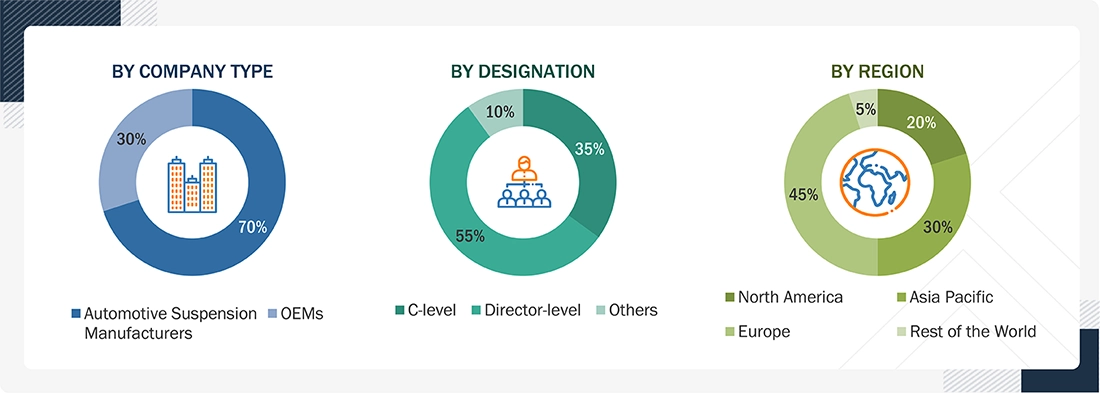
To know about the assumptions considered for the study, download the pdf brochure
Market Size Estimation
A detailed market estimation approach was followed to estimate and validate the size of the automotive suspension market and other dependent submarkets, as mentioned below:
- Key players in the automotive suspension market were identified through secondary research, and their global market share was determined through primary and secondary research.
- The research methodology included the study of identifying the percentage penetration of suspension type (MacPherson Strut, Double Wishbone, MultiLink, Twist Beam/Torsion Beam, Leaf Spring Suspension, Air Suspension) installed in passenger cars, LCVs, HCVs, and EVs.
- These percentage penetrations by each vehicle type are multiplied by the vehicle production to arrive at the total market size, by volume (million units)
- The market size, by value, is derived by multiplying the average selling price of MacPherson Strut, Double Wishbone, MultiLink, Twist Beam/Torsion Beam, Leaf Spring Suspension, and Air Suspension by the number of units.
- All major penetration rates, percentage shares, splits, and breakdowns for the component & vehicle type of the automotive suspension market were determined by using secondary sources and verified through primary sources.
- All key macro indicators affecting the revenue growth of the market segments and subsegments were accounted for, viewed in extensive detail, verified through primary research, and analyzed to get the validated and verified quantitative & qualitative data.
Automotive Suspension Market : Top-Down and Bottom-Up Approach
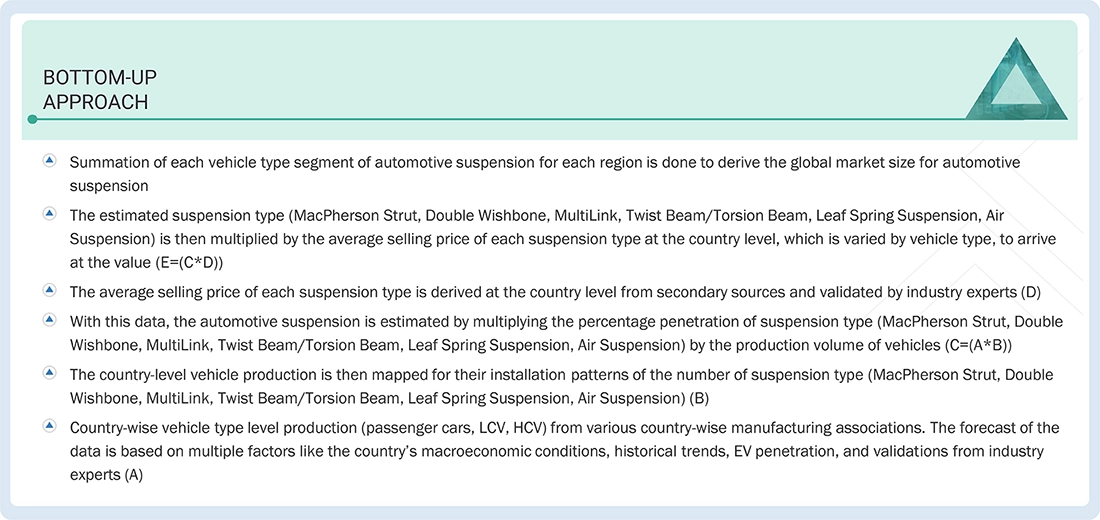
Data Triangulation
After arriving at the overall market size of the global market through the above-mentioned methodology, this market was split into several segments and subsegments. The data triangulation and market breakdown procedures were employed, wherever applicable, to complete the overall market engineering process and arrive at the exact data for the market by value for the key segments and subsegments. The extrapolated market data was triangulated by studying various macro indicators and regional trends from both the demand and supply participants.
Market Definition
A suspension is the arrangement of shock absorbers, springs, tires, and linkages that connect a vehicle to its wheels and allows movement between the wheel and suspension components. The suspension system in a vehicle minimizes shocks received by the body of the vehicle while moving on a surface. It makes the ride comfortable and keeps the tires in constant contact with the surface, regardless of contours. A suspension needs to keep the wheel in contact with the road surface to maintain the driver’s control of the vehicle.
Key Stakeholders
- Automotive Suspension Manufacturers
- Automotive Raw Material Suppliers
- Automotive OEMs
- Research & Development (R&D) Centers
- Associations, Forums, and Alliances Related to Automobiles
- Automobile Organizations/Associations
- EV Component Manufacturers
- EV Manufacturers
- Government Agencies and Policymakers
- Traders and Distributors of Automotive Suspension
Report Objectives
-
To segment and forecast the size of the automotive suspension market in terms of volume (million units) & value (USD million) from 2021 to 2032
- To define, describe, and forecast the automotive suspension market in terms of volume & value (USD million)
- To define, describe, and forecast the global automotive suspension market based on system, vehicle type, architecture, OE component, EV type, off-highway vehicles, ATV, and region
- To segment and forecast the market size of the automotive suspension market by architecture (MacPherson Strut, Double Wishbone, Multilink, Twist Beam/Torsion Beam, and Air Suspension)
- To segment and forecast the market size of the automotive suspension market by vehicle type (ICE) (passenger car, light commercial vehicle, and heavy commercial vehicle)
- To segment and forecast the market size of the electric & hybrid passenger cars suspension market, by architecture (MacPherson Strut, Double Wishbone, Multilink, Twist Beam/Torsion Beam, and Air Suspension)
- To segment and forecast the market size of the electric & hybrid HCVs suspension market, by vehicle type (trucks and buses)
- To segment and forecast the market size of the off-highway vehicles suspension market, by application (construction equipment and agricultural tractors)
- To segment and forecast the market size of the ATV suspension market, by region (Asia Pacific, Europe, and North America)
- To forecast the market size with respect to key regions, namely, Asia Pacific, Europe, North America, and the Rest of the World.
- To provide detailed information regarding the major factors influencing market growth (drivers, challenges, restraints, and opportunities)
- To strategically analyze markets with respect to individual growth trends, prospects, and contributions to the total market
- To strategically profile the key players and comprehensively analyze their market share and core competencies
-
To study the following with respect to the market:
- Supply Chain Analysis
- Ecosystem Analysis
- Technology Analysis
- HS Code Analysis
- Case Study Analysis
- Patent Analysis
- Regulatory Landscape
- Conferences and Events
- Key Stakeholders and Buying Criteria
- Investment and Funding Scenario
- To analyze opportunities for stakeholders and the competitive landscape for market leaders
- To track and analyze competitive developments such as product developments, deals, and others undertaken by the key industry participants
Available Customizations
With the given market data, MarketsandMarkets offers customizations tailored to the company’s specific needs.
- Front Suspension by architecture (Passenger Cars, LCVs, HCVs)
- Rear Suspension by Architecture (Passenger Cars, LCVs, HCVs)
- Passive, Semi-active, and Active Suspension, by Architecture (Country-level)
- Electric & Hybrid Vehicles (Regional Level)
- Off-highway, by Type and Region (Regional Level)
Company Information
- Profiling of Additional Market Players (Up to 6)
Fact checked
Personalize This Research
- Triangulate with your Own Data
- Get Data as per your Format and Definition
- Gain a Deeper Dive on a Specific Application, Geography, Customer or Competitor
- Any level of Personalization
Let Us Help You
- What are the Known and Unknown Adjacencies Impacting the Automotive Suspension Market
- What will your New Revenue Sources be?
- Who will be your Top Customer; what will make them switch?
- Defend your Market Share or Win Competitors
- Get a Scorecard for Target Partners

Custom Market Research Services
We Will Customise The Research For You, In Case The Report Listed Above Does Not Meet With Your Requirements
Get 10% Free CustomisationTESTIMONIALS

JIM NAAS
PRODUCT DIRECTOR, WEASLER
Weasler Engineering, a CentroMotion organization
Global Provider of Industrial Actuation & Control Solutionswww.weasler.com
Our organization was interested in learning more about the attractiveness of a particular market space. We contacted MarketsandMarkets to help us based on previous positive experiences we had with them. The results did not disappoint! We discussed our objectives with them, and the team at MarketsandMarkets developed and executed a proposal that met our needs precisely. We were very impressed by their level of expertise, the quality of the analysis and their insightful recommendations. We would not hesitate in working with them again in the future.

Matt Kardel,
Vice President
Aptiv,
A global technology company that develops safer, greener and more connected solutions.www.aptiv.com
We contracted with
MarketsandMarkets to evaluate the value chain and potential go-to-market partners related to our
interest in the Fleet Management space. The team successfully completed the work on time and at the
pricing agreed. MarketsandMarkets listened and understood our objectives and collaborated well with
us to help us get the visibility we needed to make an investment.
We have subsequently used
MarketsandMarkets again related to Smart Cities to good results.
- China Automotive Suspension Market
- India Automotive Suspension Market
- Japan Automotive Suspension Market
- South Korea Automotive Suspension Market
- US Automotive Suspension Market
- Mexico Automotive Suspension Market
- Canada Automotive Suspension Market
- Germany Automotive Suspension Market
- UK Automotive Suspension Market
- France Automotive Suspension Market
- Spain Automotive Suspension Market
- Italy Automotive Suspension Market
- Russia Automotive Suspension Market
- Brazil Automotive Suspension Market
- South Africa Automotive Suspension Market
- Iran Automotive Suspension Market
Growth opportunities and latent adjacency in Automotive Suspension Market






Richard
Jun, 2022
How do emerging markets offer revenue expansion opportunities in Automotive Suspension Market?.
User
Aug, 2019
I am interested to get the report for Vietnam manufacturer air suspension market and how many registered car user with car brand in Vietnam market. .
User
Aug, 2019
What are the sources used for the market figures and a segmentation between OEMs and Aftermarket?.
User
Aug, 2019
I need to get information such as graph with numerical values for the size of global automotive suspension part market. .
User
Aug, 2019
Hello! i am about to provide suspension parts to Indian automobile vehicles as a vendor. I want to know various suspension segments that are available in the industry within different countries. .
User
Aug, 2019
I would like to understand 1) Market share of the biggest companies, 2) Market size with respect to technology (Active/Semi-Active/Passive).
User
Aug, 2019
I need to understand suspension market for Electric quadricycles, Electric three wheelers , L7 vehicles, L6 vehicles and L5 vehicles .
User
Aug, 2019
Global market share of suspension by system(passive, semiactive, active) and supplier (Sachs, KYB, Mando, etc). Is this report contain this information?.
User
Jul, 2019
In which vehicles in general are air suspension compressors to find? In which vehicles worldwide can they be installed? (types, quantity, not only OEMs) Data about air suspension compressors on the commercial vehicle market in China: Trucks, agricultural vehicle Is there a tendency, that EVs use air suspension compressors regulary?.
Manolo
Jun, 2026
I need to analyze for a project the market of suspension systems .
David
Jun, 2026
Looking to understand this area of mechanical application .
Marion
Jun, 2026
Searching for pdf and xls to analyse Air Suspension Market until 2032 for automotive industry.
Cyril
Jun, 2026
We need Automotive Suspension Insights for clients.