
US Aircraft Engine Test Cells Market (2023-2028)

The US Aircraft Engine Test Cells Market was valued at $1636.8 Million in 2023 and projected to reach to $1987.4 Million by 2028, representing a compound annual growth rate of 4.0%. The US aircraft engine test cells market is positioned for sustained growth through 2028, supported by increased defense budgets, modernization of aging test infrastructure, and rising demand from commercial aviation recovery.


| Market Size in | USD 26.32 MN |
| Market Forecast in | |
| CAGR | |
| Forecast Period | |
| Units Considered | Value (USD MN) |
US Aircraft Engine Test Cells Market Trends and Insights
- The US maintains a dominant position in aerospace and defence infrastructure, with advanced testing facilities supporting both commercial and military aviation programs.
- In 2023, the US market benefited from increased aircraft production rates and modernization of legacy test infrastructure across major OEM facilities and independent service providers. Driving growth through 2028, the US market is supported by rising demand for next-generation engine certification, aftermarket maintenance testing, and compliance with evolving environmental regulations.
- The US aerospace sector's investment in digital transformation and predictive maintenance technologies is accelerating adoption of advanced test cell capabilities.
- By 2028, the US is expected to capture significant value from both new aircraft development programs and the expansion of MRO (maintenance, repair, and overhaul) operations across the country..
Key Market Statistics
- CAGR (2023-2028) 4.0% CAGR
- Market Size, 2023 ~USD 1636.8 Million
- Forecast, 2028 ~USD 1987.4 Million
- Country US
US Aircraft Engine Test Cells Market Overview
Market Valuation :
The US aircraft engine test cells market reached $1,636.8 million in 2023, representing the largest regional market globally with significant infrastructure investments across commercial and military aerospace sectors.
Steady Growth Trajectory :
Projected to expand from $1,636.8 million (2023) to $1,987.4 million (2028) at a 4.0% CAGR, driven by increased defense spending, commercial aviation recovery, and modernization of existing test facilities.
Defense & Commercial Dual Demand :
US market benefits from robust military aviation programs including fighter jet development and maintenance, alongside commercial aircraft production from Boeing and regional manufacturers requiring advanced engine testing capabilities.
Technological Infrastructure Leadership :
The US maintains world-leading aerospace testing infrastructure with state-of-the-art facilities supporting next-generation engine development, certification requirements, and compliance with FAA and military specifications.
US Aircraft Engine Test Cells Market Dynamics
- Key drivers include military aircraft programs, engine certification requirements, and investments in sustainable aviation fuel (SAF) testing capabilities.
- The market will benefit from technological advancements in digital testing, real-time monitoring systems, and automation.
- However, growth may be tempered by high capital expenditure requirements and supply chain constraints.
- Strategic partnerships between aerospace OEMs, defense contractors, and testing service providers will shape market dynamics, with emphasis on upgrading facilities to meet next-generation engine performance standards and environmental compliance mandates..
Market Ecosystem
Related Ecosystem
Key Takeaways
- The US aircraft engine test cells market reached $1,636.8 million in 2023 with a projected value of $1,987.4 million by 2028, representing steady 4.0% CAGR growth.
- The US dominates global aerospace testing infrastructure, supported by major OEM facilities and independent MRO service providers across multiple regions.
- Next-generation engine certification and environmental compliance requirements are primary growth drivers for the US market through 2028.
- Digital transformation and predictive maintenance adoption in the US aerospace sector are accelerating demand for advanced test cell technologies.
Aircraft Engine Test Cells Market Report Scope
| Report Metric | Details |
|---|---|
| Base Year | 2023 |
| Fastest Growing Segment | RETROFIT & UPGRADES (Point Of Sale) |
| Forecast Period | 2023-2028 |
| Growth Rate | CAGR of 4.2% from 2023 to 2028 |
| Largest Segment | COMMERCIAL (End-Use Industry) |
| Market Size Base Year (Billions) | ~USD 3.34 (2023) |
| Revenue Forecast (Billions) | ~USD 4.1 (2028) |
| Segments Covered | Engine Test, End User, End-Use Industry, Point Of Sale, Solution Type |
US Aircraft Engine Test Cells Market Report Segmentation
5 segment dimensions are covered across the global market.
By Engine Test
- Apu
- Piston Engine
- Turbofan
- Turbojet
- Turboshaft
By End User
- Airlines And Operators
- Mro
- Mros
- Oems
By End-Use Industry
- Commercial
- Military
By Point Of Sale
- Maintenance & Services
- New Installations
- Retrofit & Upgrades
By Solution Type
- Ancillary System
- Component Test Bench
- Data Acquisition & Control System
- Software
- Test Cell
US: AIRCRAFT ENGINE TEST CELLS MARKET, BY END-USE INDUSTRY, 2023–2028
| Segment | 2023 | 2024 | 2025 | 2026 | 2027 | 2028 | CAGR (%) |
|---|---|---|---|---|---|---|---|
| COMMERCIAL | 1131.6 | 1169.8 | 1213.4 | 1263.5 | 1321.2 | 1387.8 | 4.2 |
| MILITARY | 505.1 | 518.8 | 534.7 | 553.1 | 574.5 | 599.5 | 3.5 |
| TOTAL | 1636.8 | 1688.6 | 1748.1 | 1816.6 | 1895.7 | 1987.4 | 4 |
Target Audience
- Aerospace OEMs & Engine Manufacturers : Boeing, Pratt & Whitney, GE Aviation, and Rolls-Royce require detailed US market data to plan engine development programs, facility partnerships, and testing capacity investments aligned with production forecasts.
- Defense Contractors & Military Programs : Lockheed Martin, Northrop Grumman, and military aviation programs need market intelligence on test cell availability, modernization timelines, and capacity planning for fighter jet and military transport aircraft engine testing.
- Test Facility Operators & Service Providers : Independent testing laboratories and facility operators require market sizing and growth forecasts to justify capital investments in new test cells, equipment upgrades, and workforce expansion across US locations.
- Equipment & Technology Suppliers : Manufacturers of test cell instrumentation, automation systems, and monitoring technologies need US market data to identify customer segments, forecast demand, and develop targeted solutions for aerospace testing applications.
- Investment & Strategy Consultants : Private equity firms, management consultants, and strategic advisors require comprehensive US market analysis to evaluate acquisition targets, assess growth potential, and guide portfolio companies in aerospace testing sectors.
Reasons to Buy this Report
- Market Size & Growth Validation : Obtain precise US market valuation ($1,636.8M in 2023) and verified forecast data through 2028, enabling accurate budget allocation and investment decisions for aerospace testing infrastructure projects.
- Competitive Landscape Intelligence : Understand market dynamics specific to the US aerospace sector, including key players in defense and commercial aviation, facility utilization rates, and competitive positioning for strategic planning.
- Regulatory & Compliance Insights : Access detailed analysis of FAA requirements, military specifications, and certification standards driving test cell demand in the US market, ensuring compliance-aligned business strategies.
- Investment Opportunity Assessment : Evaluate growth drivers including defense spending trends, commercial aviation recovery, and modernization cycles to identify high-potential investment windows and partnership opportunities in US aerospace testing.
- Technology & Innovation Trends : Gain insights into emerging technologies in US test facilities such as digital monitoring systems, automation, and SAF testing capabilities to align product development and service offerings with market evolution.
Frequently asked questions
What is the current size of the US aircraft engine test cells market?
The US aircraft engine test cells market was valued at $1,636.8 million in 2023 and is expected to reach $1,987.4 million by 2028.
What is the growth rate of the US aircraft engine test cells market?
The US market is projected to grow at a compound annual growth rate (CAGR) of 4.0% from 2023 to 2028.
What factors are driving growth in the US aircraft engine test cells market?
Key drivers include increased aircraft production rates, next-generation engine certification requirements, environmental compliance regulations, and expansion of MRO operations across the US.
Who are the primary users of aircraft engine test cells in the US?
Primary users include major aircraft engine OEMs, independent MRO service providers, military aviation programs, and aerospace research institutions throughout the US.
How is digital transformation impacting the US aircraft engine test cells market?
Digital transformation and predictive maintenance technologies are accelerating adoption of advanced test cell capabilities, enabling more efficient and data-driven engine testing and certification processes in the US.
RESEARCH METHODOLOGY
This research study on the aircraft engine test cells market involved extensive use of secondary sources, directories, and databases such as Hoovers, Bloomberg BusinessWeek, and Factiva to identify and collect information relevant to the market. The primary sources considered included industry experts as well as service providers, manufacturers, solution providers, technology developers, alliances, and organizations related to all segments of the value chain of this market. In-depth interviews with various primary respondents, including key industry participants, subject matter experts, industry consultants, and C-level executives, were conducted to obtain and verify critical qualitative and quantitative information pertaining to the aircraft engine test cells market as well as assess its growth prospects.
Secondary Research
The market share of companies in the aircraft engine test cells market has been determined using secondary data made available through paid and unpaid sources and by analyzing product portfolios of major companies operating in the market. These companies have been rated based on the performance and quality of their products. These data points have been further validated by primary sources.
Secondary sources that have been referred to for this research study on the aircraft engine test cells market included government sources such as the US Department of Defense (DoD), corporate filings such as annual reports, investor presentations, and financial statements, and trade, business, and professional associations. This secondary data has been collected and analyzed to arrive at the overall size of the aircraft engine test cells market, which has been further validated by primary respondents.
Primary Research
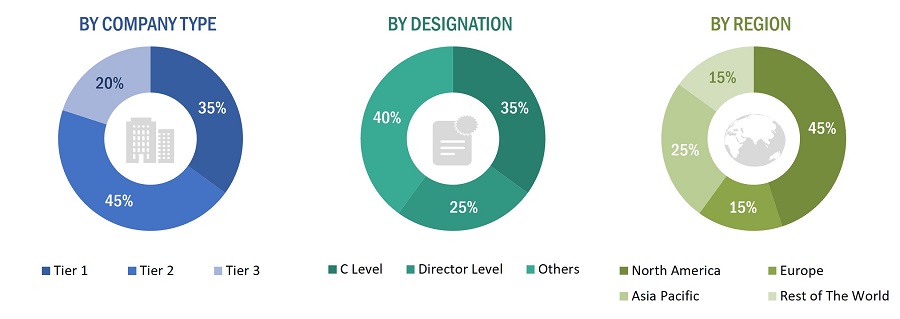
Extensive primary research has been conducted after obtaining information about the current scenario of the aircraft engine test cells market through secondary research. Several primary interviews have been conducted with market experts from both the demand and supply sides across four regions: North America, Europe, Asia Pacific, and Rest of the World. This primary data has been collected through questionnaires, emails, and telephonic interviews.
These interviews have been conducted to gather insights such as market statistics, data on revenue collected from products and services, market breakdowns, market size estimations, market size forecasting, and data triangulation. It has also helped analyze the segments of the aircraft engine test cells market.
To know about the assumptions considered for the study, download the pdf brochure
Market Size Estimation
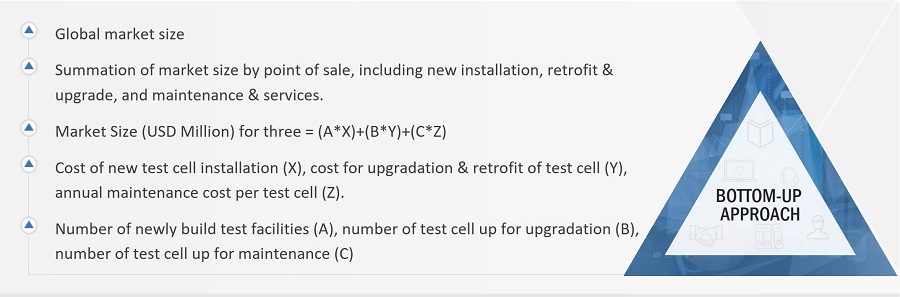
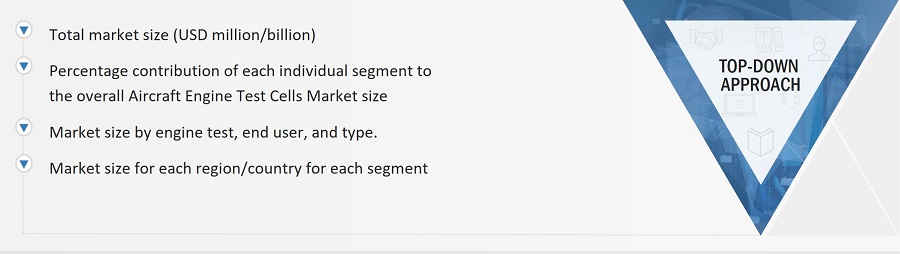
The top-down and bottom-up approaches have been used to estimate and validate the size of the aircraft engine test cells market. The research methodology used to estimate the market size also includes the following details.
- The key players have been identified through secondary research, and their market ranking has been determined through primary and secondary research. This includes a study of the annual and financial reports of the top market players and extensive interviews of leaders, including chief executive officers (CEO), directors, and marketing executives.
- All percentage shares, splits, and breakdowns have been determined using secondary sources and verified through primary sources. All possible parameters that affect the markets covered in this research study have been accounted for, viewed in extensive detail, verified through primary research, and analyzed to obtain the final quantitative and qualitative data. This data has been consolidated, enhanced with detailed inputs, analyzed by MarketsandMarkets, and presented in this report.
Market size estimation methodology: Bottom-up Approach
Market size estimation methodology: Top-Down Approach
Data Triangulation
After arriving at the overall size of the aircraft engine test cells market from the market size estimation process explained above, the total market was split into several segments and subsegments. To complete the overall market engineering process and arrive at the exact statistics for various market segments and subsegments, data triangulation and market breakdown procedures were implemented, wherever applicable. The data was triangulated by studying various factors and trends from both demand and supply sides. Along with this, the market size was validated using both top-down and bottom-up approaches.
Market Definition
?An aircraft engine test cell is a specialized facility designed to safely test and evaluate the performance of aircraft engines. These test cells are typically large, enclosed structures that are equipped with a variety of sensors, instrumentation, and control systems to monitor and measure engine performance parameters such as thrust, fuel consumption, emissions, and vibration.
Report Objectives
- To define, describe, segment, and forecast the size of the aircraft engine test cells market based on engine test, end user, end-use industry, point of sale, type, and region
- To forecast sizes of various segments of the aircraft engine test cells market with respect to four major regions, namely, North America, Europe, Asia Pacific, and Rest of the World, along with major countries in each of these regions
- To identify and analyze key drivers, restraints, opportunities, and challenges influencing the growth of the aircraft engine test cells market across the globe
- To identify industry trends, market trends, and technology trends that are currently prevailing in the aircraft engine test cells market
- To provide an overview of the tariff and regulatory landscape in the aircraft engine test cells market across various regions
- To analyze micromarkets1 with respect to individual growth trends, prospects, and their contribution to the overall market
- To analyze opportunities in the market for stakeholders by identifying key market trends
- To profile key market players and comprehensively analyze their market share and core competencies2
- To analyze the degree of competition in the market by identifying key growth strategies, such as acquisitions, new product launches, investments, contracts, and partnerships, adopted by leading market players
- To identify detailed financial positions, key products, and unique selling points of leading companies in the market
- To provide a detailed competitive landscape of the aircraft engine test cells market, along with a ranking analysis, market share analysis, and revenue analysis of key players
Available customizations
Along with the market data, MarketsandMarkets offers customizations as per the specific needs of companies. The following customization options are available for the report:
Product Analysis
- Product matrix, which gives a detailed comparison of the product portfolio of each company
Regional Analysis
- Further breakdown of the market segments at country-level
Company Information
- Detailed analysis and profiling of additional market players (up to 5)
Get the Full Aircraft Engine Test Cells Market Report
Full forecast, segment splits, and company analysis for all Aircraft Engine Test Cells Market.
- Canada Aircraft Engine Test Cells Market
- UK Aircraft Engine Test Cells Market
- France Aircraft Engine Test Cells Market
- Germany Aircraft Engine Test Cells Market
- Italy Aircraft Engine Test Cells Market
- Russia Aircraft Engine Test Cells Market
- China Aircraft Engine Test Cells Market
- Japan Aircraft Engine Test Cells Market
- India Aircraft Engine Test Cells Market
- Australia Aircraft Engine Test Cells Market
- Rest Of Europe Aircraft Engine Test Cells Market
- Rest Of Asia Pacific Aircraft Engine Test Cells Market
Need a Tailored Report?
Customize this report to your needs
Get 10% FREE Customization
Customize This Report
