
South America Alginates and Derivatives Market (2023-2028)

The South America Alginates and Derivatives Market was valued at $37.3 Million in 2023 and projected to reach to $50.5 Million by 2028, representing a compound annual growth rate of 6.3%. South America's alginates and derivatives market is positioned for robust growth driven by the region's expanding food processing infrastructure and rising consumer demand for natural, functional ingredients.


| Market Size in | USD 26.32 MN |
| Market Forecast in | |
| CAGR | |
| Forecast Period | |
| Units Considered | Value (USD MN) |
South America Alginates and Derivatives Market Trends and Insights
- South America's market growth is driven by increasing demand for natural food additives and functional ingredients across the food and beverage sector.
- The region's expanding processed food industry and rising consumer preference for clean-label products are key factors propelling South America's market expansion during the forecast period. South America's alginate market benefits from growing applications in dairy, bakery, and confectionery segments, where these ingredients serve as thickeners, stabilizers, and gelling agents.
- South America's food manufacturers are increasingly adopting alginates to meet regulatory standards and consumer expectations for quality and safety.
- The region's competitive pricing and availability of raw materials further support market penetration across South America's food production landscape..
Key Market Statistics
- CAGR (2023-2028) 6.3% CAGR
- Market Size, 2023 ~USD 37.3 Million
- Forecast, 2028 ~USD 50.5 Million
- Country South America
South America Alginates and Derivatives Market Overview
Market Valuation Growth :
South America's alginates and derivatives market reached USD 37.3 million in 2023 and is expected to grow to USD 50.5 million by 2028, demonstrating strong regional expansion outpacing the global CAGR of 5.7%.
Natural Additives Demand :
Growing consumer preference for clean-label and natural food additives in South America is driving alginate adoption across dairy, bakery, and beverage applications as manufacturers seek plant-based thickening and stabilizing solutions.
Processed Food Industry Expansion :
South America's rapidly expanding processed food sector, particularly in Brazil and Argentina, is creating substantial opportunities for alginate derivatives used in texture modification and shelf-life extension.
Regional CAGR Performance :
At 6.3% CAGR through 2028, South America's market growth rate exceeds the global average, indicating accelerating adoption and investment in alginate-based food solutions across the region.
South America Alginates and Derivatives Market Dynamics
- Brazil and Argentina lead market development, with increasing applications in yogurt, sauces, and plant-based products.
- The shift toward sustainable and clean-label formulations continues to propel alginate adoption among regional manufacturers seeking competitive differentiation. Looking ahead, South America's market will benefit from growing health consciousness, regulatory support for natural additives, and technological advancements in alginate extraction and modification.
- Investment in food innovation and export-oriented production will further accelerate market penetration, particularly in premium and functional food segments where alginates enhance product quality and consumer appeal..
Market Ecosystem
Related Ecosystem
Fandb Additives
- Dairy Products
- Bakery Products
- Polyglycerol Esters
- Microorganism
- Carbohydrates
- AZELIS HOLDINGS SA
- Archer-Daniels-Midland Company
- Amway
- UNILEVER PLC
- DuPont de Nemours, Inc.
Fandb Ingredients
- Dairy Products
- Bakery Products
- Microorganism
- Polydextrose
- Carbohydrates
- AZELIS HOLDINGS SA
- Archer-Daniels-Midland Company
- Kerry Group plc
- Amway
- DSM FIRMMENICH
Key Takeaways
- South America's alginates market is projected to grow from USD 37.3 million (2023) to USD 50.5 million (2028) at a 6.3% CAGR.
- South America's food and beverage industry is increasingly adopting alginates as natural stabilizers and thickening agents in processed foods.
- South America's clean-label trend and regulatory compliance requirements are accelerating alginate adoption among regional manufacturers.
- South America's competitive raw material costs and expanding dairy and bakery sectors present significant growth opportunities through 2028.
Alginates and Derivatives Market Report Scope
| Report Metric | Details |
|---|---|
| Base Year | 2023 |
| Fastest Growing Segment | LIQUID (Form) |
| Forecast Period | 2023-2028 |
| Growth Rate | CAGR of 5.7% from 2023 to 2028 |
| Largest Segment | ANIMAL (Source) |
| Market Size Base Year (Billions) | ~USD 0.49 (2023) |
| Revenue Forecast (Billions) | ~USD 0.65 (2028) |
| Segments Covered | Type, Application, Source, Form |
South America Alginates and Derivatives Market Report Segmentation
4 segment dimensions are covered across the global market.
By Type
- Calcium Alginate
- Other Types
- Potassium Alginate
- Propylene Glycol Alginate
- Sodium Alginate
By Application
- Food & Beverage
- Food & Beverages
- Industrial
- Other Applications
- Pharmaceuticals
By Source
- Animal
- Botanical
- Microbial
- Seaweed
- Synthetic
By Form
- Liquid
- Solid
Target Audience
- Food & Beverage Manufacturers : South American F&B producers need regional market data to optimize alginate sourcing, formulation strategies, and product positioning in a competitive landscape experiencing 6.3% annual growth.
- Ingredient Suppliers & Distributors : Suppliers operating in South America require detailed market intelligence to identify high-growth segments, forecast demand by country, and develop targeted sales strategies for alginate products.
- Investment & Private Equity Firms : Investors evaluating opportunities in South America's food additives sector need comprehensive market analysis, growth projections, and competitive insights to assess portfolio companies and acquisition targets.
- Food Technology & Innovation Teams : R&D departments developing new alginate applications for South American markets require regional trend analysis, consumer preference data, and regulatory insights to guide product innovation initiatives.
- Market Consultants & Business Strategists : Consultants advising clients on South American market expansion need authoritative regional data, CAGR analysis, and segment breakdowns to support strategic recommendations and feasibility assessments.
Reasons to Buy this Report
- Regional Market Sizing & Forecasts : Obtain precise valuation data specific to South America's alginates market with detailed projections through 2028, enabling accurate budget allocation and investment planning for regional expansion strategies.
- Competitive Landscape Intelligence : Understand key players, market share distribution, and competitive dynamics unique to South America's alginate sector, identifying partnership and acquisition opportunities within the region.
- Country-Specific Growth Drivers : Access detailed analysis of South America-specific factors including regulatory environment, consumer preferences, and industry trends driving the 6.3% CAGR across Brazil, Argentina, and other key markets.
- Application & Segment Breakdown : Gain insights into alginate usage patterns across South American food and beverage segments, from dairy and bakery to plant-based products, guiding product development and market entry strategies.
- Strategic Market Entry Roadmap : Develop informed go-to-market strategies for South America with actionable intelligence on distribution channels, customer requirements, and growth opportunities specific to the region's expanding processed food industry.
Frequently asked questions
What is the current market size of alginates in South America?
South America's alginates and derivatives market was valued at USD 37.3 million in 2023 and is expected to reach USD 50.5 million by 2028.
What is the projected growth rate for South America's alginate market?
South America's alginate market is expected to grow at a compound annual growth rate (CAGR) of 6.3% from 2023 to 2028.
Which food segments drive alginate demand in South America?
South America's primary alginate applications include dairy products, bakery items, and confectionery, where they function as stabilizers, thickeners, and gelling agents.
What factors are driving alginate adoption in South America?
South America's market growth is fueled by clean-label consumer preferences, regulatory compliance requirements, and the expansion of processed food manufacturing in the region.
How does South America's alginate market compare to global trends?
South America's 6.3% CAGR outpaces the global market growth rate of 5.7%, indicating stronger regional demand and market expansion potential.
RESEARCH METHODOLOGY
The research study involved extensive secondary sources, directories, and databases such as Bloomberg Businessweek and Factiva to identify and collect information useful for a technical, market-oriented, and commercial study of the alginates and derivatives market. In-depth interviews were conducted with various primary respondents—such as key industry participants, subject matter experts (SMEs), C-level executives of key market players, and industry consultants—to obtain and verify critical qualitative and quantitative information and assess prospects.
Secondary Research
In the secondary research process, sources such as annual reports, press releases, and investor presentations of companies, white papers, certified publications, articles from recognized authors, gold standard and silver standard websites, food safety organizations, regulatory bodies, trade directories, government websites, and databases were used to identify and collect information.
Secondary research was used to obtain key information about the industry’s supply chain, the market’s monetary chain, the total pool of key players, market classification, and segmentation according to industry trends to the bottom-most level, geographic markets, and key developments from market- and technology-oriented perspectives.
Primary Research
The market includes several stakeholders in the supply chain, such as suppliers, processors, and end-product manufacturers. The demand side of the market is characterized by the presence of key food, pharmaceutical, textile, animal feed/pet food, and cosmetics manufacturers. The supply side is characterized by the presence of farmers and key technology providers for the extraction of alginates. Various primary sources from the supply and demand sides of both markets were interviewed to obtain qualitative and quantitative information.
The primary interviewees from the demand side include key opinion leaders, executives, vice presidents, and CEOs from the F&B, pharmaceutical, animal feed/pet food, and chemical industries. The primary sources from the supply side include research institutions involved in R&D to introduce technology, key opinion leaders, distributors, and alginate manufacturers.
- Breakdown of Primary Participants
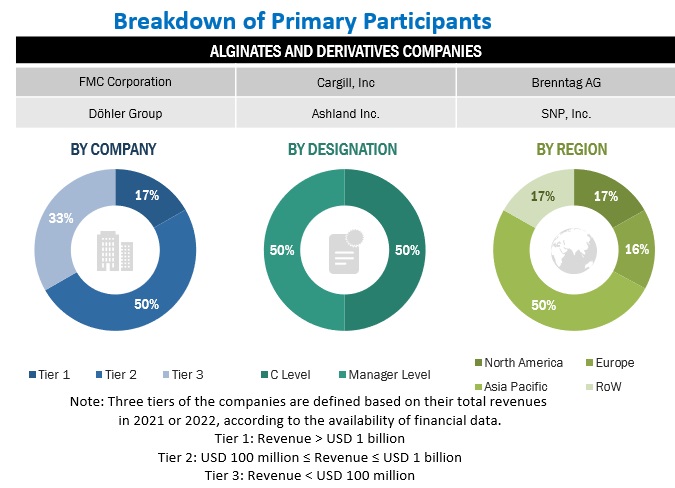
To know about the assumptions considered for the study, download the pdf brochure
Market Size Estimation
Both top-down and bottom-up approaches were used to estimate and validate the total size of the alginates & derivatives market. These approaches were also used extensively to estimate the size of various sub-segments in the market. The research methodology used to estimate the market size includes the following details:
- The key players in the industry and markets were identified through extensive secondary research
- The alginates & derivatives industry’s value chain and market size, in terms of value and volume, were determined through primary and secondary research
- All percentage shares, splits, and breakdowns were determined using secondary sources and verified through primary sources
- All the possible parameters that affect the market covered in this research study have been accounted for, viewed in extensive detail, verified through primary research, and analyzed to obtain the final quantitative and qualitative data
- Secondary research included the study of reports, reviews, and newsletters of top market players, along with extensive interviews for key opinions from leaders, such as CEOs, directors, and marketing executives.
Market Size Estimation: Bottom-up Approach
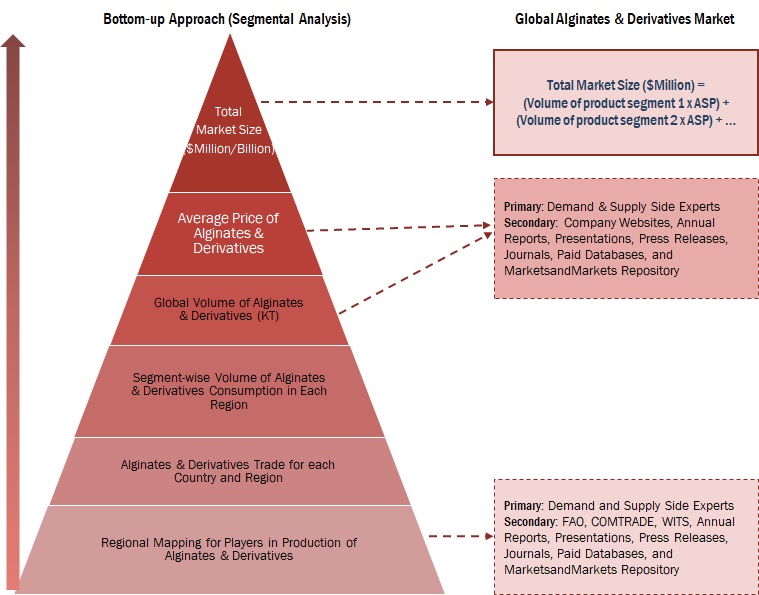
To know about the assumptions considered for the study, Request for Free Sample Report
Market Size Estimation Methodology: Top-Down Approach
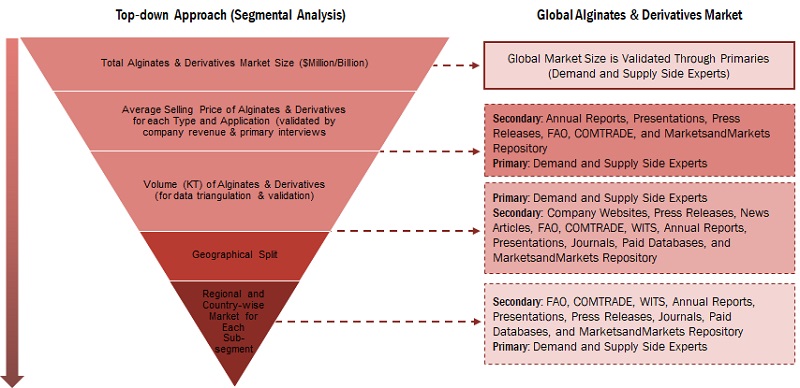
Data Triangulation
After arriving at the overall market size—using the market size estimation processes as explained above—the market was split into several segments and sub-segments. In order to complete the overall market engineering process and arrive at the exact statistics of each market segment and sub-segment, data triangulation and market breakdown procedures were employed, wherever applicable. The data was triangulated by studying various factors and trends from the demand and supply sides, in the food, pharmaceutical, and non-food industries. The market size was validated using the top-down and bottom-up approaches.
Market Definition
Alginates can be defined as natural hydrocolloids with unique functionalities that are derived from various species of brown seaweeds (phaecohyceae). Alginates provide properties such as gelling, viscosifying, suspending, and stabilizing in processed food & beverage products.
Alginates are primarily the alkali or alkaline earth salts of alginic acid extracted usually from seaweeds. Alginates are present in the cell walls of brown algae as the calcium, magnesium, and sodium salts of alginic acid. They are frequently sold as blends that increase the volume of a product in the food & beverage and pharmaceutical industries.
Key Stakeholders
- Raw material suppliers
- Regulatory bodies
- Food safety agencies such as the FDA, EFSA, USDA, and FSANZ
- Government agencies and NGOs
- Food safety agencies
-
End-users
- Food & beverage manufacturers/suppliers
- Pharmaceutical manufacturers/suppliers
- Animal feed/pet food manufacturers/suppliers
- Companies (manufacturers/suppliers) involved in industrial segments such as textile, printing, and cosmetics
- Retailers
- Commercial research and development (R&D) institutions and financial institutions
- Importers and exporters of alginates & derivatives
- Traders, distributors, and suppliers
- Government and research organizations
- Trade associations and industry bodies
Report Objectives
Market Intelligence
- Determining and projecting the size of the alginates and derivatives market with respect to type, application, form, and region, over a five-year period ranging from 2023 to 2028.
- Identifying the attractive opportunities in the market by determining the largest and fastest-growing segments across regions
- Providing detailed information about the key factors influencing the growth of the market (drivers, restraints, opportunities, and industry-specific challenges)
- Analyzing the micro-markets with respect to individual growth trends, prospects, and their contribution to the total market
Competitive Intelligence
- Identifying and profiling the key market players in the alginates and derivatives market.
-
Providing a comparative analysis of the market leaders on the basis of the following:
- Product offerings
- Business strategies
- Strengths and weaknesses
- Key financials
- Understanding the competitive landscape and identifying the major growth strategies adopted by players across the key regions.
- Providing insights on key product innovations and investments in the alginates and derivatives market.
Available Customizations:
With the given market data, MarketsandMarkets offers customizations according to company-specific scientific needs.
The following customization options are available for the report:
Product Analysis
- Product Matrix, which gives a detailed comparison of the product portfolio of each company.
Geographic Analysis
With the given market data, MarketsandMarkets offers customizations according to company-specific scientific needs.
- Further breakdown of the Rest of European alginates and derivatives market, by key country
- Further breakdown of the Rest of the South American alginates and derivatives market, by key country
- Further breakdown of the Rest of Asia Pacific alginates and derivatives market, by key country
Company Information
- Detailed analyses and profiling of additional market players
Get the Full Alginates and Derivatives Market Report
Full forecast, segment splits, and company analysis for all Alginates and Derivatives Market.
- US Alginates and Derivatives Market
- Canada Alginates and Derivatives Market
- Mexico Alginates and Derivatives Market
- Germany Alginates and Derivatives Market
- UK Alginates and Derivatives Market
- France Alginates and Derivatives Market
- Spain Alginates and Derivatives Market
- China Alginates and Derivatives Market
- Japan Alginates and Derivatives Market
- India Alginates and Derivatives Market
- Rest Of Europe Alginates and Derivatives Market
- Rest Of Asia Pacific Alginates and Derivatives Market
- Africa Alginates and Derivatives Market
- Middle East Alginates and Derivatives Market
Need a Tailored Report?
Customize this report to your needs
Get 10% FREE Customization
Customize This Report
