
Saudi Arabia Antibody Therapeutics Market (2026-2031)

The Saudi Arabia Antibody Therapeutics Market was valued at $670 Million in 2026 and projected to reach to $640 Million by 2031, representing a compound annual growth rate of -0.5%. Saudi Arabia's antibody therapeutics market faces headwinds despite the nation's broader healthcare modernization efforts under Vision 2030.


| Market Size in | USD 26.32 MN |
| Market Forecast in | |
| CAGR | |
| Forecast Period | |
| Units Considered | Value (USD MN) |
Saudi Arabia Antibody Therapeutics Market Trends and Insights
- This contraction in Saudi Arabia contrasts sharply with global market expansion, indicating unique regional headwinds affecting antibody therapeutic adoption and deployment.
- Saudi Arabia's market dynamics are shaped by healthcare infrastructure maturity, regulatory frameworks, and the competitive pricing pressures facing biopharmaceutical manufacturers in the region. Despite the overall decline, Saudi Arabia remains an important market within the Middle East and Africa region for antibody-based treatments.
- The forecast period from 2026 to 2031 will be critical for Saudi Arabia as stakeholders assess opportunities to stabilize demand through improved market access, enhanced clinical education, and strategic partnerships with local healthcare providers.
- Saudi Arabia's healthcare sector continues to invest in advanced therapeutics, though the antibody therapeutics segment faces specific challenges that warrant close monitoring through 2031..
Key Market Statistics
- CAGR (2026-2031) -0.5%
- Market Size, 2026 ~USD 670 Million
- Forecast, 2031 ~USD 640 Million
- Country Saudi Arabia
Saudi Arabia Antibody Therapeutics Market Overview
Market Contraction :
Saudi Arabia's antibody therapeutics market is experiencing a negative CAGR of -0.5%, declining from USD 670 million in 2026 to USD 640 million by 2031, contrasting with the global market's robust 7.5% growth trajectory.
Regional Divergence :
While global antibody therapeutics markets expand significantly, Saudi Arabia faces unique headwinds including regulatory complexities, limited local manufacturing infrastructure, and pricing pressures that constrain market growth.
Healthcare Investment Landscape :
Saudi Arabia's Vision 2030 healthcare initiatives focus on domestic capacity building, yet antibody therapeutics adoption remains challenged by high treatment costs and limited patient access compared to developed markets.
Market Dynamics :
The modest market decline reflects shifting treatment paradigms, competition from biosimilars, and healthcare budget constraints within Saudi Arabia's public and private healthcare systems.
Saudi Arabia Antibody Therapeutics Market Dynamics
- The projected decline to USD 640 million by 2031 reflects structural challenges including limited local manufacturing capabilities, stringent regulatory pathways, and pricing pressures that constrain adoption rates among healthcare providers and patients. However, strategic opportunities exist through partnerships with international biopharmaceutical companies, expansion of specialized treatment centers, and increased government support for oncology and immunology programs.
- Market stabilization may occur as healthcare infrastructure improves and biosimilar penetration increases, potentially offsetting the current negative growth trajectory in the coming years..
Market Ecosystem
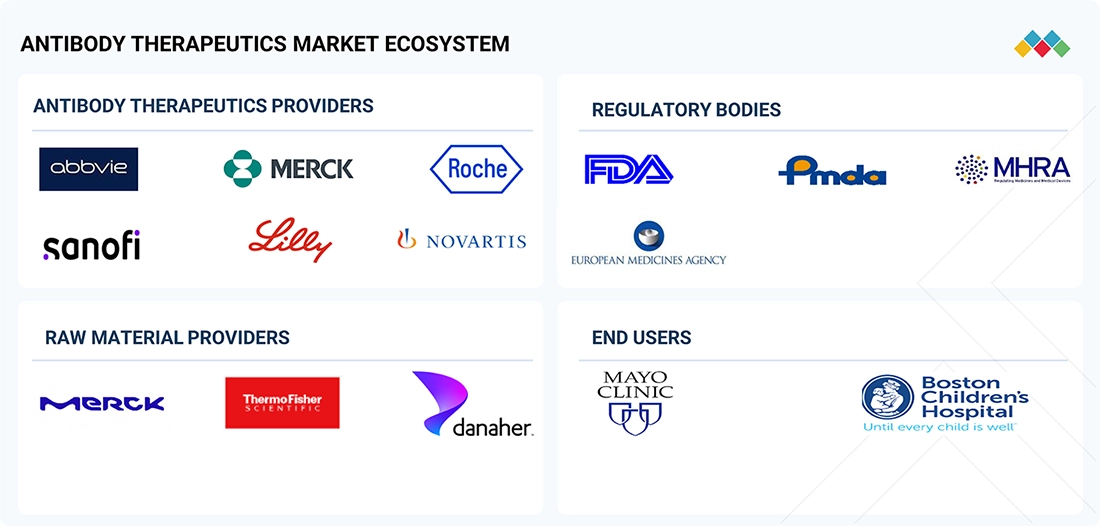
ANTIBODY THERAPEUTICS MARKET: COMMERCIAL USE CASES ACROSS INDUSTRIES
| COMPANY | USE CASE DESCRIPTION | BENEFITS |
|---|---|---|
 |
Administered teclistamab, a BCMA×CD3 bispecific antibody for relapsed/refractory multiple myeloma, using a hospital-based step-up dosing model. | Supports safe administration of complex bispecific antibodies, reduces serious toxicity risk through specialist monitoring, and creates a practical hospital-to-clinic care pathway for high-value antibody therapeutics. |
Logos and trademarks shown above are the property of their respective owners. Their use here is for informational and illustrative purposes only.
Related Ecosystem
Pharmaceuticals
- Bioreactors
- Analytical Testing
- Bioanalytical Testing Services
- Cell Counters
- Data Management Services
- Thermo Fisher Scientific Inc.
- SANOFI
- Merck KGaA
- NOVARTIS
- Pfizer Inc.
Key Takeaways
- Saudi Arabia's antibody therapeutics market will decline from USD 670M (2026) to USD 640M (2031) at a -0.5% CAGR, contrasting with global growth.
- Saudi Arabia faces unique regional headwinds including pricing pressures and regulatory challenges that differ from global market drivers.
- Despite the decline, Saudi Arabia remains strategically important within the Middle East and Africa region for antibody therapeutic deployment.
- Market stabilization in Saudi Arabia through 2031 will depend on improved access initiatives and healthcare provider partnerships.
Antibody Therapeutics Market Report Scope
| Report Metric | Details |
|---|---|
| Base Year | 2026 |
| Fastest Growing Segment | PIPELINE PRODUCTS (Product) |
| Forecast Period | 2026-2031 |
| Growth Rate | CAGR of 7.5% from 2026 to 2031 |
| Largest Segment | COMMERCIALIZED PRODUCTS (Product) |
| Market Size Base Year (Billions) | ~USD 311.44 (2026) |
| Revenue Forecast (Billions) | ~USD 447.11 (2031) |
| Segments Covered | Product, Type, Format, Payload Type, Target, Source, Route Of Administration, Therapeutic Area, End User |
Saudi Arabia Antibody Therapeutics Market Report Segmentation
9 segment dimensions are covered across the global market.
By Product
- Commercialized Products
- Pipeline Products
By Type
- Darzalex
- Dupixent
- Ivonescimab
- Izalontamab Brengitecan
- Keytruda
- Other Commercialized Products
- Other Pipeline Products
- Sacituzumab Tirumotecan (Sac-Tmt)
- Skyrizi
- Vyvgart
By Format
- Antibody Drug Conjugates (Adcs)
- Antibody Fragments
- Antibody-Drug Conjugates
- Bispecific Antibodies
- Monoclonal Antibodies
- Other Antibody Therapeutics
- Other Formats
- Polyclonal Antibodies
By Payload Type
- Dm1
- Dm4
- Mmae
- Other Payload Types
- Sn-38
By Target
- Cytokine/Inflammatory Pathway Targets
- Her2
- Other Targets
- Pd-1/Pd-L1
- Tnf Alpha
By Source
- Chimeric
- Human
- Humanized
- Other Sources
By Route Of Administration
- Intravenous
- Other Routes Of Administration
- Subcutaneous
By Therapeutic Area
- Autoimmune & Inflammatory Diseases
- Bone Disorders
- Hematology
- Immunology
- Infectious Diseases
- Neurology
- Oncology
- Osteology
- Other Therapeutic Areas
By End User
- Hospitals & Specialty Care Centers
- Long-Term Care Facilities
- Other End Users
Target Audience
- Biopharmaceutical Companies : Evaluate market viability, competitive landscape, and localization strategies for antibody therapeutic launches in Saudi Arabia's contracting but strategically important healthcare market.
- Healthcare Investors : Assess investment risks and opportunities in Saudi Arabia's antibody therapeutics sector, including potential for market stabilization and long-term growth through Vision 2030 initiatives.
- Government Health Agencies : Inform policy decisions on drug pricing, reimbursement frameworks, and local manufacturing incentives to address market contraction and improve patient access to antibody therapeutics.
- Hospital and Clinic Administrators : Understand market trends, treatment adoption rates, and budget allocation strategies for antibody therapeutics procurement and patient care delivery in Saudi healthcare facilities.
- Market Research and Consulting Firms : Leverage comprehensive Saudi Arabia-specific data to support client advisory services, competitive analysis, and strategic recommendations in the antibody therapeutics sector.
Reasons to Buy this Report
- Identify Market Headwinds : Understand the specific regulatory, economic, and structural factors driving the -0.5% CAGR decline in Saudi Arabia, enabling informed market entry and investment strategies.
- Competitive Positioning : Benchmark your antibody therapeutic portfolio against Saudi Arabia's market dynamics and identify gaps in treatment availability, patient populations, and unmet clinical needs.
- Strategic Partnership Opportunities : Discover collaboration potential with Saudi healthcare institutions, government agencies, and private providers to navigate regulatory pathways and expand market presence.
- Pricing and Reimbursement Insights : Access detailed analysis of Saudi Arabia's healthcare budget constraints, pricing pressures, and reimbursement mechanisms affecting antibody therapeutic commercialization.
- Long-term Growth Planning : Develop evidence-based forecasts for market stabilization and recovery opportunities as Vision 2030 healthcare investments mature and biosimilar competition evolves.
Frequently asked questions
What is the current size of the antibody therapeutics market in Saudi Arabia?
Saudi Arabia's antibody therapeutics market is estimated at USD 670 million in 2026, according to verified market data.
What is the forecast for Saudi Arabia's antibody therapeutics market by 2031?
Saudi Arabia's antibody therapeutics market is projected to reach USD 640 million by 2031, representing a decline from 2026 levels.
Why is Saudi Arabia's antibody therapeutics market declining when global markets are growing?
Saudi Arabia faces region-specific challenges including pricing pressures, regulatory constraints, and competitive dynamics that differ from global market conditions driving the -0.5% negative CAGR.
How does Saudi Arabia's market performance compare to the global antibody therapeutics market?
While the global antibody therapeutics market grows at 7.5% CAGR from USD 311.44B (2026) to USD 597.1B (2031), Saudi Arabia experiences a -0.5% CAGR, indicating divergent regional trends.
What factors could reverse the declining trend in Saudi Arabia's antibody therapeutics market?
Improved market access, enhanced clinical education, strategic healthcare partnerships, and supportive regulatory reforms could help stabilize and potentially reverse the decline in Saudi Arabia's antibody therapeutics market through 2031.
RESEARCH METHODOLOGY
This research study extensively used secondary sources, directories, and databases to identify and collect valuable information for analyzing the global antibody therapeutics market. In-depth interviews were conducted with primary respondents, including key industry participants, subject-matter experts (SMEs), C-level executives of key market players, and industry consultants, to obtain and verify critical qualitative and quantitative information and to assess the market's growth prospects. The global market size estimated through secondary research was then triangulated with primary research inputs to arrive at the final market size.
Secondary Research
Secondary research was used primarily to identify and collect information for the extensive, technical, market-oriented, and commercial study. The secondary sources used for this study include annual reports, SEC filings, investor presentations, the World Health Organization (WHO), the United States Food and Drug Administration (US FDA), the National Center for Biotechnology Information (NCBI), and regulatory body websites, among others. These sources also provided key information on major players, market classification, and segmentation aligned with industry trends, regional and country-level markets, market developments, and technology perspectives.
Primary Research
In-depth interviews were conducted with primary respondents, including key industry participants, subject-matter experts (SMEs), C-level executives of key market players, and industry consultants, to obtain and verify critical qualitative and quantitative information and to assess the market's prospects. Primary sources from both the supply and demand sides of the market were interviewed to gather qualitative and quantitative information. The following is a breakdown of the primary respondents:
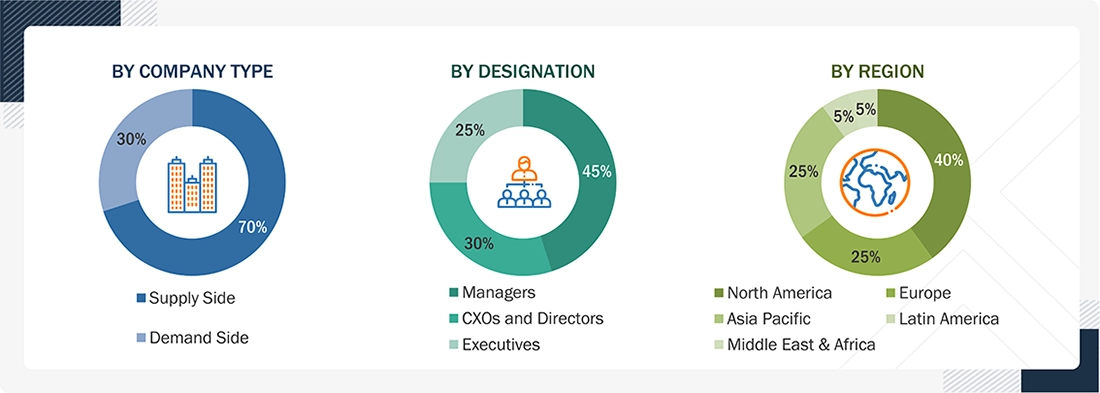
To know about the assumptions considered for the study, download the pdf brochure
Market Size Estimation
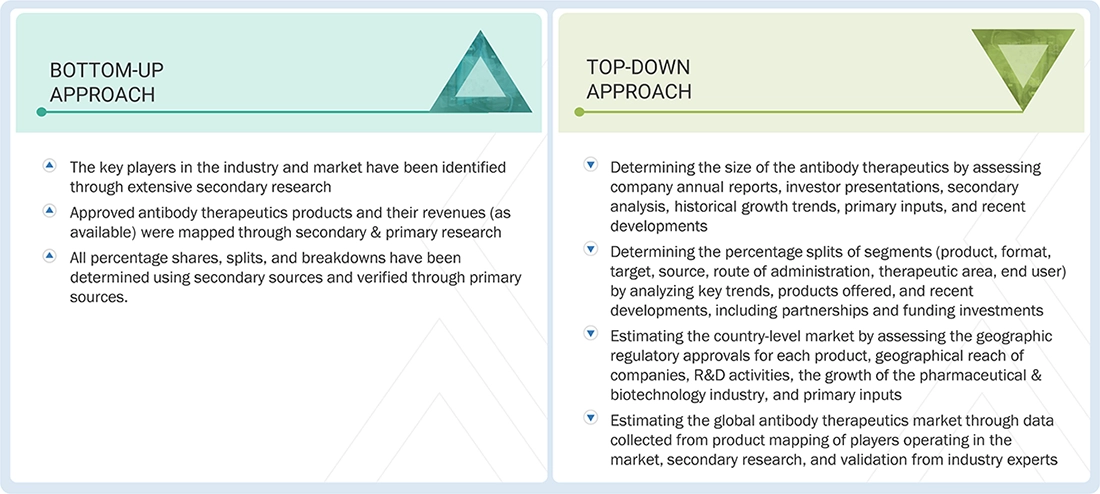
Both top-down and bottom-up approaches were used to estimate and validate the total size of the antibody therapeutics market. These methods were also used extensively to estimate the size of various market subsegments. The research methodology used to estimate the market size includes the following:
Antibody Therapeutics Market : Top-Down and Bottom-Up Approach
Data Triangulation
After determining the overall market size through the estimation process, the total market was segmented into several segments and subsegments. Where applicable, data triangulation and market breakdown procedures were employed to complete the overall market engineering process and arrive at the exact statistics for all segments and subsegments. The data was triangulated by analyzing various factors and trends from both the demand and supply sides.
Market Definition
Therapeutic antibodies are targeted biopharmaceuticals that trigger a biological response. Therapeutic antibodies are drugs that use antibodies, which play a significant role in the body's innate immune system. Antibodies are produced by B cells, a type of immune cell, to attack foreign substances (antigens) in response to infections or allergens. Since antibodies recognize and attack only specific antigens, these properties are leveraged to generate genetically engineered antibodies (chimeric, humanized, fully human, engineered fragments & bispecific) designed to target and neutralize specific disease markers.
Key Stakeholders
- Pharmaceutical & biotechnology companies
- Hospitals
- Specialty care centers
- Regulatory agencies
- Health insurers and payers
- Private and government-funding organizations
Report Objectives
- To define, describe, and forecast the global antibody therapeutics market by product, format, target, source, route of administration, therapeutic area, end user, and region
- To strategically analyze micromarkets with respect to individual growth trends, prospects, and contributions to the overall antibody therapeutics market
- To analyze the opportunities in the market for stakeholders and provide details of the competitive landscape for market leaders
- To provide detailed information regarding the major factors influencing the market growth, such as drivers, restraints, opportunities, and challenges
- To forecast the size of the market segments with respect to six regions: North America, Europe, the Asia Pacific, Latin America, the Middle East, and Africa
- To strategically analyze the market structure and profile the key players of the global antibody therapeutics market, and comprehensively analyze their core competencies
- To track and analyze competitive developments such as expansions, acquisitions, partnerships, collaborations, agreements, and product launches in the antibody therapeutics market
Available customizations:
With the given market data, MarketsandMarkets offers customizations per the company’s specific needs. The following customization options are available for this report:
Portfolio Assessment
- Product Matrix gives a detailed comparison of the product portfolios of the top five companies
Company Information
- Detailed analysis and profiling of additional market players (up to five)
Geographical Analysis
- Further breakdown of the Rest of Europe market, by country
- Further breakdown of the Rest of Asia Pacific market, by country
Get the Full Antibody Therapeutics Market Report
Full forecast, segment splits, and company analysis for all Antibody Therapeutics Market.
- UK Antibody Therapeutics Market
- France Antibody Therapeutics Market
- Italy Antibody Therapeutics Market
- Spain Antibody Therapeutics Market
- China Antibody Therapeutics Market
- Japan Antibody Therapeutics Market
- South Korea Antibody Therapeutics Market
- India Antibody Therapeutics Market
- Australia Antibody Therapeutics Market
- Brazil Antibody Therapeutics Market
- Mexico Antibody Therapeutics Market
- UAE Antibody Therapeutics Market
- Rest Of Europe Antibody Therapeutics Market
- Rest Of Asia Pacific Antibody Therapeutics Market
- Rest Of Latin America Antibody Therapeutics Market
- Rest Of GCC Countries Antibody Therapeutics Market
- US Antibody Therapeutics Market
- Canada Antibody Therapeutics Market
- Germany Antibody Therapeutics Market
Need a Tailored Report?
Customize this report to your needs
Get 10% FREE Customization
Customize This Report
