
Rest Of Middle East AI Chip Market (2025-2030)

The Rest Of Middle East AI Chip Market was valued at $1004.3 Million in 2025 and projected to reach to $1130.7 Million by 2030, representing a compound annual growth rate of CAGR 1.7%. Rest Of Middle East's AI chip market is positioned for steady, albeit modest, growth over the forecast period.


| Market Size in | USD 26.32 MN |
| Market Forecast in | |
| CAGR | |
| Forecast Period | |
| Units Considered | Value (USD MN) |
Rest Of Middle East AI Chip Market Trends and Insights
- Rest Of Middle East demonstrates modest but steady expansion in AI semiconductor adoption, driven by increasing digital transformation initiatives and cloud infrastructure investments across the region.
- The market in Rest Of Middle East reflects a measured pace of AI chip deployment compared to global benchmarks, with growth concentrated in enterprise data centers and emerging AI applications. Rest Of Middle East's AI chip market is characterized by selective technology adoption and infrastructure modernization efforts.
- Between 2025 and 2030, Rest Of Middle East is expected to see incremental gains as regional governments and private sector entities invest in AI capabilities and edge computing solutions.
- The relatively conservative growth trajectory in Rest Of Middle East underscores the region's developing AI ecosystem maturity and the gradual integration of advanced semiconductor technologies into local industries..
Key Market Statistics
- CAGR (2025-2030) CAGR 1.7%
- Market Size, 2025 ~USD 1004.3 Million
- Forecast, 2030 ~USD 1130.7 Million
- Country Rest Of Middle East
Rest Of Middle East AI Chip Market Overview
Modest Growth Trajectory :
Rest Of Middle East AI chip market grows at 1.7% CAGR from 2025-2030, significantly below the global 15.7% rate, reflecting a developing but emerging AI semiconductor ecosystem in the region.
Market Valuation :
The market is valued at USD 1,004.3 million in 2025 and is projected to reach USD 1,130.7 million by 2030, indicating steady incremental expansion driven by regional digital initiatives.
Digital Transformation Driver :
Increasing digital transformation initiatives across Rest Of Middle East are catalyzing AI chip adoption, with enterprises modernizing infrastructure and expanding cloud-based operations.
Cloud Infrastructure Investment :
Growing cloud infrastructure investments in the region are creating demand for AI semiconductors, supporting data centers and edge computing deployments across multiple sectors.
Rest Of Middle East AI Chip Market Dynamics
- While the region lags behind global expansion rates, increasing government digitalization programs and private sector cloud adoption are gradually building demand for AI semiconductors.
- The market benefits from regional economic diversification efforts and growing technology infrastructure investments. Looking ahead, Rest Of Middle East is expected to experience incremental market expansion as enterprises integrate AI capabilities into operations and data centers scale.
- However, challenges including limited local semiconductor manufacturing, technology import dependencies, and competitive pricing pressures will temper growth rates.
- Strategic partnerships with global chip manufacturers and regional tech hubs will be critical for accelerating AI chip market penetration..
Market Ecosystem
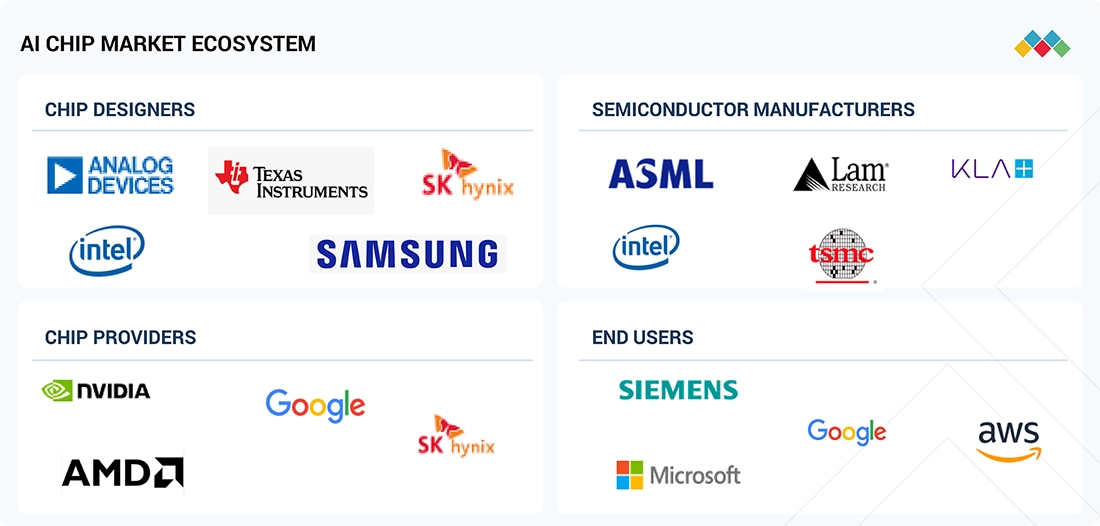
artificial-intelligence-chipset-market: COMMERCIAL USE CASES ACROSS INDUSTRIES
| COMPANY | USE CASE DESCRIPTION | BENEFITS |
|---|---|---|
 |
OVH SAS integrated 4th Gen AMD EPYC processors into its Bare Metal server lineup to boost performance and reliability for demanding AI inference workloads. | The deployment delivered a 15–20% performance uplift, higher resilience, and improved core density, enabling OVH SAS to provide more cost-efficient, high-performance cloud solutions. |
 |
Tencent adopted 3rd Gen Intel Xeon Scalable Processors with advanced acceleration features to power its Xiaowei intelligent speech and video service platform, enabling high-quality neural TTS processing. | The Intel-optimized solution enhanced speech synthesis performance, delivering faster, more efficient TTS capabilities for enterprises and intelligent device vendors. |
|
|
AIC deployed AMD EPYC-powered custom servers to build Western Digital’s high-density SSD test and validation chamber, enabling faster and more flexible drive testing in a compact environment. | The solution enhanced batch processing speeds, improved overall QA efficiency, and ensured rigorous SSD reliability validation to protect customer data. |
Logos and trademarks shown above are the property of their respective owners. Their use here is for informational and illustrative purposes only.
Related Ecosystem
Automotive Electronics And Electrical Equipment
- Battery Electric Vehicle (BEV)
- Light Commercial Vehicles (LCVs)
- Fuel Cell Electric Vehicle (FCEV)
- Sensors
- Hybrid Electric Vehicle (HEV)
- BOSCH LIMITED
- DENSO Corporation
- Continental ag
- Panasonic Holdings Corporation
- Texas Instruments Incorporated
Analytics
- Natural Language Processing (NLP)
- Machine Learning
- Supply Chain Management
- Predictive Analytics
- Image Sensors
- International Business Machines Corporation
- MICROSOFT CORPORATION
- Oracle Corporation
- SAP SE
Cloud Computing
- Software as A Service (SaaS)
- Natural Language Processing (NLP)
- Platform as A Service (PaaS)
- Machine Learning
- Supply Chain Management
- International Business Machines Corporation
- MICROSOFT CORPORATION
- Oracle Corporation
- Amazon.com, Inc.
Key Takeaways
- Rest Of Middle East AI chip market valued at USD 1,004.3 million in 2025 with projected growth to USD 1,130.7 million by 2030.
- Rest Of Middle East exhibits a 1.7% CAGR, indicating steady but modest market expansion over the forecast period.
- Rest Of Middle East's growth is primarily driven by enterprise data center modernization and digital transformation initiatives.
- Rest Of Middle East represents a developing AI semiconductor market with selective adoption patterns and emerging infrastructure investments.
AI Chip Market Report Scope
| Report Metric | Details |
|---|---|
| Base Year | 2025 |
| Fastest Growing Segment | NIC/NETWORK ADAPTERS (Network) |
| Forecast Period | 2025-2030 |
| Growth Rate | CAGR of 15.7% from 2025 to 2030 |
| Largest Segment | DATA CENTERS (End User) |
| Market Size Base Year (Billions) | ~USD 203.52 (2025) |
| Revenue Forecast (Billions) | ~USD 421.97 (2030) |
| Segments Covered | Compute, Memory, Network, Type, Technology, Function, End User |
Rest Of Middle East AI Chip Market Report Segmentation
7 segment dimensions are covered across the global market.
By Compute
- Ascend
- Athena Asic
- Cpu
- Dojo & Fsd
- Fpga
- Gpu
- Lpu
- Mtia
- Npu
- Other Asic
- T-Head
- Tpu
- Trainium & Inferentia
By Memory
- Ddr
- Hbm
By Network
- Interconnects
- Nic/Network Adapters
By Type
- Autoencoders
- Convolutional Neural Networks (Cnns)
- Deep Learning
- Ethernet
- Generative Adversarial Networks (Gans)
- Infiniband
- Rule-Based Models
- Statistical Models
- Transformer Models
By Technology
- Computer Vision
- Generative AI
- Machine Learning
- Natural Language Processing
By Function
- Inference
- Training
By End User
- Automotive
- Bfsi
- Cloud Service Providers
- Consumers
- Data Centers
- Enterprises
- Government Organizations
- Healthcare
- Media & Entertainment
- Retail & E-Commerce
Target Audience
- Semiconductor Manufacturers : Need Rest Of Middle East-specific demand forecasts and adoption drivers to optimize product portfolios, pricing strategies, and distribution channels for the region's emerging AI chip market.
- Technology Solution Providers : Require regional market insights to develop localized AI solutions, identify enterprise customers investing in digital transformation, and tailor offerings to Rest Of Middle East infrastructure requirements.
- Investment & Private Equity Firms : Seek detailed Rest Of Middle East market data to evaluate investment opportunities in regional tech companies, cloud providers, and semiconductor distributors with growth potential.
- Enterprise IT Decision Makers : Need market intelligence on AI chip availability, pricing trends, and technology roadmaps specific to Rest Of Middle East to inform infrastructure modernization and cloud adoption strategies.
- Government & Policy Advisors : Require regional market analysis to develop technology policies, support digital economy initiatives, and identify opportunities for building local semiconductor capabilities in Rest Of Middle East.
Reasons to Buy this Report
- Regional Market Sizing : Obtain precise valuation data for Rest Of Middle East AI chip market with verified 2025 baseline (USD 1,004.3M) and 2030 forecast (USD 1,130.7M), enabling accurate regional business planning and investment decisions.
- Growth Trajectory Analysis : Understand the 1.7% CAGR context within global 15.7% benchmarks, identifying why Rest Of Middle East grows slower and what factors could accelerate regional AI chip adoption.
- Digital Transformation Insights : Access detailed analysis of how digital transformation initiatives and cloud infrastructure investments specifically drive AI chip demand across Rest Of Middle East, informing go-to-market strategies.
- Competitive Positioning : Benchmark Rest Of Middle East market dynamics against other regions to identify competitive opportunities, market gaps, and strategic entry points for semiconductor vendors and solution providers.
- Investment & Expansion Planning : Leverage region-specific market intelligence to support capital allocation decisions, partnership strategies, and expansion plans tailored to Rest Of Middle East's unique growth profile and infrastructure needs.
Frequently asked questions
What is the current market size of AI chips in Rest Of Middle East?
Rest Of Middle East's AI chip market is estimated at USD 1,004.3 million in 2025.
What is the projected market size for Rest Of Middle East by 2030?
Rest Of Middle East's AI chip market is forecasted to reach USD 1,130.7 million by 2030.
What is the CAGR for the AI chip market in Rest Of Middle East?
Rest Of Middle East's AI chip market is expected to grow at a CAGR of 1.7% from 2025 to 2030.
What are the primary growth drivers for Rest Of Middle East's AI chip market?
Rest Of Middle East's market growth is driven by enterprise data center investments, digital transformation initiatives, and increasing adoption of cloud infrastructure and edge computing solutions.
How does Rest Of Middle East's AI chip market compare to global trends?
Rest Of Middle East exhibits a more conservative growth trajectory at 1.7% CAGR compared to the global market CAGR of 15.7%, reflecting a developing AI ecosystem and selective technology adoption patterns.
RESEARCH METHODOLOGY
The research process for this study involved the systematic gathering, recording, and analysis of data on customers and companies operating in the AI chip market. This process involved the extensive use of secondary sources, directories, and databases (Factiva and Oanda) to identify and collect valuable information for a comprehensive, technical, market-oriented, and commercial study of the AI chip market. In-depth interviews were conducted with primary respondents, including experts from core and related industries, as well as preferred manufacturers, to obtain and verify critical qualitative and quantitative information, and to assess growth prospects. Key players in the AI chip market were identified through secondary research, and their market rankings were determined through a combination of primary and secondary research. This research involved studying the annual reports of top players and conducting interviews with key industry experts, including CEOs, directors, and marketing executives.
Secondary Research
During the secondary research process, various sources were utilized to identify and collect information relevant to this study. These include annual reports, press releases, and investor presentations from companies, as well as white papers, technology journals, certified publications, articles by recognized authors, directories, and databases.
Secondary research was primarily used to gather key information about the industry's value chain, the total pool of market players, the classification of the market according to industry trends, and regional markets, as well as key developments from both market- and technology-oriented perspectives.
Primary Research
Primary research was also conducted to identify the segmentation types, key players, competitive landscape, and key market dynamics, including drivers, restraints, opportunities, challenges, and industry trends, as well as the key strategies adopted by players operating in the AI chip market. Extensive qualitative and quantitative analyses were performed on the complete market engineering process to list key information and insights throughout the report.
Extensive primary research has been conducted following the acquisition of knowledge about the AI chip market scenario through secondary research. Several primary interviews have been conducted with experts from both the demand side (end use and region) and the supply side (offering, technology, and function) across four major geographic regions: North America, Europe, Asia Pacific, and RoW. Approximately 80% and 20% of the primary interviews were conducted from the supply and demand sides, respectively. This primary data was collected through questionnaires, emails, and telephonic interviews.
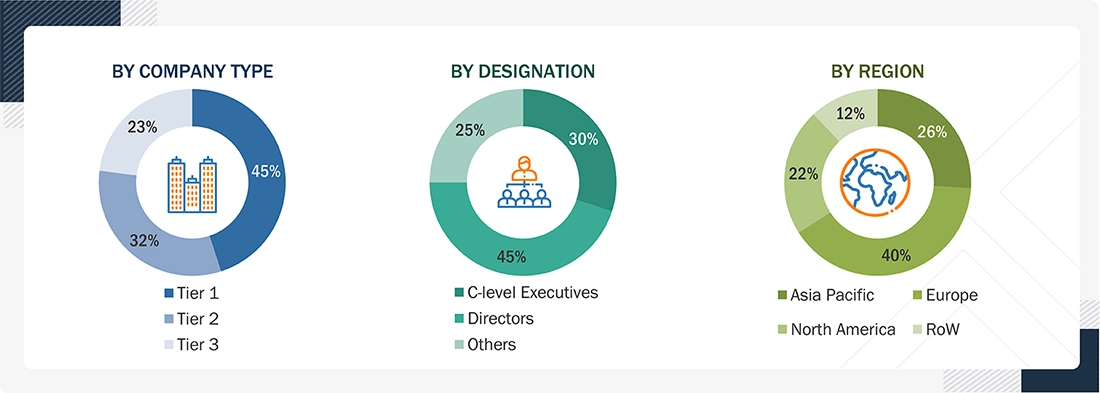
Note: Other designations include technology heads, media analysts, sales managers, marketing managers, and product managers.
The three tiers of the companies are based on their total revenues as of 2024 ? Tier 1: >USD 1 billion, Tier 2: USD 500 million–1 billion, and Tier 3: USD 500 million.
To know about the assumptions considered for the study, download the pdf brochure
Market Size Estimation
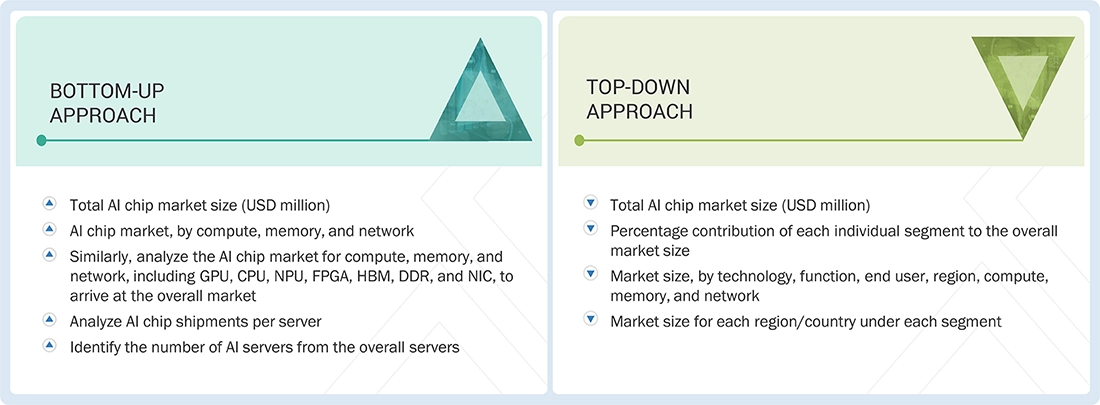
Throughout the comprehensive market engineering process, both top-down and bottom-up approaches were employed, along with several data triangulation methods, to estimate and validate the size of the AI chip market and its various dependent submarkets. Key players in the market were identified through secondary research, and their market share in the respective regions was determined through a combination of primary and secondary research. This entire research methodology involved studying the annual and financial reports of the top players, as well as conducting interviews with experts (including CEOs, VPs, directors, and marketing executives) to gather key insights (both quantitative and qualitative).
All percentage shares, splits, and breakdowns were determined using secondary sources and verified through primary sources. All the possible parameters that affect the markets covered in this research study were accounted for, viewed in detail, verified through primary research, and analyzed to obtain the final quantitative and qualitative data. This data was consolidated and supplemented with detailed inputs and analysis from MarketsandMarkets and presented in this report.
Bottom-Up Approach
- Initially, the companies offering AI chips were identified. Their products were categorized based on compute, memory, network, technology, function, and end user.
- After understanding the different types of AI chips offered by various manufacturers, the market was categorized into segments based on the data gathered through primary and secondary sources.
- To derive the global AI chip market, global chip shipments of top players for AI servers considered in the report's scope were tracked.
- A suitable penetration rate was assigned for compute, memory, and network offerings to derive the shipments of AI chips.
- We derived the AI chip market based on different offerings using the average selling price (ASP) at which a particular company offers its devices. The ASP of each offering was identified based on secondary sources and validated through primary sources.
- For the CAGR, a market trend analysis was conducted by examining the industry penetration rate, as well as the demand and supply of AI chips for various end users.
- The AI chip market is also tracked through the data sanity method. The revenues of key providers were analyzed through annual reports and press releases and summed to derive the overall market.
- For each company, a percentage is assigned to its overall revenue or, in a few cases, segmental revenue to derive its revenue for the AI chips. This percentage for each company is assigned based on its product portfolio and the range of AI chip offerings it provides.
- The estimates at every level were verified and cross-checked through discussions with key opinion leaders, including CXOs, directors, and operations managers, and subsequently validated by domain experts at MarketsandMarkets.
- Various paid and unpaid sources of information, such as annual reports, press releases, white papers, and databases, were studied.
Top-Down Approach
- The global market size of AI chips was estimated based on data from major companies.
- The growth of the AI chip market exhibited an upward trend during the studied period, as it is currently in the initial stage of the product cycle, with major players beginning to expand their business into various market application areas.
- The types of AI chips, their features and properties, geographic presence, and key applications served by all players in the AI chip market were studied to estimate and determine the percentage split of the segments.
- Different types of AI chip offerings, including compute, memory, and network, and their penetration among end users, were also studied.
- Based on secondary research, the market was categorized by compute, memory, network, technology, function, and end user.
- The demand generated by companies operating in different end-use application segments was analyzed.
- Multiple discussions were conducted with key opinion leaders across major companies involved in developing AI chips and related components to validate the market split by compute, memory, network, technology, function, and end user.
- The regional splits were estimated using secondary sources, based on factors such as the number of players in a specific country and region, as well as the adoption and use cases of each implementation type in relation to applications within the region.
Al Chip Market : Top-Down and Bottom-Up Approach
Data Triangulation
After determining the overall market size through the market size estimation process explained earlier, the total market was divided into several segments and subsegments. Data triangulation and market breakdown procedures were employed to complete the overall market engineering process and derive precise statistics for all segments and subsegments, as applicable. The data was triangulated by studying various factors and trends from both the demand and supply sides. Additionally, the AI chip market size was validated using both top-down and bottom-up approaches.
Market Definition
An AI chip is a type of specialized processor designed to efficiently perform artificial intelligence tasks, particularly in machine learning, natural language processing, generative AI, computer vision, and neural network computations. These chips are capable of conducting parallel processing in complex AI operations, including AI training and inference, allowing for faster execution of AI workloads compared to general-purpose processors.
Key Stakeholders
- Government and financial institutions, and investment communities
- Analysts and strategic business planners
- Semiconductor product designers and fabricators
- Application providers
- AI solution providers
- AI platform providers
- Business providers
- Professional service/solution providers
- Research organizations
- Technology standard organizations, forums, alliances, and associations
- Technology investors
Report Objectives
- To define, describe, and forecast the AI chip market based on offering, function, technology, and end user
- To forecast the size of the market segments for four major regions: North America, Europe, Asia Pacific, and the Rest of the World (RoW)
- To forecast the size and market segments of the AI chip market by volume based on offerings
- To provide detailed information regarding drivers, restraints, opportunities, and challenges influencing the growth of the market
- To provide an ecosystem analysis, case study analysis, patent analysis, technology analysis, pricing analysis, Porter's five forces analysis, investment and funding scenario, and regulations pertaining to the market
- To provide a detailed overview of the value chain analysis of the AI chip ecosystem
- To strategically analyze micro markets with regard to individual growth trends, prospects, and contributions to the total market
- To analyze opportunities for stakeholders by identifying high-growth segments of the market
- To strategically profile the key players, comprehensively analyze their market positions in terms of ranking and core competencies, and provide a competitive landscape of the market
- To analyze strategic approaches such as product launches, acquisitions, agreements, and partnerships in the AI chip market
- To understand and analyze the impact of the 2025 US trump tariff on the AI chip market
Available Customizations
With the given market data, MarketsandMarkets offers customizations according to the company’s specific needs. The following customization options are available for the report:
Company Information
- Detailed analysis and profiling of additional market players (up to 5)
Get the Full AI Chip Market Report
Full forecast, segment splits, and company analysis for all AI Chip Market.
- France AI Chip Market
- Spain AI Chip Market
- Italy AI Chip Market
- Rest Of Europe AI Chip Market
- China AI Chip Market
- Japan AI Chip Market
- South Korea AI Chip Market
- India AI Chip Market
- Rest Of Asia Pacific AI Chip Market
- GCC Countries AI Chip Market
- US AI Chip Market
- Canada AI Chip Market
- Mexico AI Chip Market
- Germany AI Chip Market
- UK AI Chip Market
Need a Tailored Report?
Customize this report to your needs
Get 10% FREE Customization
Customize This Report
