
New Zealand AI in Aviation Market (2025-2030)

The New Zealand AI in Aviation Market was valued at $14.6 Million in 2025 and projected to reach to $43.5 Million by 2030, representing a compound annual growth rate of 24.4%. New Zealand's AI in Aviation market is poised for substantial expansion, growing from USD 14.6 million in 2025 to USD 43.5 million by 2030.


| Market Size in | USD 26.32 MN |
| Market Forecast in | |
| CAGR | |
| Forecast Period | |
| Units Considered | Value (USD MN) |
New Zealand AI in Aviation Market Trends and Insights
- This represents a compound annual growth rate (CAGR) of 24.4%, significantly outpacing global trends.
- New Zealand's aviation sector is increasingly adopting AI-driven solutions for predictive maintenance, flight optimization, and autonomous systems, driven by the country's commitment to technological innovation and digital transformation within its aerospace ecosystem. The expansion of New Zealand's AI in Aviation market reflects growing investments in smart airport infrastructure and airline operational efficiency.
- New Zealand's geographic position and reliance on air connectivity have accelerated adoption of AI technologies for route optimization and safety enhancement.
- Between 2025 and 2030, New Zealand is expected to see heightened integration of machine learning algorithms and data analytics platforms across commercial and regional aviation operators, positioning the nation as a regional leader in aviation technology adoption within the Asia Pacific region..
Key Market Statistics
- CAGR (2025-2030) 24.4% CAGR
- Market Size, 2025 ~USD 14.6 Million
- Forecast, 2030 ~USD 43.5 Million
- Country New Zealand
New Zealand AI in Aviation Market Overview
Exceptional Growth Trajectory :
New Zealand's AI in Aviation market is expanding at 24.4% CAGR, outperforming the global average of 22.6%, driven by increasing adoption of intelligent aviation technologies across the country's aerospace sector.
Predictive Maintenance Leadership :
New Zealand aviation operators are rapidly implementing AI-powered predictive maintenance systems to reduce downtime, enhance aircraft reliability, and optimize operational costs across domestic and regional carriers.
Autonomous Systems Integration :
The nation's aviation industry is advancing autonomous flight systems and unmanned aerial vehicle (UAV) technologies, positioning New Zealand as a regional hub for AI-driven aviation innovation and testing.
Flight Optimization Adoption :
Airlines and operators in New Zealand are leveraging AI algorithms for route optimization, fuel efficiency, and real-time flight management, significantly improving operational performance and sustainability metrics.
New Zealand AI in Aviation Market Dynamics
- This robust 24.4% CAGR reflects the nation's commitment to modernizing its aviation infrastructure and embracing digital transformation across commercial, regional, and cargo operations.
- The market is driven by increasing investments in smart airport technologies, enhanced safety protocols, and competitive pressures to adopt cutting-edge solutions. Key growth catalysts include government support for aerospace innovation, partnerships between local operators and technology providers, and the rising demand for operational efficiency in New Zealand's geographically dispersed aviation network.
- As the market matures, emerging opportunities in AI-enabled air traffic management, crew optimization, and passenger experience personalization will further accelerate adoption, positioning New Zealand as a significant player in the Asia-Pacific aviation technology landscape..
Market Ecosystem
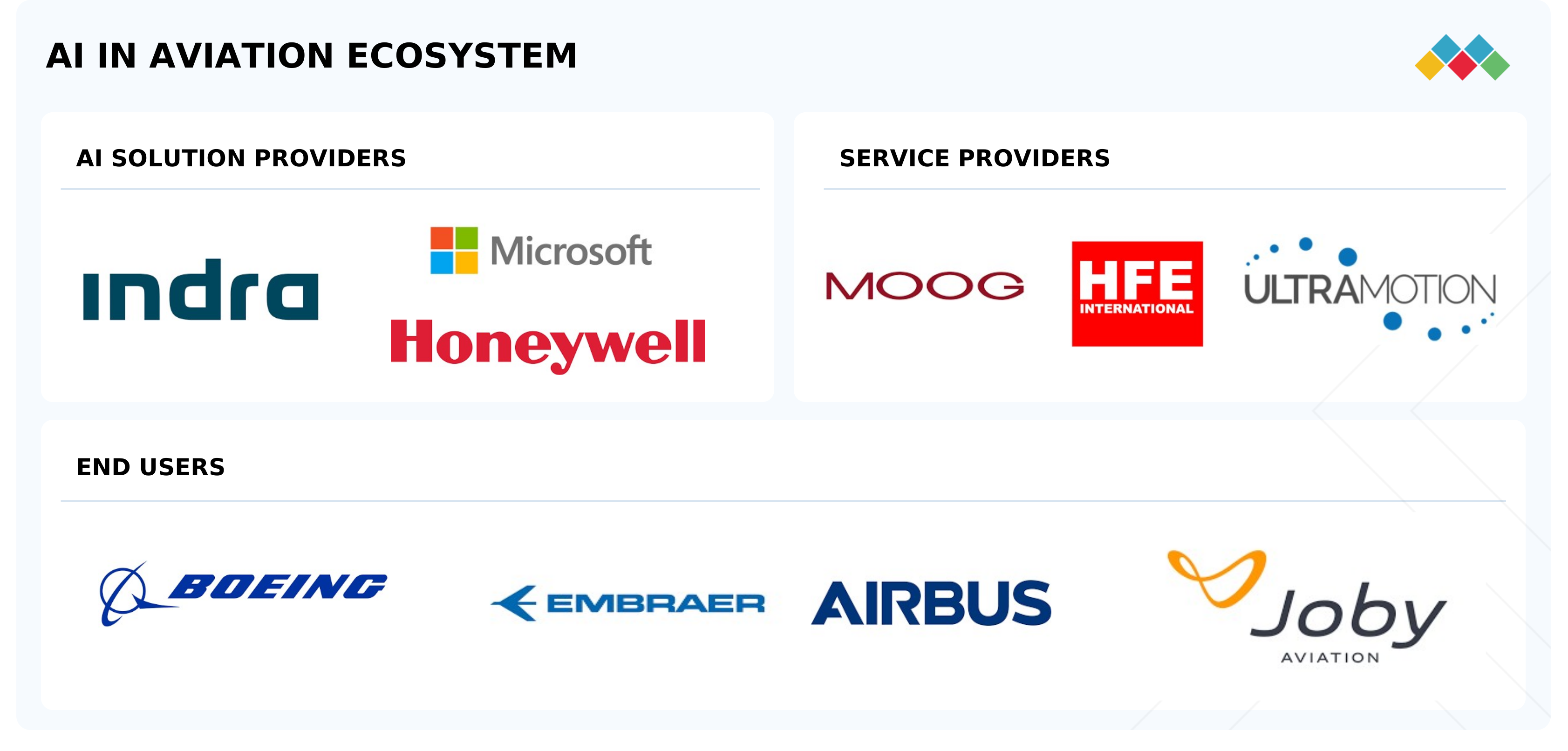
Artificial Intelligence (AI) in Aviation Market: COMMERCIAL USE CASES ACROSS INDUSTRIES
| COMPANY | USE CASE DESCRIPTION | BENEFITS |
|---|---|---|
 |
Deployment of Airbus Skywise platform integrating AI to predict maintenance issues across aircraft fleets | Up to 30 - 40% reduction in unscheduled maintenance, improved aircraft dispatch reliability, enhanced safety, and optimized lifecycle costs |
 |
Implementation of AI-driven tools by Delta Air Lines for baggage tracking and irregular operations management using predictive analytics and real-time data. | Reduced mishandled baggage rate to 0.47%, minimized delays, enhanced customer satisfaction, and improved operational resilience during disruptions |
Logos and trademarks shown above are the property of their respective owners. Their use here is for informational and illustrative purposes only.
Related Ecosystem
Aviation
- Narrow Body Aircraft
- Wide Body Aircraft
- Military Helicopters
- Special Mission Aircraft
- Fighter Aircraft
- HONEYWELL INTERNATIONAL INC.
- COLLINS AEROSPACE
- Thales group
- Safran group
- HEICO Corporation
Key Takeaways
- New Zealand's AI in Aviation market is valued at USD 14.6 million in 2025 and is forecast to grow to USD 43.5 million by 2030, representing a 24.4% CAGR.
- New Zealand's aviation operators are increasingly deploying AI for predictive maintenance, fuel optimization, and autonomous flight systems to enhance operational efficiency.
- New Zealand's geographic isolation and reliance on air transport are key drivers accelerating AI adoption across the country's aviation infrastructure.
- New Zealand is positioned as a regional innovation hub within Asia Pacific, with growing investment in AI-powered smart airport technologies and digital transformation initiatives.
AI in Aviation Market Report Scope
| Report Metric | Details |
|---|---|
| Base Year | 2025 |
| Fastest Growing Segment | ON-TIME PERFORMANCE MONITORING (Flight Operation) |
| Forecast Period | 2025-2030 |
| Growth Rate | CAGR of 22.6% from 2025 to 2030 |
| Largest Segment | INFRASTRUCTURE (Solution) |
| Market Size Base Year (Billions) | ~USD 1.75 (2025) |
| Revenue Forecast (Billions) | ~USD 4.86 (2030) |
| Segments Covered | Business Function, Flight Operation, Maintenance & Safety, Airport Operations & Ground Handling, Passenger Experience & Service, Solution, Infrastructure, Software, Service, Technology, Machine Learning, Computer Vision, End User |
New Zealand AI in Aviation Market Report Segmentation
13 segment dimensions are covered across the global market.
By Business Function
- Airport Operations & Ground Handling
- Flight Operations
- Maintenance & Safety
- Passenger Experience & Service
- R&D & Product Development
- Revenue Management
- Sustainability & Emission Management
- Training & Human Capital
By Flight Operation
- Crew Scheduling & Duty Time Optimization
- Fuel Efficiency Modeling
- On-Time Performance Monitoring
- Route Planning & Airspace Optimization
- Weather Disruption Rerouting
By Maintenance & Safety
- Automated Troubleshooting & Digital Workflows
- Fault Isolation & Diagnostics
- Predictive Maintenance
- Real-Time Aircraft Health Monitoring
- Spare Parts & Demand Forecasting
- Visual Inspection & Defect Detection
- Warranty Claim Optimization
By Airport Operations & Ground Handling
- Airside Congestion Forecasting
- Baggage Tracking & Rerouting
- Gate & Gse Assignment Optimization
- Passenger Flow Prediction & Check-In Allocation
- Tarmac Safety Monitoring
By Passenger Experience & Service
- Emotion Recognition & Sentiment Analysis
- Nlp-Based Virtual Assistants
- Passenger Safety & Risk Monitoring
- Personalized In-Flight Experience
- Real-Time Feedback Analytics
By Solution
- Infrastructure
- Services
- Software
By Infrastructure
- Computer Hardware
- Memory & Storage
- Networking
By Software
- AI Application Platforms
- AI Development Tools
By Service
- Core Data Services
- Integrated Services
By Technology
- Computer Vision
- Generative AI
- Machine Learning
- Natural Language Processing
- Sensor Fusion AI
By Machine Learning
- Reinforcement Learning
- Supervised Learning
- Unsupervised Learning
By Computer Vision
- Facial Recognition
- Object Detection
By End User
- Aircraft Manufacturers & System Integrators
- Airlines & Operators
- Airport Authorities
- Mro Providers
Target Audience
- Aviation Operators & Airlines : New Zealand-based carriers and regional operators need market data to evaluate AI technology investments, understand competitive adoption rates, and plan digital transformation initiatives for operational efficiency.
- Technology Solution Providers : AI and software vendors targeting New Zealand's aviation sector require detailed market sizing, growth forecasts, and application-specific demand insights to develop localized offerings and sales strategies.
- Airport Authorities & Infrastructure Managers : New Zealand airport operators need intelligence on AI adoption trends, smart airport technologies, and market growth projections to justify capital investments and modernization programs.
- Investment & Private Equity Firms : Investors evaluating opportunities in New Zealand's aerospace and aviation technology sectors require accurate market valuations, growth trajectories, and competitive landscape analysis for portfolio decisions.
- Government & Policy Makers : New Zealand regulatory bodies and economic development agencies need market research to inform aviation policy, innovation incentives, and strategic industry development initiatives aligned with growth opportunities.
Reasons to Buy this Report
- Market-Specific Growth Intelligence : Gain detailed insights into New Zealand's unique 24.4% CAGR trajectory, understanding local market drivers, adoption patterns, and competitive dynamics that differ from global trends.
- Investment Decision Support : Access comprehensive valuation data (USD 14.6M in 2025 to USD 43.5M in 2030) to inform strategic investments, partnerships, and market entry strategies specific to New Zealand's aviation sector.
- Competitive Positioning Analysis : Identify key players, technology adoption rates, and market gaps in New Zealand's AI aviation landscape to benchmark your organization against regional competitors and emerging opportunities.
- Sector-Specific Application Insights : Understand New Zealand's focus areas including predictive maintenance, autonomous systems, and flight optimization, enabling targeted product development and service offerings aligned with local demand.
- Regulatory and Operational Context : Leverage market intelligence on New Zealand's regulatory environment, infrastructure readiness, and operational challenges to develop compliant, market-fit solutions for aviation operators.
Frequently asked questions
What is the current market size of AI in Aviation in New Zealand?
New Zealand's AI in Aviation market was valued at USD 14.6 million in 2025 and is projected to reach USD 43.5 million by 2030.
What is the growth rate for AI in Aviation in New Zealand?
New Zealand's AI in Aviation market is growing at a compound annual growth rate (CAGR) of 24.4% from 2025 to 2030.
Which AI applications are most prevalent in New Zealand's aviation sector?
New Zealand's aviation industry is primarily adopting AI for predictive maintenance, flight route optimization, fuel efficiency, and autonomous systems integration.
What factors are driving AI adoption in New Zealand's aviation market?
New Zealand's geographic isolation, reliance on air connectivity, digital transformation initiatives, and investment in smart airport infrastructure are key growth drivers.
How does New Zealand's AI in Aviation market compare to the Asia Pacific region?
New Zealand's 24.4% CAGR demonstrates strong regional performance, positioning the country as a leader in aviation AI adoption within the Asia Pacific market.
RESEARCH METHODOLOGY
The study involved four major activities in estimating the current size of the AI in aviation market. Exhaustive secondary research was done to collect information on the AI in aviation market, its adjacent markets, and its parent market. The next step was to validate these findings, assumptions, and sizing with industry experts across the value chain through primary research. Demand-side analyses were carried out to estimate the overall size of the market. After that, market breakdown and data triangulation procedures were used to estimate the sizes of different segments and subsegments of the AI in aviation market.
Secondary Research
In the secondary research process, various sources were referred to to identify and collect information for this study. The secondary sources included government sources, such as SIPRI; corporate filings such as annual reports, press releases, and investor presentations of companies; white papers, journals, and certified publications; and articles from recognized authors, directories, and databases.
Primary Research
Extensive primary research was conducted after acquiring information about the AI in aviation market scenario through secondary research. Several primary interviews were conducted with market experts from both the demand and supply sides across major countries of North America, Europe, Asia Pacific, the Middle East, Africa, and Latin America. Primary data was collected through questionnaires, emails, and telephonic interviews.
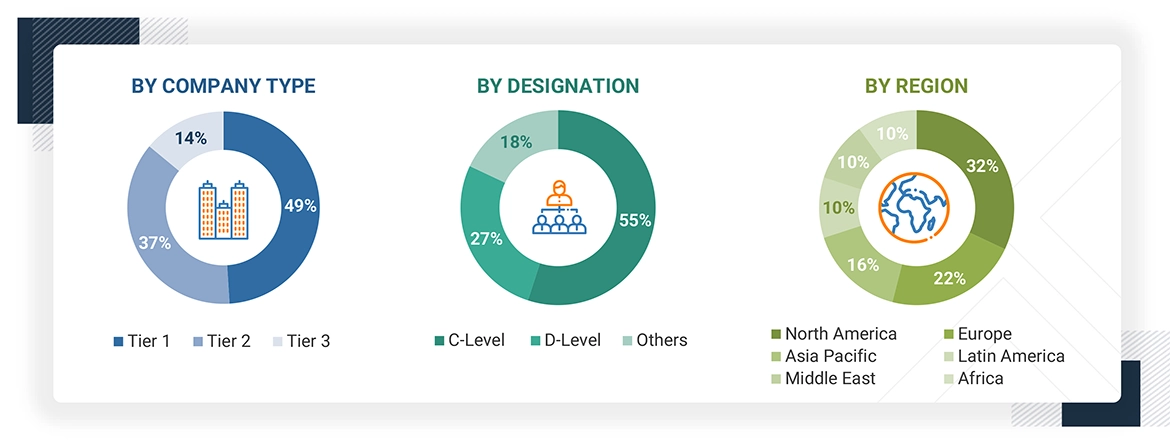
To know about the assumptions considered for the study, download the pdf brochure
Market Size Estimation
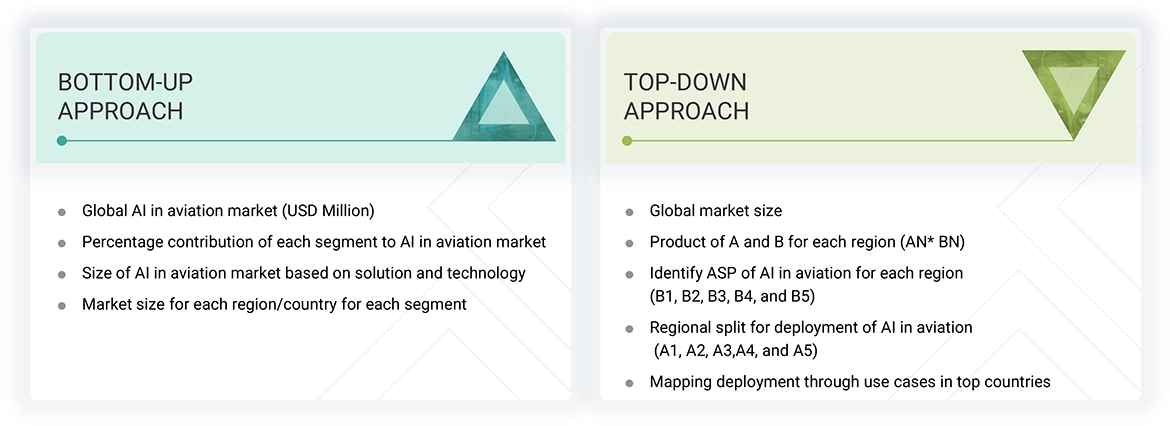
The top-down and bottom-up approaches were used to estimate and validate the size of the AI in aviation market. The research methodology used to estimate the size of the market includes the following details. Key players in the AI in aviation market were identified through secondary research, and their market share was determined through primary and secondary research. This included a study of the annual and financial reports of the top market players and extensive interviews with leaders such as directors, engineers, marketing executives, and other stakeholders of leading companies operating in the market. All percentage shares, splits, and breakdowns were determined using secondary sources and verified through primary sources. All possible parameters that affect the markets covered in this research study were accounted for, viewed in extensive detail, verified through primary research, and analyzed to obtain the final quantitative and qualitative data on the AI in aviation market. This data was consolidated, enhanced with detailed inputs, analyzed by MarketsandMarkets, and presented in this report.
AI in Aviation Market : Top-Down and Bottom-Up Approach
Data Triangulation
After arriving at the overall market size, the total market was split into several segments and subsegments. The data triangulation and market breakdown procedures explained below were implemented, wherever applicable, to complete the overall market engineering process and arrive at the estimated market numbers for the market segments and subsegments. The data was triangulated by studying various factors and trends from the demand and supply sides. The market size was also validated using the top-down and bottom-up approaches.
Market Definition
The AI in aviation refers to the ecosystem of AI solutions purpose-built for commercial aviation stakeholders, including airlines, airport operators, OEMs, and MRO providers, where AI is deployed as an aviation-specific enabler integrated across operations, infrastructure, passenger experience, and safety systems. This market strictly excludes military applications, general tourism platforms, and unrelated travel services, while explicitly covering airport operations and aviation infrastructure that support civil air transport.
Key Stakeholders
- Aircraft & Avionics OEMs
- AI Software & Algorithm Providers
- Cloud & Edge Infrastructure Providers
- Airport Operators & Airlines
- AI Hardware & Sensor Fusion Module Suppliers
- Air Traffic Management & Navigation System Providers
- End Users
- Regulatory & Certification Bodies (FAA, EASA, ICAO)
- Distributors & Systems Integrators
- R&D Institutions
Report Objectives
- To define, describe, segment, and forecast the size of the AI in aviation market based on solution, technology, business function, end user, and region
- To forecast the size of market segments with respect to various regions, including North America, Europe, Asia Pacific, the Middle East, Latin America, and Africa, along with key countries in each region
- To identify and analyze key drivers, opportunities, and challenges influencing market growth
- To identify prevailing technology trends in the AI in aviation market
- To analyze micro markets1 with respect to individual growth trends, prospects, and their contribution to the overall market
- To analyze opportunities in the market for stakeholders by identifying key market trends
- To profile key market players and comprehensively analyze their market share and core competencies2
- To analyze the degree of competition in the market by identifying key growth strategies, such as acquisitions, agreements, contracts, expansions, partnerships, and product launches, adopted by the leading market players
- To identify detailed financial positions, key products, and unique selling points of leading companies in the market
- To provide a detailed competitive landscape of the AI in aviation market, along with market share analysis and revenue analysis of key players
Available customizations:
MarketsandMarkets offers the following customizations for this market report:
- Additional country-level analysis of the AI in aviation market
- Profiling of up to five other players
- Product matrix, which provides a detailed comparison of the product portfolio of each company in the AI in aviation market
Get the Full AI in Aviation Market Report
Full forecast, segment splits, and company analysis for all AI in Aviation Market.
- Rest Of Europe AI in Aviation Market
- Rest Of Asia Pacific AI in Aviation Market
- Rest Of Latin America AI in Aviation Market
- Rest Of Middle East AI in Aviation Market
- Rest Of Africa AI in Aviation Market
- Canada AI in Aviation Market
- US AI in Aviation Market
- UK AI in Aviation Market
- France AI in Aviation Market
- Germany AI in Aviation Market
- Italy AI in Aviation Market
- Spain AI in Aviation Market
- China AI in Aviation Market
- India AI in Aviation Market
- Japan AI in Aviation Market
- South Korea AI in Aviation Market
- Australia AI in Aviation Market
- Saudi Arabia AI in Aviation Market
- UAE AI in Aviation Market
- Turkey AI in Aviation Market
- Brazil AI in Aviation Market
- Mexico AI in Aviation Market
- Chile AI in Aviation Market
- Argentina AI in Aviation Market
- South Africa AI in Aviation Market
- Egypt AI in Aviation Market
Need a Tailored Report?
Customize this report to your needs
Get 10% FREE Customization
Customize This Report
