
US Artificial Intelligence(AI) in Chemicals Market (2024-2029)

The US Artificial Intelligence(AI) in Chemicals Market was valued at $157.1 Million in 2024 and projected to reach to $713.2 Million by 2029, representing a compound annual growth rate of 35.3%. The US artificial intelligence in chemicals market is positioned for sustained high-growth expansion through 2029, driven by increasing digitalization of chemical manufacturing processes and heightened focus on operational efficiency.


| Market Size in | USD 26.32 MN |
| Market Forecast in | |
| CAGR | |
| Forecast Period | |
| Units Considered | Value (USD MN) |
US Artificial Intelligence(AI) in Chemicals Market Trends and Insights
- This robust growth reflects the US chemical industry's accelerating adoption of AI technologies for process optimization, predictive maintenance, and supply chain management.
- The US market is driven by significant investments from major chemical manufacturers and technology providers seeking competitive advantages through automation and data-driven decision-making. US enterprises are increasingly deploying AI solutions across formulation development, quality control, and manufacturing operations.
- The 35.3% compound annual growth rate (CAGR) through 2029 underscores the US market's momentum as regulatory frameworks evolve and AI capabilities mature.
- The US chemical sector's digital transformation agenda positions the country as a leading adopter of intelligent systems, with applications spanning from research and development to logistics optimization. The US market benefits from strong infrastructure, skilled workforce availability, and substantial R&D investment.
- By 2029, the US is expected to capture significant value as AI integration becomes standard practice across chemical production facilities and corporate operations..
Key Market Statistics
- CAGR (2024-2029) 35.3% CAGR
- Market Size, 2024 ~USD 157.1 Million
- Forecast, 2029 ~USD 713.2 Million
- Country US
US Artificial Intelligence(AI) in Chemicals Market Overview
Explosive Growth Trajectory :
The US AI in chemicals market is projected to grow from $157.1 million in 2024 to $713.2 million by 2029, representing a 35.3% CAGR. This growth significantly outpaces traditional chemical industry expansion, driven by digital transformation initiatives across major US chemical manufacturers.
Process Optimization Leadership :
US chemical companies are leveraging AI for advanced process optimization, predictive maintenance, and real-time quality control. Major investments from Fortune 500 chemical firms in AI infrastructure are accelerating adoption rates and creating competitive advantages in manufacturing efficiency.
Supply Chain Intelligence :
AI-powered supply chain management solutions are becoming critical for US chemical manufacturers facing complex logistics challenges. Predictive analytics and demand forecasting tools are reducing operational costs and improving inventory management across the sector.
Regional Innovation Hub :
The US hosts leading AI technology providers and chemical companies, creating a robust ecosystem for innovation. Strategic partnerships between tech firms and chemical manufacturers are accelerating AI solution development and market penetration in the region.
US Artificial Intelligence(AI) in Chemicals Market Dynamics
- Major US chemical producers are prioritizing AI investments to enhance competitiveness, reduce production costs, and improve product quality.
- The convergence of advanced AI capabilities with industry-specific challenges creates significant opportunities for solution providers and end-users alike. Regulatory support for industrial innovation and substantial R&D budgets from leading US chemical companies will continue fueling market growth.
- Integration of AI with IoT sensors, cloud computing, and advanced analytics platforms is enabling real-time decision-making and autonomous process management.
- As AI technologies mature and become more accessible, mid-sized chemical manufacturers will increasingly adopt these solutions, further expanding the addressable market and driving sustained growth momentum..
Market Ecosystem
Related Ecosystem
Analytics
- Natural Language Processing (NLP)
- Machine Learning
- Supply Chain Management
- Predictive Analytics
- Image Sensors
- International Business Machines Corporation
- MICROSOFT CORPORATION
- Oracle Corporation
- SAP SE
Software And Services
- Natural Language Processing (NLP)
- Machine Learning
- Supply Chain Management
- Predictive Analytics
- Image Sensors
- International Business Machines Corporation
- MICROSOFT CORPORATION
- Oracle Corporation
- SAP SE
- Amazon.com, Inc.
Industrial Automation
- Sensors
- Image Sensors
- Manufacturing Execution System (MES)
- Actuators
- Flow Sensors
- Siemens ag
- ABB India Limited
- Emerson Electric Co.
- HONEYWELL INTERNATIONAL INC.
- SCHNEIDER ELECTRIC SE
Key Takeaways
- The US AI in chemicals market will grow from $157.1M (2024) to $713.2M (2029) at a 35.3% CAGR.
- US chemical manufacturers are prioritizing AI for process optimization, predictive maintenance, and supply chain efficiency.
- The US market benefits from advanced infrastructure, regulatory support, and substantial technology investment.
- By 2029, AI integration is expected to become standard practice across US chemical production and operations.
Artificial Intelligence(AI) in Chemicals Market Report Scope
| Report Metric | Details |
|---|---|
| Base Year | 2024 |
| Fastest Growing Segment | MANAGED SERVICES (Service) |
| Forecast Period | 2024-2029 |
| Growth Rate | CAGR of 39.2% from 2024 to 2029 |
| Largest Segment | SOFTWARE (Offering) |
| Market Size Base Year (Billions) | ~USD 0.73 (2024) |
| Revenue Forecast (Billions) | ~USD 3.8 (2029) |
| Segments Covered | Component, Hardware, Software Type, Technology, Deployment Mode, Service, Professional Service, Business Application, End User, Offering, Business Function, Vertical |
US Artificial Intelligence(AI) in Chemicals Market Report Segmentation
12 segment dimensions are covered across the global market.
By Component
- Hardware
- Services
- Software
By Hardware
- Accelerators
- Memory
- Network
- Processors
By Software Type
- Chemical Modeling Software
- Chemical Property Prediction Tools
- Dashboard & Analytics Tools
- Laboratory Management Software
- Process Simulation Software
- Virtual Screening Tools
By Technology
- Advanced Analytics
- Computer Vision
- Context Awareness
- Deep Learning
- Generative AI
- Machine Learning
- ML
- Natural Language Processing
- Nlp
By Deployment Mode
- Cloud
- On-Premises
By Service
- Managed Services
- Professional Services
By Professional Service
- Consulting Services
- Deployment & Integration Services
- Support & Maintenance Services
By Business Application
- Production
- R&D
- Strategy Management
- Supply Chain Management
By End User
- Active Ingredients
- Adhesive & Sealants
- Adhesives & Sealants
- Advance Materials
- Advanced Materials
- Basic & Chemicals
- Basic Chemicals
- Green & Biochemicals
- Other End Users
- Paints & Coatings
- Water Treatment & Services
By Offering
- Hardware
- Services
- Software
By Business Function
- Finance
- Human Resource
- Law
- Marketing & Sales
- Operations
- Security
- Supply Chain Management
By Vertical
- Agriculture
- Automotive, Transportation, And Logistics
- Bfsi
- Construction And Real Estate
- Energy & Utilities
- Energy And Utilities
- Energy And Utilties
- Government & Defense
- Government And Defense
- Healthcare & Life Sciences
- It & Ites
- It/Ites
- Manufacturing
- Media & Entertainment
- Other Verticals
- Retail & Ecommerce
- Telecom
- Transportation & Logistics
Target Audience
- Chemical Manufacturers & Producers : US-based chemical companies need this data to benchmark their AI adoption against competitors, identify technology gaps, and make informed investment decisions in digital transformation initiatives to maintain market competitiveness.
- AI & Software Solution Providers : Technology vendors targeting the US chemical sector require detailed market insights to validate demand, size addressable opportunities, develop industry-specific solutions, and establish effective sales strategies for chemical industry clients.
- Private Equity & Venture Capital : Investment firms evaluating opportunities in the US AI and chemicals space need comprehensive market data to assess growth potential, identify acquisition targets, and make data-driven funding decisions in this high-growth segment.
- Management Consultants & Strategy Firms : Consulting professionals advising US chemical companies on digital transformation require detailed market analysis to develop credible strategic recommendations, benchmark performance, and guide clients through AI implementation roadmaps.
- Industry Analysts & Researchers : Market research professionals and financial analysts covering the US chemical and technology sectors need verified market data to support investment research, industry reports, and client advisory services with accurate, region-specific insights.
Reasons to Buy this Report
- Market Size & Growth Validation : Obtain precise US market valuation ($157.1M in 2024) and verified 5-year forecast ($713.2M by 2029) to support strategic planning, investment decisions, and competitive positioning in the rapidly expanding AI chemicals sector.
- Regional Competitive Intelligence : Gain detailed insights into US-specific market dynamics, major player strategies, and regional adoption patterns to identify competitive advantages and market entry opportunities unique to the American chemical industry landscape.
- Investment & Funding Decisions : Access comprehensive data on US market growth drivers, technology trends, and investment hotspots to guide capital allocation, M&A strategies, and partnership development within the high-growth AI chemicals segment.
- Product Development Roadmap : Understand US customer requirements, pain points, and emerging use cases in process optimization and supply chain management to align product development priorities and accelerate time-to-market for AI solutions.
- Sales & Marketing Strategy : Leverage US-specific market segmentation, customer profiles, and adoption trends to refine go-to-market strategies, identify high-value customer segments, and optimize sales messaging for maximum conversion and market penetration.
Frequently asked questions
What is the current size of the US AI in chemicals market?
The US AI in chemicals market was valued at $157.1 million in 2024 and is projected to reach $713.2 million by 2029.
What is the growth rate of the US AI in chemicals market?
The US market is growing at a compound annual growth rate (CAGR) of 35.3% from 2024 to 2029.
What are the primary applications of AI in the US chemicals industry?
US chemical companies are deploying AI for process optimization, predictive maintenance, formulation development, quality control, supply chain management, and logistics optimization.
What factors are driving AI adoption in the US chemicals market?
Key drivers include competitive pressure for efficiency gains, significant R&D investments, advanced digital infrastructure, regulatory support, and the availability of skilled AI talent in the US.
How will the US AI in chemicals market evolve by 2029?
By 2029, AI integration is expected to become standard practice across US chemical manufacturing facilities, with widespread adoption in research, production, and operational management.
RESEARCH METHODOLOGY
The research study for the AI in chemicals market involved extensive secondary sources, directories, International Journal of Innovation and Technology Management and paid databases. Primary sources were mainly industry experts from the core and related industries, preferred AI in chemicals market providers, third-party service providers, consulting service providers, end users, and other commercial enterprises. In-depth interviews were conducted with various primary respondents, including key industry participants and subject matter experts, to obtain and verify critical qualitative and quantitative information, and assess the market’s prospects.
Secondary Research
The market size of companies offering AI in chemicals hardware, software and services was arrived at hardware, software, and services was determined based on secondary data available through paid and unpaid sources. It was also arrived at by analyzing the product portfolios of major companies and rating the companies based on their performance and quality.
In the secondary research process, various sources were referred to, for identifying and collecting identify and collect information for this study. Secondary sources included annual reports, press releases, and investor presentations of companies; white papers, journals, and certified publications; and articles from recognized authors, directories, and databases. The data was also collected from other secondary sources, such as journals, government websites, blogs, and vendors' websites. Additionally, AI in chemicals spending of spending in various countries was extracted from the respective sources. Secondary research was mainly used to obtain key information related to the industry’s value chain and supply chain to identify key players based on hardware, software, services, market classification, and segmentation according to offerings of major players, industry trends related to components, business applications, end users, and regions, and key developments from both market- and technology-oriented perspectives.
Primary Research
In the primary research process, various primary sources from both the supply and demand sides were interviewed to obtain qualitative and quantitative information on the market. The primary sources from the supply side included various industry experts, including Chief Experience Officers (CXOs); Vice Presidents (VPs); directors from business development, marketing, and AI in chemicals expertise; related key executives from AI in chemicals solution vendors, System Integrators (SIs), professional service providers, and industry associations; and key opinion leaders.
Primary interviews were conducted to gather insights, such as market statistics, revenue data collected from hardware, software, and services, market breakups, market size estimations, market forecasts, and data triangulation. Primary research also helped in understandingunderstand various trends related to technologies, applications, deployments, and regions. Stakeholders from the demand side, such as Chief Information Officers (CIOs), Chief Technology Officers (CTOs), Chief Strategy Officers (CSOs), and end users using AI in chemicals hardware, software, and services, were interviewed to understand the buyer’s perspective on suppliers, products, service providers, and their current usage of AI in chemicals hardware, software, and services and services, which would impact the overall AI in chemicals market.
The following is the breakup of primary profiles:
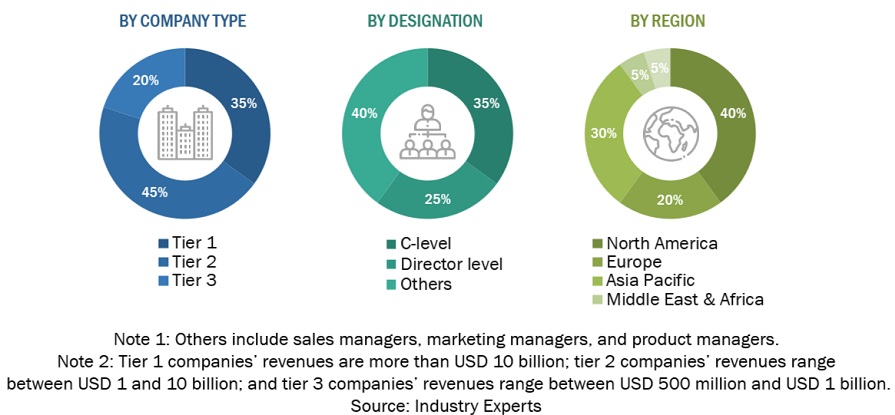
To know about the assumptions considered for the study, download the pdf brochure
Market Size Estimation
Multiple approaches were adopted for estimating and forecasting the AI in chemicals market. The first approach involves estimating the market size by summation of companies’ revenue generated through the sale of hardware, software and services.
Market Size Estimation Methodology-Top-down approach
In the top-down approach, an exhaustive list of all the vendors offering hardware, software and services in the AI in chemicals market was prepared. The revenue contribution of the market vendors was estimated through annual reports, press releases, funding, investor presentations, paid databases, and primary interviews. Each vendor’s offerings were evaluated based on the breadth of hardware, solutions, solution by component, business application, end user and regions. The aggregate of all the companies’ revenue was extrapolated to reach the overall market size. Each subsegment was studied and analyzed for its global market size and regional penetration. The markets were triangulated through both primary and secondary research. The primary procedure included extensive interviews for key insights from industry leaders, such as CIOs, CEOs, VPs, directors, and marketing executives. The market numbers were further triangulated with the existing MarketsandMarkets repository for validation.
Market Size Estimation Methodology-Bottom-up approach
In the bottom-up approach, the adoption rate of AI in chemicals hardware, software and services among different end users in key countries with respect to their regions contributing the most to the market share was identified. For cross-validation, the adoption of AI in chemicals hardware, software and services among industries, along with different use cases with respect to their regions, was identified and extrapolated. Weightage was given to use cases identified in different regions for the market size calculation.
Based on the market numbers, the regional split was determined by primary and secondary sources. The procedure included the analysis of the AI in chemicals market’s regional penetration. Based on secondary research, the regional spending on Information and Communications Technology (ICT), socio-economic analysis of each country, strategic vendor analysis of major AI in chemicals hardware, software and services providers, and organic and inorganic business development activities of regional and global players were estimated. With the data triangulation procedure and data validation through primaries, the exact values of the overall AI in chemicals hardware, software and services market size and segments’ size were determined and confirmed using the study.
Top-down and Bottom-up approaches
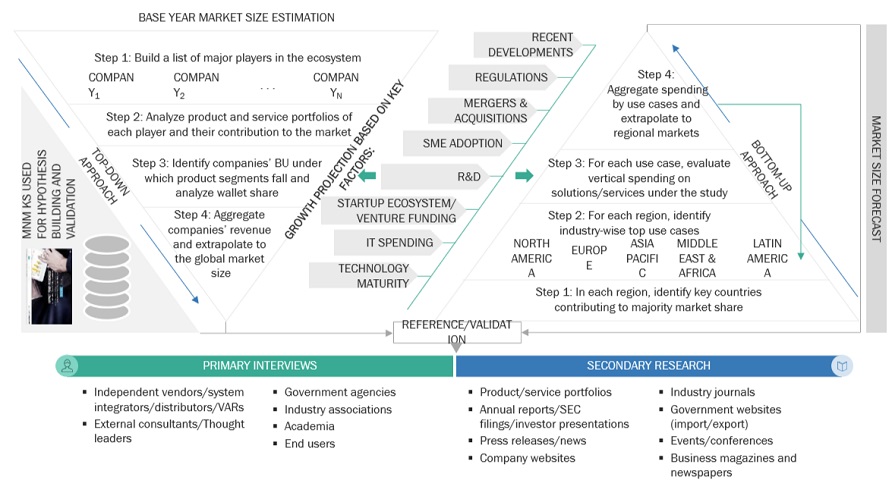
To know about the assumptions considered for the study, Request for Free Sample Report
Data Triangulation
After arriving at the overall market size using the market size estimation processes as explained above, the market was split into several segments and subsegments. To complete the overall market engineering process and arrive at the exact statistics of each market segment and subsegment, data triangulation and market breakup procedures were employed, wherever applicable. The overall market size was then used in the top-down procedure to estimate the size of other individual markets via percentage splits of the market segmentation.
Market Definition
According to Nexocode, Artificial Intelligence (AI) is a powerful tool that can help chemical companies work smarter and faster. The technology enables more productive processes by automating tasks, providing insights into how chemicals react, or improving manufacturing environments.
AI in chemicals refers to the application of AI technologies and techniques within the chemical industry to enhance processes, improve decision-making, and drive innovation. It uses advanced algorithms, machine learning models, and data analytics to optimize various aspects of chemical production, research and development, supply chain management, and environmental sustainability. AI in chemicals enables companies to streamline operations, develop new materials and products more efficiently, and respond effectively to market dynamics, ultimately leading to improved productivity, cost savings, and competitive advantage.
Stakeholders
- AI in Chemicals Sofware Providers
- AI Technology Providers
- Professional and Managed Service Providers
- Industry Associations
- Research Institutions
- System Integrators
- Technology Consultants
- Independent Software Vendors (ISVs)
- Consulting Firms
- Value-Added Resellers (VARs)
- Government Agencies
Report Objectives
- To define, describe, and predict the AI in chemicals market by component (hardware, software, and services), business application, and end users.
- To provide detailed information related to major factors (drivers, restraints, opportunities, and industry-specific challenges) influencing the market growth
- To forecast the market size of segments with respect to five main regions: North America, Europe, Asia Pacific, Middle East & Africa, and Latin America
- To strategically analyze micromarkets with respect to individual growth trends, prospects, and contributions to the overall AI in chemicals market
- To analyze opportunities in the market and provide details of the competitive landscape for stakeholders and market leaders
- To analyze competitive developments, such as partnerships, mergers and acquisitions, and product developments, in the AI in chemicals market
- To analyze the impact of the recession across all the regions in the AI in chemicals market
Available Customizations
With the given market data, MarketsandMarkets offers customizations as per the company’s specific needs. The following customization options are available for the report:
Product Analysis
- The product matrix provides a detailed comparison of the product portfolio of each company.
Geographic Analysis as per Feasibility
- Further breakup of the North American AI in chemicals Market
- Further breakup of the European Market
- Further breakup of the Asia Pacific Market
- Further breakup of the Middle East & Africa Market
- Further breakup of the Latin American AI in chemicals Market
Company Information
- Detailed analysis and profiling of additional market players (up to five)
Get the Full Artificial Intelligence(AI) in Chemicals Market Report
Full forecast, segment splits, and company analysis for all Artificial Intelligence(AI) in Chemicals Market.
- France Artificial Intelligence(AI) in Chemicals Market
- Italy Artificial Intelligence(AI) in Chemicals Market
- Rest Of Europe Artificial Intelligence(AI) in Chemicals Market
- Spain Artificial Intelligence(AI) in Chemicals Market
- UK Artificial Intelligence(AI) in Chemicals Market
- India Artificial Intelligence(AI) in Chemicals Market
- Japan Artificial Intelligence(AI) in Chemicals Market
- Rest Of Asia Pacific Artificial Intelligence(AI) in Chemicals Market
- South Korea Artificial Intelligence(AI) in Chemicals Market
- Argentina Artificial Intelligence(AI) in Chemicals Market
- Brazil Artificial Intelligence(AI) in Chemicals Market
- Mexico Artificial Intelligence(AI) in Chemicals Market
- Rest Of Latin America Artificial Intelligence(AI) in Chemicals Market
- Saudi Arabia Artificial Intelligence(AI) in Chemicals Market
- South Africa Artificial Intelligence(AI) in Chemicals Market
- UAE Artificial Intelligence(AI) in Chemicals Market
- Canada Artificial Intelligence(AI) in Chemicals Market
- Germany Artificial Intelligence(AI) in Chemicals Market
- China Artificial Intelligence(AI) in Chemicals Market
Need a Tailored Report?
Customize this report to your needs
Get 10% FREE Customization
Customize This Report
