
Singapore ASEAN Point of Care Diagnostics Market (2025-2030)

The Singapore ASEAN Point of Care Diagnostics Market was valued at $127.42 Million in 2025 and projected to reach to $154.27 Million by 2030, representing a compound annual growth rate of 3.9%. Singapore's point of care diagnostics market is poised for steady expansion through 2030, supported by increasing demand for rapid diagnostic solutions in hospitals, clinics, and home healthcare settings.


| Market Size in | USD 26.32 MN |
| Market Forecast in | |
| CAGR | |
| Forecast Period | |
| Units Considered | Value (USD MN) |
Singapore ASEAN Point of Care Diagnostics Market Trends and Insights
- Singapore's advanced healthcare infrastructure, high healthcare spending, and strong regulatory framework position the city-state as a key hub for POC diagnostic adoption across ASEAN.
- The market in Singapore is driven by increasing demand for rapid diagnostic solutions, aging population demographics, and rising prevalence of chronic diseases requiring frequent monitoring. Singapore's healthcare system emphasizes preventive care and early disease detection, creating favorable conditions for POC diagnostic technologies.
- Singapore's strategic location and role as a medical tourism destination further accelerate market penetration of innovative diagnostic platforms.
- Between 2025 and 2030, Singapore is expected to see sustained growth fueled by technological advancements, expanded healthcare access in primary care settings, and integration of digital health solutions with point of care testing..
Key Market Statistics
- CAGR (2025-2030) 3.9% CAGR
- Market Size, 2025 ~USD 127.42 Million
- Forecast, 2030 ~USD 154.27 Million
- Country Singapore
Singapore ASEAN Point of Care Diagnostics Market Overview
Market Valuation :
Singapore's point of care diagnostics market is valued at USD 127.42 million in 2025, with projected growth to USD 154.27 million by 2030, driven by advanced healthcare infrastructure and high healthcare expenditure.
Growth Trajectory :
The Singapore POC diagnostics market is expanding at a CAGR of 3.9% through 2030, outpacing regional growth patterns and reflecting strong adoption of rapid diagnostic technologies in clinical and non-clinical settings.
Healthcare Infrastructure Leadership :
Singapore's world-class healthcare system, coupled with stringent regulatory standards and high per-capita healthcare spending, positions the nation as a premier market for innovative point of care diagnostic solutions.
ASEAN Hub Status :
As a key regional hub, Singapore drives POC diagnostic adoption across Southeast Asia through its advanced medical technology ecosystem, strong pharmaceutical distribution networks, and early adoption of healthcare innovations.
Singapore ASEAN Point of Care Diagnostics Market Dynamics
- The city-state's aging population and rising prevalence of chronic diseases are driving adoption of convenient, efficient diagnostic tools that enable faster clinical decision-making. Government initiatives promoting digital health integration and preventive care, combined with Singapore's role as a medical technology hub, will accelerate market growth.
- Strategic investments by both local and international diagnostic manufacturers, alongside partnerships with healthcare institutions, will further strengthen Singapore's position as a leading POC diagnostics market in the ASEAN region..
Market Ecosystem
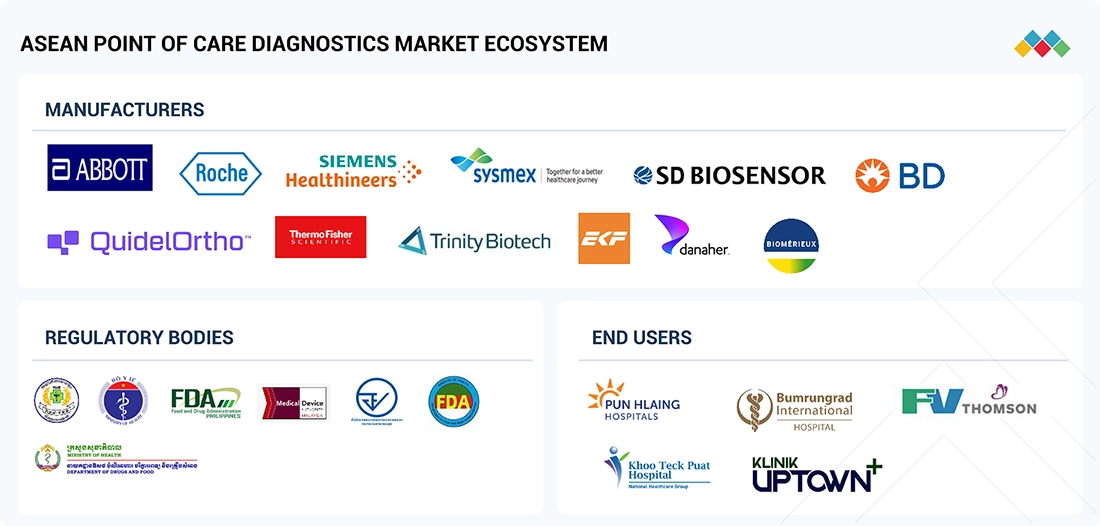
ASEAN Point of Care Diagnostics Market: COMMERCIAL USE CASES ACROSS INDUSTRIES
| COMPANY | USE CASE DESCRIPTION | BENEFITS |
|---|---|---|
 |
Provides a comprehensive range of POC diagnostics including glucose monitoring devices, cardiometabolic testing, and rapid infectious disease tests for hospitals, clinics, and home care settings. Emphasis on portable and easy-to-use solutions for chronic disease management. | Quick and reliable results for clinical and home use, supports continuous monitoring of chronic conditions, enhances patient self-management, scalable for high patient volumes, improves early intervention and treatment adherence. |
 |
Offers multiplex POC platforms for infectious diseases, cardiometabolic testing, and molecular diagnostics in hospitals, outpatient centers, and emergency care units. Focuses on integrated systems that combine sample-to-result automation. | High diagnostic accuracy, rapid turnaround times, simultaneous detection of multiple biomarkers, supports early disease detection and timely treatment decisions, reduces repeat testing and workflow burden, facilitates point-of-care decision-making in critical care. |
 |
Specializes in biochemistry-based POC testing for blood chemistry, electrolyte panels, liver and kidney function tests, and organ monitoring. Deploys compact and automated solutions in primary care centers, hospitals, and decentralized healthcare settings. | Automated, reliable, and reproducible results, reduces operator error, cost-effective, enables high-throughput testing, supports decentralized healthcare with minimal infrastructure, improves patient monitoring and disease management. |
 |
Provides a diverse portfolio of POC diagnostic instruments and assay kits for infectious disease detection, hematology, glucose monitoring, and cardiovascular markers in hospitals and clinics. Offers solutions designed for high-volume, decentralized testing environments. | Rapid and accurate results, supports multiple diagnostic applications from a single platform, improves operational efficiency and workflow integration, enhances clinical decision-making, scalable for large patient populations, facilitates timely monitoring and intervention. |
 |
Focuses on hematology and coagulation POC testing, with additional offerings for infectious diseases and chronic condition monitoring. Products are targeted at clinical laboratories, hospitals, and outpatient facilities for high-precision testing. | Accurate and reproducible results, easy-to-use compact platforms, supports timely patient management, enhances lab workflow efficiency, enables continuous monitoring of blood and coagulation parameters, facilitates early detection of abnormalities in critical care and routine testing. |
Logos and trademarks shown above are the property of their respective owners. Their use here is for informational and illustrative purposes only.
Related Ecosystem
Key Takeaways
- Singapore's POC diagnostics market is valued at USD 127.42 million in 2025 and will grow to USD 154.27 million by 2030 at a 3.9% CAGR.
- Singapore's advanced healthcare infrastructure and regulatory environment make it a regional leader in POC diagnostic adoption and innovation.
- Aging demographics and rising chronic disease prevalence in Singapore are key drivers of sustained demand for rapid diagnostic solutions.
- Singapore's emphasis on preventive care and digital health integration positions the market for accelerated growth through 2030.
ASEAN Point of Care Diagnostics Market Report Scope
| Report Metric | Details |
|---|---|
| Base Year | 2025 |
| Fastest Growing Segment | RESPIRATORY INFECTION TESTING PRODUCTS (Disease Type) |
| Forecast Period | 2025-2030 |
| Growth Rate | CAGR of 4.7% from 2025 to 2030 |
| Largest Segment | BIOCHEMISTRY (Technology) |
| Market Size Base Year (Billions) | ~USD 1.08 (2025) |
| Revenue Forecast (Billions) | ~USD 1.36 (2030) |
| Segments Covered | Product, Type, Disease Type, Technology, End User |
Singapore ASEAN Point of Care Diagnostics Market Report Segmentation
5 segment dimensions are covered across the global market.
By Product
- Cancer Marker Testing Products
- Cardiometabolic Testing Products
- Cholesterol Testing Products
- Coagulation Monitoring Products
- Drugs-Of-Abuse Testing Products
- Fecal Occult Testing Products
- Glucose Monitoring Products
- Hematology Testing Products
- Infectious Disease Testing Products
- Other Poc Products
- Pregnancy & Fertility Testing Products
- Urinalysis Testing Products
By Type
- Blood Gas & Electrolyte Testing Products
- Cardiac Marker Testing Products
- Glucometers
- Glucose Test Strips
- Hba1C Testing Products
- Hepatitis B Testing Products
- Hepatitis C Testing Products
- Influenza Testing Products
- Lancets
- Other Respiratory Infection Testing Products
- Tb Testing Products
By Disease Type
- Hai Testing Products
- Hepatitis Testing Products
- Hiv Testing Products
- Hospital-Acquired Infection Testing Products
- Mosquito-Borne Disease Testing Products
- Other Infectious Disease Testing Products
- Respiratory Infection Testing Products
- Std Testing Products
By Technology
- Biochemistry
- Lateral Flow Assays (Immunoassays)
- Rapid Tests (Molecular Diagnostics)
By End User
- Clinical Laboratories
- Home Care Settings
- Hospitals And Critical Care Centers
- Other End Users
- Outpatient Settings And Ambulatory Care Centers
SINGAPORE: ASEAN POINT OF CARE DIAGNOSTICS MARKET, BY END USER, 2022–2030
| Segment | 2022 | 2023 | 2024 | 2025 | 2026 | 2028 | 2029 | 2030 | CAGR (%) |
|---|---|---|---|---|---|---|---|---|---|
| CLINICAL LABORATORIES | 44.37 | 44.2 | 44.31 | 44.72 | 45.33 | 47.45 | 48.98 | 50.89 | 2.6 |
| HOME CARE SETTINGS | 55.54 | 56.48 | 57.84 | 59.63 | 61.78 | 67.6 | 71.39 | 75.89 | 4.9 |
| HOSPITALS AND CRITICAL CARE CENTERS | 12.13 | 12.24 | 12.43 | 12.72 | 13.07 | 14.07 | 14.75 | 15.55 | 4.1 |
| OTHER END USERS | 3.44 | 3.4 | 3.38 | 3.39 | 3.41 | 3.52 | 3.61 | 3.73 | 1.9 |
| OUTPATIENT SETTINGS AND AMBULATORY CARE CENTERS | 6.79 | 6.8 | 6.86 | 6.97 | 7.11 | 7.55 | 7.86 | 8.23 | 3.4 |
| TOTAL | 122.27 | 123.12 | 124.82 | 127.42 | 130.69 | 140.19 | 146.58 | 154.28 | 3.9 |
Target Audience
- Diagnostic Device Manufacturers : Manufacturers need Singapore-specific market data to assess market potential, identify growth opportunities, and develop localized go-to-market strategies for POC diagnostic products in this premium healthcare market.
- Healthcare Investors & PE Firms : Investors require detailed Singapore market analysis to evaluate investment opportunities in diagnostic companies, healthcare technology startups, and distribution networks operating in this high-growth ASEAN hub.
- Hospital & Clinical Networks : Healthcare institutions need market insights to benchmark procurement decisions, evaluate supplier options, and understand adoption trends for point of care diagnostics across Singapore's healthcare ecosystem.
- Pharmaceutical & Distribution Companies : Distributors and pharmaceutical companies need Singapore market intelligence to optimize product portfolios, identify partnership opportunities, and plan regional expansion strategies from this strategic ASEAN location.
- Healthcare Consultants & Analysts : Consultants require Singapore-specific market data to support client advisory work, competitive analysis, and strategic planning for healthcare organizations operating in or entering the Singapore diagnostics market.
Reasons to Buy this Report
- Market-Specific Sizing & Forecasts : Access precise valuation data for Singapore's POC diagnostics market (USD 127.42M in 2025) with detailed 5-year forecasts, enabling accurate business planning and investment decisions tailored to this high-value market.
- Competitive Intelligence for Singapore : Understand Singapore's unique competitive landscape, regulatory environment, and healthcare infrastructure advantages that differentiate it from other ASEAN markets, informing market entry and expansion strategies.
- Growth Driver Analysis : Identify key growth catalysts specific to Singapore including aging demographics, chronic disease prevalence, government health initiatives, and digital health integration driving POC diagnostic adoption.
- Regional Hub Opportunities : Leverage insights into Singapore's role as an ASEAN diagnostic hub to identify distribution, partnership, and expansion opportunities across Southeast Asia from this strategic market position.
- Investment & Stakeholder Insights : Gain actionable intelligence on healthcare spending patterns, institutional procurement trends, and technology adoption rates specific to Singapore's hospitals, clinics, and diagnostic centers for targeted business development.
Frequently asked questions
What is the current market size of point of care diagnostics in Singapore?
Singapore's point of care diagnostics market is valued at USD 127.42 million in 2025, with verified data from market analysis.
What is the projected market size for Singapore's POC diagnostics by 2030?
Singapore's POC diagnostics market is forecast to reach USD 154.27 million by 2030, representing growth of approximately USD 26.85 million over the forecast period.
What is the growth rate (CAGR) for Singapore's point of care diagnostics market?
Singapore's point of care diagnostics market is expected to grow at a compound annual growth rate of 3.9% from 2025 to 2030.
What factors are driving growth in Singapore's POC diagnostics market?
Key growth drivers in Singapore include advanced healthcare infrastructure, aging population, rising chronic disease prevalence, emphasis on preventive care, and integration of digital health technologies with POC testing.
How does Singapore's POC diagnostics market compare to the broader ASEAN region?
Singapore leads ASEAN in POC diagnostic adoption due to its superior healthcare infrastructure, regulatory framework, and healthcare spending, positioning it as a regional innovation hub for diagnostic technologies.
RESEARCH METHODOLOGY
The study involved major activities in estimating the current market size for the ASEAN point of care diagnostics market. Exhaustive secondary research was done to collect information on the ASEAN point of care diagnostics industry. The next step was to validate these findings, assumptions, and sizing with industry experts across the value chain using primary research. Different approaches, such as top-down and bottom-up, were employed to estimate the total market size. After that, the market breakup and data triangulation procedures were used to estimate the market size of the segments and subsegments of the ASEAN point of care diagnostics market.
The four steps involved in estimating the market size are:
Secondary Research
In the secondary research process, various secondary sources, such as company annual reports, press releases, and investor presentations, white papers, certified publications, articles by recognized authors, gold-standard and silver-standard websites, regulatory bodies, and databases (such as D&B Hoovers, Bloomberg Business, and Factiva), were referred to identify and collect information for this study.
Primary Research
In the primary research process, various supply and demand sources were interviewed to obtain qualitative and quantitative information for this report. Primary sources were mainly industry experts from the core and related industries and preferred suppliers, manufacturers, distributors, service providers, technology developers, researchers, and organizations related to all segments of this industry’s value chain. In-depth interviews were conducted with primary respondents, including key industry participants, subject-matter experts, C-level executives of key market players, and industry consultants, to obtain and verify critical qualitative and quantitative information and assess prospects.
The following is a breakdown of the primary respondents:
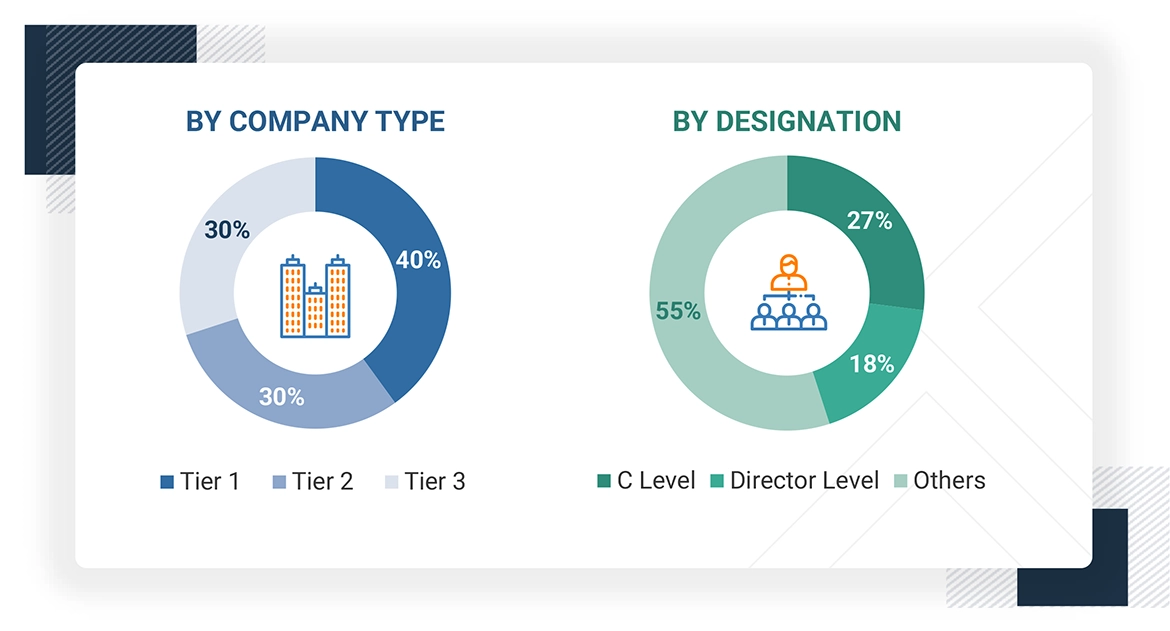
Note 1: Others include sales, marketing, and product managers.
Note 2: Companies are classified into tiers based on their total revenues. As of 2024, Tier 1 = >USD 100 million, Tier 2 = USD 10 million to USD 100 million, and Tier 3 = < USD 10 million.
To know about the assumptions considered for the study, download the pdf brochure
| COMPANY NAME | DESIGNATION |
|---|---|
| PTS Diagnostics | Regional Sales Manager |
| EKF Diagnostics Holdings plc | Product Manager |
Market Size Estimation
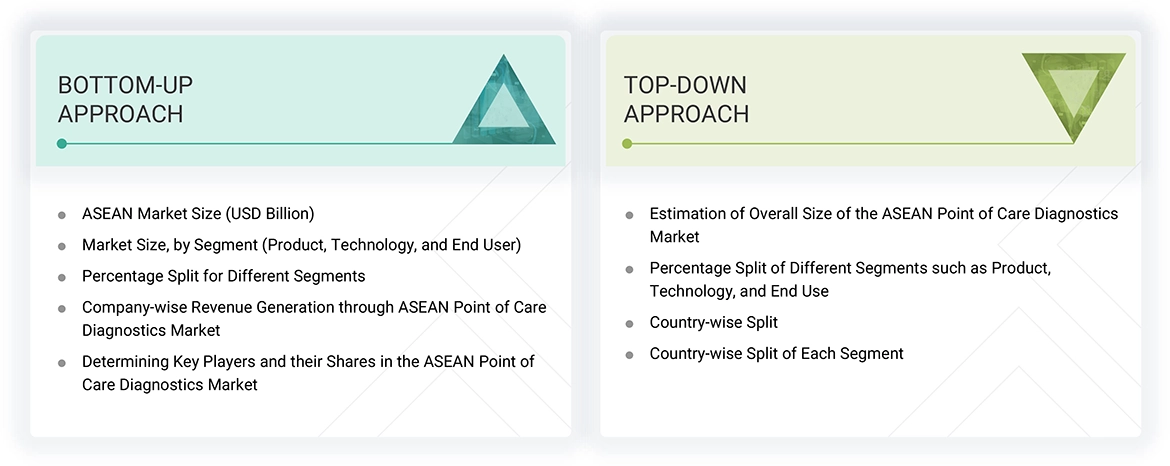
Both top-down and bottom-up approaches were used to estimate and validate the total size of the ASEAN point of care diagnostics market. These methods were also used extensively to estimate the size of various subsegments in the market. The research methodology used to estimate the market size includes the following:
- The key players in the industry have been identified through extensive secondary research
- Primary and secondary research has determined the revenues of leading players operating in the ASEAN point of care diagnostics market.
- All percentage shares, splits, and breakdowns have been determined using secondary sources and verified through primary sources.
The research methodology used to estimate the market size includes the following:
Data Triangulation
After arriving at the overall market size by applying the abovementioned process, the total market was split into several segments and subsegments. To complete the overall market engineering process and arrive at the exact statistics for all segments and subsegments, data triangulation and market breakdown procedures were employed, wherever applicable. The data was triangulated by studying various factors and trends from both the demand and supply sides.
Market Definition
Point of care testing (POCT) includes tests designed to be used at or near the patient's site (such as at home, in an ambulance, at a physician’s office, and other locations). POCT allows rapid & reliable diagnostic testing to obtain outcomes instantly, helping physicians/patients make care decisions remotely and rapidly.
Stakeholders
- Senior Management
- End User
- Finance/Procurement Department
- R&D Department
Report Objectives
- To define, describe, segment, and forecast the ASEAN point of care diagnostics market based on product, technology, end user, and country
- To provide detailed information regarding the major factors influencing market growth (such as drivers, restraints, opportunities, and challenges)
- To analyze the micromarkets with respect to individual growth trends, prospects, and contributions to the overall ASEAN point of care diagnostics market
- To analyze market opportunities for stakeholders and provide details of the competitive landscape for key players
- To forecast the size of the market segments with respect to ten countries, namely, Vietnam, Laos, Cambodia, Malaysia, Myanmar, Philippines, Singapore, Thailand, Indonesia, and Brunei
- To profile the key players and comprehensively analyze their product portfolios, market positions, and core competencies
- To track and analyze company developments such as product launches & approvals, partnerships, acquisitions, agreements, and other developments
- To benchmark players within the market using the proprietary Competitive Leadership Mapping framework, which analyzes market players on various parameters within the broad categories of business & product excellence
Get the Full ASEAN Point of Care Diagnostics Market Report
Full forecast, segment splits, and company analysis for all ASEAN Point of Care Diagnostics Market.
- Indonesia ASEAN Point of Care Diagnostics Market
- Thailand ASEAN Point of Care Diagnostics Market
- Malaysia ASEAN Point of Care Diagnostics Market
- Philippines ASEAN Point of Care Diagnostics Market
- Vietnam ASEAN Point of Care Diagnostics Market
- Brunei ASEAN Point of Care Diagnostics Market
- Cambodia ASEAN Point of Care Diagnostics Market
- Laos ASEAN Point of Care Diagnostics Market
- Myanmar ASEAN Point of Care Diagnostics Market
Need a Tailored Report?
Customize this report to your needs
Get 10% FREE Customization
Customize This Report
