
Singapore Asia-Pacific (APAC) Missile Market (2025-2030)

The Singapore Asia-Pacific (APAC) Missile Market was valued at $197.1 Million in 2025 and projected to reach to $381.3 Million by 2030, representing a compound annual growth rate of 14.1%. Singapore's missile market is poised for accelerated expansion through 2030, driven by geopolitical tensions in the Indo-Pacific region, increasing defence budgets, and the nation's strategic imperative to maintain advanced military capabilities.


| Market Size in | USD 26.32 MN |
| Market Forecast in | |
| CAGR | |
| Forecast Period | |
| Units Considered | Value (USD MN) |
Singapore Asia-Pacific (APAC) Missile Market Trends and Insights
- Valued at USD 197.1 million in 2025, Singapore's market is forecast to nearly double to USD 381.3 million by 2030, representing a compound annual growth rate of 14.1%.
- This accelerated growth trajectory significantly outpaces the global APAC average, positioning Singapore as a critical hub for missile technology development and procurement in the region. The expansion of Singapore's missile market is driven by heightened regional security concerns, modernization of defence capabilities, and strategic investments in advanced weaponry systems.
- Singapore's geographic position and role as a maritime security leader have catalyzed demand for sophisticated missile platforms and systems.
- Between 2025 and 2030, Singapore is expected to strengthen its defence procurement initiatives, supporting both indigenous development and international partnerships in missile technology. Singapore's market growth reflects broader geopolitical dynamics and the nation's commitment to maintaining technological superiority in regional defence.
- The country's emphasis on innovation and strategic defence partnerships continues to underpin sustained investment in missile systems and related capabilities through the forecast period..
Key Market Statistics
- CAGR (2025-2030) 14.1% CAGR
- Market Size, 2025 ~USD 197.1 Million
- Forecast, 2030 ~USD 381.3 Million
- Country Singapore
Singapore Asia-Pacific (APAC) Missile Market Overview
Exceptional Growth Trajectory :
Singapore's missile market is projected to nearly double from USD 197.1 million in 2025 to USD 381.3 million by 2030, with a CAGR of 14.1%, significantly outpacing the global APAC average of 11.1%.
Strategic Regional Hub :
Singapore's position as a critical maritime and aerospace defence hub in Southeast Asia drives demand for advanced missile systems, air defence capabilities, and naval strike platforms to secure regional shipping lanes and territorial waters.
Defence Modernization Initiatives :
Singapore's ongoing military modernization programs, including upgrades to air defence systems and naval capabilities, are fueling procurement of next-generation missile technologies and integrated defence solutions.
High-Value Market Opportunity :
With a CAGR of 14.1%, Singapore represents one of the fastest-growing missile markets in APAC, offering substantial opportunities for defence contractors and technology providers specializing in precision-guided systems and advanced weaponry.
Singapore Asia-Pacific (APAC) Missile Market Dynamics
- The city-state's emphasis on technological innovation and integration of cutting-edge defence systems positions it as a premium market for high-end missile platforms and air defence solutions.
- Government investments in modernizing the Singapore Armed Forces, coupled with regional security concerns, will sustain robust demand for advanced weaponry and integrated defence ecosystems throughout the forecast period..
Market Ecosystem
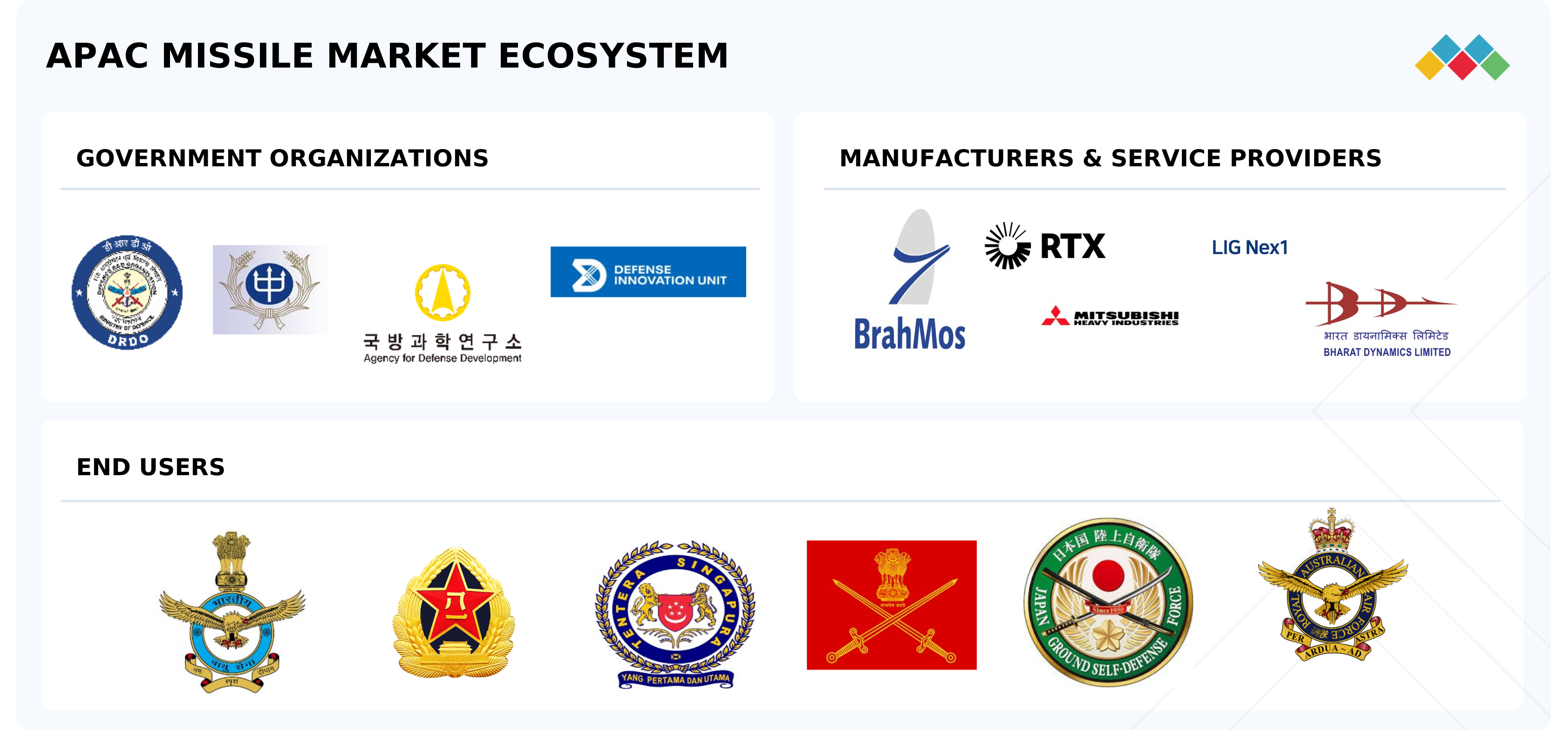
Asia-Pacific (APAC) Missile Market: COMMERCIAL USE CASES ACROSS INDUSTRIES
| COMPANY | USE CASE DESCRIPTION | BENEFITS |
|---|---|---|
 |
India’s DRDO and BEL developed and inducted the Akash-NG (Next Generation) Surface-to-Air Missile system (2021–2023), designed for improved range and faster reaction against aerial threats. | Provided extended range (up to 70 km), improved reaction time, and higher kill probability, strengthening India’s layered air defense capability |
 |
South Korea’s LIG Nex1 successfully developed and delivered the Cheongung-II (M-SAM Block-II) air defense system (2017–2023), deployed to replace legacy Nike and Hawk systems. | Offered enhanced interception of ballistic missiles, higher mobility, and improved accuracy, reinforcing South Korea’s missile defense shield |
 |
Japan’s Mitsubishi Heavy Industries (MHI), in partnership with the Japanese MoD, advanced the Type 12 Surface-to-Ship Missile modernization program (2022–2025), focusing on extended range and network-centric warfare. | Boosted long-range strike capability (up to 1,000 km), reduced reliance on foreign imports, and enhanced deterrence against regional threats |
Logos and trademarks shown above are the property of their respective owners. Their use here is for informational and illustrative purposes only.
Related Ecosystem
Key Takeaways
- Singapore's missile market is valued at USD 197.1 million in 2025 and is projected to reach USD 381.3 million by 2030, reflecting a 14.1% CAGR.
- Singapore's growth rate significantly exceeds the global APAC average of 11.1%, indicating accelerated regional demand and strategic importance.
- Singapore's maritime security role and geopolitical positioning drive sustained investment in advanced missile systems and defence modernization.
- Singapore's market expansion is supported by strategic defence partnerships and commitment to maintaining technological superiority in the region.
Asia-Pacific (APAC) Missile Market Report Scope
| Report Metric | Details |
|---|---|
| Base Year | 2025 |
| Fastest Growing Segment | HYPERSONIC (Speed) |
| Forecast Period | 2025–2030 |
| Growth Rate | CAGR of 11.1% from 2025 to 2030 |
| Largest Segment | SUPERSONIC (Speed) |
| Market Size Base Year (Billions) | ~USD 3.7 (2025) |
| Revenue Forecast (Billions) | ~USD 6.26 (2030) |
| Segments Covered | Type, Component, Speed, End User |
Singapore Asia-Pacific (APAC) Missile Market Report Segmentation
4 segment dimensions are covered across the global market.
By Type
- Air-To-Air
- Air-To-Surface
- Anti-Ship Missiles
- Anti-Tank Missiles
- Ballistic Missiles
- Batteries
- Beyond Visual Range Aam (>40 Km)
- Cruise Missiles
- Ground Attack Missiles
- Man-Portable Air Defense Systems
- Mobile Air Defense Systems
- Slbm
- Slcm
- Subsea-To-Surface
- Surface-To-Air
- Surface-To-Surface
- Turbo Alternators
- Within Visual Range Aam (<40 Km)
By Component
- Boosters
- Communication Links
- Detonating Mechanisms
- Guidance, Navigation, And Control
- Igniters
- Missile Airframes
- Motors & Actuators
- Navigation Systems
- Onboard Computers & Avionics
- Power Supplies
- Propulsion Systems
- Safety & Arming Mechanisms
- Seeker Systems
- Sustainers
- Warheads
By Speed
- Hypersonic
- Subsonic
- Supersonic
By End User
- Air Force
- Army
- Navy
SINGAPORE: MISSILE MARKET, BY END USER, 2025–2030
| Segment | 2025 | 2026 | 2027 | 2028 | 2029 | 2030 | CAGR (%) |
|---|---|---|---|---|---|---|---|
| AIR FORCE | 57.3 | 65.4 | 74.6 | 85.2 | 97.2 | 110.9 | 14.1 |
| ARMY | 31.8 | 35.6 | 39.8 | 44.5 | 49.7 | 55.5 | 11.7 |
| NAVY | 108 | 124 | 142.2 | 163.2 | 187.2 | 214.8 | 14.7 |
| TOTAL | 197.1 | 224.9 | 256.6 | 292.8 | 334.1 | 381.3 | 14.1 |
Target Audience
- Defence Contractors & OEMs : Missile manufacturers and aerospace defence companies need Singapore-specific market data to identify procurement opportunities, tailor product offerings to regional requirements, and establish strategic partnerships with local defence agencies.
- Government & Military Procurement : Singapore's Ministry of Defence and armed forces require market intelligence to benchmark international capabilities, evaluate vendor solutions, and justify defence budget allocations for missile system modernization programs.
- Investment & Private Equity Firms : Investors targeting the APAC defence sector need Singapore market analysis to identify high-growth opportunities, assess portfolio companies' competitive positioning, and evaluate acquisition targets in the missile and air defence space.
- Technology & Systems Integrators : Defence technology providers and systems integrators require detailed Singapore market insights to develop localized solutions, understand regulatory requirements, and identify partnerships for integrated defence system deployment.
- Strategic Consultants & Analysts : Management consulting firms and research institutions need Singapore-specific market data to support client advisory work, competitive analysis, and strategic planning in the Asia-Pacific defence and aerospace sectors.
Key Companies in the Singapore Asia-Pacific (APAC) Missile Market
| Company | HQ | Ownership | Strongest segments |
|---|---|---|---|
| RTX | United States | Public Company | Collins Aerospace (avionics, interiors, mission systems, aftermarket),Pratt & Whitney (commercial and military engines, APU, MRO),Raytheon (sensors, effectors, C2, space and cyber solutions), |
| MITSUBISHI HEAVY INDUSTRIES, LTD. | Japan | Public Company | Thermal power generation systems (gas turbine combined cycle, steam),Nuclear power systems and post-operational services,Wind power generators and CO2 capture / environmental systems, |
| LIG NEX1 | South Korea | Public Company | Precision Guided Munitions & Air/Missile Defense,Radars, Sensors & Weapon Locating Systems,Naval Warfare & Sonar Systems, |
| BHARAT DYNAMICS LIMITED | India | Public Company | Surface-to-air missile systems (Akash, Astra, MR-SAM, QRSAM, VL-SRSAM),Anti-tank guided missiles (NAG, MPATGM, Konkurs-M, Milan-2T, Invar, Amogha-III, Helina),Underwater weapons and ASW systems (torpedoes, ASW suites, Dishani, anti-torpedo decoys), |
| KALYANI RAFAEL ADVANCED SYSTEMS PVT. LTD. | India | Joint Venture | Missile systems and subsystems (assembly, integration, components),Air and missile defense systems (launchers, C2 elements, integration),Electro-optics, guidance, and avionics modules, |
| BEML LIMITED | India | Public Company | Mining & Construction Equipment,Rail & Metro Rolling Stock and Wagons,Defense & Aerospace Platforms and Aggregates, |
| ASTRA MICROWAVE PRODUCTS LTD | India | Public Company | Radar electronics (incl. active antenna arrays, T/R modules, SSPAs, receivers),Electronic warfare subsystems and antennas,Strategic electronics, seekers, and telemetry/data links, |
RTX
RTX is a United States-based public company founded in 1934 that employs 180,000 people. The company operates as a major aerospace and defense contractor.
MITSUBISHI HEAVY INDUSTRIES, LTD.
Mitsubishi Heavy Industries, Ltd. is a Japanese public company established in 1884 with 78,793 employees. The company is a diversified manufacturer operating in aerospace, defense, and industrial sectors.
LIG NEX1
LIG NEX1 is a South Korean public company founded in 1976 with 5,766 employees. The company specializes in defense and aerospace technologies.
BHARAT DYNAMICS LIMITED
Bharat Dynamics Limited is an Indian public company established in 1970 with 2,269 employees. The company is engaged in defense manufacturing and missile systems production.
KALYANI RAFAEL ADVANCED SYSTEMS PVT. LTD.
Kalyani Rafael Advanced Systems Pvt. Ltd. is an Indian joint venture established in 2015. The company operates in the defense and aerospace sectors.
BEML LIMITED
BEML Limited is an Indian public company founded in 1964 with 4,469 employees. The company is engaged in manufacturing and defense production.
ASTRA MICROWAVE PRODUCTS LTD
Astra Microwave Products Ltd. is an Indian public company founded in 1991 with 1,491 employees. The company manufactures microwave and defense electronics systems.
Reasons to Buy this Report
- Market Size & Growth Validation : Obtain precise market valuation data for Singapore (USD 197.1M in 2025) with verified 14.1% CAGR forecasts through 2030, enabling accurate investment decisions and competitive positioning in this high-growth segment.
- Strategic Market Intelligence : Access detailed insights into Singapore's unique defence procurement landscape, geopolitical drivers, and military modernization priorities that differentiate it from broader APAC trends and inform targeted business strategies.
- Competitive Benchmarking : Compare Singapore's 14.1% CAGR against global APAC average of 11.1% to identify market outperformance factors, competitive advantages, and opportunities for market share capture in this accelerating segment.
- Investment & Partnership Opportunities : Identify high-potential segments within Singapore's missile market, key procurement timelines, and strategic partnerships with local defence entities to maximize ROI and establish long-term market presence.
- Risk Mitigation & Forecasting : Leverage comprehensive market forecasts and scenario analysis specific to Singapore to mitigate investment risks, optimize resource allocation, and align product development with anticipated market demands through 2030.
Frequently asked questions
What is the current size of Singapore's missile market in 2025?
Singapore's missile market is valued at USD 197.1 million in 2025, establishing a strong baseline for growth through the forecast period.
What is the projected size of Singapore's missile market by 2030?
Singapore's missile market is forecast to reach USD 381.3 million by 2030, nearly doubling from 2025 levels.
What is Singapore's missile market CAGR from 2025 to 2030?
Singapore's missile market is expected to grow at a compound annual growth rate of 14.1% between 2025 and 2030.
How does Singapore's missile market growth compare to the global APAC average?
Singapore's 14.1% CAGR outpaces the global APAC missile market CAGR of 11.1%, reflecting Singapore's strategic importance and accelerated defence modernization.
What factors are driving growth in Singapore's missile market?
Singapore's missile market growth is driven by regional security concerns, maritime security requirements, defence modernization initiatives, and strategic international partnerships.
RESEARCH METHODOLOGY
This research study on the Asia-Pacific (APAC) missile market involved extensively using secondary sources, directories, and databases, such as Hoovers, Bloomberg BusinessWeek, and Factiva, to identify and collect information relevant to the market. Primary sources included industry experts, service providers, manufacturers, solution providers, technology developers, alliances, and organizations related to all segments of this industry’s value chain. In-depth interviews with primary respondents, including key industry participants, subject matter experts, industry consultants, and C-level executives, were conducted to obtain and verify critical qualitative and quantitative information about the Asia-Pacific (APAC) missile market and assess the market’s growth prospects.
Secondary Research
The market share of companies in the Asia-Pacific (APAC) missile market was determined using the secondary data acquired through paid and unpaid sources and by analyzing the product portfolios of major companies operating in the market. These companies were rated based on the performance and quality of their products. Primary sources further validated these data points.
Secondary sources referred to for this research study on the Asia-Pacific (APAC) missile market included government sources, such as the country’s defense budget; SIPRI; corporate filings, such as annual reports, investor presentations, and financial statements; and trade, business, and professional associations; among others. Secondary data was collected and analyzed to determine the overall size of the Asia-Pacific (APAC) missile market, which primary respondents further validated.
Primary Research
After acquiring information on the Asia-Pacific (APAC) missile market scenario through secondary research, extensive primary research was conducted. Several primary interviews were conducted with market experts from the demand and supply sides across major countries of the Asia Pacific region. Primary data was collected through questionnaires, emails, and telephone interviews.
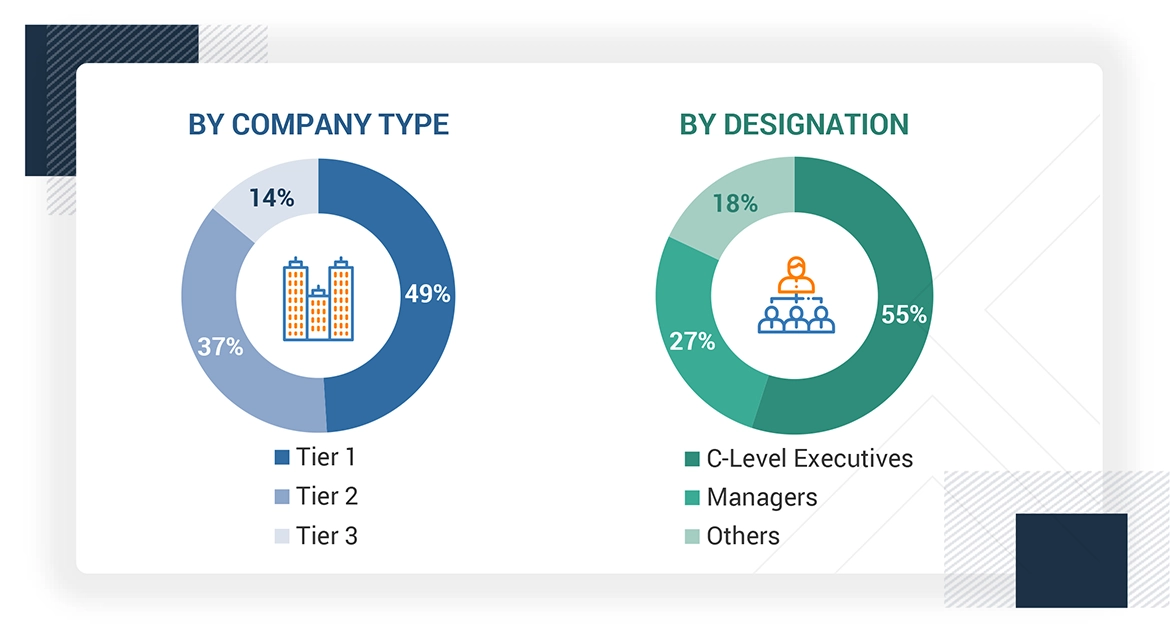
Note 1: C-level Executives include the CEO, COO, and CTO, among others.
Note 2: Others include sales managers, marketing managers, and product managers.
Note 3: Tiers of companies have been defined based on their total revenue as of 2024 (Tier 1 = > USD 1 billion, Tier 2 = USD 100 million to USD 1 billion, and Tier 3 = < USD 100 million).
To know about the assumptions considered for the study, download the pdf brochure
Market Size Estimation
All percentage shares, splits, and breakdowns were determined using secondary sources and verified through primary sources. All possible parameters that affect the markets covered in this research study were accounted for, viewed in extensive detail, verified through primary research, and analyzed to obtain the final quantitative and qualitative data. This data was consolidated, enhanced with detailed inputs, analyzed by MarketsandMarkets, and presented in this report.
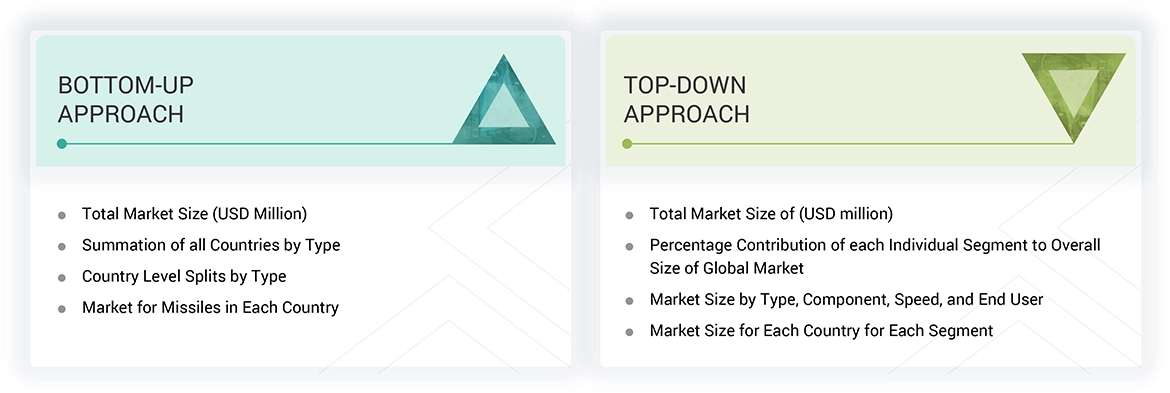
- Both top-down and bottom-up approaches were used to estimate and validate the Asia-Pacific (APAC) missile market size.
- Key players were identified through secondary research, and their market ranking was determined through primary and secondary research. This included a study of annual and financial reports of the top market players and extensive interviews with leaders, including CEOs, directors, and marketing executives.
Asia-Pacific (APAC) Missile Market : Top-Down and Bottom-Up Approach
Data Triangulation
After arriving at the overall size of the Asia-Pacific (APAC) missile market from the market size estimation process explained above, the total market was split into several segments and subsegments. Wherever applicable, data triangulation and market breakdown procedures described below were implemented to complete the overall market engineering process and arrive at the exact statistics for various market segments and subsegments. The data was triangulated by studying different factors and trends from the demand and supply sides. Additionally, the market size was validated using both top-down and bottom-up approaches.
Market Definition
A missile is a weapon designed to be launched or propelled toward a target to deliver an explosive payload, offering precision-strike capability across tactical and strategic scenarios. These airborne weapons combine propulsion, guidance, and warhead subsystems to engage targets at ranges from a few kilometers to intercontinental distances.
The Asia-Pacific (APAC) missile market includes producing and procuring missiles within APAC countries for strategic and tactical applications. The market is segmented by type, component, speed, end user, and region. By type, the Asia-Pacific (APAC) market is divided into surface-to-surface, surface-to-air, air-to-air, air-to-surface, and subsea-to-surface segments.
Key Stakeholders
- Missile Manufacturers
- Defense Contractors
- Original Equipment Manufacturers
- Military Service Providers
- Payload & Warhead Suppliers
- Research Organizations
- Investors and Venture Capitalists
- Ministries of Defense
- R&D Companies
Report Objectives
- To define, describe, and forecast the size of the Asia-Pacific (APAC) missile market based on type, component, speed, end user, and country
- To identify and analyze key drivers, restraints, opportunities, and challenges influencing market growth
- To strategically analyze micromarkets with respect to individual growth trends, prospects, and their contribution to the market
- To analyze opportunities for stakeholders in the market by identifying key market trends
- To analyze competitive developments, such as contracts, acquisitions, expansions, agreements, joint ventures, partnerships, product developments, and research and development (R&D) activities in the market
- To provide a detailed competitive landscape of the market, in addition to an analysis of business and corporate strategies adopted by leading market players
- To strategically profile key market players and comprehensively analyze their core competencies
Available Customizations
Along with the market data, MarketsandMarkets offers customizations to meet the specific needs of companies. The following customization options are available for the report:
Product Analysis
- Product matrix, which gives a detailed comparison of the product portfolio of each companyy
Company Information
- Detailed analysis and profiling of additional market players (up to five)
Get the Full Asia-Pacific (APAC) Missile Market Report
Full forecast, segment splits, and company analysis for all Asia-Pacific (APAC) Missile Market.
- India Asia-Pacific (APAC) Missile Market
- Japan Asia-Pacific (APAC) Missile Market
- South Korea Asia-Pacific (APAC) Missile Market
- Australia Asia-Pacific (APAC) Missile Market
- Taiwan Asia-Pacific (APAC) Missile Market
- Indonesia Asia-Pacific (APAC) Missile Market
- Vietnam Asia-Pacific (APAC) Missile Market
Need a Tailored Report?
Customize this report to your needs
Get 10% FREE Customization
Customize This Report
