
Vietnam Electric 3 Wheeler Market (2025-2030)

The Vietnam Electric 3 Wheeler Market was valued at $202 Million in 2025 and projected to reach to $591 Million by 2030, representing a compound annual growth rate of CAGR 16.5%. Vietnam's electric 3 wheeler market is positioned for exceptional growth through 2030, driven by urbanization, environmental concerns, and supportive government policies.


| Market Size in | USD 26.32 MN |
| Market Forecast in | |
| CAGR | |
| Forecast Period | |
| Units Considered | Value (USD MN) |
Vietnam Electric 3 Wheeler Market Trends and Insights
- This exceptional growth trajectory, driven by a 16.5% compound annual growth rate, reflects Vietnam's strategic shift toward sustainable urban mobility solutions and government incentives for electric vehicle adoption.
- Vietnam's dense urban centers and rising middle-class demand for affordable, eco-friendly transportation are catalyzing market penetration across both passenger and commercial segments. The forecast period through 2030 positions Vietnam as a critical growth hub within the Asia Pacific electric 3 wheeler sector.
- Vietnam's favorable regulatory environment, coupled with increasing fuel costs and environmental awareness, is accelerating the transition from traditional combustion-powered three-wheelers to electric alternatives.
- Vietnam's manufacturing capabilities and emerging supply chain infrastructure further strengthen its competitive position, attracting both domestic and international players to invest in production and distribution networks..
Key Market Statistics
- CAGR (2025-2030) CAGR 16.5%
- Market Size, 2025 ~USD 202 Million
- Forecast, 2030 ~USD 591 Million
- Country Vietnam
Vietnam Electric 3 Wheeler Market Overview
Rapid Market Expansion :
Vietnam's electric 3 wheeler market is projected to grow from USD 202.0 million in 2025 to USD 591.0 million by 2030, representing a robust 16.5% CAGR that significantly outpaces the global average of 5.3%.
Government Support & Incentives :
Vietnam's government has implemented comprehensive policies promoting electric vehicle adoption, including tax incentives, subsidies for EV purchases, and infrastructure development initiatives that accelerate market penetration in urban areas.
Urban Mobility Transformation :
Dense urban centers in Ho Chi Minh City, Hanoi, and Da Nang are driving demand for sustainable last-mile transportation solutions, with electric 3 wheelers becoming the preferred choice for commercial delivery and passenger transport.
Manufacturing & Supply Chain Growth :
Vietnam is emerging as a regional manufacturing hub for electric 3 wheelers, with local and international OEMs establishing production facilities to capitalize on lower labor costs and growing domestic demand.
Vietnam Electric 3 Wheeler Market Dynamics
- The country's dense urban infrastructure and rising middle-class population create ideal conditions for electric 3 wheeler adoption as a cost-effective, eco-friendly transportation solution.
- Increasing fuel prices and air quality concerns further accelerate the shift from traditional combustion engines to electric alternatives. The market will benefit from expanding charging infrastructure, declining battery costs, and growing consumer awareness of sustainability.
- Local manufacturers are scaling production capabilities while international players establish strategic partnerships.
- Government targets for EV adoption and carbon neutrality will continue to fuel market expansion, positioning Vietnam as a key growth market in Southeast Asia's electric 3 wheeler segment..
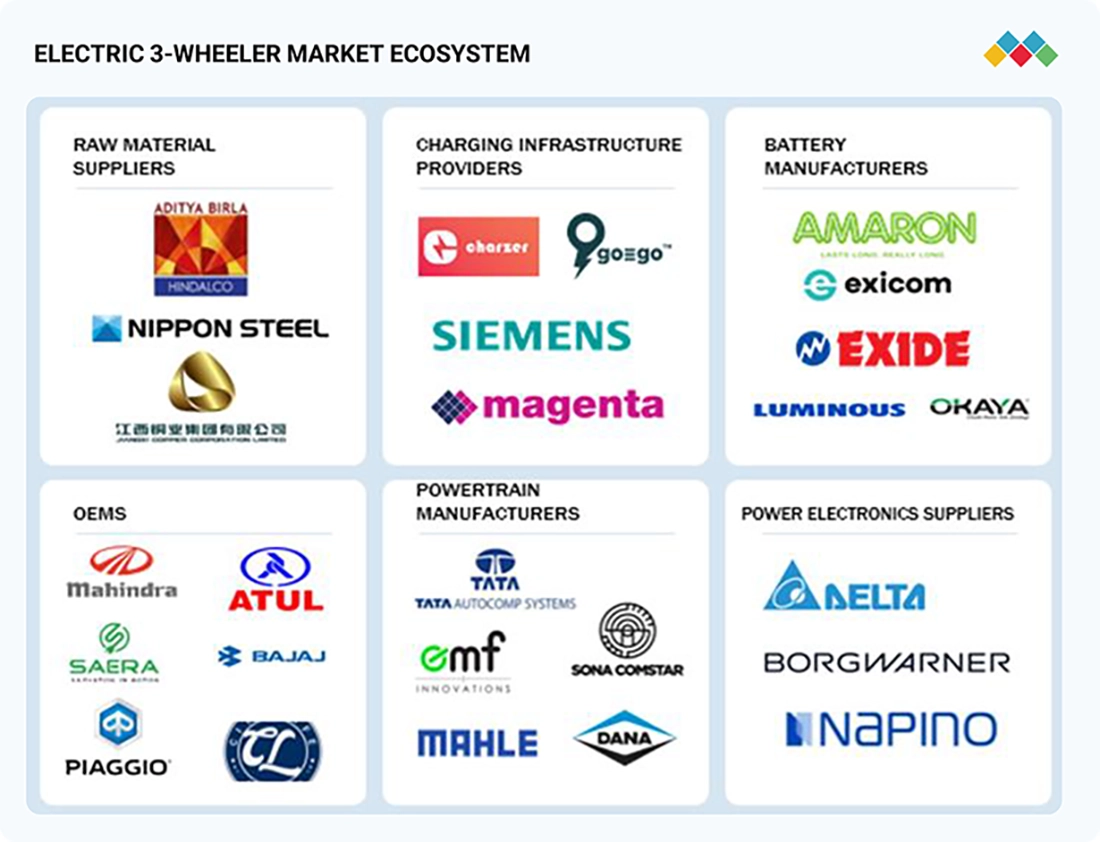
Market Ecosystem
ELECTRIC 3 WHEELER MARKET: COMMERCIAL USE CASES ACROSS INDUSTRIES
| COMPANY | USE CASE DESCRIPTION | BENEFITS |
|---|---|---|
 |
High-utilization passenger and cargo operations using Treo Plus, Treo Yaari, Treo Zor, and Zor Grand deployed by fleet operators and logistics players for last-mile mobility and urban goods movement | High range and payload | Low operating cost | Reduced downtime | Strong service network | Telematics-enabled fleet efficiency |
 |
Passenger and cargo applications using RE E TEC 9.0, Maxima XL Cargo E TEC, and Bajaj GoGo focused on high-performance fleet operations and commercial logistics | High motor power and battery capacity | Better performance | Improved gradability | Strong durability | Reliable fleet operations |
 |
Entry-level passenger and cargo mobility using the Yatri range and E Loader used by individual operators and small fleets for short-distance transport and micro logistics | Low upfront cost | Simple design | Easy maintenance | Quick payback | High trip frequency | Suitable for short-range operations |
 |
Passenger and cargo use cases through Mayuri range deployed for urban logistics, small commercial transport, and semi-urban mobility | Flexible product range and dual-use capability | Cost-efficient setup | Simple charging | Scalable fleet deployment | Easy maintenance |
 |
Passenger and cargo electric 3-wheelers, including Butterfly, LI PRIMA, School Type, and loader variants used for intra-city mobility, small cargo transport, and municipal operations | Low cost systems | Easy maintenance | Standardized range | Multiple body options | Application flexibility | Basic charging compatibility |
Logos and trademarks shown above are the property of their respective owners. Their use here is for informational and illustrative purposes only.
Related Ecosystem
Electric Hybrid Vehicles
- Battery Electric Vehicle (BEV)
- Fuel Cell Electric Vehicle (FCEV)
- Light Commercial Vehicles (LCVs)
- Hybrid Electric Vehicle (HEV)
- Agricultural Tractors
- Visteon Corporation
- BOSCH LIMITED
- Byd company ltd.
- Tesla, Inc.
- FORD MOTOR COMPANY
Logistics And Transportation
- Internal Combustion Engine (ICE)
- Crawler Excavator
- Fuel Cell
- Light Commercial Vehicles (LCVs)
- Sensors
- Siemens ag
- Alstom s.a.
- Hitachi, Ltd.
- Godrej Industries Limited
- ABB India Limited
On Highway Off Highway Vehicles
- Internal Combustion Engine (ICE)
- Agricultural Tractors
- Crawler Excavator
- Battery Electric Vehicle (BEV)
- Excavators
- Visteon Corporation
- Deere & Company
- AB VOLVO PENTA
- Honda Motor Co., Ltd.
- Komatsu Ltd.
Key Takeaways
- Vietnam's electric 3 wheeler market is projected to nearly triple from USD 202.0 million in 2025 to USD 591.0 million by 2030, representing a robust 16.5% CAGR.
- Vietnam's urbanization and rising disposable incomes are driving demand for affordable, sustainable last-mile mobility solutions in the electric 3 wheeler segment.
- Vietnam's government support through subsidies, tax incentives, and favorable EV policies is accelerating market adoption and attracting manufacturer investments.
- Vietnam's emerging manufacturing ecosystem and supply chain development position the country as a regional production and export hub for electric 3 wheelers.
Electric 3 Wheeler Market Report Scope
| Report Metric | Details |
|---|---|
| Base Year | 2025 |
| Fastest Growing Segment | ABOVE 500 KG (Payload Capacity) |
| Forecast Period | 2025–2030 |
| Growth Rate | CAGR of 5.3% from 2025 to 2030 |
| Largest Segment | MID MOTOR (Motor Type) |
| Market Size Base Year (Billions) | ~USD 2.68 (2025) |
| Revenue Forecast (Billions) | ~USD 3.47 (2030) |
| Segments Covered | Motor Power, Battery Capacity, Battery Type, End Use, Motor Type, Payload Capacity, Range |
Vietnam Electric 3 Wheeler Market Report Segmentation
7 segment dimensions are covered across the global market.
By Motor Power
- 1500-3500 W
- Above 3500 W
- Below 1500 W
By Battery Capacity
- 5–8 Kwh
- Above 8 Kwh
- Below 5 Kwh
By Battery Type
- Lead Acid
- Lithium-Ion
By End Use
- Load Carrier
- Passenger Carrier
By Motor Type
- Hub Motor
- Mid Motor
By Payload Capacity
- 300–500 Kg
- Above 500 Kg
- Up To 300 Kg
By Range
- Above 50 Miles
- Less Than 50 Miles
Target Audience
- OEM & Automotive Manufacturers : Manufacturers need Vietnam-specific market data to evaluate production facility investments, localization strategies, and competitive positioning in Southeast Asia's fastest-growing electric 3 wheeler market.
- Investment & Private Equity Firms : Investors require detailed market forecasts and growth metrics for Vietnam to identify high-potential acquisition targets, fund allocation decisions, and portfolio companies in the sustainable mobility sector.
- Government & Policy Makers : Vietnamese government agencies and policymakers need market intelligence to refine EV incentive programs, infrastructure investments, and regulatory frameworks aligned with market growth projections.
- Supply Chain & Component Suppliers : Battery manufacturers, electronics suppliers, and component makers require Vietnam market insights to plan capacity expansion, establish local partnerships, and secure long-term supply contracts.
- Logistics & Fleet Operators : Commercial fleet operators and logistics companies need market data to evaluate electric 3 wheeler adoption for last-mile delivery, assess total cost of ownership, and plan fleet electrification strategies.
Key Companies in the Vietnam Electric 3 Wheeler Market
| Company | HQ | Ownership | Strongest segments |
|---|---|---|---|
| VISTEON CORPORATION | United States | Public Company | Digital instrument clusters and information displays,Infotainment, connectivity, and Android-based head units,Battery management systems (lead-acid and lithium-ion), |
| MAHINDRA&MAHINDRA LTD. | India | Public Company | Passenger carriers – lead acid, <50 miles,Passenger carriers – lithium-ion, >50 miles,Load carriers – lead acid, <50 miles, |
| YATRI ELECTRIC VEHICLE | Nepal | Private Company | |
| BAJAJ AUTO LTD. | India | Public Company | Passenger carriers – lithium-ion – above 50 miles,Passenger carriers – lead acid – less than 50 miles,Load carriers – lithium-ion – above 50 miles, |
| PIAGGIO & C. SPA | Italy | Public Company | Passenger carriers,Load carriers,Lead-acid battery variants, |
VISTEON CORPORATION
Visteon Corporation is a United States-based public company founded in 2000 with 10,500 employees. The company operates in the automotive sector.
MAHINDRA&MAHINDRA LTD.
Mahindra & Mahindra Ltd. is an Indian public company founded in 1945 with 26,765 employees. The company is a major industrial conglomerate operating across multiple sectors.
YATRI ELECTRIC VEHICLE
Yatri Electric Vehicle is a private company based in Nepal founded in 2017. The company operates in the electric vehicle industry.
BAJAJ AUTO LTD.
Bajaj Auto Ltd. is an Indian public company founded in 1945 with 5,231 employees. The company is a major manufacturer of automobiles and two-wheelers.
PIAGGIO & C. SPA
Piaggio & C. S.p.A. is an Italian public company founded in 1884 with 5,417 employees. The company is a manufacturer of vehicles and mobility solutions.
Reasons to Buy this Report
- Market Size & Growth Validation : Obtain precise market valuation data for Vietnam (USD 202M in 2025) with verified 5-year forecasts to support investment decisions, business planning, and competitive positioning in this high-growth market.
- Regional Competitive Intelligence : Understand Vietnam's market dynamics relative to global trends (16.5% vs 5.3% CAGR) to identify competitive advantages, market gaps, and opportunities for market entry or expansion strategies.
- Government Policy & Incentive Insights : Access detailed analysis of Vietnam's EV incentive programs, regulatory frameworks, and sustainability targets that directly impact market growth, consumer adoption rates, and long-term business viability.
- Urban Market Segmentation : Gain insights into Vietnam's major urban centers (Hanoi, Ho Chi Minh City, Da Nang) with specific demand drivers, consumer preferences, and distribution channel opportunities for targeted market penetration.
- Supply Chain & Manufacturing Opportunities : Identify local manufacturing capabilities, supply chain partnerships, and production facility locations to optimize sourcing strategies, reduce costs, and establish competitive manufacturing operations in Vietnam.
Frequently asked questions
What is the current market size of electric 3 wheelers in Vietnam?
Vietnam's electric 3 wheeler market was valued at USD 202.0 million in 2025 and is expected to grow to USD 591.0 million by 2030.
What is the projected growth rate for Vietnam's electric 3 wheeler market?
Vietnam's electric 3 wheeler market is projected to grow at a compound annual growth rate (CAGR) of 16.5% from 2025 to 2030.
What factors are driving growth in Vietnam's electric 3 wheeler market?
Vietnam's market growth is driven by urbanization, rising disposable incomes, government EV incentives, environmental awareness, and the need for affordable last-mile transportation solutions.
How does Vietnam's electric 3 wheeler market compare to the global market?
Vietnam's 16.5% CAGR significantly outpaces the global electric 3 wheeler market CAGR of 5.3%, positioning Vietnam as a high-growth regional leader.
What role does government policy play in Vietnam's electric 3 wheeler adoption?
Vietnam's government supports market growth through subsidies, tax incentives, favorable EV regulations, and infrastructure development initiatives that encourage electric vehicle adoption.
RESEARCH METHODOLOGY
The study involved four major activities in estimating the current size of the electric 3-wheeler market. Exhaustive secondary research was done to collect information on the market, the peer market, and the child markets. The next step was to validate these findings, assumptions, and sizing with the industry experts across value chains through primary research. The top-down and bottom-up approaches were employed to estimate the complete market size. Thereafter, market breakdown and data triangulation processes were used to estimate the market size of segments and subsegments.
Secondary Research
In the secondary research process, various secondary sources such as company annual reports/presentations, press releases, industry association publications [European Alternative Fuels Observatory (EAFO), China Association of Automobile Manufacturers (CAAM), International Organization of Motor Vehicle Manufacturers (OICA), International Energy Association (IEA)], articles, directories, technical handbooks, trade websites, technical articles, and databases (Factiva) were used to identify and collect information useful for an extensive commercial study of the global electric 3-wheeler market.
Primary Research
Extensive primary research was conducted after acquiring an understanding of the electric 3-wheeler market scenario through secondary research. Several primary interviews were conducted with market experts from the supply side. These included automotive OEMs and E3W component providers across Asia Pacific, Southeast Asia, Europe, North America, and the rest of the World. Primary data was collected through questionnaires, emails, and telephonic interviews.
In the canvassing of primaries, various departments within organizations, such as sales, operations, and marketing, were covered to provide a holistic viewpoint in the report. After interacting with industry experts, brief sessions were also conducted with highly experienced independent consultants to reinforce the findings from primaries. This, along with the in-house subject matter experts’ opinions, led to the findings described in the remainder of this report.
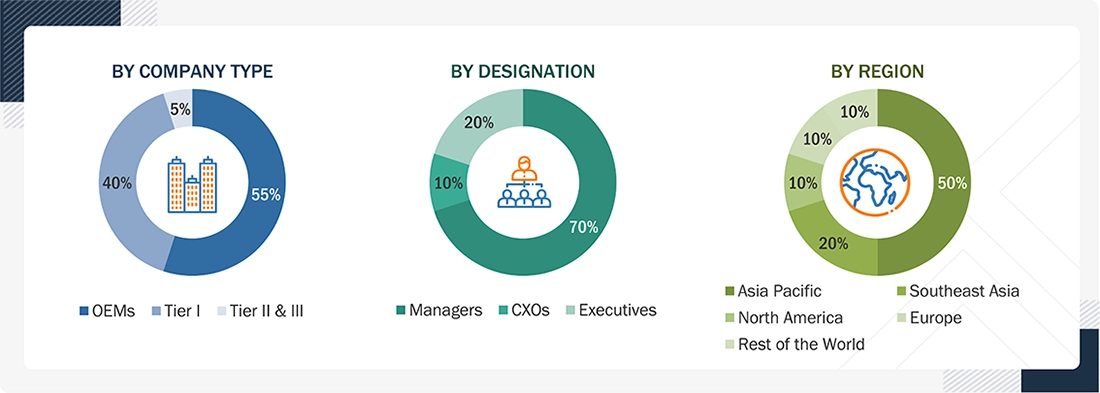
Notes:
- Others include Sales, Managers, and Product Managers.
- OEMs: 3-Wheeler Providers; Tier I Players: Component Suppliers, Battery Manufacturers, Powertrain Manufacturers, Power Electronic Suppliers, Charging Infrastructure Suppliers; Tier II & III Players: Raw Material Suppliers
To know about the assumptions considered for the study, download the pdf brochure
Market Size Estimation
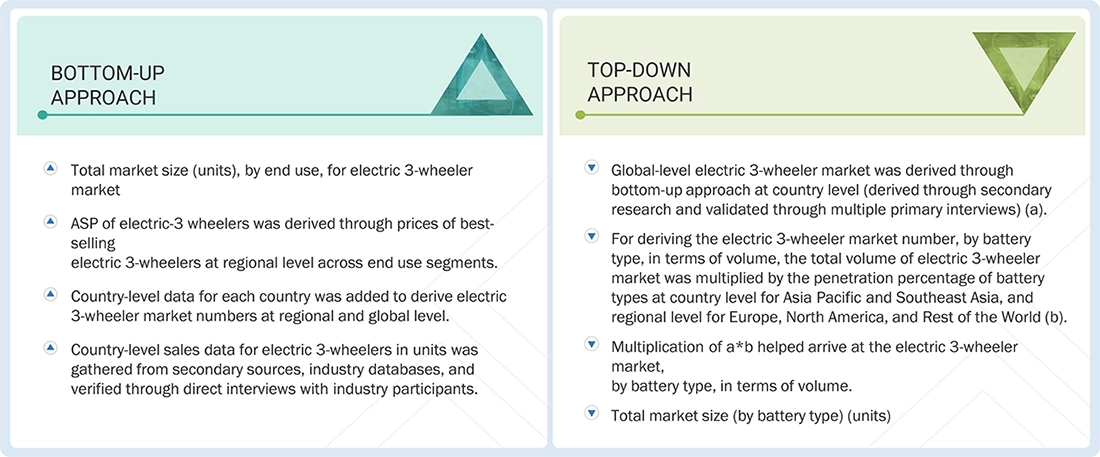
The bottom-up approach was used to estimate and validate the size of the electric 3-wheeler market. In this approach, vehicle production statistics for each end use were considered at the country level. The penetration of each end-use at the country level was identified through model mapping to determine the electric 3-wheeler market size in terms of volume. Thereafter, the penetration of each end-use for all countries was applied to obtain the volume of the electric 3-wheeler market. The country-level volume for each end use was multiplied by the average OE price of each end use to derive the market size in terms of volume. Extensive secondary and primary research was conducted to understand the market scenario for the end use in the automotive industry. Several primary interviews were conducted with key opinion leaders related to electric vehicle developments. These leaders include OEMs and Tier-1 suppliers. Qualitative aspects such as drivers, restraints, opportunities, and challenges were considered while calculating and forecasting the market size.
To estimate the electric 3-wheeler market, by battery type, in terms of volume, adoption rates for each segment were analyzed at the country level. For market value, the share of each end use segment at the regional level was applied to the overall market size. Battery type contribution was also mapped at the regional level to understand its impact on the market. The total market size in volume was first calculated at the regional level. This was then distributed across segments using percentage splits at the country level to arrive at final segment-wise estimates.
Data Triangulation
After arriving at the overall market size using the market size estimation processes as explained above, the market was split into several segments and subsegments. To complete the overall market engineering process and arrive at the exact statistics of each market segment and subsegment, data triangulation, and market breakdown procedures were employed, wherever applicable. The data was triangulated by studying various factors and trends from both the demand and supply sides.
Market Definition
Electric 3-wheelers are plug-in vehicles with three wheels. These vehicles use electric motors for propulsion and are powered by rechargeable batteries that store electricity and supply energy to the motor. These vehicles operate with zero tailpipe emissions and are designed for passenger and cargo applications. Their performance, including speed and range, depends on battery type, motor power, and overall vehicle configuration.
Key Stakeholders
- Automotive Component Manufacturers
- Automotive OEMs
- Companies Operating in Electric 3-Wheeler Ecosystem
- Distributors and Retailers
- Electric 3-Wheeler Component Manufacturers
- EV Battery Manufacturers
- EV Motor Manufacturers
- Fleet Operators
- Legal and Regulatory Authorities
- Manufacturers of Electric 3-Wheelers
- Raw Material Suppliers
- Technology Providers
- Electric Vehicle Association of Thailand
- Association of Indonesian Automotive Manufacturers
- Lanka Electric Vehicle Association
- Transport Authorities
Report Objectives
- To analyze the electric 3-wheeler market and forecast its size, in terms of volume (units) and value (USD Million), from 2026 to 2035
- To provide detailed information regarding major factors (drivers, restraints, opportunities, and challenges) influencing market growth
- To segment the electric 3-wheeler market by end use, payload capacity, motor type, motor power, battery type, battery capacity, range, and region
-
To segment the market, in terms of volume (units), based on motor type,
into hub motor and mid motor; and forecast its size - To segment the market, in terms of volume (units), based on motor power, into below 1,500 W, 1,500–3,500 W, and above 3,500 W, and forecast its size
- To segment the market, in terms of volume (units), based on battery capacity, into below 5 kWh, 5–8 kWh, and above 8 kWh, and forecast its size
- To segment the market, in terms of volume (units) and value (USD million), based on end use, into passenger carrier and load carrier, and forecast its size
- To segment the market, in terms of volume (units), based on range, less than 50 miles and above 50 miles, and forecast its size
- To segment the market, in terms of volume (units), based on battery type, into lead acid, lithium-ion, and others, and forecast its size
- To segment the market, in terms of volume (units), based on payload capacity, into up to 300 kg, 300–500 kg, and above 500 kg, and forecast its size
- To segment the market in terms of volume (units), based on region, into Asia Pacific, Southeast Asia, Europe, North America, and the Rest of the World, and forecast its size
- To strategically profile key players and comprehensively analyze their market share and core competencies
- To track and analyze competitive developments, such as product launches & developments, deals, and other industry activities carried out by key industry participants
- To analyze the technological developments impacting the electric 3-wheeler market
- To analyze opportunities for stakeholders and the competitive landscape for market leaders
- To strategically analyze markets with respect to individual growth trends, prospects, and contributions to the total market
- To study the following with respect to the market:
- Value Chain Analysis
- Ecosystem Analysis
- Technology Analysis
- Trade Analysis
- Case Study Analysis
- Patent Analysis
- Regulatory Landscape
- Pricing Analysis
- Trends and Disruptions Impacting Customer Business
- Impact of AI/Gen AI
- Key Stakeholders and Buying Criteria
- Key Conferences and Events
- Impact of Asia Pacific Trade Policies/Subsidies & Localization Mandates
- OEM Analysis
- To track and analyze competitive developments, such as deals (joint ventures, mergers & acquisitions, partnerships, collaborations), product developments, and other activities carried out by key industry participants.
Available customizations:
With the given market data, MarketsandMarkets offers customizations in line with company-specific needs. The following customization options are available:
- Electric 3-Wheeler Market, by Battery Type, at the Country Level (For countries covered in the report)
- Electric 3-Wheeler Market, by Battery Capacity, at the Country Level (For countries covered in the report)
- Company Information
- Profiling of Additional Market Players (Up to 5)
Get the Full Electric 3 Wheeler Market Report
Full forecast, segment splits, and company analysis for all Electric 3 Wheeler Market.
- India Electric 3 Wheeler Market
- China Electric 3 Wheeler Market
- Japan Electric 3 Wheeler Market
- South Korea Electric 3 Wheeler Market
- Germany Electric 3 Wheeler Market
- UK Electric 3 Wheeler Market
- France Electric 3 Wheeler Market
- Spain Electric 3 Wheeler Market
- Italy Electric 3 Wheeler Market
- Canada Electric 3 Wheeler Market
- US Electric 3 Wheeler Market
- Thailand Electric 3 Wheeler Market
- Indonesia Electric 3 Wheeler Market
- Philippines Electric 3 Wheeler Market
- Bangladesh Electric 3 Wheeler Market
- Sri Lanka Electric 3 Wheeler Market
- Kenya Electric 3 Wheeler Market
- South Africa Electric 3 Wheeler Market
- Nepal Electric 3 Wheeler Market
Need a Tailored Report?
Customize this report to your needs
Get 10% FREE Customization
Customize This Report
