
Australia Automated Border Control Market (2025-2030)

The Australia Automated Border Control Market was valued at $44.9 Million in 2025 and projected to reach to $83.4 Million by 2030, representing a compound annual growth rate of 13.2%. Australia's automated border control market is positioned for sustained growth driven by government initiatives to modernize border infrastructure and enhance security protocols.


| Market Size in | USD 26.32 MN |
| Market Forecast in | |
| CAGR | |
| Forecast Period | |
| Units Considered | Value (USD MN) |
Australia Automated Border Control Market Trends and Insights
- This 13.2% compound annual growth rate reflects Australia's increasing investment in border security infrastructure and biometric technologies.
- Australia is leveraging advanced semiconductor and electronics solutions to modernize its immigration and customs processes, driven by rising passenger volumes and heightened security requirements. The Australian market benefits from the country's geographic isolation and stringent biosecurity protocols, which necessitate sophisticated automated systems at major entry points.
- Australia's government initiatives to enhance border efficiency and passenger experience are accelerating adoption of e-gates, facial recognition, and integrated border management platforms.
- By 2030, Australia is expected to solidify its position as a regional leader in automated border control deployment, with significant investments in technology infrastructure supporting this trajectory..
Key Market Statistics
- CAGR (2025-2030) 13.2% CAGR
- Market Size, 2025 ~USD 44.9 Million
- Forecast, 2030 ~USD 83.4 Million
- Country Australia
Australia Automated Border Control Market Overview
Market Valuation Growth :
Australia's automated border control market is valued at $44.9 million in 2025, with projections reaching $83.4 million by 2030, representing an 85.7% increase over the five-year forecast period.
Strong CAGR Performance :
The Australian market is growing at a 13.2% CAGR, slightly below the global average of 14.4%, indicating steady domestic adoption of biometric and semiconductor-based border security solutions.
Biometric Technology Integration :
Australia is actively modernizing its immigration and border control infrastructure through advanced biometric technologies, including facial recognition, iris scanning, and fingerprint identification systems powered by cutting-edge semiconductors.
Government Investment Focus :
Increased government spending on border security infrastructure reflects Australia's commitment to enhancing national security while improving passenger processing efficiency at major airports and maritime ports.
Australia Automated Border Control Market Dynamics
- The adoption of advanced biometric technologies and semiconductor-based solutions is accelerating as Australian authorities seek to balance security requirements with passenger experience improvements.
- Investment in smart border systems at major entry points, including airports and seaports, continues to expand the market opportunity. Looking ahead to 2030, Australia's market will benefit from technological advancements in AI-powered facial recognition, real-time data processing capabilities, and integrated border management systems.
- The country's focus on regional security cooperation and alignment with international border control standards will further drive demand for sophisticated automated solutions, positioning Australia as a key market within the Asia-Pacific region..
Market Ecosystem
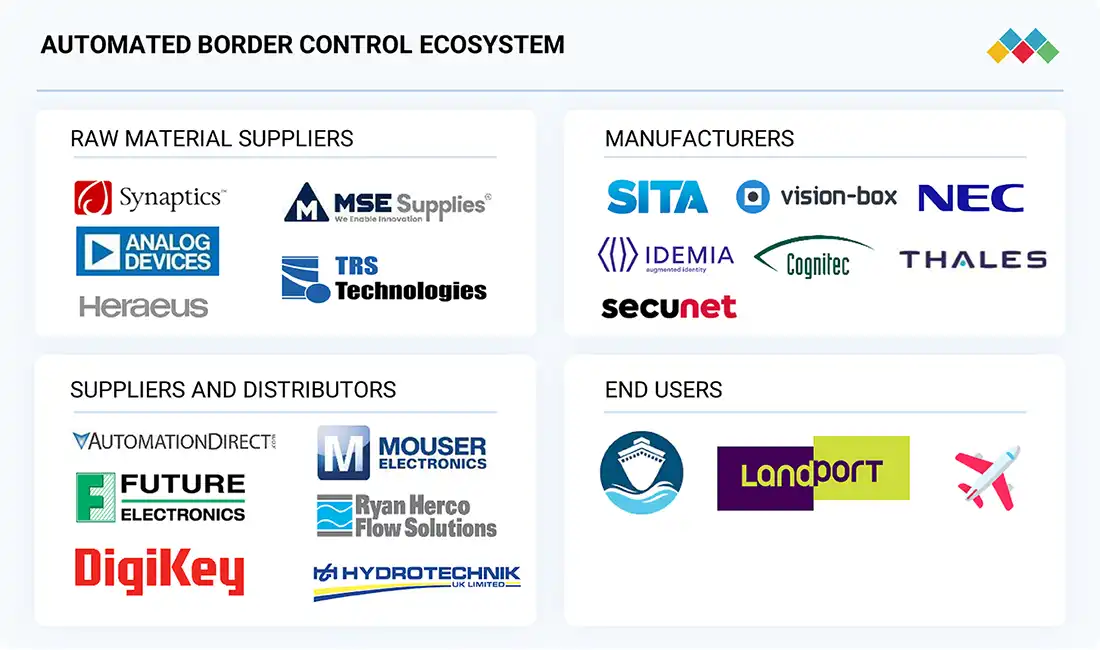
Automated Border Control Market: COMMERCIAL USE CASES ACROSS INDUSTRIES
| COMPANY | USE CASE DESCRIPTION | BENEFITS |
|---|---|---|
 |
ABC eGates and integrated border/visa management that connect to national border systems and perform on-the-fly biometric verification | Faster throughput, lower queue times as well as scalable/modular hardware footprint for constrained spaces |
 |
ABC eGate and kiosk portfolio for automated passport/border checks (sensor-rich eGates used in German/European airports) | Proven high security (anti-tailgating, robust sensors) and high throughput |
 |
Multi-modal ABC gates (face/fingerprint), centralized supervisor for kiosks/gates and entry/exit authorization with proven roll-outs | Multi-biometric verification, centralized monitoring, stronger identity assurance and exception handling |
 |
Biometric identity hub and self-service gates/kiosks plus mobile enrolment (face = boarding pass) to automate check-in → security → border → boarding flows | End-to-end passenger journey automation and mobile enrolment that reduces on-site friction and contact points |
 |
Biometric walkthrough gates and ABC solutions (high-accuracy face recognition, large-scale walkthrough deployments — integration partnerships, e.g., with SITA). Recent deployments in major Japanese airports | Very fast passenger processing, mature face recognition, and flexible integration |
Logos and trademarks shown above are the property of their respective owners. Their use here is for informational and illustrative purposes only.
Related Ecosystem
Airport Systems
- Antennas
- Sensors
- Aeronautical Information Management (AIM)
- Digital Signage
- Face Recognition
- SYSTRA LTD.
- Thales group
- Idaho Strategic Resources, Inc.
- HONEYWELL INTERNATIONAL INC.
- Leidos Holdings, Inc.
Application Security
- Cloud Security
- Security Analytics
- Network Testing
- Biometric Security and Authentication System
- Cloud Encryption
- International Business Machines Corporation
- MICROSOFT CORPORATION
- Cisco Systems, Inc.
- PALO ALTO NETWORKS, INC
- Fortinet, Inc.
Security And Surveillance
- Face Recognition
- Video Surveillance as A Service (VSaaS)
- Voice Recognition
- Fingerprint Recognition
- IRIS Recognition
- HONEYWELL INTERNATIONAL INC.
- Thales group
- HID-GLOBAL
- Lenovo
- AXIS COMMUNICATIONS
Key Takeaways
- Australia's automated border control market is valued at $44.9 million in 2025 and will reach $83.4 million by 2030, representing 85.7% growth over five years.
- Australia's 13.2% CAGR outpaces many developed markets, driven by government modernization initiatives and increased international travel.
- Australia's biosecurity requirements and geographic isolation create unique demand for advanced biometric and automated screening technologies.
- Australia's major airports and seaports are prioritizing e-gate and facial recognition deployments to enhance security and passenger throughput.
Automated Border Control Market Report Scope
| Report Metric | Details |
|---|---|
| Base Year | 2025 |
| Fastest Growing Segment | BIOMETRIC VERIFICATION SYSTEM (Hardware Type) |
| Forecast Period | 2025-2030 |
| Growth Rate | CAGR of 14.4% from 2025 to 2030 |
| Largest Segment | ABC E-GATES (Solution Type) |
| Market Size Base Year (Billions) | ~USD 2.57 (2025) |
| Revenue Forecast (Billions) | ~USD 5.03 (2030) |
| Segments Covered | Solution Type, Application, Offering, Hardware Type, Biometric Verification System Type, Service Type, Solution |
Australia Automated Border Control Market Report Segmentation
7 segment dimensions are covered across the global market.
By Solution Type
- Abc E-Gates
- Abc Kiosks
By Application
- Airports
- Land Ports
- Seaports
By Offering
- Hardware
- Services
- Software
By Hardware Type
- Baggage Scanner
- Biometric Verification System
- Digital Id Verification System
- Document Authentication System
By Biometric Verification System Type
- Face Recognition System
- Fingerprint Recognition System
- Iris Recognition System
- Other Biometric Verification Systems
By Service Type
- Installation
- Maintenance
By Solution
- Abc E-Gates
- Abc Kiosks
AUSTRALIA: AUTOMATED BORDER CONTROL MARKET, BY APPLICATION, 2025–2030
| Segment | 2025 | 2026 | 2027 | 2028 | 2029 | 2030 | CAGR (%) |
|---|---|---|---|---|---|---|---|
| AIRPORTS | 37.4 | 42.5 | 48.4 | 55.1 | 62.2 | 71.3 | 13.8 |
| LAND PORTS | 3.1 | 3.4 | 3.7 | 4 | 4.4 | 4.8 | 8.9 |
| SEAPORTS | 4.4 | 4.9 | 5.4 | 6 | 6.6 | 7.4 | 10.7 |
| TOTAL | 44.9 | 50.8 | 57.5 | 65.2 | 73.2 | 83.4 | 13.2 |
Target Audience
- Government & Border Agencies : Australian Department of Home Affairs, Border Force, and state immigration authorities need market intelligence to justify budget allocations, evaluate technology vendors, and plan infrastructure modernization initiatives.
- Technology & Semiconductor Vendors : Hardware manufacturers, biometric solution providers, and semiconductor companies require detailed market sizing and growth forecasts to develop go-to-market strategies and identify partnership opportunities in Australia.
- System Integrators & Solution Providers : Border control system integrators and IT service providers need comprehensive market data to identify project opportunities, understand client requirements, and position integrated solutions for Australian government contracts.
- Investment & Private Equity Firms : Investors evaluating opportunities in Australian border security and smart infrastructure sectors require detailed market analysis, growth projections, and competitive landscape data for due diligence and portfolio decisions.
- Airport & Port Operators : Major Australian airports and seaports planning border control upgrades need market insights on technology trends, vendor capabilities, and implementation costs to optimize passenger processing and security operations.
Reasons to Buy this Report
- Market Size & Growth Data : Access precise valuation figures for Australia's automated border control market with detailed CAGR analysis, enabling accurate financial forecasting and investment decision-making for the 2025-2030 period.
- Competitive Landscape Intelligence : Understand the competitive positioning within Australia's border control sector, identifying key players, market share distribution, and emerging technology providers in the biometric and semiconductor space.
- Government Policy & Regulatory Insights : Gain comprehensive understanding of Australian government initiatives, border security investments, and regulatory frameworks driving market expansion and technology adoption across federal and state agencies.
- Technology Adoption Trends : Identify which biometric technologies and semiconductor solutions are gaining traction in Australia, including facial recognition systems, AI integration, and real-time processing capabilities at border checkpoints.
- Regional Market Positioning : Benchmark Australia's market performance against Asia-Pacific peers, understanding regional dynamics and how Australian border control investments compare to neighboring countries' security infrastructure spending.
Frequently asked questions
What is the current size of Australia's automated border control market?
Australia's automated border control market is valued at $44.9 million in 2025 and is projected to grow to $83.4 million by 2030.
What is the growth rate for Australia's automated border control market?
Australia's automated border control market is growing at a compound annual growth rate (CAGR) of 13.2% from 2025 to 2030.
What technologies are driving Australia's automated border control adoption?
Australia is adopting e-gates, facial recognition systems, biometric scanners, and integrated border management platforms to enhance security and operational efficiency.
Why is Australia investing heavily in automated border control?
Australia's geographic isolation, stringent biosecurity protocols, rising passenger volumes, and government modernization initiatives are driving significant investment in automated border technologies.
Which Australian airports are leading in automated border control deployment?
Australia's major international airports, including Sydney, Melbourne, and Brisbane, are prioritizing e-gate and biometric system installations to streamline passenger processing.
RESEARCH METHODOLOGY
The research process for this study included systematic gathering, recording, and analysis of data about customers and companies operating in the automated border control market. This process involved the extensive use of secondary sources, directories, and databases (Factiva and Oanda) to identify and collect valuable information for the comprehensive, technical, market-oriented, and commercial study of the automated border control market.
In-depth interviews were conducted with primary respondents, including experts from core and related industries and preferred manufacturers, to obtain and verify critical qualitative and quantitative information and assess growth prospects. Key players in the automated border control market were identified through secondary research, and their market rankings were determined through primary and secondary research. This research included studying annual reports of top players and interviewing key industry experts, such as CEOs, directors, and marketing executives.
Secondary Research
Various sources were used in the secondary research process to identify and collect information important for this study. These include company annual reports, press releases, investor presentations, white papers, technology journals, certified publications, articles by recognized authors, directories, and databases.
Secondary research was mainly used to obtain key information about the industry’s value chain, the total pool of market players, the market classification according to industry trends to the bottom-most level, regional markets, and key developments from market and technology-oriented perspectives.
Primary Research
Primary research was also conducted to identify the segmentation types, key players, competitive landscape, and key market dynamics, such as drivers, restraints, opportunities, challenges, and industry trends, along with key strategies adopted by players operating in the automated border control market. Extensive qualitative and quantitative analyses were performed on the complete market engineering process to list key information and insights throughout the report.
Extensive primary research has been conducted after acquiring knowledge about the automated border control market scenarios through secondary research. Several primary interviews have been conducted with experts from the demand (application and region) and supply side (solution type) across four major geographic regions: North America, Europe, Asia Pacific, and RoW. Approximately 60% and 40% of the primary interviews were conducted from the supply and demand sides. These primary data have been collected through questionnaires, emails, and telephonic interviews.
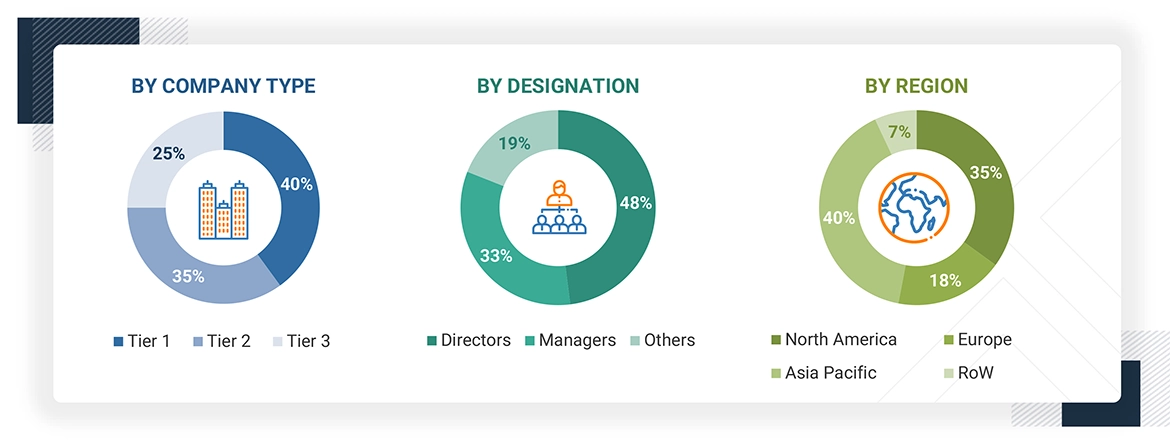
Note: The three tiers of the companies have been defined based on their total/segmental revenue as of 2024: Tier 1 = >USD 1 billion, Tier 2 = USD 1 billion–USD 500 million, and Tier 3 = USD 500 million. ‘Others’ include sales, marketing, and product managers.
To know about the assumptions considered for the study, download the pdf brochure
Market Size Estimation
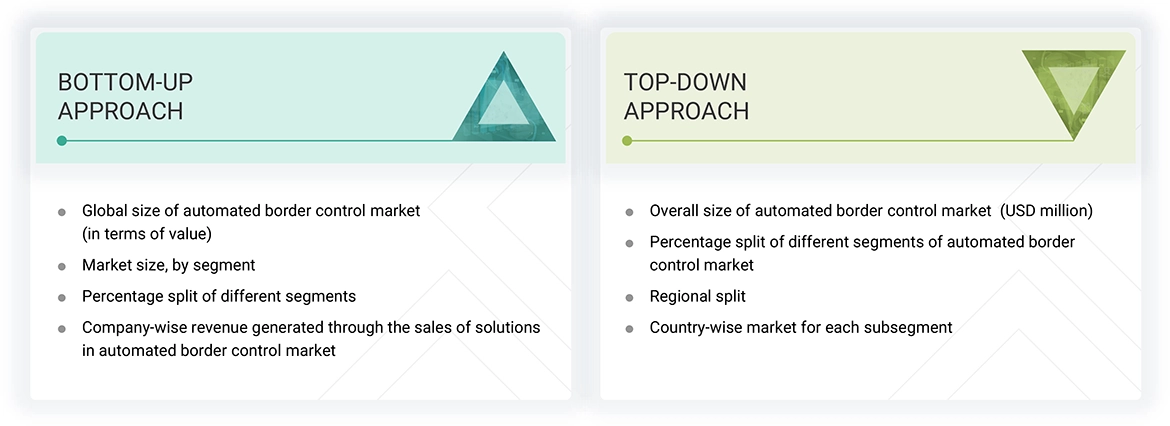
In the complete market engineering process, the top-down and bottom-up approaches and several data triangulation methods were implemented to estimate and validate the size of the automated border control market and various other dependent submarkets. Key players in the market were identified through secondary research, and their market share in the respective regions was determined through primary and secondary research. This entire research methodology included the study of annual and financial reports of the top players and interviews with experts (CEOs, VPs, directors, and marketing executives) for key insights (quantitative and qualitative).
All percentage shares, splits, and breakdowns were determined using secondary sources and verified through primary sources. All the possible parameters that affect the markets covered in this research study were accounted for, viewed in detail, verified through primary research, and analyzed to obtain the final quantitative and qualitative data. This data was consolidated and supplemented with detailed inputs and analysis from MarketsandMarkets and presented in this report.
Automated Border Control Market : Top-Down and Bottom-Up Approach
Data Triangulation
After arriving at the overall market size from the market size estimation process, as explained above, the total market has been split into several segments and subsegments. To complete the overall market engineering process and arrive at the exact statistics for all segments and subsegments, market breakdown and data triangulation procedures have been employed, wherever applicable. The data have been triangulated by studying various factors and trends from the demand and supply sides. Along with this, the market has been validated using top-down and bottom-up approaches.
Market Definition
The automated border control refers to the industry segment focused on deploying automated systems—eGates, biometric kiosks, facial recognition cameras, and document readers—to streamline and secure border crossing processes at airports, seaports, and land borders. These solutions verify traveler identities and authenticate documents with minimal human intervention, enhancing efficiency, reducing wait times, and strengthening security. The market includes hardware, software, and related services, such as installation and maintenance. Growing international travel, rising security concerns, and the push for contactless processing are key drivers of market expansion. Adoption is supported by government agencies and airport authorities worldwide, with initiatives such as ICAO’s TRIP and IATA’s One ID promoting standardization and interoperability.
Key Stakeholders
- Raw material and manufacturing equipment suppliers
- Automated border control hardware and software manufacturers
- Card readers and biometrics original equipment manufacturers (OEMs)
- ODM and OEM technology solution providers
- Suppliers and distributors
- System integrators
- Middleware providers
- Assembly, testing, and packaging vendors
- Research institutes and organizations
- Technology standards organizations, forums, alliances, and associations
- Technology investors
- Governments, financial institutions, and regulatory bodies
Report Objectives
- To define, describe, and forecast the automated border control market, by solution type, application, and component in terms of value
- To forecast the size of the market segments for four major regions—North America, Europe, Asia Pacific, and the Rest of the World (RoW), in terms of value
- To define, describe, and forecast the automated border control market, by solution type, in terms of volume
- To provide detailed information regarding the major drivers, restraints, opportunities, and challenges influencing the growth of the market
- To strategically analyze micromarkets with respect to individual growth trends, prospects, and contributions to the total market
- To study the complete value chain and allied industry segments, and perform a value chain analysis of the market
- To strategically profile the key players and comprehensively analyze their market shares and core competencies
- To analyze the opportunities in the market for stakeholders and describe the competitive landscape of the market
- To analyze competitive developments, such as collaborations, agreements, contracts, partnerships, mergers & acquisitions, product developments, and research & development (R&D), in the market
- To analyze the macroeconomic outlook for regions in the report
- To understand the impact of the 2025 US tariff and AI/Gen AI on the market
Available customizations:
With the given market data, MarketsandMarkets offers customizations according to the company’s specific needs. The following customization options are available for the report:
Get the Full Automated Border Control Market Report
Full forecast, segment splits, and company analysis for all Automated Border Control Market.
- US Automated Border Control Market
- Canada Automated Border Control Market
- Mexico Automated Border Control Market
- Germany Automated Border Control Market
- UK Automated Border Control Market
- France Automated Border Control Market
- Italy Automated Border Control Market
- Spain Automated Border Control Market
- Poland Automated Border Control Market
- China Automated Border Control Market
- Japan Automated Border Control Market
- South Korea Automated Border Control Market
- India Automated Border Control Market
- Indonesia Automated Border Control Market
- Malaysia Automated Border Control Market
- Thailand Automated Border Control Market
- Vietnam Automated Border Control Market
- Nordics Automated Border Control Market
- Rest Of Europe Automated Border Control Market
- Rest Of Asia Pacific Automated Border Control Market
Need a Tailored Report?
Customize this report to your needs
Get 10% FREE Customization
Customize This Report
