
China Automotive Bearing Market (2025-2030)

The China Automotive Bearing Market was valued at $3215 Million in 2025 and projected to reach to $2643 Million by 2030, representing a compound annual growth rate of -2.76%. China's automotive bearing market faces headwinds as the nation accelerates its electric vehicle adoption, fundamentally reshaping demand for traditional bearing components.


| Market Size in | USD 26.32 MN |
| Market Forecast in | |
| CAGR | |
| Forecast Period | |
| Units Considered | Value (USD MN) |
China Automotive Bearing Market Trends and Insights
- This downturn in China reflects structural shifts in the automotive sector, including the transition toward electric vehicles with different bearing requirements and increased domestic competition pressuring margins.
- China's bearing manufacturers face headwinds from overcapacity and shifting supply chain dynamics as original equipment manufacturers optimize sourcing strategies. The forecast period through 2030 indicates that China will continue to experience market contraction despite the country's dominance in global automotive production.
- China's bearing market decline is driven by technological transitions, reduced demand from traditional internal combustion engine platforms, and consolidation among suppliers.
- Industry participants in China must adapt to evolving vehicle architectures and invest in next-generation bearing technologies to remain competitive in this challenging landscape..
Key Market Statistics
- CAGR (2025-2030) -2.76%
- Market Size, 2025 ~USD 3215 Million
- Forecast, 2030 ~USD 2643 Million
- Country China
China Automotive Bearing Market Overview
Market Contraction :
China's automotive bearing market is declining at -2.76% CAGR, shrinking from USD 3,215 million in 2025 to USD 2,643 million by 2030, reflecting significant structural shifts in the automotive industry.
EV Transition Impact :
The rapid shift toward electric vehicles in China is fundamentally altering bearing specifications and demand patterns, as EVs require different bearing technologies compared to traditional internal combustion engines.
Domestic Competition Intensification :
Increased domestic bearing manufacturers in China are consolidating market share, creating pricing pressure and reducing margins for both local and international suppliers operating in the region.
Structural Market Shift :
China's automotive bearing market is undergoing a fundamental transformation driven by electrification, localization of supply chains, and changing vehicle architectures that reduce traditional bearing requirements.
China Automotive Bearing Market Dynamics
- The projected decline from USD 3,215 million to USD 2,643 million through 2030 reflects not market weakness but rather a structural realignment where EV powertrains require fewer and different bearing specifications than conventional vehicles. Domestic Chinese manufacturers are rapidly capturing market share through cost advantages and localized production, intensifying competition.
- However, opportunities exist in specialized bearings for EV drivetrains, hub assemblies, and high-speed applications.
- Companies adapting to China's EV-centric future and investing in advanced bearing technologies for electric motors and transmissions will find sustainable growth despite overall market contraction..
Market Ecosystem
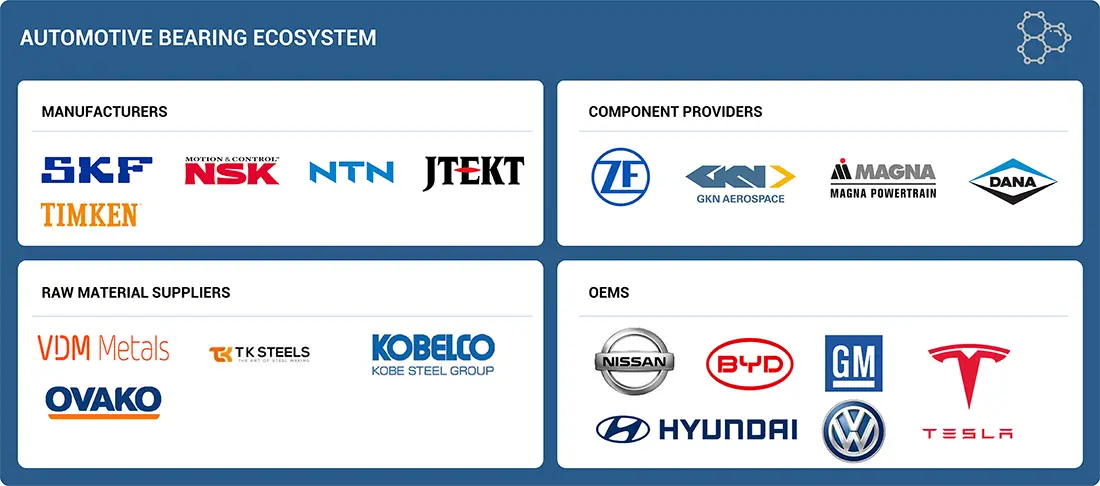
Automotive Bearing Market: COMMERCIAL USE CASES ACROSS INDUSTRIES
| COMPANY | USE CASE DESCRIPTION | BENEFITS |
|---|---|---|
 |
Advanced automotive bearings with low-friction coatings for passenger and commercial vehicles | Reduced friction losses, improved fuel efficiency, extended service life |
 |
Electrified vehicle bearings designed for e-axles and electric motors | High-speed performance, reduced noise and vibration, longer durability under high torque |
 |
Bearings integrated with sensors for condition monitoring in vehicles | Real-time performance data, predictive maintenance, reduced downtime |
 |
Lightweight wheel hub bearings for electric and hybrid vehicles | Improved energy efficiency, reduced vehicle weight, longer wheel-end life |
 |
Sealed bearings with enhanced lubrication for harsh environments | Lower maintenance needs, better resistance to contamination, extended bearing reliability |
Logos and trademarks shown above are the property of their respective owners. Their use here is for informational and illustrative purposes only.
Related Ecosystem
Automotive Materials
- Light Commercial Vehicles (LCVs)
- Battery Electric Vehicle (BEV)
- Hybrid Electric Vehicle (HEV)
- Fuel Cell Electric Vehicle (FCEV)
- Agricultural Tractors
- GORKOVSKY AVTOMOBILNY ZAVOD
- AISIN CORPORATION
- Continental ag
- Basf se
- BOSCH LIMITED
Key Takeaways
- China's automotive bearing market will contract from USD 3,215M (2025) to USD 2,643M (2030) at a -2.76% CAGR.
- China's market decline is primarily driven by the shift toward electric vehicles, which require fewer and different bearing specifications than traditional ICE platforms.
- Overcapacity and intense domestic competition in China are pressuring margins and forcing consolidation among bearing suppliers.
- China's manufacturers must invest in advanced bearing technologies and EV-compatible solutions to offset market contraction and maintain competitiveness.
Automotive Bearing Market Report Scope
| Report Metric | Details |
|---|---|
| Base Year | 2025 |
| Fastest Growing Segment | BEV (Ev Type) |
| Forecast Period | 2025-2030 |
| Growth Rate | CAGR of 0.32% from 2025 to 2030 |
| Largest Segment | PASSENGER CARS (Vehicle Type) |
| Market Size Base Year (Billions) | ~USD 31.02 (2025) |
| Revenue Forecast (Billions) | ~USD 31.52 (2030) |
| Segments Covered | Application, Bearing Type, Ev Type, Vehicle Type |
China Automotive Bearing Market Report Segmentation
4 segment dimensions are covered across the global market.
By Application
- Aftermarket Drivetrain
- Aftermarket Engine
- Aftermarket Interior & Exterior
- Aftermarket Transmission
- Aftermarket Wheel Hub
- Drivetrain
- Engine
- Interior & Exterior
- Transmission
- Wheel Hub
By Bearing Type
- Ball Bearing
- Other Bearings
- Roller Bearing
By Ev Type
- Bev
- Phev
By Vehicle Type
- Heavy Commercial Vehicles
- Light Commercial Vehicles
- Passenger Cars
CHINA: AUTOMOTIVE BEARING MARKET, BY APPLICATION, 2025–2032
| Segment | 2025 | 2026 | 2027 | 2028 | 2029 | 2030 | 2031 | 2032 | CAGR (%) |
|---|---|---|---|---|---|---|---|---|---|
| DRIVETRAIN | 2827.3 | 2768.8 | 2706.4 | 2640.4 | 2578 | 2516.7 | 2466.2 | 2435.6 | -2.11 |
| ENGINE | 1775.9 | 1745.6 | 1713.5 | 1679.8 | 1649.6 | 1621 | 1598.9 | 1588 | -1.58 |
| INTERIOR & EXTERIOR | 2556.2 | 2498.4 | 2436.7 | 2372.1 | 2310.2 | 2249.4 | 2198.4 | 2165.5 | -2.34 |
| TRANSMISSION | 1586.6 | 1546.9 | 1506.5 | 1462.3 | 1421.9 | 1383.7 | 1353.7 | 1340.7 | -2.38 |
| WHEEL HUB | 1805.1 | 1774.4 | 1741.9 | 1708.2 | 1678.4 | 1650.6 | 1629.3 | 1618.8 | -1.54 |
| TOTAL | 10551.1 | 10334.1 | 10105.1 | 9862.7 | 9638.1 | 9421.4 | 9246.4 | 9148.5 | -2.02 |
Target Audience
- Bearing Manufacturers : Manufacturers need China-specific market data to optimize production capacity, adjust product portfolios toward EV-compatible bearings, and develop competitive strategies against domestic rivals.
- Automotive OEMs : OEMs operating in China require detailed bearing market intelligence to manage supply chain costs, identify qualified suppliers, and plan bearing specifications for EV platforms.
- Supply Chain Strategists : Supply chain professionals need insights into China's bearing market dynamics to optimize sourcing strategies, negotiate supplier contracts, and mitigate supply chain risks.
- Investment & Private Equity : Investors evaluating opportunities in China's automotive sector need market contraction analysis, competitive positioning data, and growth segment identification for portfolio decisions.
- Market Consultants & Analysts : Consultants advising clients on China automotive strategies require comprehensive market data, trend analysis, and forecasts to support strategic recommendations and business case development.
Reasons to Buy this Report
- Strategic Market Positioning : Understand China's unique market dynamics and contraction drivers to make informed decisions about market entry, expansion, or exit strategies in the world's largest automotive market.
- EV Transition Insights : Gain detailed intelligence on how electric vehicle adoption is reshaping bearing requirements and demand patterns, enabling product development aligned with China's EV-centric future.
- Competitive Landscape Analysis : Identify domestic and international competitors, market consolidation trends, and competitive positioning strategies specific to China's intensifying bearing market competition.
- Demand Forecasting Accuracy : Access precise market size projections and segment-level forecasts for China through 2030, enabling accurate demand planning and resource allocation for automotive bearing operations.
- Investment Decision Support : Evaluate investment opportunities, risk factors, and growth pockets within China's declining market to identify where capital deployment will generate sustainable returns.
Frequently asked questions
Why is China's automotive bearing market declining?
China's automotive bearing market is declining due to the rapid transition from internal combustion engines to electric vehicles, which require fewer bearings and different specifications, combined with overcapacity and intense domestic competition.
What is the market size of automotive bearings in China in 2025?
China's automotive bearing market is valued at USD 3,215 million in 2025, with projections showing a decline to USD 2,643 million by 2030.
How will China's bearing market perform through 2030?
China's automotive bearing market is expected to decline at a CAGR of -2.76% from 2025 to 2030, reflecting structural challenges in the automotive industry and the shift toward electrification.
What strategies should China's bearing manufacturers adopt?
China's bearing manufacturers should focus on developing EV-compatible bearing solutions, investing in advanced technologies, pursuing strategic consolidation, and optimizing production efficiency to remain competitive amid market contraction.
How does China's bearing market compare to global trends?
While the global automotive bearing market shows modest growth at 0.32% CAGR, China's market is contracting at -2.76%, indicating that China is experiencing more severe headwinds than the global average due to its heavy exposure to traditional automotive platforms.
RESEARCH METHODOLOGY
The research study involved extensive use of secondary sources, such as company annual reports/presentations, industry association publications, magazines, directories, technical handbooks, World Economic Outlook, trade websites, technical articles, and databases to identify and collect information on the automotive bearing market. In-depth interviews were conducted with various primary sources experts from related industries, automobile OEMs, and suppliers to obtain and verify critical information and assess the growth prospects and market estimations.
Secondary Research
In the secondary research process, various secondary sources were used to identify and collect information on the automotive bearing market for this study. Secondary sources included annual reports, press releases, and investor presentations of companies; whitepapers, certified publications, and articles from recognized authors; directories; databases; and articles from recognized associations and government publishing sources.
Primary Research
Extensive primary research was conducted after understanding the automotive bearing market scenario through secondary research. Several primary interviews were conducted with market experts from the demand and supply sides across North America, Europe, Asia Pacific, and Rest of the world. Approximately 45% and 55% of primary interviews were conducted from the demand and supply sides. Primary data was collected through questionnaires, emails, and telephonic interviews.
In the canvassing of primaries, various departments within organizations, such as sales, operations, and marketing, were covered to provide a holistic viewpoint in the report. After interacting with industry experts, brief sessions were conducted with experienced independent consultants to reinforce the findings from the primaries. This and the opinions of in-house subject matter experts led to the conclusions described in the remainder of this report.
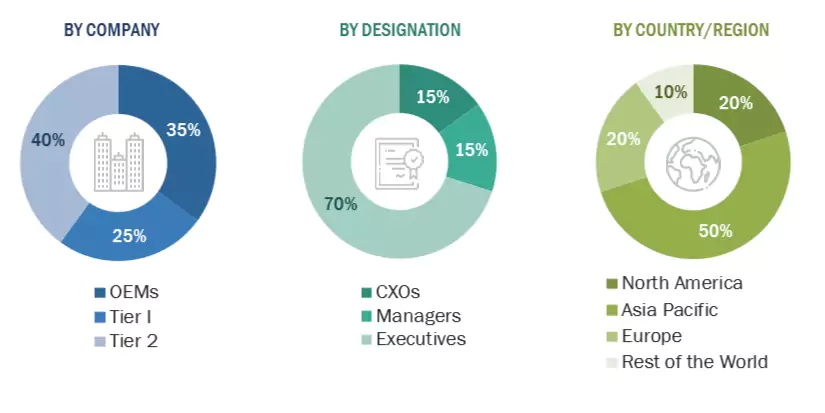
Note: The tiers above are based on the value chain of the bearing market; companies’ revenues were
not considered. Tier I companies are auto component providers, and Tier 2 includes automotive bearing manufacturers.
To know about the assumptions considered for the study, download the pdf brochure
Market Size Estimation
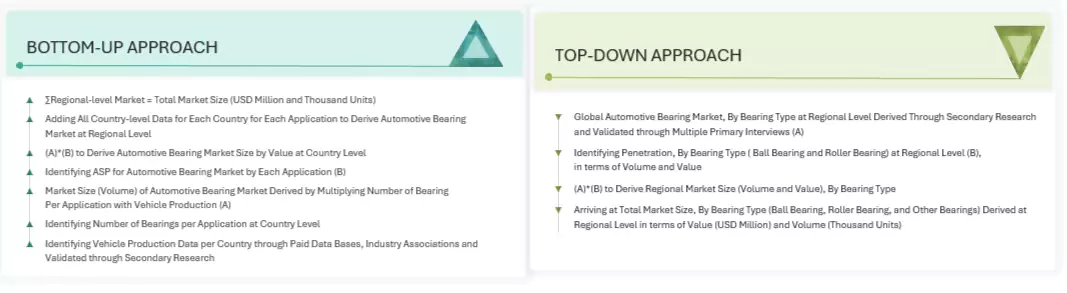
The top-down and bottom-up approaches were used to estimate and validate the automotive bearing market size. The research methodology used to estimate the market size included the following details:
- The market size was derived using parameters, such as sales of bearings and the corresponding penetration of the applications considered under the scope.
- Key players in the market were identified through secondary research, and their global market rankings were determined through primary and secondary research.
- The research methodology included studying annual and quarterly financial reports, regulatory filings of major market players, and interviews with industry experts to gain detailed market insights.
- All major penetration rates, percentage shares, splits, and breakdowns for the market were determined through secondary sources and verified through primary sources.
- All key macro indicators affecting the revenue growth of the market segments and subsegments have been accounted for, viewed in extensive detail, verified through primary research, and analyzed to get the validated and verified quantitative & qualitative data.
Automotive Bearing Market : Top-Down and Bottom-Up Approach
Data Triangulation
After arriving at the overall market size of the global market through the above-mentioned methodology, this market was split into several segments and subsegments. The data triangulation and market breakdown procedures were employed, wherever applicable, to complete the overall market engineering process and arrive at the exact data for the market by value for the key segments and subsegments. The extrapolated market data was triangulated by studying various macro indicators and regional trends from the demand and supply-side participants.
Market Definition
The automotive bearing market involves developing, producing, and supplying precision-engineered components that minimize friction and support rotational or linear movement across various automotive systems. These include various bearing types, such as ball bearings, roller bearings, and plain bearings, each tailored to specific load and performance requirements. Automotive bearings are integral to critical functions in engines, transmissions, wheels, steering mechanisms, drivetrains, and electric powertrains, ensuring efficiency, durability, and safety in traditional internal combustion vehicles and modern electric or hybrid platforms.
Stakeholders
- Associations, Forums, and Alliances Related to Automotive Software
- Authorized and Independent Automobile Service Centers
- Automotive Component Manufacturers
- Aftermarket Bearing Suppliers
- Automotive Dealers and Distributors
- Automotive Electronic Control Unit Manufacturers
- Automotive OEMs
- Automotive Component Manufacturers
- Equipment Service Providers
- EV Component Manufacturers
- EV Manufacturers
- ICE Vehicle Manufacturers
- Legal and Regulatory Authorities
- Network Providers
- Raw Material Suppliers for Bearings
- Raw Material Suppliers for Components
- Vehicle Safety Regulatory Bodies
Report Objectives
- To segment and forecast the size of the automotive bearing Market in terms of volume (million units) and value (USD million) from 2021 to 2032
- To define, describe, and forecast the market in terms of volume (million units) and value (USD million)
-
To define, describe, and forecast the global market based on bearing type, application, vehicle type, EV type, end uses, and region
- To segment and forecast the market size by bearing type (Ball Bearings, Roller Bearings, and Other bearings)
- To segment and forecast the market size by application (Wheel Hub, Transmission System, Drivetrain, Engine, and Other Applications)
- To segment and forecast the market size by vehicle type (Passenger Car, Light Commercial Vehicle, and Heavy Commercial Vehicle)
- To segment and forecast the market size by EV type (BEV and PHEV)
- To segment and forecast the market size by aftermarket (Wheel Hub, Transmission System, Drivetrain, Engine, and Other Applications)
- To forecast the market size with respect to key regions, namely Asia Pacific, Europe, North America, and the Rest of the World
- To provide detailed information regarding the major factors influencing market growth (drivers, challenges, restraints, and opportunities)
- To strategically analyze markets with respect to individual growth trends, prospects, and contributions to the total market
-
To study the following dynamics of the automotive bearing market:
- Pricing Analysis
- Investment and Funding Scenario
- Value Chain Analysis
- Ecosystem Analysis
- Technology Analysis
- HS Code/Trade Analysis
- Case Study Analysis
- Patent Analysis
- Regulatory Landscape
- Key Stakeholders and Buying Criteria
- Key Conferences and Events
- Impact of AI
- To strategically profile key players and comprehensively analyze their market share and core competencies
- To analyze opportunities for stakeholders and the competitive landscape for market leaders
- To track and analyze competitive developments such as product developments, deals, and others undertaken by the key industry participants
Available Customizations
With the given market data, MarketsandMarkets offers customizations in accordance with a company’s specific needs.
- Automotive Bearing Market, By Material Type, at Country Level (For countries covered in the report)
- Automotive Bearing Market, By Vehicle Type, at Country Level (For countries covered in the report)
Company Information
- Profiling of Additional Market Players (Up to Five)
Get the Full Automotive Bearing Market Report
Full forecast, segment splits, and company analysis for all Automotive Bearing Market.
- India Automotive Bearing Market
- Japan Automotive Bearing Market
- South Korea Automotive Bearing Market
- Canada Automotive Bearing Market
- Mexico Automotive Bearing Market
- US Automotive Bearing Market
- France Automotive Bearing Market
- Germany Automotive Bearing Market
- Italy Automotive Bearing Market
- Spain Automotive Bearing Market
- UK Automotive Bearing Market
- Brazil Automotive Bearing Market
- Russia Automotive Bearing Market
- South Africa Automotive Bearing Market
- Rest Of Europe Automotive Bearing Market
Need a Tailored Report?
Customize this report to your needs
Get 10% FREE Customization
Customize This Report
