
Canada Automotive Camera Market (2033-2038)

The Canada Automotive Camera Market was valued at $14412 Million in 2033 and projected to reach to $14412 Million by 2038, representing a compound annual growth rate of 5.5%. Canada's automotive camera market is entering a phase of steady-state growth, with the 5.5% CAGR reflecting market consolidation around established ADAS technologies.


| Market Size in | USD 26.32 MN |
| Market Forecast in | |
| CAGR | |
| Forecast Period | |
| Units Considered | Value (USD MN) |
Canada Automotive Camera Market Trends and Insights
- The Canadian market is driven by increasing regulatory mandates for advanced driver assistance systems (ADAS) and growing consumer demand for vehicle safety features.
- Canada's automotive sector, supported by major manufacturing hubs and OEM presence, continues to integrate camera-based technologies across passenger vehicles and commercial fleets. The stability of Canada's market size between 2033 and 2038 indicates a mature adoption phase for automotive cameras in the region.
- Canada's stringent safety standards and insurance incentives for ADAS-equipped vehicles are accelerating camera system integration.
- The market encompasses front-view, surround-view, and interior cabin monitoring cameras, with Canada's cold climate driving demand for robust thermal and weather-resistant camera solutions.
- OEMs and Tier-1 suppliers operating in Canada are investing in localized production and R&D to meet evolving regulatory requirements and consumer expectations..
Key Market Statistics
- CAGR (2033-2038) 5.5% CAGR
- Market Size, 2033 ~USD 14412 Million
- Forecast, 2038 ~USD 14412 Million
- Country Canada
Canada Automotive Camera Market Overview
Market Valuation Stability :
Canada's automotive camera market was valued at $14.4 billion USD in 2033 and is projected to maintain this valuation through 2038, indicating market maturation and saturation in advanced camera technologies.
Regulatory Driver :
Increasing regulatory mandates for Advanced Driver Assistance Systems (ADAS) in Canada are propelling automotive camera adoption, with federal safety standards requiring enhanced vision-based safety features across new vehicle models.
Consumer Safety Demand :
Canadian consumers demonstrate strong preference for vehicle safety features, driving OEM investment in multi-camera systems for 360-degree monitoring, collision avoidance, and autonomous parking capabilities.
Automotive Sector Support :
Canada's robust automotive manufacturing ecosystem, including major OEM facilities and Tier-1 suppliers, supports sustained demand for integrated camera solutions and aftermarket upgrades across domestic and export markets.
Canada Automotive Camera Market Dynamics
- While below the global 7.9% CAGR, Canada's mature regulatory environment and high vehicle safety standards have already driven widespread camera adoption, limiting explosive growth potential.
- The market will be sustained by continuous technology upgrades, integration of AI-powered vision systems, and replacement cycles for aging vehicle fleets. Looking ahead to 2038, growth will be driven by emerging technologies such as thermal imaging, LiDAR integration, and autonomous vehicle development.
- Canadian automotive manufacturers and suppliers will focus on innovation in edge computing and real-time processing capabilities.
- Government incentives for electric vehicle adoption and autonomous vehicle testing will create niche opportunities, though overall market expansion will remain moderate compared to developing automotive markets globally..
Related Ecosystem
Automotive Advance Technologies
- Battery Electric Vehicle (BEV)
- Light Commercial Vehicles (LCVs)
- Fuel Cell Electric Vehicle (FCEV)
- Hybrid Electric Vehicle (HEV)
- Internal Combustion Engine (ICE)
- BOSCH LIMITED
- Continental ag
- Visteon Corporation
- DENSO Corporation
- ZF FRIEDRICHSHAFEN AG
Automotive Materials
- Light Commercial Vehicles (LCVs)
- Battery Electric Vehicle (BEV)
- Hybrid Electric Vehicle (HEV)
- Fuel Cell Electric Vehicle (FCEV)
- Agricultural Tractors
- GORKOVSKY AVTOMOBILNY ZAVOD
- AISIN CORPORATION
- Continental ag
- Basf se
- BOSCH LIMITED
Connected Car
- Light Commercial Vehicles (LCVs)
- Battery Electric Vehicle (BEV)
- Fuel Cell Electric Vehicle (FCEV)
- Cellular Network
- Sensors
- BOSCH LIMITED
- Visteon Corporation
- Jabil Inc.
- DENSO Corporation
- VALENS SEMICONDUCTOR LTD.
Key Takeaways
- Canada's automotive camera market reached $14.4 billion in 2033 with a 5.5% CAGR through 2038, indicating mature market consolidation.
- Regulatory mandates for ADAS and safety features are primary growth drivers in Canada's automotive camera adoption.
- Canada's cold climate and geographic diversity create specialized demand for weather-resistant and thermal camera technologies.
- Market stability suggests Canada has achieved high camera penetration rates, with future growth tied to autonomous vehicle development and next-generation ADAS.
Automotive Camera Market Report Scope
| Report Metric | Details |
|---|---|
| Base Year | 2033 |
| Fastest Growing Segment | INTELLIGENT PARKING ASSIST (Application) |
| Forecast Period | 2033–2038 |
| Growth Rate | CAGR of 7.9% from 2033 to 2038 |
| Largest Segment | DIGITAL (Technology) |
| Market Size Base Year (Billions) | ~USD 15.82 (2033) |
| Revenue Forecast (Billions) | ~USD 23.14 (2038) |
| Segments Covered | Application, Vehicle Type, Technology, View Type |
Canada Automotive Camera Market Report Segmentation
4 segment dimensions are covered across the global market.
By Application
- Adaptive Cruise Control
- Adaptive Cruise Control + Forward Collision Warning + Traffic Sign Recognition
- Adaptive Cruise Control+ Forward Collision Warning
- Adaptive Lighting System
- Blind Spot Detection
- Blind Spot Detection + Lane Keep Assist + Lane Departure Warning
- Driver Monitoring System
- Intelligent Parking Assist
- Night Vision System
- Parking Assist
By Vehicle Type
- Heavy Commercial Vehicle
- Light Commercial Vehicle
- Passenger Car
By Technology
- Digital
- Infrared
- Thermal
By View Type
- Front View
- Rear View
- Surround View
CANADA: AUTOMOTIVE CAMERA MARKET, BY APPLICATION, 2030–2033
| Segment | 2030 | 2031 | 2032 | 2033 | CAGR (%) |
|---|---|---|---|---|---|
| ADAPTIVE CRUISE CONTROL | 47.3 | 46.2 | 52 | 58.7 | 7.4 |
| ADAPTIVE CRUISE CONTROL + FORWARD COLLISION WARNING | 31.6 | 30.8 | 34.7 | 39.1 | 7.3 |
| ADAPTIVE CRUISE CONTROL + FORWARD COLLISION WARNING + TRAFFIC SIGN RECOGNITION | 25.7 | 25.7 | 29.6 | 33.3 | 9 |
| ADAPTIVE LIGHTING SYSTEM | 70.2 | 72.2 | 74 | 63.1 | -3.5 |
| BLIND SPOT DETECTION | 103.5 | 110.9 | 120.5 | 134.9 | 9.2 |
| BLIND SPOT DETECTION + LANE KEEP ASSIST + LANE DEPARTURE WARNING | 132.4 | 146.1 | 161 | 172 | 9.1 |
| DRIVER MONITORING SYSTEM | 42.1 | 47.2 | 52.7 | 56.5 | 10.3 |
| INTELLIGENT PARKING ASSIST | 24.8 | 29 | 33.7 | 39 | 16.3 |
| NIGHT VISION SYSTEM | 0.5 | 0.5 | 0.6 | 0.7 | 12.6 |
| PARKING ASSIST | 38.6 | 39.6 | 40.3 | 40.9 | 1.9 |
| TOTAL | 516.8 | 548 | 599.1 | 638.2 | 7.3 |
Target Audience
- Automotive OEMs : Canadian and international vehicle manufacturers need market data to inform camera system sourcing decisions, technology roadmaps, and compliance strategies for the Canadian market and North American exports.
- Tier-1 & Tier-2 Suppliers : Camera system manufacturers and component suppliers require detailed Canadian market insights to identify growth opportunities, plan capacity investments, and develop competitive offerings for domestic OEM partnerships.
- Investment & Private Equity Firms : Investors evaluating automotive technology companies need Canada-specific market data to assess growth potential, valuation multiples, and strategic fit within the North American automotive supply chain.
- Technology & Software Developers : Companies developing ADAS software, AI vision systems, and autonomous vehicle technologies need Canadian market context to prioritize development efforts and identify commercialization opportunities in regulated markets.
- Government & Policy Makers : Canadian regulatory bodies and transportation agencies require market intelligence to inform safety standards, autonomous vehicle policies, and incentive programs aligned with industry capabilities and consumer adoption trends.
Key Companies in the Canada Automotive Camera Market
| Company | HQ | Ownership | Strongest segments |
|---|---|---|---|
| JABIL | United States | Public Company | Regulated Industries (healthcare, medical devices, packaging, automotive and transportation),Intelligent Infrastructure (5G, wireless and cloud, networking, storage, industrial and semi-cap),Connected Living and Digital Commerce (connected devices, mobility, digital print and retail, smart building), |
| GAZ | Russia | Public Company | Gas business (upstream, midstream, downstream gas and condensate products),Oil and refined products,Electric power and heat, |
| AISIN SEIKI CO LTD | Japan | Public Company | Automatic, CVT, and manual transmissions,eAxle and electrified driveline modules,Brakes, steering, doors, roofs, and body systems, |
| LATTICE SEMICONDUCTOR | United States | Public Company | Small FPGA platforms (Nexus, Nexus 2, MachXO, iCE, CrossLink families),Mid-range and general-purpose FPGA (Avant, Avant-G, Certus-NX/Pro/N2),Specialized FPGAs and video connectivity ASSPs, |
| AT&S | Canada | Public Company | Custom automated manufacturing and assembly systems,Lifecycle and post-automation services,Software and digital solutions, |
| VALENS | Israel | Public Company | Cross Industry / Pro-AV (HDBaseT: VS100, VS2000, VS3000, VS6000, VS7000, VS6320),Automotive (MIPI A-PHY: VA6000, VA7000 and related), |
| MEDIATEK INC | Taiwan | Public Company | Smartphone and tablet SoCs,Consumer multimedia ICs (TV, set-top, smart home),Connectivity ICs (Wi-Fi, Bluetooth, GNSS), |
| ROBERT BOSCH GMBH | Germany | Private Company | Mobility (powertrain, chassis, electronics, aftermarket, steering),Industrial Technology (drive, control, automation, process & packaging),Energy and Building Technology (HVAC, heat pumps, boilers, security, building management), |
| MAGNA INTERNATIONAL INC. | Canada | Public Company | Body Exteriors & Structures,Power & Vision (incl. ADAS and electronics),Seating Systems, |
| VALEO | France | Public Company | Power (thermal systems, EV battery and comfort solutions),Brain (ADAS, sensors, lidar, connectivity, access),Light (lighting and wiper systems), |
| ZF FRIEDRICHSHAFEN AG | Germany | Private Company | Passenger car driveline and chassis systems,Commercial vehicle and fleet systems,Industrial and off-highway applications, |
| DENSO CORPORATION | Japan | Public Company | Thermal and air-conditioning systems,Powertrain systems (gasoline, diesel, hybrid, EV, fuel cell),Safety and cockpit systems, |
JABIL
Jabil is a United States-based manufacturing and supply chain solutions company founded in 1966, operating as a public company with 135,000 employees.
GAZ
GAZ is a Russian public company established in 1993 with 468,000 employees, operating in the industrial and manufacturing sector.
AISIN SEIKI CO LTD
Aisin Seiki Co Ltd is a Japanese public company founded in 1943 with 113,292 employees, specializing in automotive components and systems.
LATTICE SEMICONDUCTOR
Lattice Semiconductor is a United States-based public company founded in 1983 with 1,174 employees, focused on semiconductor design and manufacturing.
AT&S
AT&S is a Canadian public company established in 1978 with 7,000 employees, providing manufacturing and industrial services.
VALENS
Valens is an Israeli public company founded in 2006 with 233 employees, operating in the technology and semiconductor sector.
MEDIATEK INC
MediaTek Inc is a Taiwanese public company established in 1997 with 17,449 employees, specializing in semiconductor and chipset design.
ROBERT BOSCH GMBH
Robert Bosch GmbH is a German private company founded in 1886 with 412,774 employees, operating as a major global engineering and technology conglomerate.
MAGNA INTERNATIONAL INC.
Magna International Inc. is a Canadian public company founded in 1957 with 156,000 employees, specializing in automotive parts and systems manufacturing.
VALEO
Valeo is a French public company established in 1923 with 87,115 employees, focused on automotive technology and components.
ZF FRIEDRICHSHAFEN AG
ZF Friedrichshafen AG is a German private company founded in 1915 with 145,909 employees, specializing in driveline and chassis technology.
DENSO CORPORATION
Denso Corporation is a Japanese public company founded in 1949 with 154,716 employees, a leading manufacturer of automotive components and systems.
Reasons to Buy this Report
- Market Size & Valuation Data : Access precise market valuation of $14.4 billion USD for Canada's automotive camera sector with detailed forecasts through 2038, enabling accurate financial planning and investment decisions for market participants.
- Regulatory Landscape Intelligence : Understand Canada-specific ADAS regulatory mandates and safety standards driving camera adoption, helping suppliers align product development with federal requirements and anticipate compliance timelines.
- Competitive Positioning Analysis : Benchmark your organization against Canadian market dynamics and identify growth opportunities within a mature, stable market environment with 5.5% CAGR, informing strategic expansion and resource allocation.
- Consumer Demand Insights : Leverage data on Canadian consumer preferences for vehicle safety features to guide marketing strategies, product positioning, and feature prioritization for automotive camera solutions in the North American market.
- Supply Chain & Manufacturing Strategy : Utilize Canada-specific market intelligence to optimize manufacturing footprint decisions, supplier relationships, and distribution strategies within Canada's established automotive ecosystem and OEM network.
Frequently asked questions
What is the size of Canada's automotive camera market in 2033?
Canada's automotive camera market was valued at $14.4 billion USD in 2033, representing a significant segment within North America's broader automotive technology landscape.
What is the projected market size for Canada in 2038?
Canada's automotive camera market is projected to remain at $14.4 billion USD in 2038, reflecting a 5.5% CAGR over the forecast period.
What is driving growth in Canada's automotive camera market?
Growth in Canada is driven by regulatory mandates for ADAS, consumer demand for safety features, insurance incentives, and OEM investments in camera-based technologies for passenger and commercial vehicles.
How does Canada's climate impact automotive camera demand?
Canada's cold climate and diverse geographic conditions create specialized demand for weather-resistant, thermal, and high-performance camera systems that can operate reliably in extreme temperatures and variable visibility.
Which camera types are most prevalent in Canada's market?
Canada's market includes front-view cameras for collision avoidance, surround-view systems for parking and maneuvering, and interior cabin monitoring cameras for driver attention and occupant safety.
RESEARCH METHODOLOGY
The study involved four major activities to estimate the current size of the automotive camera market. Exhaustive secondary research collected information on the market, the peer market, and model mapping. The next step was to validate these findings and assumptions and size them with industry experts across value chains through primary research. The bottom-up and top-down approaches were employed to estimate the total market size. After that, market breakdown and data triangulation were used to determine the market size of segments and subsegments.
Secondary Research
In the secondary research process, various secondary sources were used to identify and collect information on the automotive camera market for this study. Secondary sources for this research study include corporate filings, such as annual reports, investor presentations, and financial statements; trade, business, and professional associations; whitepapers and automotive software-related journals; certified publications; articles by recognized authors; directories; and databases. Secondary research was used to obtain key information about the industry's supply chain, the overall pool of key players, market classification and segmentation according to industry trends to the bottom-most level, regional markets, and key developments from the market- and technology-oriented perspectives.
Primary Research
Extensive primary research was conducted after understanding the automotive camera market scenario through secondary research. Several primary interviews were conducted with market experts from demand-side automotive camera providers and supply-side OEMs across four major regions: North America, Europe, the Asia Pacific, and the Rest of the World. Approximately 30% and 70% of primary interviews were conducted from the demand and supply sides, respectively. Primary data was collected through questionnaires, emails, and telephonic interviews. In the canvassing of primaries, various departments within organizations, such as sales, operations, and marketing, were covered to provide a holistic viewpoint in the report.
After interacting with industry experts, brief sessions with highly experienced independent consultants were conducted to reinforce the findings from our primaries. This, along with the in-house subject matter expert opinions, led to the findings as described in the remainder of this report.
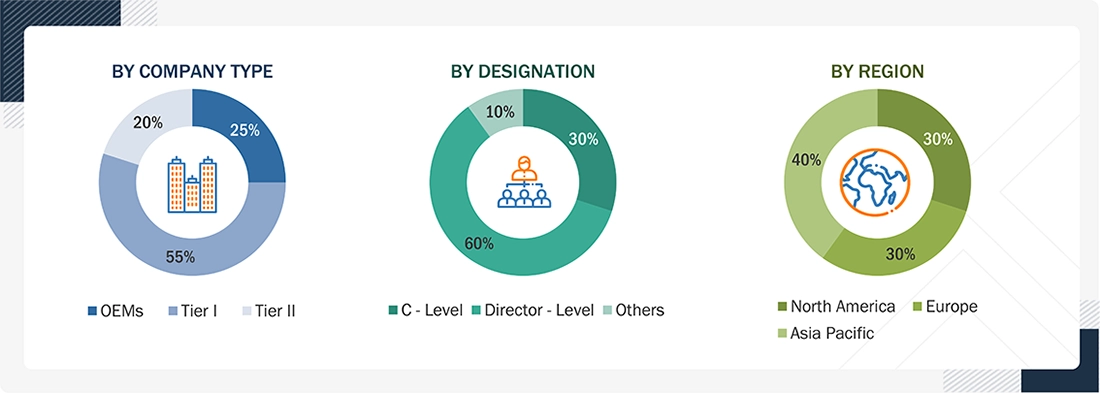
Note: Tiers of companies are based on the supply chain of the automotive camera market; companies’ revenues have not been considered.
To know about the assumptions considered for the study, download the pdf brochure
Market Size Estimation
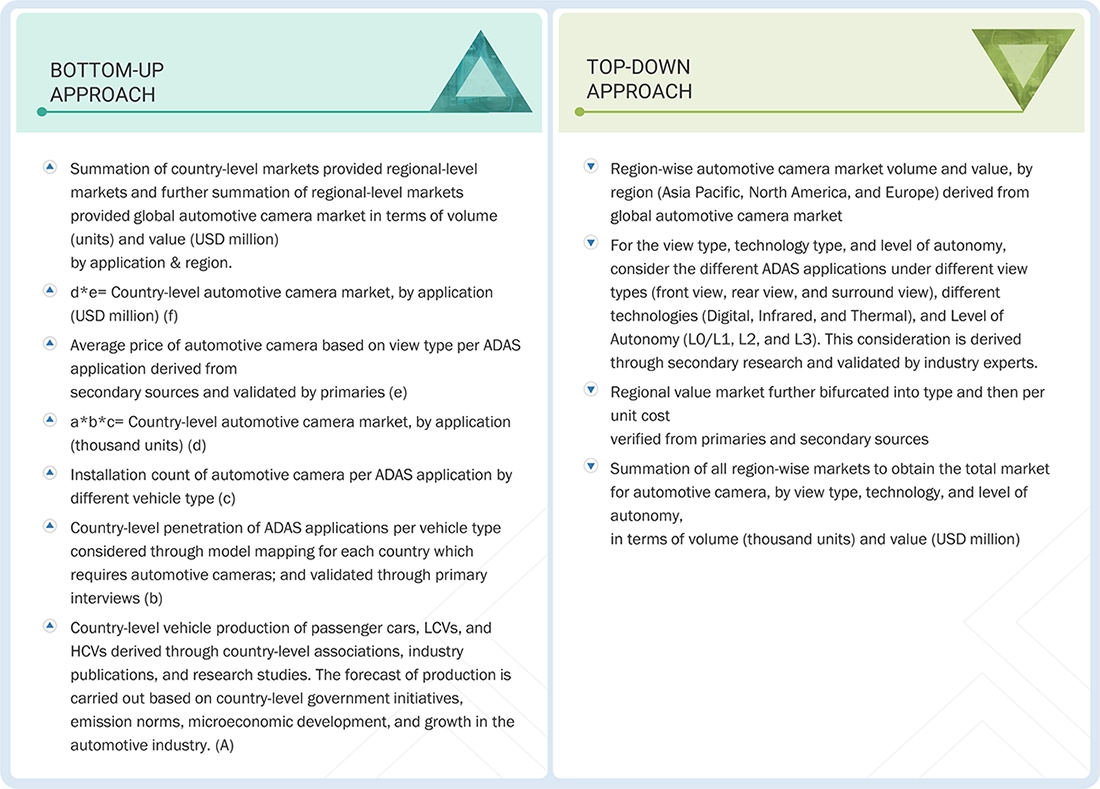
Both top-down and bottom-up approaches were used to estimate and validate the total size of the automotive camera market. These methods were also used extensively to estimate the size of various subsegments in the market. The research methodology used to estimate the market size includes the following:
Bottom-Up Approach, By Application and Vehicle Type
The bottom-up approach was used to estimate and validate the size of the automotive camera market. In this approach, the country-level production of each vehicle type (passenger cars, LCVs, and HCVs) was identified using country-level associations and OICA data. The vehicle production forecast for each country was based on multiple factors, including country-specific macroeconomic indicators, emission regulations, automotive industry growth, GDP growth, and government initiatives.
Further, to determine the automotive camera market in terms of volume, country-level penetration of various ADAS applications by vehicle type was identified through model mapping for each country, and the automotive camera installed per application by vehicle type was derived from secondary research and validated with industry experts. The country-level vehicle type production was then multiplied by the country-level ADAS application penetration for each vehicle type, and the number of cameras installed in each ADAS application yields the country-level automotive market by vehicle type and application, in terms of volume.
The average selling price of automotive cameras installed in each ADAS application for each vehicle type was derived through secondary sources and further validated by industry experts. The country-level automotive camera market volume, by application, was multiplied by the average selling price of automotive cameras, yielding the market in terms of value (USD million) by vehicle type and application.
Further, the summation of country-level markets provided the regional-level markets in terms of volume (thousand units) and value (USD million). A further breakdown of regional markets for the global automotive camera market, by volume (thousand units) and value (USD million), was provided by region and application. A similar approach was followed to derive the total number of automotive camera installations in electric vehicles by application and vehicle type.
Global Automotive Camera Market Size: Top-Down Approach, By Level of Autonomy, View Type, and Technology
A top-down approach was used to determine the automotive camera market size by view type, technology, and level of autonomy, in terms of volume and value. The market volume and value by region (Asia Pacific, North America, Europe, and the Rest of the World) were derived from the global market. For the view type, technology type, and level of autonomy, consider the different ADAS applications under different view types (front view, rear view, and surround view), different technologies (digital, infrared, and thermal), and level of autonomy (L0/L1, L2, and L3). Through this, the market volume and value for automotive cameras, by view type, technology, and level of autonomy, were derived. The summation of all region-wise markets was performed to obtain the total market by view type, technology, and level of autonomy, in terms of volume (thousand units) and value (USD million).
Data Triangulation
After arriving at the overall market size through the aforementioned methodology, the automotive camera market was split into several segments and subsegments. The data triangulation procedure was employed, wherever applicable, to complete the overall market engineering process and arrive at the exact market value for key segments and subsegments. The extrapolated market data was triangulated by studying various macro indicators and regional trends from both the demand- and supply-side participants.
Market Definition
Automotive Camera: A camera is a device that records visual images in the form of photographs, film, or video signals. In the automotive sector, the camera is used as an advanced safety device for enhancing the visibility of the surrounding environment of a driver to improve vehicle safety. An automotive camera records images through lenses and converts them into electrical signals. The growing demand for advanced driver assist systems (ADAS) in developed and emerging economies is attributed to the use of cameras in various applications such as parking assist, cross-traffic alert, and pedestrian detection systems.
Key Stakeholders
- Automotive OEMs
- Tier 1 Automotive Suppliers (System Integrators)
- Image Sensor Manufacturers
- Semiconductor & AI Chip Companies
- Lens & Optical Component Suppliers
- Raw Material & Glass Suppliers
- ADAS & Software Developer Companies
- Contract Manufacturers / Module Assemblers
- Regulators & Safety Organizations
- Autonomous & Software-defined Vehicle Manufacturers
Report Objectives
- To segment and forecast the automotive camera market in terms of volume (thousand units) and value (USD million)
- To analyze regional OE markets for growth trends, prospects, in terms of volume (thousand units) and value (USD million)
- For ICE Vehicles, by application (adaptive cruise control; adaptive cruise control + forward collision warning; adaptive cruise control + forward collision warning + traffic sign recognition; blind spot detection; blind spot detection; blind spot detection; blind spot detection + lane keep assist + lane departure warning; adaptive lighting system; intelligent parking assist; driver monitoring system; night vision system; and parking assist)
- By vehicle type (ICE) [passenger car, light commercial vehicle (LCV), heavy commercial vehicle (HCV)]
- By view type (front view, surround view, and rear view)
- By technology (digital, infrared, and thermal)
- By EV type [battery electric vehicle (BEV), plug-in hybrid electric vehicle (PHEV), fuel cell electric vehicle (FCEV)]
- By EV application (adaptive cruise control; adaptive cruise control + forward collision warning; adaptive cruise control + forward collision warning + traffic sign recognition; blind spot detection; blind spot detection; blind spot detection; blind spot detection + lane keep assist + lane departure warning; adaptive lighting systems; intelligent parking assist; driver monitoring systems; night vision systems; and parking assist)
- By level of autonomy (Level 0/ Level 1, Level 2, and Level 3)
- By region [North America, Europe, Asia Pacific, and the Rest of the World (RoW)]
- Automotive camera aftermarket demand (qualitative) (organized, unorganized, regional trends (APAC, NA, Europe, and ROW), pricing analysis for different types of cameras at the regional level, and technology landscape.
- To analyze the current and future technological developments impacting the camera market
- To provide detailed information about the major factors influencing market growth (drivers, challenges, restraints, and opportunities)
- To strategically analyze the market, considering individual growth trends, prospects, and contributions to the total market
- To study the following concerning the market
- Impact of AI/Generative AI on the automotive camera market
- Trends/Disruptions impacting customer business
- Supply chain analysis
- Ecosystem analysis
- Technology analysis
- Trade analysis/HS code analysis
- Case study analysis
- Patent analysis
- Regulatory landscape
- Key stakeholders and buying criteria
- Key conferences and events
- Supplier analysis
- Investment and funding scenario
- To estimate the following with respect to the automotive camera market:
- Pricing analysis
- By vehicle type
- By Region
- To strategically profile key players and comprehensively analyze their market share and core competencies
- To track and analyze competitive developments, such as product launches, deals, and expansions, carried out by key industry participants
Available customizations:
With the given market data, MarketsandMarkets offers customizations in accordance with the company’s specific needs.
Global Automotive Camera Market, By Application and Vehicle Type (ICE)- Note: The market will be provided for ICE vehicle types – passenger cars, light commercial vehicles, and heavy commercial vehicles. No further bifurcation at the regional level will be provided.
- Note: The market will be provided for electric & hybrid vehicle types – BEV, PHEV, and FCEV. No further bifurcation at the regional level will be provided.
- Note: The market will be provided for aftermarket camera, Asia Pacific, Europe, North America, and Rest of the world at the regional level will be provided.
Company Information:
- Profiling of additional market players (Up to 5)
Get the Full Automotive Camera Market Report
Full forecast, segment splits, and company analysis for all Automotive Camera Market.
- US Automotive Camera Market
- China Automotive Camera Market
- India Automotive Camera Market
- Japan Automotive Camera Market
- South Korea Automotive Camera Market
- Thailand Automotive Camera Market
- Germany Automotive Camera Market
- France Automotive Camera Market
- Spain Automotive Camera Market
- Russia Automotive Camera Market
- UK Automotive Camera Market
- Turkey Automotive Camera Market
- Mexico Automotive Camera Market
- Brazil Automotive Camera Market
- Iran Automotive Camera Market
Need a Tailored Report?
Customize this report to your needs
Get 10% FREE Customization
Customize This Report
