
Thailand Exhaust System Market (2026-2031)

The Thailand Exhaust System Market was valued at $1321.2 Million in 2026 and projected to reach to $1617.8 Million by 2031, representing a compound annual growth rate of CAGR 5.0%. Thailand's exhaust system market is positioned for sustained growth driven by the country's robust automotive manufacturing ecosystem and increasing vehicle production.


| Market Size in | USD 26.32 MN |
| Market Forecast in | |
| CAGR | |
| Forecast Period | |
| Units Considered | Value (USD MN) |
Thailand Exhaust System Market Trends and Insights
- This 5.0% compound annual growth rate reflects Thailand's strengthening automotive manufacturing sector and rising vehicle production volumes.
- Thailand's position as a regional automotive hub drives demand for advanced exhaust technologies and emission control systems across both domestic and export markets. The market expansion in Thailand is underpinned by increasing vehicle sales, stricter environmental regulations, and growing adoption of emission-reduction technologies.
- Thailand's automotive industry, supported by major OEM investments and a robust supply chain, continues to fuel exhaust system demand through 2031.
- Rising consumer awareness of environmental standards and regulatory compliance requirements further accelerates market penetration across Thailand's automotive ecosystem..
Key Market Statistics
- CAGR (2026-2031) CAGR 5.0%
- Market Size, 2026 ~USD 1321.2 Million
- Forecast, 2031 ~USD 1617.8 Million
- Country Thailand
Thailand Exhaust System Market Overview
Strong Regional Manufacturing Hub :
Thailand's automotive manufacturing sector is a cornerstone of Southeast Asia's production landscape, driving significant demand for exhaust system components and technologies across domestic and export markets.
Accelerating Vehicle Production :
Rising vehicle production volumes in Thailand are directly fueling exhaust system market expansion, with manufacturers increasingly adopting advanced emission control technologies to meet regulatory standards.
5% CAGR Growth Trajectory :
Thailand's exhaust system market is projected to grow from USD 1,321.2 million in 2026 to USD 1,617.8 million by 2031, significantly outpacing the global CAGR of 1.7%.
Advanced Technology Adoption :
Thai automotive manufacturers are increasingly investing in advanced exhaust technologies including catalytic converters, particulate filters, and selective catalytic reduction systems to enhance vehicle performance and environmental compliance.
Thailand Exhaust System Market Dynamics
- The 5% CAGR reflects strong demand from both domestic consumption and regional export markets, as Thai manufacturers expand capacity to serve Southeast Asian demand.
- Government initiatives supporting automotive sector development and stricter emission regulations are accelerating the adoption of advanced exhaust technologies. Looking ahead to 2031, Thailand's market will benefit from rising middle-class vehicle ownership, fleet modernization, and manufacturer investments in emission control systems.
- The transition toward more stringent environmental standards and potential electrification trends will create opportunities for innovative exhaust solutions, positioning Thailand as a critical market for exhaust system suppliers and component manufacturers in the Asia-Pacific region..
Market Ecosystem
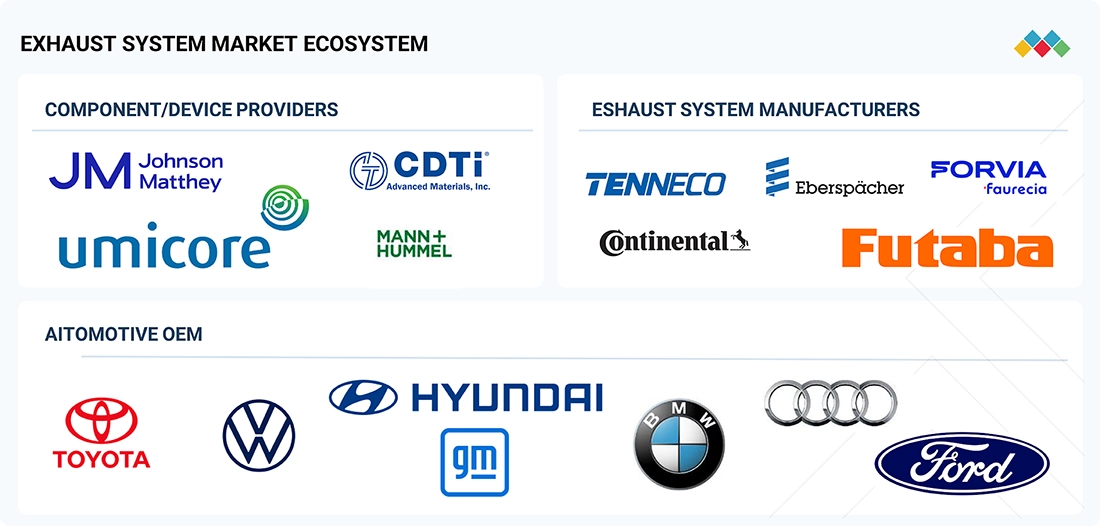
EXHAUST SYSTEM MARKET SIZE, SHARE & ANALYSIS: COMMERCIAL USE CASES ACROSS INDUSTRIES
| COMPANY | USE CASE DESCRIPTION | BENEFITS |
|---|---|---|
 |
Supplies close-coupled catalytic converters and integrated NOx sensor modules for turbocharged gasoline passenger cars and hybrid SUVs. The systems are positioned closer to the engine manifold to achieve faster catalyst activation during urban stop-start driving cycles. | Improves cold start emission control, reduces catalyst warm up time, supports compact engine structure |
 |
Develops lightweight stainless steel mufflers and tailpipe systems for premium passenger vehicles where OEMs seek lower NVH levels without increasing vehicle weight | Reduces cabin resonance, improves acoustic tuning |
 |
Provides SCR catalytic converters, particulate sensors, and heavy-duty exhaust manifolds for long haul diesel trucks | Enhances NOx conversion efficiency under variable load conditions, improves onboard diagnostics accuracy |
 |
Provides thin wall stainless steel exhaust manifolds and performance downpipes for premium passenger cars equipped with high output turbocharged engines | Improves turbocharger response, lowers thermal losses between engine and catalyst |
 |
Produces exhaust manifolds, mufflers, and catalytic converter housings for mass market hybrid passenger vehicles in Asia. The systems are optimized for compact transverse engine layouts. | Improves manufacturability for high volume OEM production, reduces vibration transfer to the cabin |
Logos and trademarks shown above are the property of their respective owners. Their use here is for informational and illustrative purposes only.
Related Ecosystem
Engine Engine System Exhaust
- Light Commercial Vehicles (LCVs)
- Agricultural Tractors
- Battery Electric Vehicle (BEV)
- Hybrid Electric Vehicle (HEV)
- Sensors
- TENNECO
- GORKOVSKY AVTOMOBILNY ZAVOD
- Titan Company Limited
- AISIN CORPORATION
- TI AUTOMOTIVE
Key Takeaways
- Thailand's exhaust system market grows at 5.0% CAGR from 2026 to 2031, outpacing global growth of 1.7%.
- Market size in Thailand expands from USD 1,321.2 million in 2026 to USD 1,617.8 million by 2031.
- Thailand's automotive manufacturing leadership and OEM presence drive sustained exhaust system demand.
- Stricter emission regulations and environmental compliance requirements accelerate technology adoption in Thailand.
Exhaust System Market Report Scope
| Report Metric | Details |
|---|---|
| Base Year | 2026 |
| Fastest Growing Segment | AGRICULTURAL TRACTORS (Equipment Type) |
| Forecast Period | 2026–2031 |
| Growth Rate | CAGR of 1.7% from 2026 to 2031 |
| Largest Segment | AFTERMARKET (Sales Channel) |
| Market Size Base Year (Billions) | ~USD 58 (2026) |
| Revenue Forecast (Billions) | ~USD 63.1 (2031) |
| Segments Covered | Component, After-Treatment Device, Type, Fuel Type, Vehicle Type, Sales Channel, Aftertreatment Device, Equipment Type |
Thailand Exhaust System Market Report Segmentation
8 segment dimensions are covered across the global market.
By Component
- Catalytic Converters
- Downpipes
- Exhaust Manifolds
- Hangers
- Manifolds
- Mufflers
- Sensors
- Tailpipes
By After-Treatment Device
- Diesel Oxidization Catalyst
- Diesel Particulate Filter
- Doc
- Dpf
- Gpf
- Lnt
- Scr
- Selective Catalytic Reduction
By Type
- Nox Sensors
- Oxygen Sensors
- Pm Sensors
- Temperature Sensors
By Fuel Type
- Diesel
- Gasoline
By Vehicle Type
- Buses
- Lcvs
- Passenger Cars
- Trucks
By Sales Channel
- Aftermarket
- OEM
By Aftertreatment Device
- Doc
- Dpf
- Gpf
- Lnt
- Scr
By Equipment Type
- Agricultural Tractors
- Construction Equipment
- Mining Equipment
Target Audience
- Automotive Component Manufacturers : Thai and regional exhaust system suppliers need detailed market data to optimize production capacity, identify growth segments, and benchmark competitive positioning within Thailand's manufacturing ecosystem.
- Vehicle OEMs & Assemblers : Major automotive manufacturers operating in Thailand require market insights to forecast exhaust system demand, plan supply chain investments, and align technology roadmaps with regulatory requirements.
- Investment & Private Equity Firms : Investors targeting Thailand's automotive sector need comprehensive market analysis to evaluate investment opportunities, assess growth potential, and identify acquisition targets in the exhaust systems space.
- Market Entry & Expansion Strategists : Companies planning to enter or expand operations in Thailand's automotive market require country-specific data on market size, growth drivers, and competitive dynamics to inform strategic decisions.
- Policy & Regulatory Analysts : Government agencies, trade associations, and regulatory bodies need market intelligence to develop automotive policies, emission standards, and industrial development strategies aligned with market realities.
Key Companies in the Thailand Exhaust System Market
| Company | HQ | Ownership | Strongest segments |
|---|---|---|---|
| GAZ | Russia | Public Company | Gas business (exploration, production, processing, transport, sales),Oil and refined products,Electric power and heat generation, |
| AISIN SEIKI CO LTD | Japan | Public Company | Automatic, CVT, and manual transmissions,eAxle and electrified driveline components,Brakes, steering, and chassis systems, |
| ACTUANT | United States | Public Company | High-force hydraulic tools (cylinders, pumps, valves, specialty tools),Bolting, torque, and tensioning systems,Heavy lifting technology solutions, |
| CUMMINS INC | United States | Public Company | Engine,Components,Power Systems, |
| HONDA MOTOR CO LTD | Japan | Public Company | Automobile Business,Motorcycle Business,Financial Services Business, |
| RHEINMETALL AG | Germany | Public Company | Vehicle Systems (combat, logistics, support, special vehicles),Weapon and Ammunition (weapons, ammo, protection, propellants),Electronic Solutions (sensors, C2, air defense, soldier systems), |
| FEDERAL-MOGUL CORPORATION | United States | Private Company | OE light vehicle powertrain components,OE medium and heavy-duty commercial vehicle powertrain,Aftermarket replacement parts, |
| DONALDSON COMPANY, INC | United States | Public Company | Mobile Solutions (off-highway, transportation, replacement filters),Industrial Solutions (dust collection, compressed air, gas and liquid, A&D),Life Sciences (bioprocess, food and beverage, micro-environment filtration), |
| LINAMAR | Canada | Public Company | Electrified driveline and eAxles,Traditional driveline, transmission, and engine components,Structures and chassis systems, |
| TOYODA GOSEI CO., LTD | Japan | Public Company | Weatherstrips and sealing systems,Functional components (fuel tank, battery, engine, chassis/drivetrain parts),Interior and exterior plastic parts, |
| FORVIA | France | Public Company | Seating,Interiors,Clean Mobility, |
| TENNECO INC. | United States | Private Company | Clean air and emissions-control systems,Powertrain and engine components,Ride-performance systems (suspension, damping, related), |
| FUTABA INDUSTRIAL CO., LTD. | Japan | Public Company | Exhaust systems and manifolds (incl. diesel aftertreatment),Body parts and structural assemblies,Suspension parts and underbody components, |
| SANGO CO., LTD. | Canada | Public Company | UC platforms (cloud, hybrid, on-premises including PBXact),SIP trunking and fax as a service,Contact center and CX (Sangoma CX), |
| YUTAKA GIKEN COMPANY LIMITED | Japan | Private Company | Torque converters and drive system components,Exhaust system,Brake system, |
| SEJONG INDUSTRIAL CO., LTD. | South Korea | Public Company | Complete exhaust systems (manifolds, converters, resonators, SCR hardware),Exhaust-related electromechanical modules and sensors,Hydrogen and fuel-cell vehicle components, |
| BENTELER INTERNATIONAL AG | Austria | Private Company | Chassis and subframes,Body and structural components,Engines and exhaust systems, |
GAZ
GAZ is a Russian public company founded in 1993 with 468,000 employees.
AISIN SEIKI CO LTD
Aisin Seiki Co Ltd is a Japanese public company founded in 1943 with 113,292 employees.
ACTUANT
Actuant is a United States public company founded in 1910 with 2,100 employees.
CUMMINS INC
Cummins Inc is a United States public company founded in 1919 with 67,400 employees.
HONDA MOTOR CO LTD
Honda Motor Co Ltd is a Japanese public company founded in 1946 with 195,109 employees.
RHEINMETALL AG
Rheinmetall AG is a German public company founded in 1889 with 28,815 employees.
FEDERAL-MOGUL CORPORATION
Federal-Mogul Corporation is a United States private company founded in 1899 with 44,275 employees.
DONALDSON COMPANY, INC
Donaldson Company, Inc is a United States public company founded in 1915 with 15,000 employees.
LINAMAR
Linamar is a Canadian public company founded in 1964 with 36,000 employees.
TOYODA GOSEI CO., LTD
Toyoda Gosei Co., Ltd is a Japanese public company founded in 1949 with 41,304 employees.
FORVIA
Forvia is a French public company founded in 1914 with 106,513 employees.
TENNECO INC.
Tenneco Inc. is a United States private company founded in 1930 with 71,000 employees.
FUTABA INDUSTRIAL CO., LTD.
Futaba Industrial Co., Ltd. is a Japanese public company founded in 1935 with 10,104 employees.
SANGO CO., LTD.
Sango Co., Ltd. is a Canadian public company with 645 employees.
YUTAKA GIKEN COMPANY LIMITED
Yutaka Giken Company Limited is a Japanese private company founded in 1954 with 4,726 employees.
SEJONG INDUSTRIAL CO., LTD.
Sejong Industrial Co., Ltd. is a South Korean public company founded in 1976 with 609 employees.
BENTELER INTERNATIONAL AG
Benteler International AG is an Austrian private company founded in 1876 with 20,133 employees.
Reasons to Buy this Report
- Market Size & Growth Validation : Obtain precise market valuation data for Thailand's exhaust system sector with verified CAGR projections through 2031, enabling accurate financial forecasting and investment decision-making.
- Competitive Positioning Intelligence : Understand Thailand's market dynamics relative to global trends, with detailed insights into regional manufacturing advantages and competitive landscape specific to Thai automotive suppliers.
- Regulatory & Technology Insights : Access comprehensive analysis of Thailand's emission standards, environmental regulations, and technology adoption patterns driving exhaust system innovation and market opportunities.
- Strategic Market Entry Planning : Leverage Thailand-specific market data to develop targeted go-to-market strategies, identify key manufacturing clusters, and pinpoint high-growth segments within the country's automotive ecosystem.
- Supply Chain & Partnership Opportunities : Identify critical supply chain dynamics, manufacturing partnerships, and distribution channels specific to Thailand's exhaust system market for strategic collaboration and expansion planning.
Frequently asked questions
What is the current size of Thailand's exhaust system market?
Thailand's exhaust system market is valued at USD 1,321.2 million in 2026 and is projected to grow to USD 1,617.8 million by 2031.
What is the growth rate of Thailand's exhaust system market?
Thailand's exhaust system market is growing at a compound annual growth rate (CAGR) of 5.0% between 2026 and 2031.
What factors are driving growth in Thailand's exhaust system market?
Key drivers include Thailand's strong automotive manufacturing base, increasing vehicle production, stricter emission regulations, and growing adoption of advanced emission-control technologies.
How does Thailand's market growth compare to global trends?
Thailand's 5.0% CAGR significantly outpaces the global exhaust system market CAGR of 1.7%, reflecting Thailand's dynamic automotive sector.
What is the forecast market size for Thailand's exhaust system market by 2031?
Thailand's exhaust system market is forecast to reach USD 1,617.8 million by 2031, representing a USD 296.6 million increase from 2026.
RESEARCH METHODOLOGY
The study relies extensively on secondary sources, including company annual reports and presentations, industry association publications, industry magazine articles, directories, technical handbooks, the World Economic Outlook, technical articles, and databases, to identify and collect information on the exhaust system market. In-depth interviews were conducted with primary respondents, including key industry participants, subject-matter experts, C-level executives of key market players (exhaust system providers, automotive OEMs, and technology suppliers), and industry consultants, among other experts, to obtain and verify critical qualitative and quantitative information and to assess market prospects.
Secondary Research
The secondary study involves three major activities, namely, background study, market understanding, and trends. Secondary sources referred to in this research study included the International Council on Clean Transportation (ICCT), Organisation Internationale des Constructeurs d'Automobiles (OICA); corporate filings (such as annual reports, investor presentations, and financial statements); and trade, business, and automotive associations. The secondary data was collected and analyzed to arrive at the overall market size, which was further validated by primary research.
Primary Research
Extensive primary research was conducted after gaining an understanding of the exhaust system market through secondary research. Several primary interviews were conducted with market experts from exhaust system providers, after-treatment device providers, and OEMs (vehicle manufacturers) across three major regions, namely, North America, Europe, and the Asia Pacific. Approximately 80% of the primary interviews were conducted with exhaust system component providers, and 20% with OEM participants. Primary data was collected through questionnaires, emails, and telephonic interviews. Various departments within organizations, including sales, operations, and administration, were contacted to provide a holistic viewpoint in the reports while canvassing primary interviews. After interacting with industry participants, brief sessions were conducted with experienced independent consultants to reinforce the findings from the primary interviews. This, along with the opinions of in-house subject matter experts, led to the findings delineated in the rest of this report.
Primary interviews have been conducted to gather insights, including exhaust system market sizing and forecast, future trends, and upcoming technologies in the market. Data triangulation of these points was performed using information from secondary research and model mapping. Stakeholders from the demand and supply sides have been interviewed to understand their views on these points.
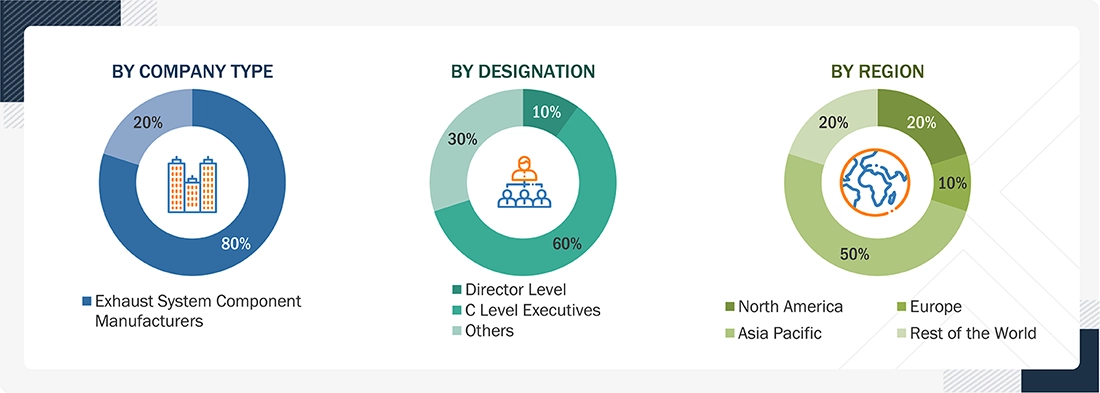
Note: Other designations include sales, marketing, and product managers.
Company tiers are based on the value chain; the revenue of the company is not considered.
To know about the assumptions considered for the study, download the pdf brochure
Market Size Estimation
A detailed market estimation approach was followed to estimate and validate the value and volume of the exhaust system market and other dependent submarkets, as mentioned below:
- The bottom-up approach was used to estimate and validate the size of the market. The market size by component, in terms of volume, was derived by multiplying the country-level fuel breakup of each vehicle type by the country-level production of each vehicle type (passenger cars, LCVs, trucks, and buses) (which was estimated using secondary research and then validated by primary interviews) for each vehicle type.
- The country-level exhaust system component market size, by volume, was multiplied by the country-level average OE component price (AOP) for each component and vehicle type to obtain the country-level component market by value.
- The summation of the country-level markets provides the regional level, and further addition yields the global market by component (sensors, catalytic converters, downpipes, manifolds, mufflers, tailpipes, and hangers). The values for each country were summed to derive the total value of the exhaust systems market for after-treatment device components.
- The OE market size for exhaust system aftertreatment devices, including DOC, DPF, and SCR, was estimated using a bottom-up approach based on country and vehicle-type-level production data sourced from vehicle associations and secondary research. Fuel type share across vehicle segments was derived through model-level mapping, secondary research, and industry expert validation. Based on fuel type and country-specific emission regulations, aftertreatment device fitment and penetration were mapped across vehicle categories. Future estimates were developed using expected fuel-share trends, upcoming emission regulations, and aftertreatment adoption rates, while market value was calculated using OE fitment rates and average selling prices (ASPs) for aftertreatment devices.
- The aftermarket size of exhaust systems, by after-treatment devices—DOC, DPF, and SCR —by volume was derived by multiplying the regional-level parc of each vehicle type by the regional-level average miles driven for that type.
- The derived total miles driven at the regional level for each vehicle type were then multiplied by the regional-wise fuel share and the regional-level after-treatment devices penetration for each vehicle type. The estimated regional number of after-treatment devices was further divided by the regional-level average life of each after-treatment device for each vehicle type to analyze the aftermarket exhaust system by after-treatment device volume.
- The regional aftermarket size, by volume, was multiplied by the regional-level average selling price of each after-treatment device for each vehicle type, yielding the exhaust system aftermarket value by after-treatment device for each vehicle type.
- All key macro indicators affecting the revenue growth of the market segments and subsegments were accounted for, examined in detail, verified through primary research, and analyzed to obtain validated quantitative and qualitative data.
- The market data gathered was consolidated and added with detailed input, analyzed, and presented in this report.
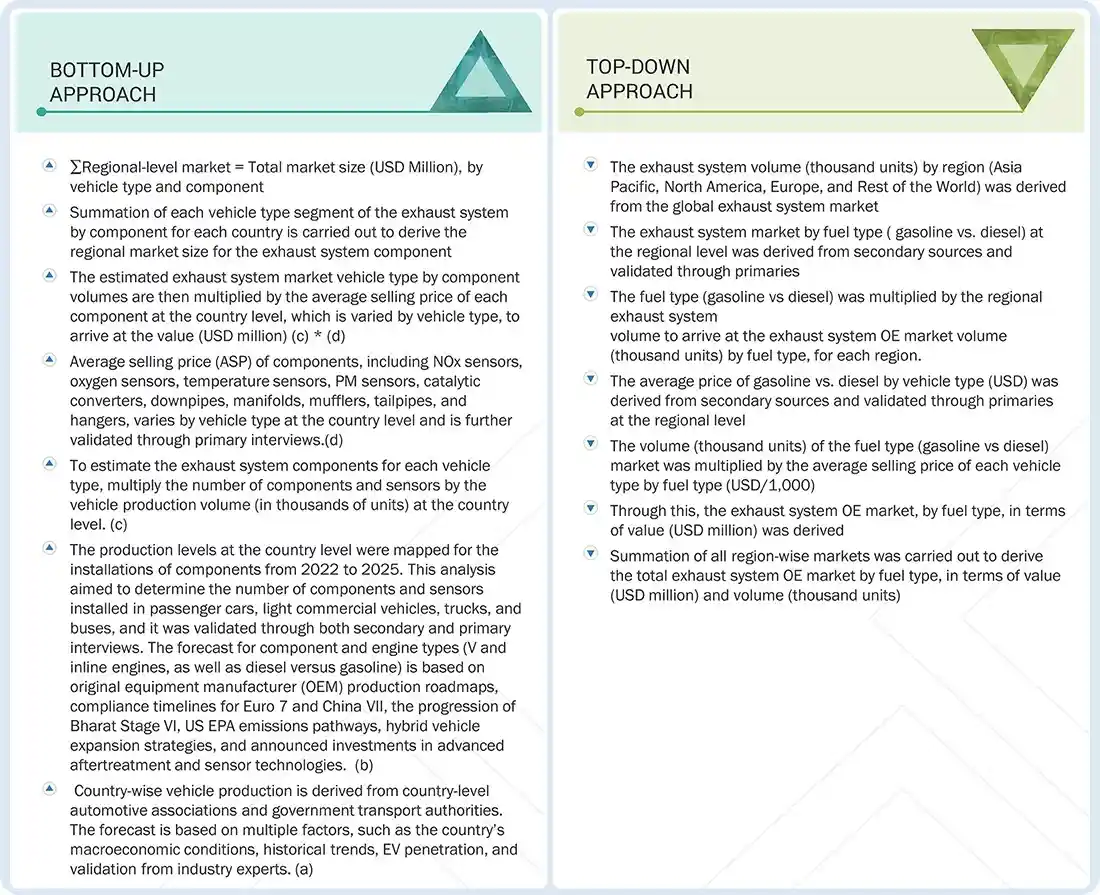
Data Triangulation
After determining the global market's overall size using the above-mentioned methodology, the market was segmented into several segments and subsegments. Data triangulation and market breakdown procedures were employed to complete the overall market engineering process and arrive at the exact data for the market by volume and value for the key segments and subsegments, wherever applicable. The extrapolated market data was triangulated by studying various macro indicators and regional trends from both the OEM and exhaust system participants.
Market Definition
Exhaust Systems: The key components of an exhaust system are the exhaust manifold, downpipe, and tailpipe. Exhaust gases from the engine cylinders are collected and cooled by the exhaust manifold and then passed to the catalytic converter through the downpipe. The catalytic converter acts as an exhaust gas purifier, removing harmful constituents from the gases. The gases then travel through the muffler, which reduces noise, and finally exit through the tailpipe as cleansed exhaust gases.
After-treatment Devices: These devices remove harmful constituents such as carbon monoxide (CO), carbon dioxide (CO2), nitrogen oxides (NOX), and particulate matter (PM) from the exhaust gas. After-treatment devices considered in this study for diesel engines include a diesel particulate filter, a diesel oxidation catalyst, a lean NOx trap, and a selective catalytic converter. For gasoline engines, the device is a gasoline particulate filter (GPF).
Key Stakeholders
- Exhaust System Manufacturers
- Exhaust System Component Providers
- Automotive OEMs
- Emission Control Technology Providers
- Aftermarket Service Providers
- Industrial and End Use Organizations/Associations
- Regulatory Authorities
Report Objectives
- To define, describe, and forecast the size of the exhaust system market in terms of value (USD million/billion) and volume (thousand units) between 2026 and 2033 based on the following segments:
- OE market, by component (sensors, catalytic converters, downpipes, manifolds, mufflers, tailpipes, hangers)
- OE market, by vehicle type (passenger cars, LCVs, trucks, buses)
- OE market, by fuel type (gasoline, diesel)
- OE market, by aftertreatment device (DOC, DPF, LNT, SCR, GPF)
- Aftermarket, by aftertreatment device (DOC, DPF, SCR)
- By sales channel (OEM, aftermarket)
- OE market for off-highway vehicles, by equipment type (construction equipment, mining equipment, agricultural tractors)
- OE market for off-highway vehicles, by aftertreatment device (DOC, DPF, SCR)
- By region (Asia Pacific, Europe, North America, Rest of the World)
- To identify and analyze key drivers, restraints, opportunities, and challenges influencing the market
- To strategically profile key players and analyze their market share and core competencies
- To analyze recent developments, including product launches, deals, and expansions, by key market players
- To study the following with respect to the market
- Trends/Disruptions Impacting Customer Business
- Ecosystem Analysis
- Technology Analysis
- Supply Chain Analysis
- Patent Analysis
- Regulatory Landscape
- Case Study Analysis
- Key Stakeholders and Buying Criteria
- Key Conferences and Events
- Trade Analysis
- Pricing Analysis
- Impact of EU-FTA Trade Deal
- Impact of the Israel-Iran War
Available customizations:
MarketsandMarkets offers the following customizations for this market report:
-
exhaust system Market, By sensor type & vehicle type
- NOx Sensors
- Oxygen Sensors
- Temperature Sensors
- PM Sensors
Note: The after-treatment devices OE market can be offered for IC vehicle types - Passenger Cars, LCVs, Trucks, and Buses.
-
exhaust system Components OE market, By vehicle type
- Passenger Cars
- LCVs
- Trucks
- Buses
Note: The component (exhaust manifolds, downpipes, catalytic converters, mufflers, tailpipes, and sensors) OE market can be offered for IC vehicle types - Passenger Cars, LCVs, Trucks, and Buses at the regional level- North America, Europe, Asia Pacific, and Rest of the World.
-
Hybrid Vehicle Exhaust system OE market, By After-treatment device
- LNT
- GPF
Note: The hybrid vehicle (HEV & PHEV) exhaust system OE market can be offered by after-treatment devices - LNT and GPF. The off-highway vehicle (construction equipment and agricultural tractors) market can be offered by after-treatment devices - DOC, DPF, and SCR at the regional level - North America, Europe, Asia Pacific, and the Rest of the World.
-
Two & THREE-WHEELER vehicle exhaust system OE market, By region
- Asia Pacific
- Europe
- North America
- Rest of the World
Note: The exhaust system OE market can be offered at the regional level - North America, Europe, Asia Pacific, and the Rest of the World.
Get the Full Exhaust System Market Report
Full forecast, segment splits, and company analysis for all Exhaust System Market.
- China Exhaust System Market
- India Exhaust System Market
- Japan Exhaust System Market
- South Korea Exhaust System Market
- Germany Exhaust System Market
- France Exhaust System Market
- UK Exhaust System Market
- Spain Exhaust System Market
- Turkey Exhaust System Market
- Russia Exhaust System Market
- US Exhaust System Market
- Mexico Exhaust System Market
- Canada Exhaust System Market
- Brazil Exhaust System Market
- Argentina Exhaust System Market
Need a Tailored Report?
Customize this report to your needs
Get 10% FREE Customization
Customize This Report
