
US Automotive LiDAR Market (2026-2031)

The US Automotive LiDAR Market was valued at $370 Million in 2026 and projected to reach to $5181 Million by 2031, representing a compound annual growth rate of 45.8%. The US automotive LiDAR market stands at an inflection point, driven by the convergence of autonomous vehicle commercialization, regulatory mandates for ADAS, and substantial investment from both established OEMs and technology startups.


| Market Size in | USD 26.32 MN |
| Market Forecast in | |
| CAGR | |
| Forecast Period | |
| Units Considered | Value (USD MN) |
US Automotive LiDAR Market Trends and Insights
- This represents a compound annual growth rate of 45.8%, significantly outpacing global expansion trends.
- The US market is driven by accelerating autonomous vehicle development, regulatory support for advanced driver assistance systems (ADAS), and substantial investments from both legacy automakers and technology companies establishing LiDAR manufacturing and integration capabilities domestically. In the US, LiDAR adoption is concentrated among premium vehicle segments and autonomous vehicle fleets, with major automotive OEMs and technology firms competing intensely for market share.
- The US market benefits from a robust supply chain ecosystem, favorable government incentives for electric and autonomous vehicles, and consumer demand for advanced safety features.
- By 2031, the US is expected to command a dominant position in the global LiDAR market, reflecting the country's leadership in autonomous vehicle commercialization and sensor technology innovation..
Key Market Statistics
- CAGR (2026-2031) 45.8% CAGR
- Market Size, 2026 ~USD 370 Million
- Forecast, 2031 ~USD 5181 Million
- Country US
US Automotive LiDAR Market Overview
Explosive US Growth Trajectory :
The US automotive LiDAR market is projected to grow from $370 million in 2026 to $5,181 million by 2031, representing a 45.8% CAGR—significantly exceeding the global growth rate of 31%.
Autonomous Vehicle Acceleration :
US-based autonomous vehicle development by Tesla, Waymo, Cruise, and other manufacturers is driving substantial LiDAR adoption for Level 3+ autonomous systems and advanced perception capabilities.
Regulatory ADAS Mandates :
Federal and state regulations increasingly require advanced driver assistance systems (ADAS) in new vehicles, creating mandatory LiDAR integration across mainstream automotive manufacturers in the US market.
Domestic Supply Chain Expansion :
US-based LiDAR manufacturers and suppliers are scaling production capacity to meet domestic demand, reducing import dependency and creating competitive pricing advantages for American OEMs.
US Automotive LiDAR Market Dynamics
- Major US automakers are rapidly integrating LiDAR into their vehicle platforms, while companies like Tesla explore alternative perception technologies, creating a competitive landscape that accelerates innovation and cost reduction.
- The market's 45.8% CAGR reflects strong demand from both premium and mid-market segments seeking advanced safety and autonomous capabilities. Looking ahead to 2031, the US market will likely consolidate around a handful of dominant LiDAR suppliers while new entrants focus on specialized applications and cost-optimized solutions.
- Regulatory clarity on autonomous vehicle standards, combined with declining sensor costs and improved performance metrics, will drive mainstream adoption beyond luxury vehicles.
- Strategic partnerships between automotive OEMs, technology companies, and LiDAR manufacturers will define competitive positioning, with the US market becoming a critical proving ground for global autonomous vehicle deployment strategies..
Market Ecosystem
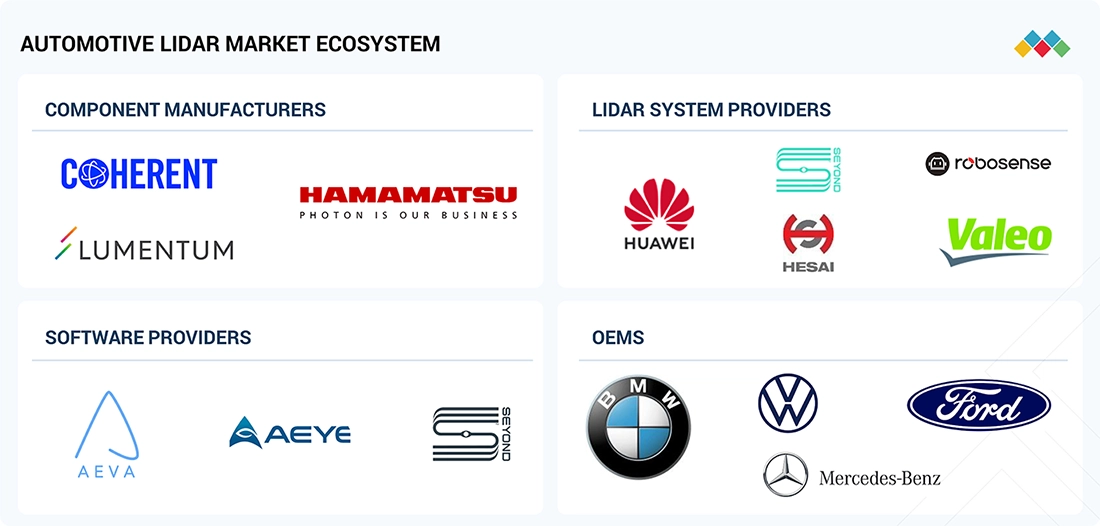
AUTOMOTIVE LIDAR MARKET SIZE, SHARE & ANALYSIS: COMMERCIAL USE CASES ACROSS INDUSTRIES
| COMPANY | USE CASE DESCRIPTION | BENEFITS |
|---|---|---|
 |
Long-range and high-resolution LiDAR solutions for ADAS, autonomous driving, and intelligent vehicle platforms supporting highway and complex road perception | Extended detection range, improved obstacle recognition, stronger driving confidence, reduced perception blind spots |
 |
Automotive-grade solid-state LiDAR and perception solutions for passenger cars, robotaxis, and ADAS to support object detection, lane understanding, and vehicle environment perception | Improved vehicle sensing accuracy, stronger urban driving capability, enhanced safety performance, scalable deployment across vehicle platforms |
 |
Integrated automotive LiDAR and intelligent vehicle sensing solutions combined with compute and software platforms for smart vehicle architectures | Better sensor integration, optimized system performance, improved automated driving response, accelerated intellige |
 |
High-resolution LiDAR sensing platforms for autonomous mobility, vehicle perception, and intelligent transportation applications | Greater environmental awareness, reliable detection in complex conditions, improved operational safety, higher perception consistency |
 |
Automotive-grade LiDAR and ADAS sensing solutions for Level 3 driving, production vehicle integration, and intelligent perception across premium passenger vehicle platforms | Improved long-range perception accuracy, enhanced automated driving safety, better vehicle integration, and scalable deployment across production vehicle programs |
Logos and trademarks shown above are the property of their respective owners. Their use here is for informational and illustrative purposes only.
Related Ecosystem
Automotive Advance Technologies
Electric Hybrid Vehicles
Semi Autonomous And Autonomous Vehicle
Key Takeaways
- The US automotive LiDAR market will grow from $370.0M in 2026 to $5,181.0M in 2031, representing a 45.8% CAGR.
- US market growth is driven by autonomous vehicle commercialization, ADAS adoption, and government support for advanced mobility technologies.
- The US maintains a competitive advantage through established OEM partnerships, technology innovation, and domestic manufacturing investments.
- By 2031, the US is positioned to represent a substantial share of the global automotive LiDAR market, reflecting leadership in autonomous vehicle deployment.
Automotive LiDAR Market Report Scope
| Report Metric | Details |
|---|---|
| Base Year | 2026 |
| Fastest Growing Segment | HEAVY COMMERCIAL VEHICLE (HCV) (Ice Vehicle Type) |
| Forecast Period | 2026–2031 |
| Growth Rate | CAGR of 31% from 2026 to 2031 |
| Largest Segment | 3D (Image Type) |
| Market Size Base Year (Billions) | ~USD 1.7 (2026) |
| Revenue Forecast (Billions) | ~USD 6.56 (2031) |
| Segments Covered | Ice Vehicle Type, Image Type, Laser Wavelength, Level Of Autonomy, Measurement Process, Technology, Range, Vehicle Type |
US Automotive LiDAR Market Report Segmentation
8 segment dimensions are covered across the global market.
By Ice Vehicle Type
- Heavy Commercial Vehicle (Hcv)
- Light Commercial Vehicle (Lcv)
- Passenger Car
By Image Type
- 2D
- 3D
By Laser Wavelength
- Near-Infrared
- Short-Wave Infrared
By Level Of Autonomy
- Autonomous
- Semi-Autonomous
By Measurement Process
- Frequency-Modulated Continuous Wave (Fmcw)
- Time Of Flight (Tof)
By Technology
- Mechanical Lidar
- Solid-State Lidar
By Range
- Long-Range (Above 170 Meters)
- Short & Mid-Range (170 Meters And Below)
By Vehicle Type
- Heavy Commercial Vehicle (Hcv)
- Light Commercial Vehicle (Lcv)
- Passenger Car
Target Audience
- Automotive OEM Executives : US-based and international automakers need detailed US market intelligence to guide LiDAR procurement strategies, supplier negotiations, and autonomous vehicle platform development decisions.
- LiDAR Technology Suppliers : Manufacturers and component suppliers require US-specific market data to assess demand, competitive positioning, pricing strategies, and expansion opportunities in the fastest-growing automotive segment.
- Autonomous Vehicle Companies : Self-driving technology developers and robotaxi operators need comprehensive US market insights to understand LiDAR adoption rates, regulatory requirements, and technology preferences among potential customers.
- Investment & Private Equity Firms : Investors evaluating automotive technology companies require detailed US market forecasts, growth drivers, and competitive dynamics to assess investment returns and portfolio company valuations.
- Automotive Suppliers & Tier-1s : Tier-1 suppliers and component manufacturers need US market segmentation data to identify LiDAR integration opportunities, customer demand patterns, and strategic partnership potential with OEMs.
Key Companies in the US Automotive LiDAR Market
| Company | HQ | Ownership | Strongest segments |
|---|---|---|---|
| JABIL | United States | Public Company | Mechanical LiDAR hardware and assemblies,Solid-state LiDAR modules and PCBAs,LiDAR-enabled ECUs and system integration, |
| MELEXIS NV | Belgium | Public Company | Solid-state LiDAR IC content (ToF, optical, drivers),Mechanical LiDAR IC content (motor control, position, drivers),In-cabin ToF and driver monitoring related to LiDAR stack, |
| STONERIDGE INC | United States | Public Company | Solid-state LiDAR integrated in vision/driver information systems,Mechanical LiDAR for development and low-volume programs,LiDAR-enabled telematics, tracking, and compliance solutions, |
| MCLAREN GROUP | United Kingdom | Private Company | Mechanical LiDAR content on ICE performance vehicles,Solid-state LiDAR content on ICE performance vehicles,LiDAR content on emerging electric performance platforms, |
| TOYODA GOSEI CO., LTD | Japan | Public Company | Solid-state LiDAR for passenger cars (ICE and EV),Mechanical LiDAR for test fleets and HCV/LCV,LiDAR modules integrated into safety systems (airbags, steering, cockpits), |
| VALEO S.A. | France | Public Company | Solid state LiDAR,Mechanical LiDAR,Passenger cars (ICE), |
| HESAI GROUP | China | Public Company | Mechanical LiDAR for AV fleets (robotaxis, freight),Solid-state LiDAR for passenger vehicle ADAS (ICE and EV),LiDAR for commercial vehicles (LCV, HCV) and logistics robots, |
| ROBOSENSE | China | Public Company | Solid-state LiDAR for passenger vehicles (ADAS and autonomous),Mechanical LiDAR for autonomous driving and robotaxis,LiDAR for robotics, cleaning, logistics, and industrial automation, |
| SEYOND | United States | Public Company | Falcon K (ultra-long-range mechanical/hybrid LiDAR),Robin W and Robin E1X (wide FOV, mass-production LiDAR),Hummingbird D1 (short-range flash LiDAR), |
| VALEO | France | Public Company | Solid-state LiDAR for passenger cars (PC),Mechanical LiDAR and hybrid architectures,LiDAR for LCV/HCV ADAS and autonomy, |
| INNOVIZ TECHNOLOGIES LTD | Israel | Public Company | InnovizTwo Long-Range and Ultra Long-Range (automotive-grade solid-state LiDAR),InnovizTwo Short to Mid-Range (side, corner, and near-field LiDAR),InnovizThree (behind-the-windshield integration), |
| OUSTER INC. | United States | Public Company | Mechanical LiDAR (Velodyne surround-view + OS1/OS2 mechanical deployments),Solid-state LiDAR (DF series and developing digital flash sensors),Smart infrastructure & Gemini/BlueCity automotive-adjacent deployments, |
| DENSO CORPORATION | Japan | Public Company | Solid state LiDAR,Mechanical LiDAR,LiDAR for ICE vehicles (PC/LCV/HCV), |
| ZF FRIEDRICHSHAFEN AG | Germany | Private Company | Solid-state LiDAR,Mechanical LiDAR,LiDAR for ICE vehicles (PC/LCV/HCV), |
| APTIV | Switzerland | Public Company | Solid state LiDAR for L2/L2+ ADAS (PC and premium EVs),Mechanical LiDAR for higher autonomy and pilot fleets,LiDAR-enabled perception software and fusion (all vehicle types), |
| INFINEON TECHNOLOGIES AG | Germany | Public Company | Solid-state LiDAR semiconductor content,Mechanical LiDAR semiconductor content,LiDAR-related sensing (ToF, radar crossover, auxiliary sensors), |
| RENESAS ELECTRONICS CORPORATION | Japan | Public Company | Automotive MCUs/MPUs for LiDAR ECUs and perception,Power management, FET drivers, and power discrete for LiDAR,Timing, clocking, and high-speed interface ICs, |
| CEPTON, INC. | United States | Private Company | Automotive solid-state long-range LiDAR (Ultra, Vista-X, Vista-P),Automotive near-range LiDAR (Nova, short-range variants),Industrial and smart infrastructure LiDAR (Sora-P, tolling, smart cities), |
| AEVA INC. | United States | Public Company | Atlas long-range 4D LiDAR (incl. Atlas for mass production),Atlas Ultra for SAE Level 3–4 automated driving,Aeva Omni wide-view short-range 4D LiDAR, |
| AEYE, INC. | United States | Public Company | Accessibility SaaS platform and automated fixes,Professional services (audits, custom fixes, legal support),PDF, mobile app remediation and reporting, |
JABIL
Jabil is a large U.S.-based manufacturing and supply chain solutions company founded in 1966, operating as a public company with approximately 135,000 employees.
MELEXIS NV
Melexis NV is a Belgian semiconductor company founded in 1988, operating as a public company with approximately 2,000 employees.
STONERIDGE INC
Stoneridge Inc. is a U.S.-based automotive supplier founded in 1965, operating as a public company with approximately 4,200 employees.
MCLAREN GROUP
McLaren Group is a British private company founded in 1963 with approximately 2,627 employees, operating in the automotive and motorsports sectors.
TOYODA GOSEI CO., LTD
Toyoda Gosei Co., Ltd. is a Japanese automotive parts manufacturer founded in 1949, operating as a public company with approximately 41,304 employees.
VALEO S.A.
Valeo S.A. is a French automotive supplier founded in 1923, operating as a public company with approximately 87,115 employees.
HESAI GROUP
Hesai Group is a Chinese lidar technology company founded in 2014, operating as a public company with approximately 1,118 employees.
ROBOSENSE
RoboSense is a Chinese lidar and autonomous driving perception company founded in 2014, operating as a public company with approximately 1,800 employees.
SEYOND
Seyond is a U.S.-based lidar technology company founded in 2016, operating as a public company with approximately 649 employees.
VALEO
Valeo is a French automotive supplier founded in 1923, operating as a public company with approximately 87,115 employees.
INNOVIZ TECHNOLOGIES LTD
Innoviz Technologies Ltd. is an Israeli autonomous driving perception company founded in 2016, operating as a public company with approximately 372 employees.
OUSTER INC.
Ouster Inc. is a U.S.-based lidar sensor manufacturer founded in 2015, operating as a public company with approximately 320 employees.
DENSO CORPORATION
Denso Corporation is a Japanese automotive parts supplier founded in 1949, operating as a public company with approximately 154,716 employees.
ZF FRIEDRICHSHAFEN AG
ZF Friedrichshafen AG is a German private automotive supplier founded in 1915 with approximately 145,909 employees.
APTIV
Aptiv is a Switzerland-based automotive technology company founded in 2011, operating as a public company with approximately 140,000 employees.
INFINEON TECHNOLOGIES AG
Infineon Technologies AG is a German semiconductor manufacturer founded in 1952, operating as a public company with approximately 56,500 employees.
RENESAS ELECTRONICS CORPORATION
Renesas Electronics Corporation is a Japanese semiconductor company founded in 2002, operating as a public company with approximately 21,907 employees.
CEPTON, INC.
Cepton, Inc. is a U.S.-based lidar technology company founded in 2016, operating as a private company with approximately 87 employees.
AEVA INC.
Aeva Inc. is a U.S.-based 4D lidar and sensing technology company founded in 2017, operating as a public company with approximately 239 employees.
AEYE, INC.
AEye, Inc. is a U.S.-based adaptive lidar and AI perception company founded in 2005, operating as a public company with approximately 116 employees.
Reasons to Buy this Report
- US-Specific Market Sizing & Forecasts : Obtain precise valuation data for the US market segment with detailed projections through 2031, enabling accurate budget allocation and revenue forecasting for US-focused business strategies.
- Competitive Landscape Intelligence : Identify leading US-based and international LiDAR suppliers, their market share, technology differentiation, and strategic positioning within the American automotive ecosystem.
- Regulatory & Policy Insights : Understand federal and state-level ADAS mandates, autonomous vehicle regulations, and safety standards shaping LiDAR adoption requirements across US automotive manufacturers.
- OEM Adoption Strategies : Analyze how major US automakers (Tesla, Ford, GM, etc.) are integrating LiDAR into their vehicle platforms and autonomous driving programs, informing supplier and partnership decisions.
- Investment & Growth Opportunities : Identify high-growth segments, emerging applications, and market gaps within the US LiDAR ecosystem to guide product development, M&A, and go-to-market strategies.
Frequently asked questions
What is the current size of the US automotive LiDAR market?
The US automotive LiDAR market is estimated at $370.0 million in 2026 and is projected to grow to $5,181.0 million by 2031.
What is the growth rate of the US automotive LiDAR market?
The US automotive LiDAR market is expected to grow at a compound annual growth rate (CAGR) of 45.8% from 2026 to 2031.
What factors are driving growth in the US automotive LiDAR market?
Key drivers include autonomous vehicle development, ADAS adoption, government incentives, consumer demand for safety features, and domestic manufacturing investments by major technology and automotive companies.
Which vehicle segments are leading LiDAR adoption in the US?
Premium vehicle segments and autonomous vehicle fleets are leading LiDAR adoption in the US, with major OEMs and technology firms competing for market dominance.
How does the US market compare to global automotive LiDAR growth?
The US market is growing at 45.8% CAGR, significantly faster than the global market's 31% CAGR, positioning the US as a dominant regional market by 2031.
RESEARCH METHODOLOGY
The research uses extensive secondary sources, such as company annual reports/presentations, industry association publications, magazine articles, directories, technical handbooks, World Economic Outlook, trade websites, technical articles, and databases, to identify and collect information on the automotive LiDAR market. Primary sources, such as experts from related industries, OEMs, and suppliers, have been interviewed to obtain and verify critical information and assess the growth prospects and market estimations.
Secondary Research
Secondary sources for this research study include corporate filings, such as annual reports, investor presentations, and financial statements; trade, business, and professional associations; whitepapers and autonomous vehicles and ADAS-related journals; certified publications; articles by recognized authors; directories; and databases. Secondary data has been collected and analyzed to determine the overall market size, further validated by primary research.
Primary Research
After understanding the automotive LiDAR market scenario through secondary research, extensive primary research has been conducted. Primary interviews have been conducted with market experts from both demand and supply sides across North America, Europe, and Asia Pacific. Approximately 35% of interviews have been conducted from the demand side, while 65% of primary interviews have been conducted from the supply side. The primary data has been collected through questionnaires, emails, and telephone interviews.
In the canvassing of primaries, various departments within organizations, such as sales and operations, have been covered to provide a holistic viewpoint in this report. Primary sources from the supply side include various industry experts, such as CXOs, vice presidents, directors from business development, marketing, product development/innovation teams, and related key executives from various key companies. Various system integrators, industry associations, independent consultants/industry veterans, and key opinion leaders have also been interviewed.
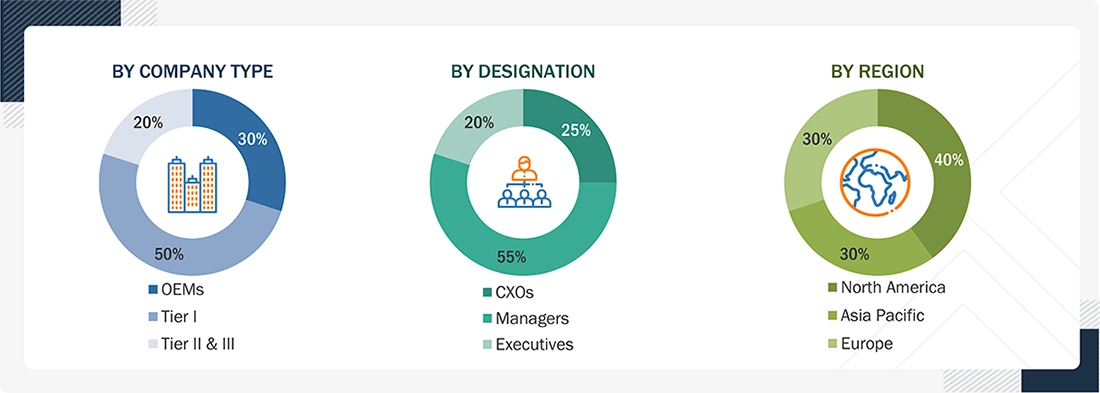
Note: Others include sales, managers, and product managers.
To know about the assumptions considered for the study, download the pdf brochure
Market Size Estimation
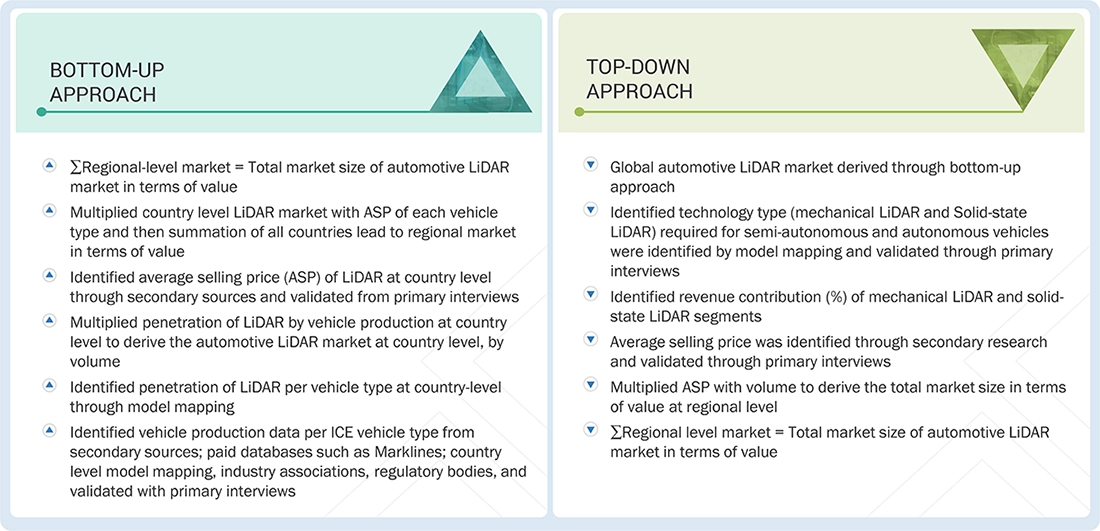
Both top-down and bottom-up approaches were used to estimate and validate the total size of the automotive LiDAR market. These methods were also used extensively to estimate the size of various subsegments in the market. The research methodology used to estimate the market size includes the following:
Data Triangulation
After arriving at the overall market size of the global market through the methodology mentioned above, this market was split into several segments and subsegments. The data triangulation and market breakdown procedures were employed to complete the overall market engineering process and arrive at the exact market value data for the key segments and sub-segments, wherever applicable. The extrapolated market data was triangulated by studying various macro indicators and regional trends from both the demand and supply-side participants.
Market Definition
According to Texas Instruments, LiDAR is a sensing technology that detects objects and maps their distances. The technology works by illuminating a target with an optical pulse and measuring the characteristics of the reflected return signal.
Key Stakeholders
- ADAS System Manufacturers
- Automobile Original Equipment Manufacturers (OEMs)
- Automotive Parts Manufacturers’ Association (APMA)
- Automotive Component Manufacturers
- Governments, Financial Institutions, and Investment Communities
- European Automobile Manufacturers Association (ACEA)
- LiDAR Hardware Suppliers
- LiDAR Software Suppliers
- LiDAR System Integrators
- Manufacturers of Automotive LiDAR Microprocessors
- Original Device Manufacturer (ODM) and OEM Technology Solution Providers
- National Highway Traffic Safety Administration (NHTSA)
- Raw Material and Manufacturing Equipment Suppliers
- Research Institutes and Organizations
- Semiconductor Foundries
- Technology Investors
- Technology Standards Organizations, Forums, Alliances, and Associations
- Vehicle Safety Regulatory Bodies
Report Objectives
- To analyze and forecast the automotive LiDAR market in terms of volume (thousand units) and value (USD million) from 2026 to 2033
- To segment the market by Technology, Image Type, ICE Vehicle Type, Location, Electric Vehicle, Range, Laser Wavelength, Measurement Process, Level of Autonomy, and region
- To segment and forecast the market by Technology (Mechanical LiDAR and Solid-state LiDAR)
- To segment and forecast the market by Image Type (2D and 3D)
- To segment and forecast the market by ICE Vehicle Type (Passenger Car, Light Commercial Vehicle, and Heavy Commercial Vehicle)
- To segment and forecast the market by Location (Bumper & Grille, Headlight & Taillight, Roof & Upper Pillar, and Others)
- To segment and forecast the market by Electric Vehicle Type (BEV, PHEV, FCEV, and HEV)
- To segment and forecast the market by Range (Short & Mid-range and Long-range)
- To segment and forecast the market by Laser Wavelength (Near Infrared, Short-wave Infrared, and Long-wave Infrared)
- To segment and forecast the market by Measurement Process (Frequency Modulated Continuous Process and Time of Flight)
- To segment and forecast the market by Level of Autonomy (Semi-autonomous and Autonomous)
- To forecast the market by region (North America, Europe, and Asia Pacific)
- To identify and analyze key drivers, challenges, restraints, and opportunities influencing the market growth
- To strategically analyze the market for individual growth trends, prospects, and contributions to the total market
- To study the following with respect to the market
- Pricing Analysis
- Investment and Funding Scenario
- Value Chain Analysis
- Ecosystem Analysis
- Technology Analysis
- HS Code
- Case Study Analysis
- Patent Analysis
- Regulatory Landscape
- Key Stakeholders and Buying Criteria
- Key Conferences and Events
- To strategically profile the key players and comprehensively analyze their market share and core competencies
- To analyze the impact of AI on the market
- To track and analyze competitive developments such as deals, product launches/developments, expansions, and other activities undertaken by the key industry participants
Available customizations:
With the given market data, MarketsandMarkets offers customizations in accordance with the company’s specific needs.
- Additional Company Profiles (Up to Five)
- Global Automotive LiDAR market, by Level of Autonomy, at Country Level
- Global Automotive LiDAR market, by BEV Type, at Country Level
Get the Full Automotive LiDAR Market Report
Full forecast, segment splits, and company analysis for all Automotive LiDAR Market.
- China Automotive LiDAR Market
- India Automotive LiDAR Market
- Japan Automotive LiDAR Market
- South Korea Automotive LiDAR Market
- Germany Automotive LiDAR Market
- France Automotive LiDAR Market
- Italy Automotive LiDAR Market
- UK Automotive LiDAR Market
- Spain Automotive LiDAR Market
- Canada Automotive LiDAR Market
Need a Tailored Report?
Customize this report to your needs
Get 10% FREE Customization
Customize This Report
