
Japan Automotive Rubber Seals Market (2025-2030)

The Japan Automotive Rubber Seals Market was valued at $216.4 Million in 2025 and projected to reach to $231.8 Million by 2030, representing a compound annual growth rate of 1.0%. Japan's automotive rubber seals market is characterized by steady, predictable growth reflecting the maturity of the domestic automotive industry.


| Market Size in | USD 26.32 MN |
| Market Forecast in | |
| CAGR | |
| Forecast Period | |
| Units Considered | Value (USD MN) |
Japan Automotive Rubber Seals Market Trends and Insights
- Japan's mature automotive sector and established manufacturing base support steady demand for high-quality rubber seals across passenger vehicles, commercial vehicles, and aftermarket applications.
- The market in Japan reflects the country's focus on precision engineering and durability standards, with domestic OEMs and suppliers maintaining strong competitive positions. Growth in Japan's automotive rubber seals market is constrained by slower vehicle production growth and market saturation in the domestic passenger vehicle segment.
- However, Japan continues to benefit from its reputation for quality and innovation, with manufacturers investing in advanced sealing technologies to meet evolving emission regulations and electric vehicle requirements.
- Between 2025 and 2030, Japan's market will experience incremental expansion driven by replacement demand, export-oriented production, and the gradual transition to electrified powertrains..
Key Market Statistics
- CAGR (2025-2030) 1.0% CAGR
- Market Size, 2025 ~USD 216.4 Million
- Forecast, 2030 ~USD 231.8 Million
- Country Japan
Japan Automotive Rubber Seals Market Overview
Mature Market Stability :
Japan's automotive rubber seals market demonstrates steady growth with a 1.0% CAGR from 2025 to 2030, reflecting the stability of the country's mature and well-established automotive manufacturing sector.
High-Quality Manufacturing Standards :
Japanese manufacturers maintain stringent quality standards for rubber seals, supporting demand across passenger vehicles, commercial vehicles, and the robust aftermarket sector with premium product offerings.
Market Valuation Growth :
The market is valued at USD 216.4 million in 2025 and is projected to reach USD 231.8 million by 2030, representing incremental growth driven by vehicle maintenance and replacement cycles.
Diversified Application Base :
Demand spans multiple segments including OEM production, commercial fleet maintenance, and aftermarket replacement, providing stable revenue streams across Japan's automotive value chain.
Japan Automotive Rubber Seals Market Dynamics
- With a 1.0% CAGR through 2030, the market benefits from Japan's established manufacturing infrastructure, strong quality standards, and consistent vehicle maintenance demand.
- The slower growth compared to global rates (3.6% CAGR) reflects market saturation and demographic factors, yet the market remains resilient due to the longevity of Japanese vehicles and the critical nature of rubber seals in automotive applications. Future growth will be driven by vehicle fleet replacement cycles, increasing focus on durability and performance in aftermarket segments, and potential innovations in seal materials and designs.
- Japanese manufacturers' commitment to sustainability and advanced manufacturing techniques positions them well to maintain market leadership.
- The market outlook remains stable for investors seeking consistent returns in a mature, quality-focused automotive components sector..
Market Ecosystem
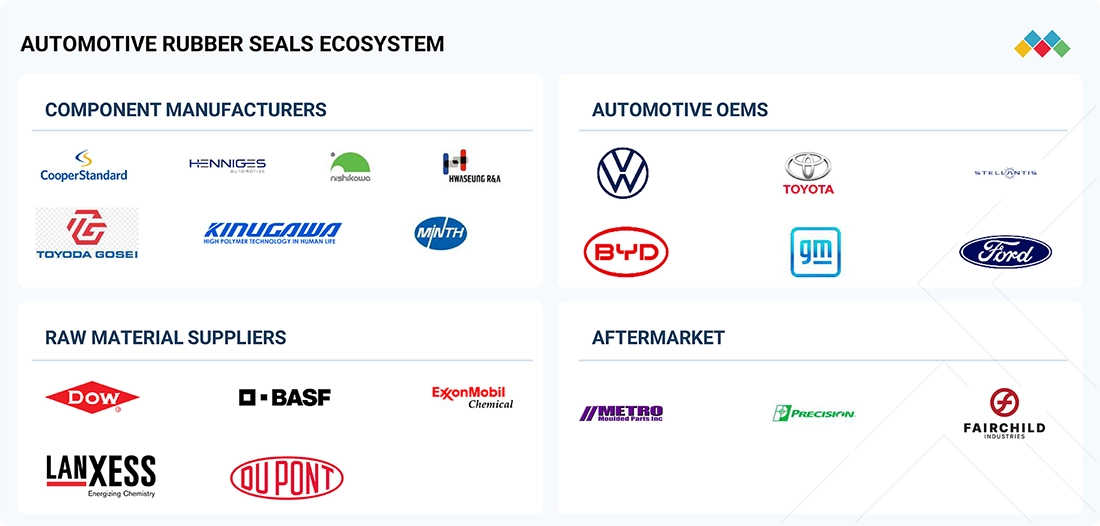
Automotive Rubber Seals Market: COMMERCIAL USE CASES ACROSS INDUSTRIES
| COMPANY | USE CASE DESCRIPTION | BENEFITS |
|---|---|---|
 |
Design and supply of automotive window and sealing systems, including weatherstrips, glass run channels, and door seals | Ensure high durability, weather resistance, NVH reduction, and integration with vehicle aerodynamics |
 |
Provide advanced materials such as EPDM, TPE/TPV, silicone, and PVC for seals and window systems | Enable lightweight, flexible, and thermally/chemically resistant seals; support innovation in EVs and premium vehicles |
 |
Integrate sealing systems into production vehicles, including EVs, PCs, LCVs, and HCVs | Enhance cabin comfort, noise insulation, safety, and overall vehicle quality |
 |
Supply replacement windows and sealing components for maintenance and refurbishment | Maintain vehicle performance, extend lifespan, and offer cost-effective solutions for older vehicles |
Logos and trademarks shown above are the property of their respective owners. Their use here is for informational and illustrative purposes only.
Related Ecosystem
Body Exterior Interior
- Battery Electric Vehicle (BEV)
- Fuel Cell Electric Vehicle (FCEV)
- Light Commercial Vehicles (LCVs)
- Hybrid Electric Vehicle (HEV)
- Agricultural Tractors
- AISIN CORPORATION
- Magna International Inc.
- GORKOVSKY AVTOMOBILNY ZAVOD
- BOCAR
- Continental ag
Key Takeaways
- Japan's automotive rubber seals market is valued at USD 216.4 million in 2025 with a projected value of USD 231.8 million by 2030.
- Japan experiences a conservative 1.0% CAGR, reflecting market maturity and slower domestic vehicle production growth.
- Japan's market is driven by replacement demand, aftermarket sales, and the transition to electric vehicle platforms.
- Japan maintains competitive advantage through precision manufacturing, quality standards, and established OEM relationships.
Automotive Rubber Seals Market Report Scope
| Report Metric | Details |
|---|---|
| Base Year | 2025 |
| Fastest Growing Segment | BEV (Ev Type) |
| Forecast Period | 2025–2030 |
| Growth Rate | CAGR of 3.6% from 2025 to 2030 |
| Largest Segment | PASSENGER CAR (Vehicle Type) |
| Market Size Base Year (Billions) | ~USD 8.38 (2025) |
| Revenue Forecast (Billions) | ~USD 10.01 (2030) |
| Segments Covered | Component, Vehicle Type, Ev Type |
Japan Automotive Rubber Seals Market Report Segmentation
3 segment dimensions are covered across the global market.
By Component
- Door Seals
- Front Windshield Seals
- Glass Encapsulation
- Glass Run Channels
- Hood Seals
- Rear Windshield Seals
- Roof Ditch Molding
- Trunk Seals
- Waist Belt Seals
By Vehicle Type
- Heavy Commercial Vehicle
- Light Commercial Vehicle
- Passenger Car
By Ev Type
- Bev
- Phev
Target Audience
- Automotive Component Manufacturers : Japanese and international rubber seal manufacturers need market-specific data to optimize production capacity, pricing strategies, and distribution networks for Japan's quality-demanding OEM and aftermarket segments.
- OEM Procurement Teams : Vehicle manufacturers and their procurement departments require detailed market intelligence to forecast rubber seal demand, negotiate supplier contracts, and ensure supply chain resilience in Japan.
- Aftermarket Distributors & Retailers : Parts distributors and automotive retailers in Japan need market forecasts and segment analysis to stock appropriate inventory levels and capitalize on replacement demand cycles.
- Investment & Private Equity Firms : Investors evaluating opportunities in Japan's automotive components sector require reliable market sizing and growth projections to assess investment returns and portfolio fit.
- Market Entry & Expansion Strategists : Companies planning market entry or expansion in Japan need localized competitive analysis, regulatory insights, and demand forecasts to minimize risk and optimize go-to-market strategies.
Key Companies in the Japan Automotive Rubber Seals Market
| Company | HQ | Ownership | Strongest segments |
|---|---|---|---|
| AISIN SEIKI CO LTD | Japan | Public Company | Door Seals,Hood & Trunk Seals,Glass Run Channels, |
| GRUPO ANTOLIN | Spain | Private Company | Door Seals (including door perimeter and integrated door-module seals),Glass Run Channels & Glass-Interface Seals,Front Windshield and Fixed Glass Seals, |
| FEDERAL-MOGUL CORPORATION | United States | Private Company | Door Seals,Glass Run Channels,Front Windshield Seals, |
| ASAHI GLASS CO LTD | Japan | Public Company | Glass Run Channels,Front Windshield Seals,Door Seals, |
| TENNECO | United States | Private Company | Glass Run Channels,Roof Ditch Molding,Door Seals, |
| COOPER STANDARD | United States | Public Company | Glass Run Channels,Roof Ditch Molding,Door Seals, |
| TOYODA GOSEI CO., LTD. | Japan | Public Company | Door and outer weatherstrips,Door glass runs and glass run channels,Front windshield, hood & trunk, back weatherstrips, |
| NISHIKAWA RUBBER CO., LTD. | Japan | Public Company | Door and Back Door Seals,Glass Run Channels and Waist Seals,Front Windshield, Roof Ditch, Hood & Trunk Seals, |
| HWASEUNG R&A | South Korea | Public Company | Door seals and door opening weatherstrips,Glass run channels and glass moldings (front/rear),Hood & trunk / liftgate seals, |
| MINTH GROUP CO., LTD. | Taiwan | Public Company | Door Seals,Glass Run Channels,Front Windshield Seals, |
| MAGNA INTERNATIONAL, INC. | Canada | Public Company | Door Seals & SmartAccess-integrated systems,Glass Run Channels & Greenhouse Surrounds,Front Windshield, Roof Ditch, Hood & Trunk Seals, |
| PPAP | India | Public Company | Glass Run Channels,Door Seals,Front Windshield Seals, |
| GUIZHOU GUIHANG AUTOMOTIVE COMPONENTS CO., LTD. | China | Public Company | Door Seals,Glass Run Channels,Front Windshield Seals, |
| JIANGYIN HAIDA RUBBER AND PLASTIC CO LTD | China | Public Company | Door Seals,Glass Run Channels,Front Windshield Seals, |
| FALTEC CO., LTD. | Japan | Public Company | Glass Run Channels,Roof Ditch Molding,Door Seals, |
AISIN SEIKI CO LTD
AISIN SEIKI CO LTD is a Japanese public company founded in 1943 with 113,292 employees. The company operates as a major automotive components manufacturer serving global markets.
GRUPO ANTOLIN
GRUPO ANTOLIN is a Spanish private company founded in 1959 with 18,444 employees, specializing in automotive interior components and systems.
FEDERAL-MOGUL CORPORATION
Federal-Mogul Corporation is a United States-based private company founded in 1899 with 44,275 employees, serving the automotive and industrial markets.
ASAHI GLASS CO LTD
ASAHI GLASS CO LTD is a Japanese public company founded in 1907 with 52,896 employees, specializing in glass and chemical products.
TENNECO
TENNECO is a United States-based private company founded in 1930 with 71,000 employees, operating in automotive emissions control and ride performance systems.
COOPER STANDARD
COOPER STANDARD is a United States public company established in 1960 with 18,000 employees, specializing in automotive sealing and fluid handling systems.
TOYODA GOSEI CO., LTD.
TOYODA GOSEI CO., LTD. is a Japanese public company founded in 1949 with 41,304 employees, manufacturing automotive components and industrial products.
NISHIKAWA RUBBER CO., LTD.
NISHIKAWA RUBBER CO., LTD. is a Japanese public company founded in 1934 with 6,294 employees, specializing in rubber and plastic automotive components.
HWASEUNG R&A
HWASEUNG R&A is a South Korean public company established in 1978 with 626 employees, operating in automotive components manufacturing.
MINTH GROUP CO., LTD.
MINTH GROUP CO., LTD. is a Taiwan-based public company founded in 2005 with 27,367 employees, specializing in automotive interior and exterior components.
MAGNA INTERNATIONAL, INC.
MAGNA INTERNATIONAL, INC. is a Canadian public company founded in 1957 with 156,000 employees, serving as a global automotive supplier of components and systems.
PPAP
PPAP is an Indian public company established in 1978 with 1,542 employees, operating in automotive components manufacturing.
GUIZHOU GUIHANG AUTOMOTIVE COMPONENTS CO., LTD.
GUIZHOU GUIHANG AUTOMOTIVE COMPONENTS CO., LTD. is a Chinese public company founded in 1999 with 3,450 employees, specializing in automotive components.
JIANGYIN HAIDA RUBBER AND PLASTIC CO LTD
JIANGYIN HAIDA RUBBER AND PLASTIC CO LTD is a Chinese public company founded in 1998 with 2,898 employees, manufacturing rubber and plastic products.
FALTEC CO., LTD.
FALTEC CO., LTD. is a Japanese public company founded in 1917 with 1,764 employees, manufacturing automotive components and systems.
Reasons to Buy this Report
- Precise Market Sizing for Japan : Obtain accurate valuation data specific to Japan's market (USD 216.4M in 2025), enabling precise budgeting and investment decisions tailored to this mature automotive economy.
- Segment-Specific Insights : Understand demand patterns across passenger vehicles, commercial vehicles, and aftermarket applications unique to Japan's automotive landscape and consumer behavior.
- Competitive Positioning Strategy : Leverage Japan-specific market analysis to benchmark against local manufacturers, identify competitive advantages, and develop targeted strategies for this quality-conscious market.
- Forecast-Driven Planning : Access reliable 5-year projections (1.0% CAGR through 2030) to inform long-term capacity planning, supply chain optimization, and market entry strategies in Japan.
- Regulatory and Quality Compliance : Understand Japan's stringent quality standards and manufacturing requirements essential for OEM partnerships and aftermarket success in this premium-focused market segment.
Frequently asked questions
What is the current size of Japan's automotive rubber seals market?
Japan's automotive rubber seals market is valued at USD 216.4 million in 2025.
What is the projected market size for Japan by 2030?
Japan's automotive rubber seals market is forecast to reach USD 231.8 million by 2030.
What is the CAGR for Japan's automotive rubber seals market?
Japan's automotive rubber seals market is expected to grow at a CAGR of 1.0% from 2025 to 2030.
Why is Japan's market growth rate lower than the global average?
Japan's 1.0% CAGR reflects market maturity, slower domestic vehicle production, and saturation in the passenger vehicle segment compared to emerging markets.
What factors are driving growth in Japan's automotive rubber seals market?
Growth in Japan is driven by replacement demand, aftermarket sales, electric vehicle adoption, and stringent emission and durability regulations.
RESEARCH METHODOLOGY
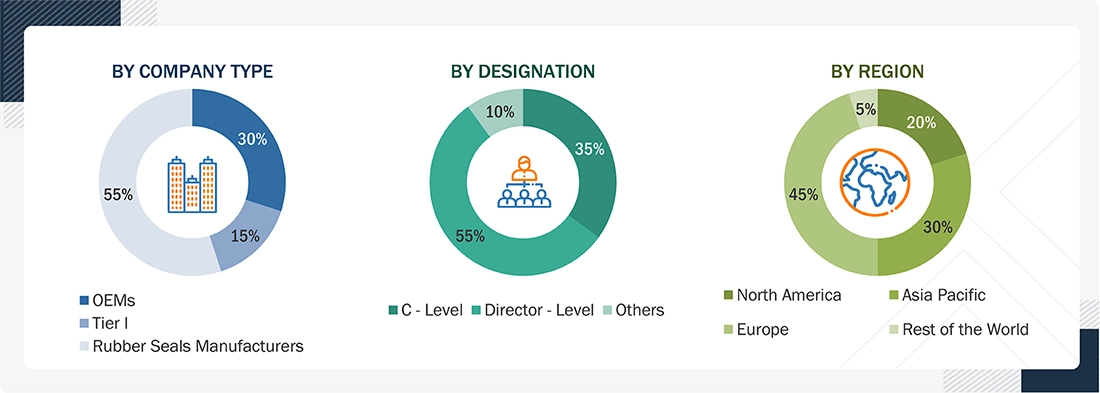
The research study involved extensive use of secondary sources such as company annual reports/presentations, industry association publications, magazines, directories, technical handbooks, World Economic Outlook, trade websites, technical articles, and databases to identify and collect information on the automotive rubber seals market. In-depth interviews were conducted with various primary sources—experts from related industry players, rubber seal suppliers, and automotive OEMs - to obtain and verify critical information and assess the growth prospects and market estimations.
Secondary Research
In the secondary research process, various secondary sources were used to identify and collect information on the automotive rubber seals for this study. The secondary sources referred to for this research study included automotive industry organizations (such as Organisation Internationale des Constructeurs d'Automobiles (OICA), CAAM, JAMA, ACEA, etc.), automotive rubber seals manufacturers, Automotive Services Association (ASA), and automotive rubber seals suppliers, regulatory bodies, corporate filings (such as annual reports, investor presentations, and financial statements), and trade, business, and automotive associations. Secondary data has been collected and analyzed to arrive at the overall market size, which has been further validated through primary research.
Primary Research
Extensive primary research has been conducted after acquiring an understanding of the automotive rubber seals market scenario through secondary research. Several primary interviews have been conducted with market experts from both the demand side (automotive OEMs) and the supply side (automotive rubber seals manufacturers and distributors), and players across 4 major regions, namely, North America, Europe, Asia Pacific, and the Rest of the World. Approximately 55% primary interviews from the demand side and 45% from the supply side have been conducted. Primary data has been collected through questionnaires, emails, and telephonic interviews.
In our canvassing of primaries, we have strived to cover various departments within organizations, such as sales, operations, and administration, to provide a holistic viewpoint in our reports. After interacting with industry participants, we have also conducted brief sessions with highly experienced independent consultants to reinforce the findings from our primaries. This, along with the opinions of in-house subject-matter experts, has led us to the findings described in the remainder of this report.
Market Size Estimation
A detailed market estimation approach was followed to estimate and validate the size of the automotive rubber seals market and other dependent submarkets, as mentioned below:
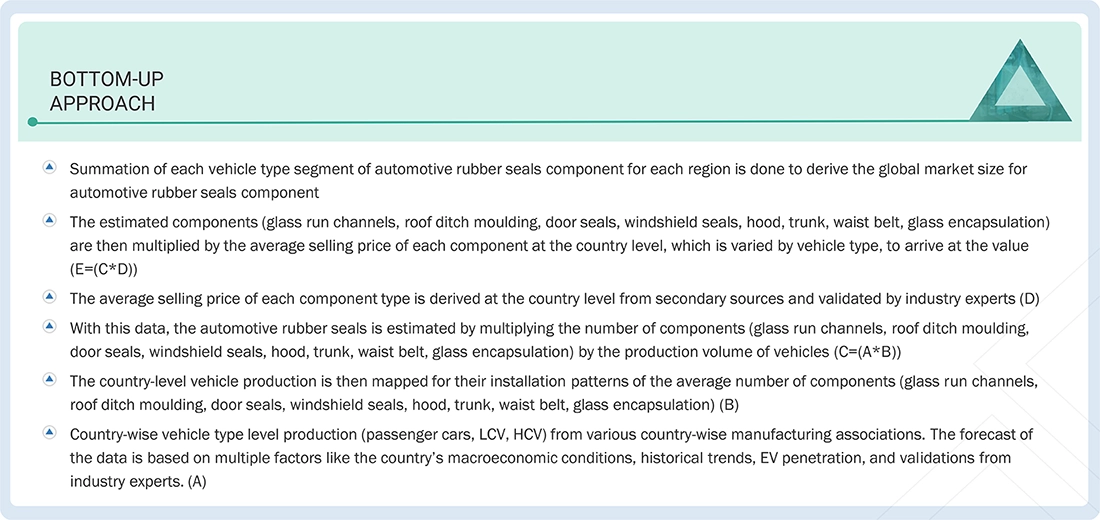
Market Size Estimation Methodology-Bottom-up approach
- Key players in the automotive rubber seals market were identified through secondary research, and their global market share was determined through primary and secondary research.
- The research methodology included the study of identifying the average number of glass run channels, roof ditch molding, and exterior sealing components installed in passenger cars, LCVs, HCVs, and EVs.
- These average numbers are multiplied by the vehicle production to arrive at the total market size, by volume.
- The average number of glass run channels, roof ditch molding, and exterior sealing components is then multiplied by the weight in gms per vehicle type (PC, LCV, HCVs, and EVs) at the country level to arrive at the total market size, by volume (million LBS)
- The market size, by value, is derived by multiplying the average selling price of automotive glass run channels, roof ditch molding, and exterior sealing components by the number of units.
- All major penetration rates, percentage shares, splits, and breakdowns for the component & vehicle type of the automotive rubber seals market were determined by using secondary sources and verified through primary sources.
- All key macro indicators affecting the revenue growth of the market segments and subsegments were accounted for, viewed in extensive detail, verified through primary research, and analyzed to obtain validated and verified quantitative and qualitative data.
- The gathered market data was consolidated and added with detailed inputs, analyzed, and presented in this report.
Automotive Rubber Seals Market : Top-Down and Bottom-Up Approach
Data Triangulation
After arriving at the overall size of the global market through the above-mentioned methodology, this market was split into several segments and subsegments. The data triangulation and market breakdown procedures were employed, wherever applicable, to complete the overall market engineering process and arrive at the exact data for the market by value for the key segments and subsegments. The extrapolated market data was triangulated by studying various macro indicators and regional trends from both the demand and supply participants.
Market Definition
The automotive rubber seals market consists of different sealing systems that are used in a vehicle, which include seals of doors, windows, hood, and trunk to prevent water, dust, air, and noise from entering the vehicle.
Stakeholders
- Automotive rubber seal manufacturers
- Automotive raw material suppliers
- Automotive OEMs
- Research & development (R&D) centers
- Associations, forums, and alliances related to automobiles
- Automobile organizations/associations
- EV component manufacturers
- EV manufacturers
- Government agencies and policymakers
- Traders and distributors of automotive seals
Report Objectives
-
To segment and forecast the size of the automotive rubber seals market in terms of volume (Units & million LBS) and value (USD million) from 2021 to 2032
- To define, describe, and forecast the automotive rubber seals market in terms of volume and value
- To define, describe, and forecast the global automotive seals market based on component, vehicle type, end, and region
- To segment and forecast the market size of the automotive rubber seals market by component (Glass run channels, roof ditch molding, door seals, front windshield seals, rear windshield seals, hood seals, trunk seals, waist belt seals, and glass encapsulation)
- To segment and forecast the market size of the automotive rubber seals market by vehicle type (ICE) (Passenger car, light commercial vehicle, and heavy commercial vehicle)
- To segment and forecast the market size of the automotive rubber seals market by vehicle type (EV, BEV, PHEV)
- To forecast the market size with respect to key regions, namely Asia Pacific, Europe, North America, and the Rest of the World
- To provide detailed information regarding the major factors influencing market growth (drivers, challenges, restraints, and opportunities)
- To strategically analyze markets with respect to individual growth trends, prospects, and contributions to the total market
- To strategically profile key players and comprehensively analyze their market share and core competencies
-
To study the following with respect to the market:
- Supply Chain Analysis
- Ecosystem Analysis
- Technology Analysis
- HS Code Analysis
- Case Study Analysis
- Patent Analysis
- Regulatory Landscape
- Conferences and Events
- Key Stakeholders and Buying Criteria
- Investment and Funding Scenario
- To analyze opportunities for stakeholders and the competitive landscape for market leaders
- To track and analyze competitive developments such as product developments, deals, and others undertaken by the key industry participants
Available Customizations
With the given market data, MarketsandMarkets offers customizations in accordance with the company’s specific needs.
Automotive Rubber Seals Market, By Electric Heavy Commercial Vehicle, at the regional level
Automotive Rubber Seals Market, by Off-Highway Vehicle, at the regional level
Company Information
- Profiling of Additional Market Players (Up to 6)
Get the Full Automotive Rubber Seals Market Report
Full forecast, segment splits, and company analysis for all Automotive Rubber Seals Market.
- China Automotive Rubber Seals Market
- India Automotive Rubber Seals Market
- South Korea Automotive Rubber Seals Market
- Germany Automotive Rubber Seals Market
- France Automotive Rubber Seals Market
- UK Automotive Rubber Seals Market
- Spain Automotive Rubber Seals Market
- Canada Automotive Rubber Seals Market
- Mexico Automotive Rubber Seals Market
- US Automotive Rubber Seals Market
- Brazil Automotive Rubber Seals Market
- Russia Automotive Rubber Seals Market
- Rest Of Asia Pacific Automotive Rubber Seals Market
Need a Tailored Report?
Customize this report to your needs
Get 10% FREE Customization
Customize This Report
