
Canada Autonomous Underwater Vehicle Market (2025-2030)

The Canada Autonomous Underwater Vehicle Market was valued at $143.7 Million in 2025 and projected to reach to $202.9 Million by 2030, representing a compound annual growth rate of 7.1%. Canada's Autonomous Underwater Vehicle market is experiencing robust growth driven by geographic advantages, strategic defense priorities, and marine research excellence.


| Market Size in | USD 26.32 MN |
| Market Forecast in | |
| CAGR | |
| Forecast Period | |
| Units Considered | Value (USD MN) |
Canada Autonomous Underwater Vehicle Market Trends and Insights
- This 7.1% compound annual growth rate reflects Canada's increasing investment in marine research, offshore resource exploration, and defense capabilities.
- Canada's geographic advantage—with extensive coastlines and Arctic waters—drives demand for advanced AUV technologies across government, academic, and commercial sectors. The Canadian AUV market benefits from strong government funding in oceanographic research and environmental monitoring initiatives.
- Canada's commitment to Arctic sovereignty and marine infrastructure development creates sustained demand for autonomous underwater systems.
- Between 2025 and 2030, Canada is expected to see accelerated adoption driven by climate change monitoring, fisheries management, and subsea infrastructure inspection applications. Canada's position within North America's broader AUV ecosystem positions the country as a key hub for technology development and deployment.
- Strategic partnerships between Canadian research institutions and private sector players are expected to enhance market penetration and innovation throughout the forecast period..
Key Market Statistics
- CAGR (2025-2030) 7.1% CAGR
- Market Size, 2025 ~USD 143.7 Million
- Forecast, 2030 ~USD 202.9 Million
- Country Canada
Canada Autonomous Underwater Vehicle Market Overview
Arctic Exploration Catalyst :
Canada's vast Arctic waters and extended continental shelf create unique demand for AUVs in resource exploration, environmental monitoring, and sovereignty operations, positioning the nation as a key growth driver in the North American market.
Defense & Security Investment :
Canadian Department of National Defence and Royal Canadian Navy investments in autonomous maritime capabilities are accelerating AUV adoption for surveillance, mine countermeasures, and underwater infrastructure inspection across both Atlantic and Pacific coasts.
Marine Research Leadership :
Canada's world-class oceanographic institutions and fisheries management agencies are driving AUV deployment for climate research, fish stock assessment, and coastal ecosystem monitoring, supporting the 7.1% CAGR through 2030.
Offshore Energy Transition :
Shift from traditional oil & gas to renewable offshore energy projects (wind, tidal) requires advanced AUV capabilities for site surveys, cable installation, and maintenance, creating sustained market expansion opportunities.
Canada Autonomous Underwater Vehicle Market Dynamics
- The $143.7 million market in 2025 is projected to reach $202.9 million by 2030, reflecting a steady 7.1% CAGR.
- Key growth catalysts include Arctic sovereignty initiatives, offshore renewable energy development, and increased oceanographic research funding. The Canadian market benefits from strong government support, advanced research institutions, and private sector innovation in autonomous systems.
- Investment in coastal infrastructure protection, fisheries management, and climate monitoring will sustain demand.
- As global AUV adoption accelerates at 8.2% CAGR, Canada's specialized requirements for cold-water operations and Arctic conditions position domestic and international suppliers for sustained revenue growth through the forecast period..
Market Ecosystem
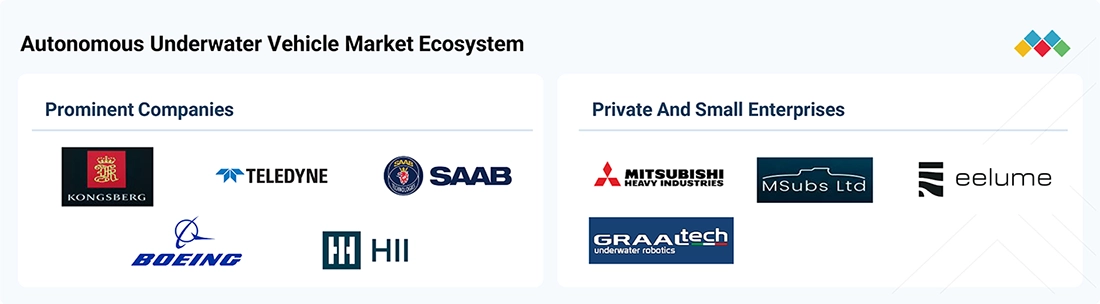
AUTONOMOUS UNDERWATER VEHICLE MARKET: COMMERCIAL USE CASES ACROSS INDUSTRIES
| COMPANY | USE CASE DESCRIPTION | BENEFITS |
|---|---|---|
 |
Kongsberg develops HUGIN AUVs for hydrographic surveying, seabed mapping, geophysical surveys, environmental monitoring, and defense missions. HUGIN platforms integrate sonar, imaging, navigation, and environmental sensors for autonomous underwater operations. | Supports high-resolution seabed and hydrographic surveys | Enables multi-sensor data collection | Supports autonomous navigation and underwater inspection | Reduces dependence on continuous operator control |
 |
Teledyne Marine develops AUVs including Gavia for defense, commercial, scientific, environmental, archaeological, and survey applications. Its modular AUV architecture allows different sensors, payloads, and battery configurations to be integrated for mission-specific requirements. | Supports mine countermeasure and survey missions | Enables modular mission configuration | Supports environmental and oceanographic data collection | Provides flexible platforms for different underwater applications |
 |
Saab develops the Sabertooth hybrid AUV/ROV for subsea inspection, maintenance, offshore surveys, environmental monitoring, and infrastructure applications. The system can operate autonomously and can be integrated with subsea docking stations for charging and data transfer during extended operations. | Enables autonomous subsea inspection | Supports extended resident operations | Reduces dependence on surface vessels | Provides flexible autonomous and remotely operated capabilities |
Logos and trademarks shown above are the property of their respective owners. Their use here is for informational and illustrative purposes only.
Related Ecosystem
Defence Platforms And Systems
- Sensors
- Unmanned Ground Vehicles (UGV)
- Fighter Aircraft
- Special Mission Aircraft
- Antennas
- Thales group
- BAE Systems plc
- LOCKHEED MARTIN CORPORATION
- Northrop Grumman Corporation
- L3Harris Technologies, Inc.
Automotive Advance Technologies
- Battery Electric Vehicle (BEV)
- Light Commercial Vehicles (LCVs)
- Fuel Cell Electric Vehicle (FCEV)
- Hybrid Electric Vehicle (HEV)
- Internal Combustion Engine (ICE)
- BOSCH LIMITED
- Continental ag
- Visteon Corporation
- DENSO Corporation
- ZF FRIEDRICHSHAFEN AG
Drones And Robotics
- Sensors
- Articulated Robots
- Cartesian Robots
- Scara Robots
- Actuators
- ABB India Limited
- KUKA AG
- MOMENTIVE PERFORMANCE MATERIALS INC.
- STAUBLI INTERNATIONAL AG
- Fanuc Corporation
Key Takeaways
- Canada's AUV market is valued at $143.7 million in 2025 and will grow to $202.9 million by 2030, representing a 7.1% CAGR.
- Canada's extensive coastlines and Arctic waters create unique demand drivers for autonomous underwater vehicle applications in research and defense.
- Government funding for oceanographic research and environmental monitoring is a primary growth catalyst for Canada's AUV market.
- Canada's strategic position in North America positions the country as a technology development hub for AUV innovation and deployment.
Autonomous Underwater Vehicle Market Report Scope
| Report Metric | Details |
|---|---|
| Base Year | 2025 |
| Fastest Growing Segment | OCEANOGRAPHY (Application) |
| Forecast Period | 2025–2030 |
| Growth Rate | CAGR of 8.2% from 2025 to 2030 |
| Largest Segment | ELECTRIC (Propulsion) |
| Market Size Base Year (Billions) | ~USD 3.13 (2025) |
| Revenue Forecast (Billions) | ~USD 4.64 (2030) |
| Segments Covered | Type, Propulsion, Application |
Canada Autonomous Underwater Vehicle Market Report Segmentation
3 segment dimensions are covered across the global market.
By Type
- Large
- Medium
- Shallow
By Propulsion
- Electric
- Hybrid
- Mechanical
By Application
- Archaeology & Exploration
- Environmental Protection & Monitoring
- Military & Defense
- Oceanography
- Oil & Gas
- Search & Salvage Operation
CANADA: AUTONOMOUS UNDERWATER VEHICLE MARKET, BY APPLICATION,2025–2030
| Segment | 2025 | 2026 | 2027 | 2028 | 2029 | 2030 | CAGR (%) |
|---|---|---|---|---|---|---|---|
| ARCHAEOLOGY & EXPLORATION | 17.5 | 18.7 | 20 | 21.6 | 23.3 | 25.3 | 7.6 |
| ENVIRONMENTAL PROTECTION & MONITORING | 14 | 14.7 | 15.5 | 16.5 | 17.6 | 18.8 | 6.1 |
| MILITARY & DEFENSE | 50.5 | 53.3 | 56.5 | 60.5 | 64.8 | 69.6 | 6.6 |
| OCEANOGRAPHY | 19.2 | 20.9 | 22.7 | 25 | 27.5 | 30.3 | 9.6 |
| OIL & GAS | 26.9 | 28.2 | 29.5 | 31.2 | 33.1 | 35.1 | 5.4 |
| SEARCH & SALVAGE OPERATION | 15.6 | 16.9 | 18.3 | 20 | 21.8 | 23.8 | 8.9 |
| TOTAL | 143.7 | 152.6 | 162.4 | 174.6 | 188.1 | 202.9 | 7.1 |
Target Audience
- Defense & Government Agencies : Canadian Department of National Defence, Royal Canadian Navy, and Coast Guard require market intelligence on AUV capabilities, procurement trends, and technology roadmaps to support Arctic operations and coastal security mandates.
- Offshore Energy Companies : Oil & gas operators and renewable energy developers need data on AUV applications for subsea infrastructure inspection, cable surveys, and environmental monitoring to optimize offshore project economics and compliance.
- Marine Research Institutions : Universities, oceanographic centers, and fisheries research organizations require market insights on AUV technology adoption, funding trends, and competitive capabilities to advance climate and ecosystem research programs.
- AUV Manufacturers & Suppliers : Domestic and international autonomous vehicle manufacturers need Canada-specific demand forecasts, customer segmentation, and competitive landscape analysis to develop targeted go-to-market strategies and product customization.
- Investment & Consulting Firms : Private equity, venture capital, and management consultants require validated market sizing, growth drivers, and sector trends to evaluate investment opportunities and advise clients on Canadian marine technology ventures.
Key Companies in the Canada Autonomous Underwater Vehicle Market
| Company | HQ | Ownership | Strongest segments |
|---|---|---|---|
| MASE INC. | United States | Private Company | Secure Hybrid Networking (SD-WAN, virtualized CPE, Masergy Secure Hybrid Networking),Managed Security & MDR (including Managed CASB, professional security services),Cloud Communications (UCaaS, Intelligent SIP Trunking, cloud contact center, Masergy Connect), |
| WARTSILA | Finland | Public Company | Marine power & propulsion (engines, generating sets, propulsors, shaft lines),Energy power plants (gas, multi-fuel, diesel engines, hybrid plants),Energy storage & digital platforms (Quantum BESS, GEMS), |
| KONGSBERG | Norway | Public Company | Air and Naval Combat Systems & C2,Missiles (Naval Strike and Air-to-Surface),Remote Weapon Stations & Land Systems, |
| SAIPEM S.P.A. | Italy | Public Company | Asset Based Services (subsea fields, pipelaying, offshore installation and lifting),Onshore Engineering & Construction and Sustainable Infrastructures,Energy Carriers (including LNG and related infrastructure), |
| EXAIL TECHNOLOGIES | France | Public Company | Navigation Systems and Positioning,Maritime Robotics and Drones,Sonars and Underwater Sensors, |
| BAE SYSTEMS | United Kingdom | Public Company | Air (combat air, future combat air systems, Eurofighter, MBDA-related activity),Electronic Systems (EW, avionics, sensors, precision guidance, space electronics),Maritime (submarines, ship build, and support), |
| SAAB AB | Sweden | Public Company | Aeronautics (manned and unmanned aircraft, aviation technology),Dynamics (combat weapons, missile systems, training and simulation),Surveillance (radar, EW, combat systems, C4I), |
| TELEDYNE TECHNOLOGIES INCORPORATED | United States | Public Company | Digital Imaging (visible, IR, X-ray, multispectral),Instrumentation (monitoring, test, connectivity),Aerospace & Defense Electronics, |
| HII | United States | Public Company | Nuclear-powered aircraft carriers,Submarines and naval nuclear support services,Non-nuclear surface combatants and amphibious ships, |
| GENERAL DYNAMICS CORPORATION | United States | Public Company | Aerospace (business jets and services),Marine Systems (submarines, surface combatants, support),Combat Systems (land combat vehicles, weapons, munitions), |
| KAWASAKI HEAVY INDUSTRIES, LTD | Japan | Public Company | Powersports and Engines (motorcycles, off-road, PWC, general-purpose gasoline engines),Energy Solutions and Plant Equipment (turbines, boilers, gas engines, energy storage and management),Aerospace Systems (airplanes, helicopters, space-related systems), |
| LOCKHEED MARTIN CORPORATION | United States | Public Company | |
| TKMS | Germany | Public Company | |
| L3HARRIS TECHNOLOGIES, INC. | United States | Public Company | |
| BOEING | United States | Public Company | |
| XYLEM INC | United States | Public Company |
MASE INC.
MASE INC. is a private company founded in 2000 in the United States with 159 employees.
WARTSILA
WARTSILA is a Finnish public company founded in 1834 with 17,938 employees. It is one of the largest industrial manufacturers globally.
KONGSBERG
KONGSBERG is a Norwegian public company founded in 1814 with 7,586 employees.
SAIPEM S.P.A.
SAIPEM S.P.A. is an Italian public company established in 1957 with 30,000 employees.
EXAIL TECHNOLOGIES
EXAIL TECHNOLOGIES is a French public company founded in 1988 with 2,259 employees.
BAE SYSTEMS
BAE SYSTEMS is a British public company founded in 1979 with 111,400 employees, making it one of the world's largest defense contractors.
SAAB AB
SAAB AB is a Swedish public company established in 1937 with 28,667 employees, operating in defense and aerospace sectors.
TELEDYNE TECHNOLOGIES INCORPORATED
TELEDYNE TECHNOLOGIES INCORPORATED is a U.S. public company founded in 1960 with 15,800 employees, specializing in digital imaging and instrumentation.
HII
HII is a U.S. public company founded in 1886 with 44,000 employees, operating primarily in shipbuilding and defense.
GENERAL DYNAMICS CORPORATION
GENERAL DYNAMICS CORPORATION is a U.S. public company established in 1899 with 117,000 employees, serving the aerospace and defense industries.
KAWASAKI HEAVY INDUSTRIES, LTD
KAWASAKI HEAVY INDUSTRIES, LTD is a Japanese public company founded in 1878 with 40,640 employees, operating across multiple industrial sectors.
LOCKHEED MARTIN CORPORATION
LOCKHEED MARTIN CORPORATION is a U.S. public company established in 1912 with 123,000 employees, a leading global security and aerospace company.
TKMS
TKMS is a German public company founded in 2005 with 8,810 employees.
L3HARRIS TECHNOLOGIES, INC.
L3HARRIS TECHNOLOGIES, INC. is a U.S. public company established in 1895 with 45,000 employees, providing advanced defense and commercial technologies.
BOEING
BOEING is a U.S. public company established in 1916 with 182,000 employees, one of the world's largest aerospace and defense manufacturers.
XYLEM INC
XYLEM INC is a U.S. public company founded in 2011 with 22,000 employees, specializing in water technology and infrastructure solutions.
Reasons to Buy this Report
- Arctic Market Differentiation : Gain insights into Canada's unique Arctic and sub-Arctic AUV requirements, including cold-water performance specifications, ice-interaction protocols, and specialized applications unavailable in broader market reports.
- Defense Procurement Intelligence : Access detailed analysis of Canadian Department of National Defence spending patterns, Royal Canadian Navy modernization plans, and government contract opportunities driving AUV adoption in defense and security sectors.
- Regulatory & Policy Landscape : Understand Canada-specific regulations, environmental compliance requirements, and government incentives for marine technology adoption, including Arctic sovereignty initiatives and offshore renewable energy policies.
- Competitive Positioning Strategy : Identify key Canadian players, international competitors entering the market, and partnership opportunities with research institutions, enabling data-driven market entry and expansion strategies.
- Investment & Growth Forecasting : Leverage granular 5-year projections ($143.7M to $202.9M) with segment breakdowns by application, enabling accurate financial planning, resource allocation, and ROI modeling for Canada-focused business initiatives.
Frequently asked questions
What is the current size of Canada's Autonomous Underwater Vehicle market?
Canada's AUV market was valued at $143.7 million in 2025 and is projected to reach $202.9 million by 2030.
What is the expected growth rate for Canada's AUV market?
Canada's AUV market is expected to grow at a compound annual growth rate (CAGR) of 7.1% from 2025 to 2030.
What are the primary drivers of growth in Canada's AUV market?
Key growth drivers in Canada include government investment in oceanographic research, Arctic sovereignty initiatives, climate change monitoring, fisheries management, and subsea infrastructure inspection applications.
Which sectors are driving demand for AUVs in Canada?
Canada's AUV demand is driven by government agencies, academic research institutions, defense and security sectors, and commercial offshore industries focused on resource exploration and environmental monitoring.
How does Canada's AUV market compare to North America?
Canada represents a significant portion of North America's AUV market, with its geographic advantages and government funding positioning it as a key regional hub for technology development and deployment.
RESEARCH METHODOLOGY
The study involved four major activities in estimating the current size of the autonomous underwater vehicle market. Exhaustive secondary research was done to collect information on the autonomous underwater vehicle market, its adjacent markets, and its parent market. The next step was to validate these findings, assumptions, and sizing with industry experts across the value chain through primary research. Demand-side analysis was conducted to estimate the overall market size. After that, market breakdown and data triangulation procedures were employed to estimate the sizes of various segments and subsegments within the autonomous underwater vehicle market.
Secondary Research
During the secondary research process, various sources were consulted to identify and collect information for this study. These include government sources, such as SIPRI; corporate filings, including annual reports, press releases, and investor presentations from companies; white papers, journals, and certified publications; and articles from recognized authors, directories, and databases.
Primary Research
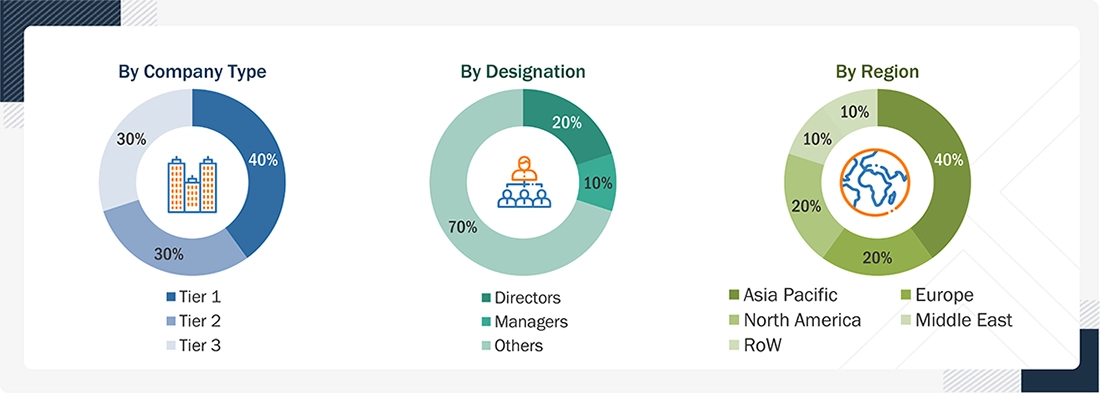
Extensive primary research was conducted after acquiring information regarding the autonomous underwater vehicle market scenario through secondary research. Several primary interviews were conducted with market experts from both the demand and supply sides across major countries in North America, Europe, Asia Pacific, the Middle East, and the Rest of the World. Primary data were collected through questionnaires, emails, and telephonic interviews.
To know about the assumptions considered for the study, download the pdf brochure
Market Size Estimation
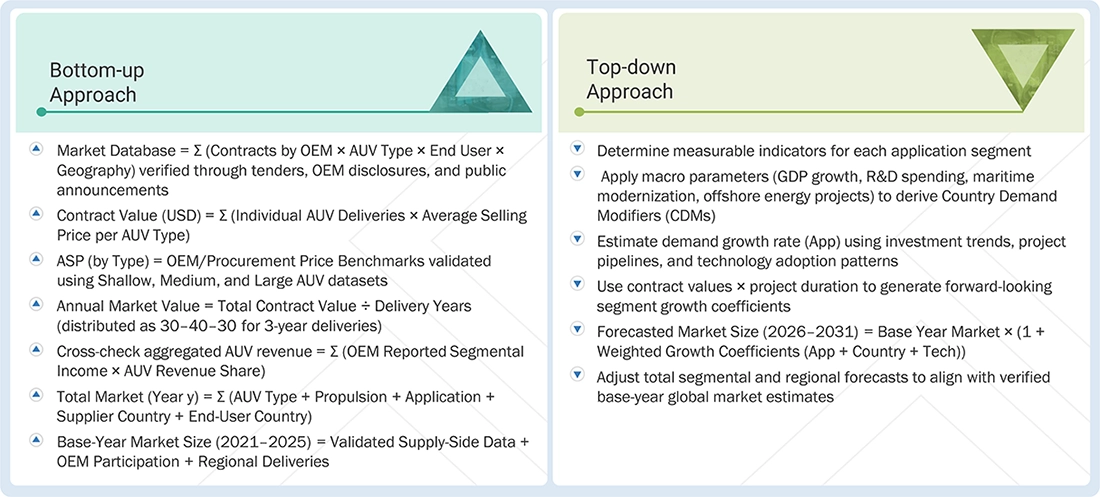
The top-down and bottom-up approaches were used to estimate and validate the size of the autonomous underwater vehicle market. The research methodology used to estimate the size of the market included the following details:
- Key players in the autonomous underwater vehicle market were identified through secondary research, and their market shares were determined through a combination of primary and secondary research. This included a study of the annual and financial reports of the top market players, as well as extensive interviews with leaders, including directors, engineers, marketing executives, and other key stakeholders of leading companies operating in the market.
- All percentage shares, splits, and breakdowns were determined using secondary sources and verified through primary sources.
- All possible parameters that affect the markets covered in this research study were accounted for, viewed in extensive detail, verified through primary research, and analyzed to obtain the final quantitative and qualitative data on the autonomous underwater vehicle market. This data was consolidated, enhanced with detailed inputs, analyzed by MarketsandMarkets, and presented in this report.
Autonomous Underwater Vehicle Market : Top-Down and Bottom-Up Approach
Data Triangulation
After determining the overall market size, the total market was divided into several segments and subsegments. The data triangulation and market breakdown procedures explained below were implemented, wherever applicable, to complete the overall market engineering process and arrive at the estimated market numbers for the market segments and subsegments. The data were triangulated by studying various factors and trends from the demand and supply sides. Additionally, the market size was validated using top-down and bottom-up approaches.
Market Definition
An autonomous underwater vehicle is a self-propelled, untethered underwater robotic platform capable of independent navigation and task execution without real-time human control, used for applications such as seafloor mapping, inspection, surveillance, and data collection across defense, research, and commercial domains.
Key Stakeholders
- OEMs
- Component Suppliers
- System Integrators
- Service Providers
- Regulatory and Certification Bodies
- Research and Technology Institutions
- Investors and Funding Agencies
Report Objectives
- To define, describe, and forecast the autonomous underwater vehicle market based on type, shape, speed, propulsion, application, system, and region
- To forecast the size of different segments of the market with respect to North America, Europe, Asia Pacific, the Middle East, and the Rest of the World
- To identify and analyze key drivers, restraints, opportunities, and challenges influencing market growth
- To identify industry trends, market trends, and technology trends currently prevailing in the market
- To analyze micro markets with respect to individual growth trends, prospects, and their contribution to the overall market
- To analyze the degree of competition in the market by analyzing recent developments adopted by leading players
- To strategically profile the key market players and comprehensively analyze their core competencies
- To provide a detailed competitive landscape of the market, along with a market share analysis and revenue analysis of key players
Available customizations:
MarketsandMarkets offers the following customizations for this market report:
- Additional country-level analysis of the autonomous underwater vehicle market
- Profiling of other market players (up to five)
Product Analysis
-
Product matrix, which provides a detailed comparison of the product portfolio of each company in the autonomous underwater vehicle market
Get the Full Autonomous Underwater Vehicle Market Report
Full forecast, segment splits, and company analysis for all Autonomous Underwater Vehicle Market.
- Germany Autonomous Underwater Vehicle Market
- France Autonomous Underwater Vehicle Market
- Italy Autonomous Underwater Vehicle Market
- Spain Autonomous Underwater Vehicle Market
- Norway Autonomous Underwater Vehicle Market
- China Autonomous Underwater Vehicle Market
- Japan Autonomous Underwater Vehicle Market
- Australia Autonomous Underwater Vehicle Market
- South Korea Autonomous Underwater Vehicle Market
- India Autonomous Underwater Vehicle Market
- Saudi Arabia Autonomous Underwater Vehicle Market
- UAE Autonomous Underwater Vehicle Market
- Israel Autonomous Underwater Vehicle Market
- Turkey Autonomous Underwater Vehicle Market
- US Autonomous Underwater Vehicle Market
- UK Autonomous Underwater Vehicle Market
Need a Tailored Report?
Customize this report to your needs
Get 10% FREE Customization
Customize This Report
