



Autonomous Underwater Vehicle (AUV) Market Size, Share & Trends
Report Code
AS 3671
Published in
Oct, 2026, By MarketsandMarkets™
Autonomous Underwater Vehicle Market Size, Share and Trends by Shape (Torpedo, Laminar Flow Body, Streamlined Rectangular Style, Multi-Hull Vehicle), Type (Shallow, Medium, Large, ), Speed(<5 Knots,>5 Knots), System, Propulsion, Application,and Region - Global Forecast To 2031

USD 10.94 BN
MARKET SIZE, 2031

CAGR 24.4%
(2026-2031)

300
REPORT PAGES

200
MARKET TABLES
AUTONOMOUS UNDERWATER VEHICLE (AUV) MARKET OVERVIEW
According to Marketsandmarkets, the Global Autonomous Underwater Vehicle (AUV) Market Size was valued at USD 3.67 billion in 2026 and is projected to reach USD 10.94 billion by 2031, growing at a CAGR of 24.4% from 2026-2031. In terms of volume, it is likely to grow from 1,123 units in 2026 to 2,771 units by 2031. This growth is driven by increasing adoption of AUVs for defense surveillance, offshore energy inspections, deep-sea research, and advanced autonomous mapping missions.
REPORT SCOPE
| REPORT METRIC | DETAILS |
|---|---|
| Market Size in 2025 (Value) | USD 3.24 Billion |
| Market Size in 2026 (Value) | USD 3.67 Billion |
| Market Forecast in 2031 (Value) | USD 10.94 Billion |
| Growth Rate | CAGR of 24.4% from 2026 to 2031 |
| Market Size in 2025 (Units) | 1,021 |
| Market Size in 2026 (Units) | 1,123 |
| Market Forecast in 2031 (Units) | 2,771 |
| Years Considered | 2021–2031 |
| Base Year | 2025 |
| Forecast Period | 2026–2031 |
| Units Considered | Value (USD MN/BN), Volume (Units) |
| Report Coverage | Revenue forecast, company ranking, competitive landscape, growth factors, and trends |
| Top Companies |
|
| Growth Drivers |
|
| Segments Covered |
|
| Regions Covered | North America, Asia Pacific, Europe, Middle East, Rest of the World |
KEY TAKEAWAYS
-
By RegionThe European autonomous underwater vehicle market accounted for a 38.0% share in 2026.
-
By TypeThe large AUV (>1000 meters) segment is expected to record the highest CAGR of 25.1% during the forecast period.
-
By ApplicationThe military & defense segment is expected to be dominant during the forecast period.
-
Competitive LandscapeSaab AB, HII, and Kongsberg were identified as the star players in the global autonomous underwater vehicle market due to their strong market share and product footprint.
The Autonomous Underwater Vehicle (AUV) Industry is witnessing steady growth, driven by increasing adoption of autonomous systems for defense surveillance, offshore infrastructure inspection, and deep-sea research. Advancements in energy systems, sensing technologies, and AI-enabled navigation are further enhancing mission capability and accelerating market expansion.
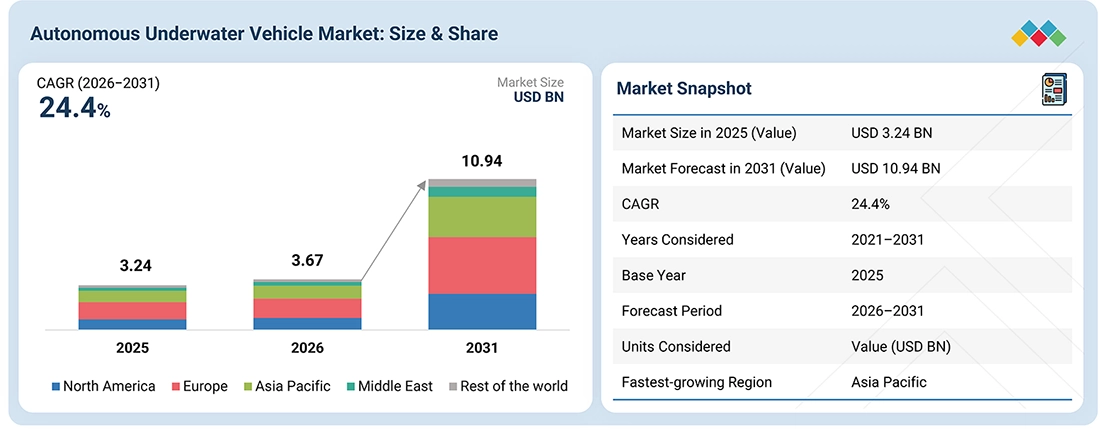
Source: Secondary Research, Interviews with Experts, MarketsandMarkets Analysis
TRENDS & DISRUPTIONS IMPACTING CUSTOMERS' CUSTOMERS
The AUV Industry is increasingly influenced by defense, offshore, environmental, oceanographic, and research organizations shifting from conventional survey operations toward autonomous, long-endurance, and data-intensive underwater missions. Historically, the market relied mainly on AUV platform sales, sonar and sensing systems, navigation and positioning systems, propulsion and power systems, communication equipment, and mission management systems, while new revenue opportunities are emerging through deep-water AUVs, multi-AUV operations, adaptive navigation, AI-enabled underwater sensing, modular payloads, resident AUV systems, and AUV-based inspection services. Demand is being shaped by the need for autonomous underwater surveillance, subsea inspection, persistent environmental monitoring, high-resolution ocean mapping, underwater documentation, and deep-water exploration. At the same time, end users are adopting advanced sensing, autonomous navigation, modular payload architectures, and AI-enabled data analysis to support diverse missions and operating environments. These changes are shifting the AUV market toward more autonomous, flexible, data-driven, and service-oriented systems, with defense forces, offshore operators, environmental organizations, oceanographic institutions, and research organizations becoming increasingly important across the value chain.
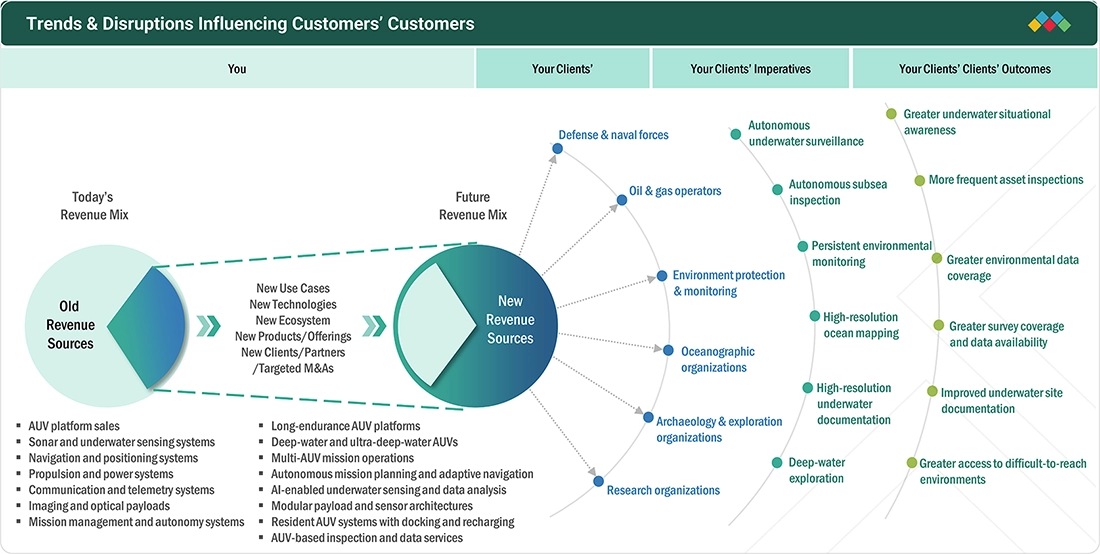
Source: Secondary Research, Interviews with Experts, MarketsandMarkets Analysis
AUTONOMOUS UNDERWATER VEHICLE MARKET DYNAMICS

Drivers
Impact
Level
Level
-
Increasing investments in offshore oil and gas drilling

-
Deployment of advanced technologies to ensure border and maritime security


RESTRAINTS
Impact
Level
Level
-
High development, operational, and maintenance costs

-
Limited endurance and range


OPPORTUNITIES
Impact
Level
Level
-
Integration of NiMH batteries into high-speed AUVs

-
Rising use of AUVs to protect subsea cables and seabed environment


CHALLENGES
Impact
Level
Level
-
Low speed, signal processing, and environmental issues during underwater surveys

-
Risk of data loss and prolonged research timelines due to challenging marine environment

Source: Secondary Research, Interviews with Experts, MarketsandMarkets Analysis
Driver: Increasing investments in offshore oil and gas drilling
Increasing capital expenditure in offshore oil and gas drilling is supporting demand for AUVs as operators seek autonomous platforms for high-precision subsea inspection, critical infrastructure monitoring, and deep-water surveys. AUVs enable operators to conduct these activities with greater operational safety, improved efficiency, and reduced dependence on conventional crewed inspection methods.
Restraint: High development, operational, and maintenance costs
The AUV market faces cost-related constraints because the development of pressure-resistant structures, advanced payload systems, navigation technologies, and long-endurance architectures requires substantial investment. In addition to high initial costs, regular maintenance, system upgrades, mission preparation, and operational requirements can increase the overall cost of ownership for end users.
Opportunity: Integration of NiMH batteries into high-speed AUVs
The integration of NiMH batteries presents an opportunity for AUV manufacturers, as these battery systems can provide high burst power, improved thermal stability, as well as cost-effective energy storage. Their use can support higher-speed AUV operations and longer missions while providing a practical alternative to reliance on more expensive next-generation battery chemistries.
Challenge: Low speed, signal processing, and environmental issues during underwater surveys
Underwater survey missions face operational challenges because slow navigation speeds, acoustic signal degradation, and unpredictable underwater environmental conditions can affect mission performance as well as data quality. Addressing these limitations requires more advanced sensing technologies, improved data processing capabilities, and adaptive navigation systems capable of maintaining mission accuracy under changing underwater conditions.
AUTONOMOUS UNDERWATER VEHICLE MARKET: COMMERCIAL USE CASES ACROSS INDUSTRIES
| COMPANY | USE CASE DESCRIPTION | BENEFITS |
|---|---|---|
 |
Kongsberg develops HUGIN AUVs for hydrographic surveying, seabed mapping, geophysical surveys, environmental monitoring, and defense missions. HUGIN platforms integrate sonar, imaging, navigation, and environmental sensors for autonomous underwater operations. | Supports high-resolution seabed and hydrographic surveys | Enables multi-sensor data collection | Supports autonomous navigation and underwater inspection | Reduces dependence on continuous operator control |
 |
Teledyne Marine develops AUVs including Gavia for defense, commercial, scientific, environmental, archaeological, and survey applications. Its modular AUV architecture allows different sensors, payloads, and battery configurations to be integrated for mission-specific requirements. | Supports mine countermeasure and survey missions | Enables modular mission configuration | Supports environmental and oceanographic data collection | Provides flexible platforms for different underwater applications |
 |
Saab develops the Sabertooth hybrid AUV/ROV for subsea inspection, maintenance, offshore surveys, environmental monitoring, and infrastructure applications. The system can operate autonomously and can be integrated with subsea docking stations for charging and data transfer during extended operations. | Enables autonomous subsea inspection | Supports extended resident operations | Reduces dependence on surface vessels | Provides flexible autonomous and remotely operated capabilities |
Logos and trademarks shown above are the property of their respective owners. Their use here is for informational and illustrative purposes only.
AUTONOMOUS UNDERWATER VEHICLE MARKET ECOSYSTEM
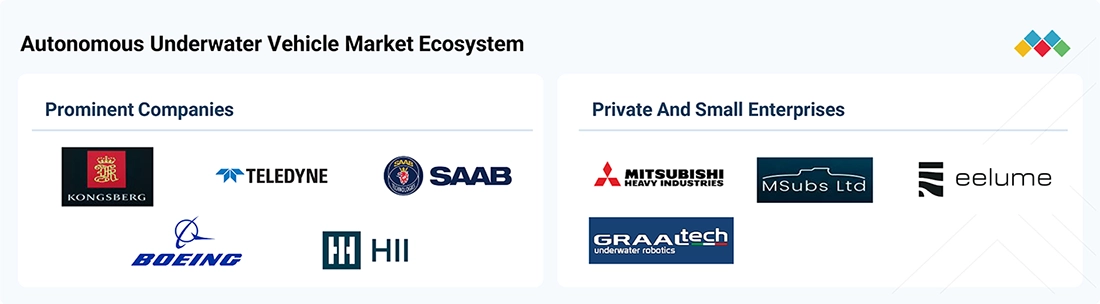
The autonomous underwater vehicle market ecosystem comprises major OEMs such as Kongsberg, Saab AB, Teledyne, HII, and Boeing, supported by specialized innovators like MSubs, Eelume, and Graal Tech. These players integrate advanced sensors, propulsion systems, and autonomy software to deliver mission-ready AUV platforms for defense, offshore energy, and ocean research. Collaboration among manufacturers, subsystem suppliers, and end users drives continuous innovation and supports the expansion of operational requirements in the underwater domain.
Logos and trademarks shown above are the property of their respective owners. Their use here is for informational and illustrative purposes only.
AUTONOMOUS UNDERWATER VEHICLE MARKET SEGMENTS
Source: Secondary Research, Interviews with Experts, MarketsandMarkets Analysis
Autonomous Underwater Vehicle Market, By Type
Large AUVs (>1,000 meters) lead the type segment due to their deep-water endurance, extended operational range, and advanced payload capacity, which support demanding applications such as defense ISR, deep-sea exploration, and subsea infrastructure inspection.
Autonomous Underwater Vehicle Market, By Shape
Torpedo-shaped AUVs dominate the AUV market because their hydrodynamic design provides low drag and efficient underwater movement, supporting long-endurance missions for ocean mapping, naval surveillance, and offshore energy surveys.
Autonomous Underwater Vehicle Market, By Propulsion
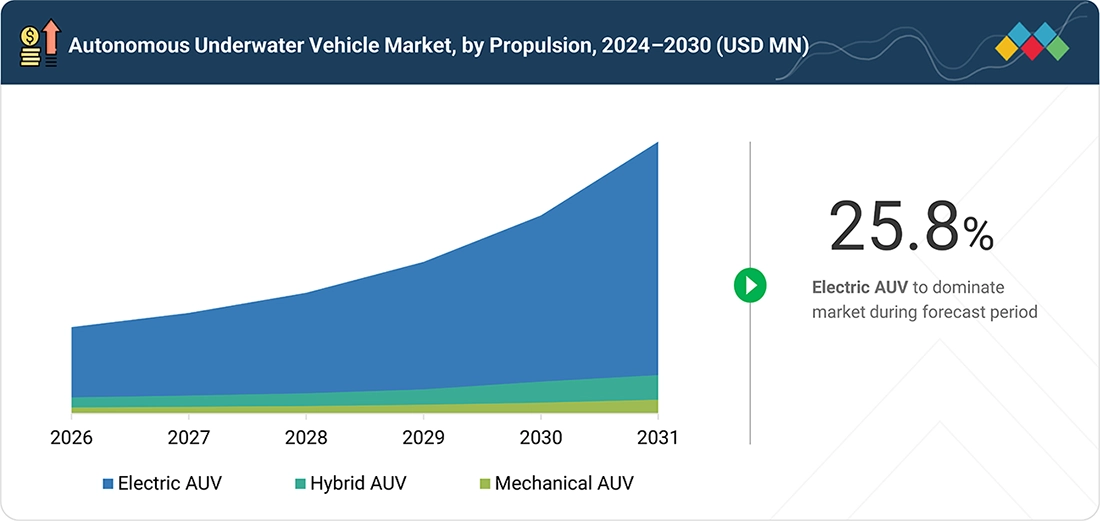
Electric AUVs account for the largest market share supported by advancements in battery technology and higher energy density while their quiet operation makes them suitable for extended defense missions and long-duration scientific surveys.
Autonomous Underwater Vehicle Market, By System
Payload & sensor systems represent the leading segment as high-resolution sonar, synthetic aperture sonar, optical cameras, and oceanographic sensors are increasingly essential for accurate seabed mapping, subsea inspection, and environmental monitoring.
Autonomous Underwater Vehicle Market, By Application
Military & defense leads the market as naval forces increasingly deploy AUVs for mine countermeasures, anti-submarine warfare, harbor protection, and ISR missions that require autonomous operation and extended endurance.
Autonomous Underwater Vehicle Market, By Speed
The > 5 knots segment leads the AUV Market because higher-speed AUVs can cover larger survey areas within shorter mission windows. They are well suited for defense surveillance, hydrographic surveys, offshore inspections, and search operations where faster underwater transit improves mission efficiency and coverage.
AUTONOMOUS UNDERWATER VEHICLE MARKET REGION
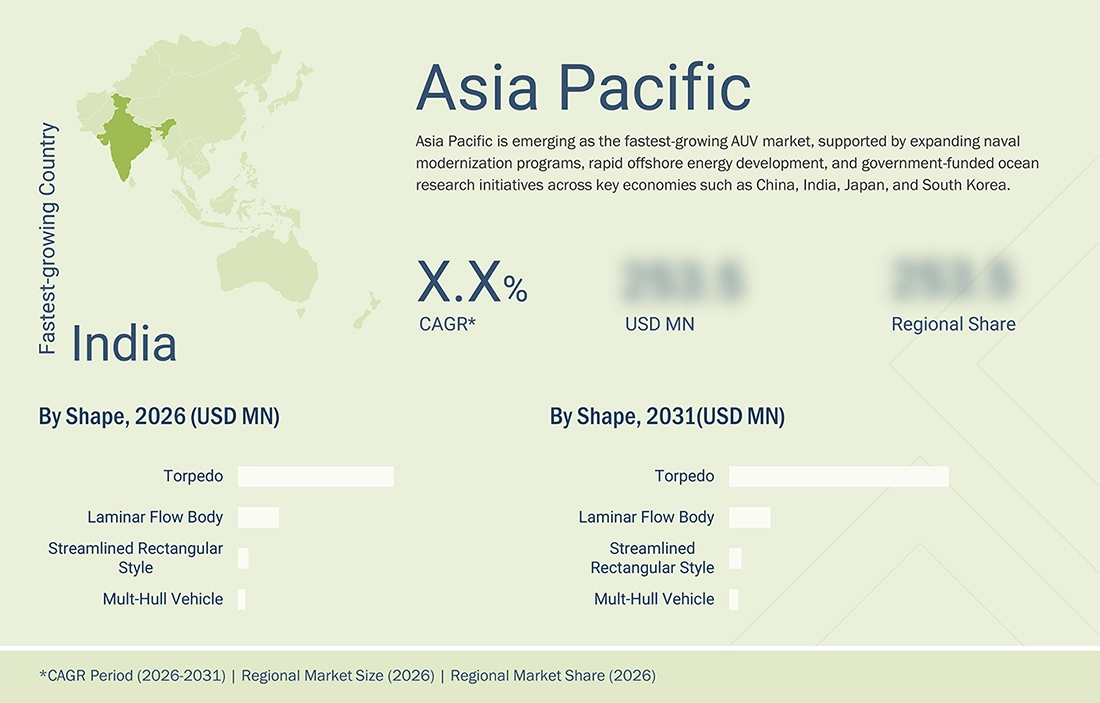
Asia Pacific to be fastest-growing region in global AUV market during forecast period
Asia Pacific is expected to record the highest CAGR during the forecast period, supported by rising defense investments in autonomous underwater systems, expanding offshore wind and oil & gas activities, and increasing AUV deployment for coastal surveillance and environmental monitoring. Government-supported oceanographic research initiatives across major regional economies are also expected to support market growth.
AUTONOMOUS UNDERWATER VEHICLE MARKET: COMPANY EVALUATION MATRIX
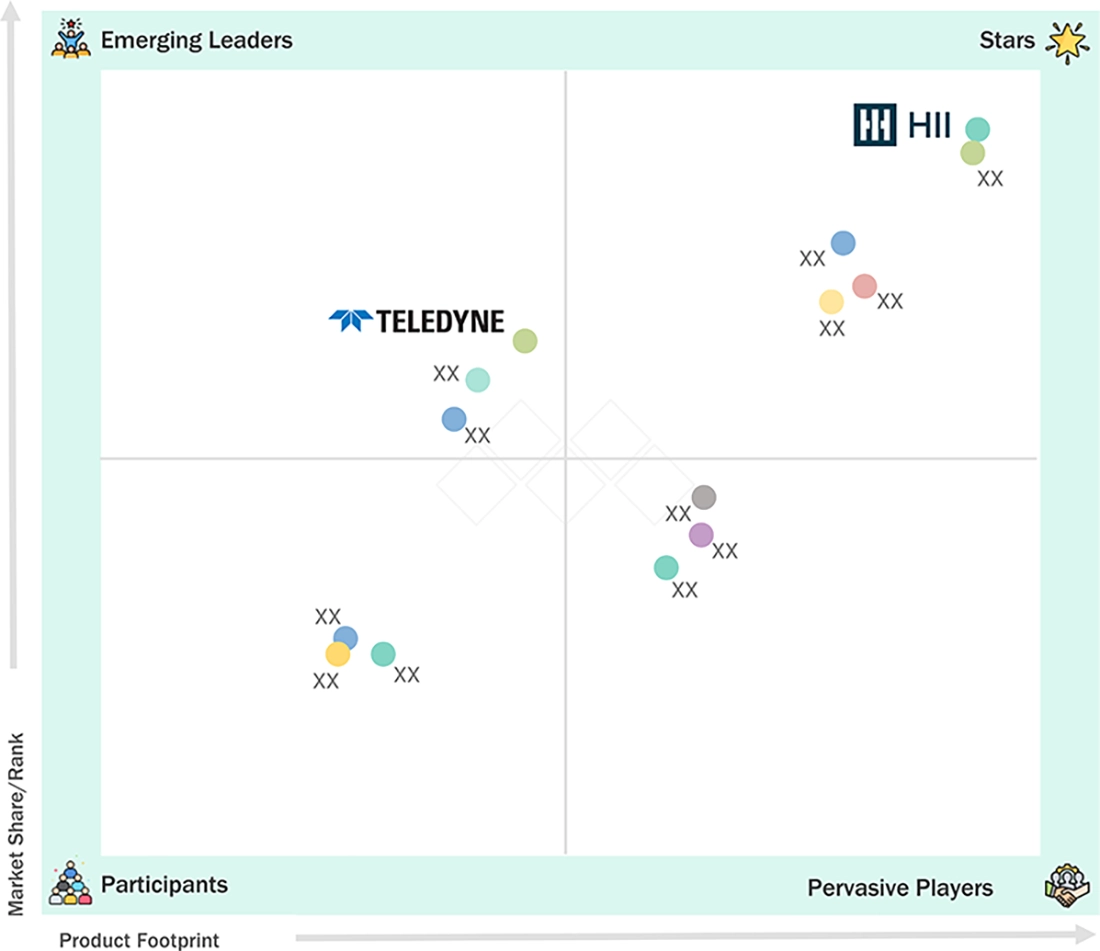
In the autonomous underwater vehicle market, HII (Star) leads with a substantial market share and a broad product footprint, supported by its robust portfolio of large-class and defense-grade AUVs, which are widely deployed in naval and strategic undersea missions. Meanwhile, Teledyne Technologies Incorporated (Emerging Leader) is strengthening its position through advanced sensor-driven AUV platforms and mission-specific systems that enhance survey accuracy and subsea data acquisition.
Source: Secondary Research, Interviews with Experts, MarketsandMarkets Analysis
KEY AUTONOMOUS UNDERWATER VEHICLE MARKET PLAYERS
List of Top Autonomous Underwater Vehicle Companies
- Kongsberg (Norway)
- Saab AB (Sweden)
- BAE Systems (UK)
- Exail Technologies (France)
- Saipem S.p.A (Italy)
- Teledyne Technologies Incorporated (US)
- HII (US)
- General Dynamics Corporation (US)
- Boeing (US)
- Lockheed Martin Corporation (US)
- Kawasaki Heavy Industries, Ltd. (Japan)
- TKMS (Germany)
- L3Harris Technologies, Inc. (US)
- Boston Engineering (US)
- Sonardyne (UK)
- Xylem (US)
- International Submarine Engineering Limited (Canada)
- Northrop Grumman (US)
WHAT IS IN IT FOR YOU: AUTONOMOUS UNDERWATER VEHICLE MARKET REPORT CONTENT GUIDE
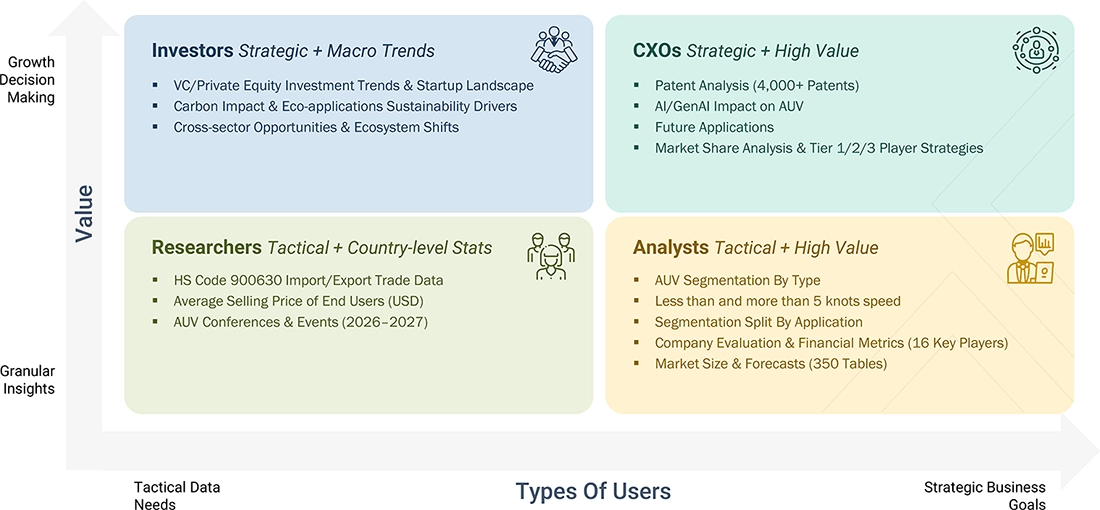
DELIVERED CUSTOMIZATIONS
We have successfully delivered the following deep-dive customizations:
| CLIENT REQUEST | CUSTOMIZATION DELIVERED | VALUE ADDS |
|---|---|---|
| Leading Manufacturer | Additional segment breakdown for countries | Additional country-level market sizing tables for segments/subsegments covered at the regional/global level to gain an understanding of market potential by each country |
| Emerging Leader | Additional company profiles | Competitive information on targeted players to gain granular insights into direct competition |
| Regional Market Leader | Additional country market estimates | Additional country-level deep dive for a more targeted understanding of the total addressable market |
RECENT DEVELOPMENTS
- September 2026 : Kongsberg announced that the Norwegian University of Science and Technology (NTNU) is purchasing a HUGIN 6000 AUV for the Norwegian Ocean Technology Centre. The 6,000-meter-rated AUV will support deep-water ocean research and mapping, with up to three days of operation without recharging. The development is directly relevant to deep-water AUVs, oceanographic research, and advanced autonomous underwater operations.
- July 2026 : Teledyne Marine, Spry Technocon, Klein Marine Systems, and VideoRay announced a strategic partnership to pursue unmanned mine-countermeasure solutions for the Indian Navy. The proposed solution includes Teledyne AUVs with mine detection, classification, and identification capabilities, supporting autonomous mine warfare and underwater surveillance requirements.
- March 2026 : Teledyne Gavia announced that the Swedish Defence Materiel Administration (FMV) placed a follow-on order for additional GAVIA AUVs and payload modules. The systems support mine countermeasures and EOD missions, with the modular architecture also enabling applications such as critical underwater infrastructure surveys. The order forms part of a multiyear framework supporting Swedish Armed Forces fleet modernization and underwater surveillance.
Table of Contents
 Exclusive indicates content/data unique to MarketsandMarkets and not available with any competitors.
TITLE
PAGE NO
1
INTRODUCTION
15
2
EXECUTIVE SUMMARY
3
PREMIUM INSIGHTS
4
MARKET OVERVIEW
Outlines emerging trends, technology impact, and regulatory signals affecting growth trajectory and stakeholder decisions.
4.1
INTRODUCTION
4.2
MARKET DYNAMICS
4.2.1
DRIVERS
4.2.2
RESTRAINTS
4.2.3
OPPORTUNITIES
4.2.4
CHALLENGES
4.3
UNMET NEEDS & WHITE SPACES
4.4
INTERCONNECTED MARKETS AND CROSS-SECTOR OPPORTUNITIES
4.5
STRATEGIC MOVES BY TIER 1/2/3 PLAYERS
5
INDUSTRY TRENDS
Provides a snapshot of current market scenario, value chain context, and factors impacting competitive intensity.
5.1
ECOSYSTEM ANALYSIS
5.1.1
PROMINENT COMPANIES
5.1.2
PRIVATE AND SMALL ENTERPRISES
5.1.3
END USERS
5.2
VALUE CHAIN ANALYSIS
5.4
PRICING ANALYSIS
5.4.1
AVERAGE SELLING PRICE OF AUV TYPE, BY KEY PLAYERS,
5.4.2
AVERAGE SELLING PRICE TREND BY REGION, 2021-2026
5.6
TRADE ANALYSIS
5.6.1
IMPORT SCENARIO (HS CODE: 900630)
5.6.2
EXPORT SCENARIO (HS CODE: 900630)
5.7
CASE STUDY ANALYSIS
5.8
KEY CONFERENCES & EVENTS 2026-2027
5.9
INVESTMENT AND FUNDING SCENARIO
5.10
TRENDS/DISRUPTION IMPACTING CUSTOMER BUSINESS
5.11
OPERATIONAL DATA
5.12
TOTAL COST OF OWNERSHIP (TCO)
5.13
MACROECONOMIC OUTLOOK
5.13.1
INTRODUCTION
5.13.2
GDP TRENDS AND FORECAST
5.13.3
TRENDS IN GLOBAL UNDERWATER MARITIME VEHICLES INDUSTRY
5.13.4
TRENDS IN GLOBAL MARINE INDUSTRY
5.14
KEY STAKEHOLDERS & BUYING CRITERIA
5.14.1
KEY STAKEHOLDERS IN BUYING PROCESS
5.14.2
BUYING CRITERIA
5.15
VOLUME DATA
5.16
BILL OF MATERIALS
5.17
BUSINESS MODELS
6
TECHNOLOGICAL ADVANCEMENTS, AI-DRIVEN IMPACT, PATENTS, INNOVATIONS, AND FUTURE APPLICATIONS
6.1
KEY EMERGING TECHNOLOGIES
6.2
COMPLEMENTARY TECHNOLOGIES
6.3
TECHNOLOGY ROADMAP
6.4
PATENT ANALYSIS
6.5
FUTURE APPLICATIONS
6.6
IMPACT OF AI/GEN AI ON AUV MARKET
6.6.1
TOP USE CASES AND MARKET POTENTIAL
6.6.2
BEST PRACTICES IN AUV SYSTEM
6.6.3
CASE STUDIES OF AI IMPLEMENTATION IN AUV MARKET
6.6.4
INTERCONNECTED ADJACENT ECOSYSTEM AND IMPACT ON MARKET PLAYERS
6.6.5
CLIENTS’ READINESS TO ADOPT GENERATIVE AI IN AUV MARKET
6.7
IMPACT OF MEGATRENDS
7
SUSTAINABILITY AND REGULATORY LANDSCAPE
7.1
REGIONAL REGULATIONS AND COMPLIANCE
7.1.1
REGULATORY BODIES, GOVERNMENT AGENCIES, AND OTHER ORGANIZATIONS
7.1.2
INDUSTRY STANDARDS
7.2
SUSTAINABILITY INITIATIVES
7.2.1
CARBON IMPACT AND ECO-APPLICATIONS OF AUV
7.3
SUSTAINABILITY IMPACT AND REGULATORY POLICY INITIATIVES
7.4
CERTIFICATIONS, LABELING, AND ECO-STANDARDS
8
CUSTOMER LANDSCAPE & BUYER BEHAVIOR
8.1
DECISION-MAKING PROCESS
8.2
BUYER STAKEHOLDERS AND BUYING EVALUATION CRITERIA
8.3
ADOPTION BARRIERS & INTERNAL CHALLENGES
8.4
UNMET NEEDS FROM VARIOUS END-USE INDUSTRIES
9
AUTONOMOUS UNDERWATER VEHICLE (AUV) MARKET, BY TYPE (MARKET SIZE & FORECAST TO 2031 – IN VALUE, USD MILLION & VOLUME, UNITS)
TYPE-SPECIFIC ADOPTION DRIVERS, DEMAND DYNAMICS AND MARKET POTENTIAL ACROSS EACH END-USE INDUSTRY
9.1
INTRODUCTION
9.2
SHALLOW AUVS (UP TO 100 METERS)
9.2.1
USE CASE: REMUS-100 HAS BEEN EXPLICITLY FIELDED FOR VERY-SHALLOW WATER MCM MISSIONS
9.2.2
MICRO/SMALL AUV (UP TO 20 KG)
9.2.3
MINI AUV (20 – 100 KG)
9.3
MEDIUM AUVS (100 – 1,000 METERS)
9.3.1
USE CASE: MBARI’S SEAFLOOR MAPPING DEEP-RATED SURVEY VEHICLES LAUNCHED ON FULLY AUTONOMOUS MISSIONS
9.4
LARGE AUVS (>1,000 METERS)
9.4.1
USE CASE: ORCA’S 8-TON PAYLOAD BAY AND 6,500 NM RANGE ARE ENABLED FOR MODULAR MISSION PACKAGES
9.4.3
DEEP WATER AUTONOMOUS UNDERWATER VEHICLE (1,000 – 3,000 METERS)
9.4.3
LARGE DISPLACEMENT AUTONOMOUS UNDERWATER VEHICLE (3,000 – 6,000 METERS)
9.4.4
EXTRA LARGE AUTONOMOUS UNDERWATER VEHICLE (>6,000 METERS)
10
AUTONOMOUS UNDERWATER VEHICLE (AUV) MARKET, BY SHAPE
Market Size, Volume & Forecast – USD Million
(MARKET SIZE & FORECAST TO 2031 – IN VALUE, USD MILLION & VOLUME, UNITS )
COMPARATIVE ASSESSMENT OF KEY AUV SHAPES, THEIR MARKET POTENTIAL, AND DEMAND PATTERNS BY VARIOUS SUPPLIER COMPANIES
Market Size, Volume & Forecast – USD Million
10.1
INTRODUCTION
10.2
TORPEDO
10.3
LAMINAR FLOW BODY
10.4
STREAMLINED RECTANGULAR STYLE
10.5
MULTI-HULL VEHICLE
11
AUTONOMOUS UNDERWATER VEHICLE (AUV) MARKET, BY SPEED
Market Size, Volume & Forecast – USD Million
(MARKET SIZE & FORECAST TO 2031 – IN VALUE, USD MILLION)
SPEED-WISE DEMAND POTENTIAL AND GROWTH PATHWAYS SHAPING AUV ADOPTION IN DIVERSE INDUSTRIES
11.1
INTRODUCTION
11.2
LESS THAN 5 KNOTS
11.3
MORE THAN 5 KNOTS
12
AUTONOMOUS UNDERWATER VEHICLE (AUV) MARKET, BY PROPULSION
Market Size, Volume & Forecast – USD Million
(MARKET SIZE & FORECAST TO 2031 – IN VALUE, USD MILLION)
PROPULSION-WISE DEMAND POTENTIAL AND GROWTH PATHWAYS SHAPING AUV ADOPTION IN DIVERSE INDUSTRIES
12.1
INTRODUCTION
12.2
ELECTRIC AUV
12.2.1
USE CASE: REMUS SERIES LI-ION BATTERY SYSTEMS DEVELOPED WITH SAFT/MATHEWS, FROM 1–16 KWH PACKS FOR LONGER MISSIONS
12.3
MECHANICAL AUV
12.3.1
USE CASE: SLOCUM G3 GLIDER – OPTIMIZED FOR LONG ENDURANCE WITH A BUOYANCY ENGINE AND WINGS FOR COASTAL PROGRAMS
12.3
HYBRID AUV
12.4.1
USE CASE: EARLY PEM FUEL-CELL AUV PROTOTYPES DELIVERING ~4 KW FOR PROPULSION WITH HYDROGEN STORED IN METAL HYDRIDE TANKS
13
AUTONOMOUS UNDERWATER VEHICLE (AUV) MARKET, BY APPLICATION
Market Size, Volume & Forecast – USD Million
(MARKET SIZE & FORECAST TO 2031 – IN VALUE, USD MILLION)
COMPARATIVE ASSESSMENT OF KEY APPLICATIONS, THEIR MARKET POTENTIAL, AND DEMAND PATTERNS BY VARIOUS SUPPLIER COMPANIES
Market Size, Volume & Forecast – USD Million
13.1
INTRODUCTION
13.2
MILITARY & DEFENSE
13.2.1
BORDER SECURITY & SURVEILLANCE
13.2.2
ANTISUBMARINE WARFARE
13.2.3
ANTI-TRAFFICKING & CONTRABAND MONITORING
13.2.4
ENVIRONMENTAL ASSESSMENT
13.2.5
MINE COUNTERMEASURE IDENTIFICATION
13.3
OIL & GAS
13.3.1
PIPELINE SURVEYS
13.3.2
GEOPHYSICAL SURVEYS
13.3.3
DEBRIS/CLEARANCE SURVEYS
13.3.4
BASELINE ENVIRONMENTAL ASSESSMENT
13.4
ENVIRONMENT PROTECTION & MONITORING
13.4.1
HABITAT RESEARCH
13.4.2
WATER SAMPLING
13.4.3
FISHERY STUDY
13.4.4
EMERGENCY RESPONSE
13.5
OCEANOGRAPHY
13.6
ARCHAEOLOGY & EXPLORATION
13.7
SEARCH & SALVAGE OPERATIONS
14
AUTONOMOUS UNDERWATER VEHICLE (AUV) MARKET, BY SYSTEM
Market Size, Volume & Forecast – USD Million
(MARKET SIZE & FORECAST TO 2031 – IN VALUE, USD MILLION)
SYSTEM-WISE DEMAND POTENTIAL AND GROWTH PATHWAYS SHAPING AUV ADOPTION IN DIVERSE INDUSTRIES
14.1
INTRODUCTION
14.2
COLLISION AVOIDANCE
14.2.1
FORWARD-LOOKING SONAR (FLS)
14.2.2
OTHERS (BLOW-BALLAST/EMERGENCY BUOYANCY ACTIVATION)
14.3
COMMUNICATION & NETWORKING
14.3.1
UNDERWATER ACOUSTIC COMMUNICATION SYSTEMS
14.3.2
SUBSEA WIRELESS OPTICAL COMMUNICATION SYSTEMS
14.3.3
SURFACE RADIO-FREQUENCY (RF) & WI-FI COMMUNICATION SYSTEMS
14.3.4
SATELLITE COMMUNICATION INTERFACES
14.3.5
OTHERS (ADVANCED COMMUNICATION GATEWAY SYSTEMS)
14.4
NAVIGATION & GUIDANCE
14.4.1
INERTIAL & DEAD-RECKONING SYSTEMS
14.4.1.1
INERTIAL NAVIGATION SYSTEM (INS)
14.4.1.2
COMPASS-BASED NAVIGATION
14.4.1.3
OTHERS (DVL, PRESSURE/DEPTH ALTIMETER)
14.4.2
ACOUSTIC NAVIGATION SYSTEMS
14.4.3
OTHERS (TERRAIN, HYBRID, ADAPTIVE MISSION CONTROL & SENSOR FUSION SYSTEM, INTEGRATED / HYBRID NAVIGATION SYSTEMS)
14.5
PROPULSION & MOBILITY
14.5.1
THRUST GENERATION SUBSYSTEM
14.5.1.1
PROPULSION MOTORS
14.5.1.2
THRUSTERS
14.5.1.3
OTHERS (PROPELLERS)
14.5.2
MOTION & CONTROL ACTUATION SUBSYSTEM
14.5.2.1
FIN CONTROL ACTUATORS
14.5.2.1
SERVO/LINEAR ELECTROMECHANICAL ACTUATORS
14.5.3
BUOYANCY & VERTICAL MOTION SUBSYSTEM
14.5.3.1
PUMP MOTORS
14.5.3.1
VARIABLE BUOYANCY DEVICES
14.5.3.1
OTHERS (BALLAST TANKS)
14.5.4
OTHERS (SHAFTS, SEALS, DRIVES)
14.6
PAYLOAD & SENSOR SYSTEMS
14.6.1
ACOUSTIC IMAGING & MAPPING PAYLOADS
14.6.1.1
SIDE-SCAN SONAR IMAGERS
14.6.1.2
MULTIBEAM ECHO SOUNDERS
14.6.1.3
SYNTHETIC APERTURE SONAR (SAS)
14.6.1.4
SUB-BOTTOM PROFILERS
14.6.1.5
OTHERS (SINGLE, SPLIT BEAM ECHO SOUNDERS)
14.6.2
OPTICAL IMAGING PAYLOADS
14.6.2.1
HIGH-RESOLUTION DIGITAL STILL CAMERA
14.6.2.2
DUAL-EYE CAMERA
14.6.2.3
OTHERS (LED LIGHTING, STROBES, LASERS FOR ILLUMINATION)
14.6.3
ENVIRONMENTAL & OCEANOGRAPHIC SENSOR PAYLOADS
14.6.3.1
CONDUCTIVITY, TEMPERATURE AND DEPTH SENSORS (CTD)
14.6.3.2
BIOGEOCHEMICAL SENSORS
14.6.3.3
ACOUSTIC DOPPLER CURRENT PROFILERS (ADCP)
14.6.4
OTHERS (SPECIALIZED / MISSION-SPECIFIC PAYLOADS- MAGNETOMETER, HYDROPHONES, SAMPLERS, SENSOR FUSION & AI-DRIVEN PAYLOAD SUITES)
14.7
CHASSIS
14.7.1
METAL ALLOY HULLS
14.7.2
FIBER-REINFORCED COMPOSITES
14.7.3
OTHERS (ENGINEERING PLASTICS, SYNTATIC FOAMS)
14.8
POWER & ENERGY SYSTEM
14.8.1
ENERGY STORAGE
14.8.1.1
BATTERY MODULES (LITHIUM-ION / LITHIUM-POLYMER BATTERY MODULES)
14.8.1.2
PRESSURE-TOLERANT SUBSEA BATTERY SYSTEM
14.8.1.3
SUPERCAPACITORS
14.8.2
POWER MANAGEMENT & DISTRIBUTION
14.8.2.1
BATTERY MANAGEMENT SYSTEMS
14.8.2.2
DC/DC CONVERTERS
14.8.2.3
BUSBARS
14.8.2.4
OTHERS (BREAKERS, CONTACTORS, HARNESSES)
14.8.3
OTHERS (DOCKING & CHARGING SYSTEMS)
14.9
OTHERS (CONTROL, AUTONOMY & MISSION MANAGEMENT SYSTEM, SAFETY & RECOVERY SYSTEM, DATA STORAGE & HANDLING)
16
AUTONOMOUS UNDERWATER VEHICLE (AUV) MARKET, REGIONAL ANALYSIS
(MARKET SIZE & FORECAST TO 2031 – IN VALUE, USD MILLION)
ASSESSING GROWTH PATTERNS, INDUSTRY FORCES, REGULATORY LANDSCAPE, AND MARKET POTENTIAL ACROSS KEY COUNTRIES
16.1
INTRODUCTION
16.2
NORTH AMERICA
16.2.2
US
16.2.3
CANADA
16.3
EUROPE
16.3.2
UK
16.3.3
GERMANY
16.3.4
FRANCE
16.3.5
ITALY
16.3.6
SPAIN
16.3.7
NORWAY
16.3.8
REST OF EUROPE
16.4
ASIA PACIFIC
16.4.2
CHINA
16.4.3
JAPAN
16.4.4
INDIA
16.4.5
SOUTH KOREA
16.4.6
AUSTRALIA
16.4.7
REST OF ASIA PACIFIC
16.5
MIDDLE EAST
16.5.2
GCC
16.5.2.1
UAE
16.5.2.2
SAUDI ARABIA
16.5.3
ISRAEL
16.5.4
TURKEY
16.5.5
REST OF MIDDLE EAST
16.6
REST OF THE WORLD
16.6.2
LATIN AMERICA
16.6.3
AFRICA
17
COMPETITIVE LANDSCAPE
STRATEGIC ASSESSMENT OF LEADING PLAYERS, MARKET SHARE, REVENUE ANALYSIS, COMPANY POSITIONING, AND COMPETITIVE BENCHMARKS INFLUENCING MARKET POTENTIAL
17.1
OVERVIEW
17.2
KEY PLAYER STRATEGIES/RIGHT TO WIN
17.3
MARKET SHARE ANALYSIS,
17.4
REVENUE ANALYSIS, 2021-2025
17.5
COMPANY EVALUATION MATRIX: KEY PLAYERS,
17.5.1
STARS
17.5.2
EMERGING LEADERS
17.5.3
PERVASIVE PLAYERS
17.5.4
PARTICIPANTS
17.5.5
COMPANY FOOTPRINT: KEY PLAYERS,
17.5.5.1
COMPANY FOOTPRINT
17.5.5.2
REGION FOOTPRINT
17.5.5.3
SYSTEM FOOTPRINT
17.5.5.4
APPLICATION FOOTPRINT
17.5.5.5
SPEED FOOTPRINT
17.6
COMPANY VALUATION AND FINANCIAL METRICS
17.7
COMPANY EVALUATION MATRIX: STARTUPS/SME,
17.7.1
PROGRESSIVE COMPANIES
17.7.2
RESPONSIVE COMPANIES
17.7.3
DYNAMIC COMPANIES
17.7.4
STARTING BLOCKS
17.7.5
COMPETITIVE BENCHMARKING: STARTUPS/SMES,
17.7.5.1
LIST OF STARTUPS/SMES
17.7.5.2
COMPETITIVE BENCHMARKING OF KEY STARTUPS/SMES
17.8
TECHNOLOGY COMPARISON
17.9
COMPETITIVE SCENARIO
17.9.1
PRODUCT LAUNCHES
17.9.2
DEALS
17.9.3
EXPANSIONS
18
COMPANY PROFILES
IN-DEPTH REVIEW OF COMPANIES, PRODUCTS, SERVICES, RECENT INITIATIVES, AND POSITIONING STRATEGIES IN AUV MARKET LANDSCAPE
18.1
KEY PLAYERS
18.1.1
KONGSBERG
18.1.2
TELEDYNE TECHNOLOGIES INCORPORATED
18.1.3
BOEING
18.1.4
GENERAL DYNAMICS CORPORATION
18.1.5
SAAB AB
18.1.6
EXAIL TECHNOLOGIES
18.1.7
LOCKHEED MARTIN CORPORATION
18.1.8
KAWASAKI HEAVY INDUSTRIES, LTD
18.1.9
L3HARRIS TECHNOLOGIES, INC.
18.1.10
BOSTON ENGINEERING
18.1.11
BAE SYSTEMS
18.1.12
SONARDYNE
18.1.13
XYLEM
18.1.14
TKMS
18.1.15
INTERNATIONAL SUBMARINE ENGINEERING
18.1.16
HII
18.2
OTHER PLAYERS
18.3.1
MSUBS/ SUBMERGENCE GROUP
18.3.2
FALMOUTH SCIENTIFIC, INC.
18.3.3
TERRADEPTH
18.3.4
ECOSUB ROBOTICS LIMITED
18.3.5
EELUME AS
18.3.6
HYDROMEA
18.3.7
GRAAL TECH S.R.L.
18.3.8
RIPTIDE AUTONOMOUS SOLUTIONS LLC
18.3.9
BALTROBOTICS
18.3.10
OCEANSCAN-MST
18.3.11
RTSYS
18.3.12
MITSUBISHI HEAVY INDUSTRIES, LTD.
19
RESEARCH METHODOLOGY
19.1
RESEARCH DATA
19.1.1
SECONDARY DATA
19.1.1.1
KEY DATA FROM SECONDARY SOURCES
19.1.2
PRIMARY DATA
19.1.2.1
KEY DATA FROM PRIMARY SOURCES
19.1.2.2
KEY PRIMARY PARTICIPANTS
19.1.2.3
BREAKDOWN OF PRIMARY INTERVIEWS
19.1.2.4
KEY INDUSTRY INSIGHTS
19.2
MARKET SIZE ESTIMATION
19.2.1
BOTTOM-UP APPROACH
19.2.2
TOP-DOWN APPROACH
19.2.3
BASE NUMBER CALCULATION
19.3
MARKET FORECAST APPROACH
19.3.1
SUPPLY SIDE
19.3.2
DEMAND SIDE
19.4
DATA TRIANGULATION
19.5
FACTOR ANALYSIS
19.6
RESEARCH ASSUMPTIONS
19.7
RESEARCH LIMITATIONS AND RISK ASSESSMENT
20
APPENDIX
20.1
DISCUSSION GUIDE
20.2
KNOWLEDGESTORE: MARKETSANDMARKETS’ SUBSCRIPTION PORTAL
20.3
CUSTOMIZATION OPTIONS
20.4
RELATED REPORTS
20.5
AUTHOR DETAILS
Methodology
The study involved four major activities in estimating the current size of the autonomous underwater vehicle market. Exhaustive secondary research was done to collect information on the autonomous underwater vehicle market, its adjacent markets, and its parent market. The next step was to validate these findings, assumptions, and sizing with industry experts across the value chain through primary research. Demand-side analysis was conducted to estimate the overall market size. After that, market breakdown and data triangulation procedures were employed to estimate the sizes of various segments and subsegments within the autonomous underwater vehicle market.
Secondary Research
During the secondary research process, various sources were consulted to identify and collect information for this study. These include government sources, such as SIPRI; corporate filings, including annual reports, press releases, and investor presentations from companies; white papers, journals, and certified publications; and articles from recognized authors, directories, and databases.
Primary Research
Extensive primary research was conducted after acquiring information regarding the autonomous underwater vehicle market scenario through secondary research. Several primary interviews were conducted with market experts from both the demand and supply sides across major countries in North America, Europe, Asia Pacific, the Middle East, and the Rest of the World. Primary data were collected through questionnaires, emails, and telephonic interviews.
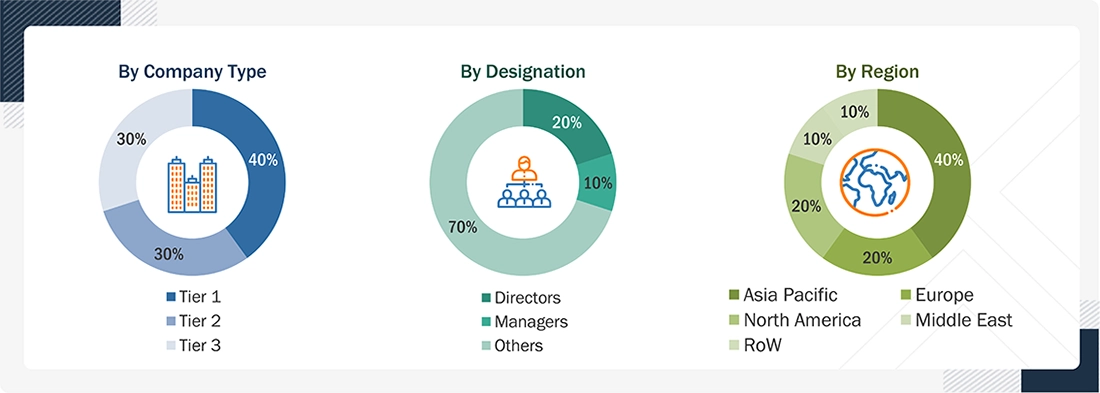
To know about the assumptions considered for the study, download the pdf brochure
Market Size Estimation
The top-down and bottom-up approaches were used to estimate and validate the size of the autonomous underwater vehicle market. The research methodology used to estimate the size of the market included the following details:
- Key players in the autonomous underwater vehicle market were identified through secondary research, and their market shares were determined through a combination of primary and secondary research. This included a study of the annual and financial reports of the top market players, as well as extensive interviews with leaders, including directors, engineers, marketing executives, and other key stakeholders of leading companies operating in the market.
- All percentage shares, splits, and breakdowns were determined using secondary sources and verified through primary sources.
- All possible parameters that affect the markets covered in this research study were accounted for, viewed in extensive detail, verified through primary research, and analyzed to obtain the final quantitative and qualitative data on the autonomous underwater vehicle market. This data was consolidated, enhanced with detailed inputs, analyzed by MarketsandMarkets, and presented in this report.
Autonomous Underwater Vehicle Market : Top-Down and Bottom-Up Approach

Data Triangulation
After determining the overall market size, the total market was divided into several segments and subsegments. The data triangulation and market breakdown procedures explained below were implemented, wherever applicable, to complete the overall market engineering process and arrive at the estimated market numbers for the market segments and subsegments. The data were triangulated by studying various factors and trends from the demand and supply sides. Additionally, the market size was validated using top-down and bottom-up approaches.
Market Definition
An autonomous underwater vehicle is a self-propelled, untethered underwater robotic platform capable of independent navigation and task execution without real-time human control, used for applications such as seafloor mapping, inspection, surveillance, and data collection across defense, research, and commercial domains.
Key Stakeholders
- OEMs
- Component Suppliers
- System Integrators
- Service Providers
- Regulatory and Certification Bodies
- Research and Technology Institutions
- Investors and Funding Agencies
Report Objectives
- To define, describe, and forecast the autonomous underwater vehicle market based on type, shape, speed, propulsion, application, system, and region
- To forecast the size of different segments of the market with respect to North America, Europe, Asia Pacific, the Middle East, and the Rest of the World
- To identify and analyze key drivers, restraints, opportunities, and challenges influencing market growth
- To identify industry trends, market trends, and technology trends currently prevailing in the market
- To analyze micro markets with respect to individual growth trends, prospects, and their contribution to the overall market
- To analyze the degree of competition in the market by analyzing recent developments adopted by leading players
- To strategically profile the key market players and comprehensively analyze their core competencies
- To provide a detailed competitive landscape of the market, along with a market share analysis and revenue analysis of key players
Available customizations:
MarketsandMarkets offers the following customizations for this market report:
- Additional country-level analysis of the autonomous underwater vehicle market
- Profiling of other market players (up to five)
Product Analysis
-
Product matrix, which provides a detailed comparison of the product portfolio of each company in the autonomous underwater vehicle market
Key Questions Addressed by the Report
What is the projected size of the Autonomous Underwater Vehicle (AUV) Market by 2031?
The global Autonomous Underwater Vehicle (AUV) Market is projected to grow from USD 3.24 billion in 2025 to USD 10.94 billion by 2031, registering a CAGR of 24.4% during 2026–2031.
What are the major factors driving the growth of the AUV Market?
Market growth is driven by increasing investments in offshore oil and gas exploration, maritime and border security, deep-sea research, underwater surveillance, seabed mapping, and subsea infrastructure inspection. Advances in sensors, energy systems, navigation, and AI-enabled autonomy are further supporting adoption.
Which type of AUV is expected to grow at the highest CAGR?
The large AUV segment is expected to register the highest CAGR of 24.4% during the forecast period. Large AUVs provide greater endurance, payload capacity, and deep-water operating capability for defense, exploration, and subsea infrastructure applications.
Which application is expected to dominate the AUV Market?
The military & defense segment is expected to dominate the AUV Market. AUVs are increasingly used for mine countermeasures, anti-submarine warfare, harbor protection, intelligence, surveillance, and reconnaissance missions.
Which region is expected to grow fastest in the AUV Market?
Asia Pacific is expected to register the highest CAGR during the forecast period. Growth is supported by defense investments, offshore wind and oil projects, coastal surveillance, environmental monitoring, and government-backed ocean research programs.
Which propulsion technology dominates the AUV Market?
Electric propulsion holds the largest market share. Improvements in battery technology and energy density, combined with the quiet operation of electric propulsion, make electric AUVs suitable for defense missions and long-duration scientific surveys.
What are the major challenges facing the AUV Market?
Key challenges include high development, operational, and maintenance costs; limited endurance and range; low underwater operating speeds; signal-processing limitations; environmental conditions; and risks of data loss during complex underwater surveys.
What opportunities exist in the Autonomous Underwater Vehicle Market?
Major opportunities include the integration of advanced battery technologies, AI-enabled navigation, improved sensors, autonomous systems, subsea cable protection, seabed monitoring, and long-endurance AUV platforms. Growing demand for underwater infrastructure inspection and environmental monitoring is also creating opportunities.
Who are the key companies operating in the AUV Market?
Key companies include Kongsberg, Saab AB, BAE Systems, Exail Technologies, Saipem, Teledyne Technologies, HII, General Dynamics, Boeing, Lockheed Martin, Kawasaki Heavy Industries, TKMS, L3Harris Technologies, and Northrop Grumman, among others.
What are the key trends shaping the AUV Market?
Key trends include the development of long-endurance AUVs, AI-enabled navigation, advanced sonar and sensor systems, autonomous mission planning, modular payloads, improved battery technologies, electric propulsion, underwater communication systems, and multi-AUV operations.
Fact checked
Personalize This Research
- Triangulate with your Own Data
- Get Data as per your Format and Definition
- Gain a Deeper Dive on a Specific Application, Geography, Customer or Competitor
- Any level of Personalization
Let Us Help You
- What are the Known and Unknown Adjacencies Impacting the Autonomous Underwater Vehicle Market
- What will your New Revenue Sources be?
- Who will be your Top Customer; what will make them switch?
- Defend your Market Share or Win Competitors
- Get a Scorecard for Target Partners

Custom Market Research Services
We Will Customise The Research For You, In Case The Report Listed Above Does Not Meet With Your Requirements
Get 10% Free CustomisationTESTIMONIALS
- Germany Autonomous Underwater Vehicle Market
- France Autonomous Underwater Vehicle Market
- Italy Autonomous Underwater Vehicle Market
- Spain Autonomous Underwater Vehicle Market
- Norway Autonomous Underwater Vehicle Market
- China Autonomous Underwater Vehicle Market
- Japan Autonomous Underwater Vehicle Market
- Australia Autonomous Underwater Vehicle Market
- South Korea Autonomous Underwater Vehicle Market
- India Autonomous Underwater Vehicle Market
- Saudi Arabia Autonomous Underwater Vehicle Market
- UAE Autonomous Underwater Vehicle Market
- Israel Autonomous Underwater Vehicle Market
- Turkey Autonomous Underwater Vehicle Market
- Canada Autonomous Underwater Vehicle Market
- US Autonomous Underwater Vehicle Market
- UK Autonomous Underwater Vehicle Market
Growth opportunities and latent adjacency in Autonomous Underwater Vehicle Market



Edward
Apr, 2026
Can I see real world use cases or deployments involving companies like Kongsberg or Boeing in deep sea missions?.
Aaron
Apr, 2026
Is there analysis on advanced navigation and positioning technologies like Doppler velocity logs and acoustic positioning systems?.
User
Sep, 2019
Have you profiled L3Harris technologies? I believe they are one of the top vendors in the AUV market. Apart from the one's mentioned in the company profile chapter what other companies have profiled?.
Tracey
Jul, 2018
I want to speak to the analyst who wrote this to get more insight for an article about the growth and potential (and pitfalls) of the underwater drone market. Also would like to understand the methodology for the same. .
Andrew
Oct, 2017
Hi, We are a start up company and would very much like to view this report but we don't have 5k or 8k to do so, do you have any deals that you can offer us as a start up company? Also would like to understand the payloads such as cameras, sensors, etc. and their use in Torpedo's. .
User
Sep, 2019
Can you provide me comparitive qualitative and quantitave analysis of ROV and AUV? Make sure to provide unit shipments and ASP of ROV and AUV. Also provide me the top 10 vendors in the ROV market. .
User
Sep, 2019
Is there any scope for new entrants in the market? If yes please provide me few start-ups in the market along with entry barriers in the market. Information on best practices in the market will also be well appriciated..
User
Nov, 2019
Have you provided information on ASP and unit shipment of each type of AUV i.e., shallow, medium and large? Can you also provide me both qualitative and quantitative information on each type and its application along with top vendors in each type?.
Pat
Oct, 2015
Neptune has recently completed its first deep water AUV survey in oil and gas. However, I would appreciate more information on defense, scientific and geography markets across all water depths as we have not had much visibility on this and believe we can use our vehicle for numerous purposes..
Bhushan
Oct, 2016
How AUVs are associated with the environmental protection and oceanography? .
Allison
Oct, 2017
Hello, I am a PhD student in Engineering/Oceanography concentrating on the technological development of AUVs. Would it be possible to request a sample of this report? Are there any discounts available for students at academic institutions who are using this information for research? .
sandy
Sep, 2015
Have been involved for many years now in providing Logistic/Customs Support Services to Clients who operate AUV Systems Worldwide. What are the latest trends of AUVs in military and defense and oil & gas industries.
admiral
Jun, 2015
What are the various Technologies and Types covered in the research. Also I would like to understand the opportunities and how government initiatives would be a driving factor for this market>?.
Michal
May, 2017
I would like to understand about acquisitions and or technology purchases made by market players (purchases of startups, R&D firms or purchases of licenses form universities etc..) in the AUV market. Have you covered this in your scope?.
User
Mar, 2019
Does your report have information on AUV batteries and various types of AUV batteries? Also can you provide me quantitative information on various AUV batteries? It should also include upcoming AUV battery technologies along with top vendor in each AUV battery type. .
Jerry
Feb, 2019
Hello. I am the founder of a newly formed autonomous underwater vehicle and I am interested in this report so we can better identify our target markets and customers. Also I would like to know the major areas that have been covered in this market. .
Ibrahim
Jan, 2019
We are a team of Electrical Engineering students from ITB (Bandung Institute of Technology) developing an AUV with an open source system for our capstone design project. The project is being developed for academicals maritime research purposes needed in Indonesia as it is the largest archipelago in the world. We request access for this pdf because we need a source of information for researching the global market for AUV development, as the Indonesian market for undersea exploration is currently very limited..