
Asia Pacific Backscatter X-ray Device Market (2025-2030)

The Asia Pacific Backscatter X-ray Device Market was valued at $110.4 Million in 2025 and projected to reach to $569.9 Million by 2030, representing a compound annual growth rate of 26.4%. Asia Pacific is positioned as the fastest-growing market for backscatter X-ray devices, with exceptional momentum driven by rapid industrialization, increasing security investments, and expanding trade infrastructure.


| Market Size in | USD 26.32 MN |
| Market Forecast in | |
| CAGR | |
| Forecast Period | |
| Units Considered | Value (USD MN) |
Asia Pacific Backscatter X-ray Device Market Trends and Insights
- This represents a compound annual growth rate (CAGR) of 26.4%, significantly outpacing global expansion trends.
- Asia Pacific's rapid industrialization, increasing security concerns, and rising adoption of advanced inspection technologies across ports, airports, and border checkpoints are driving robust demand for backscatter X-ray solutions. The region's growth trajectory reflects strong investments in infrastructure modernization and heightened regulatory focus on cargo and baggage screening.
- Asia Pacific countries are increasingly deploying backscatter X-ray devices to enhance threat detection capabilities while maintaining operational efficiency.
- Government initiatives supporting border security and customs modernization, combined with growing private sector adoption in logistics and manufacturing, are accelerating market penetration throughout the forecast period from 2025 to 2030..
Key Market Statistics
- CAGR (2025-2030) 26.4% CAGR
- Market Size, 2025 ~USD 110.4 Million
- Forecast, 2030 ~USD 569.9 Million
- Geography Asia Pacific
Asia Pacific Backscatter X-ray Device Market Overview
Fastest Growing Region Globally :
Asia Pacific leads the backscatter X-ray device market with a 26.4% CAGR (2025-2030), significantly exceeding the global growth rate of 21.5%, driven by rapid industrialization and infrastructure expansion across the region.
Explosive Market Expansion :
The Asia Pacific market is projected to grow from USD 110.4 million in 2025 to USD 569.9 million by 2030, representing a 416% increase over five years, reflecting strong demand for advanced security and inspection technologies.
Rising Security & Border Concerns :
Increasing geopolitical tensions, cross-border trade growth, and heightened security protocols across Asia Pacific nations are accelerating adoption of backscatter X-ray devices for customs, airport, and port security applications.
Industrial & Manufacturing Boom :
Rapid industrialization in China, India, and Southeast Asia is driving demand for non-destructive testing and quality control solutions, positioning backscatter X-ray technology as critical infrastructure for manufacturing excellence.
Asia Pacific Backscatter X-ray Device Market Dynamics
- China and India are leading contributors, supported by government initiatives in border security and infrastructure modernization.
- The region's 26.4% CAGR reflects strong demand from both public sector security agencies and private industrial enterprises seeking advanced inspection capabilities. Looking ahead, Asia Pacific's market growth will be sustained by rising geopolitical security concerns, expanding airport and port infrastructure, and increasing adoption of non-destructive testing in manufacturing.
- Investment in smart border solutions, coupled with technological advancements in backscatter imaging, will further accelerate market penetration across developed and emerging economies in the region..
Market Ecosystem
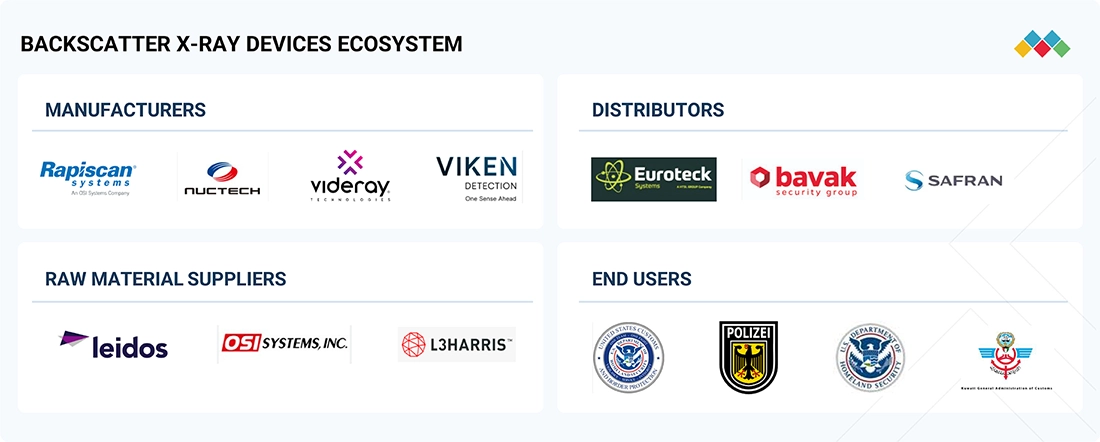
backscatter-x-ray-device-market: COMMERCIAL USE CASES ACROSS INDUSTRIES
| COMPANY | USE CASE DESCRIPTION | BENEFITS |
|---|---|---|
 |
Provides a full range of backscatter and hybrid (backscatter + transmission) X-ray systems for scanning vehicles, cargo containers, baggage, parcels, and personnel. Solutions include fixed gantry portals, mobile/vehicle-mounted scanners (M-series), handheld/portable backscatter imagers, and high-energy hybrid inspection platforms for customs, border security, aviation cargo, defense bases, and critical infrastructure. | High-penetration imaging |
 |
Manufactures a wide portfolio of backscatter and hybrid inspection systems, including large-portal gantries, drive-through cargo systems, mobile vehicle scanners, and portable backscatter units. Widely deployed in customs, airports (air cargo), ports, homeland security, and military checkpoints. Integrates advanced imaging algorithms and safety controls. | High throughput and inspection efficiency |
 |
Specializes in handheld backscatter X-ray devices for rapid field inspection, such as the HBI-120 and PB-series. Used heavily by law enforcement, border agents, narcotics units, and security teams for locating contraband inside vehicles, tires, dashboards, baggage, and hidden compartments. | Cost-efficient deployment with rapid ROI due to low training needs and minimal setup time |
 |
Provides advanced personnel screening systems using backscatter and millimeter-wave imaging technologies for correctional facilities, security checkpoints, and defense environments. Focuses on detecting contraband in individuals and small items with high sensitivity. | Non-contact, full-body inspection |
 |
Develops ultra-portable handheld backscatter imagers (PX1, PX2 models) designed for tactical inspections, hazardous environments, and field-based security operations. Used by homeland security teams, police units, special forces, and industrial inspectors for rapid scanning of suspicious items, packages, and vehicle compartments. | Lightweight and rugged for harsh conditions |
Logos and trademarks shown above are the property of their respective owners. Their use here is for informational and illustrative purposes only.
Related Ecosystem
Security And Surveillance
- Face Recognition
- Video Surveillance as A Service (VSaaS)
- Voice Recognition
- Fingerprint Recognition
- IRIS Recognition
- HONEYWELL INTERNATIONAL INC.
- Thales group
- HID-GLOBAL
- Lenovo
- AXIS COMMUNICATIONS
Key Takeaways
- Asia Pacific backscatter X-ray device market is projected to grow from USD 110.4 million in 2025 to USD 569.9 million by 2030, representing a 26.4% CAGR.
- Asia Pacific's growth rate significantly exceeds the global CAGR of 21.5%, positioning the region as the fastest-expanding market for backscatter X-ray technologies.
- Asia Pacific's expansion is driven by increased security investments, border modernization initiatives, and rising adoption across ports, airports, and logistics hubs.
- Asia Pacific governments and private enterprises are prioritizing advanced inspection solutions to enhance threat detection while maintaining operational efficiency in high-traffic facilities.
Backscatter X-ray Device Market Report Scope
| Report Metric | Details |
|---|---|
| Base Year | 2025 |
| Fastest Growing Segment | SOFTWARE (Component) |
| Forecast Period | 2025–2030 |
| Growth Rate | CAGR of 21.5% from 2025 to 2030 |
| Largest Segment | HARDWARE (Component) |
| Market Size Base Year (Billions) | ~USD 0.35 (2025) |
| Revenue Forecast (Billions) | ~USD 0.93 (2030) |
| Segments Covered | Application, Type, Component, Detection Mode, Imaging Mode, Mobility, Power Range, Detection |
Asia Pacific Backscatter X-ray Device Market Report Segmentation
8 segment dimensions are covered across the global market.
By Application
- Airport/Aviation
- Customs & Border Protection
- Industrial & Critical
- Law Enforcement
- Military & Defense
- Other Applications
By Type
- Baggage Scanner Devices
- Gantry/Cargo Devices
- Hybrid Multisensor Devices
- Portable/Handheld Devices
- Vehicle-Mounted Devices
- Vehicle/Porter Scanner Devices
By Component
- Hardware
- Services
- Software
By Detection Mode
- Large-Area Detector Panels
- Pencil-Beam Raster-Scan Systems
- Z-Backscatter/Flying-Spot Implementation
By Imaging Mode
- Dual-View
- Hybrid
- Multi-View
- Single-View
By Mobility
- Fixed/Stationary
- Mobile/Vehicle-Mounted
- Portable/Handheld
By Power Range
- High
- Low
- Medium
By Detection
- Large-Area Detector Panels
- Pencil-Beam Raster-Scan Systems
- Z-Backscatter/Flying-Spot Implementation
Target Audience
- Security & Defense Agencies : Government border control, customs, and airport security authorities across Asia Pacific require detailed market intelligence to justify budget allocations, evaluate vendor capabilities, and plan technology modernization initiatives.
- Equipment Manufacturers & OEMs : Backscatter X-ray device manufacturers need regional market data to identify growth opportunities, assess competitive positioning, plan product localization, and develop go-to-market strategies for Asia Pacific expansion.
- System Integrators & Distributors : Regional distributors and system integrators require country-specific market sizing and growth forecasts to optimize inventory, identify high-potential markets, and align sales strategies with regional demand patterns.
- Private Security & Industrial Operators : Port authorities, manufacturing facilities, and private security firms across Asia Pacific need market insights to evaluate technology investments, benchmark against industry standards, and plan security infrastructure upgrades.
- Investment & Strategy Consultants : Private equity firms, management consultants, and strategic investors require comprehensive Asia Pacific market analysis to evaluate investment opportunities, assess market attractiveness, and guide portfolio companies in the region.
Key Companies in the Asia Pacific Backscatter X-ray Device Market
| Company | HQ | Ownership | Strongest segments |
|---|---|---|---|
| MICRO-X LIMITED | Australia | Public Company | Rover Plus and mobile medical X-ray systems,Head CT and stroke-focused imaging,Airport Checkpoints and baggage CT scanners, |
| HAMAMATSU PHOTONICS K.K. | Japan | Public Company | Electron Tube (photomultiplier tubes and related sensors),Opto-Semiconductor (photodiodes, APDs, SPADs, MPPCs, sensors),Imaging and Measurement Instruments (cameras, x-ray systems, analyzers), |
MICRO-X LIMITED
Micro-X Limited is a public company founded in 2011 in Australia.
HAMAMATSU PHOTONICS K.K.
Hamamatsu Photonics K.K. is a public company founded in 1953 in Japan with 6601 employees.
Countries within Asia Pacific - compare and drill down
| Country | 2025 size (native) |
|---|---|
| China | USD 183.7 Million |
| Japan | USD 57 Million |
| India | USD 75.3 Million |
| South Korea | USD 41.3 Million |
| Australia | USD 46.4 Million |
Country market size visualization
Reasons to Buy this Report
- Regional Growth Intelligence : Gain exclusive insights into Asia Pacific's 26.4% CAGR trajectory, understanding market dynamics that significantly outpace global trends and identifying high-growth opportunities across the region's diverse economies.
- Country-Level Market Breakdown : Access detailed market sizing for China (USD 183.7M), India (USD 75.3M), Japan (USD 57M), and other key Asia Pacific nations, enabling precise market entry and expansion strategies tailored to each country's unique demand drivers.
- Competitive Positioning Strategy : Understand regional competitive landscapes, identify market gaps, and benchmark your offerings against competitors in Asia Pacific's fastest-growing backscatter X-ray segment to maximize market share capture.
- Investment & Expansion Planning : Leverage comprehensive forecasts through 2030 to make informed capital allocation decisions, identify partnership opportunities, and plan manufacturing or distribution expansion across Asia Pacific's high-potential markets.
- Regulatory & Security Insights : Stay ahead of evolving security regulations, border control initiatives, and industrial standards across Asia Pacific nations, ensuring your products and strategies align with regional compliance requirements and market demands.
Frequently asked questions
What is the current market size of backscatter X-ray devices in Asia Pacific?
Asia Pacific's backscatter X-ray device market was valued at USD 110.4 million in 2025 and is expected to reach USD 569.9 million by 2030.
What is the projected growth rate for Asia Pacific's backscatter X-ray market?
Asia Pacific's backscatter X-ray device market is projected to grow at a CAGR of 26.4% from 2025 to 2030, outpacing the global average of 21.5%.
Which sectors are driving demand for backscatter X-ray devices in Asia Pacific?
Key sectors driving Asia Pacific demand include border security, airport baggage screening, port cargo inspection, customs enforcement, and logistics and manufacturing facilities.
Why is Asia Pacific experiencing faster growth than the global market?
Asia Pacific's accelerated growth is attributed to rapid industrialization, heightened security concerns, government border modernization initiatives, and increased private sector adoption across high-traffic facilities.
What factors are expected to sustain Asia Pacific's market growth through 2030?
Sustained growth in Asia Pacific is expected from continued infrastructure investments, regulatory mandates for advanced screening, rising threat awareness, and expanding logistics and trade activities across the region.
RESEARCH METHODOLOGY
The research study involved four major activities in estimating the size of the backscatter X-ray devices market. Exhaustive secondary research has been conducted to gather key information about the market and its peer markets. The next step has been to validate these findings and assumptions through primary research involving industry experts across the value chain. Both top-down and bottom-up approaches have been used to estimate the market size. The market breakdown and data triangulation have been adopted to estimate the market sizes of segments and sub-segments.
Secondary Research
During the secondary research process, various secondary sources were consulted to identify and collect the information required for this study. The secondary sources include annual reports, press releases, investor presentations of companies, white papers, and articles from recognized authors. Secondary research has primarily been conducted to gather key information about the market’s value chain, the pool of key market players, market segmentation based on industry trends, regional outlook, and developments from both market and technology perspectives.
Primary Research
In primary research, various sources from both the supply and demand sides have been interviewed to obtain the qualitative and quantitative insights required for this report. Primary sources from the supply side include experts such as CEOs, vice presidents, marketing directors, manufacturers, technology and innovation directors, end users, and related executives from multiple key companies and organizations operating in the backscatter x-ray devices market ecosystem. After interacting with industry experts, brief sessions were conducted with highly experienced independent consultants to reinforce the findings from our primary research. This, along with the opinions of our in-house subject matter experts, has led us to the findings described in the report. The breakdown of primary respondents is as follows:
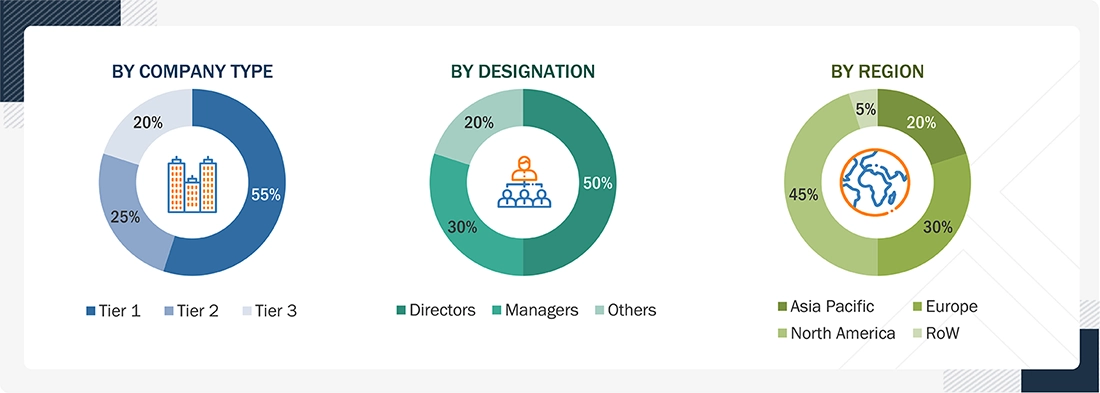
Note: “Others” includes sales, marketing, and product managers
To know about the assumptions considered for the study, download the pdf brochure
Market Size Estimation
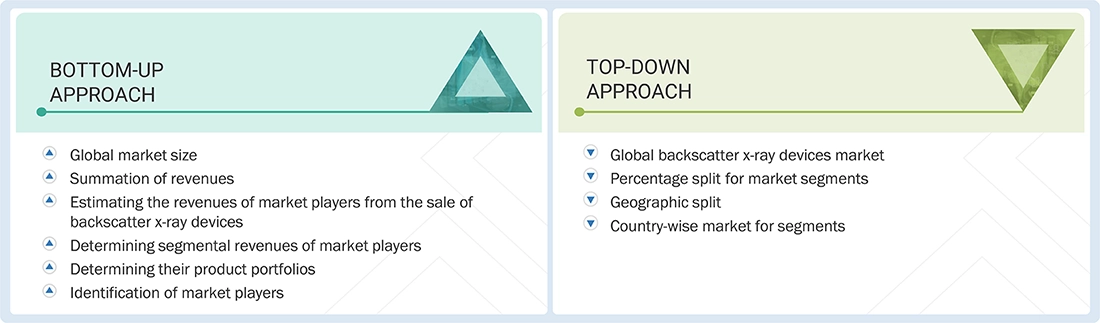
In the market engineering process, both top-down and bottom-up approaches and data triangulation methods have been used to estimate and validate the size of the backscatter x-ray devices market and other dependent submarkets. The research methodology used to estimate the market sizes includes the following:
A bottom-up procedure has been employed to determine the overall size of the backscatter X-ray devices market.
- Major companies that provide backscatter X-ray devices were identified. This included analyzing company portfolios, product offerings, and presence across various regions.
- The segment-specific revenues of the companies, particularly those related to backscatter x-ray devices, were determined.
- The product-specific revenues of the companies, particularly those related to backscatter x-ray devices, were determined.
- These individual revenue figures were compiled to determine the total revenue generated across the identified companies within the sector.
- The global market size for backscatter x-ray devices was obtained using this consolidated data.
The top-down approach has been used to estimate and validate the total size of the backscatter X-ray devices market.
- Identified top-line investments and spending in the ecosystem and major market developments to consider segment-level splits
- Estimated the overall backscatter x-ray devices market size, then segmented the global market by allocating shares based on the segments considered
- Distributed the segment-level markets into regions and countries by aligning regional backscatter x-ray devices activity with economic indicators, backscatter x-ray devices manufacturing presence, and national development initiatives
Backscatter X-ray Device Market : Top-Down and Bottom-Up Approach
Data Triangulation
After determining the overall market size using the market size estimation processes explained above, the market has been segmented into several segments and subsegments. Data triangulation and market breakdown procedures have been employed to complete the entire market engineering process and determine the exact statistics for each market segment and subsegment. The data has been triangulated by studying various factors and trends from the demand and supply sides of the backscatter X-ray devices market.
Market Definition
The backscatter X-ray devices market involves the development of non-intrusive inspection systems that use low-energy X-rays to detect concealed threats in vehicles, cargo, baggage, and on-person scenarios. These systems provide real-time imaging, which is crucial for border security and law enforcement, enabling the identification of substances such as explosives and narcotics. Backscatter technologies utilize advanced detector arrays, X-ray modules, and automated algorithms for efficient screening, which are deployed at customs, airports, and military bases. The market growth is driven by rising cross-border trade, increasing smuggling, and stricter security regulations. Innovations such as AI-assisted image analysis and portable units enhance detection and operational efficiency, making backscatter X-ray devices essential for reliable security inspections worldwide.
Key Stakeholders
- Backscatter X-ray device manufacturers
- Security screening and imaging technology suppliers
- System integrators and non-intrusive inspection solution providers
- Border security, customs enforcement, and homeland security agencies
- Law enforcement, defense, and military organizations
- Distributors, maintenance, and calibration service providers
- Government procurement agencies and public security departments
Report Objectives
- To define, describe, segment, and forecast the backscatter X-ray devices market size by type, application, mobility, imaging mode, detection mode, component, power range, and region, in terms of value
- To assess the backscatter X-ray devices market size in four key regions: North America, Europe, Asia Pacific, and RoW, in terms of value
- To provide detailed information regarding the key factors such as drivers, restraints, opportunities, and challenges influencing the growth of the market
- To analyze the backscatter X-ray devices value chain and ecosystem, along with the average selling price by product and region
- To strategically study the regulatory landscape, tariff, standards, patents, Porter’s Five Forces, import & export scenarios, trade values, and case studies pertaining to the market under study
- To understand micromarkets with regard to individual growth trends, prospects, and contributions to the overall market
- To assess opportunities in the market for stakeholders by identifying high-growth segments
- To provide details of the competitive landscape for market leaders
- To offer the impact of AI/Gen AI on the backscatter X-ray devices market
- To outline the macroeconomic outlook for the regions under study
- To analyze strategies such as product launches, collaborations, acquisitions, and partnerships adopted by players in the backscatter X-ray devices market
- To profile key market players and comprehensively analyze their ranking based on their revenue, market share, and core competencies
Customization Options:
With the given market data, MarketsandMarkets offers customizations according to the specific requirements of companies. The following customization options are available for the report:
Country-wise Information:
- Country-wise breakdown for North America, Europe, Asia Pacific, and the Rest of the World
Company Information:
- Detailed analysis and profiling of additional market players (up to five)
Get the Full Backscatter X-ray Device Market Report
Full forecast, segment splits, and company analysis for all Backscatter X-ray Device Market.
- Netherlands Backscatter X-ray Device Market
- Belgium Backscatter X-ray Device Market
- China Backscatter X-ray Device Market
- Japan Backscatter X-ray Device Market
- India Backscatter X-ray Device Market
- South Korea Backscatter X-ray Device Market
- Australia Backscatter X-ray Device Market
- Nordic Countries Backscatter X-ray Device Market
- Rest Of Europe Backscatter X-ray Device Market
- US Backscatter X-ray Device Market
- Canada Backscatter X-ray Device Market
- Mexico Backscatter X-ray Device Market
- Germany Backscatter X-ray Device Market
- UK Backscatter X-ray Device Market
- France Backscatter X-ray Device Market
- Spain Backscatter X-ray Device Market
- Italy Backscatter X-ray Device Market
Need a Tailored Report?
Customize this report to your needs
Get 10% FREE Customization
Customize This Report
