
Europe Battery Manufacturing Equipment Market (2025-2030)

The Europe Battery Manufacturing Equipment Market was valued at $213.9 Million in 2025 and projected to reach to $414.2 Million by 2030, representing a compound annual growth rate of 14.1%. Europe's battery manufacturing equipment market is poised for sustained expansion through 2030, driven by aggressive electrification targets and regulatory mandates.


| Market Size in | USD 26.32 MN |
| Market Forecast in | |
| CAGR | |
| Forecast Period | |
| Units Considered | Value (USD MN) |
Europe Battery Manufacturing Equipment Market Trends and Insights
- This expansion reflects Europe's strategic commitment to electrification and renewable energy adoption, driven by stringent EU regulations and substantial investments in EV production capacity.
- Europe is positioning itself as a critical hub for battery technology innovation and manufacturing, with major automotive and energy storage players establishing advanced production facilities across the region. The 14.1% compound annual growth rate (CAGR) through 2030 underscores Europe's accelerating demand for sophisticated manufacturing equipment, including cell assembly lines, electrode coating systems, and thermal management solutions.
- Europe's market growth is supported by government incentives, green industrial policies, and the continent's transition toward carbon neutrality.
- Key European nations are investing heavily in domestic battery supply chains to reduce dependence on imports and strengthen competitive positioning in the global EV market..
Key Market Statistics
- CAGR (2025-2030) 14.1% CAGR
- Market Size, 2025 ~USD 213.9 Million
- Forecast, 2030 ~USD 414.2 Million
- Geography Europe
Europe Battery Manufacturing Equipment Market Overview
Market Valuation & Growth :
Europe's battery manufacturing equipment market is valued at $213.9 million in 2025, with a robust CAGR of 14.1% projected through 2030, reaching $414.2 million. This growth significantly outpaces global average expansion rates in adjacent sectors.
EU Regulatory Drivers :
Stringent EU regulations on emissions and battery sustainability are accelerating demand for advanced manufacturing equipment. The European Green Deal and Battery Regulation framework mandate increased domestic production capacity, directly boosting equipment investments across member states.
EV Production Expansion :
Europe's commitment to electrification is driving substantial investments in EV production facilities. Major automotive manufacturers are establishing gigafactories across the continent, creating unprecedented demand for specialized battery manufacturing equipment and automation solutions.
Regional Hub Positioning :
Europe is establishing itself as a critical global hub for battery manufacturing, competing with Asia-Pacific markets. Strategic investments in supply chain localization and technological innovation position the region as a key player in the global battery equipment ecosystem.
Europe Battery Manufacturing Equipment Market Dynamics
- The region's focus on achieving carbon neutrality by 2050 necessitates rapid scaling of domestic battery production capacity, directly translating to equipment demand.
- Investment in advanced automation, thermal management systems, and quality control technologies will remain critical growth drivers. The competitive landscape is intensifying as European manufacturers seek to reduce dependency on Asian suppliers and establish technological leadership.
- Government incentives, including subsidies for battery gigafactories and R&D funding, will continue to stimulate market growth.
- Strategic partnerships between equipment manufacturers and automotive OEMs are expected to accelerate innovation cycles and market penetration across Germany, Poland, Hungary, and emerging manufacturing hubs..
Market Ecosystem
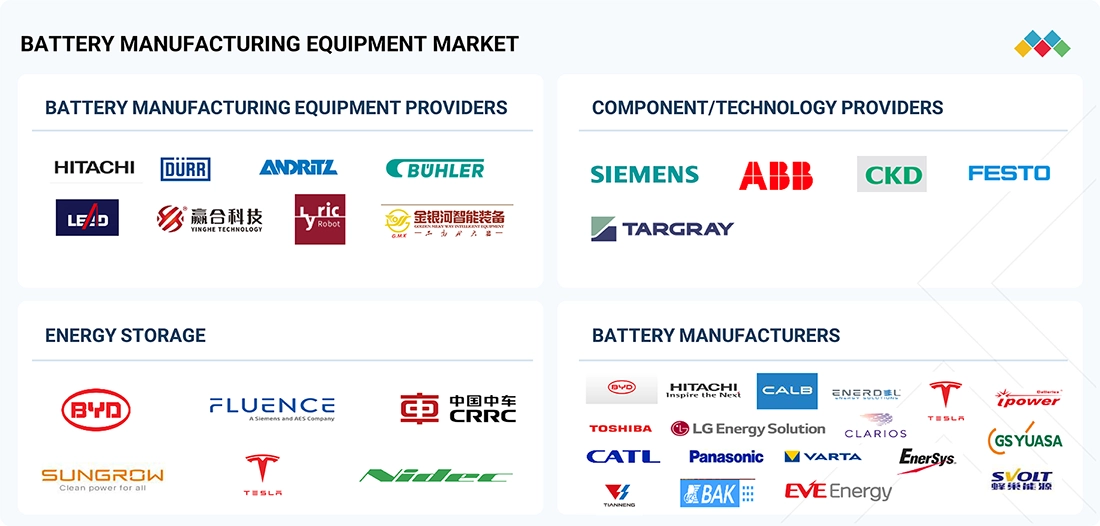
battery-production-machine-market: COMMERCIAL USE CASES ACROSS INDUSTRIES
| COMPANY | USE CASE DESCRIPTION | BENEFITS |
|---|---|---|
 |
Hitachi High-Tech’s equipment portfolio, comprising Li-ion battery assembling machines, electrode stacking systems, roll coaters, and slitting machines, enables high-precision electrode production and final cell assembly under controlled dry room environments. | Enhances production precision and efficiency, ensures safety and quality consistency, and supports sustainable operations through NMP recovery and advanced environmental control systems. |
 |
Dürr provides turnkey solutions including slurry mixing and fluid delivery, coating, calendering, drying, and cell finishing systems. Its integrated solvent recovery systems and automation platforms streamline the full battery manufacturing value chain. | Improves process automation and scalability, reduces NMP emissions by over 99%, and enhances energy efficiency while maintaining superior coating and formation quality for lithium-ion batteries. |
 |
Lead Intelligent delivers lithium-ion battery manufacturing systems encompassing slurry mixing, electrode making, cell assembly, formation, coating, and module/pack assembly—supported by proprietary feedback and cell testing software. | Enables large-scale gigafactory automation, reduces energy consumption, and enhances throughput and reliability across pilot and mass-production battery lines. |
 |
ANDRITZ Schuler offers comprehensive solutions for cathode active material production, electrode calendering, cell assembly, and finishing. Its modular roll-to-roll and laser-based notching systems deliver high-speed, precision-driven cell manufacturing. | Supports high-efficiency and flexible production, enhances coating and calendering uniformity, and enables circular manufacturing through integrated solvent recovery and recycling technologies. |
 |
Yinghe’s product line spanning coating, calendering, slitting, winding, stacking, and assembly line systems—provides complete automation for lithium-ion battery production with integrated control for precision and consistency. | Boosts production flexibility, enhances automation scalability, reduces operational costs, and ensures consistent cell quality across high-volume manufacturing. |
Logos and trademarks shown above are the property of their respective owners. Their use here is for informational and illustrative purposes only.
Related Ecosystem
Electric Hybrid Vehicles
- Battery Electric Vehicle (BEV)
- Fuel Cell Electric Vehicle (FCEV)
- Light Commercial Vehicles (LCVs)
- Hybrid Electric Vehicle (HEV)
- Agricultural Tractors
- Visteon Corporation
- BOSCH LIMITED
- Byd company ltd.
- Tesla, Inc.
- FORD MOTOR COMPANY
Battery And Wireless Charging
- Nickel-Cadmium Battery
- Battery Electric Vehicle (BEV)
- Energy Harvesting
- Hybrid Electric Vehicle (HEV)
- Smart Cards
- Panasonic Holdings Corporation
- MOMENTIVE PERFORMANCE MATERIALS INC.
- Lg corp
- FDK Corporation
- EnerSys
Electronics System And Components
- Sensors
- Temperature Sensors
- Pressure Sensors
- Actuators
- Image Sensors
- Lenovo
- Samsung
- Texas Instruments Incorporated
- HONEYWELL INTERNATIONAL INC.
- Teledyne Technologies Incorporated
Key Takeaways
- Europe's battery manufacturing equipment market will nearly double from $213.9M (2025) to $414.2M (2030), reflecting strong regional demand for EV and energy storage solutions.
- The 14.1% CAGR in Europe demonstrates faster growth momentum than many mature markets, driven by EU green policies and automotive electrification mandates.
- Europe is establishing itself as a strategic manufacturing hub, with investments in advanced equipment for cell production, assembly, and quality control systems.
- Government support through subsidies, regulatory frameworks, and supply chain initiatives is accelerating equipment adoption across Europe's battery production ecosystem.
Battery Manufacturing Equipment Market Report Scope
| Report Metric | Details |
|---|---|
| Base Year | 2025 |
| Fastest Growing Segment | FORMATION & TESTING MACHINES (Machine Type) |
| Forecast Period | 2025–2030 |
| Growth Rate | CAGR of 18.8% from 2025 to 2030 |
| Largest Segment | FORMATION & TESTING MACHINES (Machine Type) |
| Market Size Base Year (Billions) | ~USD 15.61 (2025) |
| Revenue Forecast (Billions) | ~USD 36.94 (2030) |
| Segments Covered | Machine Type, Battery Type, Application |
Europe Battery Manufacturing Equipment Market Report Segmentation
3 segment dimensions are covered across the global market.
By Machine Type
- Assembling & Handling Machines
- Calendering Machines
- Coating & Drying Machines
- Electrode Stacking Machines
- Formation & Testing Machines
- Mixing Machines
- Slitting Machines
By Battery Type
- Lco
- Lfp
- Lmo
- Lto
- Nca
- Nmc
By Application
- Automotive
- Consumer Electronics
- Industrial
- Renewable Energy
EUROPE: BATTERY MANUFACTURING EQUIPMENT MARKET, BY APPLICATION, 2025–2030
| Segment | 2025 | 2026 | 2027 | 2028 | 2029 | 2030 | CAGR (%) |
|---|---|---|---|---|---|---|---|
| AUTOMOTIVE | 2284.6 | 2743.9 | 3289.5 | 3936.5 | 4702.5 | 5607.8 | 19.7 |
| CONSUMER ELECTRONICS | 254.2 | 283.8 | 315.8 | 350.3 | 387.3 | 426.8 | 10.9 |
| INDUSTRIAL | 161.5 | 185.5 | 212.6 | 243.4 | 278.4 | 318.1 | 14.5 |
| OTHERS | 237.9 | 263 | 290.7 | 321.2 | 354.8 | 391.7 | 10.5 |
| RENEWABLE ENERGY | 447.5 | 521.4 | 606.3 | 703.8 | 815.5 | 943.1 | 16.1 |
| TOTAL | 3385.6 | 3997.5 | 4714.9 | 5555.3 | 6538.6 | 7687.6 | 17.8 |
Target Audience
- Equipment Manufacturers : Battery manufacturing equipment suppliers need detailed European market data to identify growth regions, assess competitive positioning, and develop localized product strategies aligned with regional regulatory requirements and customer preferences.
- Automotive OEMs & Tier-1 Suppliers : EV manufacturers and battery suppliers require market intelligence on equipment availability, technological capabilities, and supply chain options to optimize gigafactory investments and production scaling across European locations.
- Private Equity & Investors : Investment firms evaluating opportunities in battery manufacturing infrastructure need comprehensive market sizing, growth projections, and regional performance data to assess portfolio companies and identify acquisition targets in Europe.
- Government & Policy Bodies : EU and national government agencies developing industrial policy and subsidy programs require market data to allocate resources effectively, support domestic manufacturing capabilities, and achieve electrification and sustainability targets.
- Technology & Consulting Firms : Strategy consultants and technology providers advising battery manufacturers need detailed European market insights to develop client recommendations, identify partnership opportunities, and guide technology adoption decisions.
Key Companies in the Europe Battery Manufacturing Equipment Market
| Company | HQ | Ownership | Strongest segments |
|---|---|---|---|
| WUXI LEAD INTELLIGENT EQUIPMENT CO., LTD. | China | Public Company | Lithium-ion battery intelligent equipment,Solid-state battery intelligent equipment,PV intelligent equipment, |
| HITACHI | Japan | Public Company | Digital Systems & Services (IT, cloud, integration, ATMs),Green Energy & Mobility (power grids, energy, rail),Connective Industries (industrial automation, e-mobility, elevators), |
| HITACHI HIGH-TECH CORPORATION | Japan | Private Company | Analytical & Medical Solutions,Nano-Technology Solutions (CD-SEM, dry etch, inspection),Industrial Solutions (infrastructure, energy, control systems), |
| DüRR GROUP | Germany | Public Company | Automotive paint shops and final assembly systems,Industrial automation, testing, and battery production technology,DXQ software, analytics, and services, |
| LEAD INTELLIGENT EQUIPMENT CO., LTD. | China | Public Company | Lithium-ion battery intelligent equipment,Solid-state battery intelligent equipment,Photovoltaic (PV) intelligent equipment, |
| ANDRITZ SCHULER GMBH | Germany | Private Company | Automotive presses and press lines,Hydraulic presses and forging/pipe systems,High-speed presses and specialized systems, |
| YINGHE TECHNOLOGY CO., LTD. | China | Public Company | Cell production lines (coating, calendaring, slitting, winding/stacking),Formation, aging, and testing equipment,Pack/Module assembly and automation systems, |
| NORDSON CORPORATION | United States | Public Company | Industrial Precision Solutions,Medical and Fluid Solutions,Advanced Technology Solutions, |
| CKD CORPORATION | Japan | Public Company | Pneumatic actuators and cylinders,Valves and fluid control (including refining, pressure, and special gas components),Electric and direct-drive actuators, |
| DAIICHI JITSUGYO CO., LTD. | Japan | Public Company | Plant & process machinery (natural resources, petroleum, chemicals, pulp),Decarbonization, renewable energy, and next-generation batteries,Industrial machinery (home appliances, OA, food packaging, medical, housing), |
| FOSHAN GOLDEN MILKY WAY INTELLIGENT EQUIPMENT CO., LTD. | China | Public Company | Lithium battery pulping and related energy equipment,Silicone material equipment (HTV, LSR, electronic glue),Fine chemical equipment and new chemical materials, |
| HIRANO TECSEED CO., LTD | Japan | Public Company | Optical function film and electronic material coating lines,Battery electrode coating lines,Adhesive, release film/paper, and hot-melt coating lines, |
WUXI LEAD INTELLIGENT EQUIPMENT CO., LTD.
Wuxi Lead Intelligent Equipment Co., Ltd. is a Chinese public company founded in 2002 with 15,173 employees, specializing in intelligent equipment manufacturing.
HITACHI
Hitachi is a Japanese multinational public company founded in 1910 with 287,901 employees, operating across diverse industrial and technology sectors.
HITACHI HIGH-TECH CORPORATION
Hitachi High-Tech Corporation is a Japanese private company established in 1947 with 11,482 employees, providing advanced technology and equipment solutions.
DüRR GROUP
Dürr Group is a German public company founded in 1895 with 17,731 employees, specializing in machinery and equipment manufacturing.
LEAD INTELLIGENT EQUIPMENT CO., LTD.
Lead Intelligent Equipment Co., Ltd. is a Chinese public company founded in 2002 with 15,173 employees, focused on intelligent equipment production.
ANDRITZ SCHULER GMBH
Andritz Schuler GmbH is a German private company established in 1839 with 6,276 employees, operating in industrial machinery and equipment manufacturing.
YINGHE TECHNOLOGY CO., LTD.
Yinghe Technology Co., Ltd. is a Chinese public company founded in 2006 providing technology solutions and services.
NORDSON CORPORATION
Nordson Corporation is a United States public company founded in 1909 with 8,200 employees, specializing in precision dispensing and coating equipment.
CKD CORPORATION
CKD Corporation is a Japanese public company founded in 1943 with 4,826 employees, manufacturing automation and control equipment.
DAIICHI JITSUGYO CO., LTD.
Daiichi Jitsugyo Co., Ltd. is a Japanese public company established in 1948 with 1,564 employees, operating in industrial manufacturing and services.
FOSHAN GOLDEN MILKY WAY INTELLIGENT EQUIPMENT CO., LTD.
Foshan Golden Milky Way Intelligent Equipment Co., Ltd. is a Chinese public company founded in 2002 with 1,634 employees, manufacturing intelligent equipment solutions.
HIRANO TECSEED CO., LTD
Hirano Tecseed Co., Ltd is a Japanese public company established in 1935 with 417 employees, providing specialized technology and equipment.
Countries within Europe - compare and drill down
| Country | 2025 size (native) |
|---|---|
| Germany | USD 95.4 Million |
| UK | USD 18.9 Million |
| France | USD 10 Million |
| Sweden | USD 4.1 Million |
| Poland | USD 111.7 Million |
| Hungary | USD 154.7 Million |
| Rest Of Europe | USD 19.4 Million |
Country market size visualization
Reasons to Buy this Report
- Regional Market Segmentation : Gain detailed insights into Europe's battery equipment market broken down by country, including Germany, Poland, Hungary, UK, France, and Sweden. Understand market dynamics specific to each region's manufacturing capabilities and regulatory environment.
- Competitive Landscape Analysis : Identify leading equipment manufacturers operating in Europe, their market share, technological capabilities, and strategic positioning. Benchmark your offerings against competitors and identify white-space opportunities across the continent.
- Investment & Growth Opportunities : Discover high-growth markets within Europe where battery manufacturing is accelerating. Understand which countries and regions offer the best ROI potential for equipment suppliers, manufacturers, and technology providers through 2030.
- Regulatory & Policy Insights : Access comprehensive analysis of EU regulations, government incentives, and policy frameworks driving battery equipment demand. Stay informed on compliance requirements and subsidy programs that influence purchasing decisions across European markets.
- Strategic Planning Data : Leverage accurate market forecasts and CAGR projections to inform 5-year strategic plans, capacity investments, and market entry strategies. Make data-driven decisions on resource allocation and geographic expansion priorities within Europe.
Frequently asked questions
What is the current size of Europe's battery manufacturing equipment market?
Europe's battery manufacturing equipment market is valued at $213.9 million in 2025 and is expected to grow to $414.2 million by 2030, representing a 14.1% CAGR.
What factors are driving growth in Europe's battery manufacturing equipment market?
Growth in Europe is driven by EU electrification mandates, EV production expansion, renewable energy adoption, government subsidies, and the need to establish domestic battery supply chains independent of imports.
Which European countries are leading battery manufacturing equipment investments?
Major European nations including Germany, Poland, Sweden, and France are investing significantly in battery production facilities and advanced manufacturing equipment to support their EV and energy storage industries.
What types of equipment are most in demand in Europe's battery manufacturing sector?
Europe's market demand includes cell assembly lines, electrode coating and drying systems, thermal management equipment, quality control systems, and automated packaging solutions for battery production.
How does Europe's battery equipment market growth compare to global trends?
Europe's 14.1% CAGR is competitive with the global 18.8% CAGR, reflecting Europe's mature but rapidly expanding market with strong regulatory support and established manufacturing infrastructure.
RESEARCH METHODOLOGY
The study involved four major activities in estimating the current size of the battery manufacturing equipment market. Exhaustive secondary research has been conducted to gather information on the market, adjacent markets, and the broader landscape of battery manufacturing equipment. These findings, along with assumptions and projections, were validated through primary research involving interviews with industry experts and key stakeholders across the value chain. Both top-down and bottom-up approaches were utilized to estimate the overall market size. Subsequently, market breakdown and data triangulation techniques were applied to determine the sizes of various segments and subsegments. Two key sources, secondary and primary, were leveraged to conduct a comprehensive technical and commercial assessment of the battery manufacturing equipment market.
Secondary Research
Various secondary sources were consulted during the secondary research process to identify and collect relevant information for this study. The secondary sources include annual reports, press releases, and investor presentations of companies; white papers; journals and certified publications; and articles from recognized authors, as well as websites, directories, and databases. Secondary research has been conducted to obtain key information about the industry’s supply chain, the market’s value chain, the total pool of key players, market segmentation according to the industry trends (to the bottom-most level), regional markets, and key developments from market- and technology-oriented perspectives. The secondary data have been collected and analyzed to determine the overall market size, which has been further validated by primary research.
Primary Research
Extensive primary research was conducted after gaining knowledge about the current scenario of the battery manufacturing equipment market through secondary research. Several primary interviews were conducted with experts from the demand and supply sides across four major regions—North America, Europe, Asia Pacific, and RoW. This primary data was collected through questionnaires, emails, and telephonic interviews.
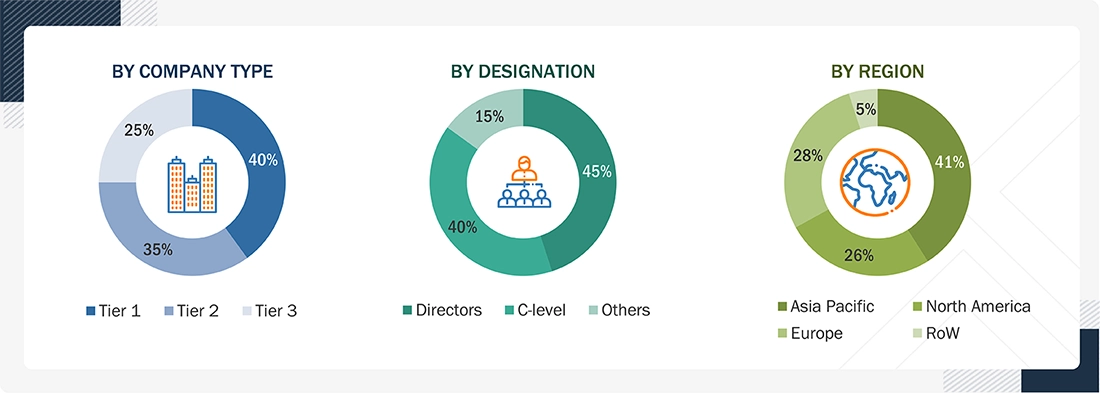
Note: The RoW region includes the Middle East, Africa, and South America. Other designations include product, sales, and marketing managers. The tiers of companies have been defined based on their total revenue as of 2024: Tier 3, with revenue less than USD 300 million; Tier 2, with revenue between USD 300 million and USD 1 billion; and Tier 1, with revenue exceeding USD 1 billion.
To know about the assumptions considered for the study, download the pdf brochure
Market Size Estimation
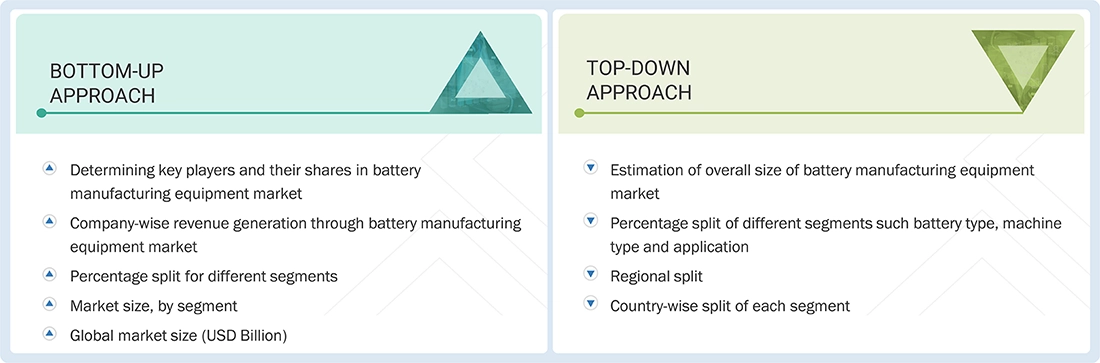
Both top-down and bottom-up approaches have been used to estimate and validate the total size of the battery manufacturing equipment market. These methods have also been extensively used to estimate the size of various market subsegments.
The following research methodology has been used to estimate the market size:
- Major players in the industry and markets have been identified through extensive secondary research.
- The industry’s value chain and market size (in terms of value) have been determined through primary and secondary research processes.
- All percentage shares, splits, and breakdowns have been determined using secondary sources and verified through primary sources.
Battery Manufacturing Equipment Market : Top-Down and Bottom-Up Approach
Data Triangulation
After determining the overall size of the battery manufacturing equipment market through the market size estimation process explained above, the total market has been segmented into several segments and subsegments. Data triangulation and market breakdown procedures have been employed, wherever applicable, to complete the overall market engineering process and arrive at the exact statistics for all segments and subsegments of the market. The data has been triangulated by studying various factors and trends from both the demand and supply sides. Additionally, the market size has been validated using both top-down and bottom-up approaches.
Market Definition
The battery manufacturing equipment market comprises machinery and systems used in the production of battery cells and packs, including mixing machines, coating & drying machines, calendering machines, slitting machines, and electrode stacking machines. These equipment types play a crucial role in ensuring precision, efficiency, and quality across various stages of battery manufacturing. The market primarily serves producers of lithium-ion advanced batteries for applications in automotive, renewable energy, industrial, and consumer electronics sectors. Growing investments in automation, AI-based quality control, and smart manufacturing are transforming production processes, enabling large-scale gigafactory operations and improving yield and consistency. As global electrification accelerates and demand for high-performance energy storage increases, the battery manufacturing equipment market continues to expand, serving as a cornerstone of the sustainable energy ecosystem.
Key Stakeholders
- Government bodies and policymakers
- Industry-standard organizations, forums, alliances, and associations
- Market research and consulting firms
- Raw material suppliers and distributors
- Research institutes and organizations
- Battery manufacturing equipment suppliers
- Battery cell and battery pack manufacturers
- Testing, inspection, and certification providers
- Distributors and resellers
- End users
Report Objectives
- To describe and forecast the size of the battery manufacturing equipment market based on battery type, machine type, application, and region.
- To study and forecast the size of the market based on region: North America, Europe, Asia Pacific, and the Rest of the World (RoW), along with their respective countries
- To provide detailed information on the drivers, restraints, opportunities, and challenges influencing market growth
- To define, describe, and forecast the battery production machine market, based on volume
- To provide ecosystem analysis, case study analysis, patent analysis, technology analysis, value chain analysis, trends/disruptions impacting customers' business, the impact of AI/generative AI, key conferences & events, pricing analysis, Porter’s five forces analysis, and regulations pertaining to the market under study
- To strategically analyze micromarkets with respect to individual growth trends, prospects, and contributions to the overall market size
- To study the complete value chain of the battery production machine market
- To strategically profile the key players and comprehensively analyze their market positions in terms of their ranking and core competencies, along with a detailed market competitive landscape
- To analyze competitive developments, such as product launches, agreements, contracts, collaborations, and partnerships, in the market
Customization Options
With the given market data, MarketsandMarkets offers customizations according to the company’s specific needs. The following customization options are available for the report:
Company Information:
- Detailed analysis and profiling of additional market players (up to 5)
Get the Full Battery Manufacturing Equipment Market Report
Full forecast, segment splits, and company analysis for all Battery Manufacturing Equipment Market.
- Poland Battery Manufacturing Equipment Market
- Hungary Battery Manufacturing Equipment Market
- Rest Of Europe Battery Manufacturing Equipment Market
- China Battery Manufacturing Equipment Market
- Japan Battery Manufacturing Equipment Market
- South Korea Battery Manufacturing Equipment Market
- Australia Battery Manufacturing Equipment Market
- Rest Of Asia Pacific Battery Manufacturing Equipment Market
- US Battery Manufacturing Equipment Market
- Canada Battery Manufacturing Equipment Market
- Mexico Battery Manufacturing Equipment Market
- Germany Battery Manufacturing Equipment Market
- UK Battery Manufacturing Equipment Market
- France Battery Manufacturing Equipment Market
- Sweden Battery Manufacturing Equipment Market
Need a Tailored Report?
Customize this report to your needs
Get 10% FREE Customization
Customize This Report
