
Asia Pacific Battery Separators Market (2023-2028)

The Asia Pacific Battery Separators Market was valued at $3236.4 Million in 2023 and projected to reach to $6573.1 Million by 2028, representing a compound annual growth rate of CAGR 15.2%. Asia Pacific's battery separators market is poised for exceptional growth, expanding from $3,236.4 million in 2023 to $6,573.1 million by 2028, representing a robust 15.2% CAGR.


| Market Size in | USD 26.32 MN |
| Market Forecast in | |
| CAGR | |
| Forecast Period | |
| Units Considered | Value (USD MN) |
Asia Pacific Battery Separators Market Trends and Insights
- In 2023, Asia Pacific's battery separators market was valued at $3,236.4 million, driven by surging demand from lithium-ion battery production across China, Japan, South Korea, and India.
- Asia Pacific is projected to expand significantly, reaching $6,573.1 million by 2028, reflecting a compound annual growth rate of 15.2% as regional economies accelerate electrification and renewable energy adoption. The Asia Pacific region benefits from established battery manufacturing ecosystems, government incentives for EV adoption, and substantial investments in battery technology infrastructure.
- Asia Pacific's growth trajectory outpaces many global regions due to the concentration of major battery producers and the region's leadership in electric vehicle sales.
- Between 2023 and 2028, Asia Pacific will continue to capture the largest share of global battery separator demand, supported by expanding production capacities and rising consumer adoption of electric vehicles and energy storage systems..
Key Market Statistics
- CAGR (2023-2028) CAGR 15.2%
- Market Size, 2023 ~USD 3236.4 Million
- Forecast, 2028 ~USD 6573.1 Million
- Geography Asia Pacific
Asia Pacific Battery Separators Market Overview
China's Manufacturing Dominance :
China commands the largest share of Asia Pacific's battery separators market at $2,418.9 million in 2023, driven by its position as the world's leading EV manufacturer and lithium-ion battery producer. The country's vertically integrated supply chain and government incentives for clean energy accelerate separator demand.
India's Rapid Growth Trajectory :
India's battery separators market reached $1,243.5 million in 2023, positioning it as the second-largest market in Asia Pacific. Government initiatives like the Production-Linked Incentive (PLI) scheme and domestic EV adoption are fueling exponential growth in separator manufacturing capacity.
Japan's Advanced Technology Hub :
Japan's market valued at $1,024.4 million reflects its role as a technology leader in separator innovation and high-performance battery materials. Japanese manufacturers focus on premium separators for automotive and energy storage applications across the region.
Taiwan and Malaysia's Strategic Positioning :
Taiwan ($864.6 million) and Malaysia ($733 million) serve as critical manufacturing and supply chain hubs for battery separators in Asia Pacific. Their strategic locations and established semiconductor/electronics infrastructure support rapid scaling of separator production.
Asia Pacific Battery Separators Market Dynamics
- This expansion is underpinned by China's continued EV dominance, India's emerging battery manufacturing ecosystem, and Japan's technological leadership in separator materials.
- The region benefits from favorable government policies, increasing EV adoption rates, and substantial investments in energy storage infrastructure. The forecast period will witness intensified competition among regional manufacturers and new entrants seeking to capitalize on the growing demand for lithium-ion batteries.
- Supply chain consolidation, technological advancements in separator porosity and thermal stability, and strategic partnerships between battery makers and separator manufacturers will shape market dynamics.
- Asia Pacific's position as the global epicenter for battery production ensures sustained demand growth through 2028..
Market Ecosystem
Related Ecosystem
Membranes
- Reverse Osmosis
- Acetone
- Acrylonitrile Butadiene Styrene (ABS)
- Bioremediation
- Cartridge Filters
- Veolia
- Toray Industries, Inc.
- PALL CORPORATION
- DuPont de Nemours, Inc.
- Pentair plc
Battery And Wireless Charging
- Nickel-Cadmium Battery
- Battery Electric Vehicle (BEV)
- Energy Harvesting
- Hybrid Electric Vehicle (HEV)
- Smart Cards
- Panasonic Holdings Corporation
- MOMENTIVE PERFORMANCE MATERIALS INC.
- Lg corp
- FDK Corporation
- Samsung
Equipment Machine And Tooling
- Wastewater Treatment
- Air Cooled Heat Exchangers
- Diaphragm Pumps
- Fiberglass
- HVAC System
- Alfa Laval Corporate AB
- Johnson Controls International plc
- Veolia
- Daikin Industries,Ltd.
- Carrier Global Corporation
Key Takeaways
- Asia Pacific battery separators market valued at $3,236.4 million in 2023 with projected growth to $6,573.1 million by 2028.
- Asia Pacific maintains a 15.2% CAGR, driven by EV electrification and lithium-ion battery manufacturing expansion across the region.
- Asia Pacific's dominance stems from major battery producers in China, Japan, and South Korea and strong government EV incentives.
- Asia Pacific is expected to remain the largest regional market through 2028, supported by renewable energy storage demand and supply chain consolidation.
Battery Separators Market Report Scope
| Report Metric | Details |
|---|---|
| Base Year | 2023 |
| Fastest Growing Segment | SALT LAKE BRINE (Source) |
| Forecast Period | 2023-2028 |
| Growth Rate | CAGR of 15.7% from 2023 to 2028 |
| Largest Segment | DRY BATTERY SEPARATOR (Technology) |
| Market Size Base Year (Billions) | ~USD 6.27 (2023) |
| Revenue Forecast (Billions) | ~USD 13 (2028) |
| Segments Covered | Battery Type, Material, Technology, End-Use Industry, Source |
Asia Pacific Battery Separators Market Report Segmentation
5 segment dimensions are covered across the global market.
By Battery Type
- Lead-Acid
- Lithium-Ion
- Other Battery Types
- Others Battery Types
By Material
- Other Materials
- Others Materials
- Polyethylene
- Polypropylene
By Technology
- Dry Battery Separator
- Wet Battery Separator
By End-Use Industry
- Automotive
- Consumer Electronics
- Industrial
- Othe End-Use Industries
- Other End-Use Industries
By Source
- Lithium Ores
- Salt Lake Brine
Target Audience
- Battery & EV Manufacturers : Manufacturers in Asia Pacific need detailed separator market data to optimize sourcing strategies, negotiate supplier contracts, and plan capacity investments. Country-level insights enable informed decisions on production location selection and supply chain diversification.
- Separator Material Producers : Separator manufacturers require granular regional and country-level market intelligence to identify growth opportunities, assess competitive positioning, and develop targeted expansion strategies across Asia Pacific's diverse markets.
- Energy Storage & Grid Companies : Energy storage solution providers need Asia Pacific market data to understand separator demand trends, plan battery system deployments, and identify regional supply chain partners for stationary and grid-scale applications.
- Investment & Private Equity Firms : Investors evaluating opportunities in Asia Pacific's battery ecosystem require detailed market sizing, growth forecasts, and country-specific dynamics to assess valuations, identify acquisition targets, and structure investment theses.
- Supply Chain & Logistics Providers : Logistics and supply chain companies need regional market intelligence to optimize distribution networks, plan warehouse locations, and anticipate demand patterns across Asia Pacific's key battery manufacturing hubs.
Countries within Asia Pacific - compare and drill down
| Country | 2025 size (native) |
|---|---|
| China | USD 2418.9 Million |
| India | USD 1243.5 Million |
| Japan | USD 1024.4 Million |
| Taiwan | USD 864.6 Million |
| Malaysia | USD 733 Million |
| South Korea | USD 186.1 Million |
Country market size visualization
Reasons to Buy this Report
- Regional Market Sizing & Forecasts : Obtain precise market valuations for Asia Pacific ($3,236.4M in 2023) and country-level breakdowns including China, India, Japan, Taiwan, and Malaysia. Access detailed 5-year forecasts to 2028 with granular CAGR analysis specific to the region.
- Country-Specific Growth Drivers : Understand unique market dynamics across Asia Pacific nations—from China's EV manufacturing scale to India's emerging battery ecosystem and Japan's advanced separator technology. Identify which countries offer the highest growth potential for your business expansion.
- Competitive Landscape Intelligence : Gain insights into regional manufacturer strategies, supply chain positioning, and competitive advantages across Asia Pacific. Benchmark your operations against market leaders in China, Japan, and emerging players in India and Southeast Asia.
- Investment & Partnership Opportunities : Identify high-potential markets and strategic partnership locations within Asia Pacific. Leverage country-level market data to prioritize investments in manufacturing facilities, R&D centers, or distribution networks across the region's fastest-growing economies.
- Regulatory & Policy Insights : Access region-specific regulatory frameworks, government incentives (PLI schemes, EV subsidies), and policy trends driving separator demand across Asia Pacific. Make informed decisions aligned with local market conditions and compliance requirements.
Frequently asked questions
What is the current size of the Asia Pacific battery separators market?
In 2023, Asia Pacific's battery separators market was valued at $3,236.4 million, making it the largest regional market globally.
What is the projected market size for Asia Pacific battery separators by 2028?
Asia Pacific's battery separators market is forecast to reach $6,573.1 million by 2028, representing a 15.2% compound annual growth rate.
Which countries drive growth in Asia Pacific's battery separators market?
China, Japan, South Korea, and India are the primary growth drivers in Asia Pacific, supported by large-scale EV manufacturing and battery production facilities.
What factors are accelerating Asia Pacific battery separators demand?
Key drivers include rapid EV adoption, government electrification policies, renewable energy storage expansion, and investments in battery manufacturing infrastructure across Asia Pacific.
How does Asia Pacific's growth compare to the global battery separators market?
Asia Pacific's 15.2% CAGR is competitive with the global 15.7% CAGR, reflecting the region's critical role in the worldwide battery separator supply chain.
RESEARCH METHODOLOGY
The study involved four major activities in estimating the current size of the battery separators market. Exhaustive secondary research was done to collect information on the market, peer markets, and parent market. The next step was to validate these findings, assumptions, and sizing with the industry experts across the battery separators value chain through primary research. Both top-down and bottom-up approaches were employed to estimate the complete market size. Thereafter, market breakdown and data triangulation were used to estimate the market size of segments and subsegments.
Secondary Research
Secondary sources for this research study include annual reports, press releases, and investor presentations of companies; white papers; certified publications; and articles by recognized authors; gold- and silver-standard websites; battery separators manufacturing companies, regulatory bodies, trade directories, and databases. The secondary research was mainly used to obtain key information about the industry’s supply chain, the total pool of key players, market classification, and segmentation according to industry trends to the bottom-most level and regional markets. It has also been used to obtain information about key developments from a market-oriented perspective.
Primary Research
The battery separators market comprises several stakeholders, such as such as raw material suppliers, technology support providers, battery separators manufacturers, and regulatory organizations in the supply chain. Various primary sources from both the supply and demand sides of the market were interviewed to obtain qualitative and quantitative information. Primary sources from the supply side included industry experts such as Chief Executive Officers (CEOs), vice presidents, marketing directors, technology and innovation directors, and related key executives from various key companies and organizations operating in the battery separators market . Primary sources from the demand side included directors, marketing heads, and purchase managers from various sourcing industries. Following is the breakdown of the primary respondents:
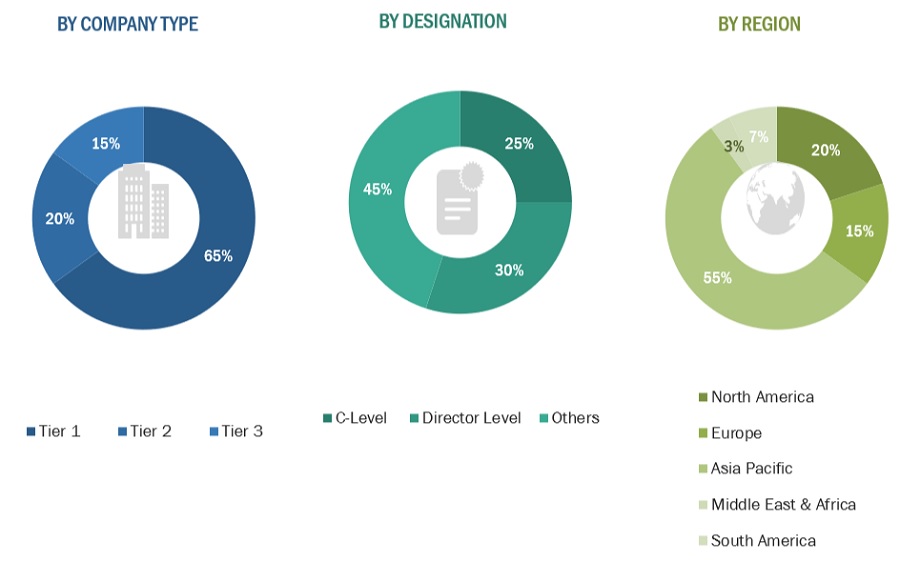
To know about the assumptions considered for the study, download the pdf brochure
Market Size Estimation
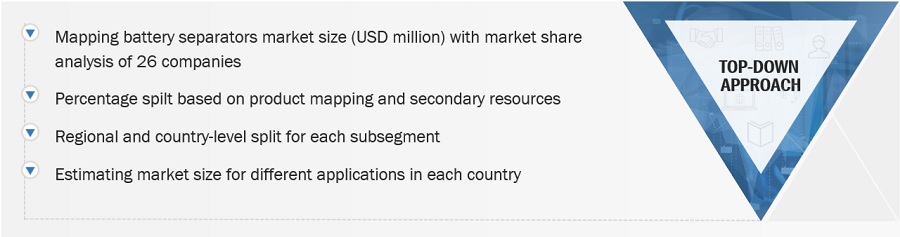
Both the top-down and bottom-up approaches have been used to estimate and validate the total size of the battery separators market. These approaches have also been used extensively to estimate the size of various dependent subsegments of the market. The research methodology used to estimate the market size included the following:
The following segments provide details about the overall market size estimation process employed in this study
- The key players in the market were identified through secondary research.
- The market shares in the respective regions were identified through primary and secondary research.
- The value chain and market size of the battery separators market, in terms of value, were determined through primary and secondary research.
- All percentage shares, splits, and breakdowns were determined using secondary sources and verified through primary sources.
- All possible parameters that affect the market covered in this research study were accounted for, viewed in extensive detail, verified through primary research, and analyzed to obtain the final quantitative and qualitative data.
- The research included the study of annual and financial reports of the top market players and interviews with industry experts, such as CEOs, VPs, directors, sales managers, and marketing executives, for key insights, both quantitative and qualitative.
Global Battery separators market Size: Bottom-Up Approach
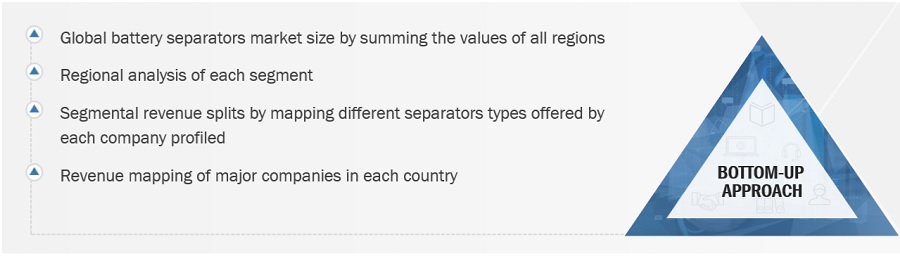
To know about the assumptions considered for the study, Request for Free Sample Report
Global Battery separators market Size: Top-Down Approach
Data Triangulation
After arriving at the overall market size using the market size estimation processes as explained above, the market was split into several segments and sub-segments. To complete the overall market engineering process and arrive at the exact statistics of each market segment and subsegment, the data triangulation and market breakdown procedures were employed, wherever applicable. The data was triangulated by studying various factors and trends from both the demand and supply sides in the oil & gas sector.
Market Definition
According to Hollingsworth & Vose, a battery separator is a polymeric membrane placed between the positively charged anode and the negatively charged cathode. The separators act as isolators. Ions can freely go across separators, but these are not electrically conductive. The main purpose of battery separators is to isolate the negative and positive electrodes. They must obstruct any processes which negatively affect the electrochemical energy efficiency of a battery. This helps in avoiding electrical short circuits while permitting rapid transportation of ionic charge carriers to complete the circuit during the transit of current in an electrochemical cell.
Key Stakeholders
- Raw material manufacturers
- Technology support providers
- Manufacturers of battery separators
- Traders, distributors, and suppliers
- Regulatory Bodies and Government Agencies
- Research & Development (R&D) Institutions
- End-use Industries
- Consulting Firms, Trade Associations, and Industry Bodies
- Investment Banks and Private Equity Firms
Report Objectives
- To analyze and forecast the market size of battery separators market in terms of value
- To provide detailed information regarding the major factors (drivers, restraints, challenges, and opportunities) influencing the regional market
- To analyze and forecast the global battery separators market on the basis of battery type, thickness, type, technology, material, end-use, and region
- To analyze the opportunities in the market for stakeholders and provide details of a competitive landscape for market leaders
- To forecast the size of various market segments based on four major regions: North America, Europe, Asia Pacific, South America, and the Middle East & Africa, along with their respective key countries
- To track and analyze the competitive developments, such as acquisitions, partnerships, collaborations, agreements and expansions in the market
- To strategically profile the key players and comprehensively analyze their market shares and core competencies
Available Customizations
With the given market data, MarketsandMarkets offers customizations according to the client-specific needs.
The following customization options are available for the report:
- Additional country-level analysis of the battery separators market
- Profiling of additional market players (up to 5)
Product Analysis
- Product matrix, which gives a detailed comparison of the product portfolio of each company.
Get the Full Battery Separators Market Report
Full forecast, segment splits, and company analysis for all Battery Separators Market.
- China Battery Separators Market
- South Korea Battery Separators Market
- Japan Battery Separators Market
- India Battery Separators Market
- Taiwan Battery Separators Market
- Malaysia Battery Separators Market
- Canada Battery Separators Market
- Mexico Battery Separators Market
- US Battery Separators Market
- Germany Battery Separators Market
- France Battery Separators Market
- UK Battery Separators Market
- Italy Battery Separators Market
- Spain Battery Separators Market
- Netherlands Battery Separators Market
- Norway Battery Separators Market
- Saudi Arabia Battery Separators Market
- UAE Battery Separators Market
- South Africa Battery Separators Market
- Brazil Battery Separators Market
- Argentina Battery Separators Market
- Rest Of Europe Battery Separators Market
- Rest Of Asia Pacific Battery Separators Market
- Rest Of South America Battery Separators Market
Need a Tailored Report?
Customize this report to your needs
Get 10% FREE Customization
Customize This Report
