
China Battery Separators Market (2023-2028)

The China Battery Separators Market was valued at $1306.9 Million in 2023 and projected to reach to $2418.9 Million by 2028, representing a compound annual growth rate of CAGR 13.1%. China's battery separators market is poised for robust expansion through 2028, driven by the country's aggressive EV adoption targets and government incentives for new energy vehicles.


| Market Size in | USD 26.32 MN |
| Market Forecast in | |
| CAGR | |
| Forecast Period | |
| Units Considered | Value (USD MN) |
China Battery Separators Market Trends and Insights
- The market in China is projected to expand significantly to USD 2,418.9 million by 2028, driven by China's dominance in electric vehicle production and energy storage deployment.
- China's rapid EV adoption and government support for battery technology advancement are accelerating demand for high-performance separators across lithium-ion battery applications. The battery separators market in China reflects the country's strategic focus on energy transition and industrial modernization.
- China's manufacturing capabilities and supply chain integration enable cost-competitive separator production, supporting both domestic consumption and export markets.
- Between 2023 and 2028, China is expected to maintain its leadership position as the world's largest battery separator consumer and producer, with the 13.1% CAGR underscoring sustained investment in battery technology and EV infrastructure..
Key Market Statistics
- CAGR (2023-2028) CAGR 13.1%
- Market Size, 2023 ~USD 1306.9 Million
- Forecast, 2028 ~USD 2418.9 Million
- Country China
China Battery Separators Market Overview
Market Valuation Growth :
China's battery separators market reached USD 1,306.9 million in 2023 and is projected to grow to USD 2,418.9 million by 2028, representing an 85% increase over the forecast period.
EV Production Dominance :
China accounts for over 60% of global electric vehicle production, creating unprecedented demand for battery separators as a critical component in EV battery manufacturing.
Energy Storage Expansion :
Rapid deployment of grid-scale and residential energy storage systems across China is driving incremental demand for high-performance battery separators beyond the automotive sector.
Manufacturing Hub Status :
China's established battery component supply chain and manufacturing infrastructure position it as the world's leading battery separator production and consumption center.
China Battery Separators Market Dynamics
- The 13.1% CAGR reflects sustained investment in battery technology and manufacturing capacity, with domestic producers increasingly competing on innovation and cost efficiency.
- Energy storage systems for renewable integration represent an emerging growth vector alongside traditional automotive applications. The competitive landscape will intensify as Chinese manufacturers scale production to meet both domestic demand and export opportunities.
- Supply chain localization efforts and technological advancements in separator materials will enhance margins and market penetration.
- Strategic partnerships between battery makers and separator producers will accelerate market consolidation, positioning China as the global epicenter for battery component innovation and supply..
Market Ecosystem
Related Ecosystem
Membranes
- Reverse Osmosis
- Acetone
- Acrylonitrile Butadiene Styrene (ABS)
- Bioremediation
- Cartridge Filters
- Veolia
- Toray Industries, Inc.
- PALL CORPORATION
- DuPont de Nemours, Inc.
- Pentair plc
Battery And Wireless Charging
- Nickel-Cadmium Battery
- Battery Electric Vehicle (BEV)
- Energy Harvesting
- Hybrid Electric Vehicle (HEV)
- Smart Cards
- Panasonic Holdings Corporation
- MOMENTIVE PERFORMANCE MATERIALS INC.
- Lg corp
- FDK Corporation
- Samsung
Equipment Machine And Tooling
- Wastewater Treatment
- Air Cooled Heat Exchangers
- Diaphragm Pumps
- Fiberglass
- HVAC System
- Alfa Laval Corporate AB
- Johnson Controls International plc
- Veolia
- Daikin Industries,Ltd.
- Carrier Global Corporation
Key Takeaways
- China's battery separators market reached USD 1,306.9 million in 2023 and is forecast to grow to USD 2,418.9 million by 2028 at a 13.1% CAGR.
- China's electric vehicle production surge and energy storage expansion are primary drivers of separator demand growth through 2028.
- China maintains competitive manufacturing advantages in separator production, supporting both domestic and international battery supply chains.
- Government policies and investments in battery technology innovation position China as the dominant global battery separator market through the forecast period.
Battery Separators Market Report Scope
| Report Metric | Details |
|---|---|
| Base Year | 2023 |
| Fastest Growing Segment | SALT LAKE BRINE (Source) |
| Forecast Period | 2023-2028 |
| Growth Rate | CAGR of 15.7% from 2023 to 2028 |
| Largest Segment | DRY BATTERY SEPARATOR (Technology) |
| Market Size Base Year (Billions) | ~USD 6.27 (2023) |
| Revenue Forecast (Billions) | ~USD 13 (2028) |
| Segments Covered | Battery Type, Material, Technology, End-Use Industry, Source |
China Battery Separators Market Report Segmentation
5 segment dimensions are covered across the global market.
By Battery Type
- Lead-Acid
- Lithium-Ion
- Other Battery Types
- Others Battery Types
By Material
- Other Materials
- Others Materials
- Polyethylene
- Polypropylene
By Technology
- Dry Battery Separator
- Wet Battery Separator
By End-Use Industry
- Automotive
- Consumer Electronics
- Industrial
- Othe End-Use Industries
- Other End-Use Industries
By Source
- Lithium Ores
- Salt Lake Brine
Target Audience
- Battery & EV Manufacturers : Chinese and international battery producers need market intelligence to optimize separator sourcing, negotiate supplier contracts, and plan capacity expansion aligned with EV production growth.
- Battery Separator Producers : Domestic and foreign separator manufacturers require detailed market forecasts and competitive analysis to guide R&D investment, production scaling, and market entry strategies in China.
- Investment & Private Equity Firms : Investors evaluating opportunities in China's battery supply chain need validated market sizing and growth projections to assess portfolio companies and identify acquisition targets.
- Raw Material & Equipment Suppliers : Suppliers of separator materials, production equipment, and related inputs require demand forecasts to align manufacturing capacity and distribution networks with market expansion.
- Strategic Consultants & Analysts : Management consultants and research firms need comprehensive China market data to support client advisory work, competitive benchmarking, and strategic planning initiatives.
Reasons to Buy this Report
- Market Size & Growth Validation : Obtain precise valuation data for China's battery separators market with verified 2023 baseline (USD 1,306.9M) and 2028 forecast (USD 2,418.9M), enabling accurate business planning and investment decisions.
- China-Specific Competitive Intelligence : Understand the competitive dynamics, market share distribution, and strategic positioning of Chinese battery separator manufacturers to identify partnership and acquisition opportunities.
- EV & Energy Storage Demand Drivers : Analyze China's electric vehicle production trends and energy storage deployment patterns to forecast separator demand by application segment and optimize supply chain strategies.
- Regulatory & Policy Insights : Access analysis of Chinese government policies, EV subsidies, and battery technology standards that directly impact market growth and manufacturing requirements.
- Regional Market Segmentation : Leverage China-focused data segmented by province, manufacturer tier, and end-use application to identify high-growth regions and emerging market opportunities within the country.
Frequently asked questions
What was China's battery separators market size in 2023?
China's battery separators market was valued at USD 1,306.9 million in 2023, representing a significant portion of global battery component demand.
What is the projected market size for battery separators in China by 2028?
China's battery separators market is projected to reach USD 2,418.9 million by 2028, reflecting sustained growth in EV and energy storage applications.
What is the CAGR for China's battery separators market?
China's battery separators market is expected to grow at a compound annual growth rate (CAGR) of 13.1% from 2023 to 2028.
What factors are driving growth in China's battery separators market?
Key growth drivers in China include rapid electric vehicle adoption, expanding energy storage capacity, government support for battery technology, and China's position as a global battery manufacturing hub.
Why is China significant in the global battery separators market?
China is the world's largest EV producer and battery manufacturer, making it the dominant consumer and producer of battery separators globally, with substantial export capabilities.
RESEARCH METHODOLOGY
The study involved four major activities in estimating the current size of the battery separators market. Exhaustive secondary research was done to collect information on the market, peer markets, and parent market. The next step was to validate these findings, assumptions, and sizing with the industry experts across the battery separators value chain through primary research. Both top-down and bottom-up approaches were employed to estimate the complete market size. Thereafter, market breakdown and data triangulation were used to estimate the market size of segments and subsegments.
Secondary Research
Secondary sources for this research study include annual reports, press releases, and investor presentations of companies; white papers; certified publications; and articles by recognized authors; gold- and silver-standard websites; battery separators manufacturing companies, regulatory bodies, trade directories, and databases. The secondary research was mainly used to obtain key information about the industry’s supply chain, the total pool of key players, market classification, and segmentation according to industry trends to the bottom-most level and regional markets. It has also been used to obtain information about key developments from a market-oriented perspective.
Primary Research
The battery separators market comprises several stakeholders, such as such as raw material suppliers, technology support providers, battery separators manufacturers, and regulatory organizations in the supply chain. Various primary sources from both the supply and demand sides of the market were interviewed to obtain qualitative and quantitative information. Primary sources from the supply side included industry experts such as Chief Executive Officers (CEOs), vice presidents, marketing directors, technology and innovation directors, and related key executives from various key companies and organizations operating in the battery separators market . Primary sources from the demand side included directors, marketing heads, and purchase managers from various sourcing industries. Following is the breakdown of the primary respondents:
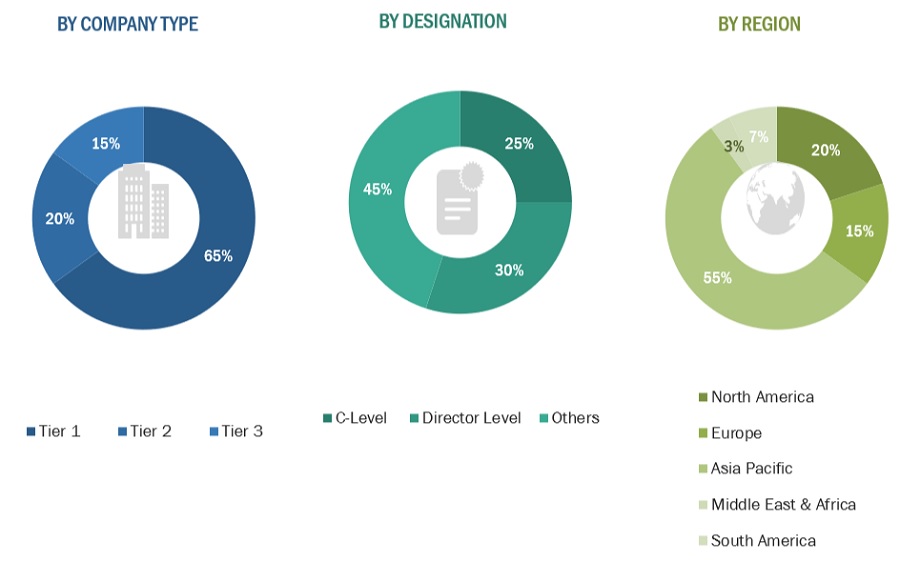
To know about the assumptions considered for the study, download the pdf brochure
Market Size Estimation
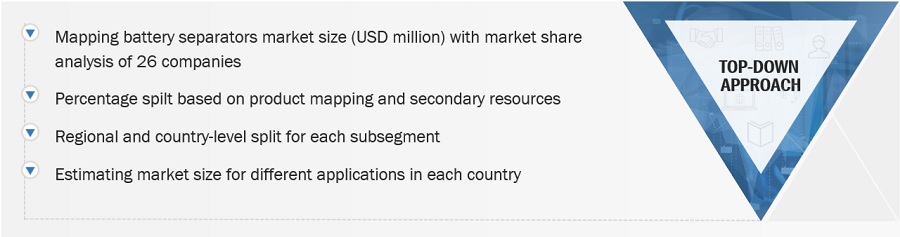
Both the top-down and bottom-up approaches have been used to estimate and validate the total size of the battery separators market. These approaches have also been used extensively to estimate the size of various dependent subsegments of the market. The research methodology used to estimate the market size included the following:
The following segments provide details about the overall market size estimation process employed in this study
- The key players in the market were identified through secondary research.
- The market shares in the respective regions were identified through primary and secondary research.
- The value chain and market size of the battery separators market, in terms of value, were determined through primary and secondary research.
- All percentage shares, splits, and breakdowns were determined using secondary sources and verified through primary sources.
- All possible parameters that affect the market covered in this research study were accounted for, viewed in extensive detail, verified through primary research, and analyzed to obtain the final quantitative and qualitative data.
- The research included the study of annual and financial reports of the top market players and interviews with industry experts, such as CEOs, VPs, directors, sales managers, and marketing executives, for key insights, both quantitative and qualitative.
Global Battery separators market Size: Bottom-Up Approach
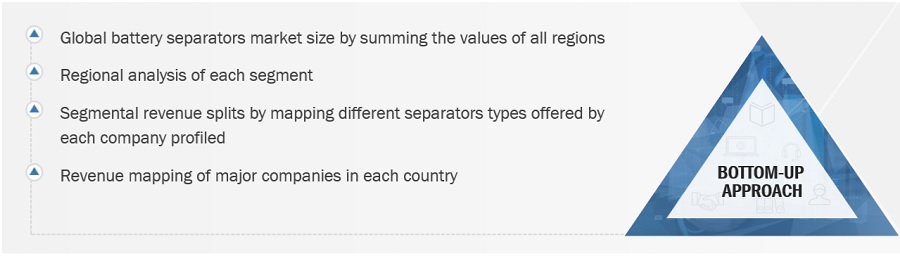
To know about the assumptions considered for the study, Request for Free Sample Report
Global Battery separators market Size: Top-Down Approach
Data Triangulation
After arriving at the overall market size using the market size estimation processes as explained above, the market was split into several segments and sub-segments. To complete the overall market engineering process and arrive at the exact statistics of each market segment and subsegment, the data triangulation and market breakdown procedures were employed, wherever applicable. The data was triangulated by studying various factors and trends from both the demand and supply sides in the oil & gas sector.
Market Definition
According to Hollingsworth & Vose, a battery separator is a polymeric membrane placed between the positively charged anode and the negatively charged cathode. The separators act as isolators. Ions can freely go across separators, but these are not electrically conductive. The main purpose of battery separators is to isolate the negative and positive electrodes. They must obstruct any processes which negatively affect the electrochemical energy efficiency of a battery. This helps in avoiding electrical short circuits while permitting rapid transportation of ionic charge carriers to complete the circuit during the transit of current in an electrochemical cell.
Key Stakeholders
- Raw material manufacturers
- Technology support providers
- Manufacturers of battery separators
- Traders, distributors, and suppliers
- Regulatory Bodies and Government Agencies
- Research & Development (R&D) Institutions
- End-use Industries
- Consulting Firms, Trade Associations, and Industry Bodies
- Investment Banks and Private Equity Firms
Report Objectives
- To analyze and forecast the market size of battery separators market in terms of value
- To provide detailed information regarding the major factors (drivers, restraints, challenges, and opportunities) influencing the regional market
- To analyze and forecast the global battery separators market on the basis of battery type, thickness, type, technology, material, end-use, and region
- To analyze the opportunities in the market for stakeholders and provide details of a competitive landscape for market leaders
- To forecast the size of various market segments based on four major regions: North America, Europe, Asia Pacific, South America, and the Middle East & Africa, along with their respective key countries
- To track and analyze the competitive developments, such as acquisitions, partnerships, collaborations, agreements and expansions in the market
- To strategically profile the key players and comprehensively analyze their market shares and core competencies
Available Customizations
With the given market data, MarketsandMarkets offers customizations according to the client-specific needs.
The following customization options are available for the report:
- Additional country-level analysis of the battery separators market
- Profiling of additional market players (up to 5)
Product Analysis
- Product matrix, which gives a detailed comparison of the product portfolio of each company.
Get the Full Battery Separators Market Report
Full forecast, segment splits, and company analysis for all Battery Separators Market.
- South Korea Battery Separators Market
- Japan Battery Separators Market
- India Battery Separators Market
- Taiwan Battery Separators Market
- Malaysia Battery Separators Market
- Canada Battery Separators Market
- Mexico Battery Separators Market
- US Battery Separators Market
- Germany Battery Separators Market
- France Battery Separators Market
- UK Battery Separators Market
- Italy Battery Separators Market
- Spain Battery Separators Market
- Netherlands Battery Separators Market
- Norway Battery Separators Market
- Saudi Arabia Battery Separators Market
- UAE Battery Separators Market
- South Africa Battery Separators Market
- Brazil Battery Separators Market
- Argentina Battery Separators Market
- Rest Of Europe Battery Separators Market
- Rest Of Asia Pacific Battery Separators Market
- Rest Of South America Battery Separators Market
Need a Tailored Report?
Customize this report to your needs
Get 10% FREE Customization
Customize This Report
