
Asia Pacific Battery Technology Market (2025-2030)

The Asia Pacific Battery Technology Market was valued at $142692.8 Million in 2025 and projected to reach to $256210 Million by 2030, representing a compound annual growth rate of 12.4%. Asia Pacific's battery technology market is positioned for exceptional growth, expanding from $142.7 billion USD in 2025 to $256.2 billion USD by 2030.


| Market Size in | USD 26.32 MN |
| Market Forecast in | |
| CAGR | |
| Forecast Period | |
| Units Considered | Value (USD MN) |
Asia Pacific Battery Technology Market Trends and Insights
- In 2025, Asia Pacific's battery technology market is estimated at $142.7 billion USD, with strong momentum expected through 2030.
- Asia Pacific is projected to reach $256.2 billion USD by 2030, reflecting a compound annual growth rate of 12.4%, outpacing global growth trends. The region's leadership stems from concentrated EV production, renewable energy adoption, and semiconductor manufacturing hubs across China, Japan, South Korea, and India.
- Asia Pacific's battery technology sector benefits from established supply chains, government incentives for clean energy, and massive consumer demand for electric vehicles and energy storage solutions.
- Between 2025 and 2030, Asia Pacific will continue to attract significant capital investment and technological innovation, solidifying its position as the epicenter of global battery technology advancement..
Key Market Statistics
- CAGR (2025-2030) 12.4% CAGR
- Market Size, 2025 ~USD 142692.8 Million
- Forecast, 2030 ~USD 256210 Million
- Geography Asia Pacific
Asia Pacific Battery Technology Market Overview
China's Market Dominance :
China leads Asia Pacific's battery technology market with $168.5 billion USD in 2025, driven by aggressive EV adoption, renewable energy storage expansion, and world-class manufacturing capabilities positioning it as the global battery production hub.
Rapid Electrification Wave :
Asia Pacific is experiencing unprecedented electrification across automotive, consumer electronics, and grid storage sectors. Government incentives and infrastructure investments in China, India, and Japan are accelerating battery technology adoption and localized production.
Strong Regional Growth Trajectory :
With a 12.4% CAGR from 2025 to 2030, Asia Pacific's battery market is expanding faster than many mature regions, driven by rising middle-class demand, manufacturing cost advantages, and strategic supply chain relocations from Western markets.
Emerging Market Opportunities :
India ($11.6 billion) and South Korea ($10.0 billion) represent high-growth opportunities, with India's battery manufacturing initiatives and South Korea's advanced technology leadership creating significant investment and partnership potential.
Asia Pacific Battery Technology Market Dynamics
- This 12.4% CAGR reflects the region's critical role in global electrification, with China's manufacturing dominance complemented by emerging production hubs in India and Southeast Asia.
- Government policies supporting EV adoption, renewable energy integration, and battery recycling infrastructure are accelerating market expansion. The region's competitive advantages—including cost-effective manufacturing, abundant raw material access, and technological innovation—make Asia Pacific the epicenter of global battery technology development.
- Investment in next-generation chemistries, solid-state batteries, and energy storage solutions will drive differentiation.
- Strategic partnerships between regional manufacturers and global OEMs will further consolidate Asia Pacific's position as the world's battery technology leader through 2030..
Market Ecosystem
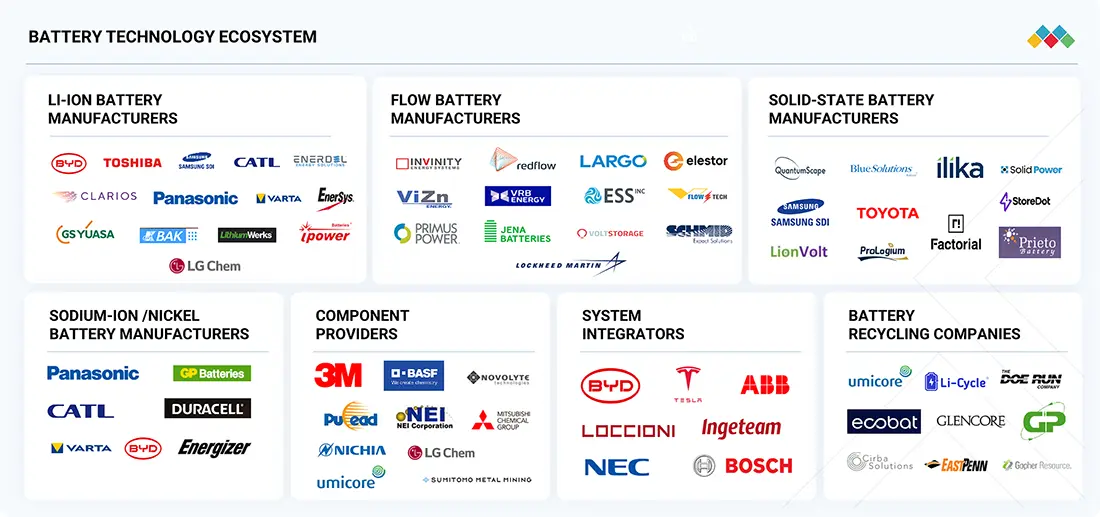
Battery Technology Market SIZE, SHARE & GROWTH, 2030: COMMERCIAL USE CASES ACROSS INDUSTRIES
| COMPANY | USE CASE DESCRIPTION | BENEFITS |
|---|---|---|
 |
Next-generation lithium-ion and sodium-ion batteries for EVs and energy storage systems | Higher energy density, faster charging, wider temperature adaptability, and cost efficiency |
 |
Lithium-ion batteries for electric vehicles, energy storage, and consumer electronics | Extended driving range, stable performance, and improved energy efficiency |
 |
Blade battery technology for electric vehicles and buses | Enhanced safety with reduced fire risk, long lifecycle, and optimized space utilization |
 |
Lithium-ion and NiMH batteries for EVs and hybrid vehicles | High energy density, reliable lifecycle, and versatile solutions for full EVs and hybrids |
 |
Lithium-ion batteries for EVs and electronics; developing solid-state batteries with anode-less designs and solid electrolytes | High energy density, improved safety, extended lifespan, and compact form factor for mobility and storage |
Logos and trademarks shown above are the property of their respective owners. Their use here is for informational and illustrative purposes only.
Related Ecosystem
Battery And Wireless Charging
- Nickel-Cadmium Battery
- Battery Electric Vehicle (BEV)
- Energy Harvesting
- Hybrid Electric Vehicle (HEV)
- Smart Cards
- Panasonic Holdings Corporation
- MOMENTIVE PERFORMANCE MATERIALS INC.
- Lg corp
- FDK Corporation
- Samsung
Key Takeaways
- Asia Pacific battery technology market valued at $142.7B in 2025, growing to $256.2B by 2030 at 12.4% CAGR
- Asia Pacific's growth rate of 12.4% exceeds the global CAGR of 11.4%, indicating regional market acceleration
- Asia Pacific leads globally due to EV production concentration, renewable energy adoption, and established manufacturing ecosystems
- Asia Pacific will capture over 59% of incremental market growth between 2025 and 2030, driven by electrification trends
Battery Technology Market Report Scope
| Report Metric | Details |
|---|---|
| Base Year | 2025 |
| Fastest Growing Segment | ABOVE 500 MAH (Capacity) |
| Forecast Period | 2025-2030 |
| Growth Rate | CAGR of 11.4% from 2025 to 2030 |
| Largest Segment | LITHIUM-ION (Battery Type) |
| Market Size Base Year (Billions) | ~USD 251.6 (2025) |
| Revenue Forecast (Billions) | ~USD 431.65 (2030) |
| Segments Covered | Battery Type, Application, Battery Capacity, Battery Form, Connection Type, Product Type, Type, Capacity, Material |
Asia Pacific Battery Technology Market Report Segmentation
9 segment dimensions are covered across the global market.
By Battery Type
- Flow
- Hybrid
- Lco
- Lead Acid
- Lfp
- Lithium-Ion
- Lmo
- Lto
- Nca
- Nickel Based
- Nmc
- Primary
- Redox
- Secondary
- Sodium-Ion
- Solid State
By Application
- Aerospace & Defense
- Automotive
- Automotive & Transportation
- Commercial
- Commercial & Industrial
- Commercial & Residential
- Consumer Electronics
- Electric Vehicles
- Energy Harvesting
- Energy Storage
- EV Charging Stations
- Evs
- Healthcare
- Industrial
- Marine
- Medical
- Medical Devices
- Other Applications
- Packaging
- Power & Utility
- Residential
- Transportation
- Utilities
- Wireless Sensors
By Battery Capacity
- 50 Kwh To 100 Kwh
- 50-100 Kwh
- <50 Kwh
- > 100 Kwh
- Above 10 Mwh
- Above 100 Kwh
- Above 30 Mwh
- Above 50 Wh
- Below 10 Wh
- Below 30 Kwh
- Below 50 Kwh
- Between 10 And 30 Wh
- Between 10 And 50 Wh
- Between 30 Kwh And 10 Mwh
By Battery Form
- Cylindrical
- Pouch
- Prismatic
By Connection Type
- Off-Grid
- On-Grid
By Product Type
- Cellphones
- Laptops & Tablets
- Wearables
By Type
- Nicd
- Nimh
By Capacity
- 20-500 Mah
- Above 500 Mah
- Below 20 Mah
By Material
- Vanadium
- Zinc Bromine
Target Audience
- Battery Manufacturers & OEMs : Manufacturers need Asia Pacific market intelligence to identify production expansion opportunities, assess regional demand dynamics, and benchmark competitive positioning in the world's fastest-growing battery market.
- EV & Automotive Companies : Automotive OEMs require detailed regional market forecasts and supply chain data to optimize battery sourcing strategies, plan manufacturing investments, and navigate Asia Pacific's electrification acceleration.
- Energy Storage & Renewable Companies : Energy storage providers need Asia Pacific market insights to capitalize on grid storage growth, identify regional partnerships, and develop localized solutions for renewable energy integration.
- Investment & Private Equity Firms : Investors seeking Asia Pacific battery technology exposure require comprehensive market sizing, growth forecasts, and competitive analysis to evaluate investment opportunities and portfolio companies.
- Government & Policy Organizations : Policymakers and government agencies need regional market data to inform battery manufacturing incentives, EV adoption policies, and supply chain resilience strategies across Asia Pacific.
Countries within Asia Pacific - compare and drill down
| Country | 2025 size (native) |
|---|---|
| China | USD 168482.3 Million |
| Japan | USD 12722.9 Million |
| India | USD 11550.4 Million |
| South Korea | USD 9995.6 Million |
| Australia | USD 5335.9 Million |
| Rest Of Asia Pacific | USD 14082.8 Million |
Country market size visualization
Reasons to Buy this Report
- Regional Market Sizing & Forecasts : Obtain precise market valuations for Asia Pacific and individual countries (China, Japan, India, South Korea, Australia) with detailed 2025-2030 projections to support strategic planning and investment decisions.
- Competitive Landscape Analysis : Understand regional competitive dynamics, manufacturing capabilities, and market share distribution across Asia Pacific's battery technology ecosystem to identify partnership and acquisition opportunities.
- Growth Driver Identification : Analyze region-specific electrification trends, government policies, EV adoption rates, and renewable energy investments driving the 12.4% CAGR to capitalize on emerging opportunities.
- Supply Chain & Manufacturing Insights : Access detailed intelligence on Asia Pacific's battery production capacity, raw material sourcing, and manufacturing cost advantages to optimize supply chain strategies and production location decisions.
- Country-Level Deep Dives : Leverage granular market data for China ($168.5B), India ($11.6B), Japan ($12.7B), and South Korea ($10.0B) to tailor market entry strategies and localization approaches for specific geographies.
Frequently asked questions
What is the current size of the Asia Pacific battery technology market?
In 2025, Asia Pacific's battery technology market is estimated at $142.7 billion USD, making it the largest regional market globally.
What is the projected market size for Asia Pacific battery technology by 2030?
Asia Pacific's battery technology market is forecast to reach $256.2 billion USD by 2030, representing significant expansion over the five-year period.
What is the CAGR for Asia Pacific battery technology market?
Asia Pacific's battery technology market is expected to grow at a compound annual growth rate of 12.4% from 2025 to 2030.
Why is Asia Pacific the dominant region for battery technology?
Asia Pacific leads due to concentrated EV manufacturing, renewable energy investments, established supply chains, and strong government support for electrification across major economies like China, Japan, and South Korea.
How does Asia Pacific's growth compare to global battery technology market growth?
Asia Pacific's 12.4% CAGR outpaces the global growth rate of 11.4%, demonstrating the region's accelerating importance in the battery technology sector.
RESEARCH METHODOLOGY
The study involved four major activities in estimating the current size of the battery technology market. Exhaustive secondary research has been conducted to gather information on the market, adjacent markets, and the overall battery technology landscape. These findings and assumptions and projections were validated through primary research involving interviews with industry experts and key stakeholders across the value chain. Both top-down and bottom-up approaches were utilized to estimate the overall market size. Subsequently, market breakdown and data triangulation techniques were applied to determine the sizes of various segments and subsegments. Two key sources, secondary and primary, were leveraged to conduct a comprehensive technical and commercial assessment of the battery technology market.
Secondary Research
Various secondary sources have been referred to in the secondary research process to identify and collect important information for this study. The secondary sources include annual reports, press releases, and investor presentations of companies; white papers; journals and certified publications; and articles from recognized authors, websites, directories, and databases. Secondary research has been conducted to obtain key information about the industry’s supply chain, the market’s value chain, the total pool of key players, market segmentation according to the industry trends (to the bottom-most level), regional markets, and key developments from market- and technology-oriented perspectives. The secondary data has been collected and analyzed to determine the overall market size, further validated by primary research.
Primary Research
Extensive primary research was conducted after gaining knowledge about the current scenario of the battery technology market through secondary research. Several primary interviews were conducted with experts from the demand and supply sides across four major regions—North America, Europe, Asia Pacific and RoW. This primary data was collected through questionnaires, emails, and telephonic interviews.
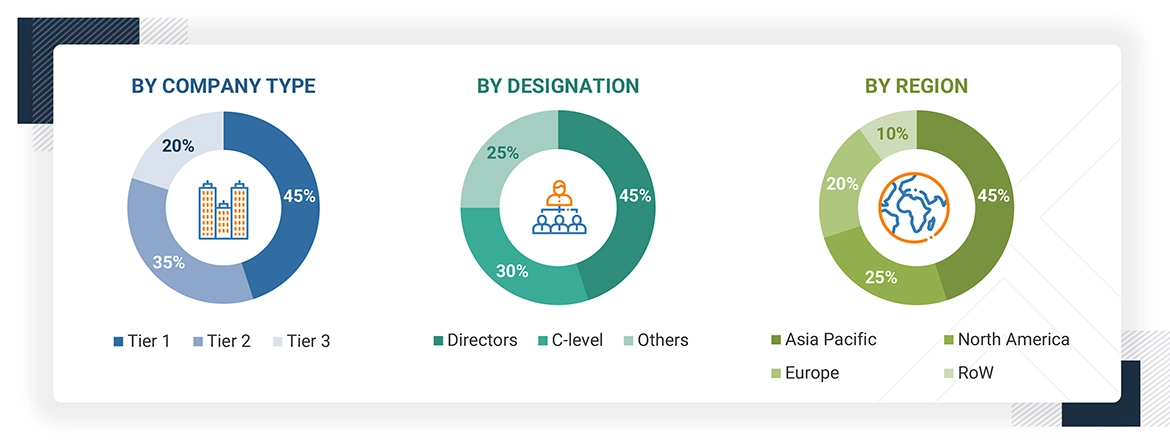
Note: Other designations include sales and product managers. The three tiers of the companies are defined based on their total revenue in 2024: Tier 1 - revenue greater than or equal to USD 5 billion; Tier 2 - revenue between USD 500 million and USD 5 billion; and Tier 3 revenue less than or equal to USD 500 million.
To know about the assumptions considered for the study, download the pdf brochure
Market Size Estimation
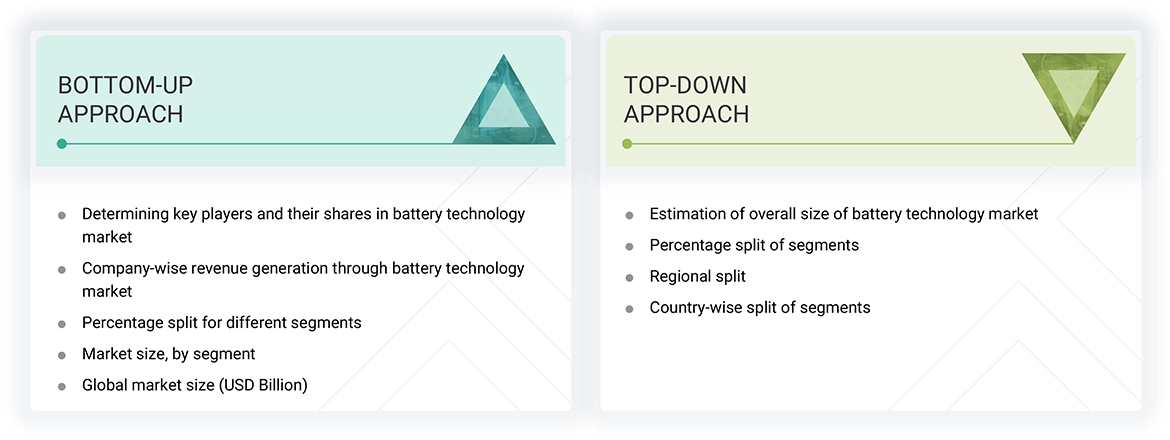
Both top-down and bottom-up approaches have been used to estimate and validate the total size of the battery technology market. These methods have also been used extensively to estimate the size of various subsegments in the market. The following research methodology has been used to estimate the market size:
- Major players in the industry and markets have been identified through extensive secondary research.
- The industry’s value chain and market size (in terms of value) have been determined through primary and secondary research processes.
- All percentage shares, splits, and breakdowns have been determined using secondary sources and verified through primary sources.
Battery Technology Market : Top-Down and Bottom-Up Approach
Data Triangulation
After arriving at the overall size of the battery technology market from the market size estimation process explained above, the total market has been split into several segments and subsegments. Data triangulation and market breakdown procedures have been employed, wherever applicable, to complete the overall market engineering process and arrive at the exact statistics for all segments and subsegments of the market. The data has been triangulated by studying various factors and trends from both the demand and supply sides. Along with this, the market size has been validated using both top-down and bottom-up approaches.
Market Definition
The battery technology encompasses advanced energy storage solutions that enable the storage, management, and delivery of electrical energy across diverse applications. These technologies include a range of battery types such as lithium-ion, lead acid, nickel-based, flow, solid-state, and sodium-ion, each designed to meet specific performance, cost, and application requirements. Battery systems provide critical functionalities including high energy density, fast charging, extended cycle life, and reliable power backup, supporting industries such as automotive and transportation, consumer electronics, industrial manufacturing, energy and power, and renewable integration. Battery technologies play a central role in advancing electrification and sustainability goals by enabling clean mobility, grid stability, and portable energy access. The market is increasingly driven by innovation in materials and chemistries, integration of digital battery management systems, and growing global emphasis on energy transition, carbon neutrality, and cost-effective storage solutions.
Key Stakeholders
- Lithium-ion Battery Manufacturers
- Lead Acid Battery Manufacturers
- Solid State Battery Manufacturers
- Nickel Battery Manufacturers
- Flow Battery Manufacturers
- Sodium-ion Battery Manufacturers
- Government Bodies and Policymakers
- Standards Organizations, Forums, Alliances, and Associations
- Market Research and Consulting Firms
- Raw Material Suppliers and Distributors
- Research Institutes and Organizations
- Material and Technology Providers
- Battery Cell and Battery Pack Manufacturers
- Consumer Electronics Manufacturers
- Testing, Inspection, and Certification Providers
- Distributors and Resellers
- End Users
Report Objectives
- To define, describe, and forecast the battery technology market, in terms of battery type and region.
- To evaluate the market, in terms of value, with regard to four main regions: North America, Europe, Asia Pacific, and Rest of the World (RoW) along with their respective countries
- To provide detailed information regarding major factors influencing the market growth (drivers, restraints, opportunities, and challenges)
- To offer a detailed overview of the value chain of battery technology market.
- To strategically analyze micromarkets with respect to individual growth trends, prospects, and contributions to the battery technology market
- To study opportunities in the market for stakeholders by identifying high-growth segments of the battery technology market.
- To strategically profile key players and comprehensively analyze their market position in terms of ranking and core competencies, along with detailing the competitive landscape for market leaders
- To provide ecosystem analysis, case study analysis, patent analysis, technology analysis, trends/disruptions impacting customers' business, impact of AI, pricing analysis, Porter’s five forces analysis, US Tariff analysis, and regulations pertaining to the market under study.
- To analyze competitive strategies, such as product launches, expansions, mergers, and acquisitions, adopted by key market players in the battery technology market.
Available Customizations
With the given market data, MarketsandMarkets offers customizations according to the company’s specific needs. The following customization options are available for the report:
Product Analysis
- Detailed analysis and profiling of additional market players (up to 5)
Get the Full Battery Technology Market Report
Full forecast, segment splits, and company analysis for all Battery Technology Market.
- US Battery Technology Market
- Canada Battery Technology Market
- Mexico Battery Technology Market
- Germany Battery Technology Market
- UK Battery Technology Market
- France Battery Technology Market
- Italy Battery Technology Market
- Rest Of Europe Battery Technology Market
- China Battery Technology Market
- Japan Battery Technology Market
- India Battery Technology Market
- South Korea Battery Technology Market
- Australia Battery Technology Market
- Rest Of Asia Pacific Battery Technology Market
- GCC Countries Battery Technology Market
- Rest Of Middle East Battery Technology Market
Need a Tailored Report?
Customize this report to your needs
Get 10% FREE Customization
Customize This Report
