
Asia Pacific Biodefense Market (2025-2030)

The Asia Pacific Biodefense Market was valued at $229.7 Million in 2025 and projected to reach to $504.5 Million by 2030, representing a compound annual growth rate of 17.0%. The Asia Pacific biodefense market is positioned for substantial growth through 2030, with the region's market size expected to more than double from $229.7 million in 2025 to $504.5 million by 2030.


| Market Size in | USD 26.32 MN |
| Market Forecast in | |
| CAGR | |
| Forecast Period | |
| Units Considered | Value (USD MN) |
Asia Pacific Biodefense Market Trends and Insights
- Asia Pacific's biodefense sector is driven by increasing government investments in biosecurity infrastructure, rising awareness of biological threats, and strengthened regulatory frameworks across the region.
- The 17.0% compound annual growth rate reflects Asia Pacific's commitment to developing advanced detection, prevention, and response capabilities against biological threats. Asia Pacific's biodefense market growth is supported by regional collaborations, technological innovation, and enhanced public health preparedness initiatives.
- Key markets within Asia Pacific are establishing dedicated biodefense research centers and procurement programs to address emerging pathogens and pandemic preparedness.
- By 2030, Asia Pacific is expected to solidify its position as a critical hub for biodefense solutions, driven by both government mandates and private sector participation in the region's defense ecosystem..
Key Market Statistics
- CAGR (2025-2030) 17.0% CAGR
- Market Size, 2025 ~USD 229.7 Million
- Forecast, 2030 ~USD 504.5 Million
- Geography Asia Pacific
Asia Pacific Biodefense Market Overview
Strong Regional Growth Trajectory :
Asia Pacific biodefense market is expanding at 17.0% CAGR, significantly outpacing the global rate of 15.1%, driven by heightened biosecurity priorities and geopolitical considerations across the region.
Government Investment Surge :
Increased government funding for biosecurity infrastructure and biodefense capabilities in major Asia Pacific economies is accelerating market development and creating substantial opportunities for defense contractors and biotech firms.
Regulatory Framework Strengthening :
Enhanced regulatory frameworks and compliance standards across Asia Pacific nations are establishing clearer pathways for biodefense product development, certification, and deployment in the region.
Rising Biological Threat Awareness :
Growing recognition of biological threats and pandemic preparedness needs among Asia Pacific governments and institutions is driving demand for advanced detection, prevention, and response biodefense solutions.
Asia Pacific Biodefense Market Dynamics
- This expansion reflects strategic government initiatives to strengthen biosecurity infrastructure and counter emerging biological threats.
- Key drivers include increased defense budgets in major economies, enhanced pandemic preparedness frameworks, and collaborative regional security efforts. The region's growth trajectory is supported by technological advancements in detection and diagnostic capabilities, coupled with rising investments in research and development.
- Asia Pacific's diverse geopolitical landscape and focus on self-sufficiency in biodefense capabilities are creating sustained demand for indigenous and international biodefense solutions, positioning the market for continued momentum beyond 2030..
Market Ecosystem
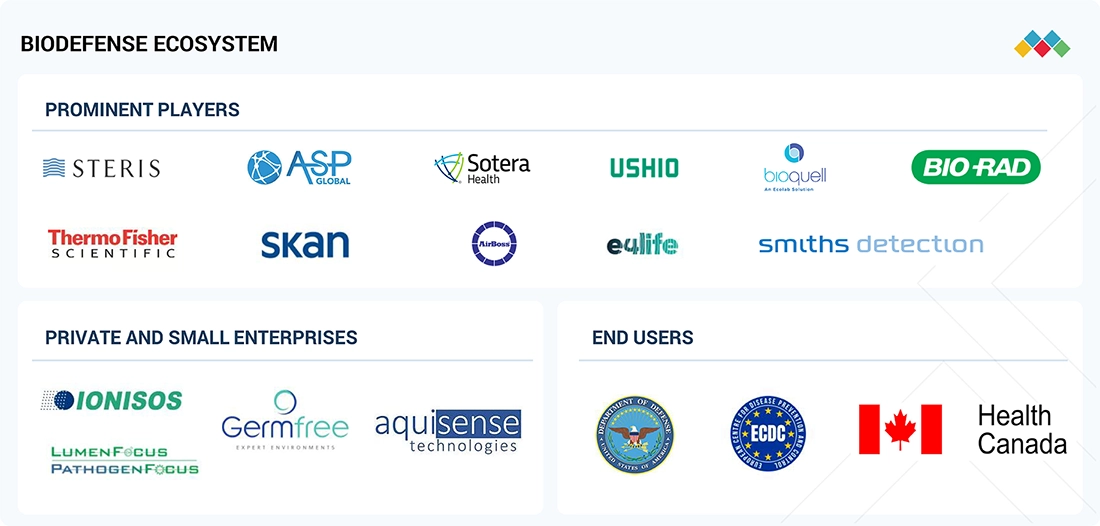
Biodefense Market: COMMERCIAL USE CASES ACROSS INDUSTRIES
| COMPANY | USE CASE DESCRIPTION | BENEFITS |
|---|---|---|
 |
Provides sterilization and disinfection systems for hospitals, defense labs, and biodefense facilities | Ensures safe reuse of equipment and reliable pathogen control in critical environments |
 |
Manufactures low-temperature sterilizers and disinfectant systems for sensitive medical and defense applications | Protects delicate instruments while enabling rapid decontamination of high-risk areas |
 |
Supplies UV-based disinfection lamps and barrier solutions for healthcare and biodefense clean zones | Offers chemical-free, scalable pathogen neutralization and enhanced safety in controlled spaces |
 |
Provides sterilization services using gamma/e-beam technology along with purification and testing solutions | Delivers validated large-scale sterilization while ensuring air and water safety in biodefense operations |
 |
Provides hydrogen peroxide vapor chambers, isolators, and whole-room decontamination systems | Creates sealed environments for containment and enables rapid eradication of biological threats |
Logos and trademarks shown above are the property of their respective owners. Their use here is for informational and illustrative purposes only.
Related Ecosystem
Defence Platforms And Systems
- Sensors
- Unmanned Ground Vehicles (UGV)
- Fighter Aircraft
- Special Mission Aircraft
- Antennas
- BAE Systems plc
- Thales group
- LOCKHEED MARTIN CORPORATION
- Northrop Grumman Corporation
- L3Harris Technologies, Inc.
Key Takeaways
- Asia Pacific biodefense market valued at $229.7M in 2025, expanding to $504.5M by 2030 at 17.0% CAGR
- Asia Pacific governments are significantly increasing biosecurity infrastructure investments and pandemic preparedness funding
- Asia Pacific's biodefense sector benefits from regional collaboration frameworks and cross-border threat intelligence sharing
- Asia Pacific is emerging as a key manufacturing and R&D hub for biodefense technologies and detection systems
Biodefense Market Report Scope
| Report Metric | Details |
|---|---|
| Base Year | 2025 |
| Fastest Growing Segment | AI TECHNOLOGIES (Technology) |
| Forecast Period | 2025–2030 |
| Growth Rate | CAGR of 15.1% from 2025 to 2030 |
| Largest Segment | DECONTAMINATION SYSTEMS (Product) |
| Market Size Base Year (Billions) | ~USD 0.9 (2025) |
| Revenue Forecast (Billions) | ~USD 1.81 (2030) |
| Segments Covered | Product, Biosensor Product Type, Ai-Based Platform Type, Decontamination System Type, Technology, Other Products, Application |
Asia Pacific Biodefense Market Report Segmentation
7 segment dimensions are covered across the global market.
By Product
- Decontamination
- Decontamination Systems
- Detection & Surveillance
By Biosensor Product Type
- Electrochemical
- Nanomechanical
- Optical
- Piezoelectric
- Thermal
By Ai-Based Platform Type
- AI Integration With Surveillance Networks
- Machine Learning For Outbreak Prediction
By Decontamination System Type
- Disinfection Units
- Sterilization Devices
By Technology
- AI Technologies
- Biosensor Technologies
- Class Iii Bscs (Plasma-Based)
- Cold Plasma-Based Inactivation
- Cold Plasma-Based Pathogen Inactivation
- Containment & Isolation Chambers (Negative Pressure Isolation Modules)
- Gamma Radiation
- Ghz-Band Wave Emission
- Ghz-Band Wave Emission For Airborne Viral Inactivation
- Hydrogen Peroxide Vapor & Dry (Vhp & Dhp)
- Ionization (X-Ray & Electro Beam)
- Microwave Heating
- Mobile Isolation Pods
- Plasma Air Purification
- Radiofrequency (Rf-Emr) Heating
- Robotic Containment Systems
- Robotic Disinfection Systems
- Uv-Based Technologies
- Uv-Based Technology
By Other Products
- Containment & Isolation Devices
- Purification Units
By Application
- Homeland Security
- Hospitals & Medical Institutes
- Military
- Public Infrastructure
Target Audience
- Defense Contractors & Aerospace Companies : Need detailed Asia Pacific biodefense market data to identify procurement opportunities, government contracts, and partnership potential with regional defense agencies investing in biosecurity capabilities.
- Biotech & Diagnostics Firms : Require market intelligence on Asia Pacific demand for detection, diagnostic, and response solutions to guide product localization, regulatory compliance, and commercial expansion strategies in the region.
- Government & Military Agencies : Utilize market insights to benchmark regional biodefense investments, assess capability gaps, and inform procurement decisions aligned with national biosecurity strategies and threat assessments.
- Investment & Private Equity Firms : Need comprehensive Asia Pacific biodefense market analysis to identify high-growth investment opportunities, evaluate portfolio companies, and assess market valuations across the region.
- Policy Makers & Regulatory Bodies : Require market data to develop informed biosecurity policies, allocate government funding effectively, and establish regulatory frameworks that support regional biodefense industry development.
Key Companies in the Asia Pacific Biodefense Market
| Company | HQ | Ownership | Strongest segments |
|---|---|---|---|
| STERIS | Ireland | Public Company | Decontamination – Sterilization Devices,Decontamination – Disinfection Units,Biosensors, |
| USHIO INC. | Japan | Public Company | Decontamination - Sterilization Devices,Decontamination - Disinfection Units,Biosensors, |
| SOTERA HEALTH COMPANY | United States | Public Company | Decontamination - Sterilization Devices & Services (Gamma, EO, e-beam),Decontamination - Disinfection & Irradiation Systems,Biosafety & Microbiological Testing (Nelson Labs), |
| BIOQUELL, AN ECOLAB SOLUTION | United States | InvalidIdentifier | Decontamination – Sterilization Devices,Decontamination – Disinfection Units,Biosensors, |
| THERMO FISHER SCIENTIFIC INC. | United States | Public Company | Decontamination - Sterilization Devices,Decontamination - Disinfection Units (UV, Gamma, Cold Plasma-linked),Biosensors and Detection Platforms, |
| SKAN AG | Sweden | Public Company | Decontamination – Sterilization Devices,Decontamination – Disinfection Units,Biosensors, |
| MICROSOFT | United States | Public Company | AI Surveillance,Biosensors (data integration and analytics layer),Decontamination (software, automation, and control stack), |
| BIO-RAD LABORATORIES, INC. | United States | Public Company | Decontamination – Sterilization Devices,Decontamination – Disinfection Units,Biosensors and Detection Systems, |
STERIS
STERIS is a public company founded in 1985 and headquartered in Ireland.
USHIO INC.
USHIO Inc. is a Japanese public company established in 1964.
SOTERA HEALTH COMPANY
Sotera Health Company is a United States-based public company founded in 2015 with 3,000 employees.
BIOQUELL, AN ECOLAB SOLUTION
Bioquell, an Ecolab Solution, is a United States-based company.
THERMO FISHER SCIENTIFIC INC.
Thermo Fisher Scientific Inc. is a United States-based public company founded in 1956 with 125,000 employees.
SKAN AG
SKAN AG is a Swedish public company founded in 1887 with 26,363 employees.
MICROSOFT
Microsoft is a United States-based public company founded in 1975 with 228,000 employees.
BIO-RAD LABORATORIES, INC.
Bio-Rad Laboratories, Inc. is a United States-based public company founded in 1952 with 7,450 employees.
Countries within Asia Pacific - compare and drill down
| Country | 2025 size (native) |
|---|---|
| China | USD 199.4 Million |
| Japan | USD 118.7 Million |
| India | USD 32.9 Million |
| Australia | USD 50.8 Million |
| Rest Of Asia Pacific | USD 102.8 Million |
Country market size visualization
Reasons to Buy this Report
- Regional Market Sizing & Forecasts : Obtain precise market valuations for Asia Pacific biodefense at $229.7M (2025) and $504.5M (2030), with detailed country-level breakdowns enabling targeted investment and expansion strategies.
- Country-Specific Intelligence : Access granular data on individual Asia Pacific markets including China ($199.4M), Japan ($118.7M), and India ($32.9M), identifying high-growth opportunities and competitive landscapes by nation.
- Growth Driver Analysis : Understand the specific factors propelling Asia Pacific's 17% CAGR—government investments, regulatory developments, and threat perception—to inform product development and market entry strategies.
- Competitive Positioning : Benchmark your organization against regional market dynamics and identify gaps in biosecurity capabilities across Asia Pacific nations to establish competitive advantages and partnerships.
- Strategic Planning & Risk Assessment : Leverage comprehensive Asia Pacific biodefense insights to develop long-term strategies, assess geopolitical risks, and allocate resources effectively across the region's diverse markets.
Frequently asked questions
What is the current size of the Asia Pacific biodefense market?
The Asia Pacific biodefense market is valued at $229.7 million in 2025 and is projected to grow to $504.5 million by 2030.
What is the growth rate of the Asia Pacific biodefense market?
Asia Pacific's biodefense market is growing at a compound annual growth rate (CAGR) of 17.0% from 2025 to 2030.
What factors are driving growth in Asia Pacific's biodefense market?
Asia Pacific's biodefense market growth is driven by increased government investments in biosecurity, rising biological threat awareness, regulatory strengthening, and enhanced pandemic preparedness initiatives across the region.
Which countries in Asia Pacific are leading biodefense market development?
Key Asia Pacific markets are establishing dedicated biodefense research centers and procurement programs, with major investments coming from developed and emerging economies focused on regional security.
What technologies are dominating Asia Pacific's biodefense sector?
Asia Pacific's biodefense sector is focused on advanced detection systems, prevention technologies, diagnostic platforms, and response capabilities designed to address emerging pathogens and biological threats.
RESEARCH METHODOLOGY
This research study involves the use of extensive secondary sources, directories, and databases (e.g., Hoovers, Bloomberg Business, Factiva, and OneSource) to identify and collect information useful for this technical, market-oriented, and commercial study of the biodefense market. Primary sources include several industry experts from the core and related industries and preferred suppliers, manufacturers, distributors, technology developers, IP vendors, standards, and organizations related to all the segments of this industry’s value chain. In-depth interviews have been conducted with various primary respondents, including key industry participants, subject matter experts (SMEs), C-level executives of key market players, and industry consultants, to obtain and verify critical qualitative and quantitative information, as well as to assess the prospects.
Secondary Research
In the secondary research process, various secondary sources have been referred to for identifying and collecting information for this study. The secondary sources include annual reports, press releases, and investor presentations of companies; white papers, journals and certified publications, and articles from recognized authors; and websites, directories, and databases. Secondary research has mainly been used to obtain key information about the industry’s supply chain, the market’s value chain, major players, market classification, and segmentation according to the industry trends to the bottommost level, geographic markets, and key developments from both market- and technology-oriented perspectives. The secondary data has been collected and analyzed to arrive at the overall market size, which has further been validated by primary research. A few important secondary sources referred to for this research study are the International Diabetes Federation (IDF), the American Diabetes Association (ADA), and the National Biodefense Analysis and Countermeasures Center (NBACC).
Primary Research
Extensive primary research has been conducted after obtaining information about the current scenario of the biodefense market through secondary research. Several primary interviews have been conducted with market experts from the demand and supply sides across North America, Europe, Asia Pacific, the Middle East, Latin America, and Africa. This primary data has been collected through questionnaires, emails, and telephonic interviews. In the primary research process, various primary sources from the supply and demand sides have been interviewed to obtain qualitative and quantitative information on the market. Primary interviews have been conducted with the demand (hospital & clinics, clinical laboratories, public infrastructure, and other end users) and supply sides (sterilization device manufacturers, disinfection unit manufacturers, biosensor providers, and other biodefense product manufacturers).
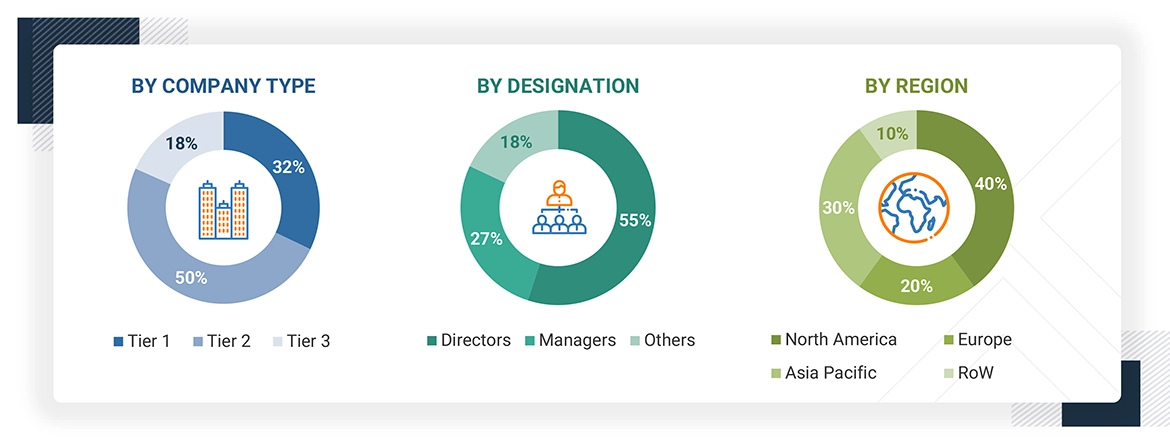
Notes: Tiers of companies are based on their revenue in 2024.
Tier 1: company revenue greater than USD 1 billion; Tier 2: company revenue between USD 100 million and USD 1 billion; and Tier 3: company revenue less than USD 100 million
To know about the assumptions considered for the study, download the pdf brochure
Market Size Estimation
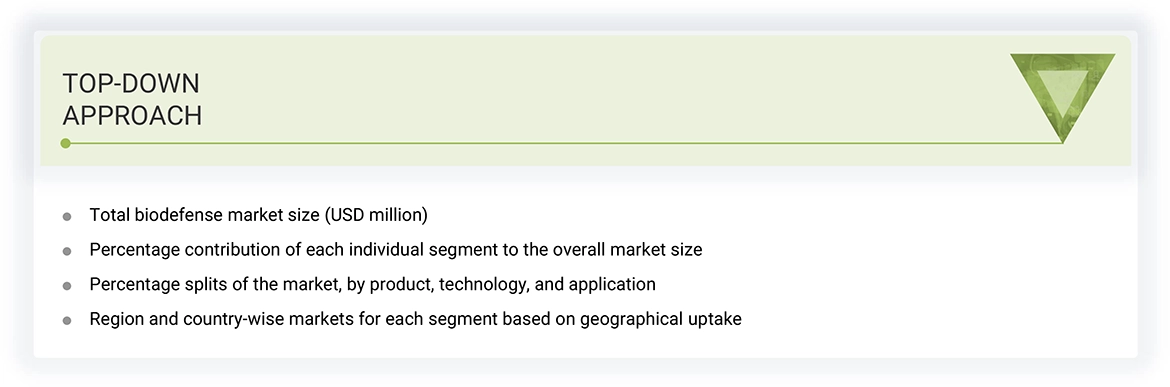
Both the top-down and bottom-up approaches have been used to estimate and validate the size of the biodefense market.
The research methodology used to estimate the market size also includes the following details:
- Key players in the market have been identified through secondary research, and their market ranking has been determined through primary and secondary research. This includes a study of annual financial reports of the top market players and extensive interviews with industry experts who are knowledgeable about cabin management systems.
- The top-down and bottom-up approaches have been used to estimate and validate the size of the global market and the dependent submarkets in the overall market.
Biodefense Market : Bottom-Up Approach
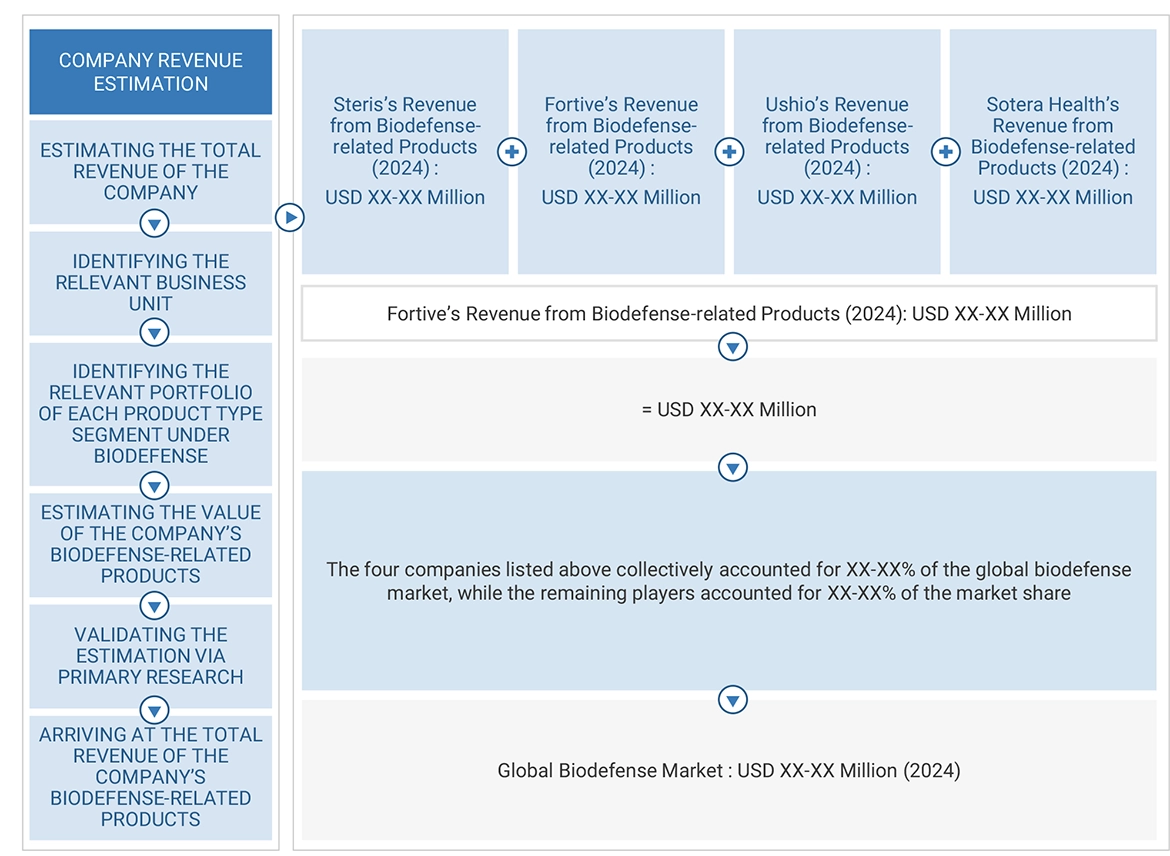
Biodefense Market : Top-down Approach
Data Triangulation
After arriving at the overall size of the biodefense market from the estimation process explained above, the total market has been split into several segments and subsegments. The data triangulation and market breakdown procedures explained below were implemented, wherever applicable, to complete the overall market engineering process and arrive at the exact statistics for various market segments and subsegments. The data has been triangulated by studying various factors and trends from the demand and supply sides. Along with this, the biodefense market size has been validated using the top-down and bottom-up approaches.
Market Definition
Biodefense refers to implementing technologies and systems to counter pathogen threats and prevent bioterrorist incidents. The market focuses on detection, decontamination, purification, and containment & isolation systems that safeguard public health, military personnel, critical infrastructure, and research environments. Biodefense measures in this domain aim to enhance biosafety and biosecurity, ensuring that harmful pathogens or biohazards are effectively neutralized, contained, or prevented from spreading. This market is essential for industries dealing with biological risks, and it is increasingly significant in the context of bioterrorism, biological warfare, and pandemic preparedness.
Key Stakeholders
- Manufacturers of biodefense products
- Hospitals & Medical Institutions
- Biotechnology Companies
- Medical Device Manufacturers
- Government Agencies
- Military Organizations
- Emergency Response and Law Enforcement Agencies
Report Objectives
- market ranking analysis, market share analysis, and revenue analysis of key players To define, describe, segment, and forecast the size of the biodefense market based on product, technology, application, and region
- To forecast sizes of various segments of the market with respect to four major regions, namely, North America, Europe, Asia Pacific, and the Rest of the World, along with major countries in each of these regions
- To identify and analyze key drivers, restraints, opportunities, and challenges influencing the growth of the market across the globe
- To identify industry trends, market trends, and technology trends that are currently prevailing in the market
- To provide an overview of the regulatory landscape with respect to biodefense regulations across regions
- To analyze micro markets with respect to individual growth trends, prospects, and their contribution to the overall market
- To analyze opportunities in the market for stakeholders by identifying key market trends
- To profile key market players and comprehensively analyze their market shares and core competencies
- To analyze the degree of competition in the market by identifying key growth strategies, such as acquisitions, product launches, contracts, and partnerships, adopted by leading market players
- To identify detailed financial positions, key products, and unique selling points of leading companies in the market
- To provide a detailed competitive landscape of the market, along with
Available Customizations
Along with the market data, MarketsandMarkets offers customizations as per the specific needs of companies. The following customization options are available for the report:
Product Analysis
- Product matrix, which gives a detailed comparison of the product portfolio of each company
Regional Analysis
- Further breakdown of the market segments at the country-level
Company Information
- Detailed analysis and profiling of additional market players (up to 5)
Get the Full Biodefense Market Report
Full forecast, segment splits, and company analysis for all Biodefense Market.
- US Biodefense Market
- Canada Biodefense Market
- Germany Biodefense Market
- UK Biodefense Market
- France Biodefense Market
- Italy Biodefense Market
- China Biodefense Market
- Japan Biodefense Market
- India Biodefense Market
- Australia Biodefense Market
- Rest Of Europe Biodefense Market
- Rest Of Asia Pacific Biodefense Market
Need a Tailored Report?
Customize this report to your needs
Get 10% FREE Customization
Customize This Report
