
Europe Blood Glucose Monitor Market (2025-2030)

The Europe Blood Glucose Monitor Market was valued at $4746.1 Million in 2025 and projected to reach to $6848 Million by 2030, representing a compound annual growth rate of 7.6%. Europe's blood glucose monitor market is positioned for steady expansion, growing from $4,746.1 million in 2025 to $6,848 million by 2030 at a 7.6% CAGR.


| Market Size in | USD 26.32 MN |
| Market Forecast in | |
| CAGR | |
| Forecast Period | |
| Units Considered | Value (USD MN) |
Europe Blood Glucose Monitor Market Trends and Insights
- This 7.6% compound annual growth rate reflects Europe's aging population, rising diabetes prevalence, and increasing adoption of continuous glucose monitoring (CGM) technologies across the region.
- Europe maintains a mature healthcare infrastructure with strong regulatory frameworks that support innovation in diabetes management devices. The European market benefits from high healthcare spending, robust reimbursement policies, and strong patient awareness regarding diabetes management.
- Europe's emphasis on preventive care and digital health integration is driving demand for advanced glucose monitoring solutions.
- Key European markets including Germany, France, the United Kingdom, and Spain are leading adoption rates, supported by favorable government health initiatives and widespread access to diabetes care programs throughout the forecast period to 2030..
Key Market Statistics
- CAGR (2025-2030) 7.6% CAGR
- Market Size, 2025 ~USD 4746.1 Million
- Forecast, 2030 ~USD 6848 Million
- Geography Europe
Europe Blood Glucose Monitor Market Overview
Mature Healthcare Infrastructure :
Europe's well-established healthcare systems and reimbursement policies support widespread adoption of blood glucose monitoring devices, particularly in Western European nations with strong diabetes management programs.
Aging Population Driving Demand :
Europe's demographic shift toward an older population significantly increases diabetes prevalence, creating sustained demand for both traditional and continuous glucose monitoring solutions across all age groups.
CGM Technology Adoption :
Increasing adoption of continuous glucose monitoring (CGM) technologies across Europe is transforming diabetes care, with patients and healthcare providers increasingly preferring real-time glucose data over traditional finger-stick testing.
Regional Market Leadership :
Germany leads Europe's blood glucose monitor market at $757.7 million, followed by the UK ($413.9M) and France ($311.9M), reflecting strong healthcare spending and high diabetes management standards in these nations.
Europe Blood Glucose Monitor Market Dynamics
- This growth trajectory is underpinned by Europe's aging demographic profile, rising diabetes incidence rates, and accelerating adoption of advanced CGM technologies that offer superior glucose monitoring capabilities.
- Healthcare providers across the region are increasingly integrating digital health solutions and remote monitoring systems into diabetes management protocols. The European market benefits from robust regulatory frameworks, established reimbursement pathways, and strong healthcare infrastructure that facilitate device adoption.
- Key growth drivers include increased patient awareness, physician recommendations for continuous monitoring, and expanding insurance coverage for CGM devices.
- While growth rates remain moderate compared to global averages, Europe's mature market demonstrates resilience and consistent demand for innovative glucose monitoring solutions..
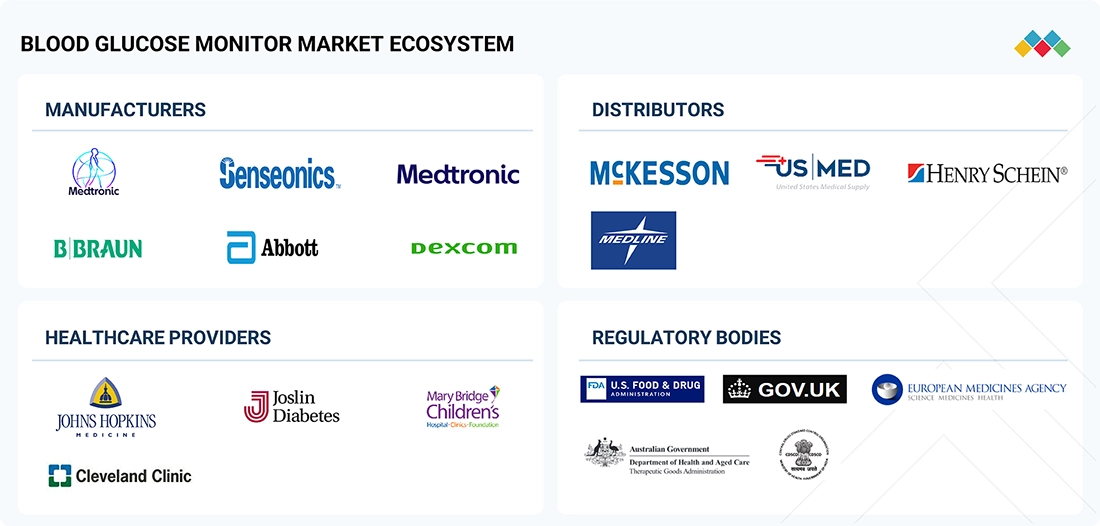
Market Ecosystem
Blood Glucose Monitor Market: COMMERCIAL USE CASES ACROSS INDUSTRIES
| COMPANY | USE CASE DESCRIPTION | BENEFITS |
|---|---|---|
 |
FreeStyle Libre 3 continuous glucose monitoring (CGM) system designed for real-time glucose tracking without routine fingersticks; transmits minute-by-minute readings to a connected smartphone app. | Eliminates fingerstick calibration, enhances patient comfort, enables proactive glucose management, and supports better glycemic control through trend-based insights |
 |
Dexcom G7 all-in-one CGM sensor providing real-time glucose readings, customizable alerts, and integration with smartphones and insulin pumps for seamless diabetes management. | Offers superior accuracy and fast warm-up; provides predictive alerts to prevent hypo- and hyperglycemia; improves adherence through connectivity and data visualization |
 |
Guardian 3 Sensor used with Medtronic insulin pumps to deliver continuous glucose data every five minutes, supporting automated insulin delivery and trend-based therapy adjustments | Enables hybrid closed-loop insulin management, improves time-in-range, reduces glycemic variability, and enhances safety for insulin-dependent users |
 |
Omnitest self-monitoring blood glucose (SMBG) device designed for capillary blood testing, offering reliable and quick results for daily home or point-of-care glucose monitoring | Provides affordable, accurate, and easy-to-use glucose testing; supports frequent monitoring and improved patient engagement in self-managed care |
 |
Accu-Chek range of SMBG systems designed for fast and dependable glucose measurement with connectivity to digital platforms for progress tracking and data sharing | Ensures consistent accuracy, simplifies diabetes management, enables remote data access, and strengthens patient–clinician communication for improved outcomes |
Logos and trademarks shown above are the property of their respective owners. Their use here is for informational and illustrative purposes only.
Related Ecosystem
Medical Devices
- Polymerase Chain Reaction (PCR)
- Magnetic Resonance Imaging (MRI)
- Disposable Autoinjectors
- Pulse Oximeters
- Blood Pressure Monitors
- Medtronic plc
- Abbott Laboratories
- Stryker Corporation
- Becton, Dickinson and Company
- CONMED Corporation
Key Takeaways
- Europe's blood glucose monitor market will grow from $4,746.1M (2025) to $6,848M (2030) at a 7.6% CAGR, driven by aging demographics and diabetes prevalence across the region.
- Europe's mature healthcare infrastructure and strong reimbursement policies create favorable conditions for continuous glucose monitoring adoption and device innovation.
- Digital health integration and preventive care initiatives in Europe are accelerating demand for advanced glucose monitoring technologies throughout the forecast period.
- Key European markets including Germany, France, UK, and Spain are leading regional growth through government health programs and widespread diabetes care access.
Blood Glucose Monitor Market Report Scope
| Report Metric | Details |
|---|---|
| Base Year | 2025 |
| Fastest Growing Segment | NON-INVASIVE PRODUCTS (Product Type) |
| Forecast Period | 2025–2030 |
| Growth Rate | CAGR of 9.1% from 2025 to 2030 |
| Largest Segment | DIABETES MANAGEMENT (Application) |
| Market Size Base Year (Billions) | ~USD 16.44 (2025) |
| Revenue Forecast (Billions) | ~USD 25.41 (2030) |
| Segments Covered | Product Type, Type, Test Site, Application, End User |
Europe Blood Glucose Monitor Market Report Segmentation
5 segment dimensions are covered across the global market.
By Product Type
- Continuous Glucose Monitoring Systems
- Non-Invasive Products
- Professional Point-Of-Care Devices
- Self-Monitoring Blood Glucose Systems
By Type
- Glucometers
- Implants
- Lancets & Lancing Devices
- Sensors
- Testing Strips
- Transmitters & Receivers
- Type 1 Diabetes
- Type 2 Diabetes
By Test Site
- Fingertip
- Other Test Sites
- Upper Arm
By Application
- Diabetes Management
- Health & Wellness Monitoring
- Other Applications
By End User
- Hospitals & Clinics
- Other End Users
- Self/Home Care
EUROPE: BLOOD GLUCOSE MONITOR MARKET, BY END USER, 2023–2030
| Segment | 2023 | 2024 | 2025 | 2026 | 2027 | 2028 | 2029 | 2030 | CAGR (%) |
|---|---|---|---|---|---|---|---|---|---|
| HOSPITALS & CLINICS | 501.4 | 514.8 | 532.1 | 543.7 | 567.8 | 589.2 | 612.6 | 638.3 | 3.7 |
| OTHER END USERS | 300.4 | 317.3 | 337.4 | 354.7 | 381.1 | 406.9 | 435.3 | 466.6 | 6.7 |
| SELF/HOME CARE | 3357.4 | 3596 | 3876.6 | 4131.8 | 4501.1 | 4872 | 5284.2 | 5743.1 | 8.2 |
| TOTAL | 4159.1 | 4428.2 | 4746.1 | 5030.1 | 5450.1 | 5868.1 | 6332.1 | 6848 | 7.6 |
REST OF EUROPE: BLOOD GLUCOSE MONITOR MARKET, BY END USER, 2023–2030
| Segment | 2023 | 2024 | 2025 | 2026 | 2027 | 2028 | 2029 | 2030 | CAGR (%) |
|---|---|---|---|---|---|---|---|---|---|
| HOSPITALS & CLINICS | 133.9 | 136.9 | 140.8 | 143.2 | 148.9 | 153.7 | 159.1 | 165 | 3.2 |
| OTHER END USERS | 80.3 | 84.4 | 89.3 | 93.5 | 99.9 | 106.2 | 113.1 | 120.6 | 6.2 |
| SELF/HOME CARE | 906.2 | 966.1 | 1036.6 | 1099.6 | 1192.2 | 1284.3 | 1386.3 | 1499.5 | 7.7 |
| TOTAL | 1120.3 | 1187.3 | 1266.7 | 1336.3 | 1441.1 | 1544.3 | 1658.5 | 1785.1 | 7.1 |
Target Audience
- Medical Device Manufacturers : Manufacturers need detailed European market data to develop region-specific product strategies, identify high-potential markets like Germany and UK, and optimize distribution and pricing for competitive advantage.
- Healthcare Providers & Hospital Networks : Hospital systems and clinics require market insights to evaluate procurement strategies, understand technology adoption trends, and align diabetes management programs with European best practices.
- Investors & Private Equity Firms : Investment professionals need comprehensive market analysis to identify acquisition targets, assess growth potential in mature European markets, and evaluate portfolio company performance against regional benchmarks.
- Pharmaceutical & Diabetes Care Companies : Companies in the diabetes care space require market segmentation data to develop integrated solutions, understand CGM adoption barriers, and align product portfolios with regional healthcare priorities.
- Market Consultants & Strategic Advisors : Consultants advising healthcare organizations need detailed European market intelligence to support client decision-making, competitive analysis, and strategic planning for market expansion or repositioning.
Key Companies in the Europe Blood Glucose Monitor Market
| Company | HQ | Ownership | Strongest segments |
|---|---|---|---|
| KINDRED HEALTHCARE INC. | United States | Private Company | Long-term acute care hospitals (LTACHs) – drug-intensive episodes,Inpatient rehabilitation facilities (IRFs) – rehab with chronic comorbidities,Contract rehabilitation and ancillary services, |
| ABBOTT LABORATORIES | United States | Public Company | Medical Devices,Diagnostic Products,Nutritional Products, |
| DEXCOM, INC. | United States | Public Company | Dexcom G7 and G7 15 Day,Dexcom G6,Dexcom ONE and ONE+, |
| MEDTRONIC | Ireland | Public Company | Cardiovascular Portfolio,Neuroscience Portfolio,Medical Surgical Portfolio (incl. Diabetes and Monitoring), |
| SINOCARE | China | Public Company | Blood glucose monitoring systems and strips,Blood pressure and multiparameter testing devices,Hospital and primary healthcare diagnostic solutions, |
| I-SENS, INC. | South Korea | Public Company | Blood glucose meters and strips (human),POCT systems (blood gas, electrolytes, coagulation),Veterinary diagnostics, |
| NIPRO | Japan | Public Company | Dialysis products and services,Injection and infusion / hospital disposables,Pharmaceuticals (generics and kits), |
| NEMAURA MEDICAL INC. | United States | Public Company | sugarBEAT non-invasive CGM,proBEAT wellness and coaching programs,Diabetes prevention and reversal services, |
| TERUMO CORPORATION | Japan | Public Company | Cardiac and Vascular Company,Medical Care Solutions Company,Blood and Cell Technologies Company, |
KINDRED HEALTHCARE INC.
Kindred Healthcare Inc. is a private healthcare company founded in 1985 and headquartered in the United States. With 64,200 employees, the company operates as a major provider of healthcare services across the nation.
ABBOTT LABORATORIES
Abbott Laboratories is a public company founded in 1888 and based in the United States. With 115,000 employees, it operates as a diversified healthcare and diagnostics company with a global presence.
DEXCOM, INC.
Dexcom, Inc. is a publicly traded company founded in 1999 and headquartered in the United States. The company employs 11,050 people and specializes in continuous glucose monitoring technology.
MEDTRONIC
Medtronic is a public company founded in 1949 and based in Ireland. With 95,000 employees, it is a global leader in medical technology and device manufacturing.
SINOCARE
Sinocare is a publicly traded company founded in 2002 and headquartered in China. The company employs 5,010 people and operates in the healthcare and medical device sector.
I-SENS, INC.
I-SENS, Inc. is a publicly traded company founded in 2000 and based in South Korea. The company employs 887 people and operates in the medical device and diagnostics industry.
NIPRO
Nipro is a publicly traded company founded in 1947 and based in Japan. With 38,593 employees, it manufactures medical devices and pharmaceutical products for global markets.
NEMAURA MEDICAL INC.
Nemaura Medical Inc. is a publicly traded company founded in 2009 and headquartered in the United States. With 36 employees, the company develops wearable medical technology solutions.
TERUMO CORPORATION
Terumo Corporation is a publicly traded company founded in 1921 and based in Japan. With 30,591 employees, it manufactures and distributes medical devices and blood products globally.
Countries within Europe - compare and drill down
| Country | 2025 size (native) |
|---|---|
| Germany | USD 757.7 Million |
| UK | USD 413.9 Million |
| France | USD 311.9 Million |
| Italy | USD 295.2 Million |
| Spain | USD 250.3 Million |
| Rest Of Europe | USD 718.5 Million |
Country market size visualization
Reasons to Buy this Report
- Country-Level Market Segmentation : Access detailed market sizing for Germany, UK, France, Italy, Spain, and Rest of Europe, enabling precise market entry strategies and competitive positioning in specific European territories.
- CGM Technology Insights : Understand the shift from traditional glucose monitors to continuous glucose monitoring systems across Europe, with analysis of adoption rates, reimbursement trends, and technology preferences by country.
- Demographic & Healthcare Trends : Leverage data on Europe's aging population, diabetes prevalence rates, and healthcare infrastructure maturity to identify high-growth opportunities and tailor product development strategies.
- Competitive Landscape Analysis : Gain insights into market consolidation, key player strategies, and regional competitive dynamics to inform partnership, acquisition, and market expansion decisions across European markets.
- Reimbursement & Regulatory Framework : Understand country-specific reimbursement policies, regulatory requirements, and healthcare spending patterns that impact device adoption and pricing strategies across European nations.
Frequently asked questions
What is the projected size of Europe's blood glucose monitor market by 2030?
Europe's blood glucose monitor market is projected to reach $6,848 million by 2030, growing from $4,746.1 million in 2025 at a 7.6% CAGR.
What factors are driving growth in Europe's blood glucose monitor market?
Europe's market growth is driven by an aging population, rising diabetes prevalence, increased adoption of continuous glucose monitoring technologies, strong healthcare infrastructure, and robust reimbursement policies across the region.
Which European countries are leading the blood glucose monitor market?
Germany, France, the United Kingdom, and Spain are the leading European markets for blood glucose monitors, supported by favorable government health initiatives and widespread access to diabetes care programs.
How is digital health integration impacting Europe's glucose monitoring market?
Europe's emphasis on digital health integration and preventive care is accelerating demand for advanced glucose monitoring solutions, including connected devices and data management platforms that support remote patient monitoring.
What is the CAGR for Europe's blood glucose monitor market from 2025 to 2030?
Europe's blood glucose monitor market is expected to grow at a compound annual growth rate (CAGR) of 7.6% between 2025 and 2030.
RESEARCH METHODOLOGY
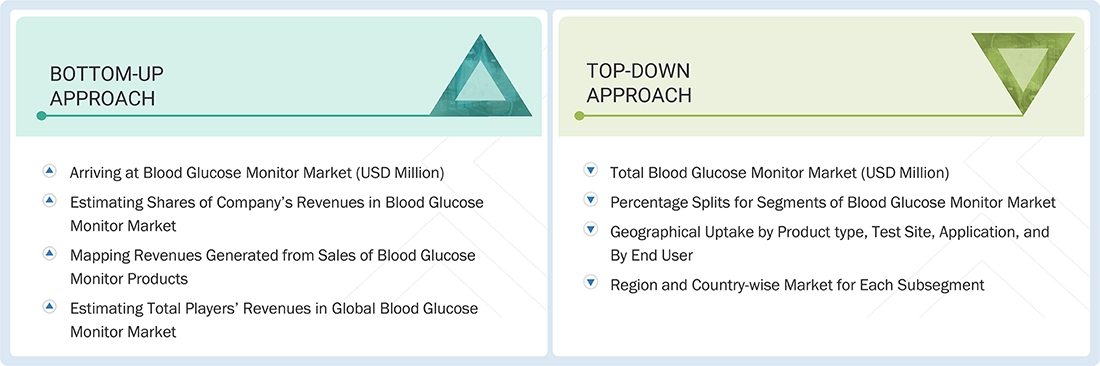
The study comprised four key activities to estimate the current size of the blood glucose monitor market. First, extensive secondary research was conducted to gather information on the market, including related and parent markets. The next step involved validating these findings, assumptions, and market size estimates through primary research with industry experts across the value chain. Top-down and bottom-up approaches were used to arrive at a comprehensive estimate of the overall market size. Finally, market breakdown and data triangulation techniques were utilized to determine the sizes of segments and subsegments within the market.
Secondary Research
The secondary research process involved extensive use of various secondary sources, including directories, databases like Bloomberg Business, Factiva, and D&B Hoovers, as well as white papers, annual reports, company house documents, investor presentations, and SEC filings. This research was conducted to gather information valuable for a comprehensive, technical, market-oriented, and commercial study of the blood glucose monitor market. It also helped obtain critical insights about key players in the industry, market classification, and segmentation based on current industry trends, down to the finest details. Additionally, a database of leading industry players was created through this secondary research.
Primary Research
In the primary research process, interviews were conducted with various sources from the supply and demand sides to gather qualitative and quantitative information for this report. On the supply side, industry experts were interviewed, including CEOs, vice presidents, marketing & sales directors, technology & innovation directors, and other key executives from prominent companies and organizations involved in the blood glucose monitor market. For the demand side, interviews were conducted with industry experts, purchase and sales managers, doctors, and personnel from research organizations. This primary research was essential to validate market segmentation, identify key players in the industry, and gather insights on important industry trends and market dynamics.
A breakdown of the primary respondents for the blood glucose monitor market is provided below:
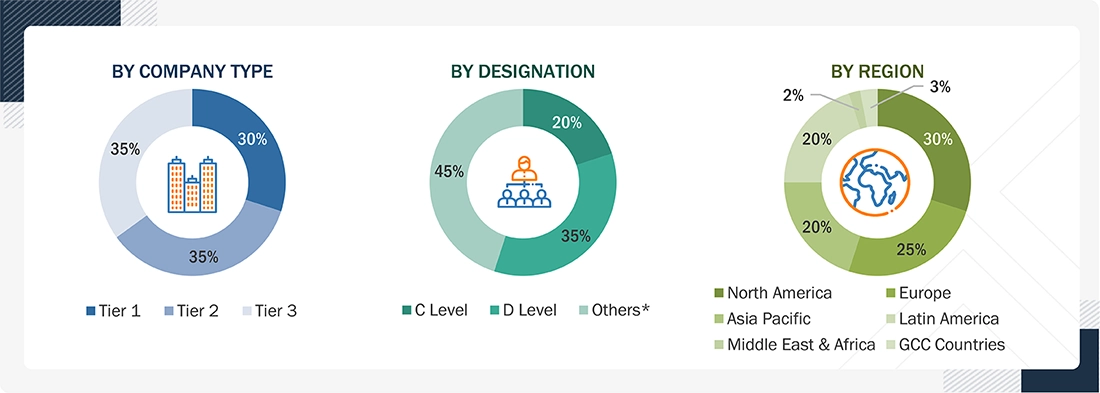
Note 1: C-level executives include CEOs, COOs, CTOs, and VPs.
Note 2: Other designations include sales, marketing, and product managers.
Note 3: Companies are classified into tiers based on their total revenue. As of 2024: Tier 1=>USD 1 billion, Tier 2 = USD 500 million to USD 1 billion, and Tier 3 = < USD 500 million.
To know about the assumptions considered for the study, download the pdf brochure
Market Size Estimation
The research methodology used to estimate the size of the blood glucose monitor market includes the following details. The market sizing was undertaken from the global side.
Country-level Analysis: The size of the blood glucose monitor market was obtained from the annual presentations of leading players and secondary data available in the public domain. The share of products in the overall blood glucose monitor market was obtained from secondary data and validated by primary participants to arrive at the total blood glucose monitor market. Primary participants further validated the numbers.
Geographic Market Assessment (By Region and Country): The geographic assessment was done using the following approaches:
Approach 1: Geographic revenue contributions/splits of leading players in the market (wherever available) and respective growth trends
Approach 2: Geographic adoption trends for individual product segments by end users and growth prospects for each of the segments (assumptions and indicative estimates validated from primary interviews)
At each point, the assumptions and approaches were validated by industry experts who were contacted during primary research. Considering the limitations of data available from secondary research, revenue estimates for individual companies (for the overall blood glucose monitor market and geographic market assessment) were ascertained based on a detailed analysis of their respective product offerings, geographic reach/strength (direct or through distributors or suppliers), and the shares of the leading players in a particular region or country.
Global Blood Glucose Monitor Market Size: Bottom-up Approach and Top-down Approach
Data Triangulation
After arriving at the overall size from the market size estimation process explained above, the total market was split into several segments and subsegments. The data triangulation and market breakdown procedures explained below were implemented, wherever applicable, to complete the overall market engineering process and arrive at the exact statistics for various market segments and subsegments. The data was triangulated by studying various factors and trends from the demand and supply sides. Along with this, the market size was validated using both the top-down and bottom-up approaches.
Market Definition
Blood glucose monitors are medical devices used to measure and monitor blood glucose (sugar) levels in individuals, primarily for the diagnosis and management of diabetes mellitus. These monitors help patients and healthcare professionals assess glycemic control, adjust treatment plans, and prevent diabetes-related complications.
Stakeholders
- Blood Glucose Monitor Manufacturers
- Contract Manufacturers
- Suppliers and Distributors of Blood Glucose Monitors
- Senior Management
- Finance Department
- Healthcare Services Providers (Hospitals and Public & Private Clinics)
- Academic & Research Institutes
- E-commerce and Digital Platforms
- Retail Pharmacies and Supermarkets
- Trade Associations and Industry Bodies
- Regulatory Bodies and Government Agencies
- Business Research and Consulting Service Providers
- Market Research and Consulting Firms
- Venture Capitalists and Investors
Report Objectives
- To define, describe, segment, analyze, and forecast the global blood glucose monitor market by product type, application, test site, end user, and region.
- To provide detailed information about the factors influencing market growth (drivers, restraints, opportunities, and challenges)
- To analyze micromarkets concerning individual growth trends, prospects, and contributions to the overall market
- To analyze market opportunities for stakeholders and provide details of the competitive landscape for key players
- To forecast the size of the blood glucose monitor market in North America, Europe, the Asia Pacific, Latin America, the Middle East & Africa, and GCC countries
- To profile the key players in the blood glucose monitor market and comprehensively analyze their core competencies
- To track and analyze competitive developments such as agreements, collaborations, and partnerships; acquisitions; and product approvals & launches in the blood glucose monitor market.
Get the Full Blood Glucose Monitor Market Report
Full forecast, segment splits, and company analysis for all Blood Glucose Monitor Market.
- Canada Blood Glucose Monitor Market
- US Blood Glucose Monitor Market
- Germany Blood Glucose Monitor Market
- UK Blood Glucose Monitor Market
- France Blood Glucose Monitor Market
- Italy Blood Glucose Monitor Market
- Spain Blood Glucose Monitor Market
- China Blood Glucose Monitor Market
- Japan Blood Glucose Monitor Market
- India Blood Glucose Monitor Market
- Australia Blood Glucose Monitor Market
- South Korea Blood Glucose Monitor Market
- Brazil Blood Glucose Monitor Market
- Mexico Blood Glucose Monitor Market
- GCC Countries Blood Glucose Monitor Market
- Rest Of Europe Blood Glucose Monitor Market
- Rest Of Asia Pacific Blood Glucose Monitor Market
- Rest Of Latin America Blood Glucose Monitor Market
Need a Tailored Report?
Customize this report to your needs
Get 10% FREE Customization
Customize This Report
