
Rest Of Asia Pacific Body Composition Analyzers Market (2024-2029)

The Rest Of Asia Pacific Body Composition Analyzers Market was valued at $33.9 Million in 2024 and projected to reach to $53.7 Million by 2029, representing a compound annual growth rate of 9.7%. Rest Of Asia Pacific's body composition analyzers market is poised for significant expansion, driven by increasing health consciousness and lifestyle changes among growing middle-class populations.


| Market Size in | USD 26.32 MN |
| Market Forecast in | |
| CAGR | |
| Forecast Period | |
| Units Considered | Value (USD MN) |
Rest Of Asia Pacific Body Composition Analyzers Market Trends and Insights
- Rest Of Asia Pacific is witnessing increased adoption of body composition analysis technologies driven by rising health consciousness, growing fitness industry investments, and expanding healthcare infrastructure across emerging economies.
- Rest Of Asia Pacific's market growth is supported by increasing prevalence of lifestyle diseases and growing demand for preventive healthcare solutions among middle-income populations. Rest Of Asia Pacific demonstrates strong momentum with a compound annual growth rate of 9.7% over the forecast period.
- Rest Of Asia Pacific's market expansion is fueled by technological advancements in non-invasive body composition measurement, rising disposable incomes, and growing integration of these analyzers in fitness centers, wellness clinics, and hospitals.
- Rest Of Asia Pacific represents a significant opportunity for market players seeking to capitalize on the region's expanding healthcare and fitness sectors..
Key Market Statistics
- CAGR (2024-2029) 9.7% CAGR
- Market Size, 2024 ~USD 33.9 Million
- Forecast, 2029 ~USD 53.7 Million
- Country Rest Of Asia Pacific
Rest Of Asia Pacific Body Composition Analyzers Market Overview
Market Valuation Growth :
Rest Of Asia Pacific body composition analyzers market valued at USD 33.9 million in 2024, with strong expansion trajectory reaching USD 53.7 million by 2029, representing 58.4% total growth over the forecast period.
Regional CAGR Performance :
Rest Of Asia Pacific demonstrates a robust CAGR of 9.7%, outpacing the global average of 9.3%, indicating accelerated market adoption and investment in body composition analysis technologies across emerging economies.
Health Consciousness Surge :
Rising health awareness among middle-class populations in Rest Of Asia Pacific countries is driving demand for advanced body composition analyzers in fitness centers, wellness clinics, and healthcare facilities.
Infrastructure Expansion :
Expanding healthcare infrastructure and increasing fitness industry investments across Rest Of Asia Pacific nations are creating favorable conditions for deployment of sophisticated body composition analysis equipment.
Rest Of Asia Pacific Body Composition Analyzers Market Dynamics
- The region's emerging economies are investing heavily in healthcare modernization and fitness infrastructure, creating substantial opportunities for market players.
- Government initiatives promoting preventive healthcare and wellness programs further support market growth.
- The proliferation of fitness centers, corporate wellness programs, and diagnostic clinics across Rest Of Asia Pacific countries is accelerating technology adoption.
- With a CAGR of 9.7%, the market is expected to maintain momentum through 2029, supported by rising disposable incomes and growing awareness of body composition's role in overall health management..
Market Ecosystem
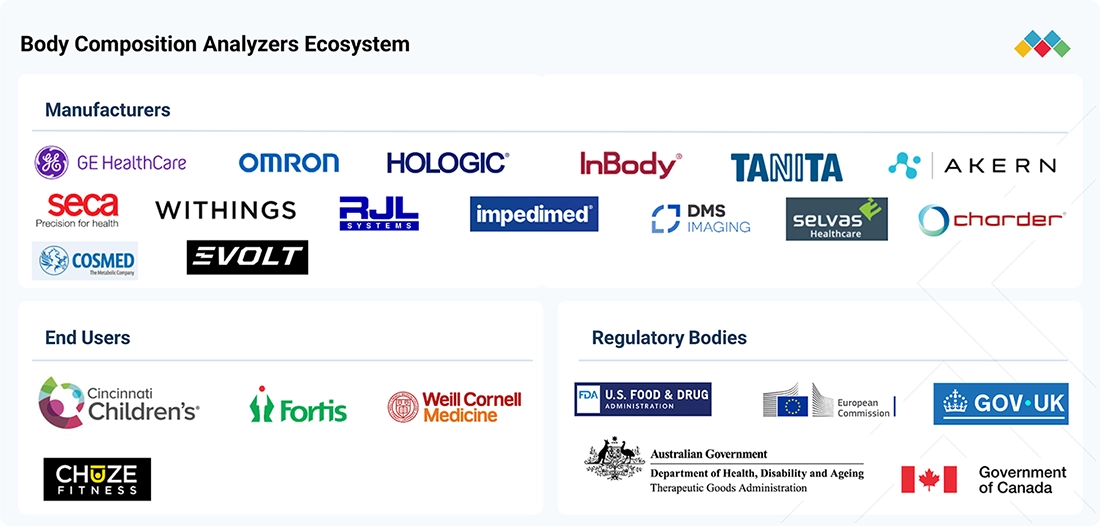
BODY COMPOSITION ANALYZERS MARKET: COMMERCIAL USE CASES ACROSS INDUSTRIES
| COMPANY | USE CASE DESCRIPTION | BENEFITS |
|---|---|---|
 |
Manufactures Lunar iDXA, a DXA instrument with dual energy, which is often used in hospitals and research contexts to provide bone density, fat, and lean mass data; the machine produces an examination of both lean and fat masses and the total body fat percentage for body composition studies as well as understanding risk of metabolic diseases | High-quality imaging and high patient weight capacity | Enables comprehensive skeletal health and body composition assessment | Detailed body composition analysis | Measures fat mass, lean mass, and body fat percentage | Metabolic health assessment | Supports evaluation of body composition-related health risks |
 |
Produces health monitoring devices available for home use and for consumer use; offers products including HBF-514C and BCM-500 blood composition monitoring devices; the OMRON BCM-500, which provides information about six body metrics and can store the results for four profiles, is one of its devices | Convenient home-based monitoring | Enables regular body composition tracking outside clinical settings | Multi-parameter assessment | Provides multiple body composition metrics in a single measurement | Multi-user data tracking | Supports individual monitoring and comparison of results over time |
 |
Provides the Horizon DXA System, a dual-energy X-ray absorptiometry technology used in healthcare, clinics, and sports performance for simultaneous, accurate bone density and body composition measurements | Full-body sensing | Provides more comprehensive measurements than foot-to-foot devices | Simultaneous bone & body composition assessment | Measures bone density alongside fat and lean mass | Research-based methodology | Supports repeatable and reliable results | Automated calibration & standardization | Ensures consistent measurements across large patient populations |
 |
Produces BIA-based professional devices, including the InBody 270 and InBody 970, among others, used in hospitals, clinics, and exercise centers for segmental body composition measurement; the DSM-MFBIA technology independently measures electrodes in the body's organs and limbs, therefore delivering high precision and not depending on estimation, based on gender, age, or body shape | Direct segmental measurement | Provides detailed analysis of individual body segments | Multi-frequency analysis | Enables comprehensive assessment of body composition and body water | Reduced reliance on predictive equations | Supports individualized measurements without dependence on age, gender, or body shape |
 |
Manufactures multi-frequency segment analyzers, including the MC-780U Plus, that are used for in-depth body composition analysis by medical providers and fitness specialists; the device collects 31 measurements in 20 seconds, including segmental levels of fat and muscle mass, basal metabolic rate, and visceral fat | Rapid comprehensive assessment | Delivers multiple body composition measurements in a short testing time | Detailed segmental analysis | Provides separate fat and muscle mass measurements for different body regions | Actionable health & fitness insights | Supports personalized assessment and program planning |
Logos and trademarks shown above are the property of their respective owners. Their use here is for informational and illustrative purposes only.
Related Ecosystem
Medical Devices
- Polymerase Chain Reaction (PCR)
- Magnetic Resonance Imaging (MRI)
- Disposable Autoinjectors
- Pulse Oximeters
- Blood Pressure Monitors
- Medtronic plc
- Abbott Laboratories
- Stryker Corporation
- Becton, Dickinson and Company
- CONMED Corporation
Key Takeaways
- Rest Of Asia Pacific body composition analyzers market valued at USD 33.9 million in 2024, expanding to USD 53.7 million by 2029
- Rest Of Asia Pacific exhibits a 9.7% CAGR, outpacing global average growth driven by rising health awareness and fitness industry expansion
- Rest Of Asia Pacific's market growth is propelled by increasing lifestyle disease prevalence and growing adoption in wellness and clinical settings
- Rest Of Asia Pacific presents significant opportunities for market entrants due to expanding middle-class populations and healthcare infrastructure development
Body Composition Analyzers Market Report Scope
| Report Metric | Details |
|---|---|
| Base Year | 2024 |
| Fastest Growing Segment | E-COMMERCE (Distribution Channel) |
| Forecast Period | 2024-2029 |
| Growth Rate | CAGR of 9.3% from 2024 to 2029 |
| Largest Segment | BIOIMPEDANCE ANALYZERS (Product) |
| Market Size Base Year (Billions) | ~USD 0.77 (2024) |
| Revenue Forecast (Billions) | ~USD 1.2 (2029) |
| Segments Covered | Product, Type, Modality, Usage Type, Application, Distribution Channel, End User |
Rest Of Asia Pacific Body Composition Analyzers Market Report Segmentation
7 segment dimensions are covered across the global market.
By Product
- Air Displacement Plethysmography Equipment
- Bioimpedance Analyzers
- Dual-Energy X-Ray Absorptiometry Equipment
- Hydrostatic Weighing Equipment
- Skinfold Calipers
By Type
- Dual-Frequency Bioimpedance Analyzers
- Multi-Frequency Bioimpedance Analyzers
- Single-Frequency Bioimpedance Analyzers
By Modality
- Portable Body Composition Analyzers
- Stationary/Benchtop Body Composition Analyzers
By Usage Type
- Consumer-Grade Body Composition Analyzers
- Professional-Grade Body Composition Analyzers
By Application
- Segmental Body Measurement
- Whole-Body Measurement
By Distribution Channel
- E-Commerce
- Offline/Retail Stores
By End User
- Academic & Research Centers
- Fitness Clubs And Wellness Centers
- Home Users
- Hospitals And Clinics
Target Audience
- Medical Device Manufacturers : Manufacturers need Rest Of Asia Pacific-specific market data to identify expansion opportunities, assess regional demand for body composition analyzers, and develop localized product strategies for emerging healthcare markets.
- Healthcare Facility Operators : Hospital chains, diagnostic centers, and wellness clinics in Rest Of Asia Pacific require market insights to justify capital investments in body composition analysis equipment and understand competitive positioning.
- Fitness & Wellness Industry Players : Gym chains, fitness centers, and corporate wellness program providers need regional market data to evaluate technology adoption trends and investment opportunities in body composition analysis services.
- Investment & Private Equity Firms : Investors targeting Rest Of Asia Pacific healthcare and wellness sectors require detailed market analysis to identify growth companies, assess market potential, and evaluate investment returns in this region.
- Healthcare Consultants & Advisors : Consulting firms advising healthcare organizations in Rest Of Asia Pacific need regional market intelligence to provide strategic recommendations on technology adoption and competitive positioning.
Reasons to Buy this Report
- Regional Market Sizing : Obtain precise market valuation data specific to Rest Of Asia Pacific, enabling accurate financial forecasting and investment decisions tailored to this high-growth regional segment.
- Growth Opportunity Identification : Identify emerging opportunities within Rest Of Asia Pacific's 9.7% CAGR market, outpacing global averages and signaling strong demand for body composition analysis technologies in underserved markets.
- Competitive Landscape Analysis : Understand Rest Of Asia Pacific-specific competitive dynamics, market entry barriers, and strategic positioning required to capture market share in this rapidly expanding regional market.
- Investment Decision Support : Make informed investment and expansion decisions with comprehensive Rest Of Asia Pacific market intelligence, including growth drivers, infrastructure trends, and healthcare sector developments.
- Strategic Market Penetration : Develop targeted go-to-market strategies for Rest Of Asia Pacific by understanding regional health consciousness trends, fitness industry growth, and healthcare infrastructure expansion patterns.
Frequently asked questions
What is the current market size of body composition analyzers in Rest Of Asia Pacific?
Rest Of Asia Pacific's body composition analyzers market was valued at USD 33.9 million in 2024 and is expected to grow to USD 53.7 million by 2029.
What is the projected growth rate for Rest Of Asia Pacific's body composition analyzers market?
Rest Of Asia Pacific's body composition analyzers market is projected to grow at a compound annual growth rate of 9.7% from 2024 to 2029.
What factors are driving growth in Rest Of Asia Pacific's body composition analyzers market?
Rest Of Asia Pacific's market growth is driven by rising health consciousness, expanding fitness industries, increasing lifestyle disease prevalence, technological advancements, and growing healthcare infrastructure investments across emerging economies.
Which sectors are adopting body composition analyzers in Rest Of Asia Pacific?
Rest Of Asia Pacific's body composition analyzers are increasingly adopted in fitness centers, wellness clinics, hospitals, and preventive healthcare facilities catering to growing health-conscious populations.
How does Rest Of Asia Pacific's market growth compare to global trends?
Rest Of Asia Pacific's 9.7% CAGR exceeds the global average of 9.3%, indicating stronger regional momentum driven by emerging market dynamics and expanding healthcare accessibility.
RESEARCH METHODOLOGY
This study involved the extensive use of both primary and secondary sources. The research process involved the study of various factors affecting the industry to identify segmentation types, industry trends, key players, competitive landscape, key market dynamics, and key player strategies.
Secondary Research
The secondary research process involves the widespread use of secondary sources, directories, databases (Bloomberg Businessweek, Factiva, and D&B Hoovers), white papers, annual reports, company house documents, investor presentations, and SEC filings of companies. Secondary research was used to identify and collect information useful for the extensive, technical, market-oriented, and commercial study of the body composition analyzers market. It was also used to obtain important information about the key players and market classification & segmentation according to industry trends, to the bottom-most level, and key developments related to market and technology perspectives. A database of the key industry leaders was also prepared using secondary research.
Primary Research
In the primary research process, various sources from the supply and demand sides were interviewed to obtain qualitative and quantitative information for this report. The primary sources from the supply side include industry experts such as CEOs, vice presidents, marketing and sales directors, technology & innovation directors, and related key executives from various key companies and organizations in the body composition analyzers market. The primary sources from the demand side include medical OEMs, medical device ISOs, and service providers, among others. Primary research was conducted to validate the market segmentation, identify key players in the market, and gather insights into key industry trends & key market dynamics.
Breakdown of Primary Interviews
A breakdown of the primary respondents for the body composition analyzers market (supply side) is provided below:
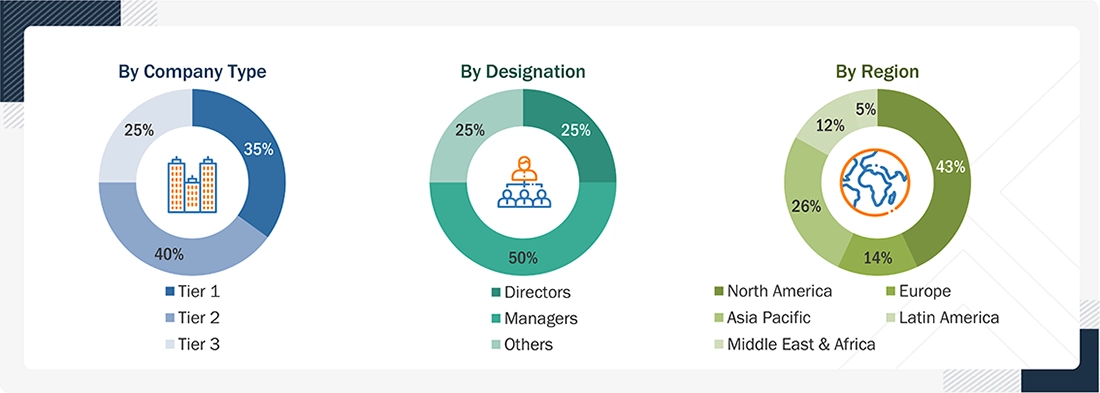
Note: Others include sales, marketing, and product managers.
Companies are classified into tiers based on their total revenue.
As of 2025, Tier 1 = >USD 2 billion, Tier 2 = USD 50 million to USD 2 billion, and Tier 3 = <USD 50 million.
To know about the assumptions considered for the study, download the pdf brochure
Market Size Estimation
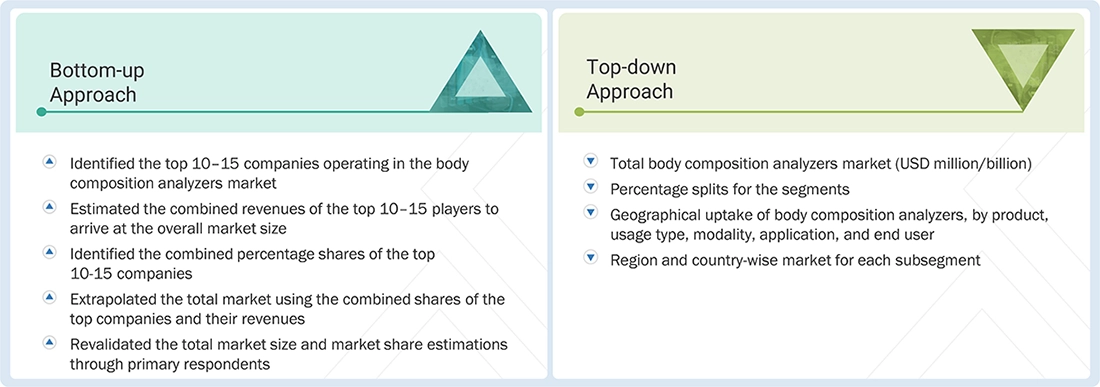
In this report, the global body composition analyzers market size was arrived at by using the revenue share analysis of leading players. For this purpose, key players were identified, and their revenues from the body composition analyzer business were determined through various insights gathered during the primary and secondary research phases. Secondary research included the study of the annual and financial reports of the top market players. In contrast, primary research included extensive interviews with key opinion leaders, such as CEOs, directors, and key marketing executives.
To calculate the global market value, segmental revenues were calculated based on the revenue mapping of major solution/service providers. This process involves the following steps:
- Generating a list of major global players operating in the body composition analyzers market
- Mapping annual revenues generated by major global players from the body composition analyzers segment (or nearest reported business unit/service category)
- Revenue mapping of key players to cover a major share of the global market as of 2025
- Extrapolating the global value of the market
Top-Down and Bottom-Up Approach
Data Triangulation
After arriving at the overall market size from the market size estimation process explained above, the global body composition analyzers market was split into segments and subsegments. Data triangulation and market breakdown procedures were employed to complete the overall market engineering process and arrive at the exact statistics for all segments and subsegments. The data was triangulated by studying various factors and trends from the demand and supply sides. Additionally, the market was validated using both top-down and bottom-up approaches.
Market Definition
Body composition analyzers consist of devices and systems that quantitatively measure a person’s body composition, which includes different parameters such as body fat mass, percentage of body fat, body muscle mass, lean mass, total body water amount, bone mass, and visceral fat. To estimate or assess body composition, analyzers employ various technologies such as bioelectrical impedance analysis (BIA), dual-energy X-ray absorptiometry (DEXA/DXA), skinfold measurement, air displacement plethysmography, and hydrostatic weighing.
Key Stakeholders
- Body composition analyzer manufacturing companies
- Original equipment manufacturing companies
- Body composition analyzer Suppliers and distributors
- Healthcare service providers
- Health insurance payers
- Government bodies/municipal corporations
- Regulatory bodies
- Medical research institutes
- Business research and consulting service providers
- Venture capitalists
- Market research and consulting firms
Report Objectives
- To describe and forecast the global body composition analyzers market, by product, usage type, modality, application, end user, and region, in terms of value
- To forecast the global body composition analyzers market, by product, in terms of volume
- To forecast the size of the market segments concerning five main regions, namely North America, Europe, Asia Pacific, Latin America, and the Middle East & Africa, in terms of value
-
To provide detailed information regarding the major factors influencing the market growth
(such as drivers, restraints, opportunities, and challenges) along with the current trends - To strategically analyze micromarkets concerning individual growth trends, prospects, and contributions to the overall market
- To analyze the opportunities in the global market for stakeholders and provide details of the competitive landscape for market leaders
- To profile the key players and analyze their market shares and core competencies
- To track and analyze competitive developments, such as product launches, partnerships, agreements, collaborations, expansions, strategic alliances, and acquisitions, in the global market
- To benchmark players within the market using the proprietary “Company Evaluation Matrix” framework, which analyzes market players on various parameters within the broad categories of business and product excellence strategy
Available customizations:
With the given market data, MarketsandMarkets offers customizations as per the company’s specific needs. The following customization options are available for the present global body composition analyzers market report:
Product Analysis
- Product matrix, which gives a detailed comparison of the product portfolios of the top twelve companies
Company Information
- Detailed analysis and profiling of additional market players (up to 10)
Geographic Analysis
- Further breakdown of the Rest of Europe’s body composition analyzers market into Russia, Finland, Switzerland, Turkey, the Czech Republic, the Netherlands, Norway, Poland, Portugal, Romania, Estonia, Austria, Belgium
- Further breakdown of the Rest of Asia Pacific’s body composition analyzers market into Taiwan, New Zealand, and Sri Lanka
- Further breakdown of the Rest of Latin America’s body composition analyzers market into Uruguay, Costa Rica, Bolivia, Venezuela, and Paraguay
Get the Full Body Composition Analyzers Market Report
Full forecast, segment splits, and company analysis for all Body Composition Analyzers Market.
- Rest Of Europe Body Composition Analyzers Market
- Rest Of Latin America Body Composition Analyzers Market
- Ksa Body Composition Analyzers Market
- Other GCC Countries Body Composition Analyzers Market
- UAE Body Composition Analyzers Market
- US Body Composition Analyzers Market
- Canada Body Composition Analyzers Market
- Germany Body Composition Analyzers Market
- France Body Composition Analyzers Market
- UK Body Composition Analyzers Market
- Italy Body Composition Analyzers Market
- Spain Body Composition Analyzers Market
- China Body Composition Analyzers Market
- Japan Body Composition Analyzers Market
- India Body Composition Analyzers Market
- Brazil Body Composition Analyzers Market
- Mexico Body Composition Analyzers Market
Need a Tailored Report?
Customize this report to your needs
Get 10% FREE Customization
Customize This Report
