
Italy Border Security Market (2024-2029)

The Italy Border Security Market was valued at $378.7 Million in 2024 and projected to reach to $463.9 Million by 2029, representing a compound annual growth rate of 4.1%. Italy's border security market is positioned for steady growth, driven by EU regulatory mandates, increasing migration pressures, and the need for modernized surveillance infrastructure.


| Market Size in | USD 26.32 MN |
| Market Forecast in | |
| CAGR | |
| Forecast Period | |
| Units Considered | Value (USD MN) |
Italy Border Security Market Trends and Insights
- Italy's strategic position as a Mediterranean gateway and EU member state drives sustained investment in advanced surveillance, monitoring, and access control technologies.
- Italy faces unique border security challenges across its maritime and land frontiers, necessitating continuous modernization of detection systems, biometric solutions, and integrated command-and-control platforms. The growth trajectory for Italy's border security market reflects heightened regional security concerns, increased cross-border mobility, and compliance with EU border management directives.
- Italy is progressively adopting AI-enabled analytics, drone surveillance, and real-time intelligence systems to enhance operational efficiency.
- Between 2024 and 2029, Italy's market expansion will be supported by government funding initiatives, public-private partnerships, and technology upgrades aligned with European border security standards and NATO interoperability requirements..
Key Market Statistics
- CAGR (2024-2029) 4.1% CAGR
- Market Size, 2024 ~USD 378.7 Million
- Forecast, 2029 ~USD 463.9 Million
- Country Italy
Italy Border Security Market Overview
Mediterranean Strategic Position :
Italy's role as a critical Mediterranean gateway and EU external border creates persistent demand for advanced border security infrastructure, particularly across maritime and land entry points.
EU Compliance & Schengen Requirements :
As a Schengen Area member, Italy must maintain stringent border control standards, driving continuous investment in surveillance systems, biometric technologies, and integrated monitoring solutions.
Migration & Security Pressures :
Italy's exposure to irregular migration flows and transnational security threats necessitates modernization of detection, identification, and response capabilities across its borders.
Technology Modernization Initiatives :
Italian government investments in AI-powered surveillance, drone monitoring, and real-time data analytics are accelerating adoption of next-generation border security technologies.
Italy Border Security Market Dynamics
- The market's 4.1% CAGR reflects sustained government spending on technology upgrades and operational enhancements across maritime, land, and airport borders.
- Investment priorities include integrated command centers, biometric systems, and AI-enabled threat detection.
- Regional cooperation within the EU and bilateral agreements with neighboring countries will further support market expansion through 2029..
Market Ecosystem
Related Ecosystem
Defence Platforms And Systems
- Sensors
- Unmanned Ground Vehicles (UGV)
- Fighter Aircraft
- Special Mission Aircraft
- Antennas
- BAE Systems plc
- Thales group
- LOCKHEED MARTIN CORPORATION
- Northrop Grumman Corporation
- L3Harris Technologies, Inc.
Security And Surveillance
- Face Recognition
- Video Surveillance as A Service (VSaaS)
- Voice Recognition
- Fingerprint Recognition
- IRIS Recognition
- HONEYWELL INTERNATIONAL INC.
- Thales group
- HID-GLOBAL
- Lenovo
- AXIS COMMUNICATIONS
Cyber Security
- Cloud Security
- Biometric Systems
- Data Loss Prevention (DLP)
- Multi-Factor Authentication
- Security Analytics
- REDINGTON
- International Business Machines Corporation
- Cisco Systems, Inc.
- MITSUI BUSSAN SECURE DIRECTIONS INC
- MICROSOFT CORPORATION
Key Takeaways
- Italy's border security market is valued at USD 378.7 million in 2024 and will grow to USD 463.9 million by 2029 at a 4.1% CAGR.
- Italy's Mediterranean geography and EU membership create sustained demand for advanced maritime and land border surveillance technologies.
- Italy is increasingly deploying AI-enabled analytics, drone systems, and biometric solutions to modernize border operations.
- Government funding, EU compliance mandates, and NATO interoperability standards are key growth drivers for Italy's border security investments.
Border Security Market Report Scope
| Report Metric | Details |
|---|---|
| Base Year | 2024 |
| Fastest Growing Segment | UPGRADES (Installation) |
| Forecast Period | 2024-2029 |
| Growth Rate | CAGR of 5.1% from 2024 to 2029 |
| Largest Segment | NEW INSTALLATIONS (Installation) |
| Market Size Base Year (Billions) | ~USD 26.83 (2024) |
| Revenue Forecast (Billions) | ~USD 34.4 (2029) |
| Segments Covered | Domain, Vertical, System, Installation |
Italy Border Security Market Report Segmentation
4 segment dimensions are covered across the global market.
By Domain
- Airborne
- Land
- Maritime
By Vertical
- Homeland Security
- Military
By System
- Command & Control Systems
- Communication Systems
- Communications Systems
- Cybersecurity Systems
- Detection Systems
- Laser Systems
- Perimeter Intrusion Detection Systems
- Surveillance Systems
- Unmanned Systems
By Installation
- New Installations
- Upgrades
Target Audience
- Government & Defense Agencies : Italian border police, coast guard, and interior ministry officials require market intelligence to justify budget requests, evaluate technology vendors, and align procurement with EU standards.
- Technology & Defense Contractors : Aerospace and defense companies seeking to enter or expand in Italy's market need detailed insights on demand drivers, competitive positioning, and government procurement opportunities.
- Security System Integrators : System integrators and solution providers require Italy-specific data on technology preferences, regulatory requirements, and customer needs to develop tailored border security offerings.
- Investment & Private Equity Firms : Investors evaluating opportunities in Italian defense and security sectors need market sizing, growth forecasts, and risk analysis to support M&A and portfolio decisions.
- Strategic Consultants & Analysts : Management consultants advising government agencies and private companies require authoritative market data and trend analysis to support strategic planning and competitive recommendations.
Reasons to Buy this Report
- Market Size & Growth Trajectory : Access precise valuation data for Italy's border security market (USD 378.7M in 2024) with 5-year forecasts, enabling accurate budget allocation and investment planning for regional expansion.
- Italy-Specific Regulatory Insights : Understand EU Schengen compliance requirements, Italian government procurement standards, and regional security policies that directly influence technology adoption and vendor selection.
- Competitive Landscape Analysis : Identify key players, market share distribution, and technology preferences specific to Italy's border security ecosystem, including local partnerships and government contracts.
- Strategic Growth Opportunities : Discover high-potential segments including maritime surveillance, biometric systems, AI-powered analytics, and integrated command centers tailored to Italy's unique border challenges.
- Risk & Opportunity Assessment : Evaluate migration trends, security threats, EU funding mechanisms, and political factors shaping Italy's border security investments through 2029.
Frequently asked questions
What is the current size of Italy's border security market?
Italy's border security market is valued at USD 378.7 million in 2024 and is expected to reach USD 463.9 million by 2029.
What is the projected growth rate for Italy's border security market?
Italy's border security market is projected to grow at a compound annual growth rate (CAGR) of 4.1% from 2024 to 2029.
What technologies is Italy adopting for border security?
Italy is adopting AI-enabled analytics, drone surveillance systems, biometric solutions, real-time intelligence platforms, and integrated command-and-control systems to enhance border operations.
What factors are driving growth in Italy's border security market?
Key drivers include EU border management compliance requirements, regional security concerns, increased cross-border mobility, government funding initiatives, and NATO interoperability standards.
How does Italy's geography influence its border security needs?
Italy's strategic Mediterranean position and extensive maritime borders, combined with its EU membership, create unique challenges requiring advanced surveillance and monitoring technologies across both land and sea frontiers.
RESEARCH METHODOLOGY
This research study involved the substantial use of secondary sources, directories, and databases, such as D&B Hoovers, Bloomberg Businessweek, and Factiva, to identify and collect information on the border security market. Primary sources included experts from core and related industries, suppliers, manufacturers, solution providers, technology developers, alliances, and organizations related to all segments of the industry’s value chain. All primary sources were interviewed to obtain and verify critical qualitative and quantitative information as well as assess prospects for the growth of the market during the forecast period.
Secondary Research
The market size of companies offering border security systems was arrived at based on the secondary data available through paid and unpaid sources, as well as by analyzing the product portfolios of major companies and rating them based on their performance and quality.
In the secondary research process, various secondary sources were referred to identify and collect information for this study. These included government sources; corporate filings such as annual reports, press releases, and investor presentations; white papers, journals, and certified publications; and articles by recognized authors, directories, and databases.
Secondary research was mainly used to obtain key information about the industry’s value and supply chain and identify the key players by various products, market classifications, and segmentation according to their offerings and industry trends related to domain, vertical, system, installation, and region, and key developments from both the market and technology-oriented perspectives.
Primary Research
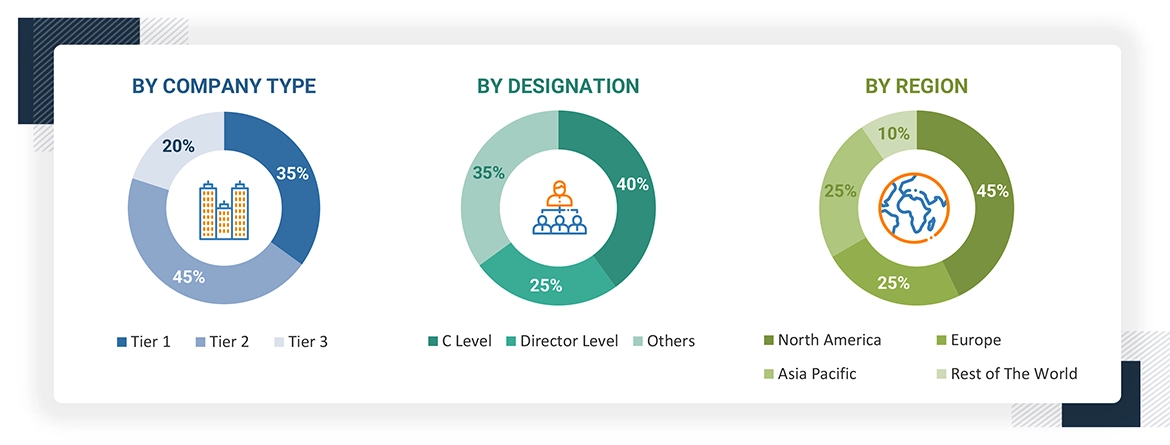
In the primary research process, various primary sources from both the supply and demand sides were interviewed to obtain qualitative and quantitative information on the market. Primary sources from the supply side included various industry experts, such as vice presidents (VPs), directors from business development, marketing, product development/innovation teams, and related key executives from components vendors, border security systems manufacturers, integrators, distributors, and key opinion leaders.
Primary interviews were conducted to gather insights such as market statistics, data on revenue collected from products, market breakdowns, market size estimations, market forecasting, and data triangulation. Primary research also helped me understand the various trends related to border security systems. Stakeholders from the demand side, such as CIOs, CTOs, CSOs, and installation teams of customers/end users of border security systems, were interviewed to understand the buyer’s perspective on suppliers, products, component providers, their current usage of border security systems, and the outlook of their businesses.
To know about the assumptions considered for the study, download the pdf brochure
Market Size Estimation
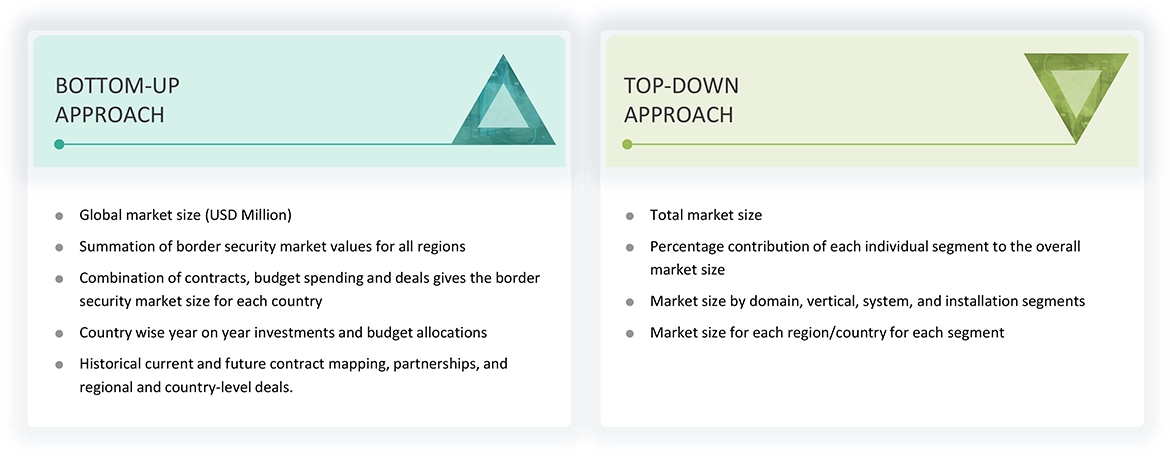
Top-down and bottom-up approaches were used to estimate and validate the size of the border security market. The research methodology used to estimate the size of the market includes the following details.
Key players in the border security market were identified through secondary research, and their market share was determined through primary and secondary research. This included a study of the annual and financial reports of top market players and extensive interviews with leaders such as directors, engineers, marketing executives, and other stakeholders of leading companies operating in the border security market.
All percentage shares, splits, and breakdowns were determined using secondary sources and verified through primary sources. All possible parameters that affect the markets covered in this research study were accounted for, viewed in extensive detail, verified through primary research, and analyzed to obtain the final quantitative and qualitative data on the border security market. This data was consolidated, enhanced with detailed inputs, analyzed by MarketsandMarkets, and presented in this report.
Data Triangulation
After arriving at the overall market size from the market size estimation process, the total market was split into several segments and subsegments. Data triangulation and market breakdown procedures explained below were implemented, wherever applicable, to complete the overall market engineering process and arrive at the estimated market numbers for border security systems segments and subsegments. The data was triangulated by studying various factors and trends from both the demand and supply sides. The market size was also validated using both top-down and bottom-up approaches.
Market Definition
Border Security systems are complete and fully integrated border management solutions as well as specific systems and products for surveillance and control of different environments such as land, airborne, and coastal border surveillance. Border security systems include buried cable/buried sensors, Radar systems, CCTV and thermal imaging IR detection camera systems, perimeter intrusion detection systems/ intelligent fencing systems, unmanned vehicles, wide-band wireless communication systems, command and control (C2) systems, biometric systems, and others (RF jammers, microwave intrusion detection system).
Report Objectives
- To define, describe, segment, and forecast the size of the border security market based on domain, vertical, system, installation, and region
- To forecast the size of market segments with respect to five regions, namely North America, Europe, Asia Pacific, the Middle East, and the Rest of the World, along with major countries in each region
- To identify and analyze key drivers, restraints, opportunities, and challenges influencing the market growth
- To analyze micromarkets1 with respect to individual growth trends, prospects, and their contribution to the overall market
- To analyze opportunities in the market for stakeholders by identifying key market trends
- To profile key market players and comprehensively analyze their market shares and core competencies2
- To identify detailed financial positions, key products, and unique selling points of leading companies in the market
- To provide a detailed competitive landscape of the market, along with market share analysis, market ranking analysis, and revenue analysis of key players
- To analyze the degree of competition in the market by identifying key growth strategies adopted by leading market players
Available customizations
Along with the market data, MarketsandMarkets offers customizations as per the specific needs of companies. The following customization options are available for the report:
Product Analysis
- Product matrix, which gives a detailed comparison of the product portfolio of each company
Regional Analysis
- Further breakdown of the market segments at country-level
Company Information
- Detailed analysis and profiling of additional market players (up to 5)
Get the Full Border Security Market Report
Full forecast, segment splits, and company analysis for all Border Security Market.
- Rest Of Europe Border Security Market
- Rest Of Asia Pacific Border Security Market
- Canada Border Security Market
- US Border Security Market
- UK Border Security Market
- Germany Border Security Market
- France Border Security Market
- India Border Security Market
- Japan Border Security Market
- Singapore Border Security Market
- Australia Border Security Market
- Saudi Arabia Border Security Market
- UAE Border Security Market
- Israel Border Security Market
- Turkey Border Security Market
Need a Tailored Report?
Customize this report to your needs
Get 10% FREE Customization
Customize This Report
