
India Bottled Water Processing Market (2023-2028)

The India Bottled Water Processing Market was valued at $29442.6 Million in 2023 and projected to reach to $49388.7 Million by 2028, representing a compound annual growth rate of 10.9%. India's bottled water processing market is poised for exceptional growth, projected to reach USD 49,388.7 million by 2028.


| Market Size in | USD 26.32 MN |
| Market Forecast in | |
| CAGR | |
| Forecast Period | |
| Units Considered | Value (USD MN) |
India Bottled Water Processing Market Trends and Insights
- India's market is experiencing accelerated growth driven by rising urbanization, increasing health consciousness, and expanding distribution networks across tier-2 and tier-3 cities.
- The forecast period through 2028 projects India's market to reach USD 49,388.7 million, significantly outpacing global growth rates and reflecting the country's demographic tailwinds and evolving consumer preferences for packaged beverages. India's bottled water processing sector benefits from favorable macroeconomic conditions, including rising disposable incomes and growing concerns over water quality and safety.
- India's market dynamics are shaped by both organized and unorganized players, with increasing consolidation among major manufacturers.
- The competitive intensity in India reflects the country's large population base and untapped rural markets, positioning India as a critical growth engine for multinational and domestic processors through 2028..
Key Market Statistics
- CAGR (2023-2028) 10.9% CAGR
- Market Size, 2023 ~USD 29442.6 Million
- Forecast, 2028 ~USD 49388.7 Million
- Country India
India Bottled Water Processing Market Overview
Market Valuation :
India's bottled water processing market reached USD 29,442.6 million in 2023, demonstrating strong market maturity and significant investment opportunities across the value chain.
Accelerated Growth Trajectory :
With a CAGR of 10.9% through 2028, India's market growth significantly outpaces the global average of 5.7%, reflecting unique domestic demand drivers and market expansion potential.
Urbanization & Tier-2/3 Expansion :
Rising urbanization and expanding distribution networks in tier-2 and tier-3 cities are unlocking new consumer segments, driving market penetration beyond metropolitan areas.
Health Consciousness Surge :
Increasing health awareness among Indian consumers is fueling demand for safe, processed bottled water, positioning the market for sustained growth through 2028.
India Bottled Water Processing Market Dynamics
- The market's 10.9% CAGR reflects strong fundamentals driven by rapid urbanization, rising disposable incomes, and heightened consumer focus on water safety and quality.
- Expansion into secondary and tertiary cities presents substantial untapped opportunities as distribution infrastructure improves. The forecast period will witness intensified competition, technological innovation in processing and packaging, and consolidation among regional players.
- Government initiatives promoting safe drinking water access and increasing regulatory standards will further accelerate market adoption.
- Strategic investments in automation, sustainability, and premium product segments will define competitive positioning in India's dynamic bottled water processing landscape..
Market Ecosystem
Related Ecosystem
Fandb Processing And Technology
- Dairy Products
- Bakery Products
- Filtration Equipment
- Heat Exchanger
- Acetic Acid
- Gea group
- John Bean Technologies Corporation
- Alfa Laval Corporate AB
- AZELIS HOLDINGS SA
- SPX FLOW INC
Key Takeaways
- India's bottled water processing market is valued at USD 29,442.6 million in 2023 and is projected to grow to USD 49,388.7 million by 2028, representing a 10.9% CAGR.
- India's market growth significantly exceeds the global CAGR of 5.7%, driven by urbanization, rising incomes, and water quality concerns across the country.
- India's expanding middle class and tier-2/tier-3 city penetration present substantial untapped opportunities for both domestic and international bottled water processors.
- India's competitive landscape is consolidating, with organized players gaining market share from unorganized segments as regulatory standards and consumer preferences evolve.
Bottled Water Processing Market Report Scope
| Report Metric | Details |
|---|---|
| Base Year | 2023 |
| Fastest Growing Segment | SPARKLING WATER (Product Type) |
| Forecast Period | 2023-2028 |
| Growth Rate | CAGR of 5.7% from 2023 to 2028 |
| Largest Segment | STILL WATER (Product Type) |
| Market Size Base Year (Billions) | ~USD 7.2 (2023) |
| Revenue Forecast (Billions) | ~USD 9.5 (2028) |
| Segments Covered | Product Type, Packaging Material, Equipment, Technology, Type, End-Use Industry |
India Bottled Water Processing Market Report Segmentation
6 segment dimensions are covered across the global market.
By Product Type
- Desalination
- Disinfection
- Filtration
- Sparkling Flavored
- Sparkling Unflavored
- Sparkling Water
- Still Flavored
- Still Unflavored
- Still Water
- Testing
By Packaging Material
- Cans
- Glass
- Other Packaging Materials
- Plastic
By Equipment
- Blow Molders
- Bottle Washers
- Fillers & Cappers
- Filters
- Other Equipment
- Others Equipment
- Shrink Wrappers
By Technology
- Disinfection
- Filtration
- Ion Exchange & Demineralization
- Packaging
By Type
- Brewery Equipment
- Carbonation Equipment
- Filtration Equipment
- Heat Exchangers
- Other Types*
- Sugar Dissolvers And Blenders & Mixers
By End-Use Industry
- Industrial
- Municipal
Target Audience
- Beverage Processing Manufacturers : Manufacturers need India-specific market data to assess expansion opportunities, benchmark production capacity requirements, and identify optimal locations for new processing facilities in high-growth regions.
- Investment & Private Equity Firms : Investors require detailed India market analysis to evaluate acquisition targets, assess portfolio company growth potential, and make informed capital allocation decisions in the bottled water sector.
- Distribution & Logistics Companies : Distributors need insights into tier-2/3 city expansion and distribution network growth to plan warehouse locations, optimize supply chains, and capture emerging market opportunities across India.
- Packaging & Equipment Suppliers : Suppliers require India market forecasts to project demand for processing equipment, packaging materials, and technology solutions aligned with the sector's 10.9% growth trajectory.
- Strategic Business Consultants : Consultants advising clients on India market entry or expansion need comprehensive market data, growth drivers, and competitive landscape analysis to develop credible business strategies and recommendations.
Reasons to Buy this Report
- India-Specific Market Sizing : Access precise valuation data for India's bottled water processing market with detailed historical performance (2023: USD 29,442.6M) and accurate forecasts through 2028, enabling confident investment decisions.
- Competitive Advantage Intelligence : Understand India's unique growth drivers—urbanization, tier-2/3 expansion, and health consciousness—to identify market gaps and develop targeted strategies ahead of competitors.
- Regional Growth Benchmarking : Compare India's 10.9% CAGR against global 5.7% growth to quantify market outperformance and justify resource allocation to India's high-potential bottled water processing sector.
- Distribution Network Insights : Leverage detailed analysis of expanding distribution channels across secondary and tertiary cities to optimize market entry strategies and supply chain planning for India.
- Forecast-Driven Planning : Utilize 2028 market projection (USD 49,388.7M) to develop long-term business plans, capacity investments, and product development roadmaps aligned with India's growth trajectory.
Frequently asked questions
What is the current size of India's bottled water processing market?
India's bottled water processing market was valued at USD 29,442.6 million in 2023 and is expected to reach USD 49,388.7 million by 2028.
What is the projected growth rate for India's bottled water processing market?
India's bottled water processing market is projected to grow at a CAGR of 10.9% from 2023 to 2028, significantly outpacing the global average of 5.7%.
What factors are driving growth in India's bottled water processing market?
India's market growth is driven by rapid urbanization, increasing health consciousness, rising disposable incomes, water quality concerns, and expanding distribution networks in emerging cities.
Which regions within India show the highest growth potential?
India's tier-2 and tier-3 cities represent the highest growth potential, as expanding middle-class populations in these regions increasingly adopt packaged water consumption.
How is India's bottled water processing market structured?
India's market comprises both organized players (major manufacturers with established distribution) and unorganized segments, with consolidation favoring organized competitors meeting regulatory standards.
RESEARCH METHODOLOGY
The research study involved extensive secondary sources, directories, and databases such as Bloomberg Businessweek and Factiva to identify and collect information useful for a technical, market-oriented, and commercial study of the bottled water processing market. In-depth interviews were conducted with various primary respondents—such as key industry participants, subject matter experts (SMEs), C-level executives of key market players, and industry consultants—to obtain and verify critical qualitative and quantitative information and assess prospects.
Secondary Research
In the secondary research process, various secondary sources were referred to, so as to identify and collect information. These secondary sources included annual reports, press releases & investor presentations of companies, white papers, certified publications, articles by recognized authors, reports by the International Bottled Water Association (IBWA) and regulatory bodies, news articles, trade directories, and databases. They were used to identify and collect information. The secondary research was used mainly to obtain key information about the industry’s supply chain, distribution channels, the total pool of key players, market classification, and segmentation according to the industry trends to the bottom-most level, regional markets and key developments from both market- and technology-oriented perspectives.
Primary Research
The bottled water processing market comprises several stakeholders, such as raw material suppliers, processors, machine and component manufacturers, and regulatory organizations, in the supply chain. The supply side of the bottled water processing market is characterized by the presence of key machine/equipment manufacturers or assembly manufacturers. The demand side is characterized by the presence of bottled water processors, manufacturers, retailers, and key technology providers for the manufacturing of bottled water. Various key opinion leaders (KOLs) from both the supply and demand sides of the market were interviewed to obtain qualitative and quantitative information. The primary interviewees from the demand side include key opinion leaders, executives, vice presidents, CEOs, managers from public and private organizations, and food & beverage stakeholders. The primary sources from the supply side include the research institutions involved in R&D to introduce technologies for updating equipment, key opinion leaders, distributors, and food equipment manufacturers.
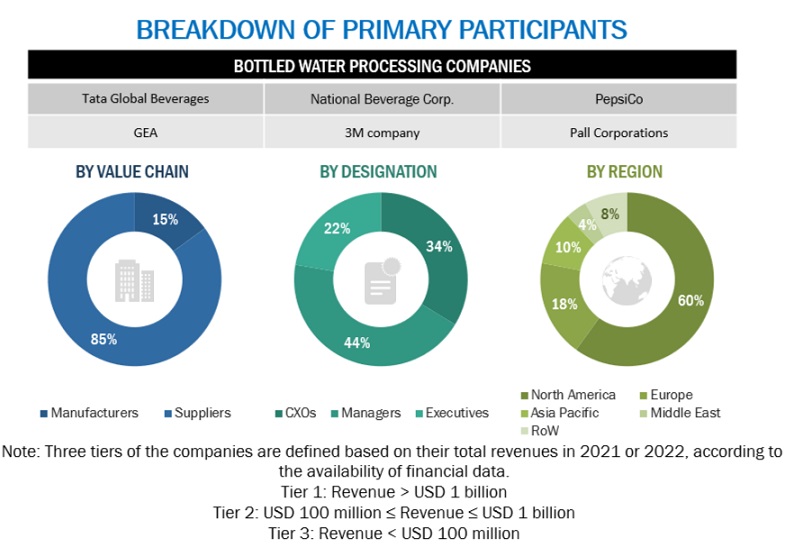
To know about the assumptions considered for the study, download the pdf brochure
Market Size Estimation
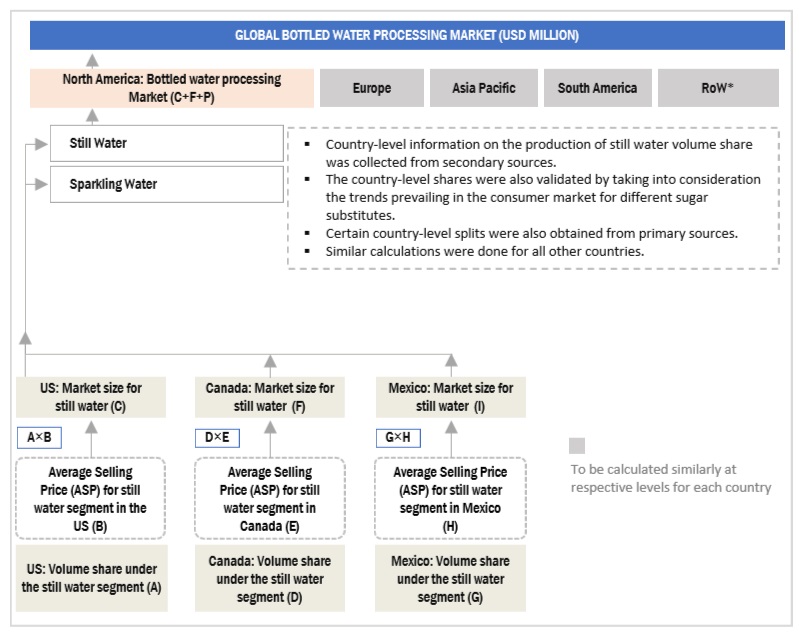
Both the top-down and bottom-up approaches were used to estimate and validate the total size of the market. These approaches were also used extensively to estimate the market size of various dependent submarkets in the overall bottled water processing market. The research methodology used to estimate the market size includes the following details:
- The key players were identified through extensive secondary and primary research.
- The industry’s value chain and market size, in terms of value, were determined through primary and secondary research.
- All percentage shares, splits, and breakdowns were determined using secondary research and verified through primary sources.
- All possible parameters that affect the markets covered in this research study have been accounted for, viewed in extensive detail, verified through primary sources, and analyzed to obtain the final quantitative and qualitative data.
Market size estimation: Top-Down approach
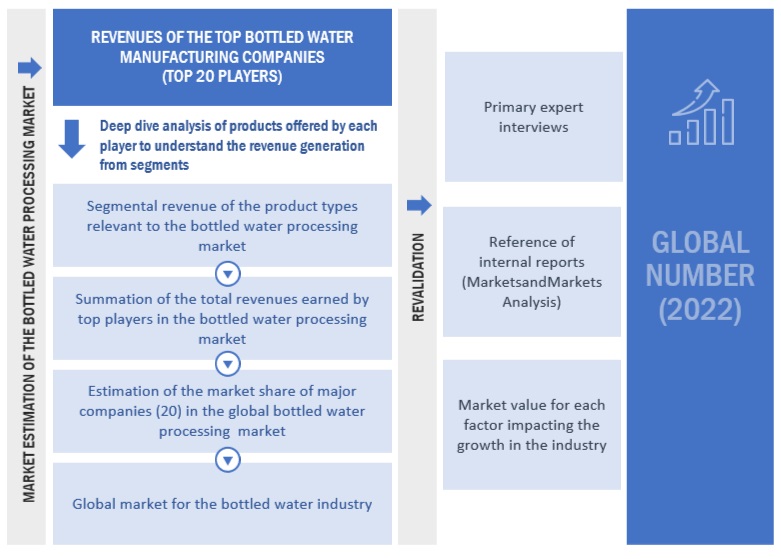
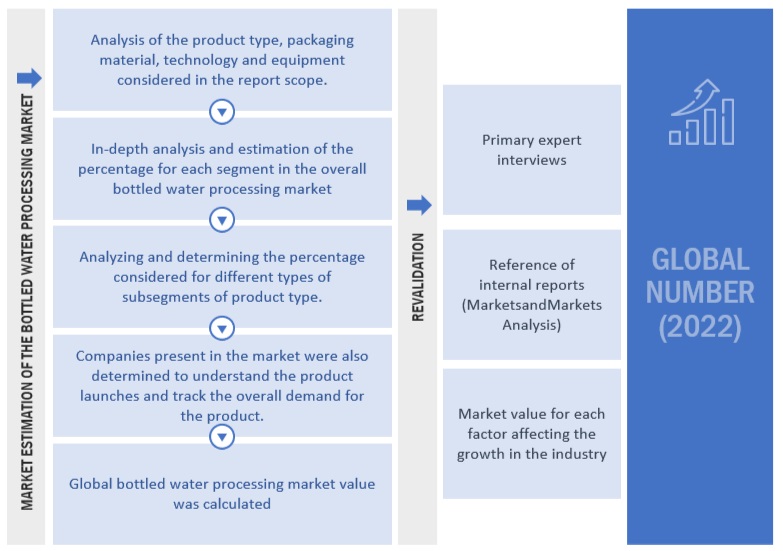
To know about the assumptions considered for the study, Request for Free Sample Report
Market size estimation methodology: Bottom-up approach
Data Triangulation
After arriving at the overall market size from the estimation process explained above, the total market was split into several segments. To complete the overall market engineering process and arrive at the exact statistics for all segments, the data triangulation and market breakdown procedures were employed, wherever applicable. The data was triangulated by studying various factors and trends from both the demand and supply sides. In addition, the market size was validated using both the top-down and bottom-up approaches; it was then verified through primary interviews. Thus, there are three approaches: the first is the top-down approach, the second is the bottom-up approach, and the third is the learning and verification approach through expert interviews. Only when the values arrived at from the three points match, is the data assumed to be correct.
Market Definition
Bottled water processing technology & equipment is defined (for this study) as: “any process, method, and protocol by which the machineries and equipment are used in the manufacturing, handling, packaging, and storing of these.” The global demand and revenue generated by the sales and marketing of these equipment and technology lead to the sizing of the global sales value market.
“Bottled water is an optimal choice for hydration and refreshment, offering consistent safety, quality, good taste, and convenience. The United States Food and Drug Administration (FDA) comprehensively regulates bottled water, treating it as a packaged food product. Bottled water must adhere to the FDA's stringent requirements regarding food safety, labeling, and inspections. It is also subject to state regulations, and members of the International Bottled Water Association (IBWA) are obligated to follow the IBWA Model Code.
The classification of water as "bottled water" or "drinking water" is contingent upon meeting all applicable federal and state standards, being sealed in a sanitary container, and being intended for human consumption. Importantly, FDA standards for bottled water are legally mandated to be at least as rigorous and health-protective as the standards set by the U.S. Environmental Protection Agency (EPA) for public water systems.”
Key Stakeholders
-
Manufacturers/Suppliers
- Bottled water manufacturers and processors.
- Polymer industry
- Bottled water retailers, wholesalers, and distributors.
- Bottled water equipment manufacturers and providers.
- Research & development laboratories
-
Regulatory bodies and institutions, and government agencies
- Organizations such as the Food and Drug Administration (FDA), United States Department of Agriculture (USDA), European Food Safety Agency (EFSA), EUROPA, Codex Alimentarius, and Food Safety Australia and New Zealand (FSANZ)
- Associations such as International Bottled Water Association (IBWA), International Council of Bottled Water Associations, Canadian Bottled Water Association (CBWA), European Federation of Bottled Waters (EFBW), China Beverage Industry Association (CBIA), Asia and Middle East Bottled Water Association (ABWA), Australasian Bottled Water Institute (ABWI) (Australia and New Zealand), European Bottled Watercooler Association (EBWA), Latin American Bottled Water Association (LABWA)
- Intermediary suppliers
- Bottled water logistics service providers and transporters.
Report Objectives
Market Intelligence
- Determining and projecting the size of the bottled water processing market with respect to equipment, technology, product type, packaging material, and region, over a five-year period ranging from 2023 to 2028.
- Identifying the attractive opportunities in the market by determining the largest and fastest-growing segments across regions
- Providing detailed information about the key factors influencing the growth of the market (drivers, restraints, opportunities, and industry-specific challenges)
- Analyzing the micro-markets with respect to individual growth trends, prospects, and their contribution to the total market
Competitive Intelligence
- Identifying and profiling the key market players in the bottled water processing market.
-
Providing a comparative analysis of the market leaders on the basis of the following:
- Product offerings
- Business strategies
- Strengths and weaknesses
- Key financials
- Understanding the competitive landscape and identifying the major growth strategies adopted by players across the key regions.
- Providing insights on key product innovations and investments in the bottled water processing market.
Available Customizations:
With the given market data, MarketsandMarkets offers customizations according to company-specific scientific needs.
The following customization options are available for the report:
Product Analysis
- Product Matrix, which gives a detailed comparison of the product portfolio of each company.
Geographic Analysis
With the given market data, MarketsandMarkets offers customizations according to company-specific scientific needs.
- Further breakdown of the Rest of European bottled water processing market, by key country
- Further breakdown of the Rest of the South American bottled water processing market, by key country
- Further breakdown of the Rest of Asia Pacific bottled water processing market, by key country
Company Information
- Detailed analyses and profiling of additional market players
Get the Full Bottled Water Processing Market Report
Full forecast, segment splits, and company analysis for all Bottled Water Processing Market.
- Canada Bottled Water Processing Market
- Mexico Bottled Water Processing Market
- Germany Bottled Water Processing Market
- UK Bottled Water Processing Market
- France Bottled Water Processing Market
- Spain Bottled Water Processing Market
- Italy Bottled Water Processing Market
- Poland Bottled Water Processing Market
- China Bottled Water Processing Market
- Japan Bottled Water Processing Market
- Indonesia Bottled Water Processing Market
- Thailand Bottled Water Processing Market
- Brazil Bottled Water Processing Market
- Argentina Bottled Water Processing Market
- South Africa Bottled Water Processing Market
- Rest Of Europe Bottled Water Processing Market
- Rest Of Asia Pacific Bottled Water Processing Market
- Middle East Bottled Water Processing Market
- Rest Of South America Bottled Water Processing Market
- US Bottled Water Processing Market
Need a Tailored Report?
Customize this report to your needs
Get 10% FREE Customization
Customize This Report
