
US Bottled Water Processing Market (2023-2028)

The US Bottled Water Processing Market was valued at $41945.9 Million in 2023 and projected to reach to $58427.9 Million by 2028, representing a compound annual growth rate of 6.9%. The US bottled water processing market is poised for sustained expansion through 2028, driven by evolving consumer preferences toward healthier beverage options and the premiumization of water products.


| Market Size in | USD 26.32 MN |
| Market Forecast in | |
| CAGR | |
| Forecast Period | |
| Units Considered | Value (USD MN) |
US Bottled Water Processing Market Trends and Insights
- This robust expansion reflects the US market's strong consumer demand for convenient, portable hydration solutions and the increasing adoption of advanced processing technologies across the country.
- The US bottled water processing sector is driven by rising health consciousness, growing preference for packaged beverages over tap water, and significant investments in sustainable processing infrastructure throughout the region. During the 2023-2028 forecast period, the US market will benefit from technological innovations in purification, filtration, and packaging systems that enhance product quality and operational efficiency.
- The US industry is also responding to evolving consumer preferences for premium and functional water products, including mineral-enriched and alkaline variants.
- Regulatory compliance and sustainability initiatives are reshaping the US bottled water processing landscape, with manufacturers increasingly adopting eco-friendly practices to meet both consumer expectations and environmental standards..
Key Market Statistics
- CAGR (2023-2028) 6.9% CAGR
- Market Size, 2023 ~USD 41945.9 Million
- Forecast, 2028 ~USD 58427.9 Million
- Country US
US Bottled Water Processing Market Overview
Market Size & Growth :
The US bottled water processing market valued at $41,945.9 million in 2023 is experiencing accelerated growth with a 6.9% CAGR, significantly outpacing the global rate of 5.7%, driven by strong domestic consumer preferences and technological investments.
Consumer Demand Drivers :
American consumers increasingly prioritize convenient, portable hydration solutions, with bottled water becoming a staple in daily routines. Health consciousness and on-the-go lifestyles continue to fuel sustained demand across all demographic segments in the US market.
Technology Adoption :
US bottled water processors are rapidly implementing advanced processing technologies including reverse osmosis, UV treatment, and automated quality control systems to enhance product safety, consistency, and operational efficiency across manufacturing facilities.
Forecast Expansion :
The US market is projected to reach $58,427.9 million by 2028, representing a $16.5 billion increase over five years. This growth trajectory reflects sustained consumer investment in premium and functional water products within the American market.
US Bottled Water Processing Market Dynamics
- Manufacturers are investing heavily in sustainable packaging solutions and advanced purification technologies to meet regulatory standards and consumer expectations for quality and environmental responsibility. Key growth catalysts include rising health awareness, increasing disposable incomes, and the proliferation of functional water variants such as alkaline, mineral-enriched, and vitamin-infused options.
- The competitive landscape will intensify as both established players and emerging brands vie for market share, with innovation in processing efficiency and product differentiation becoming critical success factors for US-based processors..
Market Ecosystem
Related Ecosystem
Fandb Processing And Technology
- Dairy Products
- Bakery Products
- Filtration Equipment
- Heat Exchanger
- Acetic Acid
- Gea group
- John Bean Technologies Corporation
- Alfa Laval Corporate AB
- AZELIS HOLDINGS SA
- SPX FLOW INC
Key Takeaways
- The US bottled water processing market is valued at $41,945.9 million in 2023 and will reach $58,427.9 million by 2028, growing at 6.9% CAGR.
- Advanced processing technologies including reverse osmosis, UV filtration, and ozonation are driving operational efficiency and product quality improvements across the US market.
- Consumer demand for premium, functional, and sustainable bottled water products is reshaping the US processing landscape and driving innovation.
- Regulatory compliance and environmental sustainability initiatives are becoming critical competitive differentiators in the US bottled water processing industry.
Bottled Water Processing Market Report Scope
| Report Metric | Details |
|---|---|
| Base Year | 2023 |
| Fastest Growing Segment | SPARKLING WATER (Product Type) |
| Forecast Period | 2023-2028 |
| Growth Rate | CAGR of 5.7% from 2023 to 2028 |
| Largest Segment | STILL WATER (Product Type) |
| Market Size Base Year (Billions) | ~USD 7.2 (2023) |
| Revenue Forecast (Billions) | ~USD 9.5 (2028) |
| Segments Covered | Product Type, Packaging Material, Equipment, Technology, Type, End-Use Industry |
US Bottled Water Processing Market Report Segmentation
6 segment dimensions are covered across the global market.
By Product Type
- Desalination
- Disinfection
- Filtration
- Sparkling Flavored
- Sparkling Unflavored
- Sparkling Water
- Still Flavored
- Still Unflavored
- Still Water
- Testing
By Packaging Material
- Cans
- Glass
- Other Packaging Materials
- Plastic
By Equipment
- Blow Molders
- Bottle Washers
- Fillers & Cappers
- Filters
- Other Equipment
- Others Equipment
- Shrink Wrappers
By Technology
- Disinfection
- Filtration
- Ion Exchange & Demineralization
- Packaging
By Type
- Brewery Equipment
- Carbonation Equipment
- Filtration Equipment
- Heat Exchangers
- Other Types*
- Sugar Dissolvers And Blenders & Mixers
By End-Use Industry
- Industrial
- Municipal
Target Audience
- Bottled Water Manufacturers : US-based and international processors need precise market data to optimize production capacity, plan facility investments, and develop competitive strategies in a market growing faster than global averages.
- Equipment & Technology Suppliers : Manufacturers of processing equipment, purification systems, and automation solutions require detailed US market insights to identify growth opportunities and tailor product offerings to domestic processor needs.
- Private Equity & Investors : Investment firms evaluating acquisition targets or expansion opportunities in the US bottled water sector need comprehensive market data, growth forecasts, and competitive analysis to support due diligence and valuation.
- Packaging & Materials Providers : Suppliers of bottles, caps, labels, and sustainable packaging solutions need US market-specific demand forecasts to align production capacity with processor growth and emerging sustainability requirements.
- Regulatory & Compliance Consultants : Consultants advising US processors on FDA compliance, quality standards, and regulatory changes require market intelligence to understand industry-wide adoption of advanced processing technologies and best practices.
Reasons to Buy this Report
- Precise US Market Valuation : Access exact market sizing data specific to the United States, with verified 2023 baseline ($41,945.9M) and 2028 forecasts ($58,427.9M), enabling accurate financial planning and investment decisions for US operations.
- Competitive Intelligence : Understand the US competitive landscape, identify market gaps, and benchmark your processing capabilities against domestic competitors operating at higher growth rates than global averages, informing strategic positioning.
- Technology & Process Insights : Gain detailed intelligence on advanced processing technologies being adopted across US facilities, including automation, quality control systems, and sustainability innovations driving the 6.9% CAGR advantage.
- Consumer Trend Analysis : Leverage US-specific consumer behavior data on portable hydration preferences, premium product demand, and functional water adoption patterns to guide product development and marketing strategies for American markets.
- Investment & Expansion Planning : Make informed capital allocation decisions for US facility expansion, technology upgrades, or market entry with comprehensive forecasts and growth trajectory analysis specific to the American bottled water processing sector.
Frequently asked questions
What is the current size of the US bottled water processing market?
The US bottled water processing market was valued at $41,945.9 million in 2023 and is expected to grow to $58,427.9 million by 2028.
What is the projected growth rate for the US bottled water processing market?
The US bottled water processing market is projected to grow at a compound annual growth rate (CAGR) of 6.9% from 2023 to 2028.
What are the main drivers of growth in the US bottled water processing market?
Key growth drivers in the US market include rising health consciousness, consumer preference for packaged beverages, technological innovations in processing, and increasing demand for premium and functional water products.
What processing technologies are most commonly used in the US bottled water industry?
The US bottled water processing industry utilizes advanced technologies such as reverse osmosis, UV filtration, ozonation, microfiltration, and multi-stage purification systems to ensure product quality and safety.
How are sustainability concerns impacting the US bottled water processing market?
Sustainability initiatives in the US market are driving adoption of eco-friendly packaging, water conservation practices, and energy-efficient processing systems as manufacturers respond to regulatory requirements and consumer environmental expectations.
RESEARCH METHODOLOGY
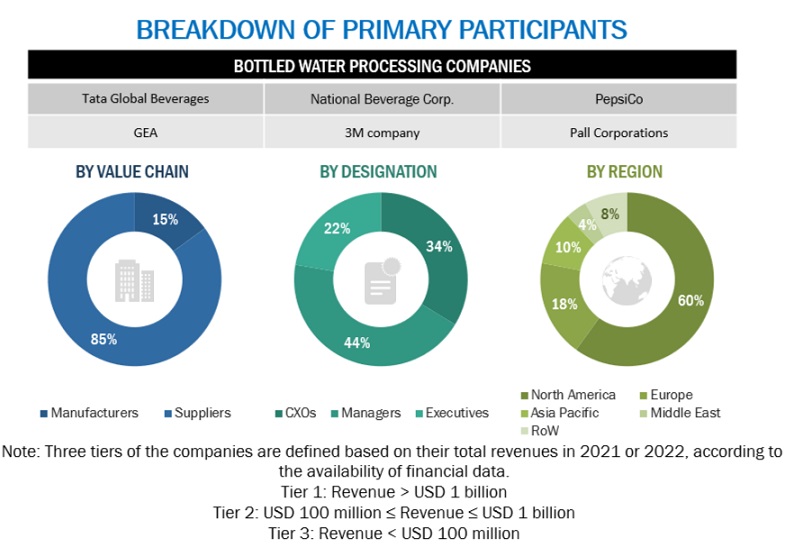
The research study involved extensive secondary sources, directories, and databases such as Bloomberg Businessweek and Factiva to identify and collect information useful for a technical, market-oriented, and commercial study of the bottled water processing market. In-depth interviews were conducted with various primary respondents—such as key industry participants, subject matter experts (SMEs), C-level executives of key market players, and industry consultants—to obtain and verify critical qualitative and quantitative information and assess prospects.
Secondary Research
In the secondary research process, various secondary sources were referred to, so as to identify and collect information. These secondary sources included annual reports, press releases & investor presentations of companies, white papers, certified publications, articles by recognized authors, reports by the International Bottled Water Association (IBWA) and regulatory bodies, news articles, trade directories, and databases. They were used to identify and collect information. The secondary research was used mainly to obtain key information about the industry’s supply chain, distribution channels, the total pool of key players, market classification, and segmentation according to the industry trends to the bottom-most level, regional markets and key developments from both market- and technology-oriented perspectives.
Primary Research
The bottled water processing market comprises several stakeholders, such as raw material suppliers, processors, machine and component manufacturers, and regulatory organizations, in the supply chain. The supply side of the bottled water processing market is characterized by the presence of key machine/equipment manufacturers or assembly manufacturers. The demand side is characterized by the presence of bottled water processors, manufacturers, retailers, and key technology providers for the manufacturing of bottled water. Various key opinion leaders (KOLs) from both the supply and demand sides of the market were interviewed to obtain qualitative and quantitative information. The primary interviewees from the demand side include key opinion leaders, executives, vice presidents, CEOs, managers from public and private organizations, and food & beverage stakeholders. The primary sources from the supply side include the research institutions involved in R&D to introduce technologies for updating equipment, key opinion leaders, distributors, and food equipment manufacturers.
To know about the assumptions considered for the study, download the pdf brochure
Market Size Estimation
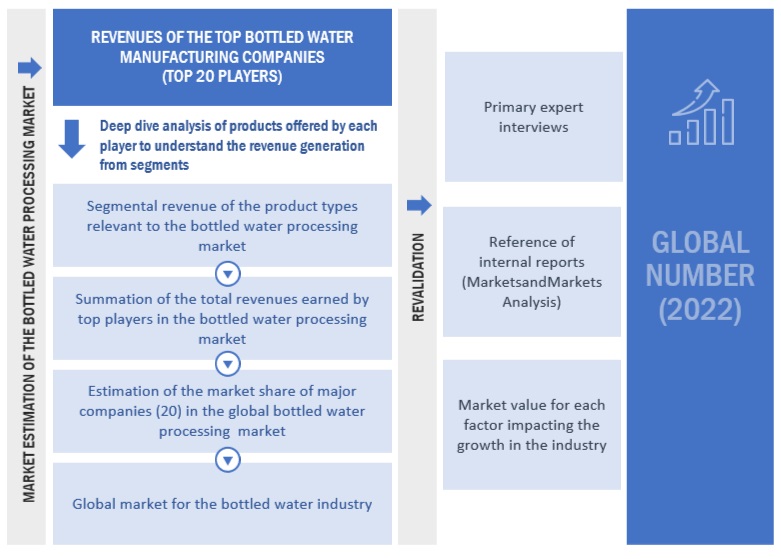
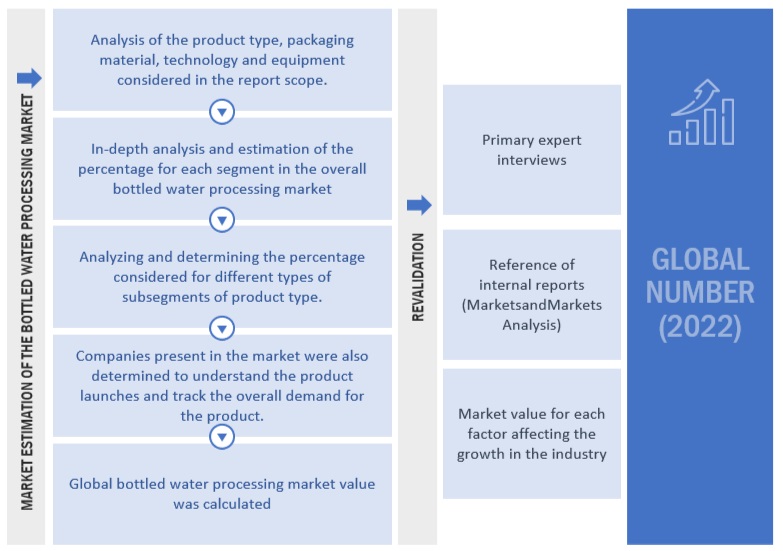
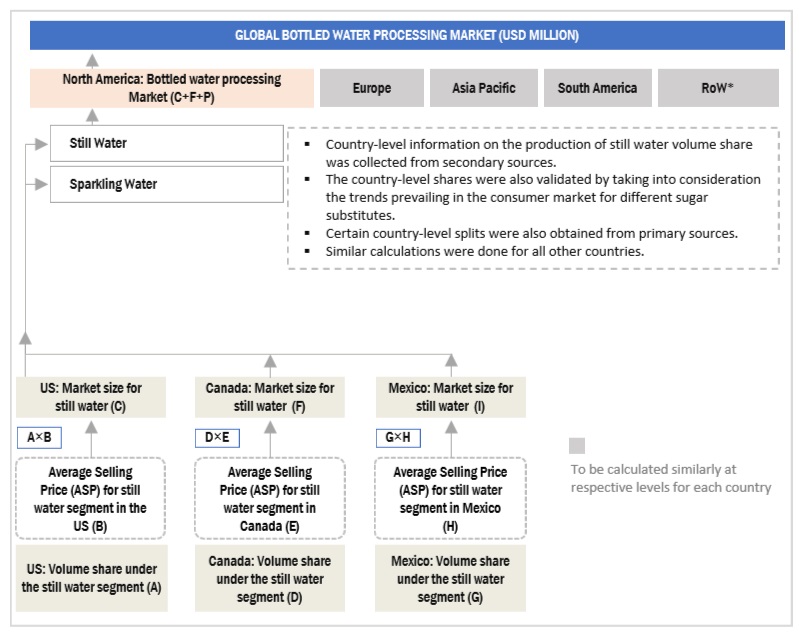
Both the top-down and bottom-up approaches were used to estimate and validate the total size of the market. These approaches were also used extensively to estimate the market size of various dependent submarkets in the overall bottled water processing market. The research methodology used to estimate the market size includes the following details:
- The key players were identified through extensive secondary and primary research.
- The industry’s value chain and market size, in terms of value, were determined through primary and secondary research.
- All percentage shares, splits, and breakdowns were determined using secondary research and verified through primary sources.
- All possible parameters that affect the markets covered in this research study have been accounted for, viewed in extensive detail, verified through primary sources, and analyzed to obtain the final quantitative and qualitative data.
Market size estimation: Top-Down approach
To know about the assumptions considered for the study, Request for Free Sample Report
Market size estimation methodology: Bottom-up approach
Data Triangulation
After arriving at the overall market size from the estimation process explained above, the total market was split into several segments. To complete the overall market engineering process and arrive at the exact statistics for all segments, the data triangulation and market breakdown procedures were employed, wherever applicable. The data was triangulated by studying various factors and trends from both the demand and supply sides. In addition, the market size was validated using both the top-down and bottom-up approaches; it was then verified through primary interviews. Thus, there are three approaches: the first is the top-down approach, the second is the bottom-up approach, and the third is the learning and verification approach through expert interviews. Only when the values arrived at from the three points match, is the data assumed to be correct.
Market Definition
Bottled water processing technology & equipment is defined (for this study) as: “any process, method, and protocol by which the machineries and equipment are used in the manufacturing, handling, packaging, and storing of these.” The global demand and revenue generated by the sales and marketing of these equipment and technology lead to the sizing of the global sales value market.
“Bottled water is an optimal choice for hydration and refreshment, offering consistent safety, quality, good taste, and convenience. The United States Food and Drug Administration (FDA) comprehensively regulates bottled water, treating it as a packaged food product. Bottled water must adhere to the FDA's stringent requirements regarding food safety, labeling, and inspections. It is also subject to state regulations, and members of the International Bottled Water Association (IBWA) are obligated to follow the IBWA Model Code.
The classification of water as "bottled water" or "drinking water" is contingent upon meeting all applicable federal and state standards, being sealed in a sanitary container, and being intended for human consumption. Importantly, FDA standards for bottled water are legally mandated to be at least as rigorous and health-protective as the standards set by the U.S. Environmental Protection Agency (EPA) for public water systems.”
Key Stakeholders
-
Manufacturers/Suppliers
- Bottled water manufacturers and processors.
- Polymer industry
- Bottled water retailers, wholesalers, and distributors.
- Bottled water equipment manufacturers and providers.
- Research & development laboratories
-
Regulatory bodies and institutions, and government agencies
- Organizations such as the Food and Drug Administration (FDA), United States Department of Agriculture (USDA), European Food Safety Agency (EFSA), EUROPA, Codex Alimentarius, and Food Safety Australia and New Zealand (FSANZ)
- Associations such as International Bottled Water Association (IBWA), International Council of Bottled Water Associations, Canadian Bottled Water Association (CBWA), European Federation of Bottled Waters (EFBW), China Beverage Industry Association (CBIA), Asia and Middle East Bottled Water Association (ABWA), Australasian Bottled Water Institute (ABWI) (Australia and New Zealand), European Bottled Watercooler Association (EBWA), Latin American Bottled Water Association (LABWA)
- Intermediary suppliers
- Bottled water logistics service providers and transporters.
Report Objectives
Market Intelligence
- Determining and projecting the size of the bottled water processing market with respect to equipment, technology, product type, packaging material, and region, over a five-year period ranging from 2023 to 2028.
- Identifying the attractive opportunities in the market by determining the largest and fastest-growing segments across regions
- Providing detailed information about the key factors influencing the growth of the market (drivers, restraints, opportunities, and industry-specific challenges)
- Analyzing the micro-markets with respect to individual growth trends, prospects, and their contribution to the total market
Competitive Intelligence
- Identifying and profiling the key market players in the bottled water processing market.
-
Providing a comparative analysis of the market leaders on the basis of the following:
- Product offerings
- Business strategies
- Strengths and weaknesses
- Key financials
- Understanding the competitive landscape and identifying the major growth strategies adopted by players across the key regions.
- Providing insights on key product innovations and investments in the bottled water processing market.
Available Customizations:
With the given market data, MarketsandMarkets offers customizations according to company-specific scientific needs.
The following customization options are available for the report:
Product Analysis
- Product Matrix, which gives a detailed comparison of the product portfolio of each company.
Geographic Analysis
With the given market data, MarketsandMarkets offers customizations according to company-specific scientific needs.
- Further breakdown of the Rest of European bottled water processing market, by key country
- Further breakdown of the Rest of the South American bottled water processing market, by key country
- Further breakdown of the Rest of Asia Pacific bottled water processing market, by key country
Company Information
- Detailed analyses and profiling of additional market players
Get the Full Bottled Water Processing Market Report
Full forecast, segment splits, and company analysis for all Bottled Water Processing Market.
- Canada Bottled Water Processing Market
- Mexico Bottled Water Processing Market
- Germany Bottled Water Processing Market
- UK Bottled Water Processing Market
- France Bottled Water Processing Market
- Spain Bottled Water Processing Market
- Italy Bottled Water Processing Market
- Poland Bottled Water Processing Market
- China Bottled Water Processing Market
- Japan Bottled Water Processing Market
- India Bottled Water Processing Market
- Indonesia Bottled Water Processing Market
- Thailand Bottled Water Processing Market
- Brazil Bottled Water Processing Market
- Argentina Bottled Water Processing Market
- South Africa Bottled Water Processing Market
- Rest Of Europe Bottled Water Processing Market
- Rest Of Asia Pacific Bottled Water Processing Market
- Middle East Bottled Water Processing Market
- Rest Of South America Bottled Water Processing Market
Need a Tailored Report?
Customize this report to your needs
Get 10% FREE Customization
Customize This Report
