
Japan Brain Computer Interface Market (2024-2029)

The Japan Brain Computer Interface Market was valued at $16.57 Million in 2024 and projected to reach to $29.02 Million by 2029, representing a compound annual growth rate of 11.9%. Japan's brain computer interface market is poised for sustained expansion driven by demographic pressures and technological capabilities.


| Market Size in | USD 26.32 MN |
| Market Forecast in | |
| CAGR | |
| Forecast Period | |
| Units Considered | Value (USD MN) |
Japan Brain Computer Interface Market Trends and Insights
- Japan's aging population and advanced healthcare infrastructure are driving adoption of BCI technologies for neurological rehabilitation and assistive applications.
- The country's strong emphasis on robotics and neurotechnology innovation positions Japan as a key regional player in the Asia Pacific BCI landscape. Japan's BCI market growth is supported by increasing investment in neuroscience research and government initiatives promoting digital health solutions.
- Japan's healthcare system's integration of cutting-edge medical devices and the nation's technological expertise create favorable conditions for BCI market expansion through 2029.
- Japan's commitment to addressing neurological disorders through innovative technologies continues to accelerate market development..
Key Market Statistics
- CAGR (2024-2029) 11.9% CAGR
- Market Size, 2024 ~USD 16.57 Million
- Forecast, 2029 ~USD 29.02 Million
- Country Japan
Japan Brain Computer Interface Market Overview
Market Valuation :
Japan's BCI market is valued at $16.57 million in 2024, with a robust 11.9% CAGR projected through 2029, reaching $29.02 million by forecast end.
Aging Population Driver :
Japan's rapidly aging demographic creates significant demand for BCI-enabled neurological rehabilitation and assistive technologies to support elderly care and quality of life.
Healthcare Infrastructure Advantage :
Advanced healthcare systems and high medical technology adoption rates in Japan accelerate BCI implementation across hospitals, rehabilitation centers, and research institutions.
Robotics & Neurotechnology Leadership :
Japan's established expertise in robotics and neurotechnology innovation positions the country as a regional hub for BCI development and commercialization.
Japan Brain Computer Interface Market Dynamics
- The aging population creates urgent demand for assistive BCI solutions in rehabilitation and mobility applications.
- Japan's healthcare sector, combined with its world-leading robotics industry, creates a unique ecosystem for BCI innovation and deployment.
- Government support for neurotechnology research and private sector investment will further accelerate market penetration across medical and consumer applications through 2029..
Market Ecosystem
Related Ecosystem
Healthcare It
- Computed Tomography (CT)
- Machine Learning
- Magnetic Resonance Imaging (MRI)
- Natural Language Processing (NLP)
- Predictive Analytics
- CERNER CORPORATION
- PHILIPS HEALTHCARE
- Oracle Corporation
- GE HealthCare Technologies Inc.
- Siemens healthineers
Medical Devices
- Polymerase Chain Reaction (PCR)
- Magnetic Resonance Imaging (MRI)
- Disposable Autoinjectors
- Pulse Oximeters
- Blood Pressure Monitors
- Medtronic plc
- Abbott Laboratories
- Stryker Corporation
- Becton, Dickinson and Company
- CONMED Corporation
Key Takeaways
- Japan's BCI market is valued at $16.57 million in 2024 and expected to grow to $29.02 million by 2029, representing an 11.9% CAGR.
- Japan's aging demographic and advanced healthcare infrastructure are primary drivers of BCI adoption for rehabilitation and assistive technologies.
- Japan's leadership in robotics and neurotechnology innovation strengthens its competitive position in the Asia Pacific BCI market.
- Japan's government support for digital health initiatives and neuroscience research accelerates market growth and technology commercialization.
Brain Computer Interface Market Report Scope
| Report Metric | Details |
|---|---|
| Base Year | 2024 |
| Fastest Growing Segment | SOFTWARE (Component) |
| Forecast Period | 2024-2029 |
| Growth Rate | CAGR of 14.1% from 2024 to 2029 |
| Largest Segment | NON-INVASIVE BCI (Product Type) |
| Market Size Base Year (Billions) | ~USD 0.26 (2024) |
| Revenue Forecast (Billions) | ~USD 0.51 (2029) |
| Segments Covered | Component, Product Type, Technology, Application, End User |
Japan Brain Computer Interface Market Report Segmentation
5 segment dimensions are covered across the global market.
By Component
- Hardware
- Software
By Product Type
- Invasive Bci
- Invasive Bcis
- Non-Invasive Bci
- Non-Invasive Bcis
- Partially Invasive Bci
- Partially Invasive Bcis
By Technology
- Ddi
- Ecog
- Eeg
- Fmri
- Fnirs
- Meg
By Application
- Assistive Technologies
- Disabilities & Rehabilitation
- Other Applications
By End User
- Home Care Settings
- Hospitals & Clinics
- Other End Users
- Rehabilitation Centers
JAPAN: BRAIN-COMPUTER INTERFACE MARKET, BY END USER, 2022–2029
| Segment | 2022 | 2023 | 2024 | 2025 | 2026 | 2027 | 2028 | 2029 | CAGR (%) |
|---|---|---|---|---|---|---|---|---|---|
| HOME CARE SETTINGS | 3.2 | 3.43 | 3.82 | 4.1 | 4.47 | 4.89 | 5.47 | 6.34 | 10.6 |
| HOSPITALS & CLINICS | 7.73 | 8.69 | 10.09 | 11.46 | 13.15 | 15.11 | 17.72 | 21.59 | 16.4 |
| OTHER END USERS | 4.88 | 5.29 | 5.92 | 6.45 | 7.11 | 7.86 | 8.88 | 10.4 | 11.9 |
| REHABILITATION CENTERS | 6.36 | 7.06 | 8.1 | 9.05 | 10.24 | 11.6 | 13.42 | 16.13 | 14.8 |
| TOTAL | 22.17 | 24.46 | 27.92 | 31.06 | 34.97 | 39.46 | 45.49 | 54.45 | 14.3 |
Target Audience
- Medical Device Manufacturers : Evaluate Japan's BCI market opportunity for product development, regulatory approval, and commercialization strategies tailored to Japanese healthcare requirements.
- Healthcare Providers & Hospitals : Understand BCI technology adoption trends, patient demand, and clinical applications relevant to Japanese rehabilitation centers and neurological care facilities.
- Investment & Venture Capital Firms : Assess market size, growth trajectory, and investment opportunities in Japan's emerging BCI sector and neurotechnology startups through 2029.
- Technology & Robotics Companies : Identify synergies between Japan's robotics expertise and BCI market expansion, including integration opportunities and competitive positioning in assistive technologies.
- Government & Policy Makers : Leverage market data to inform healthcare innovation policies, research funding priorities, and technology adoption initiatives supporting Japan's neurotechnology leadership.
Reasons to Buy this Report
- Market-Specific Growth Projections : Access detailed Japan-focused forecasts showing 11.9% CAGR through 2029, enabling precise investment and expansion planning in this high-growth Asian market.
- Demographic Opportunity Analysis : Understand how Japan's aging population creates unique BCI demand drivers for rehabilitation, assistive devices, and elderly care applications unavailable in younger markets.
- Competitive Landscape Intelligence : Identify key players, partnerships, and innovation hubs within Japan's robotics and neurotechnology sectors to inform market entry and collaboration strategies.
- Regulatory & Healthcare Framework : Gain insights into Japan's medical device approval processes, healthcare reimbursement models, and technology adoption pathways specific to BCI applications.
- Strategic Investment Guidance : Make informed decisions on R&D investments, partnerships, and market positioning based on Japan-specific market dynamics and growth catalysts through 2029.
Frequently asked questions
What is the current size of Japan's brain computer interface market?
Japan's BCI market was valued at $16.57 million in 2024 and is projected to reach $29.02 million by 2029.
What is the expected growth rate for Japan's BCI market?
Japan's BCI market is expected to grow at a compound annual growth rate (CAGR) of 11.9% from 2024 to 2029.
What factors are driving growth in Japan's BCI market?
Japan's aging population, advanced healthcare infrastructure, government digital health initiatives, and strong neurotechnology research capabilities are primary growth drivers.
How does Japan's BCI market compare to other Asia Pacific countries?
Japan's established healthcare system, technological expertise, and government support position it as a leading BCI market in the Asia Pacific region.
What applications are most prevalent in Japan's BCI market?
Neurological rehabilitation, assistive technologies for disabled individuals, and neuroscience research applications are the most prevalent uses in Japan's BCI market.
RESEARCH METHODOLOGY
This market research study involved the extensive use of secondary sources, directories, and databases to identify and collect information useful for this technical, market-oriented, and financial study of the medical robots market. In-depth interviews were conducted with various primary respondents, including key industry participants, subject-matter experts (SMEs), C-level executives of key market players, and industry consultants, among other experts, to obtain and verify critical qualitative and quantitative information and to assess market prospects. The size of the brain computer interface market was estimated through various secondary research approaches and triangulated with inputs from primary research to arrive at the final market size.
Secondary Research
The secondary research process involved the widespread use of secondary sources, directories, databases (such as Bloomberg Businessweek, Factiva, and D&B Hoovers), white papers, annual reports, company house documents, investor presentations, and SEC filings of companies. Secondary research was used to identify and collect information useful for the extensive, technical, market-oriented, and commercial study of the brain computer interface market. It was also used to obtain important information about the key players and market classification and segmentation according to industry trends to the bottom-most level and key developments related to market and technology perspectives. A database of the key industry leaders was also prepared using secondary research.
Primary Research
Extensive primary research was conducted after acquiring basic knowledge about the global brain computer interface market scenario through secondary research. Several primary interviews were conducted with market experts from both the demand side (Hospital personnel, department heads, hospital directors, corporate personnel) and supply side (such as C-level and D-level executives, technology experts, software developers, marketing and sales managers, among others) across five major regions—North America, Europe, the Asia Pacific, Latin America, Middle East, and Africa. This primary data was collected through questionnaires, e-mails, online surveys, personal interviews, and telephonic interviews.
Breakdown of Primary Interviews
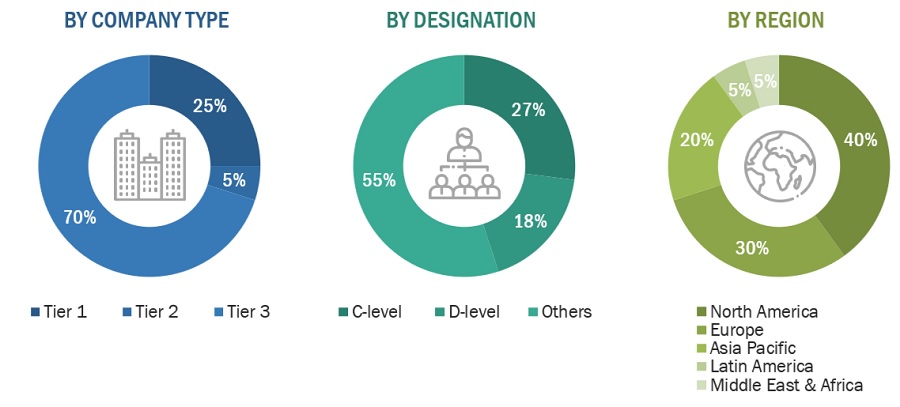
Note 1: Tiers are defined based on the total revenues of companies. As of 2023, Tier 1 = >USD 1 billion, Tier 2 = USD 500 million to USD 1 billion, and Tier 3 = <USD 500 million.
To know about the assumptions considered for the study, download the pdf brochure
Market Size Estimation
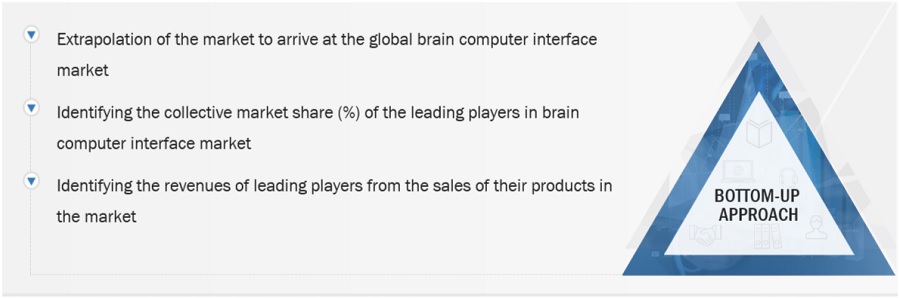
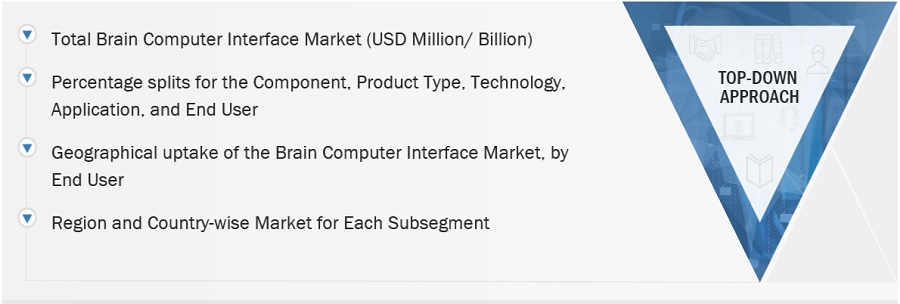
Both top-down and bottom-up approaches were used to estimate and validate the total size of the global brain computer interface market. These methods were also used extensively to estimate the size of various subsegments in the market. The research methodology used to estimate the market size includes the following:
- Key players in the global brain computer interface market were identified through secondary research, and their global market shares were determined through primary and secondary research
- The research methodology included the study of the annual and quarterly financial reports and regulatory filings, data books of major market players, and interviews with industry experts for detailed market insights.
- All percentage shares, splits, and breakdowns for the global brain computer interface market were determined by using secondary sources and verified through primary sources.
- All key macro indicators affecting the revenue growth of market segments and subsegments have been accounted for, viewed in extensive detail, verified through primary research, and analyzed to get validated and verified quantitative and qualitative data.
- The gathered market data was consolidated and added with detailed inputs and analysis and presented in this report.
Global Brain Computer Interface Market: Bottom-Up Approach
To know about the assumptions considered for the study, Request for Free Sample Report
Global Brain Computer Interface Market: Top-Down Approach
Data Triangulation
After arriving at the overall market size, from the market size estimation process explained above, the brain computer interface market was split into segments and subsegments. To complete the overall market engineering process and to arrive at the exact statistics for all segments and subsegments, data triangulation and market breakdown procedures were employed, wherever applicable. The data was triangulated by studying various factors and trends from both the demand and supply sides in the medical robots market.
Market Definition:
Brain-computer interface (BCI) refers to a technology that enables direct communication between the human brain and external devices, such as computers or prosthetic limbs, without the need for traditional input methods like keyboards. BCIs typically utilize various methods to capture the electrical activity generated by the brain utilizing different approaches such as electroencephalography (EEG) magnetoencephalography (MEG), functional near-infrared spectroscopy (fNIRS) or invasive neural implants, to interpret a user's intentions or commands. This allows individuals to interact with technology using only their thoughts or brain activity.
The BCI market encompasses the development, manufacturing, and deployment of these BCI systems and related technologies for various applications.
Key Stakeholders:
- Manufacturers of brain computer interface solutions
- Suppliers and distributors of brain computer interface solutions
- Third-party refurbishers/suppliers
- Clinical settings
- Educational institutions
- Group purchasing organizations (GPOs)
- Academic research centers and universities
- Corporate entities
- Rehabilitation centers
- Market research & consulting firms
- Contract manufacturing organizations (CMOs)
- Venture capitalists & investors
Report Objectives
- To define, describe, and forecast the brain computer interface market by component, product type, technology, application, end user, and region
- To provide detailed information regarding the major factors influencing the market growth (such as drivers, restraints, opportunities, and challenges)
- To strategically analyze micromarkets1 with respect to individual growth trends, prospects, and contributions to the overall brain computer interface market
- To analyze the opportunities in the market for stakeholders and provide details of the competitive landscape for market leaders
- To profile the key players in the market and comprehensively analyze their market shares and core competencies2
- To forecast the size of the market segments with respect to five main regions: North America, the Asia Pacific, Europe, Latin America, and the Middle East & Africa
- To track and analyze competitive developments, such as partnerships, product launches & approvals, and expansions
- To benchmark players within the brain computer interface market using the Competitive Evaluation Matrix, which analyzes market players on various parameters within the broad categories of business strategy, market share, and product offering
Available Customizations:
With the given market data, MarketsandMarkets offers customizations as per the company’s specific needs. The following customization options are available for the report:
Additional Company Profiling
- Detailed analysis and profiling of additional market players (up to 5)
Geographic Analysis
- Further breakdown of the Rest of Europe brain computer interface market into Switzerland, Russia, and others
- Further breakdown of the Rest of Asia Pacific brain computer interface market into South Korea, Singapore, and others
Get the Full Brain Computer Interface Market Report
Full forecast, segment splits, and company analysis for all Brain Computer Interface Market.
- US Brain Computer Interface Market
- Canada Brain Computer Interface Market
- Germany Brain Computer Interface Market
- UK Brain Computer Interface Market
- France Brain Computer Interface Market
- Italy Brain Computer Interface Market
- Spain Brain Computer Interface Market
- China Brain Computer Interface Market
- India Brain Computer Interface Market
- Brazil Brain Computer Interface Market
- Mexico Brain Computer Interface Market
- Rest Of Europe Brain Computer Interface Market
- Rest Of Asia Pacific Brain Computer Interface Market
- Rest Of Latin America Brain Computer Interface Market
Need a Tailored Report?
Customize this report to your needs
Get 10% FREE Customization
Customize This Report
