
Canada Building Information Modeling Market (2025-2030)

The Canada Building Information Modeling Market was valued at $405.6 Million in 2025 and projected to reach to $730.5 Million by 2030, representing a compound annual growth rate of 12.5%. Canada's Building Information Modeling market is positioned for sustained expansion through 2030, driven by increasing government infrastructure spending, mandatory BIM adoption in public projects, and growing awareness of digital construction benefits among mid-market contractors.


| Market Size in | USD 26.32 MN |
| Market Forecast in | |
| CAGR | |
| Forecast Period | |
| Units Considered | Value (USD MN) |
Canada Building Information Modeling Market Trends and Insights
- This 12.5% compound annual growth rate reflects Canada's increasing adoption of digital construction technologies across residential, commercial, and infrastructure projects.
- Canada's construction sector is leveraging BIM solutions to enhance project efficiency, reduce costs, and improve collaboration among stakeholders. The Canadian market is driven by government infrastructure investments, regulatory mandates for public projects, and growing demand from major construction firms seeking competitive advantages.
- Canada's emphasis on sustainable building practices and smart city initiatives further accelerates BIM adoption.
- By 2030, Canada is expected to solidify its position as a leading BIM market in North America, with widespread integration across design, engineering, and construction phases..
Key Market Statistics
- CAGR (2025-2030) 12.5% CAGR
- Market Size, 2025 ~USD 405.6 Million
- Forecast, 2030 ~USD 730.5 Million
- Country Canada
Canada Building Information Modeling Market Overview
Market Valuation Growth :
Canada's BIM market is valued at $405.6 million in 2025, with projections reaching $730.5 million by 2030, representing an impressive 12.5% CAGR that outpaces the global average of 11.3%.
Construction Sector Digitalization :
Canadian construction firms are rapidly adopting BIM solutions to streamline project workflows, reduce costs, and improve collaboration across residential, commercial, and infrastructure development initiatives.
Regional Leadership Position :
Canada's BIM adoption rate among construction enterprises is among the highest in North America, driven by government infrastructure investments and strict building code compliance requirements.
Technology Integration Momentum :
Integration of cloud-based BIM platforms, AI-powered analytics, and IoT connectivity is accelerating across Canadian construction projects, enhancing real-time project visibility and decision-making capabilities.
Canada Building Information Modeling Market Dynamics
- The country's mature construction ecosystem and strong technology infrastructure support rapid BIM implementation across provinces. Key growth catalysts include Canada's commitment to sustainable building practices, labor shortage mitigation through automation, and rising demand for complex infrastructure projects.
- Provincial building code updates increasingly mandate BIM compliance, while major construction firms establish BIM centers of excellence, creating a competitive advantage for early adopters and technology providers..
Market Ecosystem
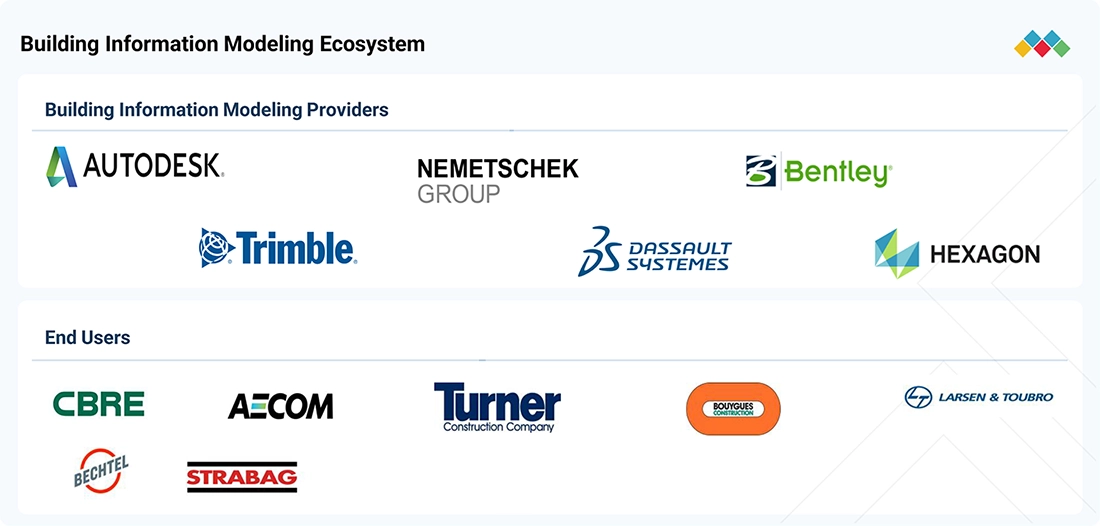
BUILDING INFORMATION MODELING MARKET SIZE, SHARE & GROWTH: COMMERCIAL USE CASES ACROSS INDUSTRIES
| COMPANY | USE CASE DESCRIPTION | BENEFITS |
|---|---|---|
 |
Autodesk provides BIM solutions through Revit, Civil 3D, Navisworks, and Autodesk Construction Cloud. These solutions support 3D building and infrastructure modeling, architectural and MEP design, design coordination, quantity takeoffs, construction planning, and project collaboration. | Improves coordination across architectural, structural, and MEP designs | Helps identify design conflicts before construction | Supports accurate quantity estimation and project planning | Improves collaboration among project stakeholders |
 |
Trimble provides BIM solutions through Tekla Structures, Tekla Structural Designer, Tekla Tedds, and Trimble Connect. Its solutions support structural modeling, engineering design, detailing, fabrication planning, model sharing, and coordination between design and construction teams. | Improves structural modeling and design accuracy | Supports efficient detailing and fabrication planning | Enables collaboration through shared BIM models | Helps reduce manual work and rework |
 |
Nemetschek provides BIM solutions through its brands, including Graphisoft, ALLPLAN, and Solibri. Its portfolio supports architectural and structural design, 3D modeling, model checking, design coordination, and construction documentation across building projects. | Supports accurate architectural and structural modeling | Improves design coordination and model quality | Helps identify design errors and clashes | Supports collaboration across project phases |
 |
Dassault Systèmes offers solutions for architecture, engineering, and construction through its 3DEXPERIENCE platform. Its capabilities support multidisciplinary design, virtual construction twins, infrastructure modeling, engineering collaboration, and simulation across the project lifecycle. | Enables integrated design and engineering workflows | Improves collaboration among project stakeholders | Supports virtual visualization and simulation | Helps improve infrastructure planning and lifecycle management |
 |
Bentley Systems provides BIM solutions through MicroStation, OpenBuildings Designer, ProjectWise, and SYNCHRO 4D. These solutions support building and infrastructure design, engineering coordination, construction sequencing, project information management, and digital twin development. | Improves infrastructure design and engineering coordination | Supports construction scheduling and progress monitoring | Helps identify project risks and coordination issues | Enables better asset information and lifecycle management |
Logos and trademarks shown above are the property of their respective owners. Their use here is for informational and illustrative purposes only.
Related Ecosystem
Electronics System And Components
- Sensors
- Temperature Sensors
- Pressure Sensors
- Actuators
- Image Sensors
- Lenovo
- Samsung
- Texas Instruments Incorporated
- HONEYWELL INTERNATIONAL INC.
- Teledyne Technologies Incorporated
Industrial Automation
- Sensors
- Image Sensors
- Manufacturing Execution System (MES)
- Actuators
- Flow Sensors
- Siemens ag
- ABB India Limited
- Emerson Electric Co.
- HONEYWELL INTERNATIONAL INC.
- SCHNEIDER ELECTRIC SE
Key Takeaways
- Canada's BIM market will grow from $405.6M (2025) to $730.5M (2030) at a 12.5% CAGR, outpacing global growth rates.
- Government infrastructure spending and regulatory requirements are primary growth catalysts driving BIM adoption across Canada.
- Canada's construction industry is increasingly prioritizing digital collaboration tools and sustainable building practices through BIM implementation.
- By 2030, Canada will represent a significant regional market opportunity within North America's broader BIM ecosystem.
Building Information Modeling Market Report Scope
| Report Metric | Details |
|---|---|
| Base Year | 2025 |
| Fastest Growing Segment | FACILITY & ASSET MANAGEMENT SOFTWARE (Software Type) |
| Forecast Period | 2025–2030 |
| Growth Rate | CAGR of 11.3% from 2025 to 2030 |
| Largest Segment | AEC PROFESSIONALS (End User) |
| Market Size Base Year (Billions) | ~USD 9.03 (2025) |
| Revenue Forecast (Billions) | ~USD 15.42 (2030) |
| Segments Covered | Deployment Type, End User, Project Lifecycle, Offering Type, Vertical, Software Type, Service Type |
Canada Building Information Modeling Market Report Segmentation
7 segment dimensions are covered across the global market.
By Deployment Type
- Cloud
- On-Premises
By End User
- Aec Professionals
- Consultants & Facility Managers
- Consultants And Facility Managers
- Other End Users
By Project Lifecycle
- Construction
- Operation
- Pre-Construction
By Offering Type
- Services
- Software
By Vertical
- Buildings
- Civil Infrastructure
- Industrial
- Oil & Gas
- Other Verticals
- Utilities
By Software Type
- Construction Simulation & Scheduling
- Cost Estimation & Quantity Takeoff
- Design & Modeling Software
- Facility & Asset Management Software
- Other Software Types
- Sustainability & Energy Analysis Software
By Service Type
- Consulting & Advisory Services
- Implementation & Integration Services
- Modeling & Documentation Services
- Other Services
- Software Support & Maintenance
- Training & Certification
Target Audience
- Construction & Engineering Firms : Canadian contractors and engineering companies need market intelligence to benchmark BIM adoption rates, identify technology investments, and develop competitive strategies within their regional markets.
- BIM Software & Technology Vendors : Solution providers require Canada-specific market data to assess growth opportunities, understand customer needs, localize offerings, and develop go-to-market strategies for the region.
- Real Estate & Development Companies : Canadian property developers and real estate firms need insights into BIM adoption trends to optimize project delivery, reduce costs, and meet evolving client and regulatory expectations.
- Government & Infrastructure Agencies : Federal, provincial, and municipal authorities require market analysis to inform BIM mandate policies, procurement strategies, and infrastructure digitalization initiatives across Canada.
- Investment & Consulting Firms : Private equity, venture capital, and management consultants need Canada-focused BIM market data to evaluate investment opportunities, assess portfolio companies, and advise clients on sector trends.
Key Companies in the Canada Building Information Modeling Market
| Company | HQ | Ownership | Strongest segments |
|---|---|---|---|
| SAMSUNG | Korea, South | Public Company | Smartphones, tablets, wearables, and accessories,TVs, audio, and digital signage,Home appliances and air solutions, |
| SNC-LAVALIN GROUP INC. | Canada | Public Company | Consultancy, Strategy, Advisory, Engineering & Design,Project & Program Management, Project Delivery,Nuclear Lifecycle Services, |
| PARSONS | United States | Public Company | Federal Solutions – Cyber, EW, Space, and Intelligence,Federal Solutions – C2, Missile Defense, and Mission Support,Critical Infrastructure – Transportation and Urban Solutions, |
| AUTODESK INC. | United States | Public Company | Architecture, Engineering & Construction (AutoCAD, Revit, Civil 3D, Autodesk Build, BIM Collaborate Pro, BuildingConnected, Tandem),Manufacturing & Product Design (Fusion, Inventor, Product Design & Manufacturing Collection, Vault),Media & Entertainment (Maya, 3ds Max, Media & Entertainment Collection, Flow Production Tracking), |
| NEMETSCHEK GROUP | Germany | Public Company | Design (Allplan, Graphisoft, dRofus),Build (Bluebeam, Nevaris and related 5D/ERP),Manage (Spacewell, Crem Solutions), |
| BENTLEY SYSTEMS, INCORPORATED | United States | Public Company | Open Modeling Applications (MicroStation, OpenRoads, OpenBuildings, etc.),Open Simulation & Geoprofessional Applications (STAAD, PLAXIS, Leapfrog, etc.),Infrastructure Cloud Applications (ProjectWise, SYNCHRO, AssetWise), |
| TRIMBLE INC. | United States | Public Company | Construction and owner software plus field and office construction solutions,Machine control, asset monitoring, and field hardware systems,Positioning and correction services (VRSNow, RTX, xFill and related), |
| DASSAULT SYSTèMES | France | Public Company | CAD/3D Modeling (CATIA, SOLIDWORKS, GEOVIA, BIOVIA, 3DVIA),PLM & Collaboration (ENOVIA, CENTRIC PLM, 3DEXCITE, 3DEXPERIENCE collaboration),Simulation & Manufacturing (SIMULIA, DELMIA), |
| SCHNEIDER ELECTRIC | France | Public Company | Low- and medium-voltage products and systems,Building management, power metering, and HVAC/cooling systems,Renewables, microgrids, and demand response solutions, |
| ASITE | United Kingdom | Private Company | Core document & project management (CDE),Collaborative BIM,Sourcing & procurement, |
| HEXAGON AB | Sweden | Public Company | Manufacturing Intelligence (metrology, CAD/CAM, CAE, QA software),Geosystems (survey, mapping, laser scanning, AEC),Autonomous Solutions and Positioning (GNSS, anti-jam, machine control, mining), |
| PROCORE TECHNOLOGIES, INC. | United States | Public Company | Project Execution,Financial Management,Preconstruction, |
| AFRY AB | Sweden | Public Company | Energy engineering and consulting,Industry and processing solutions,Transportation & Places and buildings, |
SAMSUNG
Samsung is a South Korean public company founded in 1969 with 128,735 employees. It operates as a diversified conglomerate with major divisions in electronics, semiconductors, and consumer goods.
SNC-LAVALIN GROUP INC.
SNC-Lavalin Group Inc. is a Canadian public company founded in 1911 with 40,246 employees. The company provides engineering, procurement, and construction services across multiple industries.
PARSONS
Parsons is a United States-based public company founded in 1944 with 21,000 employees. It provides engineering, construction, and technical services to government and commercial clients.
AUTODESK INC.
Autodesk Inc. is a United States-based public company founded in 1982 with 14,300 employees. It develops design and engineering software for architecture, construction, and manufacturing industries.
NEMETSCHEK GROUP
Nemetschek Group is a German public company founded in 1963 with 4,089 employees. The company provides software solutions for the architecture, engineering, and construction sectors.
BENTLEY SYSTEMS, INCORPORATED
Bentley Systems, Incorporated is a United States-based public company founded in 1984 with 5,800 employees. It develops infrastructure engineering software for design, construction, and operations.
TRIMBLE INC.
Trimble Inc. is a United States-based public company founded in 1978 with 11,500 employees. The company provides positioning, modeling, and analytics software for construction and geospatial industries.
DASSAULT SYSTèMES
Dassault Systèmes is a French public company founded in 1981 with 25,724 employees. It develops 3D design, simulation, and lifecycle management software for various industries.
SCHNEIDER ELECTRIC
Schneider Electric is a French public company founded in 1836 with 158,122 employees. The company provides energy management and automation solutions for industrial and commercial applications.
ASITE
Asite is a United Kingdom-based private company founded in 1986 with 74 employees. The company provides cloud-based collaboration and project management solutions for the construction industry.
HEXAGON AB
Hexagon AB is a Swedish public company founded in 1975 with 16,118 employees. It provides digital solutions and sensor technologies for industrial, construction, and geospatial applications.
PROCORE TECHNOLOGIES, INC.
Procore Technologies, Inc. is a United States-based public company founded in 2002 with 4,421 employees. The company develops cloud-based project management software for the construction industry.
AFRY AB
Afry AB is a Swedish public company founded in 1895 with 17,301 employees. The company provides engineering, design, and consulting services across infrastructure and industrial sectors.
Reasons to Buy this Report
- Market-Specific Growth Projections : Access detailed Canada-focused forecasts showing 12.5% CAGR through 2030, enabling accurate business planning and investment decisions tailored to the Canadian market's unique growth trajectory.
- Competitive Landscape Intelligence : Identify leading BIM solution providers, technology integrators, and service firms operating in Canada, with insights into their market positioning and strategic initiatives within the region.
- Provincial Adoption Patterns : Understand BIM penetration rates across Canadian provinces, regulatory requirements, and regional construction sector dynamics to target high-opportunity markets effectively.
- Investment & Partnership Opportunities : Discover emerging segments, technology gaps, and collaboration opportunities with Canadian construction firms, government agencies, and technology providers seeking BIM solutions.
- Regulatory & Compliance Insights : Stay informed on evolving Canadian building codes, government mandates for BIM adoption in public projects, and compliance requirements affecting market demand and solution development.
Frequently asked questions
What is the current size of Canada's Building Information Modeling market?
Canada's BIM market was valued at $405.6 million in 2025 and is expected to reach $730.5 million by 2030.
What is the projected growth rate for Canada's BIM market?
Canada's BIM market is projected to grow at a compound annual growth rate (CAGR) of 12.5% from 2025 to 2030.
What factors are driving BIM adoption in Canada?
Key drivers include government infrastructure investments, regulatory mandates for public projects, demand for cost reduction, and Canada's commitment to sustainable building practices.
How does Canada's BIM market growth compare to global trends?
Canada's 12.5% CAGR exceeds the global average of 11.3%, indicating stronger regional market momentum and accelerated digital construction adoption.
Which sectors are leading BIM adoption in Canada?
Commercial construction, infrastructure development, and public sector projects are leading BIM adoption in Canada, driven by regulatory requirements and efficiency demands.
RESEARCH METHODOLOGY
The study involved four major activities to estimate the current size of the building information modeling market. Extensive secondary research was conducted to gather information on the BIM market, related industries, and the broader architecture, engineering, construction, and infrastructure ecosystem. Primary research was then conducted with stakeholders across the value chain, including BIM software providers, BIM service providers, architects, engineers, consultants, facility managers, construction companies, contractors, infrastructure developers, and other end users to validate market estimates and assumptions. Both top-down and bottom-up approaches were used to estimate the overall market size, followed by market breakdown and data triangulation to determine the size of individual segments and subsegments. Secondary and primary research were combined to provide a comprehensive analysis of the building information modeling market.
Secondary Research
Various secondary sources were referred to during the secondary research process to identify and collect information relevant to the building information modeling market. These sources included annual reports, press releases, investor presentations of key companies, product brochures, software and solution pages, technical documents, white papers, industry journals, certified publications, industry associations, company websites, trade directories, government databases, and architecture, engineering, construction, and infrastructure industry sources. Secondary research was conducted to obtain key insights into the market's supply chain, value chain, competitive landscape, and segmentation across application, deployment type, end user, project lifecycle, vertical, and offering type. It also helped analyze industry trends and the adoption of BIM software and services, including design and modeling software, construction simulation and scheduling, cost estimation and quantity takeoff, facility and asset management, sustainability and energy analysis, implementation and integration, training, modeling, documentation, and consulting services across buildings, industrial facilities, civil infrastructure, oil & gas, utilities, and other verticals.
The collected data was further analyzed to estimate the overall market size and validate findings, which were subsequently refined through primary research with industry experts and key stakeholders.
Primary Research
Extensive primary research was conducted after gaining knowledge about the current scenario of the building information modeling market through secondary research. Several primary interviews were conducted with experts from the demand and supply sides across four major regions: North America, Europe, Asia Pacific, and RoW. This primary data was collected through questionnaires, emails, and telephonic interviews.
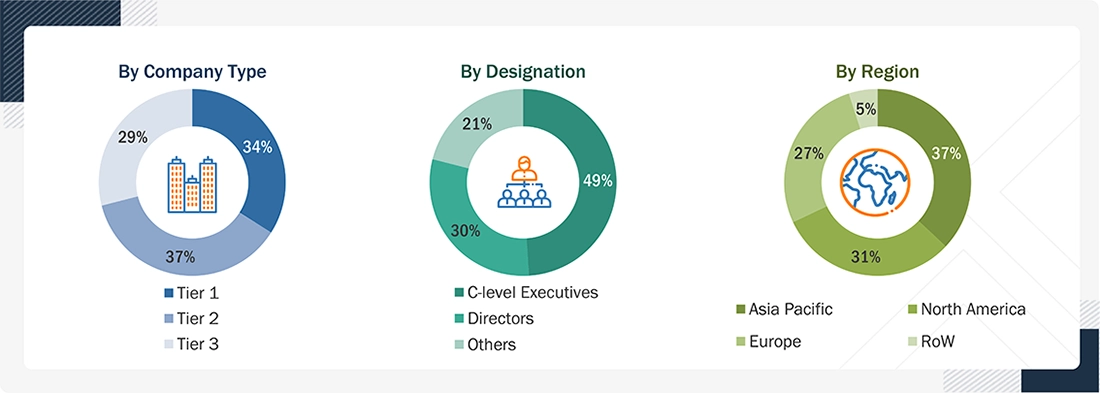
Note: The three tiers of companies are defined based on their total revenue in 2025: Tier 1 - revenue greater than or equal to USD 1 billion; Tier 2 - revenue between USD 100 million and USD 1 billion; and Tier 3 - revenue less than or equal to USD 100 million. Other designations include sales managers, marketing managers, and product managers.
To know about the assumptions considered for the study, download the pdf brochure
Market Size Estimation
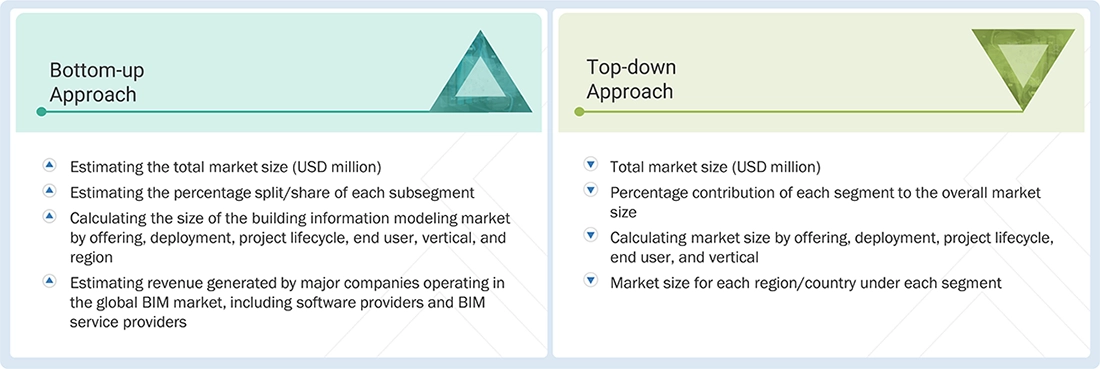
- Both top-down and bottom-up approaches were used to estimate and validate the total size of the building information modeling market. These approaches were also used extensively to estimate the size of various segments and subsegments in the market. The following research methodology was used to estimate the market size:
- Major players in the building information modeling industry and related BIM software, services, and digital construction markets were identified through extensive secondary research.
- The industry value chain and market size (in terms of value) were determined through primary and secondary research processes.
- All percentage shares, splits, and segment-level breakdowns across application, deployment type, end user, project lifecycle, vertical, and offering type were determined using secondary sources and validated through primary research.
The market size estimation methodology is as follows:
Data Triangulation
After arriving at the overall size of the building information modeling market through the market size estimation process described above, the total market was divided into relevant segments and subsegments. Data triangulation and market breakdown procedures were used, wherever applicable, to complete the overall market engineering process and derive statistics for all segments and subsegments. The data was triangulated by analyzing various factors and trends from both the demand and supply sides, including application, deployment type, end user, project lifecycle, vertical, and offering type. In addition, the market size was validated using both top-down and bottom-up approaches to ensure consistency across the overall market and individual segments.
Market Definition
A building information modeling solution is a digital process supported by software and related services used to create, manage, and share information about a building or infrastructure asset throughout its lifecycle. BIM enables architects, engineers, contractors, and other project stakeholders to develop intelligent 3D models containing physical and functional information about building components. BIM solutions help improve design coordination, visualization, project planning, cost estimation, construction scheduling, and asset management.
BIM solutions are used across various stages of a project, including planning and modeling, construction and design, asset management, and building system analysis and maintenance scheduling. BIM offerings include software and related services, with software deployed through on-premises or cloud-based models. Software solutions cover design and modeling, construction simulation and scheduling, cost estimation and quantity takeoff, facility and asset management, and sustainability and energy analysis, while services include implementation and integration, software support and maintenance, training and certification, modeling and documentation, and consulting and advisory services. BIM solutions are particularly important for projects that require coordinated design, accurate project information, efficient construction planning, and effective management of buildings and infrastructure assets. Their applications vary depending on project lifecycle, building or infrastructure type, end-user requirements, project complexity, deployment model, and the level of integration required across different design and construction disciplines.
Key Stakeholders
- Raw material suppliers
- Original equipment manufacturers (OEMs)
- Original design manufacturers (ODMs)
- Research institutes
- Building information modeling solution providers
- Forums, alliances, and associations
- Governments and financial institutions
- Analysts and strategic business planners
- AEC professionals
- Distributors
- End users
Report Objectives
- To define, describe, and forecast the building information modeling market in terms of value based on application, deployment type, end user, project lifecycle, vertical, and offering type
- To forecast the market size, in terms of value, across four major regions—North America, Europe, Asia Pacific, and the Rest of the World
- To provide detailed information regarding the major factors influencing the growth of the building information modeling market, including drivers, restraints, opportunities, and challenges
- To analyze the micromarkets¹ for individual growth trends, prospects, and contributions to the overall market
- To provide a detailed overview of the value chain of the building information modeling market
- To analyze opportunities for various stakeholders by identifying high-growth segments of the market
- To profile key players and comprehensively analyze their market positions in terms of ranking and core competencies², along with detailing the competitive landscape of the market
- To analyze competitive developments, such as product launches and developments, partnerships, acquisitions, contracts, expansions, and research and development activities in the building information modeling market.
Available customizations:
With the given market data, MarketsandMarkets offers customizations according to the company’s specific needs. The following customization options are available for the report:
Company Information:
- Detailed analysis and profiling of additional market players (up to 5)
Get the Full Building Information Modeling Market Report
Full forecast, segment splits, and company analysis for all Building Information Modeling Market.
- Spain Building Information Modeling Market
- Poland Building Information Modeling Market
- China Building Information Modeling Market
- Japan Building Information Modeling Market
- India Building Information Modeling Market
- South Korea Building Information Modeling Market
- Australia Building Information Modeling Market
- Indonesia Building Information Modeling Market
- Malaysia Building Information Modeling Market
- Thailand Building Information Modeling Market
- Vietnam Building Information Modeling Market
- Nordics Building Information Modeling Market
- Rest Of Europe Building Information Modeling Market
- Rest Of Asia Pacific Building Information Modeling Market
- Bahrain Building Information Modeling Market
- Kuwait Building Information Modeling Market
- Oman Building Information Modeling Market
- Qatar Building Information Modeling Market
- Rest Of Middle East Building Information Modeling Market
- US Building Information Modeling Market
- Mexico Building Information Modeling Market
- UK Building Information Modeling Market
- Germany Building Information Modeling Market
- France Building Information Modeling Market
- Italy Building Information Modeling Market
- North America Building Information Modeling Market
- Europe Building Information Modeling Market
- Asia Pacific Building Information Modeling Market
- Rest of World Building Information Modeling Market
- Software Building Information Modeling Market
- Services Building Information Modeling Market
- Middle East Building Information Modeling Market
Need a Tailored Report?
Customize this report to your needs
Get 10% FREE Customization
Customize This Report
